
Note: This article contains affiliate links. If you click on these links and make a purchase, we may earn a small commission at no extra cost to you. This helps support our research and content. Read our full affiliate disclosure here.
If you own serrated knives, you know the frustration of trying to sharpen scalloped edges with a standard stone or pull-through sharpener. Serrated blades require a different approach to preserve the teeth and maintain cutting performance. This guide compares seven shortlisted knife sharpeners geared specifically for serrated blades, focusing on accuracy, ease of use, and how gently they restore the scalloped edge. Below you will find practical guidance and an explanation of the evaluation criteria used to pick these sharpeners, so you can match a tool to how and how often you use your serrated knives.
Top Picks at a Glance
| Best Overall The best all-around choice for most situations | Work Sharp Precision Adjust Elite |  |
| Best Quality Built to a higher standard if you want something more solid | Chef'sChoice Trizor 15XV |  |
| Best Value The sweet spot between price and what you get | AccuSharp Knife Sharpener |  |
| Best Budget The cheapest option that still gets the job done reliably | Siyurongg Serrated Knife Sharpener |  |
| Top Rated A top-rated pick with lots of positive feedback | Work Sharp Guided Field Sharpener |  |
| Most Popular A crowd favorite that many people choose with confidence | KitchenIQ Edge Grip 2-Stage Sharpener |  |
| Best Seller A high-volume bestseller chosen again and again | KITCHELLENCE 3‑Stage Knife Sharpener |  |
Work Sharp Precision Adjust Elite

| Included components | Leather strop, ceramic rod for serrations |
|---|---|
| Material Type | Plastic, Stainless Steel |
The Work Sharp Precision Adjust Elite is a benchtop guided sharpening system built to give consistent, factory-quality edges at home. You clamp the knife, set an angle between 15 and 30 degrees and run the included abrasive plates and finishing rods through the guide to restore or refine an edge. The kit includes coarse and fine diamond plates, a ceramic finishing rod, a conical ceramic rod dedicated to serrations, and a tri-abrasive attachment for curved blades, so it covers kitchen knives, hunting blades and pocket knives. The guided angle mechanism removes much of the guesswork, making it approachable for beginners while still offering repeatable precision for experienced users. It is a desktop tool rather than a pocket or travel sharpener, and learning to use the clamp and attachments takes a few sessions to get speed and pressure right. For anyone who wants a durable, versatile system that reliably sharpens serrated and straight edges, this is a strong option.
Best for: Buyers who want a single, durable sharpening system that handles both straight and serrated blades and value consistent, repeatable angles without sending knives out for professional service.
Less Ideal for: People who need an ultra-compact or pocketable sharpener for on-the-go touch-ups or who expect instant mastery without any practice time.
- Adjustable angle guide from 15° to 30° for consistent, repeatable bevels
- Includes a conical ceramic rod specifically for sharpening serrated knives
- Comes with coarse and fine diamond plates plus a ceramic finishing rod for full sharpening progression
- Guided clamp system reduces user guesswork and speeds up learning curve
- Benchtop design is not portable for field sharpening or travel
- Takes a few practice runs to master pressure and technique for fastest results
Verdict: Choose this guided bench sharpener if you want a durable, all-purpose system that reliably restores both straight and serrated blades with repeatable angle control.
Chef'sChoice Trizor 15XV

| Material Type | Diamond |
|---|---|
| Grit Type | Fine |
| Stages | Three |
The Chef'sChoice Trizor 15XV is a three-stage electric sharpener designed to convert factory edges into a high-performance 15-degree Trizor edge using 100 percent diamond abrasives. Typical use is simple: run straight-edge and serrated blades through stage 1 for shaping, stage 2 for honing, and the patented stropping stage 3 for a polished finish and prolonged edge life. Precision angle guides and flexible spring guides remove guesswork and keep the blade aligned for consistent results, and the diamond abrasives cut quickly so initial sharpening takes about a minute and quick touch-ups only seconds. The unit handles serrated knives as well as straight blades thanks to the stropping/polishing stage, and the controlled angles make it a good choice for cooks who want a narrower, sharper slice. Limitations are typical of electric systems: it changes blade geometry to a 15-degree edge which may not suit every steel or user's preference, and it is a countertop appliance that requires space and power rather than a portable manual tool.
Best for: Buyers who prioritize high cutting performance and consistent, factory-quality 15-degree edges for both serrated and straight knives and want fast, repeatable sharpening without manual skill.
Less Ideal for: Anyone who wants to preserve original factory edge angles, prefers a non-electric/manual sharpener, or needs a compact travel-friendly tool.
- Uses 100% diamond abrasives for fast, durable material removal
- Three-stage system shapes, hones, and stropps for a polished, longer-lasting edge
- Precision angle guides and flexible spring guides ensure consistent alignment along the blade
- Works with both straight-edge and serrated knives thanks to the stropping/polishing stage
- Converts edges to a 15-degree geometry which may not match all knife preferences
- Not a portable manual option and requires countertop space and power
Verdict: If you want fast, repeatable professional-grade 15-degree edges for serrated and straight knives, the Trizor 15XV delivers consistent, polished results with 100% diamond abrasives.
AccuSharp Knife Sharpener

| Material Type | Acrylonitrile Butadiene Styrene |
|---|---|
| Grit Type | Coarse |
| Included Components | Sharpener |
| Model Number | ACCU-001C |
The AccuSharp Knife Sharpener is a simple, hand-held pull-through tool built to quickly restore edges on a wide range of blades including straight and many serrated knives. You use it by drawing the blade through the carbide sharpening slot while the ergonomic full-length handle and finger guard keep your hand steady and protected. Its diamond-honed tungsten carbide blades are reversible for longer life and the coarse grit cuts fast, so you can get a usable edge in roughly ten seconds for routine maintenance. The unit is lightweight, easy to clean and even dishwasher-safe, which makes it convenient for everyday kitchen use or bringing along for outdoor tasks. Limits: the fixed-angle pull-through design is not a substitute for professional stone sharpening for badly damaged or high-end knives, and the coarse grit means it is focused on quick edge restoration rather than fine polishing. Replacement blades are available, but heavy resharpening needs will eventually require blade swaps or a different sharpening method.
Best for: Buyers who prioritize fast, low-effort maintenance for everyday kitchen and serrated knives and want a durable, easy-to-use tool they can keep on the counter or take outdoors.
Less Ideal for: People seeking precision stropping, mirror-polished edges, or restoration of heavily chipped premium blades should choose whetstones, guided systems, or professional sharpening instead.
- Very quick to restore a usable edge in seconds
- Diamond-honed tungsten carbide blades cut aggressively and are reversible for longer life
- Ergonomic full-length handle and finger guard improve safety and control
- Dishwasher-safe and easy to clean for low-maintenance use
- Coarse grit focuses on fast edge restoration rather than fine honing or polishing
- Fixed-angle pull-through limits ability to repair heavily damaged bevels
Verdict: A fast, user-friendly pulley-style sharpener that gives practical, quick edge restoration for everyday and serrated knives.
Siyurongg Serrated Knife Sharpener

| Material Type | Diamond |
|---|---|
| Grit Type | Fine |
| Included Components | 1 |
This pen-style sharpener uses a fine diamond rod in a retractable housing to service serrated edges, small kitchen knives, scissors, and even fish hooks. Its ergonomic, pocket-clip design makes it easy to carry for camping or quick fixes, and the diamond abrasive gives fast, durable metal removal and polishing compared with ceramic steels. The adjustable, flip-out rod lets you extend the sharpening tip as needed and the fine grit is good for refining and maintaining serrations rather than heavy reprofiling. Practical limitations are its small size and single fine grit, which means it is not suited for rebuilding badly damaged serrations or for heavy-stock knives, and sharpening requires care to follow each serration. For budget-minded buyers who want a portable, durable tool for routine serrated-edge maintenance, this is a convenient option.
Best for: Buyers looking for an inexpensive, portable tool to maintain serrated knives and small blades between major sharpenings, especially for camping or everyday carry.
Less Ideal for: Users who need to repair severely damaged serrations, reshape blades, or perform heavy stock removal should choose a larger, coarser sharpening system.
- Diamond rod offers durable, effective sharpening and polishing
- Retractable pen-style housing with pocket clip for easy portability
- Ergonomic grip reduces hand fatigue during use
- Small tip and grooves allow sharpening of serrations, hooks, and small tools
- Fine grit only, so it cannot rebuild heavily damaged serrations quickly
- Compact size limits leverage and may make prolonged sharpening tiring
Verdict: A compact, budget-friendly diamond pen sharpener made for on-the-go maintenance of serrated edges and small blades.
Work Sharp Guided Field Sharpener

| Material Type | Diamond and Ceramic Sharpener |
|---|---|
| Grit Type | Coarse, Fine |
| Included Components | WSGFS221 |
The Work Sharp Guided Field Sharpener is a compact, all-in-one sharpening kit designed for hunters, anglers, and outdoors users who need a reliable way to restore edges away from the bench. It uses removable diamond plates for rapid material removal, a rotating ceramic rod with coarse and fine faces plus a grooved section for fish hooks and serrations, and a leather strop for final polishing. The guided angle system supports 20 and 25 degree edges so you get repeatable bevels with minimal skill, and every abrasive stores inside the unit for tool-free setup and transport. In practice it sharpens pocket and hunting knives quickly and the ceramic rod's grooved surface helps maintain serrated teeth better than a single straight rod. The unit is sturdy and travel-ready, but its fixed angle options limit users who want very acute or highly specialized kitchen edges and the compact abrasive sizes mean heavy repair work will take longer than with larger bench stones or powered systems.
Best for: Buyers who prioritize a dependable, travel-ready sharpener to maintain hunting, pocket, and serrated blades in the field or at camp and want consistent results without complex setup.
Less Ideal for: Those who need precise, ultra-acute kitchen edges or who frequently perform heavy blade repairs should choose a larger bench stone or adjustable bench/powered sharpener instead.
- Includes diamond plates, ceramic rod, and leather strop for a complete sharpening workflow
- Guided angles (20° and 25°) produce consistent, repeatable bevels with minimal skill
- Compact, self-contained design stores abrasives inside for easy transport
- Grooved ceramic surface supports sharpening fish hooks and serrated edges
- Fixed angle options are limited for users who need very acute or specialty kitchen angles
- Smaller abrasive surfaces make heavy chip repair or very dull blades slower than bench systems
Verdict: Choose this guided field sharpener if you want a reliable, all-in-one portable kit that preserves serrations and delivers consistent edges in the field.
KitchenIQ Edge Grip 2-Stage Sharpener

| Material Type | Plastic |
|---|---|
| Grit Type | Fine (plus carbide coarse) |
| Model Number | 50009 |
| Included Components | Complete |
The KitchenIQ Edge Grip 2-Stage Sharpener is a small, manual pull-through tool designed to restore and polish straight and some serrated blades quickly. You sharpen by pulling the blade once through the coarse carbide slot to re-profile dull or nicked edges, then finish with the ceramic fine slot to hone and polish. Its patented V-grip lets you anchor the unit on a countertop edge to protect surfaces and stabilize longer blades, and non-slip rubber feet plus a soft-grip handle add steadiness for controlled pulls. The compact plastic body fits in a drawer when not in use and is easy to operate without setup or learning curves. Limitations are its preset angles and pull-through design, which are convenient for fast touch-ups but cannot replicate the precision of a guided whetstone or the edge geometry electric systems provide; deep serration repair or highly specialized serrated profiles may require a dedicated serrated-file tool. For routine maintenance and quick edge restoration, this sharpener is simple, safe, and effective.
Best for: Buyers who want a low-effort, reliable way to keep everyday kitchen knives reasonably sharp with minimal setup and who value clear social proof before choosing a simple maintenance tool.
Less Ideal for: Users seeking precision edge work, professional sharpening results, or complete restoration of severely damaged serrated blades should look at guided stones, serration-specific files, or electric sharpening systems instead.
- Two-stage design with carbide coarse and ceramic fine slots for edge setting and honing
- Patented V-grip base stabilizes the sharpener on a countertop edge to protect surfaces
- Non-slip rubber feet and soft-grip handle improve control and safety during use
- Compact, lightweight design stores easily in a drawer
- Preset pull-through angles limit precision compared with guided stones or professional systems
- Not designed for rebuilding very deep serrations or highly irregular blade geometries
Verdict: A straightforward, compact two-stage pull-through sharpener that makes quick touch-ups and routine maintenance easy for most household blades.
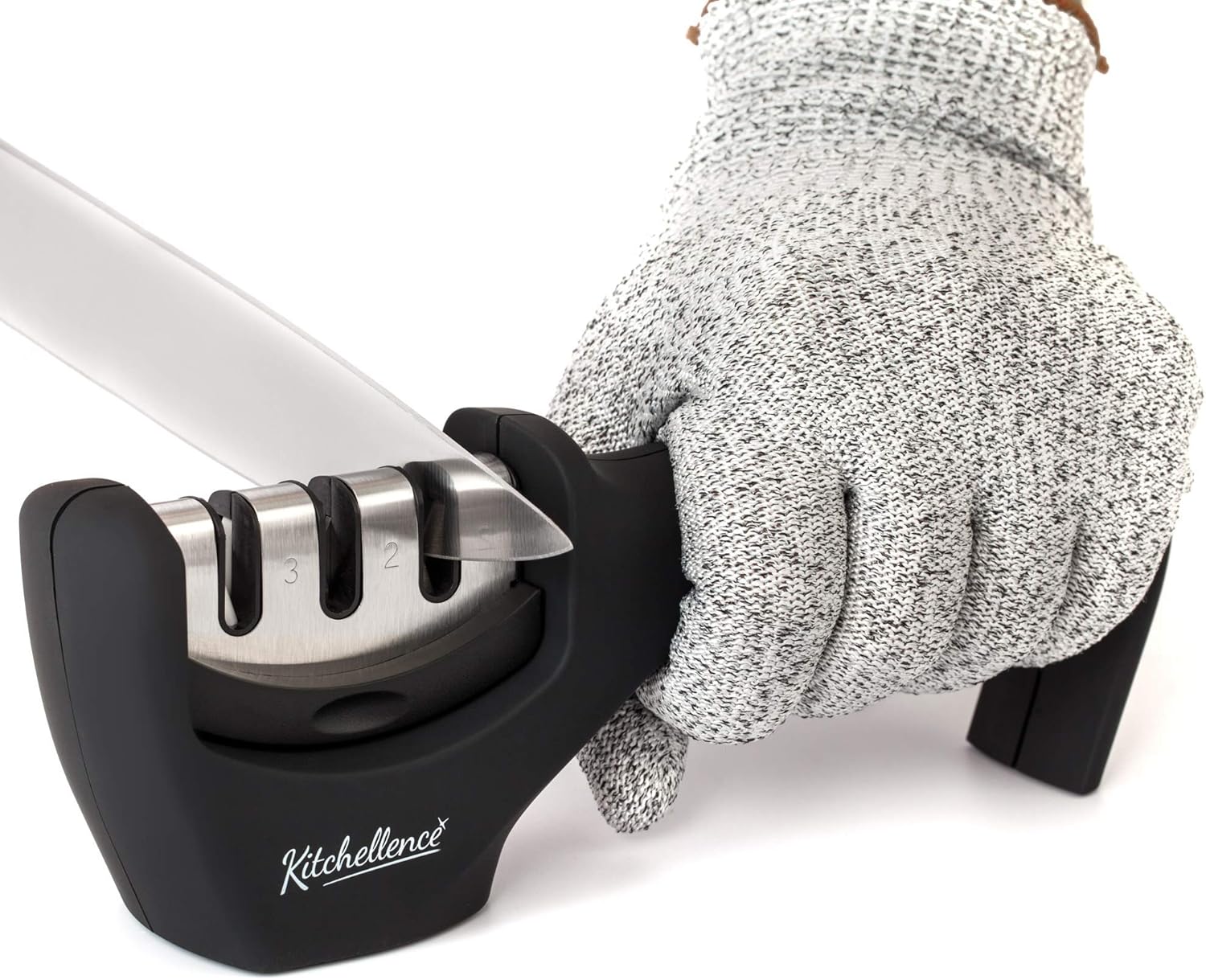
KITCHELLENCE 3‑Stage Knife Sharpener
| Material Type | Plastic |
|---|---|
| Number of Items | 1 |
| Model Number | KS37 P |
| Item Weight | 180 g |
This three-stage sharpener is designed to repair, reshape and polish straight and some serrated blades using a diamond rod in the first slot, a coarse sharpening second slot, and a fine polishing third slot. You use it by holding the non-slip base and pulling the blade through each slot a few times; the ergonomic handle works for right- and left-handed users and the included cut-resistant glove adds safety while you work. The unit is molded from ABS plastic for light durability and is compact enough to store in a drawer. Practical benefits include quick edge restoration for everyday kitchen knives and a simple step sequence that does not require technical skill. Important limitations: it is a manual pull-through system best suited to standard and partially serrated edges rather than fully scalloped specialty serrated knives, and aggressive sharpening can remove metal quickly if used improperly.
Best for: Buyers who prioritize safety and straightforward, low-skill maintenance for everyday kitchen knives and want a simple, predictable sharpening routine.
Less Ideal for: Users who need to restore deeply scalloped or specialty serrated blades or who prefer motorized or guided sharpening systems for precise bevel control.
- Three distinct sharpening stages including a diamond rod for initial repair
- Ergonomic, ambidextrous handle with non-slip base for stable use
- Includes cut-resistant glove for safer sharpening
- Compact, lightweight ABS construction for easy storage
- Not designed for fully scalloped serrated knives and may not restore deep serrations
- Manual pull-through design can over-sharpen if used with excessive force
Verdict: A simple, safe three-stage kit that gives risk-averse home cooks an easy way to revive dull kitchen blades without technical setup.
Choosing the Right Knife Sharpener for Serrated Blades: Key Factors to Consider
Serration Shape and Size
Serrated knives come with widely varying scallop depths, radii, and pitch. A sharpener that matches the tooth profile can contact each scallop precisely without altering the blade's primary bevel.
If the tool is too large or too small for a particular serration, it can under-sharpen or over-grind, shortening blade life or leaving the edge ineffective. Choose a sharpener with interchangeable guides or a tapered, small-diameter rod to accommodate the range of serration geometries you expect to encounter.
Contact Control and Angle Consistency
Maintaining a consistent contact angle across each scallop is essential for even material removal and repeatable results. Tools that lock the rod or abrasive at a fixed angle reduce the skill needed to produce a uniform edge.
Handheld rod styles require a steady wrist and clear tactile feedback. Guided systems with angle stops simplify the process and reduce the risk of uneven sharpening, which is especially helpful if you sharpen serrated knives infrequently.
Abrasive Type and Grit
The abrasive material determines how quickly metal is removed and how fine the final edge will be. Ceramic or diamond-coated rods cut faster and stay true longer, while fine-grit stones or nonwoven abrasives can be used for polishing after the initial reshaping.
For serrated edges, a sharper, hard abrasive is usually needed to reach into tight scallops. However, aggressive abrasives can remove more material than necessary, so look for options with accessible progression from coarser re-profiling to finer polishing.
Tool Stability and Ergonomics
A stable working platform reduces mistakes and increases safety. Bench-mounted sharpeners or models with secure handholds allow you to apply controlled, repeatable strokes.
Ergonomic handles, comfortable grip surfaces, and reachable abrasive elements reduce fatigue and make it easier to perform the small, precise motions required for serration work, especially when you have multiple knives to service.
Versatility and Portability
Some homes benefit from compact handheld rod systems that travel well, while others want a countertop unit for regular maintenance. Portable options are useful if you maintain knives in multiple locations, but they can trade off stability.
Consider where you will sharpen most often, and whether the sharpener needs to handle a variety of blade lengths and serration patterns. The best choice balances portability with the capability to address the serrated profiles you actually own.
Long-term Blade Preservation
Sharpening should extend a serrated knife's useful life rather than accelerate wear. Conservative abrasives and guided techniques remove minimal material while restoring cutting performance.
Frequent, gentle touch-ups with a fine rod preserve blade geometry better than infrequent heavy re-profiling. Look for systems that enable maintenance without reshaping whole teeth unless you are intentionally re-profiling.
How Serrated Edges Differ From Plain Bevels
Serrated edges cut using the individual teeth of the scallops rather than a single continuous bevel. That means sharpening must address each contact point independently and preserve the recesses between teeth to maintain the original cutting action.
Because of this geometry, techniques effective on straight edges can be destructive on serrated blades. Understanding the mechanical differences helps you choose a sharpener designed to reach into scallops without rounding or flattening the teeth.
- Serrations concentrate force at the tooth tips for slicing through tough skins or crusts.
- The recessed valleys behind each tooth are important for debris clearance and effective slicing.
Handheld Rods Versus Guided Systems
Handheld rods are simple, compact, and versatile. They require more control because you must align the rod with each scallop manually. Experienced users can get excellent results, and rods are easy to store and transport.
Guided systems fix the abrasive at a consistent angle and often present a more repeatable workflow. They can be faster for multiple knives and reduce the learning curve for occasional users. The trade-off is usually size and cost compared with a basic rod.
- Rods: Best for portability and one-off touch-ups.
- Guides: Best for consistent results and frequent maintenance.
When To Re-profile Versus Touch Up
Light maintenance involves polishing the tips of serrations to restore bite without changing the profile. This is usually enough when cutting performance is only slightly reduced. Frequent light touch-ups preserve more blade metal over time.
Re-profiling is required when teeth are heavily damaged, bent, or worn flat. It is a more aggressive process that reshapes the scallops and removes more material. Re-profile only when necessary, and expect it to permanently shorten overall edge life compared with ongoing touch-ups.
- Touch up: small, frequent sessions with a fine rod or abrasive.
- Re-profile: less frequent, uses coarser abrasives and greater material removal.
Safety Tips for Sharpening Serrated Knives
Use controlled, deliberate movements and keep fingers away from the cutting path. Stabilize the blade in a clamp or hold it on a non-slip surface when possible to prevent slips.
Work with adequate light and check progress frequently to avoid over-sharpening. If a guided sharpener is available, prefer it for first-time maintenance since it reduces the risk of changing the blade profile unintentionally.
- Wear a cut-resistant glove if you are new to sharpening.
- Inspect serrations between passes to ensure consistent results.
Maintaining Your Sharpener
Keeping the sharpening element clean and free of metal filings extends its service life. For rods, wipe filings away after use and inspect for glazing or wear. For guided systems, follow the manufacturer cleaning guidance for removable abrasives.
Store sharpeners in a dry place to prevent corrosion on any metal parts and avoid dropping ceramic rods which can chip. Periodic replacement of consumable abrasives may be necessary to maintain consistent cutting action.
- Wipe rods with a soft cloth after each session.
- Replace or rotate abrasive elements according to wear indicators.
How We Chose the Best Knife Sharpener for Serrated Blades
We focused on tools designed to restore scalloped or serrated edges without reshaping the primary bevel. Our selection filters prioritized devices and hand tools that deliver controlled contact with each serration, prevent over-grinding, and preserve blade geometry. We evaluated candidates on measurable, use-focused dimensions: sharpening accuracy on serrations, ease of positioning and use, durability of the sharpening element, versatility across common serration sizes, and cleanup or maintenance requirements. We excluded multipurpose sharpeners that rely solely on standard stones or aggressive abrasive wheels because those approaches can round or destroy serrations. We also excluded tools intended only for occasional emergency touch-ups when they could not show consistent repeatable results. The final picks balance precise sharpening performance with simple, repeatable technique and robust construction so typical home cooks can maintain scalloped knives safely and reliably.
Our full evaluation process is outlined in our review methodology.
FAQ
Can I use a sharpening stone on serrated blades?
You can use a stone for the recessed parts if you have a tapered or narrow stone and the skill to address each scallop individually. However, standard flat stones are not suitable because they cannot reach into the valleys and may round the teeth.
How often should I sharpen serrated knives?
It depends on use. Frequent light touch-ups every few months are better than rare heavy re-profiling. High-use knives might need attention more often, while occasional-use blades can go longer between sessions.
Will sharpening shorten the life of a serrated blade?
All sharpening removes metal and slowly shortens a blade over many cycles. Conservative touch-ups that remove minimal material preserve life better than aggressive re-profiling. Only re-profile when damage or wear warrants it.
Is a guided sharpener necessary for good results?
Guided sharpeners are not strictly necessary, but they make angle consistency easier and reduce the learning curve. Skilled users can achieve excellent results with handheld rods, but guides help ensure repeatable outcomes.
Can I sharpen both small and large serrations with the same tool?
Some sharpeners include multiple rod sizes or tapered abrasives to cover a range of serration pitches. Verify that the tool offers the appropriate diameter options or a fine taper to match the smallest scallops you own.
Final Verdict
Prioritize a tool that matches your serration geometry and gives stable, repeatable contact with each scallop. For occasional maintenance, a small ceramic or diamond-tipped rod can restore bite with minimal risk. If you service several serrated knives frequently, a guided system that enforces angle consistency will reduce errors and speed up the process. Balance the need for precise sharpening against ease of use and long-term blade preservation. Choose the approach that lets you maintain sharp, effective serrated knives without unnecessary re-profiling.