
Note: This article contains affiliate links. If you click on these links and make a purchase, we may earn a small commission at no extra cost to you. This helps support our research and content. Read our full affiliate disclosure here.
If you own Japanese knives, keeping their thin, acute edges precise matters more than with Western-style blades. The wrong sharpening method can quickly remove too much metal or change the edge geometry, shortening the knife's life and ruining its cutting feel. This guide covers seven shortlisted knife sharpeners selected specifically for Japanese blades, with an emphasis on angle control, abrasive type, and how gently they remove material. You will find clear criteria that matter for maintaining razor-sharp performance and practical notes on everyday upkeep. Read on to find a sharpener that matches how often you use your knives and the level of edge care you want.
Top Picks at a Glance
| Best Overall The best all-around choice for most situations | Work Sharp Precision Adjust Knife Sharpener |  |
| Best Quality Built to a higher standard if you want something more solid | Work Sharp Ken Onion Elite Mk2 | 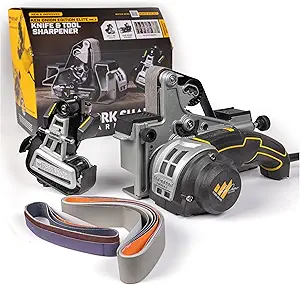 |
| Best Value The sweet spot between price and what you get | wucgea 8-in-1 Whetstone Kit |  |
| Best Budget The cheapest option that still gets the job done reliably | KING HT-43 6000 Whetstone |  |
| Top Rated A top-rated pick with lots of positive feedback | Sharp Pebble 1000/6000 Whetstone |  |
| Most Popular A crowd favorite that many people choose with confidence | KitchenIQ Edge Grip 2-Stage Sharpener |  |
| Best Seller A high-volume bestseller chosen again and again | Intelitopia Dual Grit Whetstone Set |  |
Work Sharp Precision Adjust Knife Sharpener

| Included components | 320 & 600 grit Tri-Brasive, Diamond, Fine Ceramic, Chassis, Benchtop Base, Knife Clamp, Slide Rod |
|---|---|
| Adjustable angle | 15–30 degrees in 1-degree increments |
| Model Number | WSBCHPAJ |
| Material Type | Acrylic, Ceramic, Neoprene, Plastic, Steel |
The Work Sharp Precision Adjust is a benchtop guided sharpening system that brings repeatable, user-controlled sharpening to kitchen and pocket knives. You set the blade in the clamp and select an angle from 15 to 30 degrees in 1-degree steps, then run the abrasive rod along the guide to move between coarse diamond, medium, and fine ceramic surfaces. The v-block clamp and three-sided jig make it faster and more consistent than freehand honing, and the included benchtop base keeps the tool steady during use. It is well suited to reprofiling dull edges and polishing a keen finish, and the adjustable angle range covers most Western and many Japanese blades when you need different bevels. Limitations are that it is a manual system requiring some setup and practice for best results, and very thin or specialty-profile Japanese knives may need careful angle choice or a flatter technique to avoid changing the factory bevel.
Best for: Buyers who want a stable, guided manual system that produces repeatable, reprofiling-capable edges and are willing to learn a clamp-and-guide workflow for regular maintenance.
Less Ideal for: Users who prefer fully electric sharpeners, need a hands-off instant solution, or who exclusively own very thin single-bevel Japanese knives that require traditional whetstone technique.
- Angle-adjustable guide from 15 to 30 degrees for consistent, repeatable edges
- Tri-brasive rod with coarse diamond and fine ceramic stones for shaping and polishing
- Bench base and v-block clamp secure the knife for safer, steadier sharpening
- Includes a range of abrasives and accessories to handle most sharpening tasks
- Manual setup and technique required to avoid altering delicate factory bevels
- Not optimized for ultrathin or specialty single-bevel Japanese knives without careful angle selection
Verdict: Choose this guided benchtop sharpener if you want a repeatable, angle-precise system that reprofiles and polishes a wide range of knives with consistent results.
Work Sharp Ken Onion Elite Mk2

| Material Type | Aluminum |
|---|---|
| Grit Type | Extra Fine |
| Manufacturer Warranty Description | 3 Year Warranty |
The Work Sharp Ken Onion Elite Mk2 is a benchtop sharpening system that combines a guided sharpening cassette with a blade grinding attachment to tackle everything from touch-ups to custom grinds. You use the guide cassette for consistent, repeatable bevels on kitchen knives, scissors, and small tools, and switch to the blade grinding attachment when you need wider belts, faster material removal, or to shape an edge profile. The unit is built around a variable-speed motor and quick-change components so changing modes and belts is straightforward and tool-free, which speeds workflow for frequent sharpening. Its aluminum construction feels stable on a workbench and the system is calibrated for precise angle control, helping you preserve thin, acute edges favored on many Japanese knives. The main compromises are size and power: it is a benchtop machine rather than a compact pocket sharpener, and aggressive grinding can remove steel quickly if you lack experience. For someone who wants control over angle and edge geometry, this delivers professional-capable results without needing custom jigs or stones.
Best for: Buyers who prioritize sharpness, precise angle control, and the ability to perform repeatable edge restorations or custom grinds on high-performance Japanese knives.
Less Ideal for: Casual users who only need an occasional touch-up or those who prefer a compact, travel-ready sharpener instead of a benchtop system.
- Two sharpening modes: guided cassette for repeatable angles and blade grinding attachment for faster material removal
- Variable-speed, quick-change setup simplifies belt swaps and angle adjustments
- Aluminum benchtop construction provides stability during use
- Calibrated angle control helps maintain thin, precise edges suitable for Japanese-style blades
- Benchtop footprint makes it less portable than small hand or pocket sharpeners
- Powerful grinding can remove steel quickly if used without care
Verdict: Choose this benchtop system if you want a precision, repeatable sharpening setup that delivers professional-level edges on Japanese knives.
wucgea 8-in-1 Whetstone Kit

| Grits | 400/1000 and 3000/8000 |
|---|---|
| Material Type | White Corundum |
| Included Components | Base, angle guide, flattening stone, leather strop |
This 8-in-1 whetstone kit provides the basic tools to restore and refine knife edges using water rather than oil. It includes two dual-sided stones (400/1000 and 3000/8000 grit), a bamboo base with non-slip rubber, an angle guide, flattening stone, and a leather strop so you can progress from coarse reshaping to fine polishing. Use the lower grits to reprofile damaged or dull edges and the higher grits plus the strop to refine a razor finish; the stones need 5–10 minutes of soaking before use. The rubber-backed base keeps stones steady on a counter and the angle guide helps beginners hold consistent bevels, though achieving mirror edges on delicate Japanese steels still requires practice and time. The set is water-use only and covers most household and outdoor blades, but users should expect some learning curve for blade-specific angles and regular flattening of the stones to keep them true.
Best for: Home cooks and hobbyists who want an affordable, complete whetstone kit to maintain and refine kitchen knives and are willing to spend time learning proper sharpening technique.
Less Ideal for: People seeking a zero-learning, instant-result sharpener or those who need a professional shop-level system for frequent commercial sharpening.
- Includes coarse to ultra-fine grits (400/1000 and 3000/8000) for full sharpening progression
- Comes with useful accessories: bamboo base with non-slip rubber, angle guide, flattening stone, and leather strop
- Designed for water use so no sharpening oil is required
- Non-slip base improves stability and safety during sharpening
- Requires practice to get consistent angles and to avoid removing too much material from thin Japanese blades
- Stones will need periodic flattening to maintain a true surface
Verdict: A complete, water-ready whetstone kit that lets practical users progress from coarse reshaping to fine polishing without needing sharpening oil.
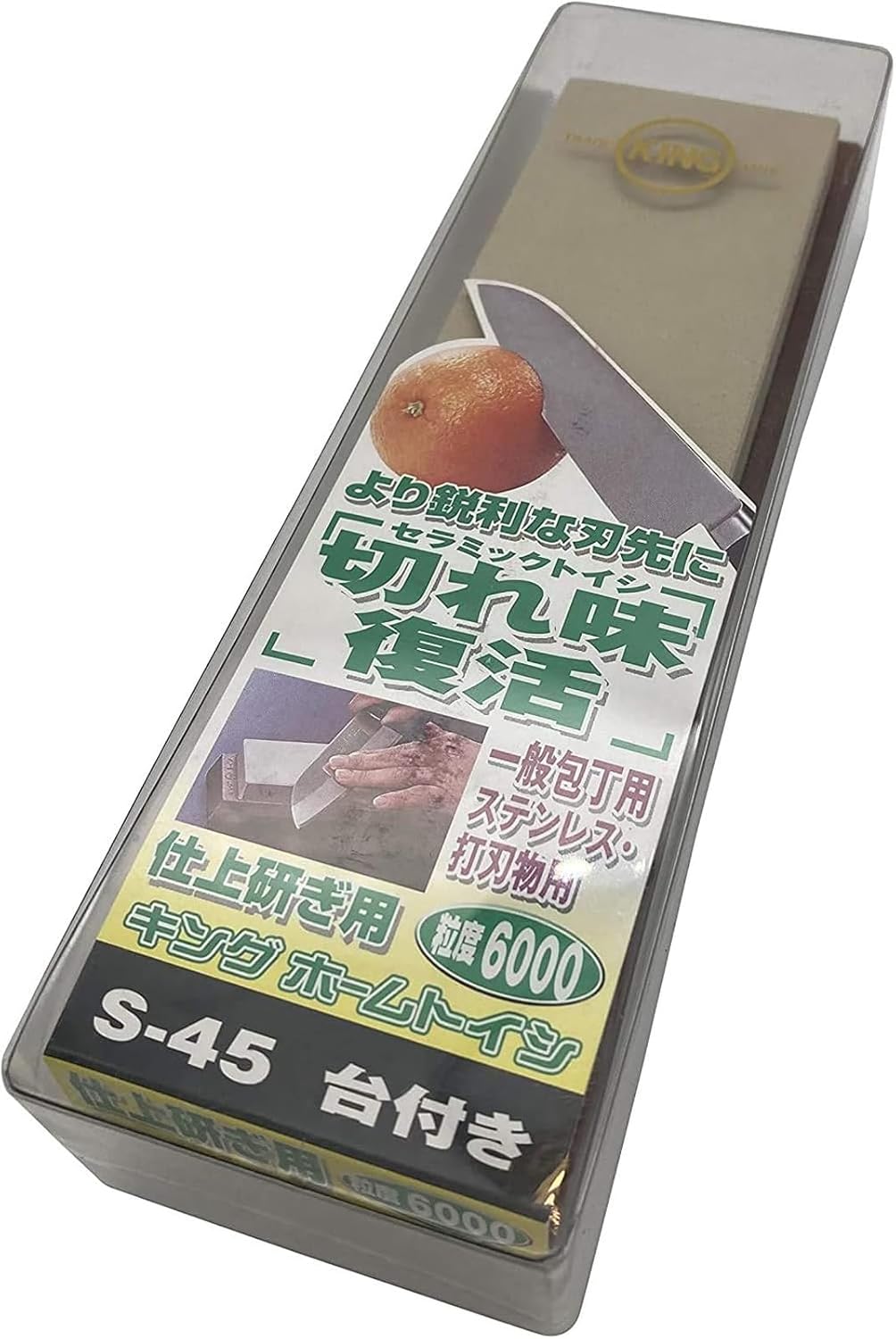
KING HT-43 6000 Whetstone
| Material Type | Ceramic |
|---|---|
| Grit Type | Ultra Fine (6000) |
| Included Components | HT-43 |
The KING HT-43 #6000 whetstone is an ultra-fine ceramic stone intended for final polishing and refining of knife edges, especially suited to Japanese-style blades. You use it wet on a flat, stable surface to remove burrs left from coarser grits and to produce a razor-steel polished edge; it is not intended to reshape badly damaged blades. Its compact rectangular format is easy to handle and the ceramic material holds an even surface for consistent stropping. Practical benefits include predictable, fine-edge results and a long-lasting surface when cared for properly. Limitations are its single ultra-fine grit, which means you will need coarser stones or a progression (e.g., 1000–3000 grit) before using this for routine sharpening, and the small working area can make processing wide blades slower. For budget-minded shoppers looking to finish Japanese knives without spending on premium synthetic kits, this stone delivers good finishing performance for the price.
Best for: Home cooks or hobbyists who already use coarser stones and want an affordable finishing stone to polish and refine Japanese blades.
Less Ideal for: People who need a single all-in-one sharpening solution or those starting from very dull or damaged knives should choose a multi-grit kit instead.
- Ultra-fine 6000 grit yields a polished, refined edge ideal for finishing
- Ceramic construction holds a consistent surface for repeatable results
- Compact shape is easy to position and handle during use
- Durable when cleaned and stored properly
- Single ultra-fine grit means you must own coarser stones to do full-edge restoration
- Small contact area slows sharpening of wider blades
Verdict: If you already own coarser stones, this economical 6000-grit KING whetstone is a reliable choice to polish and finish Japanese knives to a razor edge.
Sharp Pebble 1000/6000 Whetstone

| Grit | 1000/6000 |
|---|---|
| Material Type | Corundum |
| No Oil Required | Yes |
This Sharp Pebble whetstone is a two-sided 1000/6000 grit waterstone kit aimed at sharpening and polishing kitchen knives to a razor edge. You use the 1000 side to repair dull or slightly damaged edges and the 6000 side to refine and polish the bevel for a smooth, keen finish; the kit includes a non-slip bamboo base and an angle guide that locks blade position for consistent results. Because it is a waterstone, it requires soaking or wetting before use and produces slurry that helps cutting action, but it avoids oil and the mess that comes with oilstones. The included angle guide and beginner instructions make it straightforward for less experienced users to hold a steady angle, while the corundum composition is claimed to stay flatter and resist chipping longer than cheaper stones. Trade-offs are the usual ones for waterstones: they need occasional flattening over long-term use and take a bit more setup and technique than pull-through or electric sharpeners, but they deliver better edge geometry and polish when used correctly.
Best for: Home cooks and enthusiasts who prioritize a reliable, long-lasting sharp edge and are willing to learn basic whetstone technique to maintain Japanese-style knives.
Less Ideal for: Users wanting a quick, low-skill solution or a motorized sharpener that requires no setup should consider simpler electric or pull-through options instead.
- Dual 1000/6000 grits cover edge repair through fine polishing for kitchen knives
- Angle guide and bamboo base help maintain consistent sharpening angle for beginners
- Waterstone composition (corundum) cuts efficiently and is marketed to stay flat longer than budget stones
- Requires wetting/soaking and occasional flattening maintenance
- Not as fast or automatic as electric or pull-through sharpeners
Verdict: Choose this whetstone if you want a dependable dual-grit waterstone and guided setup that produces professional-level edges on Japanese kitchen knives when used with proper technique.
KitchenIQ Edge Grip 2-Stage Sharpener

| Material Type | Plastic |
|---|---|
| Grit Type | Fine |
| Included Components | Complete |
The KitchenIQ Edge Grip is a simple, compact 2-stage pull-through sharpener designed for quick edge setting and finishing. Use the carbide slot first to re-establish a damaged or very dull edge, then follow with the ceramic rod slot to hone and polish the bevel. Its patented V-grip lets you anchor the unit on a countertop edge to avoid dragging knife tips across surfaces, and non-slip rubber feet plus a soft-grip handle make short sessions feel secure. Because the sharpening angles are preset, it is fast and easy to use without skill or jigs, and the small size stores easily in a drawer. Limitations: preset angles and carbide abrasives are aggressive and may remove more metal than a whetstone, so the sharpener is best for touch-ups and quick edge repair rather than precision work or maintaining the thin, acute bevels prized on many Japanese knives.
Best for: Buyers who want a low-effort, reliable way to quickly restore usable edges and keep kitchen knives serviceable without learning sharpening technique or using stones.
Less Ideal for: Sharpening purists who need precise control over bevel angle, or those aiming to preserve the thin, high-angled edges on specialist Japanese knives should look at whetstones or guided systems instead.
- Two-stage system (carbide coarse, ceramic fine) covers both edge repair and honing.
- Patented V-grip base allows stable sharpening on a countertop edge to protect tips.
- Preset angles make sharpening fast and approachable for novices.
- Non-slip feet and soft-grip handle improve stability and comfort during use.
- Fixed sharpening angle and pull-through design limit precise bevel control needed for specialist Japanese blades.
- Carbide stage is aggressive and can remove significant metal if overused.
Verdict: If you need a fast, foolproof tool to quickly repair and maintain everyday knife edges, this compact two-stage sharpener delivers reliable results.
Intelitopia Dual Grit Whetstone Set

| Grits | 400/1000 and 3000/8000 (dual-sided) |
|---|---|
| Material Type | Corundum (aluminum oxide) stone |
| Included Components | Whetstones, flattening stone, leather strop, bamboo base, angle guide |
This kit provides everything a home cook needs to sharpen and polish kitchen knives, with two dual-sided whetstones (400/1000 and 3000/8000 grit) plus a coarse flattening stone, leather strop, bamboo base with non-slip feet, and an angle guide. Use the 400/1000 side to restore dull edges and the 3000/8000 side to refine and polish a razor finish; the flattening stone keeps the whetstones true over time and the strop removes the burr for a smoother edge. The breathable bamboo base and rubber pads make bench use stable, and the included guide helps beginners hold a consistent angle. Because the stones are corundum (aluminum oxide), they cut predictably and are durable for frequent household use. Expect to spend a little practice time learning proper waterstone technique and to flatten stones occasionally, but this set gives a full sharpening workflow without needing separate purchases.
Best for: Home cooks who want a risk-averse, all-in-one whetstone kit to restore and polish Japanese-style kitchen knives while learning proper waterstone technique.
Less Ideal for: Sharpeners who need a no-learning, push-button solution or those who prefer a motorized sharpener for fast, frequent touch-ups.
- Includes two dual-grit whetstones covering coarse to ultra-fine grits for edge repair and polishing
- Comes with a flattening stone and leather strop to maintain stones and finish edges
- Bamboo base with non-slip rubber feet keeps stones stable during sharpening
- Angle guide and instruction manual help beginners achieve consistent sharpening angles
- Requires practice and regular flattening to maintain optimal performance
- Contains abrasive stones only and no dedicated holder with clamping for very small blades
Verdict: A complete, beginner-friendly whetstone kit that gives Japanese knives a repairable edge and fine polish without needing extra purchases.
Choosing the Right Knife Sharpener for Japanese Knives: Key Factors to Consider
Edge Angle and Geometry
Japanese knives often use acute bevels and specific geometry to achieve superior cutting performance. Choosing a sharpener that supports the correct angle range and lets you reproduce it consistently matters because even a small change in angle can affect sharpness and durability.
A sharpener with fixed, well-marked angle guides or an adjustable jig helps protect the original geometry. If you prefer freehand sharpening, pick stones or systems that allow precise hand control and feedback so you can maintain the intended bevel.
Abrasive Type and Grit Progression
Different abrasives remove metal at different rates and leave different finishes. Coarse grits are necessary for repairing chips or reshaping an edge, while medium and fine grits refine the edge and polish it to a keen, durable razor. For Japanese knives you will typically want a progression that reaches fine grits to preserve the thin edge without over-grinding.
Natural stones, ceramic stones, and engineered whetstones each have tradeoffs in cutting speed and finish. Systems that offer replaceable belts or modular stones let you tailor grit progression to both restoration and maintenance work.
Compatibility With Hard Steels and Bevel Types
Many Japanese knives are made from harder steels and may have single-bevel profiles or very thin double-bevel edges. A good sharpener must be capable of cutting and finishing hard alloys without glazing or clogging, and it must allow you to maintain asymmetric bevels when needed.
Evaluate whether a sharpener's abrasive and mounting method suit hard steels. Some electric or belt systems work well with very hard steels, while certain ceramic or soft stones may be too slow or wear unevenly.
Control, Safety, and Ease of Use
Maintaining consistent strokes and body position reduces the risk of damaging your knives or injuring yourself. Look for sharpeners with stable bases, ergonomic grips, and clear guidance for stroke length and angle. For beginners, systems with jigs or angle guides reduce the learning curve.
For experienced sharpeners, freehand stones provide tactile feedback that is valuable for producing a refined edge. Safety features and simple maintenance, such as easy-to-clean surfaces and non-slip feet, improve daily usability.
Material Removal and Edge Preservation
Because Japanese knives often rely on thin, hard edges for performance, minimizing unnecessary metal removal preserves blade life. Choose tools that offer controlled removal rates so you can repair chips without excessive stock loss.
Options that allow for gentle deburring and progressive polishing help you retain edge geometry while achieving a sharp, long-lasting finish. Consider how often you will need to restore the edge and pick a method that balances speed with preservation.
Long-Term Maintenance and Cost of Consumables
Some sharpeners require periodic replacement stones, belts, or lubricant, which affects long-term cost and convenience. Consider whether you want a low-maintenance system or are willing to invest in consumables for superior results.
Also factor in how easy it is to flatten stones, replace worn parts, and find compatible consumables. Systems with widely available consumables or simple maintenance procedures reduce headaches over time.
Why Japanese Knives Need Different Sharpening Care
Japanese knives typically have harder steels and thinner, more acute edge angles than many Western-style blades. That combination delivers superior cutting performance but also makes the edge more sensitive to over-sharpening or incorrect angle control. A sharpening approach that is too aggressive will shorten the knife's useful life, while an approach that is too fine may be unable to quickly remove damage or re-profile an edge.
- Harder steels hold a keener edge but require abrasives that can cut them effectively.
- Thin bevels mean angle consistency is critical for edge performance.
- Some Japanese bevel styles need asymmetrical sharpening technique.
Wet Stones and Waterstones: Traditional Refinement
Waterstones remain the gold standard for many owners of Japanese knives because they provide excellent feedback and allow for a wide grit progression from repair to polish. They are well suited to the fine edge finishes Japanese blades benefit from, and skilled users can maintain precise angles freehand. Proper soaking, flattening, and stropping routines are part of effective use.
- Best for controlled finishing and polishing.
- Requires flattening and some technique to use well.
- Provides tactile feedback for experienced sharpeners.
Guided Systems and Angle Jigs: Repeatable Results
If you want consistent angles with less practice, guided systems or jigs are a practical option. They lock the edge at a fixed angle so you can reproduce it across the blade length and over time. Guided rigs work well for preserving original geometry or setting a new, consistent bevel across multiple knives.
- Reduce skill barrier for beginners.
- Useful for consistent maintenance sharpening.
- Choose systems that accommodate common Japanese angles.
Belt and Electric Systems: Speed With Care
Belt sharpeners and some electric systems remove material quickly and can be useful when repairing chips or re-profiling an edge. However, they demand restraint and technique when used on thin Japanese blades because high metal removal rates can change the bevel rapidly. Look for machines with variable speed, fine abrasive belts, and low contact pressure options.
- Fast at reshaping and repairing edges.
- Risk of over-grinding if misused.
- Prefer models with fine-grit options and adjustable guides.
Stropping and Edge Polishing for a Razor Finish
After sharpening, stropping on leather or fine compounds refines the burr and polishes the edge to its keenest potential. Stropping aligns the micro-bevel and removes the last traces of wire burr, improving slicing performance and perceived sharpness. Regular stropping can extend periods between full regrinds.
- Essential step for a mirror-like edge.
- Removes burr and improves initial bite.
- Light, consistent strokes yield best results.
How We Chose the Best Knife Sharpener for Japanese Knives
We evaluated sharpeners for Japanese knives using practical, measurable criteria that matter to owners of thin-bevel blades. First, we prioritized angle accuracy and repeatability because many Japanese knives use acute edge angles that require precise guidance or consistent freehand results. Second, we assessed abrasive types and grit progression to ensure options that can both repair damaged edges and refine a keener finish without excessive metal removal. Third, we considered material compatibility and bevel style to make sure the sharpeners work with hard steels and single- or double-bevel geometries common to Japanese knives. Fourth, ease of use and user safety were factored in, including grip, stability, and whether the tool facilitates repeatable strokes. Finally, we looked at durability and maintenance needs, such as replaceable stones or belts and cleaning requirements. Excluded items included generic multi-tool sharpeners that only offer coarse, single-step abrasion or devices that rely on overly aggressive abrasives unsuited to thin Japanese edges. We also filtered out sharpeners lacking clear angle guidance or those that cannot be adjusted for common Japanese angles. The result is a selection focused on tools that preserve blade life while delivering sharp, consistent edges.
Our full evaluation process is outlined in our review methodology.
FAQ
How often should I sharpen Japanese knives?
It depends on use. For home cooks who use their knives daily, light honing or stropping every few uses and a full sharpening every few months is common. Heavy use or damage will require sharpening more frequently.
Can I use a standard sharpening stone on hard Japanese steels?
Yes, but match the stone's abrasive to the steel hardness. Coarser or diamond stones may be necessary for very hard alloys. Softer or low-cutting stones will be slow and may glaze when used on hard steels.
Is freehand sharpening better than guided systems?
Neither is universally better. Freehand offers more control and feedback for experienced users and can better preserve original geometry. Guided systems provide repeatable angles and are easier for beginners to use consistently.
Will electric sharpeners damage a thin Japanese edge?
They can if used improperly. High-speed, coarse abrasives and excessive pressure will remove too much material. Use fine abrasive settings, low pressure, and angle control when working with thin blades.
Should I strop my Japanese knives after every sharpening?
Stropping after sharpening or as part of regular maintenance is beneficial. It removes the burr and polishes the edge, improving cutting feel and delaying the need for full sharpening.
Final Verdict
Choosing the right sharpener for Japanese knives means balancing precision, material compatibility, and how much work you are willing to do. Prioritize tools that provide accurate angle control, a sensible grit progression, and abrasives that can cut hard steels without excessive stock removal. If you are new to sharpening, opt for guided systems or stones with clear markers. If you want the finest edge and have practice, traditional stones and stropping deliver the best finish. Ultimately select a method that preserves the thin bevels while matching your maintenance routine and skill level.