
Note: This article contains affiliate links. If you click on these links and make a purchase, we may earn a small commission at no extra cost to you. This helps support our research and content. Read our full affiliate disclosure here.
If you add foil accents to cards, planners, or craft prints, the right laminator can make the difference between a crisp, metallic finish and a ruined sheet. You want a machine that holds steady temperatures, feeds media without shifting, and tolerates thin foiling films without wrinkling. This guide narrows the field to seven short-listed laminators for foiling that meet those needs. We evaluate units on temperature accuracy, feed consistency, and ease of use to help you pick a model that delivers repeatable, professional-looking foil results. Read on for the criteria we used and what to expect from each top pick.
Top Picks at a Glance
| Best Overall The best all-around choice for most situations | Scotch PRO TL906 Laminator |  |
| Best Quality Built to a higher standard if you want something more solid | SINCHI 13" Laminator LM350 |  |
| Best Value The sweet spot between price and what you get | Buyounger 9-Inch Laminator |  |
| Best Budget The cheapest option that still gets the job done reliably | MYKLLIFF 9-Inch Laminator |  |
| Top Rated A top-rated pick with lots of positive feedback | Scotch TL901X Thermal Laminator |  |
| Most Popular A crowd favorite that many people choose with confidence | Amazon Basics 9-Inch Thermal Laminator |  |
| Best Seller A high-volume bestseller chosen again and again | Amazon Basics 12-Inch Thermal Laminator |  |
Scotch PRO TL906 Laminator

| Accepts pouch width | Up to 9 in. |
|---|---|
| Pouch thickness | 3 mil and 5 mil |
| Warm up time | 5 Minutes |
| Laminating speed | 1.25 feet_per_minute |
| Number of rollers | 2 |
The Scotch PRO TL906 is a small thermal laminator aimed at home, school, and light office use that accepts 3- and 5-mil pouches up to 9 inches wide. It uses two heated rollers and two temperature settings to deliver bubble- and wrinkle-free laminates, and the unit warms up in about five to six minutes so you can get work done quickly. Never Jam Technology and LED controls make feeding and operation straightforward, and auto shutoff after one hour helps conserve energy. At roughly 15 inches per minute laminating speed, it handles typical tasks like recipe cards, photos, ID cards, flyers, and classroom handouts with consistent clarity. The machine is compact and portable enough to tuck into a craft corner, though it is designed for light-volume runs rather than continuous heavy production. For foiling projects you will need compatible foiling processes and pouches designed for heat-based laminators, since this model is a basic thermal unit and does not include specialized foiling attachments.
Best for: Buyers who want a reliable, compact thermal laminator for home, school, or small office projects and expect consistent, quick laminate finish without professional production needs.
Less Ideal for: People who need a heavy-duty, high-throughput laminator or an integrated foiling/embossing machine for craft-level decorative foiling should look at more specialized equipment.
- Accepts 3 mil and 5 mil pouches up to 9 inches wide for common document sizes
- Two heated rollers and selectable temperature settings for smooth, bubble-free results
- Fast warm-up (about five to six minutes) and 15 in./min laminating speed
- Never Jam Technology and LED controls simplify feeding and operation
- Auto shutoff after one hour reduces energy use
- Designed for light to moderate use, not high-volume production
- No built-in foiling or specialty finishing features for decorative foil application
Verdict: A compact, easy-to-use thermal laminator that delivers consistent, bubble-free laminates for home, school, and light office tasks.
SINCHI 13" Laminator LM350

| Warm up time | 48 second |
|---|---|
| Number of rollers | 4 |
| Pouch thickness range | 3 – 10 mil per side |
| Laminating speed | Up to 40 inches per minute |
The SINCHI 13" laminator is a commercial-grade machine built for high-throughput laminating and foil application. It warms up in about 48 seconds and runs up to 40 inches per minute, so it handles batch jobs quickly; the manufacturer claims ten 3-mil letter pouches can be laminated in roughly four minutes. A four-roller, anti-jamming system plus seamless pouch switching between 3–10 mil makes it suitable for mixed-thickness work without constant adjustments. The unit is optimized for heavy cardstock and dark prints and includes a heat-transfer foil applicator for simple metallic accents at the 10-mil setting. Practical safety features include auto-shutdown and sensors for voltage, temperature, and motor faults, and SINCHI ships ten starter pouches and a cleaning sheet to help maintain rollers. Expect noticeable operational noise from the metal gearbox, and this model is intended for standard pouches only, not industrial films or DTF/sublimation materials. For a workshop, small print shop, or busy office that needs reliable speed and foiling capability, it is a strong, production-focused choice.
Best for: Buyers who prioritize production speed and reliable, heavy-duty laminating for frequent batches and want integrated foiling capability for signage, certificates, or craft work.
Less Ideal for: People who need ultra-quiet operation, hobby users who laminate infrequently, or anyone who must process specialty films like DTF or sublimation should consider other options.
- Fast 48-second warm-up and up to 40 in/min laminating speed for high throughput
- Four-roller design with anti-jamming system for smoother, uninterrupted runs
- Supports 3–10 mil pouches including heavy cardstock and dark prints
- Built-in foil applicator for metallic accents without extra tools
- Includes starter pouches and cleaning paper to maintain rollers and reduce jams
- Industrial metal gearbox produces noticeable operational noise
- Not compatible with DTF, sublimation films, vinyl rolls, or industrial transfer materials
Verdict: If you need fast, heavy-duty laminating with built-in foiling for professional-looking metallic accents, this 13" SINCHI machine is a production-ready choice.
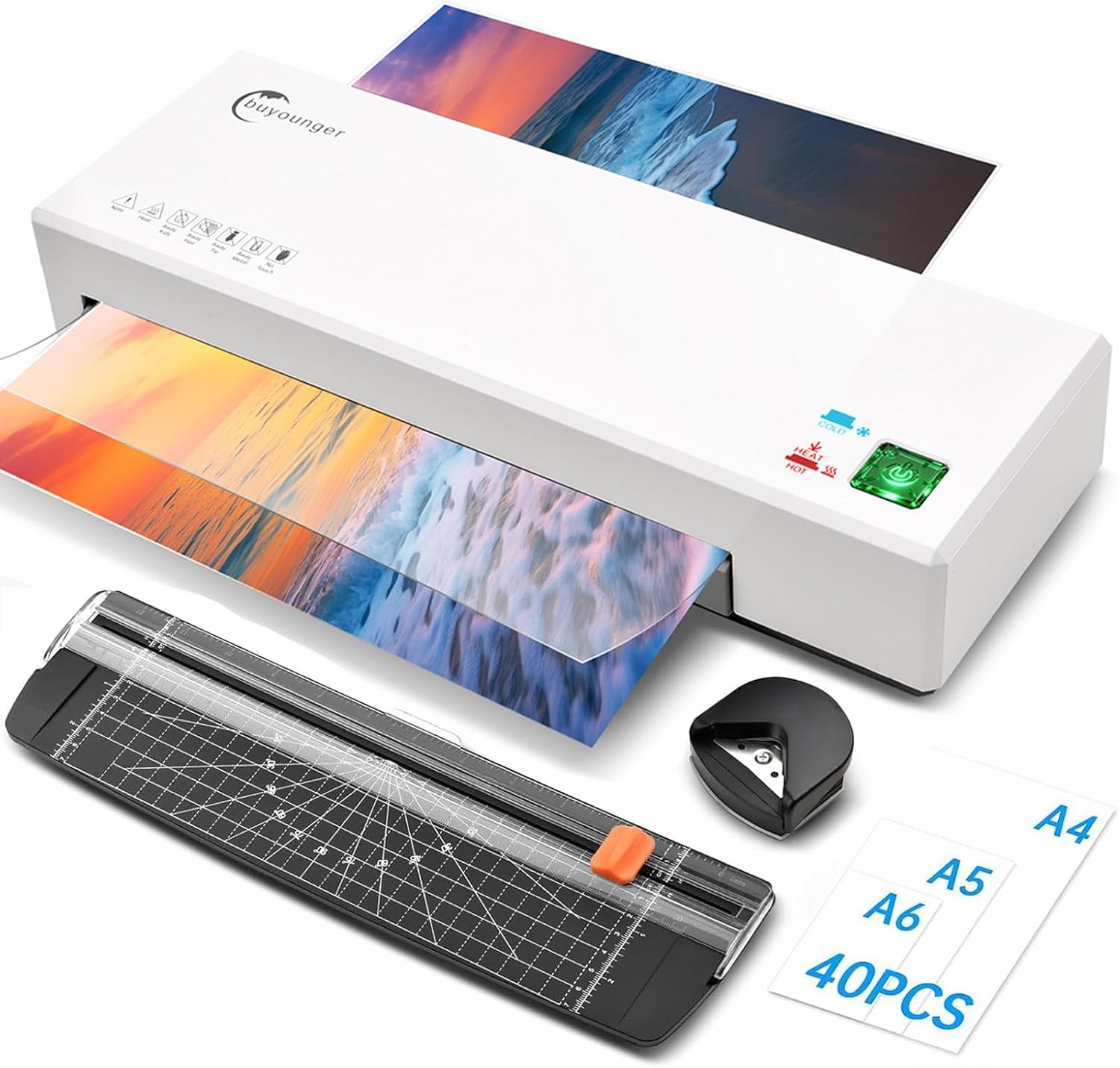
Buyounger 9-Inch Laminator
| Warm Up Time | 1 min |
|---|---|
| Laminating Speed | 340 mm/min |
| Pouch Thickness | 3-5 mil |
| Number of Rollers | 2 |
| Max. width | 9 Inch |
This Buyounger 9-inch laminator is a lightweight, entry-level machine aimed at everyday laminating like photos, documents, and classroom materials. It handles 3–5 mil thermal pouches and also supports cold pouches for heat-sensitive items, and it reaches operating temperature in about a minute thanks to two heated rollers that run at roughly 340 mm/min for steady, wrinkle-free results. The unit includes 40 pouches, a paper cutter, and a corner rounder so you can trim and finish projects without extra tools, and the ABS jam-release button simplifies recovery when a sheet catches. Noise is low during operation, making it suitable for home or small offices. Limitations include the narrow 9-inch maximum width and modest pouch thickness range, so it is not built for heavy-duty or wide-format jobs, and foiling projects that require thicker carrier sheets or specialty heat settings may not be fully supported.
Best for: Buyers who want a compact, ready-to-use laminator for everyday projects and classroom or home crafting, and who prioritize quick setup and included finishing tools.
Less Ideal for: People needing wide-format, heavy-gauge laminating or specialized heat profiles for foiling and specialty film work should consider a larger, higher-spec machine.
- Fast 60-second warm-up with two heated rollers for quick, consistent laminating
- Includes 40 pouches plus a paper cutter and corner rounder for end-to-end project prep
- ABS jam-release function makes it easy to clear jams without damaging documents
- Quiet operation suitable for home, classroom, or small office use
- Supports only up to 9-inch wide pouches and primarily 3–5 mil thickness so it is limited for larger or heavy-duty laminating
- Cold lamination requires self-adhesive pouches which are not included
Verdict: A small, fast, and user-friendly 9-inch laminator that covers routine home, school, and office laminating with convenient accessories.
MYKLLIFF 9-Inch Laminator

| Number of Rollers | 1 |
|---|
This small 9-inch laminator handles basic document and photo protection with both hot and cold modes, making it useful for a range of craft and classroom tasks. It heats up in about three minutes and accepts standard thermal pouches, while the cold mode lets you use self-adhesive sheets for heat-sensitive materials. The single-roller design and ABS jam-release lever make clearing misfeeds straightforward, and the unit is built to run quietly so it will not be disruptive in a classroom or home craft area. Its compact, lightweight footprint is easy to store and convenient for occasional projects or transport. On the downside, the machine is a basic model with one roller and is intended for narrow items up to 9 inches, so it is not suited to heavy-duty production or wide-format foiling workflows that need higher temperature control or larger rollers. For simple laminating and light craft foiling prep, it delivers good value and dependable performance for the price-conscious buyer.
Best for: Someone looking for an affordable, compact laminator for occasional craft projects, classroom materials, or home photo protection who prioritizes simplicity and low cost.
Less Ideal for: Users who need a heavy-duty, wide-format laminator or precise temperature control for professional foiling and high-volume commercial work should choose a larger, more capable machine.
- Hot and cold modes allow laminating heat-sensitive items without damage
- Fast 3-minute warm-up reduces waiting time for quick tasks
- ABS jam-release lever simplifies clearing jams and protects documents
- Compact, lightweight design is easy to store and move
- Single-roller, narrow 9-inch width limits heavy-duty or wide-format work
- No advanced temperature controls that some foiling workflows require
Verdict: A budget-friendly, compact laminator that covers basic hot and cold laminating needs and is a practical pick for occasional craft and classroom foiling prep.
Scotch TL901X Thermal Laminator

| Speed | 1 feet_per_minute |
|---|---|
| Warm Up Time | 5 minutes |
| Number of Rollers | 2 |
The Scotch TL901X is a small thermal laminator designed for home, school and light office use that accepts 3- and 5-mil pouches up to 9 inches wide. It uses a two-roller heated system with selectable temperature settings to produce bubble- and wrinkle-free results, and a one-page-per-minute feed speed keeps small jobs moving quickly. A release lever helps free stuck pouches, and the unit warms up in about five minutes so it is ready for occasional tasks without a long wait. Because it is built for standard thermal pouches and photo-safe finishes, it protects documents and photos from markers, tears and spills. For foiling specifically, the TL901X can handle pouches reliably but does not include any specialty foil settings or a cold-laminate mode, so results depend on compatible foiling pouches and careful setup. Its compact footprint and simple controls make it easy to use, though heavier or frequent commercial foiling projects may outgrow its speed and feature set.
Best for: Buyers who prioritize a reliable, easy-to-use laminator for occasional foiling experiments, craft projects, photos and routine document protection.
Less Ideal for: Not a good fit for high-volume commercial foiling or advanced foil-application techniques that require cold lamination, adjustable speed control or wider-format capacity.
- Two heated rollers and two temperature settings for smoother, bubble-free laminates
- Accepts both 3-mil and 5-mil pouches for common home and school uses
- Compact and quick warm-up with a release lever to clear jams
- Photo-safe finish suitable for preserving photos and artwork
- No dedicated cold-laminate or foil-specific settings for specialty foiling workflows
- Limited to items up to 9 inches wide and modest one-page-per-minute speed
Verdict: A dependable, compact thermal laminator that reliably produces smooth 3- and 5-mil laminates for home foiling and craft projects when you want consistent, low‑effort results.
Amazon Basics 9-Inch Thermal Laminator

| Warm Up Time Description | 5 minute |
|---|---|
| Number of Rollers | 2 |
The Amazon Basics 9-Inch Thermal Laminator is a simple, entry-level machine for laminating photos, business cards, and standard documents up to 9 inches wide. It warms up in roughly 3 to 5 minutes and has two heat settings that accept 3-mil and 5-mil pouches, letting you choose a stiffer finish for everyday items or a gentler setting for thinner papers. A two-roller path and a visible ready light make operation straightforward, and a manual jam-release lever clears misfeeds without disassembly. It ships with a couple of 3-mil pouches so you can try it right away. The unit is compact and easy to store, which is handy for occasional home or small-office use. Important limitations for this foiling-focused article: it is a thermal laminator designed for pouch lamination and does not include a dedicated foiling function, so users pairing it with separate foiling supplies or toner-reactive methods should verify compatibility and test settings carefully. Heavy-duty or high-volume shop use will quickly outgrow this model.
Best for: Buyers who want an affordable, easy-to-use laminator for occasional home, craft, or small office projects and who rely on verified user performance and straightforward operation.
Less Ideal for: If you need a dedicated foil applicator, a cold-laminator, or a heavy-duty machine for frequent professional foiling jobs, choose a specialist device instead.
- Supports both 3-mil and 5-mil pouches for different document thicknesses
- Quick warm-up with a ready indicator light for fast use
- Jam-release lever simplifies clearing misfeeds without taking the unit apart
- Compact footprint that stores easily in a home or small office
- No built-in foiling or cold-laminating mode so foil-specific workflows require separate tooling or trials
- Not intended for high-volume or heavy-duty commercial use
Verdict: A low-cost, fuss-free 9-inch thermal laminator that works well for occasional home and small-office pouch lamination.
Amazon Basics 12-Inch Thermal Laminator

| Warm Up Time | 5 minute |
|---|---|
| Number of Rollers | 2 |
This 12-inch Amazon Basics thermal laminator is a straightforward, no-frills machine for laminating letter and legal papers, photos, business cards, and small craft pieces. It offers two heat settings for 3-mil and 5-mil pouches, a 3–5 minute warm-up with a ready indicator light, and a jam-release lever to clear jams quickly. The unit ships with twenty 3-mil pouches in assorted sizes so you can start laminating right away. In practice it runs quietly and steadily for light to moderate tasks, producing smooth, clear laminations when you match the pouch thickness to the corresponding heat setting. It is not intended for laminating thick or rigid materials or items like cloth, wood, or foil, so it will not handle some specialty foiling substrates or hardware. For everyday document protection and basic craft work the machine is reliable and easy to use, but foiling-specific projects that require thicker films, adhesives, or heat-tolerant surfaces will need a more specialized laminator or additional foiling tools.
Best for: Buyers who want an easy, dependable laminator for protecting documents, photos, and everyday craft pieces and who prioritize straightforward operation and low risk of jams.
Less Ideal for: People seeking a machine for specialty foiling, heavy-duty production runs, or laminating thick or non-paper substrates should consider a more capable, higher-heat model or dedicated foiling equipment.
- Two heat settings to handle common 3-mil and 5-mil laminating pouches
- Quick 3–5 minute warm-up with an indicator light
- Includes 20 assorted 3-mil pouches to get started
- Jam-release lever simplifies clearing paper jams
- Cannot laminate textiles, foil, wood, or other non-paper materials
- Not suitable for heavy-duty or high-volume commercial use
Verdict: A simple, reliable 12-inch thermal laminator that provides safe, easy laminating for everyday documents and light craft jobs.
Choosing the Right Laminator for Foiling: Key Factors to Consider
Temperature Accuracy and Stability
Foiling requires a narrow temperature window to transfer metallic foil onto toner or adhesive layers without scorching the substrate. A laminator with precise, steady heat reduces the risk of uneven adhesion that causes patchy or dull spots.
Look for machines with clear temperature settings or presets tailored to thin foiling films. Rapid fluctuations during a run will show up as streaks or inconsistent shine, so steady-state performance matters more than a fast warm-up alone.
Feed Mechanism and Roller Pressure
How a laminator pulls sheets through is critical for wrinkle-free foiling. Rollers that grip too hard can crush delicate paper while rollers that slip let sheets skew and misalign the foil. Even pressure across the width prevents edge lift and bubbling.
Adjustable roller pressure or multiple rollers help accommodate different paper weights and foiling carriers. A reliable feed path reduces jams and keeps the foil layer smooth, which is especially important for narrow accents and detailed designs.
Speed and Throughput
If you plan to foil multiple pieces in a session, throughput becomes a practical concern. Faster machines can process more sheets in less time, but speed should not come at the cost of control. Too-fast feed rates can reduce foil transfer quality on intricate or heavy-stock pieces.
Balanced speed settings let you trade time for finish quality. For small runs, slower, controlled passes often yield the best shine. For larger batches, look for machines that maintain temperature and pressure consistency at higher throughput levels.
Compatibility With Foiling Materials
Foiling workflows use a variety of materials: carrier sheets, transfer foil, adhesive-backed laminates, and different paper stocks. A suitable laminator must accept the thickness range and handle the slippery surface of foil without tearing or jamming.
Check whether the design accommodates thin carriers and provides a straight feed path to avoid curling. Machines that trap sticky residue or shed roller material are problematic because foil fragments can accumulate and compromise subsequent runs.
User Controls, Presets, and Ease of Use
Clear, repeatable controls—digital temperature readouts, speed settings, and foil-specific presets—help you reproduce finishes across sessions. Simple indicators for ready status and error alerts reduce wasted sheets and foil.
Ergonomic features such as centered entry guides, release levers for jams, and straightforward maintenance access make the foiling workflow faster and less error-prone. Good documentation and clear markings for settings also matter when you are switching between stock types.
Maintenance and Long-Term Reliability
Foiling can deposit adhesive and foil residue on rollers over time. A laminator that is easy to clean and uses durable roller materials will perform better in the long run. Consider how accessible the rollers are for cleaning and whether parts wear out quickly.
Spare-part availability and straightforward maintenance procedures reduce downtime. Machines that trap debris or require frequent technician service inflate operating hassle, so durability is a key selection factor for regular foiling use.
Preparing Your Artwork and Foil Layers
Successful foiling starts with prep. Ensure toner coverage or adhesive placement matches the areas you want to foil. For toner-based transfer methods, high-contrast, dense toner yields stronger foil adhesion. For adhesive foils, apply a uniform layer of adhesive with no gaps.
Trim edges cleanly and square up your sheets before running them through the laminator. Misaligned or skewed paper at the entry will magnify during feeding and can ruin the foil finish. Use carrier sheets or sacrificial backing when working with very thin or fragile stocks to give the rollers a stable grip.
- Use crisp, dense toner or consistent adhesive for best transfer
- Square and trim sheets to reduce skewing during feed
- Use carriers for thin or delicate paper to protect the surface
Setting Temperature and Speed for Best Transfer
Start with conservative settings recommended for thin foils and increase heat in small increments until you reach full transfer. If your machine offers presets for film weights, use them as a baseline. Watch for signs of overheat such as discoloration, curling, or brittle edges.
When testing, run single-sheet trials with your actual paper and foil. Adjust speed if the foil appears under-transferred or if fine details are not showing. Slower speeds usually improve adhesion on detailed designs, while moderate speeds are better for simple shapes and larger areas.
- Begin with preset or low temperature then raise gradually
- Perform test passes with the same paper and foil you will use
- Reduce speed for intricate designs, increase for simple runs
Common Troubleshooting Tips
If you see bubbles or incomplete foil coverage, check that the rollers are clean and that pressure settings are appropriate for the paper thickness. Slightly increasing pressure or lowering speed often resolves partial transfer issues.
For edge lift or wrinkling, confirm the feed path is straight and that entry guides are aligned. Repositioning the sheet or using a carrier can eliminate skew and edge problems. If adhesive builds up on the rollers, clean according to the manufacturer's maintenance guidance to restore consistent feed.
- Clean rollers regularly to prevent residue buildup
- Adjust pressure and speed to remedy partial transfers
- Use carrier sheets to eliminate edge lift and wrinkling
Batch Workflow and Organization
When working on a multi-piece project, organize sheets into uniform batches by paper weight and foil type. This lets you use one set of optimized settings per batch and reduces setup time. Keep test sheets from each batch so you can confirm settings before committing the full run.
Label or separate completed pieces to avoid accidental reprocessing. Schedule short maintenance checks during long sessions to clear any accumulating foil bits or adhesive and maintain consistent results across the entire batch.
- Group sheets by stock and foil to standardize settings
- Keep a test sheet for each batch to verify settings
- Perform periodic checks to clear debris during long runs
Safety and Workspace Setup
Place the laminator on a stable, level surface with adequate clearance behind the unit for exit sheets. Hot rollers and surfaces can cause burns, so allow proper cool-down time before handling internal parts for cleaning.
Keep foil rolls and loose materials away from the machine entry to avoid accidental entanglement. Ensure proper ventilation if you are using adhesives that release fumes and follow all safety guidance for electrical appliances.
- Allow clearance behind the machine for safe sheet exit
- Let the unit cool before performing internal cleaning
- Maintain ventilation when using solvent-based adhesives
How We Chose the Best Laminator for Foiling
We shortlisted units that deliver the control and handling craft foiling requires. Primary filters included precise temperature control, consistent feed mechanics, and compatibility with lightweight foiling media. We prioritized machines with adjustable speed or pressure settings because those features directly affect foil adhesion and surface finish. Reliability in handling thin sheets and minimal tendency to wrinkle or jam were essential exclusion criteria; we excluded any unit with known reports of frequent misfeeds or unstable heat output. Evaluation measured three to five repeatable dimensions: temperature stability across common foil settings, feed alignment and roller pressure consistency, warm-up time and throughput for batch projects, and user controls that let you fine-tune results for different paper weights. We also looked at durability of the transport mechanism and ease of maintenance since sticky residue and foil fragments are common with foiling workflows. Units that lacked user-accessible adjustments or had problematic feed designs were not included in the final list. This approach ensures each recommended laminator is practical for consistent craft foiling rather than general-purpose lamination only.
Our full evaluation process is outlined in our review methodology.
FAQ
Do I need a special laminator just for foiling?
Often you do not need a separate machine, but a laminator with precise temperature control and adjustable feed pressure makes foiling much more reliable than a basic pouch-only unit.
What temperature setting is best for metallic foil transfer?
The optimal temperature depends on the foil and adhesive method, but starting at a lower preset and increasing in small steps while testing is the safest approach. Consistent heat across runs matters more than a single high setting.
Can I foil heavy cardstock as well as thin papers with the same laminator?
Many machines handle a range of paper weights if they offer adjustable roller pressure or multiple speed settings. Verify the machine accepts your heaviest stock without crushing and your thinnest stock without slipping.
How often should I clean the rollers when foiling regularly?
Clean rollers after any session where adhesive or foil flakes accumulate, or at least monthly with frequent use. Regular cleaning prevents build-up that causes streaks, jams, and inconsistent feed.
Will faster machines produce worse foil results?
Not necessarily. Faster throughput can work well if the machine maintains even heat and pressure at speed. However, intricate designs often benefit from slower passes to ensure full transfer.
Final Verdict
For foiling projects, prioritize a laminator that combines steady, accurate heat with a reliable feed path and user-adjustable controls. Expect tradeoffs between speed and finish quality: slower, controlled passes usually yield better detail and adhesion, while faster machines suit larger, simpler batches. Choose a machine with accessible maintenance, clear settings, and consistent roller pressure to minimize waste and downtime. Focusing on temperature stability, feed consistency, and ease of cleaning will help you get repeatable, professional-looking foil results.