
Note: This article contains affiliate links. If you click on these links and make a purchase, we may earn a small commission at no extra cost to you. This helps support our research and content. Read our full affiliate disclosure here.
If you need to produce large, highly detailed parts in resin, choosing the right large-format resin 3D printer matters for both output quality and workflow efficiency. Larger resin printers let you scale single-piece prototypes, full-size props, dental models, and multipart assemblies without sacrificing surface detail. They also change the way you handle post-processing, material costs, and workspace layout. This guide covers six shortlisted large-format resin 3D printers that excel for big-build resin work. We evaluated precision, usable build volume, and practical daily use considerations so you can match a machine to your workshop needs. Read on for the factors we weighed and the features that matter most for large-format resin production.
Top Picks at a Glance
| Best Overall The best all-around choice for most situations | ELEGOO Jupiter 2 |  |
| Best Quality Built to a higher standard if you want something more solid | Phrozen Sonic XL 4K |  |
| Best Value The sweet spot between price and what you get | Creality Halot-X1 Combo |  |
| Best Budget The cheapest option that still gets the job done reliably | ELEGOO Saturn 3 |  |
| Top Rated A top-rated pick with lots of positive feedback | UniFormation GK3 Ultra 13.5" Resin 3D Printer |  |
| Most Popular A crowd favorite that many people choose with confidence | ANYCUBIC Photon Mono M7 Max |  |
ELEGOO Jupiter 2

| Build volume | 302.4 × 161.98 × 300 mm |
|---|---|
| LCD resolution | 16K mono |
| Resin bottle | 2 kg automated system |
| Connectivity | Dual-band Wi-Fi |
| Storage | 8 GB ROM |
The ELEGOO Jupiter 2 is a large-format MSLA resin printer built for high-detail, big-volume work. It combines a 16K 14-inch mono LCD and a 302.4 × 161.98 × 300 mm build area so you can print larger single parts or several smaller models in one run. Practical features include multi-point auto-leveling with independent force sensors, a modular quick-swap release film and faster LCD replacement, and a smart automated resin system with a two-way pump and 2 kg bottle to avoid mid-print resin shortages. Chamber tank heating holds resin at about 30 °C for more consistent layer adhesion and faster curing, and a built-in camera provides real-time monitoring and time-lapse capture. Connectivity and workflow are supported by dual-band Wi-Fi, 8 GB ROM, OTA firmware updates, and Wi-Fi cluster management. The machine is fairly large and heavy, so it suits a dedicated workspace and workshop-oriented users rather than casual hobbyists, and the advanced feature set adds complexity that will take some learning to use reliably.
Best for: Enthusiasts or small shops who need large-format, high-detail resin prints and value automated systems that reduce failed prints and speed workflow.
Less Ideal for: Casual hobbyists with limited space or buyers seeking a simple, entry-level resin printer without advanced automation.
- Very high 16K mono LCD for fine XY detail and sharper surfaces
- Large build volume that handles big parts or multiple models in one print
- Automated resin system with pump and 2 kg bottle to reduce failed prints from running out
- Smart tank heating that maintains ~30 °C for consistent curing and better layer adhesion
- Built-in camera and real-time monitoring for remote oversight and time-lapse capture
- Physically large and heavy, requiring a dedicated, ventilated workspace
- Advanced automation and features increase setup complexity and learning curve
Verdict: Choose the Jupiter 2 if you need a large-format resin printer that delivers 16K detail plus smart automation to keep big, high-resolution prints running reliably.
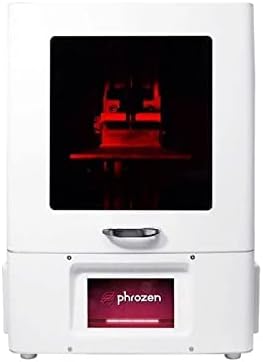
Phrozen Sonic XL 4K
| Technology | LCD (MSLA) |
|---|---|
| Build volume | 190 x 120 x 200 mm |
| LCD curing screen | Monochrome 8.9 inch 4K (3840 x 2160) |
| XY-resolution | 50 microns |
| Connectivity | USB, Ethernet, microSD, WiFi |
The Phrozen Sonic XL 4K is a speed-focused large-format resin printer aimed at users who need high-detail output and the capacity to run batches. It uses an 8.9-inch monochrome 4K LCD with ParaLED 3.0 for even illumination and 50 micron XY accuracy, and supports layer heights down to 10 microns for finely detailed parts. The 190 x 120 x 200 mm build area lets you print multiple miniatures or medium-size parts in a single run while the quoted 90 mm/hour Z travel keeps cycle times short. The machine is built with a durable monochrome screen (estimated 2000 hours) and a fan-based cooling system, and it offers WiFi, Ethernet, USB and microSD connectivity plus full ChiTuBox integration for straightforward slicing. Material support covers 405 nm resins including third-party formulas and Phrozen provides profiles, documentation and US-based support. Expect manual assisted bed leveling and a relatively heavy, sturdy chassis that suits a workshop rather than a travel setup, and note that setup still requires post-processing workflow for resin prints.
Best for: Buyers who prioritize high-detail output and fast throughput for batch runs or medium-format projects and want a robust desktop resin printer backed by slicer support and vendor resources.
Less Ideal for: Casual users who need a compact, lightweight hobby printer or those seeking a plug-and-play machine with fully automated leveling and minimal setup.
- Large 190 x 120 x 200 mm build volume suitable for batch printing or medium parts
- High-resolution 8.9-inch monochrome 4K LCD with 50 micron XY accuracy and 10 micron minimum layer height
- Fast printing speed up to 90 mm per hour reduces turnaround for multiple parts
- Multiple connectivity options (WiFi, Ethernet, USB, microSD) and full ChiTuBox support
- Durable monochrome screen with improved lifespan and ParaLED 3.0 for even light distribution
- Manual assisted bed leveling requires user attention during setup
- Heavy and bulky chassis makes it less convenient for small benchtops or frequent moves
Verdict: Choose the Sonic XL 4K when you need large-format resin printing with high 4K detail and fast throughput for professional-grade batch work.
Creality Halot-X1 Combo

| Display | 10.1" 16K mono LCD (15120×6230) |
|---|---|
| Pixel size | 14×19 μm |
| Max print speed | 170 mm/h |
| Build volume | 211.68 × 118.37 × 200 mm |
The Halot-X1 Combo is a large-format resin printer aimed at users who need high detail and faster throughput. It uses a 10.1" 16K monochrome LCD (14×19 μm) and a movable optical/resin vat system while keeping the build plate fixed, which simplifies setup by eliminating manual leveling and improves stability during long prints. Creality rates print speeds up to 170 mm/h and offers a 211.68 × 118.37 × 200 mm build volume that suits larger miniatures, small assemblies, and functional prototypes. The Intelligent AFU resin management heats and monitors resin, supports 1 kg bottles, recognizes RFID tags for automatic settings, and can recycle leftover resin which helps reduce failed prints and material waste. Exposure control uses 92 independent light zones to reduce overexposure and extend screen life, and the Z-axis design with dual lead screws promises consistent 0.01 mm positioning. Practical touches like a twist-to-release plate, quick-lock vat latch, and a top-mounted touchscreen make day-to-day use easier. Expect a machine optimized for throughput and reliability rather than the cheapest entry-level price, and plan for typical resin post-processing and ventilation needs.
Best for: Buyers who prioritize high-resolution large-format resin prints and consistent, production-friendly workflows and who want automated resin handling to reduce failed prints and setup time.
Less Ideal for: Hobbyists on a tight budget or those who only need occasional small prints and prefer a simpler, lower-cost desktop resin printer.
- Very high resolution 16K 10.1" mono LCD for fine detail
- Stationary build plate with dynamic optical vat eliminates manual leveling
- Intelligent AFU system heats, monitors, and feeds resin with RFID recognition
- 92-zone exposure reduces overexposure and helps extend LCD lifespan
- Dual lead screws and reinforced Z-axis provide stable 0.01 mm positioning
- Large footprint and heavier unit require dedicated workspace
- Higher complexity and features increase upfront cost compared with basic resin printers
Verdict: Choose the Halot-X1 Combo when you need large-format, ultra-high-resolution resin prints with automated resin management for reliable, production-style output.
ELEGOO Saturn 3

| LCD resolution | 11520×5120 |
|---|---|
| XY resolution | 19×24 μm |
| LCD size | 10" 12K mono LCD |
| Build volume | 218.88×122.88×250 mm³ |
| Printing speed | Up to 70 mm/h |
The ELEGOO Saturn 3 is a desktop MSLA resin printer built for high-detail, larger models thanks to its 10-inch 12K monochrome LCD (11520×5120) and a roomy build volume of 218.88×122.88×250 mm. It uses a COB Fresnel-collimated 405 nm light source for uniform exposure and a laser-carved build plate for strong first-layer adhesion, which together improve print consistency and success rate. Voxeldance Tango software offers static and dynamic printing modes, including a high-speed option, and the open GOO file format lets you use third-party slicers like ChiTuBox and Lychee. Practical benefits include the ability to print finely detailed parts with an XY resolution around 19×24 microns and the capacity to run batch or larger single prints without splitting models. Limitations to consider are the typical resin workflow overhead—post-processing, ventilation and consumable costs—and that this is an MSLA resin system which requires careful handling and workspace prep compared with FDM machines.
Best for: Buyers who want a cost-effective large-format resin printer that prioritizes print detail and the ability to produce bigger models without stepping up to industrial equipment.
Less Ideal for: Users seeking plug-and-play simplicity with minimal post-processing or those unwilling to manage resin safety, ventilation and the recurring cost of resin and parts.
- Very high XY resolution from a 10-inch 12K mono LCD for fine surface detail
- Generous build volume that supports larger single prints or small batch runs
- Uniform COB Fresnel-collimated light source for consistent layer curing
- Laser-carved build plate improves first-layer adhesion and print success
- Voxeldance Tango software with static and dynamic modes and open file format compatibility
- Resin printing requires post-processing, ventilation, and ongoing consumable costs
- Printing large high-resolution parts can still be time-consuming despite high detail
Verdict: If you need a budget-conscious large-format resin printer that delivers exceptional surface detail and the capacity for bigger prints, the Saturn 3 is a strong choice.
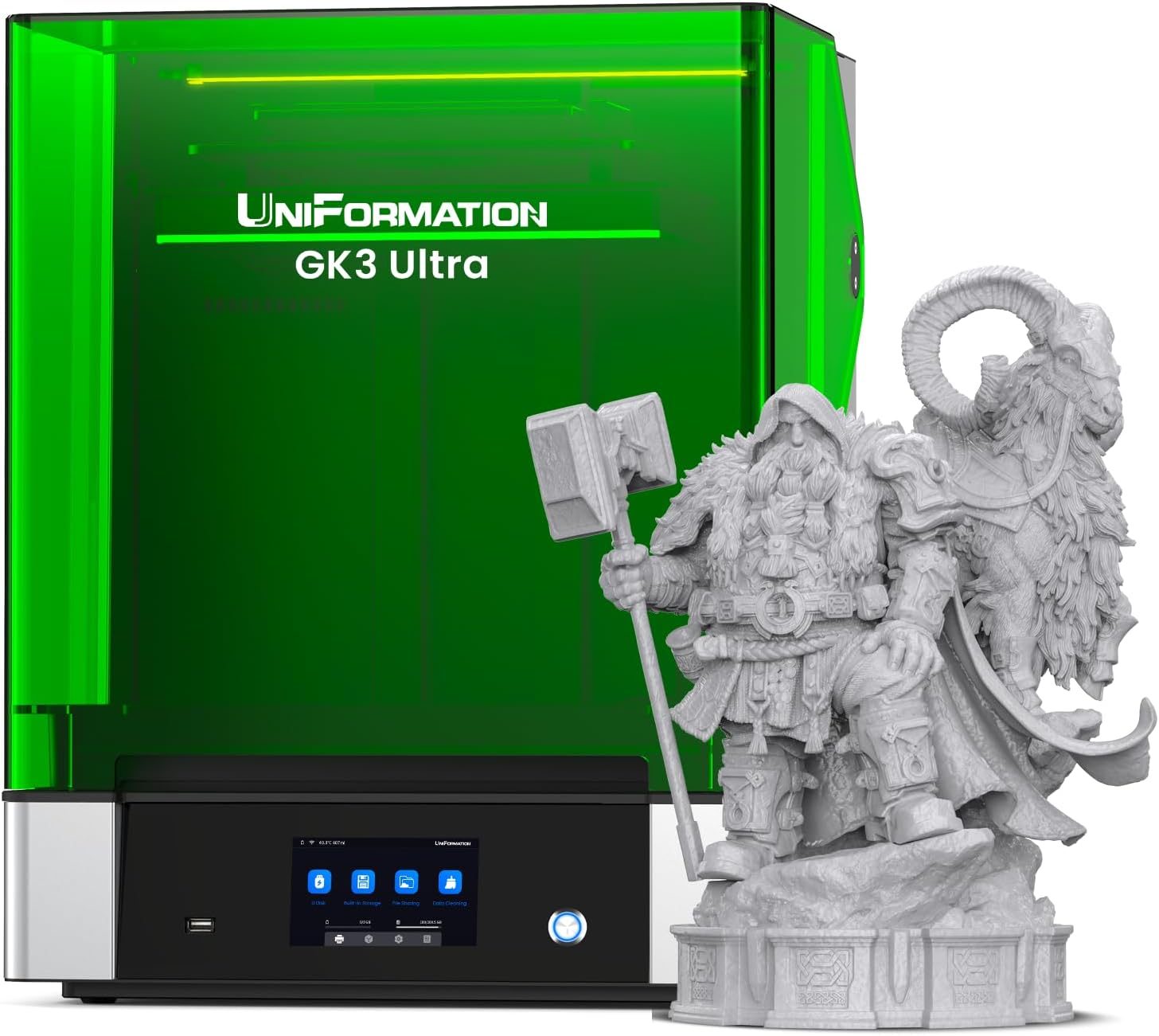
UniFormation GK3 Ultra 13.5" Resin 3D Printer
| Build volume | 300 × 160 × 300 mm |
|---|---|
| Screen resolution | 16K LCD (20–26 μm pixels) |
| Repeat accuracy | ±0.003 mm |
| Heating | Built-in resin heating to 25℃/30℃ |
| Filtration | Built-in activated carbon filter |
The UniFormation GK3 Ultra is a heavy-duty resin 3D printer built for large, high-detail prints and continuous use. It pairs a 16K LCD with 20–26 μm pixel size and a 300 × 160 × 300 mm build volume so you can print large models or multiple parts in one job while keeping fine surface detail. Mechanically the KK60 rigidity module and precise Z-axis drive aim to reduce visible layer lines and hold repeat positioning to about ±0.003 mm, which helps with consistent results across batches. Practical features for long prints include an automatic resin feed and quick-replace resin vat to minimize interruptions, a heater that brings resin to printing temperature in cold environments, and an internal activated carbon filter to reduce odors during long runs. The machine is sizable and weighty, so it suits a dedicated workspace and may require occasional maintenance like LCD or vat replacements over time. For studios and small manufacturers that need dependable large-format resin output, the GK3 Ultra emphasizes stability and workflow conveniences that reduce failed prints and downtime.
Best for: Buyers who prioritize dependable, repeatable large-format resin printing for studios, prototyping shops, or high-volume hobby setups and want features that minimize failed prints and downtime.
Less Ideal for: Casual hobbyists who need a compact, lightweight machine for occasional small prints or users who lack space and ventilation for a large resin printer.
- Large 300 × 160 × 300 mm build volume for big models or batch printing
- 16K LCD with 20–26 μm pixel size for high-resolution detail
- KK60 stiffness module and precise Z-axis for repeatable, low-layer-line prints
- Automatic resin feeding and quick-replace vat reduce interruptions during long prints
- Built-in heater and activated carbon filter support reliable printing in varied environments
- Physically large and heavy, requiring a dedicated, well-ventilated workspace
- Likely need for periodic parts replacement (LCD, vat) with extended heavy use
Verdict: Choose the GK3 Ultra when you need a stable, large-format resin printer designed to keep long, high-detail prints running reliably with minimal interruptions.
ANYCUBIC Photon Mono M7 Max

| LCD Type | 13.6'' Mono LCD |
|---|---|
| XY Resolution | 6480 x 3600 (7K) |
| Light Source | COB (LighTurbo 3.0) |
| Max Printing Speed | 60 mm/h |
The Photon Mono M7 Max is a large-format resin LCD printer built for printing bigger, detailed models without splitting parts. It uses a 13.6-inch 7K monochrome screen and a COB-based LighTurbo 3.0 illumination system to deliver high XY resolution and improved light uniformity across the large build area, which helps reduce banding and visible layer artifacts. Anycubic's Intelligent Release 2.0 adapts lift heights per layer to lower peel forces and boost first-time success for complex prints, while a top speed rating of 60 mm/h shortens long jobs. Practical resin-management additions include a temperature-controlled vat, auto-fill and one-key recycling, and a larger 1300 ml vat to handle big models. The flip-open cover and model-suspend feature make post-print resin drainage easier. Trade-offs are typical for large resin machines: it is bulky and heavy, requires careful ventilation and post-processing, and large-volume resin costs add up for frequent big prints. For buyers focused on large, high-detail prints the M7 Max balances precision and user-friendly features well.
Best for: Buyers who need a reliable large-format resin printer for detailed, single-piece models and who value features that increase success rate and simplify resin handling.
Less Ideal for: Those who lack dedicated bench space, have limited ventilation, or only print small, infrequent items should consider smaller printers or alternative technologies.
- Very large 13.6-inch 7K mono LCD for high-detail, large-format prints
- COB LighTurbo 3.0 with Fresnel lens and factory calibration for improved light uniformity
- Intelligent Release 2.0 reduces peel stress to improve print success on complex pieces
- Resin management features including temperature-controlled vat, auto-fill and one-key recycling
- Flip-open cover and model-suspend design simplify post-print resin handling
- Large footprint and weight make it less suitable for small workspaces
- Resin post-processing, ventilation, and consumable costs are higher for large-format printing
Verdict: Choose the Photon Mono M7 Max when you need a factory-calibrated, large-format resin printer that concentrates on uniform high-resolution prints and improved first-print reliability.
Choosing the Right Large-Format Resin 3D Printer: Key Factors to Consider
Build Volume and Usable Print Area
Bigger build volume is the defining feature of large-format resin printers, but usable area matters more than raw dimensions. Consider the maximum printable height plus the actual clearances around the vat and build plate that are available during printing and post-processing.
Large prints increase the chance of failed prints mid-job, so a wider margin for part orientation and support placement is valuable. Also check how easily the machine handles single large objects versus multiple parts packed together; some machines maintain consistent XY resolution only near the center of the exposure area.
XY Resolution and Optical System
Resin prints rely on the optical system to define XY detail. For large-format printers, the same pixel size across a much larger area can reduce apparent resolution unless the projector or LCD has sufficient native resolution.
Examine pixel pitch, projector type, or LCD resolution and whether the manufacturer provides specs for resolution uniformity across the full build plate. A machine with variable light intensity or inconsistent pixel mapping can produce uneven surface detail on large parts.
Z-Axis Mechanics and Tall-Print Stability
Tall resin prints place more stress on the Z-axis and linear guides. Look for robust lead screws, dual linear rails, or reinforced gantries that minimize wobble and layer shift on taller objects.
The machine should allow microstepping and fine layer height control while maintaining consistent peel forces during vat separation. Also consider vibration damping and how the chassis design reduces resonance that can affect long-duration prints.
Light Source Uniformity and Exposure Control
Uniform UV exposure is essential to cure resin consistently across a large area. Large-format systems must maintain even intensity to avoid sections of undercure or overcure, which show up as soft spots or brittle areas respectively.
Check whether the printer uses an array of LEDs with calibrated drivers, a high-quality projector, or an industrial-grade LCD and whether manufacturers publish intensity maps or calibration tools. Adjustable exposure profiles per-zone are a helpful feature for large builds.
Material Compatibility and Vat Management
Large-format printing consumes more resin and can heat the vat unevenly. Confirm the machine supports a broad range of resins and whether the vat design allows safe, clean pouring and easy replacement.
Vat size, drain and refill workflow, and whether the system supports heated vats or stirring options will affect both print quality and operational complexity. Consider how resin viscosity and cure behavior scale with larger exposure areas.
Post-Processing Workflow and Workspace Needs
Large resin parts demand more space and time for washing, curing, and handling. Think through the physical footprint of the printer plus the downstream equipment you will need to finish parts.
Heavier parts require stronger build-plate attachments and longer cure cycles. Also account for ventilation, solvent storage, and ergonomics when moving large prints from the vat to cleaning stations and curing ovens.
Preparing Your Shop for Large-Format Resin Printing
Large-format resin printing changes the requirements for workspace and handling. Allocate an area with spill containment for resin pours, a dedicated station for isopropyl or alternative cleaning solvents, and a separate, well-ventilated curing space to avoid fumes and ensure safety.
Plan for heavier build plates and larger cured parts by installing sturdy work surfaces and storage shelves sized for long cured pieces. Also ensure you have appropriate PPE, resin-compatible containers, and a safe procedure for waste disposal.
- Designate separate zones for printing, washing, and curing
- Install a stable workbench that supports lifted parts
- Provide local exhaust ventilation near cleaning and curing areas
Slicing and Orientation Strategies for Big Resin Parts
Orienting large resin parts is a balance between minimizing supports and reducing peel stress. Angling long or flat surfaces helps reduce suction forces and improves first-layer adhesion across the part's footprint.
Use slicing profiles designed for large plates that include gradual exposure ramps, adaptive layer heights, and tailored support densities. When possible, run small test prints of critical detail areas rather than full-scale trials to validate orientation and support settings.
- Use gentle initial exposure settings to improve first-layer adhesion
- Place heavy features near the build plate to lower leverage on the Z-axis
- Consider splitting highly detailed large models into bonded sections if necessary
Managing Resin Costs and Material Choice
Large-format prints use significantly more resin, so material selection impacts both results and operating cost. For functional parts choose resins rated for the intended mechanical properties such as toughness or heat resistance. For display pieces prioritize high-resolution, low-shrinkage resins.
Buy resin in larger containers where possible and plan batch printing to maximize vat usage. Be mindful that some specialty resins require different exposure profiles or longer post-cure cycles, which should be factored into throughput estimates.
- Estimate resin consumption before starting large jobs
- Keep a stock of standard and specialty resins for different use cases
- Track cured part weight and volume to refine future material estimates
Maintenance Routines That Keep Large Printers Reliable
Regular maintenance prevents mid-print failures on long jobs. Adopt a checklist that includes cleaning optics, inspecting lead screws and rails for wear, and verifying vat integrity before starting large builds.
Replace consumables—like FEP sheets, filters, and seals—on a predictable schedule rather than waiting for failure. Establish pre-print checks for bed level, Z-home repeatability, and a short calibration print to confirm consistent exposure and mechanical function.
- Wipe exposure windows and optical surfaces before each major print
- Check Z-axis backlash and re-tension linear guides monthly
- Document maintenance tasks and observations to spot recurring issues
Safety and Environmental Considerations
Working with large volumes of liquid resin and solvents increases exposure risks. Use nitrile gloves, eye protection, and respirators or ventilation when recommended. Ensure proper storage of uncured resin away from heat and UV sources.
Plan for solvent disposal and resin waste in accordance with local regulations. Larger workshops should consider spill trays and secondary containment under vats to reduce the impact of accidental leaks.
- Provide adequate PPE and a clearly labeled safety data sheet area
- Use spill containment under vats and during resin transfer
- Install ventilation or an air purifier rated for organic vapors where curing and washing occur
How We Chose the Best Large-Format Resin 3D Printer
We prioritized machines that are genuinely built to handle large resin parts rather than small desktop units with stretched bed dimensions. Key technical filters included consistent XY resolution across the full build area, UV light source uniformity for even cures, and a robust Z-axis that minimizes layer shift on tall prints. We also required a usable resin vat and build plate system sized for large objects, plus firmware or slicing profiles that support large-format workflows. Practical filters focused on reliability and maintenance: accessible optics and vat replacement, clear guidance for bed leveling on tall prints, and support for commonly used engineering resins. We excluded machines that rely on fragile, non-replaceable components or lack basic features for large builds, such as adequate cooling or reinforced lead screws. Our selection balances dimensional precision, sustained mechanical stability, and day-to-day usability for larger resin projects. Evaluation criteria emphasized measurable specs and user-impacting features: build volume, XY/Z accuracy and stability, light-source consistency, and serviceability for long prints. We also considered software and materials ecosystem support because large-format printing amplifies workflow friction when settings or resin choices are limited.
Our full evaluation process is outlined in our review methodology.
FAQ
How do large-format resin printers differ from desktop resin printers?
Large-format machines offer much bigger build volumes and usually stronger mechanical components to handle tall or wide parts. They require more careful consideration of vat management, light uniformity, and Z-axis stability than smaller desktop units.
Can I use the same resins from smaller printers in a large-format resin 3D printer?
Often the same resin chemistries are usable, but exposure settings and post-cure times will likely differ. Verify that the printer supports your preferred resin type and plan for calibration prints to dial in exposure across the full build area.
What common failure modes should I expect with big resin prints?
Tall or wide parts are more prone to layer separation, excessive peel forces, and uneven curing across the part. Failures often stem from insufficient supports, poor orientation, nonuniform light intensity, or mechanical backlash on the Z-axis.
How should I handle post-processing for very large resin parts?
Large parts need larger wash containers, stronger support removal tools, and longer, more even post-curing. Plan for gradual handling to avoid bending or stress while the part is still partially cured.
Is ventilation essential for a large-format resin printing workspace?
Yes. Larger vats and longer cure cycles increase VOCs and ozone potential during post-processing. Use local exhaust or well-rated air filtration and separate the curing area from general workspace when possible.
Final Verdict
When choosing a large-format resin 3D printer, prioritize a combination of reliable mechanical design and a proven optical system that delivers even exposure across the full build area. Balance the need for high XY detail with a robust Z-axis and easy serviceability to reduce downtime on long prints. Finally, plan your workspace, maintenance, and material logistics around the larger parts you intend to produce so you can achieve predictable, high-quality results.