
Note: This article contains affiliate links. If you click on these links and make a purchase, we may earn a small commission at no extra cost to you. This helps support our research and content. Read our full affiliate disclosure here.
Choosing the right line voltage thermostat matters when you rely on electric baseboard heaters, convectors, or in-wall radiant systems. The wrong thermostat can cause uneven heating, inefficient energy use, or installation headaches. This guide presents seven shortlisted line voltage thermostats that suit a range of wiring setups and control needs. We evaluated each pick for electrical compatibility, control accuracy, and ease of installation so you can match a thermostat to your system and DIY comfort level. Read on for the top options and the criteria used to compare them.
Top Picks at a Glance
| Best Overall The best all-around choice for most situations | Mysa Smart Thermostat LITE |  |
| Best Quality Built to a higher standard if you want something more solid | Mysa Smart Thermostat V2 |  |
| Best Value The sweet spot between price and what you get | Cadet Double Pole Wall Thermostat T522-W |  |
| Best Budget The cheapest option that still gets the job done reliably | Wengart 120V Line Voltage Thermostat |  |
| Top Rated A top-rated pick with lots of positive feedback | Honeywell TL7235A1003 Line Volt Thermostat |  |
| Most Popular A crowd favorite that many people choose with confidence | Honeywell TH1100DV1000 Thermostat |  |
| Best Seller A high-volume bestseller chosen again and again | Makevivi Attic Fan Thermostat |  |
Mysa Smart Thermostat LITE
| Connectivity Technology | Bluetooth, Wi‑Fi |
|---|---|
| Control Method | App, Touch, Voice |
| Voltage | 240 volts_of_alternating_current |
| Wattage | 3800 watts |
| 7 Day Scheduling | Yes |
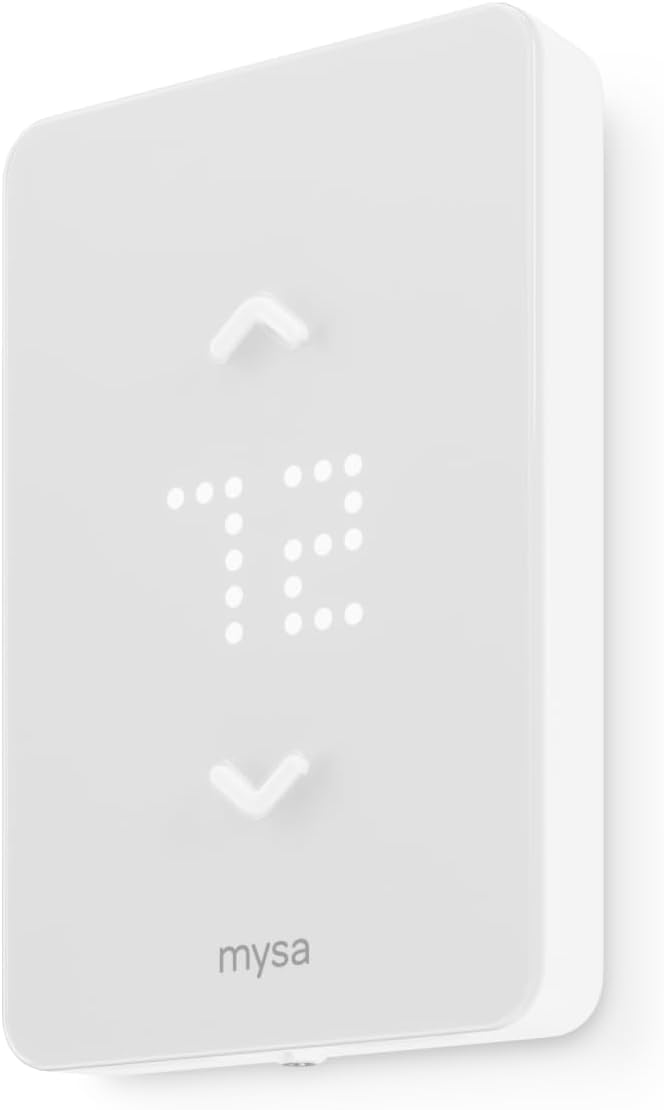
The Mysa Smart Thermostat LITE brings modern smart‑home control to line‑voltage electric heating systems by replacing traditional baseboard or convector thermostats with a Wi‑Fi connected wall unit. It is typically used to set 7‑day schedules, enable geofencing and vacation modes, or adjust temperature remotely from the Mysa app, and it also supports voice control via HomeKit, Alexa, and Google. Notable features include app-based auto‑scheduling, monthly runtime energy reports, a simple LCD touch interface, and compatibility across 120V to 240V single‑ and double‑pole setups. For buyers that want lower electric heating bills, per‑room scheduling and runtime tracking make it straightforward to reduce wasted run time. Installation is aimed at DIYers and the app provides step‑by‑step guidance, though it requires checking existing wiring since it needs four wires (neutral or second live). The unit focuses on heating control only and is built without subscription fees, but anyone without compatible wiring or who expects a combined heat/cool thermostat should look elsewhere.
Best for: Buyers who want a reliable, energy‑focused upgrade for individual electric baseboard or wall heaters and value app scheduling, remote access, and smart‑assistant control.
Less Ideal for: Homes without the required wiring or owners who need a single thermostat to control both heating and cooling across central HVAC systems.
- Works with 120V–240V line‑voltage baseboard and fan‑forced heaters for broad compatibility with electric heating.
- Wi‑Fi native connection and app control with HomeKit, Alexa, and Google integration for remote and voice control.
- 7‑day scheduling, geofencing, and auto‑scheduling help reduce runtime and lower electric heating costs.
- Monthly runtime and detailed energy reports let you monitor per‑room usage to tune schedules.
- App provides guided installation and the product includes wire nuts to simplify DIY setup.
- Requires four‑wire connection (neutral or second live) which some older baseboard circuits may not have.
- Controls heating only, so it does not replace combined HVAC heat/cool thermostats.
- LCD touch interface is basic compared with full‑color smart thermostats.
Verdict: Choose the Mysa LITE when you want a simple, app‑driven line‑voltage thermostat that saves on electric heating with per‑room schedules and smart‑assistant control.
Mysa Smart Thermostat V2

| Voltage | 240 volts |
|---|---|
| Wattage | 3800 watts |
| Connectivity Technology | WiFi, NFC |
| Display Type | LED |
| Screen Size | 3.5 inches |
The Mysa Smart Thermostat V2 replaces traditional line-voltage controls with a Wi‑Fi connected, app-driven thermostat built specifically for electric baseboard, convector, and fan-forced heaters. It installs as a wall-mounted controller on 120–240V systems that provide a neutral or second live conductor, and supports up to 1900W at 120V or 3800W at 240V. In daily use the touchscreen and Adaptive Display adjust brightness automatically and the mobile app provides scheduling, geofencing, energy insights, and remote control; it also works with HomeKit, Alexa, and Google Assistant for voice control. Practical benefits include quicker, more precise temperature scheduling compared with mechanical thermostats and monthly energy reporting to track usage. Important limitations are strict compatibility requirements — it will not work with two‑wire or low-voltage systems — and installation requires line-voltage wiring knowledge or a qualified electrician. For performance-minded users the improved control and integrations deliver measurable comfort and potential energy savings, but verify wiring and load compatibility before buying.
Best for: Buyers who prioritize precise temperature control, smart-home integration, and energy tracking for electric baseboard or fan-forced heating systems.
Less Ideal for: People with older two‑wire baseboard systems, low-voltage HVAC setups, or homeowners unwilling to verify wiring or hire professional installation.
- Purpose-built for high-voltage electric baseboard and fan-forced heaters with explicit 120–240V support
- Wi‑Fi connectivity plus app control, scheduling, geofencing, and energy insights for finer temperature management
- Works with Apple HomeKit, Alexa, and Google Assistant for voice and smart-home automation
- Adaptive Display adjusts brightness and offers touch control for easier local interaction
- Supports up to 3800 watts at 240V, covering most single‑zone baseboard circuits
- Requires a neutral or second live wire and will not work with two‑wire or low-voltage systems
- Line-voltage installation may need an electrician if you are not comfortable with high-voltage wiring
Verdict: If you want high-performance, smart control of a compatible line-voltage baseboard or fan-forced heater, Mysa V2 delivers precise scheduling, integrations, and energy insights in a purpose-built package.
Cadet Double Pole Wall Thermostat T522-W

| Voltage | 240 volts |
|---|---|
| Wattage | 5280 watts |
| Controller Type | Mechanical knob |
| Mounting Type | Wall Mount |
| Wattage Rating at 120V | 2640 watts |
The Cadet T522-W is a no-frills double-pole line‑voltage thermostat that gives reliable manual control for 120, 208, and 240 volt electric baseboard and wall heaters. It uses a twist dial and bi‑metal sensing with a snap action switch to regulate temperature between about 40 and 80°F and maintains a relatively tight 3 to 6 degree comfort band. The double‑pole design switches both legs of the circuit for added safety and the unit is rated for 22 amps, supporting up to 5,280 watts at 240V or 2,640 watts at 120V. Installation is straightforward for someone comfortable with basic wiring thanks to color‑coded lead wires and standard wall box mounting, making it a practical replacement for aging line‑voltage controls. Because it is fully mechanical there is no programming, batteries, or Wi‑Fi, which keeps operation simple but means you lose scheduling and remote control features. The clean white plastic housing blends into most rooms and the positive off position is convenient for fully shutting a heater down.
Best for: Buyers who want a dependable, low‑maintenance replacement thermostat to restore reliable on/off and temperature control for a line‑voltage heater without paying for smart features.
Less Ideal for: If you need programmable schedules, remote/voice control, or fine digital adjustments, choose an electronic or smart thermostat instead.
- Double‑pole design switches both legs for safer operation
- Simple dial control with bi‑metal sensor gives consistent, maintenance‑free temperature regulation
- High capacity 22 amp rating handles most residential line‑voltage heaters
- Color-coded lead wires and standard wall‑box fit make replacement installation straightforward
- Nonprogrammable mechanical control offers no scheduling or remote access
- No electronic display or advanced temperature features such as setback or learning
Verdict: A straightforward, safety‑minded mechanical replacement that reliably controls line‑voltage heaters without the complexity of electronics.
Wengart 120V Line Voltage Thermostat

| Voltage | 120V |
|---|---|
| Current rating | 16A |
| Power capacity | 1920W @ 120V |
| Floor sensor length | 10 ft (3 m) |
This Wengart line voltage thermostat is a straightforward manual controller for 120V electric heating systems such as radiant floor heat, baseboards, and heating cables. It provides dual sensing with a built-in air sensor plus a 10 foot external floor probe so you can control either room temperature or floor temperature to protect sensitive floor coverings. Operation is intentionally basic: a rotary dial for setpoint adjustment and an on/off switch with an LED heat indicator, which keeps installation and daily use simple for people who do not want or need programmable schedules or smart features. The unit is rated 16A (1920W at 120V) and the internal relays are designed for continuous loads at that rating, while the flame-retardant housing fits standard electrical boxes for tidy wiring. Expect no remote access, scheduling, or low-voltage HVAC compatibility, but as a low-cost, dependable manual controller it is well suited for straightforward line-voltage heating circuits.
Best for: Buyers who want an affordable, no-frills thermostat to control a single 120V electric heating circuit and prefer simple manual operation over programmable or smart features.
Less Ideal for: People who need scheduling, remote access, or integration with low-voltage HVAC systems should look for programmable or smart thermostat alternatives.
- Supports 120V line-voltage systems with a 16A (1920W) rating for common electric heaters
- Includes a 10 ft external floor probe plus built-in air sensor for flexible temperature control
- Simple manual dial and on/off switch make it easy to use and install
- Compact flame-retardant housing fits standard electrical boxes and includes an LED activity indicator
- Non-programmable with no Wi-Fi or remote control capabilities
- Not compatible with 24V low-voltage HVAC systems
Verdict: A budget-friendly, dependable manual thermostat for controlling a single 120V electric floor or baseboard heating circuit without programmable or smart features.
Honeywell TL7235A1003 Line Volt Thermostat

| Power Source | Hardwired |
|---|---|
| Connectivity Protocol | Wi-Fi |
| Control Type | Button Control |
| Wattage | 3600 watts |
The Honeywell TL7235A1003 is a straightforward line-voltage digital thermostat for controlling 240 VAC heating circuits. It uses a thermistor sensor and a digital display to set and maintain temperatures between 40 and 86 F with 1 F sensitivity, and it supports auto changeover and hardwired power. Typical use is wall-mounted control of baseboard or other line-voltage electric heat where simple manual set-and-hold temperature control is preferred over scheduling. Notable features include an easy-to-read LCD with on-demand backlight, soundproof operation to reduce clicking, and a heating indicator that shows when the system is active. The unit is UL and CSA recognized and is rated for a full load of 15 A at 240 VAC, which covers many residential electric heating circuits. Limitations are its non-programmable nature for users who want schedules, and the product is primarily single-stage heating control without advanced smart-thermostat energy management beyond basic app connectivity notes in the listing.
Best for: Buyers who prioritize a dependable, no-frills thermostat to reliably control electric baseboard or line-voltage heating where precise manual temperature control and quiet operation matter.
Less Ideal for: Users who want programmable schedules, multi-stage HVAC control, or advanced energy-saving automation should consider programmable or smart thermostats instead.
- Hardwired line-voltage design compatible with 240 VAC heating circuits
- Digital thermistor sensor with 1 F temperature sensitivity for precise setpoints
- On-demand backlight and heating indicator for clear status at a glance
- Soundproof operation reduces relay clicking common in line-voltage controls
- UL and CSA recognized for factory-quality safety compliance
- Non-programmable so it cannot run daily schedules or setback programs
- Single-stage switch type limits use with multistage or complex HVAC systems
Verdict: Choose this Honeywell thermostat when you need a simple, reliable hardwired line-voltage controller that provides precise manual temperature control and quiet operation.
Honeywell TH1100DV1000 Thermostat

| Power Source | Battery Powered |
|---|---|
| Voltage | 230 volts |
| Display Type | Digital |
| Controller Type | Push Button |
| Specific Uses For Product | Electric Baseboard Heater |
The Honeywell TH1100DV1000 is a simple, heat‑only line‑voltage thermostat for electric baseboard systems that gives direct temperature control without programming. It mounts on the wall, runs on two AAA batteries, and shows the ambient temperature continuously on a backlit 1.5‑inch digital display with push‑button setpoint control and one‑touch access to the set temperature. Useful protections like built‑in compressor protection and a wide adjustable temperature scale (40 to 90°F) make it straightforward to use in homes that need reliable, manual heating control. Connectivity notes list BACnet MS/TP and Wi‑Fi in the specs, but the interface is intentionally basic rather than smart‑home focused, so expect no scheduling or advanced automation on the unit itself. Its plastic matte housing keeps it unobtrusive on a wall plate, and the button controls are easy to operate for guests or household members who prefer tactile controls. If you want a straightforward, dependable line‑voltage thermostat without programming bells and whistles, this model covers the essentials cleanly.
Best for: Buyers who prioritize a proven, easy‑to‑use line‑voltage thermostat with a clear display and straightforward manual control backed by many positive user experiences.
Less Ideal for: People who want programmable schedules, app‑based control, or advanced smart‑home integrations should consider a programmable or smart line‑voltage option instead.
- Simple digital display that always shows ambient temperature for easy monitoring
- Backlit screen and one‑touch setpoint make adjustments quick and visible in low light
- Battery powered installation avoids wiring to low‑voltage transformers
- Designed specifically for electric baseboard heat, matching common line‑voltage systems
- Push‑button controls are intuitive for users who prefer a nonprogrammable thermostat
- Nonprogrammable so it lacks scheduling and advanced energy‑saving automation
- Limited feature set compared with full smart thermostats that offer app control
Verdict: Choose this Honeywell if you want a reliable, no‑frills 230V thermostat that makes manual temperature control simple and visible.
Makevivi Attic Fan Thermostat
| Voltage | 120 volts |
|---|---|
| Wattage | 1600 watts |
| Temperature Range | 60°F – 120°F |
| Temperature Accuracy | ±1.8°F |
| Power Source | Corded Electric |
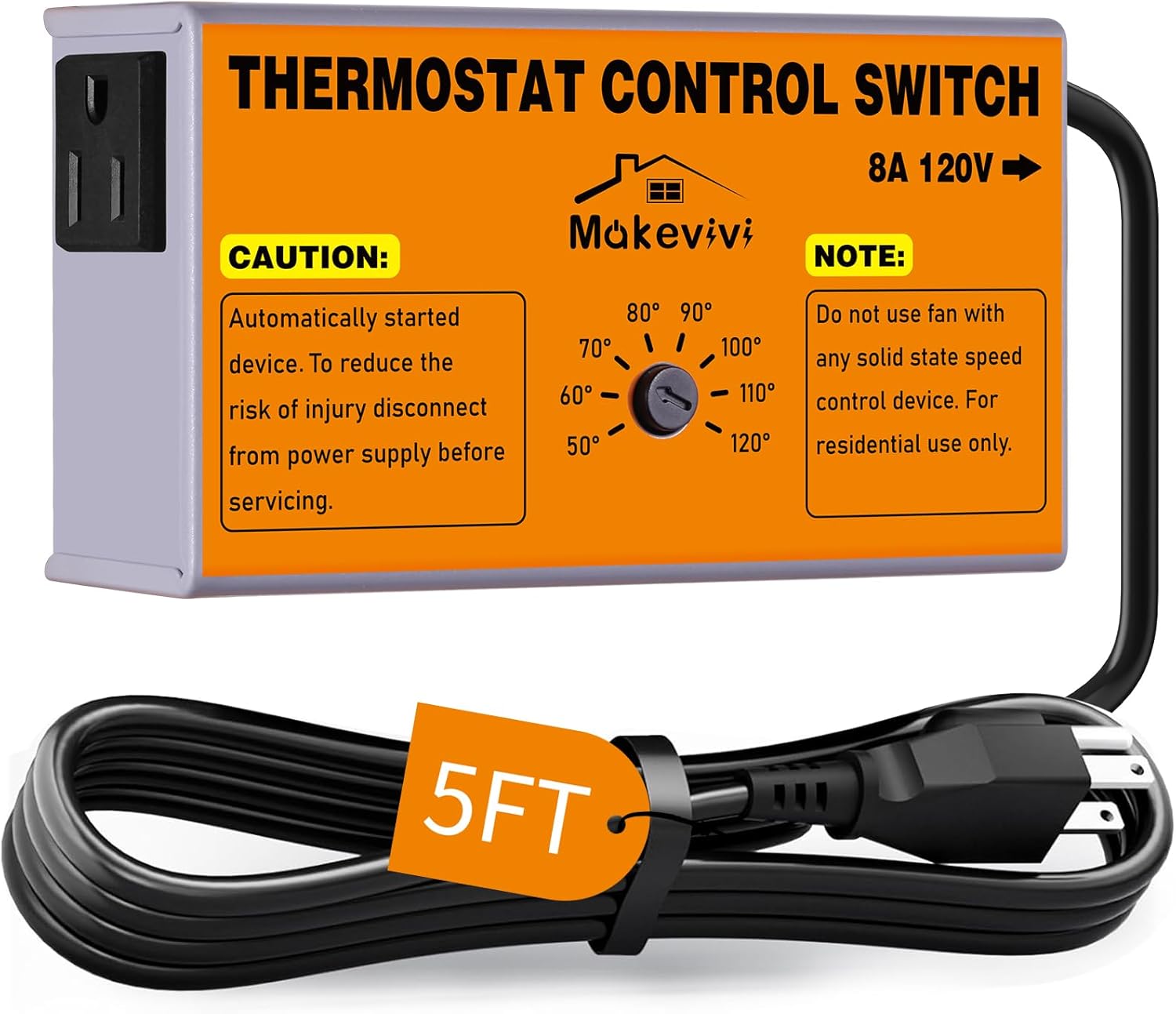
This Makevivi attic fan thermostat is a simple plug-and-play controller for line-voltage exhaust fans that aims to replace hardwired thermostats. You install it by plugging the fan into the thermostat socket and the thermostat into a 120V outlet, then set the target temperature using push-button controls. Notable features include a precision circuit-board temperature sensor rated to ±1.8°F, overload protection for up to 1600 watts, and a UL-listed power cord for safer operation. In practice the accurate sensor helps avoid the short cycling or long-run problems common with coarse bimetal controllers, and the external socket design makes it quick to install or move between locations. The aluminum/alloy casing and built-in overload protector add durability and electrical safety, but the unit is intended for straightforward on/off control rather than advanced scheduling or remote monitoring. If you need a hardwired thermostat or networked smart control, this model will be too basic, but for reliable, low-effort automatic fan control it is a practical choice.
Best for: Buyers who prioritize a safe, easy-to-install, and accurate automatic controller for an attic or exhaust fan and prefer a low-risk, ready-to-use solution over DIY wiring or smart integrations.
Less Ideal for: Users who need programmable schedules, remote/smart-home control, or a hardwired in-wall thermostat should consider more feature-rich or permanently mounted alternatives.
- Plug-and-play socket design requires no wiring and is quick to install
- Precision circuit-board temperature sensor with ±1.8°F accuracy
- Built-in overload protection and UL-certified power cord for safer operation
- Supports up to 1600W load capacity suitable for most line-voltage attic fans
- Provides simple on/off temperature control only and lacks scheduling or remote access
- Not designed for permanent hardwired installations where a wall-mounted thermostat is required
Verdict: A safe, plug-and-play line-voltage thermostat that delivers accurate automatic fan control without wiring or complicated setup.
Choosing the Right Line Voltage Thermostat: Key Factors to Consider
Voltage and Ampacity
Line voltage thermostats must match the supply voltage and the load current of the heater circuit. Choosing a thermostat rated for the correct voltage range prevents overheating of the control and reduces fire risk. Ampacity ratings matter because electric baseboard and wall-resistance heaters can draw significant current; a thermostat must handle steady-state current as well as inrush when multiple heating elements come online.
Confirming voltage and amp ratings ensures electrical compatibility and long-term reliability. If a thermostat is undersized, it may cause nuisance failures or repeatedly trip protective devices. Conversely, choosing an over-rated control provides headroom and typically improves longevity but may require larger enclosures and slightly more complex wiring.
Control Type and Accuracy
Different line voltage thermostats use different control strategies, from simple mechanical bimetal switches to solid-state proportional control or electronic digital setpoints. Control accuracy affects comfort and energy use: tighter control reduces temperature swings and avoids overshoot, which can save energy over time in well-insulated spaces.
Consider whether you need fine granularity in setpoint adjustments, programmable schedules, or adaptive control behavior. In rooms where precise comfort matters, a thermostat with better temperature sensing and smaller differential will perform noticeably better than a basic on/off mechanical control.
Wiring and Installation Ease
Installation complexity varies widely by thermostat type. Some units are drop-in replacements for existing wall boxes with the same terminals, while others require junction boxes or inline installation. Clear terminal labeling, accessible wiring compartments, and compatibility with common wiring configurations simplify installation and reduce electrician time.
If you plan DIY installation, prioritize thermostats with concise wiring diagrams and clear documentation. For multi-zone setups or unconventional wiring, select controls that support multiple pole switching or separate circuits without extensive rewiring.
Mounting and Form Factor
The physical size and mounting style of a line voltage thermostat affects where it can be installed. Slim, wall-mounted devices fit into standard electrical boxes and keep the installation discreet. Larger units intended for surface or junction-box mounting may be necessary when higher ampacity switching components need more clearance or when solid-state heat sinks require extra ventilation.
Consider the intended location and whether the thermostat must match existing aesthetics or fit within confined spaces. Also factor in ventilation and clearance requirements if the device dissipates heat during operation.
Safety and Certification
Because line voltage thermostats switch mains power, safety features and certifications are critical. Look for devices with appropriate safety listings and built-in protections such as snubbers or zero-cross switching to limit arcing and extend relay life. Grounding provisions and secure terminal covers reduce the risk of accidental contact during installation or maintenance.
Certifications and third-party testing indicate that the thermostat meets electrical safety standards. Choosing compliant hardware reduces liability and aligns with building code expectations in many jurisdictions.
User Interface and Features
The user interface determines how easily you set temperatures, schedules, or modes. Simple mechanical knobs are intuitive and fail-safe, while digital displays offer precise setpoints and programmable schedules. Connectivity features such as basic remote sensing or thermostat-level schedules can improve comfort and efficiency but may add installation or setup complexity.
Decide which features you will actually use. Extra capabilities are valuable only if they match your control habits and justify any additional setup or wiring requirements.
Types of Line Voltage Controls
Line voltage thermostats range from basic mechanical dial units to advanced electronic controls. Mechanical bimetal thermostats are simple and easy to use but have wider temperature differentials. Electronic models typically offer tighter control, digital setpoints, and sometimes programmability.
Solid-state controllers and thermostats with proportional control reduce relay wear and smooth out on/off cycles, which can be beneficial for maintaining steady temperatures with electric resistance heating.
- Mechanical (bimetal) thermostats: simple, reliable, wider swing
- Electronic digital thermostats: precise setpoints, smaller differential
- Solid-state control: reduced arcing, longer switching life
Wiring Configurations You Should Know
Common installations include single-pole switching for a single heater, double-pole switching for 240V circuits, and multi-wire setups for stacked or tandem heaters. Identifying whether your circuit is 120V or 240V is the first step before selecting a compatible thermostat.
When replacing an existing control, inspect the existing wiring and note the number of conductors and whether a neutral or ground is present. This determines whether a direct swap is possible or if additional wiring or a junction box is required.
- Single-pole vs double-pole: match the thermostat to the circuit type
- Number of conductors: affects whether you can reuse the existing box
- Label and photograph connections before disconnecting power
Installation Best Practices
Always turn off power at the breaker before touching line-voltage wiring. Use a voltage tester to confirm the circuit is de-energized. Follow local electrical codes when mounting devices and making connections.
Route wiring neatly, use appropriate wire nuts or terminal blocks rated for the circuit, and ensure strain relief where cables enter enclosures. If you're unsure about a 240V installation or multi-wire branch circuit, hire a qualified electrician.
- Confirm power is off with a voltage tester
- Use properly rated connectors and enclosures
- Follow local code and inspection requirements
When to Upgrade to Electronic Controls
Upgrade to an electronic thermostat when you need tighter temperature control, programmable schedules, or better compatibility with sensors. Electronic controls can reduce temperature swing and improve comfort in frequently used rooms.
Retrofitting electronic controls is particularly worthwhile in living spaces or bedrooms where precise comfort and energy savings matter. For simple utility rooms or garages, a basic mechanical control may be sufficient.
- Electronic controls for living areas and bedrooms
- Mechanical controls may suffice for infrequently used spaces
- Consider sensor placement when adding remote or multi-sensor features
Common Troubleshooting Tips
If a heater does not respond after installation, first verify the thermostat is wired correctly and the breaker is on. Check that the thermostat's ampacity rating meets or exceeds the heater load.
Intermittent operation can indicate loose connections, an undersized control, or a faulty internal switch. For frequent cycling or large temperature swings, review sensor placement and thermostat differential settings.
- Verify wiring and breaker before assuming a device is faulty
- Check terminal tightness and appropriate amp rating
- Adjust sensor placement if ambient readings differ from the heated space
How We Chose the Best Line Voltage Thermostat
We focused on attributes that matter most when replacing or upgrading line voltage controls for electric heating. First, electrical compatibility was a primary filter: only thermostats that support common line-voltage configurations and typical residential voltages were considered. Second, control precision and algorithm quality were evaluated, favoring devices that offer repeatable temperature regulation and clear setpoint behavior. Third, installation and wiring flexibility were important; we prioritized thermostats with labeling, multiple wiring options, or configurations that simplify retrofit work. Fourth, durability and component quality were included by assessing enclosure build, rated switching cycles, and the presence of features that reduce relay wear. Fifth, safety features and certifications were considered to ensure safe integration with high-current heater circuits. We excluded low-quality controls lacking clear voltage or ampacity specs, devices intended only for low-voltage HVAC systems, and units without adequate user documentation. Final selections balance compatibility, control accuracy, installation practicality, long-term reliability, and basic safety features to reflect what homeowners and installers actually need.
Our full evaluation process is outlined in our review methodology.
FAQ
Can I replace a low-voltage thermostat with a line voltage thermostat?
No. Low-voltage thermostats control a separate transformer and relay system and are not designed to switch mains voltage directly. Replacing a low-voltage control with a line-voltage thermostat requires reconfiguring the circuit and is best handled by a qualified electrician.
Do line voltage thermostats need a neutral wire?
Many line-voltage thermostats do not require a neutral because they switch the supply directly, but some electronic models with displays or Wi-Fi may need a neutral or a small auxiliary power source. Check the wiring requirements for the specific control before installation.
How do I know if I need single-pole or double-pole switching?
Single-pole switching is used for 120V circuits that break only the hot conductor. Double-pole switching is required for 240V circuits because both conductors must be disconnected for safe maintenance. Verify the circuit voltage and wiring before choosing a thermostat.
Will a more precise thermostat save energy on electric baseboard heating?
A thermostat with tighter control can reduce temperature overshoot and excessive cycling, which may yield modest energy savings in many homes. The amount saved depends on insulation, thermostat placement, and occupant behaviors.
What should I do if a thermostat feels warm to the touch?
Some warmth is normal for line-voltage controls that dissipate a small amount of heat, especially solid-state models. Excessive heat or burning odors indicates a problem such as overloading or poor ventilation and should be investigated immediately with power removed.
Final Verdict
Prioritize electrical compatibility, control accuracy, and installation practicality when choosing a line voltage thermostat. Match the thermostat s voltage and ampacity ratings to your heater circuit, select a control type that delivers the level of temperature precision you want, and factor in wiring and mounting constraints. Keep safety certifications and robust wiring practices at the top of the decision list. By focusing on these tradeoffs you can select a thermostat that delivers consistent comfort, reliable long-term operation, and safe integration with your electric heating system.