
Note: This article contains affiliate links. If you click on these links and make a purchase, we may earn a small commission at no extra cost to you. This helps support our research and content. Read our full affiliate disclosure here.
If you prepare charcuterie, deli-style sandwiches, or large roasts at home, a Manual Meat Slicer makes quick work of even cuts and consistent thickness. The right slicer reduces prep time, improves presentation, and helps you control portion sizes. This guide presents seven shortlisted manual meat slicers that balance blade performance, user safety, and maintainability. Below you will find the top picks selected for home kitchens, with evaluation focused on slicing precision, build quality, and how easy each unit is to clean and store. Use the quick criteria overview to match a slicer to your typical tasks and kitchen space.
Top Picks at a Glance
| Best Overall The best all-around choice for most situations | ONCE FOR ALL Fresh Meat Slicer |  |
| Best Quality Built to a higher standard if you want something more solid | Weston Manual Jerky Slicer |  |
| Best Value The sweet spot between price and what you get | Bwhhoxi Manual Frozen Meat Slicer |  |
| Best Budget The cheapest option that still gets the job done reliably | Jonscook Fresh Meat Slicer MS001 |  |
| Top Rated A top-rated pick with lots of positive feedback | Cawoods Biltong Slicer CW-002 |  |
| Most Popular A crowd favorite that many people choose with confidence | befen Manual Frozen Meat Slicer |  |
| Best Seller A high-volume bestseller chosen again and again | SupMaKin Fresh Meat Slicer MS01 |  |
ONCE FOR ALL Fresh Meat Slicer

| Material Type | Stainless Steel |
|---|---|
| Operation Mode | Manual |
| Blade Material Type | Stainless Steel |
| Included Components | 3 in 1 Rotatable Sticky Hook, Base with grip & Container, Cleaning Brush * 2, Knive sheath, Meat slicer knives set |
This manual meat slicer is built for quick home prep of fresh proteins like chicken, beef, pork, lamb and salmon. It uses stackable stainless steel blades so a single downward push can produce up to 18 thin slices in one stroke, and switching blade sets changes thickness between roughly 2 mm and 4 mm for hot pot, BBQ, or stir-fry. The slicer includes a suction-base container that holds the unit steady on smooth surfaces, a pusher and sheath for safer handling, and a hard-bristle brush for cleaning; most parts are removable and dishwasher-safe which eases cleanup. Blades are 420 stainless steel with an 8 degree edge and a small ring sharpener is included to maintain cutting performance. Expect a compact, manual tool that speeds portioning and gives consistent slice thickness without electricity, though it is meant for fresh not frozen meat and requires some force and careful handling around exposed blades. For home cooks who want neat, repeatable slices and simple maintenance, this is a practical, space-saving choice.
Best for: Home cooks who want a compact, no-power tool to quickly produce uniform thin slices of fresh meat for hot pot, BBQ, or everyday meals and who value easy cleaning and storage.
Less Ideal for: Anyone who needs to process frozen meat, very large commercial volumes, or who prefers electric slicers for hands-off operation should consider other options.
- Cuts fresh meat into many uniform slices in a single stroke using stackable blades
- Adjustable thickness with quick-change blade sets for 2 mm or 4 mm slices
- Removable, dishwasher-safe components and included cleaning brush simplify cleanup
- Suction-base container and pusher improve stability and safety during use
- Includes ring sharpener and sheath for blade care and safer storage
- Manual operation requires physical force and steady hands for best results
- Not designed for slicing frozen meat or very hard items
Verdict: A compact, dishwasher-safe manual slicer that delivers quick, repeatable thin slices of fresh meat for home cooks who want consistent results without electricity.
Weston Manual Jerky Slicer

| Number of blades | 32 stainless steel blades |
|---|---|
| Maximum cut width | 5" |
| Maximum cut thickness | 1.25" |
| Mounting | Built-in C-clamp for surfaces up to 2" thick |
The Weston Manual Jerky Slicer is a single-support, hand-cranked slicer built for processing large pieces of meat into uniform jerky strips. It mounts to a table or countertop with a built-in C-clamp and accepts cuts up to 5 inches wide and 1.25 inches thick, so you can feed whole roasts or game without precutting. Thirty-two stainless steel blades slice up to 15 quarter-inch strips at once, and included stainless steel combs and tongs help keep meat from wrapping or jamming during feeding. The cast aluminum body and stainless components make it durable for regular use, and the simple crank mechanism keeps operation mechanical and reliable without electricity. The main limitations are that it is a manual tool so large batches require elbow grease and it is single-support rather than a full stand, which can mean more vibration under heavy loads; additional accessories like the meat tenderizer blade are sold separately. For someone prioritizing slice consistency and throughput on large cuts, this is a robust, low-tech solution.
Best for: Buyers who want a high-throughput, mechanically simple slicer for turning whole roasts or large game cuts into consistent jerky without electricity, and who value durability and slice uniformity.
Less Ideal for: People who need a fully hands-off or motorized solution for continuous commercial production or those who prefer a freestanding, floor-mounted slicer for heavy industrial use.
- 32 stainless steel blades deliver consistent quarter-inch jerky strips
- Large chute handles whole cuts up to 5" wide and 1.25" thick, reducing prep work
- Built-in C-clamp secures the unit to tables and flat surfaces up to 2" thick
- Durable cast aluminum construction and stainless accessories resist wear
- Manual crank operation requires physical effort for large batches
- Single-support design can vibrate more than a floor-mounted stand
Verdict: Choose this Weston manual slicer if you need a durable, high-capacity hand-cranked tool that produces consistent quarter-inch jerky strips from large cuts of meat.
Bwhhoxi Manual Frozen Meat Slicer

| Material Type | Stainless Steel |
|---|---|
| Adjustable Thickness | 0.3–8 mm |
| Blade Length | 6.69 inches |
| Operation Mode | Manual |
This manual frozen meat slicer is a simple countertop tool for turning properly frozen blocks of beef, mutton, ham or firm vegetables into uniform thin slices for hot pot, BBQ or deli-style serving. It uses a 6.69-inch stainless steel rectangular blade and a hand-crank action with dual black knobs to set slice thickness from 0.3 to 8 mm, so you can dial in anything from wafer-thin shavings to thicker cuts. The unit is built from food-grade 304 stainless steel, includes a meat press and four suction feet for stability, and disassembles for hand-washing. Practical benefits are straightforward: it saves trips to the butcher, produces consistent home portions, and stores compactly thanks to a foldable design. Important limitations are that the slicer is designed for fully frozen, boneless pieces only, requires careful handling around a very sharp blade, and is not dishwasher safe despite some product text inconsistencies. Users should also expect a small learning curve to get uniformly sized blocks and steady hand operation for best results.
Best for: Buyers who want a low-cost, mechanical solution to make consistent frozen meat slices at home for hot pot, BBQ, or deli-style serving and who value durability and compact storage.
Less Ideal for: People who need to slice fresh or bone‑in meat, want an electric automated slicer, or prefer dishwasher-safe appliances for easy cleanup.
- Adjustable slice thickness from 0.3–8 mm for versatile cuts.
- Food‑grade 304 stainless steel construction for corrosion resistance and durability.
- Includes non-slip suction cups and a meat press for safer, more stable slicing.
- Detachable design that folds for compact storage and easier cleaning by hand.
- Only suitable for fully frozen, boneless foods and cannot handle bones or partially frozen/soft items.
- Hand‑operated design requires physical effort and steady technique for consistent slices.
- Not dishwasher safe despite mixed care instructions, so cleaning is manual.
Verdict: A durable, compact manual slicer that delivers consistent frozen‑meat slices at home for cooks who prioritize control and space-saving storage.
Jonscook Fresh Meat Slicer MS001

| Material Type | Stainless Steel |
|---|---|
| Included Components | Meat Slicer |
| BladeLength | 21 centimeters |
| Operation Mode | Manual |
| Additional Features | Adjustable Thickness |
This hand-operated meat slicer is a compact, budget-minded tool for turning fresh boneless cuts into consistently thin slices. It uses two interchangeable blade sets (2mm and 4mm) and a 17-blade holder that can produce up to 18 slices in a single pass, which speeds meal prep for sandwiches, stir-fries, and weekly portioning. The unit is mostly stainless steel with a detachable container and blade assembly that makes rinsing and brushing straightforward; a suction cup base helps keep it steady on smooth countertops. It is explicitly intended for fresh, fully thawed meat and will not handle bones, frozen or cooked meats, or very hard items. Cleaning guidance and a small sharpener are included, but the manufacturer cautions about dishwasher placement for some parts to avoid deformation. For simple home use where you want uniformly thin slices without an electric slicer, this delivers good value, though it requires the recommended push-pull sawing motion and some care to avoid the sharp blade.
Best for: Buyers on a tight budget who want a simple, non-electric way to make consistent thin slices from fresh boneless meat for meal prep and home cooking.
Less Ideal for: People who need to slice frozen, cooked, or bone-in meats or who prefer an effortless electric slicer for high-volume or commercial use.
- Produces many uniform slices at once with 17 blades and two thickness options (2mm and 4mm).
- Detachable blade sets and included cleaning brush make routine cleaning simpler than a fixed electric slicer.
- Suction-cup base improves stability on flat smooth countertops during manual slicing.
- Compact, stainless steel construction that stores easily and includes a small sharpener for blade maintenance.
- Not suitable for frozen, cooked, or bone-in meats and cannot cut very hard items.
- Requires manual push-pull sawing motion and some physical effort for larger pieces.
- Some parts may deform if washed incorrectly in a dishwasher, per manufacturer guidance.
Verdict: A low-cost manual solution that turns fresh boneless cuts into many uniform 2mm or 4mm slices quickly, making it a practical choice for budget-focused home meal prep.
Cawoods Biltong Slicer CW-002

| Material Type | Stainless Steel, Wood |
|---|---|
| Blade Material Type | Stainless Steel |
| Operation Mode | Manual |
| Additional Features | Adjustable, Easy Clean |
The Cawoods Biltong Slicer is a hand-operated slicer built for straightforward, repeatable slicing of dried meats, cheeses, and similar items. Its stainless steel V-shaped blade cuts cleanly and the manual adjustment lets you set slice thickness to your preference, while the wooden base with non-slip pads keeps the unit stable during use. The magnetic stainless steel catchment tray detaches and stores under the base for easier cleanup and handling. Because it is manual and designed for small-batch home use, it is quiet and requires no power, but it also means slicing large quantities will be slower and more labor intensive than a powered slicer. The unit is intended to be hand-washed, so thorough cleaning takes a bit more care than dishwasher-safe alternatives. Overall, this is a sturdy, no-frills slicer that emphasizes reliable, precise cuts for hobbyist biltong and jerky makers or anyone who wants consistent manual slicing without electricity.
Best for: Buyers who prioritize a reliable, well-built manual slicer for small-batch biltong, jerky, or cheese and value stable, repeatable cuts without relying on power.
Less Ideal for: People who routinely slice large volumes or want a dishwasher-safe, powered solution should consider an electric or dishwasher-compatible slicer instead.
- Sharp stainless steel V-shaped blade for clean, precise cuts
- Adjustable manual thickness control for custom slice sizes
- Weighted wooden base with non-slip pads for stable operation
- Detachable magnetic stainless steel tray that stores under the base for convenient cleanup
- Hand-wash only care required
- Manual operation is slower and more labor intensive for large batches
Verdict: A durable, manually adjusted slicer that delivers consistent, precise cuts for home biltong and jerky makers who want a dependable no-power tool.
befen Manual Frozen Meat Slicer

| Material Type | Stainless Steel |
|---|---|
| Blade Material Type | High Carbon Stainless Steel |
| BladeLength | 8 inches |
| Additional Features | Manual |
This manual befen frozen meat slicer is a simple stainless steel device for turning frozen chunks of beef, lamb, chicken or fish into uniform slices for hotpot, BBQ, sandwiches or jerky. You clamp the frozen block in the holder, use the hand-operated blade to slice and set thickness anywhere from 0.2 to 20 mm for very thin to thicker cuts. The unit is built from thicker 1.5 mm stainless steel and ships with an extra blade, suction cups, meat bags and an Allen key so it is ready to use out of the box. Its manual operation keeps things quieter and avoids motor maintenance, and the included accessories help with safe handling and consistent portioning. Limitations are that it only works well on properly frozen meat—soft or room-temperature cuts will tear—and manual slicing takes longer and more elbow grease than electric slicers. Expect to follow the instructions carefully for freezing and setup to get clean results.
Best for: Buyers who want a budget-friendly way to slice frozen meat at home and prefer a simple, durable manual tool backed by visible customer feedback.
Less Ideal for: People who need fast, high-volume slicing or who frequently slice thawed or room-temperature meats should consider electric slicers instead.
- Adjustable slice thickness from 0.2 to 20 mm for precise cuts
- Constructed from 1.5 mm stainless steel for greater durability
- Includes extra blade, suction cups, meat bags and Allen wrench for immediate use
- Manual operation is quiet and avoids electric motor maintenance
- Requires properly frozen meat to achieve clean slices
- Manual effort is more tiring and slower than electric slicers
Verdict: A sturdy, no-frills manual slicer that lets home cooks convert frozen roasts into thin, consistent slices without electricity.
SupMaKin Fresh Meat Slicer MS01
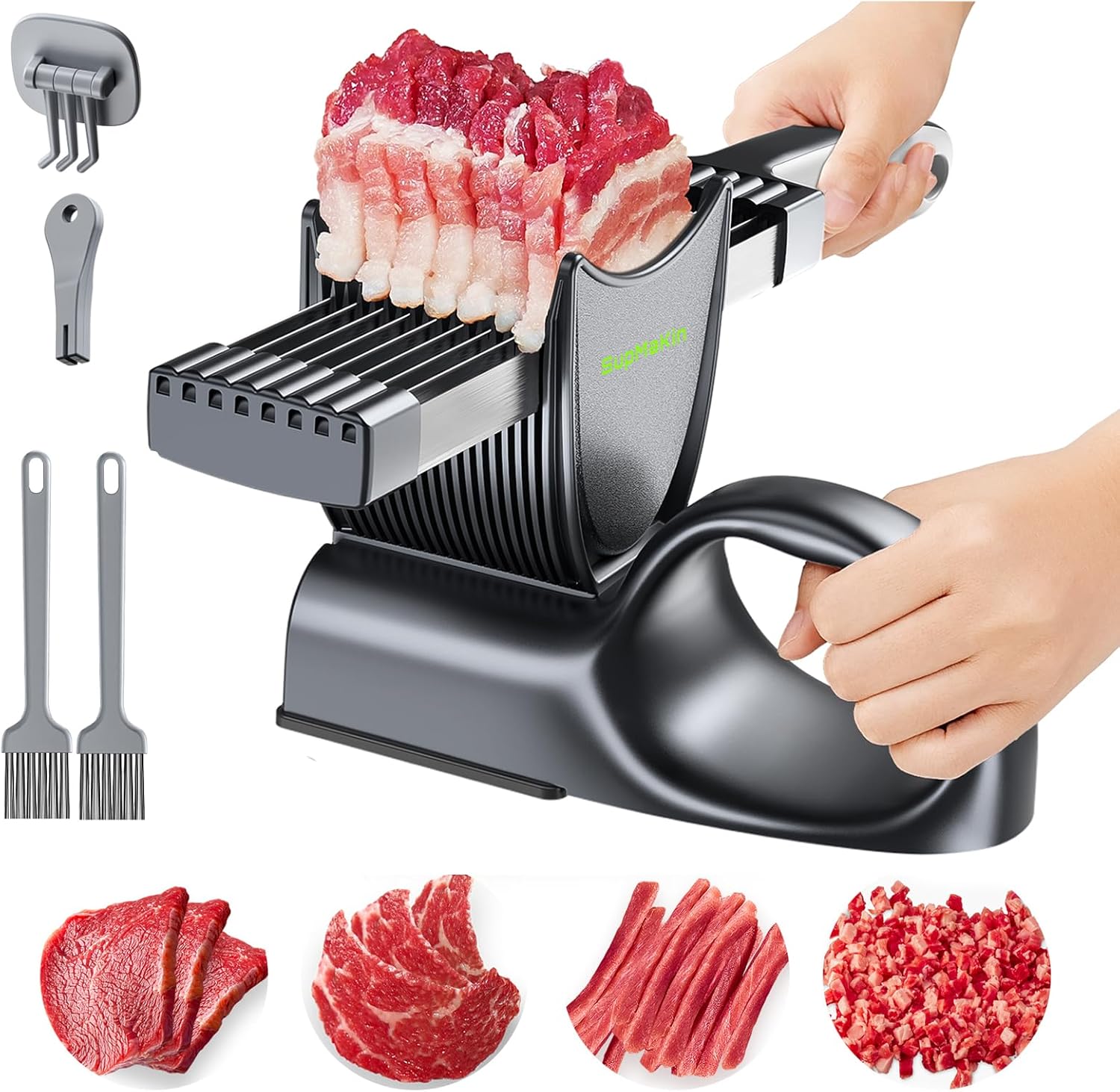
| Material Type | Stainless Steel |
|---|---|
| BladeLength | 8 inches |
| Operation Mode | Manual |
| Product Care Instructions | Hand Wash Only |
The SupMaKin Fresh Meat Slicer is a handheld manual slicer designed to cut fresh (not frozen or deli) meats into consistently thin slices using interchangeable blades and an 8-inch stainless steel cutting edge. You use it by placing a piece of meat against the blade and pulling the unit forward to slice; the product includes a suction cup base to steady the tool on smooth countertops and two blade sets that let you choose roughly 2 mm or 4 mm thicknesses. Its 17-blade set claim and compact container let you produce many uniform slices quickly for dishes like hot pot, jerky prep, or sashimi-style portions, and the stainless construction makes the cutting edge durable. Cleaning is hand-wash only but the package includes a brush and the unit stores compactly or can be wall-mounted. Limitations are that it is intended for fresh meat only, requires firm counter contact for the suction base to work, and small compact size means it is best for modest batches rather than large commercial volumes.
Best for: Buyers who prioritize safe, reliable home slicing and want a simple manual tool to make uniform fresh-meat slices for family meals, meal prep, or small-batch charcuterie.
Less Ideal for: Those who need high-volume commercial slicing, want to process frozen meats, or prefer an electric slicer that requires less manual effort.
- Adjustable thickness with two blade sets for roughly 2 mm or 4 mm slices
- Stainless steel blade and components for durability and sharp cutting edge
- Suction-cup SteadyGrip base helps stabilize the slicer on smooth countertops
- Includes a cleaning brush and compact storage or wall-mount option
- Not suitable for frozen or delicate deli meats
- Requires a smooth, flat surface for the suction base to hold reliably
- Hand wash only which may be inconvenient after heavier use
Verdict: A compact, durable manual slicer that delivers consistent thin slices of fresh meat for cautious home cooks who want predictable, factory-quality results without electricity.
Choosing the Right Manual Meat Slicer: Key Factors to Consider
Blade Type and Sharpness
The blade determines cutting quality and the types of food you can slice. Hard stainless-steel blades stay sharp longer and resist staining, which matters when you frequently slice cured meats, roasts, and cheeses. Thinner, well-honed blades produce cleaner cuts with less tearing, while serrated edges are useful for bread but can crush delicate deli slices.
Regular stropping or sharpening will be necessary depending on blade hardness and use frequency. Consider whether the blade is removable for sharpening or replacement, and whether the blade guard design allows safe access for maintenance.
Slice Thickness Adjustment
Precise thickness control affects presentation, cooking times, and portioning. A smooth, graduated knob or micrometer-style adjustment lets you dial in consistent thickness from paper-thin to thick-cut slices. Look for detents or clear measurement markings that help repeatability when switching between tasks.
If you plan to slice a variety of foods, from prosciutto-thin to thick sandwich cuts, choose a slicer with a broad adjustment range and minimal play in the carriage mechanism to avoid uneven slices.
Safety and User Controls
Manual slicers require safe design because your hands are near a sharp rotating blade. A good slicer includes a hand guard or push plate, a secure carriage clamp to hold food, and non-slip feet to prevent movement on counters. A quick and reliable blade cover or locking mechanism for storage reduces risk when not in use.
Evaluate how easy it is to operate the guard and carriage with one hand if you commonly prep alone. Simple, mechanical interlocks are preferable to complex assemblies that can be bypassed or that make cleaning difficult.
Ease of Cleaning and Maintenance
Sanitation is essential for any device that handles raw or cooked meats. Slicers with removable blades, detachable food carriages, and minimal crevices speed up cleaning and help prevent bacterial buildup. Parts that are dishwasher-safe or can be wiped down easily reduce the time you spend on upkeep.
Also check whether the design permits safe access to the blade for wiping and whether replacement parts like gaskets or clamps are standard sizes that can be serviced. Regular maintenance routines should be straightforward so the slicer stays hygienic and safe.
Construction, Weight, and Footprint
Material choices affect durability and stability. Cast aluminum and heavy-gauge steel bases reduce vibration for more consistent slices, while lighter materials improve portability and storage. Heavier units often hold steady better during slicing, which helps precision, but they require more permanent counter space.
Consider how much room you have in the kitchen, whether you will store the slicer on a shelf or keep it on the counter, and whether the unit's weight is manageable for setup and cleaning.
Accessories and Replacement Parts
Useful accessories include food clamps, removable trays, blade guards, and storage covers. These components make operation safer and cleanup easier. Availability of replacement blades, gaskets, and carriage parts matters over the long term because mechanical parts wear with use.
Verify that the manufacturer or supplier provides standard replacement parts and clear instructions for swapping components. Accessories that enhance safety or make the unit more versatile improve the overall ownership experience.
Slicing Techniques and Best Practices
Mastering a manual meat slicer requires attention to setup and technique. Start with a stable, clean work surface and secure the slicer's feet or clamp. Always use the push plate or food clamp to keep your fingers away from the blade and feed the food evenly to avoid jagged slices.
Let cooked meats rest and partially chill before slicing when possible. Slightly firm meat slices more uniformly than warm, soft cuts. For delicate items, reduce carriage speed and use a light, consistent pressure rather than pushing aggressively.
- Chill large roasts briefly for cleaner slicing.
- Use steady, even strokes rather than rapid sawing.
- Check blade angle and tension before each session.
Cleaning Routine That Keeps Food Safe
Establish a consistent cleaning routine after each use. Remove loose food debris, disassemble removable parts, and wipe or wash components according to the manufacturer's guidance. Pay special attention to the underside of the carriage and blade hub where residue can accumulate.
Sanitize surfaces that contact food with an appropriate food-safe cleaner and allow parts to dry fully before reassembly. For frequent use, schedule a deeper clean weekly that includes blade removal and inspection for dulling or corrosion.
- Wipe down non-removable parts first, then disassemble for a full clean.
- Avoid immersing motor housings in water; clean with a damp cloth.
- Inspect seals and gaskets for wear during cleaning.
Storing and Transporting a Manual Slicer
If you store your slicer between uses, lock the blade cover and secure the carriage. Keep removable parts together in a clearly labeled container so reassembly is quick. For units that will be moved, consider a padded cover or dedicated case to protect the blade and controls.
When transporting, always carry with the blade locked and the power disconnected if the model has an integrated motor. Use two hands for heavier units and place the slicer on a stable surface before unwrapping or prepping.
- Use the blade lock when storing to prevent accidental contact.
- Keep small parts and screws in a labeled pouch to avoid loss.
- Place a non-slip mat under the slicer on temporary surfaces.
Common Mistakes to Avoid
Avoid pushing food past capacity or forcing oversized items through the carriage. This can damage the carriage rails and produce uneven slices. Never bypass safety guards for faster operation; risks are not worth the marginal time saved.
Do not ignore blade maintenance. A dull blade requires more force, increases the chance of slips, and produces ragged slices. Addressing small issues such as loose fasteners or sticky slides early prevents larger repairs.
- Do not use a slicer with loose or missing guards.
- Avoid excessive pressure during slicing; let the blade do the work.
- Replace worn clamps or gaskets promptly to maintain food contact security.
Matching Slicer Features to Usage Frequency
If you slice occasionally for family meals, a compact, lightweight manual slicer that is easy to disassemble may be the best fit. For regular entertaining or batch meal prep, prioritize robust construction, larger blade diameters, and more secure carriage systems that handle larger volumes with less wear.
Consider whether you will primarily slice meats, cheeses, or bread. Models optimized for deli meats often include finer thickness control and larger blades for continuous slicing, while bread-friendly units emphasize serrated blades and detachable crumb trays.
- Light users benefit from compact, easy-clean designs.
- Frequent users should choose stable, heavy-duty construction.
- Match blade style to the most common foods you will slice.
How We Chose the Best Manual Meat Slicer
We focused on features that matter for home use and regular meal prep. Blade performance and adjustability were prioritized because consistent slice thickness and sharpness determine final results for meats, cheeses, and bread. Safety features such as finger guards, non-slip feet, and secure carriage locks were required to reduce the chance of accidents during repeated use. Ease of cleaning and parts accessibility were critical filters since manual slicers are used near food and need regular maintenance to avoid contamination. Construction and materials were evaluated to ensure durability and rust resistance for units used in home kitchens. Size, weight, and storage footprint were also considered to keep recommendations suitable for typical counters and cabinets. We excluded heavy industrial or commercial-only units and any models lacking basic safety guards or dishwasher-safe components. The final selections reflect a balance of slicing accuracy, user safety, maintainability, build quality, and appropriate home-sized footprints.
Our full evaluation process is outlined in our review methodology.
FAQ
How often should I sharpen a manual meat slicer blade?
It depends on frequency of use and the types of food. Home users who slice weekly may only need to sharpen every few months, while heavy users should check sharpness monthly. Inspect for tearing or inconsistent cuts, which indicate sharpening is needed.
Can I slice frozen meat on a manual slicer?
Partially frozen meat that is firm but not rock hard slices more cleanly than fully frozen pieces. Fully frozen meat can damage the blade and carriage, so avoid it. Thawing to a slightly firm state helps maintain blade life and slice quality.
Is it safe to put slicer parts in the dishwasher?
Some removable components are dishwasher-safe, but motor housings and permanently mounted parts must never be immersed. Follow the unit-specific cleaning instructions and hand-wash parts that could corrode or warp in high heat.
What size blade should I choose for home use?
For most home kitchens, blades between 7 and 10 inches cover a wide range of tasks, allowing you to slice large roasts and deli meats comfortably. Smaller blades are more compact for storage but limit maximum slice width.
How do I reduce slipping while slicing?
Ensure non-slip feet are clean and use a damp non-slip mat under the unit if necessary. Secure the food with the clamp or push plate and keep the carriage rails lubricated and free of debris to allow smooth, controlled motion.
Final Verdict
Choosing the right manual meat slicer is a balance between blade performance, safety, and how easy the unit is to clean and store. Prioritize sharp, durable blades and straightforward thickness controls if you want consistent, restaurant-style slices. If you plan to use the slicer frequently, favor sturdier construction and accessible replacement parts; occasional users will benefit from compact, easy-to-disassemble designs. Weigh the tradeoffs between size, stability, and maintenance needs to pick a slicer that fits your kitchen habits. Focus on safety features and cleaning accessibility to ensure long-term, hygienic performance.