
Note: This article contains affiliate links. If you click on these links and make a purchase, we may earn a small commission at no extra cost to you. This helps support our research and content. Read our full affiliate disclosure here.
If you regularly portion frozen roasts or prep large batches for meal prep, a dedicated meat slicer for frozen meat makes the job faster, safer, and more uniform. The right slicer handles dense, chilled product without bogging down or warming the meat, which preserves texture and reduces waste. This guide shortlists seven top choices suited to heavy-duty home use and details the features that matter for slicing frozen cuts. We evaluated models across blade strength, motor torque, cooling and duty-cycle considerations, and safety features. Read on for a clear explanation of what to look for and which features matter most when you need reliable frozen-meat performance.
Top Picks at a Glance
| Best Overall The best all-around choice for most situations | Borlebbi Meat Slicer SL-518M |  |
| Best Quality Built to a higher standard if you want something more solid | KWS MS-10XT Meat Slicer |  |
| Best Value The sweet spot between price and what you get | CUSIMAX Meat Slicer CNFS-2201 |  |
| Best Budget The cheapest option that still gets the job done reliably | SUPER DEAL Meat Slicer 7.5" |  |
| Top Rated A top-rated pick with lots of positive feedback | BESWOOD 10" Meat Slicer BESWOOD250 |  |
| Most Popular A crowd favorite that many people choose with confidence | OSTBA Meat Slicer SL-518 |  |
| Best Seller A high-volume bestseller chosen again and again | OSTBA Meat Slicer SL-518 |  |
Borlebbi Meat Slicer SL-518M

| Power | 200 watts |
|---|---|
| Voltage | 120 volts |
| Hertz | 50/60 Hz |
| Blade Diameter | 7.5 inch |
| Max Slice Thickness | 15 mm |
The Borlebbi SL-518M is a countertop electric slicer built for home use that handles deli meats, cheeses, bread, and firmer fruit and vegetables. Its 200W motor drives two removable 7.5" stainless steel blades so you can switch blades for different foods, and the thickness knob adjusts slices from very thin up to about 0.6 inch (15 mm). The food carriage, pusher and blade detach for cleaning, and the stainless steel tray catches slices for easy transfer. Safety features include a recessed on/off switch, a blade-guarding food pusher and four suction feet to keep the unit steady while slicing. Because it is compact and made from die-cast aluminum, it fits easily on counters and stores away in cabinets. Expect restaurant-style slices for thawed meats and firm deli items, but take care with very soft or partly frozen pieces where the blade can compress or tear the meat; using fully thawed meat and steady, even feed will yield the best results.
Best for: Buyers who want a compact, easy-to-clean slicer that delivers precise, restaurant-style slices for home meal prep and occasional entertaining.
Less Ideal for: Those who need high-capacity commercial slicing or frequent cutting of large, solidly frozen meat blocks should consider a heavier-duty model instead.
- Two removable 7.5" stainless steel blades for switching between foods
- Adjustable thickness control from paper-thin to 15 mm for precise slicing
- Detachable carriage, pusher and blade for easier cleaning
- Non-slip suction feet and recessed power switch improve stability and user safety
- 200W motor may struggle with very large or heavily frozen blocks of meat
Verdict: A compact, user-friendly home slicer that gives precise, adjustable slices and easy cleanup for balanced everyday use.
KWS MS-10XT Meat Slicer

| Blade length | 10 inches |
|---|---|
| Motor power | 320W |
| Adjustable thickness | Up to 14 mm |
| Operation mode | Semi Automatic |
| Material type | Stainless Steel |
The KWS MS-10XT is a heavy-duty countertop meat slicer designed for frequent use with fresh or semi-frozen meat, cheese, and bread. Its 320W high-torque motor and 10-inch stainless steel blade (Teflon coated) power through dense and partially frozen cuts without bogging down, while the adjustable thickness dial produces consistent slices from paper-thin to about 14 mm. Removable carriage, blade cover, and hand guard simplify cleaning after batches, and the built-in dual whetstone sharpener helps keep the blade performing between jobs. Cast aluminum construction and anti-slip feet reduce vibration for quieter operation, and the large food tray and spring-assisted carriage make it practical for bulk prep. It is semi-automatic and intended for serious home cooks, hunters, and small food businesses rather than casual users. The unit is sizable and requires hand washing for some parts, so countertop space and routine maintenance should be expected.
Best for: Buyers who need consistent, deli-style slices from fresh or partially frozen meat and prioritize motor power and build quality for frequent batch prep.
Less Ideal for: Casual users who only slice occasionally or those with very limited counter space should consider smaller, lower-capacity slicers instead.
- Powerful 320W motor suited for continuous slicing of meat and semi-frozen products
- 10-inch Teflon-coated stainless blade with built-in dual sharpener for long-lasting edge retention
- Adjustable thickness dial for precise, repeatable slice control up to 14 mm
- Removable carriage, blade cover, and hand guard simplify cleaning and servicing
- Cast aluminum body and anti-slip features reduce vibration for smoother, quieter operation
- Relatively heavy and large for tight countertops
- Requires hand washing for some components and regular sharpening/maintenance
Verdict: Choose the MS-10XT when you need a durable, high-torque slicer that reliably handles fresh and semi-frozen meat for heavy home or light commercial use.
CUSIMAX Meat Slicer CNFS-2201

| Power | 200 watts |
|---|---|
| Voltage | 120 volts |
| Blade Diameter | 8.7 inches |
| Thickness Adjustment Range | 1-20 mm |
The CUSIMAX CNFS-2201 is a 200W countertop meat slicer designed for deli-style slicing at home. It uses an 8.7-inch stainless steel blade (plus a removable second blade) and a removable food carriage and pusher so you can load and hold loaves, roasts, cheese, bread and other foods while you slice. A dial adjusts thickness from 1 to 20 mm so you can go from very thin deli cuts to about three quarters of an inch for chunkier slices. The unit emphasizes cleanup and safety with detachable parts, a blade guard, and non-slip feet, and many components are listed as dishwasher safe which makes post-use cleaning easier. The motor is modest at 200W, so while it powers through most chilled and softened items smoothly, the manufacturer warns against slicing frozen meat or meat with bones and recommends short continuous run times. For buyers who want precise, repeatable home slicing and easy maintenance, this slicer delivers good versatility; those needing heavy commercial throughput or frozen-capable cutting should consider a higher-power, purpose-built model.
Best for: Home cooks who value precise, repeatable deli-style slices and easy cleanup and who typically slice chilled or softened meats, cheeses, and breads.
Less Ideal for: Customers who need to slice frozen meat regularly or require a commercial-grade slicer for high-volume daily use should look at heavier duty models instead.
- Adjustable slice thickness from 1 to 20 mm for fine to thick cuts
- Removable blades, food carriage, and pusher for easier cleaning
- 8.7-inch stainless steel blade with a second removable blade included
- Blade guard and non-slip feet improve safety and stability during use
- 200W motor is not intended for slicing frozen meat or heavy commercial workloads
- Manufacturer recommends limiting continuous operation to short intervals
Verdict: Buy this slicer if you want an easy-to-clean, adjustable home deli slicer for chilled meats and cheeses rather than a frozen-meat or commercial workhorse.
SUPER DEAL Meat Slicer 7.5"

| Blade length | 7.5 inches |
|---|---|
| Motor power | 150 watts |
| Operation mode | Automatic |
| Material type | Alloy Steel, Aluminum, Plastic, Stainless Steel |
The SUPER DEAL Meat Slicer is an entry-level electric slicer designed to handle deli meats, cheeses, bread and some vegetables with a 7.5-inch stainless steel blade driven by a 150-watt motor. It adjusts slice thickness from very thin to about 0.6 inches, and the sliding carriage, removable ring-guard cover and detachable meat grip make it practical for regular meal prep or party platters. The die-cast aluminum housing and suction-grip feet help keep the unit stable during use, and the removable components simplify cleaning compared with fully fixed designs. Because it is compact and automatic, it fits well on a kitchen counter and is suited to occasional to moderate slicing jobs rather than heavy commercial use. Limitations include a modest 150 W motor that can struggle with very large frozen blocks or extremely dense cuts and a requirement for hand washing the parts rather than dishwasher safe cleaning.
Best for: Buyers on a budget who want a capable home slicer for deli cuts, party platters, and occasional frozen or chilled meat prep without paying for a commercial machine.
Less Ideal for: Those who need a commercial-grade slicer for constant heavy use or frequent large frozen blocks should choose a higher-powered, industrial unit instead.
- Adjustable thickness from very thin to about 3/5 inch for versatile slicing
- 7.5-inch stainless steel blade suitable for deli meats, cheeses and vegetables
- Removable carriage, ring-guard and meat grip for easier cleaning and sanitation
- Compact die-cast aluminum body with suction-grip feet for stable countertop use
- 150-watt motor is underpowered for frequent heavy-duty or large frozen meat slicing
- Not dishwasher safe—components require hand washing
Verdict: A budget-friendly, compact electric slicer that delivers versatile home slicing for deli meats and occasional frozen or chilled meat prep.
BESWOOD 10" Meat Slicer BESWOOD250
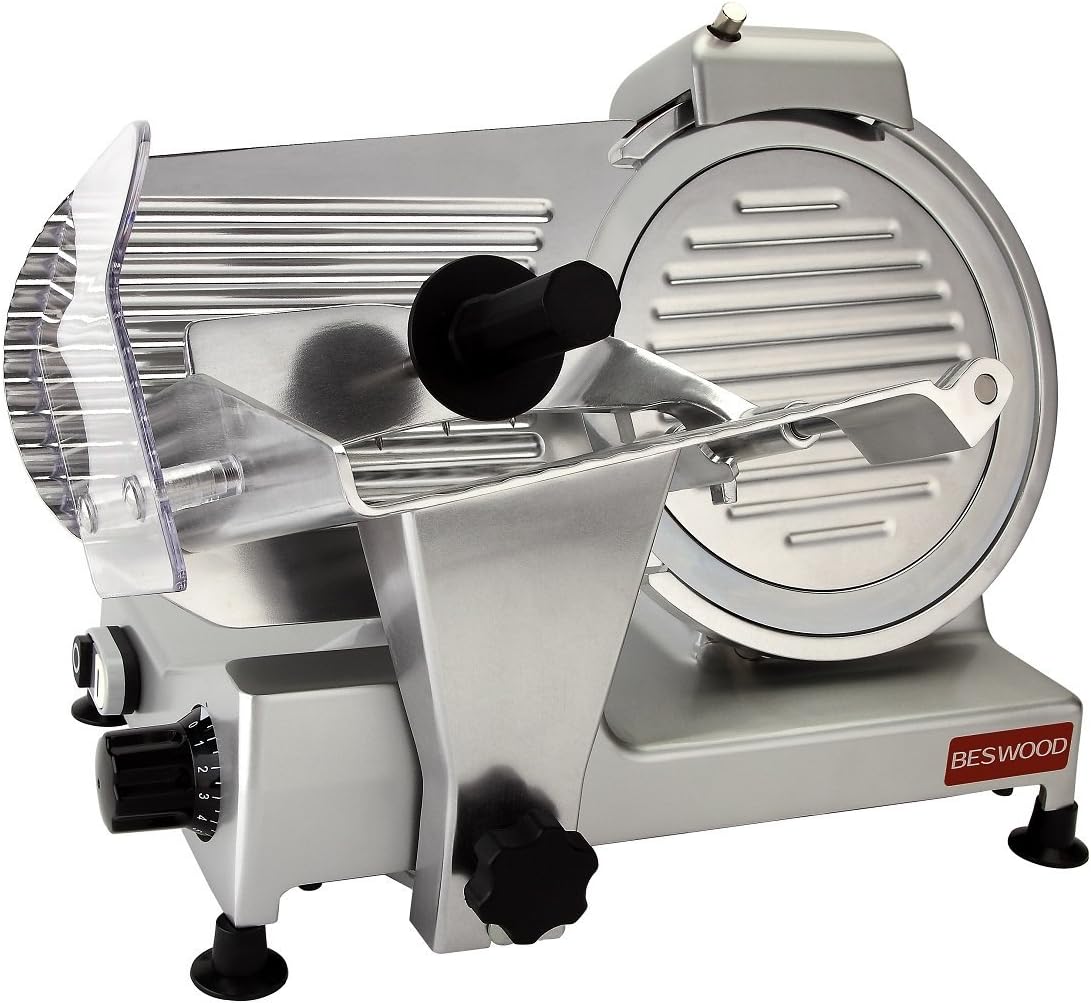
| Blade Diameter | 10" |
|---|---|
| Power | 240W 110-120V 60Hz |
| Maximum cutting thickness | 12mm |
| Blade Material | High-carbon Chromium-plated Steel |
The BESWOOD 10" electric deli slicer is a semi-automatic countertop slicer built for frequent use at home or in small commercial settings. It uses a 10-inch high-carbon, chromium-plated steel blade with a built-in two-stone sharpener so the edge stays usable longer and resists corrosion, and a 240W enclosed motor powers through cheese, deli meats, and firm vegetables. The slicer has an adjustable thickness control for anything from deli-thin to thicker cuts, a removable product table for easier cleaning, skidproof rubber feet, and a blade ring guard for safety. Practical benefits include lower maintenance thanks to the corrosion-resistant blade and an included sharpener, stable operation via the V-belt and rubber feet, and an ETL listing for electrical safety. Limitations are its weight and footprint which make it less portable and the recommendation for hand-wash only parts, so expect some disassembly for cleaning; also it is geared to boneless or partially thawed items rather than heavy-bone cutting. For slicing frozen meat, allow partial thawing to get consistent slices without stressing the motor or blade.
Best for: Buyers who prioritize a durable, low-maintenance slicer for regular home or small commercial use and want a machine that stays sharp and stable over time.
Less Ideal for: People who need a lightweight, compact unit for occasional use or those who expect dishwasher-safe components should look elsewhere.
- Chromium-plated high-carbon blade resists corrosion and holds an edge longer.
- Built-in two-stone sharpener keeps blade maintenance on hand.
- 240W enclosed motor suitable for frequent home or light commercial slicing.
- Adjustable thickness control for deli-thin to thicker cuts.
- Removable product table and skidproof feet improve cleaning and stability.
- Heavy and sizable countertop footprint limits portability and storage.
- Parts require hand washing rather than dishwasher cleaning.
Verdict: A robust, corrosion-resistant 10" slicer with an integrated sharpener and a stable motor, built for reliable daily slicing in home or small commercial kitchens.
OSTBA Meat Slicer SL-518

| BladeLength | 7.5 inches |
|---|---|
| Material Type | Stainless Steel |
| Operation Mode | Automatic |
| Adjustable thickness(mm) | 0-15mm |
The OSTBA SL-518 is a countertop electric slicer intended for home kitchens and light deli tasks. It uses a 7.5-inch stainless steel serrated blade driven by a 150W motor to slice meats, cheeses, bread, and vegetables with an adjustable thickness range up to about 15mm. The unit's removable blade cover, food carriage, slide rod and pusher make it straightforward to disassemble and clean, and suction-cup feet plus a child-lock start sequence add useful safety and stability while operating. For frozen meat, the 150W motor and serrated blade can handle partially frozen or well-chilled cuts for thin deli-style slices, though it is best used after the exterior has softened slightly rather than on fully rock-hard frozen blocks. The slicer is compact enough for counter storage and modest home use, but heavier commercial throughput or frequent slicing of very large frozen loins will reveal its limits. Overall it is a practical, easy-to-clean option for home cooks who want consistent slices without a commercial machine's footprint.
Best for: Home cooks who value a safe, easy-to-clean countertop slicer for deli-style cuts and occasional work with chilled or partially frozen meat, guided by other buyers' consistent reports of reliability.
Less Ideal for: Those who need a commercial-speed machine or who regularly slice large, fully frozen roasts should consider heavier-duty, higher-wattage slicers instead.
- Removable blade and carriage for easier cleaning and sanitation
- Child-lock plus dual-button start for safer operation
- Adjustable slice thickness from very thin to about 15mm for versatile cuts
- 7.5-inch stainless steel serrated blade suitable for deli-style slicing
- 150W motor is modest so fully frozen blocks may be difficult to slice
- Compact food carriage limits the size of pieces you can process at once
Verdict: A compact, user-friendly home deli slicer that delivers consistent thin-to-medium slices and is a dependable choice for chilled or partially frozen meat preparation.
OSTBA Meat Slicer SL-518

| Wattage | 200W |
|---|---|
| Blade length | 7.5 inches |
| Adjustable thickness | 0–15mm |
| Operation mode | Semi Automatic |
The OSTBA SL-518 is a compact, semi-automatic meat slicer built for regular home use and capable of handling frozen and deli meats. It ships with two removable 7.5" stainless steel blades — serrated for firmer or frozen cuts and non-serrated for softer foods like bread and cheese — and a 0–15mm thickness adjustment that makes it easy to get uniform slices. The 200W motor provides steady power for consistent cuts and the removable blade, carriage and food pusher simplify cleanup and sanitation. Safety features include a child-lock start and non-slip suction feet to keep the unit stable while cutting. Practical drawbacks are that it is designed for countertop home use rather than heavy commercial workloads and the semi-automatic feed requires hands-on guiding of items when slicing larger pieces. If you plan to slice frozen roasts or frequent deli-sized portions at home, the SL-518 delivers reliable, restaurant-style slices with straightforward maintenance and clear safety controls.
Best for: Home cooks who want reliable, restaurant-style slices at home and prioritize safety and easy cleaning when working with frozen and deli meats.
Less Ideal for: Commercial kitchens or users who need continuous, high-volume industrial slicing should choose a commercial-grade slicer instead.
- Two removable 7.5" stainless steel blades for serrated and non-serrated slicing
- 200W motor suited to slicing frozen and deli meats
- Adjustable 0–15mm thickness for consistent slice sizes
- Removable parts and dishwasher-safe components for easier cleaning
- Child-lock start and non-slip feet for safer operation
- Not intended for heavy commercial use or continuous high-volume slicing
- Semi-automatic feed requires manual guidance of larger items
Verdict: A safe, easy-to-clean 200W home slicer with serrated and non-serrated 7.5" blades that reliably handles frozen and deli meats for home cooks.
Choosing the Right Meat Slicer for Frozen Meat: Key Factors to Consider
Blade Material and Size
Blade composition and diameter determine how well a slicer holds an edge and cuts dense, frozen tissues. Harder stainless steels and thicker blade profiles resist chipping when encountering small frozen pockets or connective tissue. Larger-diameter blades keep a more consistent cutting angle and require less frequent sharpening during heavy use.
A blade designed for frozen work will often be specified as thicker or made from a higher-grade steel. Consider whether the blade is removable for sharpening and whether replacement blades are standard sizes, because those factors affect long-term maintenance and performance.
Motor Power and Torque
Frozen meat demands sustained torque rather than only high rotational speed. A motor with adequate horsepower and a design that preserves torque under load will slice through chilled cuts without bogging down or overheating. Look for machines that specify continuous power ratings or list duty-cycle guidance for heavy use.
Higher-starting torque matters for initial penetration into a frozen surface, while stable torque across the cut prevents the carriage from jerking or stalling. Consider whether the motor is ventilated or has thermal protection to avoid unexpected shutdowns during long sessions.
Duty Cycle and Cooling
Continuous or repeated slicing of frozen meat generates heat in the motor and bearings. Good cooling and a realistic duty-cycle rating mean the slicer can run longer without requiring long cool-down periods. Units designed for infrequent deli-style use may overheat quickly under frozen loads.
Check for features such as larger ventilation, fan-cooled motors, or manufacturer guidance on recommended run times. For heavy meal-prep days, choose equipment built to handle extended cycles or that offers easy-to-monitor thermal protection to prevent damage.
Carriage Design and Food-holding Security
A stable carriage and secure meat clamp keep frozen blocks from shifting during the cut, producing uniform slices and reducing the chance of the blade catching. Look for carriages that lock solidly, have low friction sliding surfaces, and include adjustable clamps or retainer plates suited to irregular frozen shapes.
A firm, predictable feed reduces user effort and keeps hands farther from the blade. Carriage travel length also impacts how large a piece you can process in a single pass.
Slice Thickness Control and Consistency
Precise, repeatable thickness adjustment matters when portioning frozen meat for recipes or packaging. A clearly marked, robust thickness control with fine incremental steps enables you to dial in the desired slice size from paper-thin to several millimeters thick.
Consistent thickness keeps cooking outcomes predictable and helps with efficient packaging. Controls that resist slipping under pressure and that lock in place are preferable when cutting denser product.
Sanitation and Ease of Cleaning
Frozen meat handling can leave residue and requires careful cleaning to maintain food safety. Slicers with removable blades, tool-free disassembly, and few crevices reduce cleaning time and improve sanitation. Food-contact materials should be corrosion-resistant and able to withstand regular washing.
Consider how accessible internal surfaces are and whether the design minimizes trapped moisture. Components that can be rinsed or wiped down without specialty tools simplify post-use cleanup and reduce bacterial risk.
Preparing Frozen Meat for Safe Slicing
Most frozen cuts benefit from a brief tempering period before slicing. Allow the exterior to soften just enough to avoid brittle shattering while keeping the interior solid; this reduces blade stress and helps produce cleaner slices. Avoid slicing rock-solid fully frozen cores unless your equipment is explicitly rated for that use.
Use sturdy gloves and a stable work surface. Position the meat so the carriage can engage smoothly and the clamp holds the block without slipping. If the piece has sharp ice edges or freezer burn, trim those areas first to prevent sudden blade impacts.
- Tempering time varies with cut size; monitor firmness rather than a fixed clock.
- Trim thin ice layers that can cause chipping.
- Keep hands clear and use the meat pusher or clamp, not fingers.
Sharpening and Maintenance Routines
Blades that cut frozen meat will dull faster than those used only on thawed products. Establish a regular sharpening schedule based on frequency of use and listen for signs like increased motor strain or tearing instead of clean slices. Some consumer units include integrated sharpeners; for others, a removable blade that can be professionally serviced is ideal.
Beyond the blade, weekly inspection of bearings, drive belts, and carriage slides prevents small issues from becoming failures. Replace worn seals and keep ventilation paths clear to preserve cooling efficiency.
- Sharpen or replace blades when slices start to tear rather than cut cleanly.
- Wipe food-contact surfaces after each session and deep-clean at least weekly.
Safety Features to Prioritize
Look for a combination of physical and operational safety features. A secure blade guard, a meat carriage shield, a reliable on/off switch with clear labeling, and a safety interlock for blade removal reduce the chance of accidental contact. Non-slip feet and a weighted base also keep the unit stable during forceful cuts.
Thermal cutouts and automatic shutoff protect the motor and reduce risk when the equipment is pushed beyond its duty cycle. Clear user instructions and visible thickness markings contribute to safer operation by reducing user error.
- Blade guards and locked carriage positions limit exposure.
- Thermal protection prevents overheating during heavy runs.
- Stable base and rubber feet reduce slipping risks.
Power and Performance Tradeoffs
Higher-power motors deliver better torque for frozen cuts but tend to be heavier and draw more electricity. Consider how often you will slice frozen meat and whether a heavy-duty home unit is warranted. For occasional use, a unit with moderate power and improved cooling may offer the right balance.
Also weigh speed against control. Faster blade RPMs cut quickly but can generate heat; models that provide stable torque at lower RPMs often produce cleaner slices in dense products.
- Match motor rating to typical workload to avoid unnecessary bulk.
- Prioritize torque and cooling over raw top speed for frozen meat.
Storage and Workspace Considerations
Slicers suited for frozen meat are often larger and heavier. Ensure you have a convenient, stable countertop area with adequate ventilation for the motor. If you need to store the unit between uses, check the product dimensions and whether components can be removed or nested to save space.
Keep a dedicated space for sharpening tools and cleaning supplies so you can maintain the unit promptly after use. Also plan for safe transport if you move the slicer to different prep areas; use handles or dollies rated for the unit weight.
- Measure countertop clearance and plan for airflow around the motor.
- Store removable guards and tools together to avoid misplacing safety parts.
How We Chose the Best Meat Slicer for Frozen Meat
We focused on attributes that determine how well a meat slicer performs with frozen or nearly frozen products. Key evaluation criteria included blade material and thickness, which affect edge retention and the ability to cut through dense tissue; motor power and torque, which determine whether the machine can maintain speed under heavy load without stalling; and duty cycle or cooling design, which prevents motor overheating during extended runs. We also judged carriage and meat-holding design for safe, stable feed, plus adjustment precision for consistent slice thickness. Ease of cleaning and access to food-contact surfaces were assessed so routine sanitation is practical after working with frozen meat. We excluded compact deli-only units rated strictly for soft or thawed foods and countertop mandolines that lack motor drive. The list prioritizes units with specifications and features appropriate for frequent frozen-meat use while balancing user safety and maintainability.
Our full evaluation process is outlined in our review methodology.
FAQ
Can a regular deli slicer handle frozen meat?
Often it depends on the slicer. Units rated for soft or thawed product can struggle with frozen density. Choose a slicer specified for heavier duty or frozen use to avoid motor strain and blade damage.
How cold is too cold to slice safely?
Slicing fully rock-hard cores can cause chipping and increase motor load. It is usually safer to temper the exterior until the surface yields slightly while the interior remains firm. Follow manufacturer guidance on minimum recommended product temperature.
How often should I sharpen the blade when cutting frozen meat?
You will need to sharpen more frequently than with thawed meats. Frequency depends on volume, but inspect blade edge after heavy sessions and sharpen when you notice tearing or increased motor effort.
Is a larger blade diameter better for frozen cuts?
Larger diameters tend to provide smoother cutting action and longer edge life because they engage material more gradually. However, they add weight and may require more powerful motors to maintain torque.
What sanitation steps are important after slicing frozen meat?
Thaw and clean any removable parts as recommended, sanitize food-contact surfaces, and ensure moisture is dried to prevent corrosion. Use recommended detergents and avoid submerging motors or electrical components.
Final Verdict
When choosing a meat slicer for frozen meat, prioritize blade strength, motor torque, and cooling or duty-cycle design. Those factors determine whether a unit will deliver consistent slices without overheating or premature blade wear. Also consider carriage stability and sanitation features to keep operation safe and maintenance manageable. Balance capacity and power with your expected usage. If you plan frequent frozen-meat prep, invest in a unit rated for heavier duty and with serviceable components. For occasional use, select a model with good cooling and clear duty-cycle guidance so you can slice reliably without risking damage.