
Note: This article contains affiliate links. If you click on these links and make a purchase, we may earn a small commission at no extra cost to you. This helps support our research and content. Read our full affiliate disclosure here.
If you want higher juice yield and better nutrient retention from leafy greens and hard produce, choosing the right masticating juicer matters. A slow, low-heat extractor separates juice more thoroughly than a fast centrifugal machine, giving you clearer juice and less waste. This guide shortlists the top masticating juicers for fruits and vegetables, focusing on yield, ease of cleaning, and reliability so you can pick a model that suits your daily routine. Read on for concise evaluation criteria and the top options that meet real-world kitchen needs.
Top Picks at a Glance
| Best Overall The best all-around choice for most situations | TUUMIIST TM880SJ Cold Press Juicer |  |
| Best Quality Built to a higher standard if you want something more solid | Omega VSJ843QS Cold Press Juicer |  |
| Best Value The sweet spot between price and what you get | AMZCHEF Cold Press Juicer 1902B |  |
| Best Budget The cheapest option that still gets the job done reliably | NEWBULIG Cold Press Juicer |  |
| Top Rated A top-rated pick with lots of positive feedback | anybear Cold Press Juicer SJ054C |  |
| Most Popular A crowd favorite that many people choose with confidence | EanOruus 3-in-1 Masticating Juicer E-18 |  |
| Best Seller A high-volume bestseller chosen again and again | YPONE Masticating Juicer SJ-057 |  |
TUUMIIST TM880SJ Cold Press Juicer

| Capacity | 3 liters |
|---|---|
| Maximum Power | 350 watts |
| Wattage | 300 |
| Voltage | 120 volts |
| Number of Speeds | 60 |
The TUUMIIST TM880SJ is a slow masticating juicer built for whole-fruit juicing, nut milks, and sorbets; its 6.5-inch wide chute and 100 oz hopper reduce prep time by allowing larger pieces or whole produce. The single-auger design and low-speed pressing aim to preserve nutrients and deliver high juice yield with dry pulp, while the smart touch controls, auto-reverse, and overheat protection make operation straightforward and forgiving of occasional jams. Practical features include a metal-free filter mesh intended to minimize oxidation, dishwasher-safe parts for easier cleanup, and a near-silent motor that keeps noise under typical kitchen levels. The unit is relatively powerful for a masticating machine and claims a high yield, so it is useful for daily juicing or batch prep for a family. Limitations include a somewhat complex footprint compared with compact juicers and multiple parts to clean despite the quick-rinse design, and the heavier build may be less convenient to store or move frequently.
Best for: Buyers who want a versatile masticating juicer that handles whole fruits and vegetables, makes nut milks and sorbets, and can produce larger batches for daily family use.
Less Ideal for: Anyone who needs an ultra-compact, lightweight countertop unit or who only wants a quick single-serving centrifugal juicer for occasional use.
- 6.5-inch extra-wide feed chute reduces pre-chopping and speeds prep
- Designed for high juice yield with slow cold-press extraction and dry pulp
- Smart touch controls with auto-reverse and overheat protection for easier use
- Large 100 oz hopper supports batch juicing for families or meal prep
- Dishwasher-safe parts and simplified 3-part assembly for faster cleaning
- Larger footprint and heavier build make it less convenient for small kitchens
- Multiple components still require disassembly and rinsing after use
Verdict: Choose this masticating juicer if you want a high-yield, whole-fruit capable machine that supports batch juicing and versatile drinks like nut milks and sorbets.
Omega VSJ843QS Cold Press Juicer

| Maximum Power | 150 watts |
|---|---|
| Wattage | 150 watts |
| Power Source | Corded Electric |
| Voltage | 120 |
| Number of Speeds | 1 |
The Omega VSJ843QS is a compact vertical cold press masticating juicer built for extracting nutrient-dense juice from fruits and vegetables. Its 43 RPM low-speed motor and three-stage dual-edge auger work together to crush and squeeze produce gently, reducing heat and oxidation to preserve enzymes and extend juice shelf life. The design emphasizes high yield and smooth texture by breaking down fiber and managing pulp with an automatic pulp ejection system and a no-drip tap that makes batch juicing and nut milk easier. Practical touches include an auto-cleaning feature to help keep the screen clear and dishwasher-safe components for faster cleanup. The unit's single speed and slower throughput mean it is optimized for quality and yield rather than speed, so expect longer prep and run times compared with centrifugal models. Its vertical footprint saves counter space but the juicer still requires some time to process and clean after larger batches.
Best for: Buyers who prioritize maximum nutrient retention and juice yield from fruits and vegetables and are willing to trade faster throughput for higher-quality cold-pressed juice.
Less Ideal for: People who need very fast juicing for high-volume or on-demand use should consider higher-speed or commercial-grade extractors instead.
- Low 43 RPM operation preserves enzymes and reduces oxidation for longer-lasting, nutrient-rich juice
- Three-stage dual-edge auger and reduction gears increase crushing force for higher juice yield
- Automatic pulp ejection and pulp control produce smoother juice with less manual clearing
- No-drip tap allows mess-free batching and easy removal of the juice cup
- Dishwasher-safe parts and an auto-cleaning function simplify maintenance
- Single-speed, low-throughput design takes longer to process large volumes
- 150-watt motor limits raw power compared with some higher-wattage commercial models
Verdict: Choose this juicer if you want a compact vertical cold-press machine that maximizes nutrient-rich juice yield from fruits and vegetables through slow masticating extraction.
AMZCHEF Cold Press Juicer 1902B

| Wattage | 300 watts |
|---|---|
| Maximum Power | 350 watts |
| Power Source | Electric |
| Voltage | 120 volts |
| Capacity | 5 pounds |
The AMZCHEF 1902B is a slow masticating juicer built to handle whole fruits and vegetables through a 5.4-inch feed chute, so you can often skip heavy prep and drop apples, oranges, carrots, and celery in whole. It uses an enlarged spiral auger and stainless steel blade to press produce slowly for higher juice yield and drier pulp, and the motor includes overload protection and an auto-reverse to clear jams. Detachable parts and a straightforward one-button control make assembly and rinsing quick, and the quieter heavy-duty motor reduces noise during early-morning use. Practical extras include a shaker cup for juice collection and a puree mode suitable for soft fruits or baby food. Be aware the unit requires hand washing of parts and is a moderate-power masticator, so it is best for regular household juicing rather than heavy commercial use; very hard or fibrous loads may need occasional reversing or feeding in smaller pieces despite the wide chute.
Best for: Buyers who want a practical, no-fuss masticating juicer that maximizes juice from whole fruits and vegetables with minimal prep and easy daily cleaning.
Less Ideal for: Those who need an industrial or commercial juicer for continuous heavy use or who prefer fully dishwasher-safe components should look elsewhere.
- 5.4-inch oversized feed chute reduces prep by fitting many fruits and vegetables whole
- Enlarged spiral auger and stainless steel blade deliver higher juice yield with drier pulp
- Auto-reverse and overheat protection help prevent clogs and protect the motor
- Quiet heavy-duty motor suitable for early-morning or household use
- Detachable parts and simple one-button operation make cleaning and use straightforward
- Requires hand washing of parts rather than dishwasher-safe cleaning
- Not intended for commercial-scale heavy-duty use despite high juice yield claims
Verdict: Choose this juicer if you want a countertop masticating machine that squeezes high yield from whole produce with minimal chopping and easy day-to-day use.
NEWBULIG Cold Press Juicer
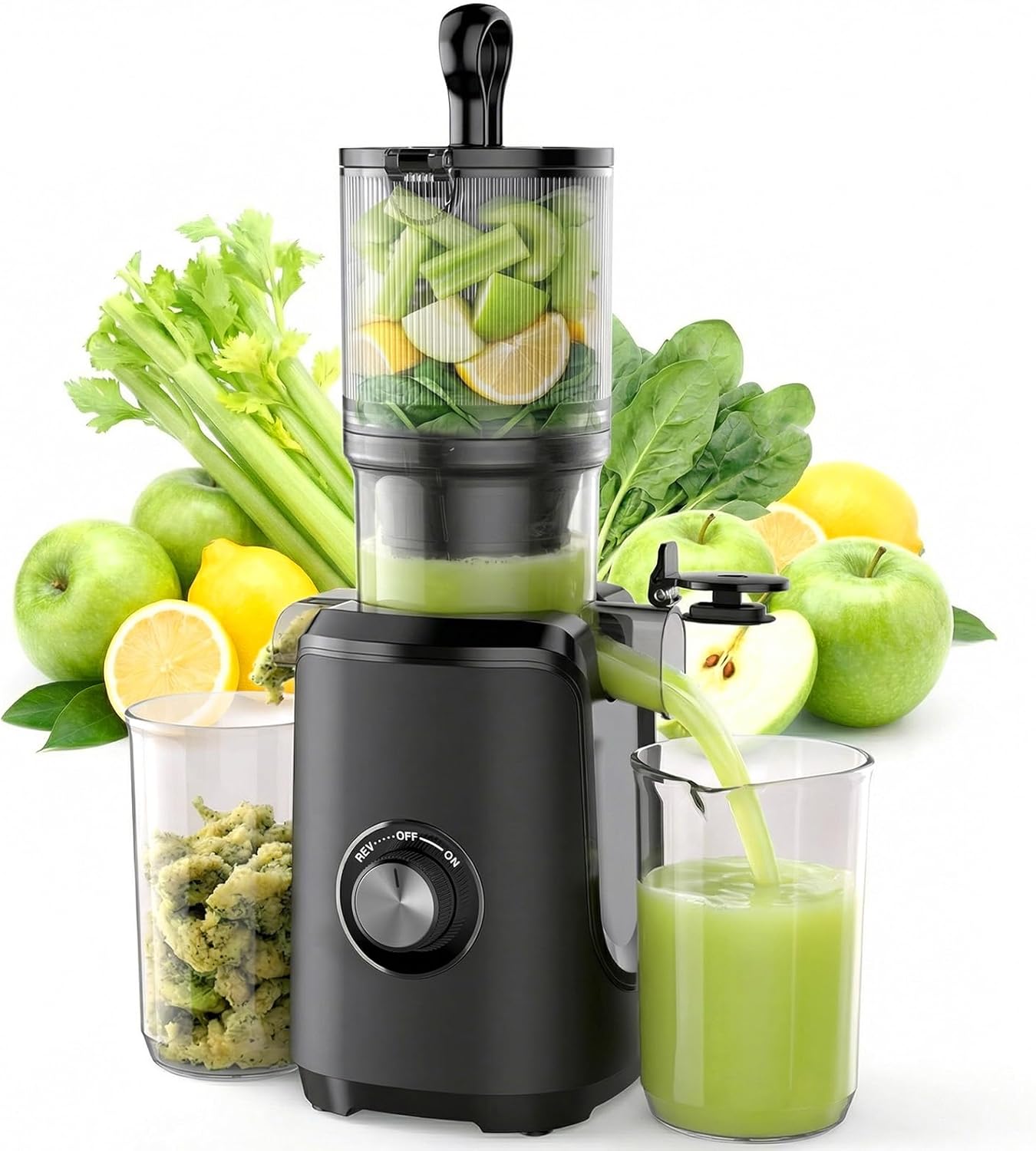
| Wattage | 200 watts |
|---|---|
| Voltage | 120 volts |
| Feed chute | 4.25 inches |
| Special features | Reverse function; Safety lock; Quiet motor |
The NEWBULIG Cold Press Juicer is a budget-friendly single-auger masticating machine built for everyday fruit and vegetable juicing. It uses a low-speed motor to press produce gently, which reduces heat and oxidation and helps retain more nutrients and flavor compared with high-speed centrifugal machines. The 4.25-inch feed chute fits many whole items so you spend less time chopping, and the reverse function clears clogs quickly without full disassembly. Parts detach for hand washing and the included brush helps remove pulp, though the manufacturer recommends hand wash only. At 200 watts it runs quietly and the safety lock prevents operation when opened, which is handy in busy kitchens. Practical limitations include the need to hand-wash components and a smaller parts set compared with pricier models, and very fibrous produce may still require some prep. For buyers prioritizing a lower price and good nutrient retention, this juicer delivers solid value.
Best for: Buyers seeking an affordable masticating juicer that preserves nutrients and handles everyday fruit and vegetable juicing with minimal chopping.
Less Ideal for: People who want dishwasher-safe parts or commercial-level throughput for large-volume juicing should consider higher-end models.
- 4.25-inch feed chute reduces pre-cutting for many fruits and vegetables
- Slow masticating action minimizes oxidation to preserve nutrients and flavor
- Reverse function clears clogs quickly without disassembly
- Quiet 200-watt motor suitable for early-morning use
- Detachable parts and cleaning brush make maintenance straightforward
- Parts are hand wash only, no dishwasher-safe components
- May require extra prep for very fibrous produce
Verdict: A cost-conscious masticating juicer that preserves nutrients, reduces prep with a wide feed chute, and includes a reverse function for easy clog clearing.
anybear Cold Press Juicer SJ054C
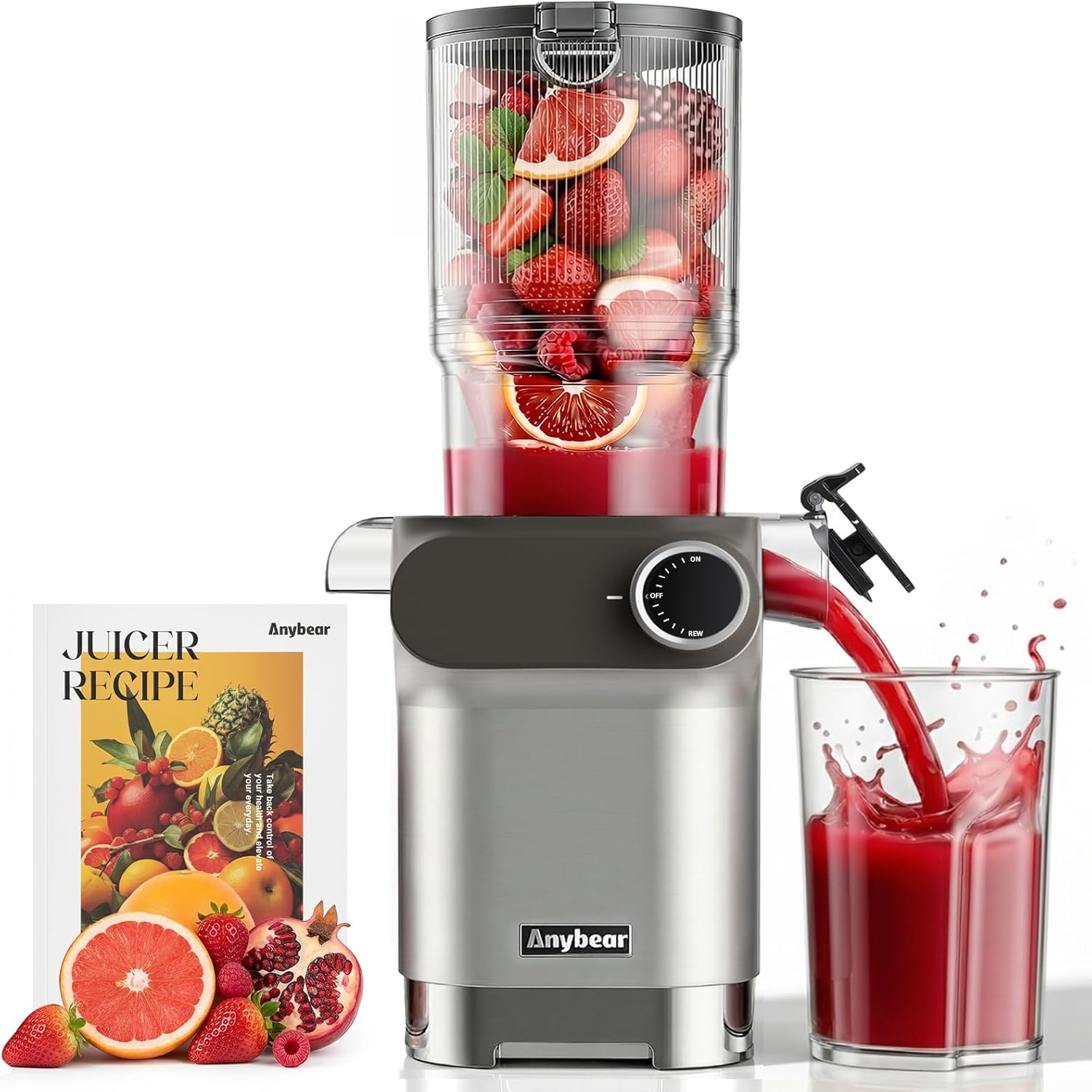
| Maximum Power | 200 watts |
|---|---|
| Wattage | 200 watts |
| Voltage | 110 volts |
| Special Features | Easy to Clean |
The anybear Cold Press Juicer SJ054C is a single-auger masticating juicer built for steady, low-speed extraction of fruits and vegetables. It uses a 200W motor and a high-torque auger that turns at about 65 RPM to minimize oxidation and preserve flavor, and the larger 4.3-inch feed chute lets you juice larger pieces with less prep. The unit emphasizes easy cleaning with a simplified stainless steel filter and a brush included for quick rinses and disassembly in three steps. Construction mixes ABS, PP, stainless steel, and Tritan material for the feed chute, which is marketed as baby food-grade. Practical benefits include higher juice yield from leafy greens and slower extraction that keeps juice fresher longer, plus a straightforward cleaning routine that reduces downtime between uses. Limitations to note are that it is hand-wash only and not a fast centrifugal-style juicer, so it is better suited to deliberate morning routines rather than quick single-cup needs.
Best for: Buyers who prioritize consistent, long-term juice quality and a durable slow-extraction machine for regular fruit and vegetable juicing routines.
Less Ideal for: People who want the fastest, one-handed countertop juicing for occasional quick servings or who need dishwasher-safe cleanup.
- Low-speed, high-torque extraction (approximately 65 RPM) preserves nutrients and reduces oxidation
- 4.3-inch wide feed chute accepts larger pieces and reduces prep time
- Simplified stainless steel filter and included brush make cleaning quick
- Tritan feed-chute material rated for food contact and mixed-material construction for durability
- Hand wash only components increase cleaning effort compared with dishwasher-safe parts
- 200W masticating design is slower than centrifugal juicers for single-cup convenience
Verdict: Choose the anybear SJ054C if you want a reliable, low-speed masticating juicer that maximizes juice yield and freshness for regular fruit and vegetable use.
EanOruus 3-in-1 Masticating Juicer E-18

| Maximum Power | 250 watts |
|---|---|
| Wattage | 250 watts |
| Power Source | ac |
| Voltage | 110 volts |
| Capacity | 100 fluid ounces |
The EanOruus E-18 is a single-auger masticating juicer designed for heavy home use and meal prep. It accepts whole fruits through a 6.5-inch wide chute and feeds them into a slow-extracting auger driven by a 250 W AC motor, producing juice while preserving nutrients and minimizing foam. The unit includes interchangeable strainers so you can switch between juicing, making nut milk and preparing sorbet, and its 100 oz hopper reduces refills when you are processing larger batches. Practical touches include an auto-reverse function to clear clogs, an easy-to-clean detachable pulp outlet, and overheat protection for repeated runs. Expect quieter operation than centrifugal models thanks to the brushless AC motor, but plan for hand washing removable parts and a relatively heavy footprint on the counter. The plastic construction keeps cost and weight down but means buyers should handle parts carefully and avoid harsh scrubbing. For shoppers who value high yield, batch capacity and quiet extraction, this model gives a solid balance of performance and convenience; those seeking commercial stainless components or dishwasher-safe parts may want a different option.
Best for: Buyers who prioritize batch juicing performance, nutrient retention and quiet operation and who rely on peer reviews and proven features when choosing a reliable home juicer.
Less Ideal for: People who need fully dishwasher-safe parts, commercial-grade metal construction, or a compact unit for very small countertops should look elsewhere.
- Extra-wide 6.5-inch chute lets you juice whole fruits with minimal prep
- Large 100 oz hopper reduces the need to refill during batch juicing
- Interchangeable strainers support juice, nut milk and sorbet functions
- Quiet, high-torque 250 W AC motor suitable for fibrous produce
- Auto-reverse and overheat protection improve reliability during heavy use
- Removable parts require hand washing rather than dishwasher cleaning
- Major components are plastic rather than metal which may feel less durable
- Relatively heavy and sizable for small kitchens
Verdict: Choose the EanOruus E-18 if you want a quiet, high-capacity masticating juicer that handles whole fruits and doubles as a nut milk and sorbet maker.
YPONE Masticating Juicer SJ-057

| Maximum Power | 400 watts |
|---|---|
| Power Source | Corded Electric |
| Voltage | 120 volts of alternating current |
| Number of Speeds | 1 |
| Capacity | 500 ml, 700 ml |
The YPONE SJ-057 is a 2-in-1 masticating juicer built for extracting juice, nut milk, and soy milk from whole fruits and vegetables using a low-speed 55 RPM auger. It is typically used for daily fresh juice and family batches thanks to its extra-large 5.8-inch feed chute that reduces prep time and a 400W motor that keeps extraction consistent. The cold-press action and dual 0.3mm mesh strainers aim to maximize yield while minimizing foam and clogging, and the package includes a cleaning brush and a few removable parts that rinse or go in the dishwasher for easier cleanup. Safety features include a lid safety lock and overheat protection, and the unit emphasizes quiet operation for early-morning use. Important limitations are single-speed operation, plastic construction for several parts, and a relatively heavier footprint compared with compact centrifugal models, so it favors nutrient retention over speed for large batches rather than quick, high-volume throughput.
Best for: Buyers who prioritize nutrient retention, quiet operation, and minimal prep time for family-sized fresh juice batches and who prefer a straightforward, safety-focused appliance.
Less Ideal for: People who need fast, single-serving juicing on a tight counter footprint or who want multi-speed control and mostly metal construction should consider other styles.
- Very large 5.8" feed chute reduces pre-cutting and speeds prep for whole fruits and veg.
- Low 55 RPM masticating action preserves nutrients and reduces oxidation and foam.
- Dual fine mesh strainers increase juice yield and limit clogging and residue.
- Includes cleaning brush and has a small number of main parts for faster disassembly and cleaning.
- Safety lock and overheat protection improve safe everyday use.
- Single-speed design limits control for tougher ingredients or variable textures.
- Several functional parts use plastic rather than higher-grade materials.
- Bulky and heavier than compact centrifugal juicers, taking more counter space.
Verdict: Choose the YPONE SJ-057 if you want a quiet, safety-minded masticating juicer that delivers high juice yield and minimal prep for family-size cold-pressed juice.
Choosing the Right Masticating Juicer for Fruits and Vegetables: Key Factors to Consider
Juice Yield and Pulp Dryness
Higher yield means you get more juice from the same quantity of fruits and vegetables, which lowers cost per serving and reduces prep time for big batches. Pulp dryness is a reliable indicator of extraction efficiency; drier pulp usually signals that the auger and screen are doing a thorough job. For buyers, look for machines that consistently produce wetness-minimized pulp across a range of produce, including carrots and kale.
Yield differences affect ingredient planning. If you plan to juice frequently or for several people, prioritize a model with proven high extraction. If occasional single-serve juices are your aim, marginal yield losses may be acceptable for other conveniences like smaller footprint.
Motor Torque and Speed Control
Torque determines whether an auger can crush dense root vegetables and fibrous greens without bogging down. Low-speed masticating mechanisms typically preserve enzymes and limit heat buildup, but torque must be sufficient to handle hard items. Variable speed or calibrated low-RPM designs help optimize extraction across produce types.
Undersized motors will struggle with tougher items, causing frequent jams and additional prep work. Look for machines with steady torque ratings or features that reduce clogging, such as reverse functions or slow, high-pressure augers.
Ease of Cleaning and Maintenance
Cleaning time is a major usage friction point. Juicers with fewer parts, straightforward disassembly, and wide openings make cleanup faster and reduce the risk of mold or residue buildup. Dishwasher-safe components can save time but verify materials are rated for repeated cycles. Screens and strainers that are easy to access and brush significantly improve daily usability.
Maintenance considerations also include how easy it is to replace wear parts and whether seals or gaskets are user-serviceable. Frequent juicers should favor designs that minimize trapped pulp and have accessible seals to extend the machine's life.
Build Materials and Food Safety
Materials exposed to juice should be BPA-free and resistant to staining and odor. Metal augers or food-safe engineering plastics are common; choose materials that combine strength with easy cleaning. Sturdier housings and thicker parts reduce vibration and extend longevity, especially when processing hard produce frequently.
Consider the interface between materials and maintenance. Softer plastics can warp over time, while higher-grade materials may add weight but deliver longer service life and better sanitary performance.
Throughput and Feed-Chute Design
Throughput refers to how quickly a machine can process produce without repeated stopping to clear jams. Larger feed chutes reduce prep by accepting longer pieces or whole fruits, while narrower inlets require more chopping but can result in better control and less oxidation. A balanced feed design helps you match the machine to your routine — quick morning juices versus batch juicing for meal prep.
Consider whether you prefer to prep produce in advance or want a machine that minimizes prep. Features like reverse functions and gravity-assisted feeding also affect how smoothly different textures move through the auger.
Noise Level and Thermal Management
Lower operating noise makes early-morning or late-night juicing less disruptive. Masticating juicers are typically quieter than centrifugal models, but motor cooling and thermal protection still matter. Machines that manage heat well sustain longer continuous runs and are less likely to trip thermal cutouts during batch processing.
If you plan to make multiple servings in one session, verify the unit's duty cycle. Better thermal management and built-in protection extend motor life and improve reliability for heavier use.
Preparing Fruits and Vegetables for Best Results
Proper prep improves extraction efficiency and reduces clogging. Hard root vegetables like carrots and beets benefit from trimming and cutting into lengths that fit the feed chute. Leafy greens and herbs can be rolled or bundled to feed more evenly and prevent them from wrapping around the auger.
Remove large pits, seeds, and fibrous cores when possible. Softer fruits may be fed whole if the chute allows, but cutting them into manageable pieces speeds throughput and reduces stress on the motor.
- Cut firm produce into uniform pieces for consistent feeding
- Bundle leafy greens to avoid stringing on the auger
- Remove hard pits and tough cores to prevent jams
Daily Maintenance Routine
A short, consistent cleaning routine keeps performance steady and reduces odors. Rinse parts immediately after use to prevent drying and staining. Use a small brush on the screen and crevices to dislodge trapped pulp before a full wash.
Inspect seals and gaskets periodically for wear and replace them if they show cracking. Store parts dry and assembled loosely to discourage mold formation in damp kitchens.
- Rinse after each use, then wash or run approved parts through the dishwasher if rated
- Brush the screen while pulp is wet for easier cleaning
- Check and replace worn gaskets to maintain suction and prevent leaks
Maximizing Nutrient Retention
Masticating juicers extract juice at low speeds, which reduces heat and oxidation compared with high-speed machines. To preserve enzymes and vitamins, process delicate greens and soft fruits gently and consume juice soon after extraction for best freshness.
If you must store juice, use airtight containers and limit exposure to light and air. Cold storage slows nutrient degradation but does not stop it entirely, so plan servings accordingly.
- Process soft and leafy items on lower-speed settings if available
- Store extracted juice in opaque, airtight containers for short-term refrigeration
- Minimize blending or forcing air into juice during transfer
Handling Fibrous and Stringy Produce
Certain vegetables like celery and some herbs can be stringy and may wrap around an auger if not prepared correctly. Alternating harder pieces with softer ones can help move fibrous materials through the system. Use the reverse function if the unit has one to clear build-up without disassembly.
Regularly inspect the screen for fiber accumulation and clean it more frequently when juicing a lot of stringy produce to maintain consistent flow.
- Alternate produce types in the feed to prevent stringing
- Use reverse mode sparingly to clear jams
- Trim excessively fibrous stalks when possible
Space and Storage Considerations
Masticating juicers vary in footprint and weight. Consider where the unit will live on the counter and whether you need to store it between uses. Heavier, more robust machines often deliver better stability during operation but can be harder to move for storage.
If counter space is limited, look for models with a compact vertical profile or removable parts that nest for storage. Balance the convenience of a permanent countertop appliance against the desire to reclaim space when not juicing.
- Measure the intended storage spot and the unit's assembled dimensions
- Look for nested or stackable parts to save cabinet space
- Consider a dedicated storage box or mat to protect surfaces from moisture
How We Chose the Best Masticating Juicer for Fruits and Vegetables
We prioritized features that directly affect everyday juicing performance and upkeep. First, juice yield and pulp dryness were central because they determine how much usable juice you get from a given amount of produce. Second, motor torque and auger speed were evaluated to ensure reliable extraction of both hard root vegetables and tender leafy greens. Third, ease of cleaning and disassembly weighed heavily since time spent maintaining the machine affects how often people actually use it. Fourth, build quality and materials mattered for durability and food safety over repeated use. Fifth, feed-chute design and throughput were considered so the machine suits different users, from single-serve juicers to families. Finally, noise level and thermal management were included to avoid motor stress during extended sessions. We excluded models that are strictly centrifugal or that lack adequate torque for hard produce. Our selections reflect machines that balance yield, versatility for fruits and vegetables, and manageable upkeep.
Our full evaluation process is outlined in our review methodology.
FAQ
Can a masticating juicer handle both hard roots and leafy greens effectively?
Often yes. Masticating juicers with sufficient torque are designed to process a range of produce from carrots to kale. Performance depends on motor strength and auger design, so check those specs if you plan heavy use of both types.
How often should I clean the juicer screen to prevent clogs?
You should clean the screen after each use. If you are juicing a lot of fibrous produce in one session, pause to brush the screen between batches to maintain flow and prevent permanent build-up.
Is it safe to put all juicer parts in the dishwasher?
It depends on the manufacturer's material guidance. Many components are dishwasher-safe on the top rack, but repeated cycles can accelerate wear. Hand washing delicate screens and seals extends their service life.
How long can fresh juice be stored and still retain nutrients?
Freshly extracted juice retains most nutrients for a short window, typically under 48 hours when refrigerated. Nutrient loss accelerates with exposure to air and light, so consume juice as soon as practical for best quality.
Will juicing reduce food waste compared with other prep methods?
Juicing converts a large portion of produce into drinkable liquid, reducing bulk waste. However, it leaves dry pulp that still contains fiber and some nutrients, which can be reused in baking or composted to minimize waste further.
Final Verdict
When choosing a masticating juicer for fruits and vegetables, prioritize extraction efficiency, motor torque, and how easy the unit is to clean. Those factors directly influence daily usability, long-term reliability, and how much usable juice you get from produce. Balance throughput and feed-chute convenience with build quality and maintenance needs to match your kitchen habits. If you juice frequently, favor models that deliver consistently dry pulp and simple upkeep. For occasional use, a compact unit with straightforward cleaning may be the better choice. Focus on the tradeoffs described here to pick a juicer that fits your routine and produces the results you want.