
Note: This article contains affiliate links. If you click on these links and make a purchase, we may earn a small commission at no extra cost to you. This helps support our research and content. Read our full affiliate disclosure here.
If you want better burgers at home, a dedicated meat grinder for burgers makes a big difference in texture and flavor. Grinding at home lets you control fat ratio, coarseness, and freshness so each patty cooks more evenly and retains juiciness. This guide covers seven top-rated meat grinders chosen for home cooks who prioritize consistent grind, easy cleanup, and reliable performance for frequent burger making. We evaluated each pick against practical criteria such as grind consistency, motor durability, and how straightforward routine maintenance is. Read on to find options that match your cook style and kitchen workflow.
Top Picks at a Glance
| Best Overall The best all-around choice for most situations | STX Turboforce II 4000 |  |
| Best Quality Built to a higher standard if you want something more solid | LEM BigBite #5 Meat Grinder |  |
| Best Value The sweet spot between price and what you get | AAOBOSI Meat Grinder MG102A |  |
| Best Budget The cheapest option that still gets the job done reliably | ALTRA LIFE Meat Grinder MGAC13 |  |
| Top Rated A top-rated pick with lots of positive feedback | LEM #8 Countertop Meat Grinder |  |
| Most Popular A crowd favorite that many people choose with confidence | CHEFFANO Meat Grinder AZ-MG091DG |  |
| Best Seller A high-volume bestseller chosen again and again | Aiheal Meat Grinder MG-2430RB |  |
STX Turboforce II 4000
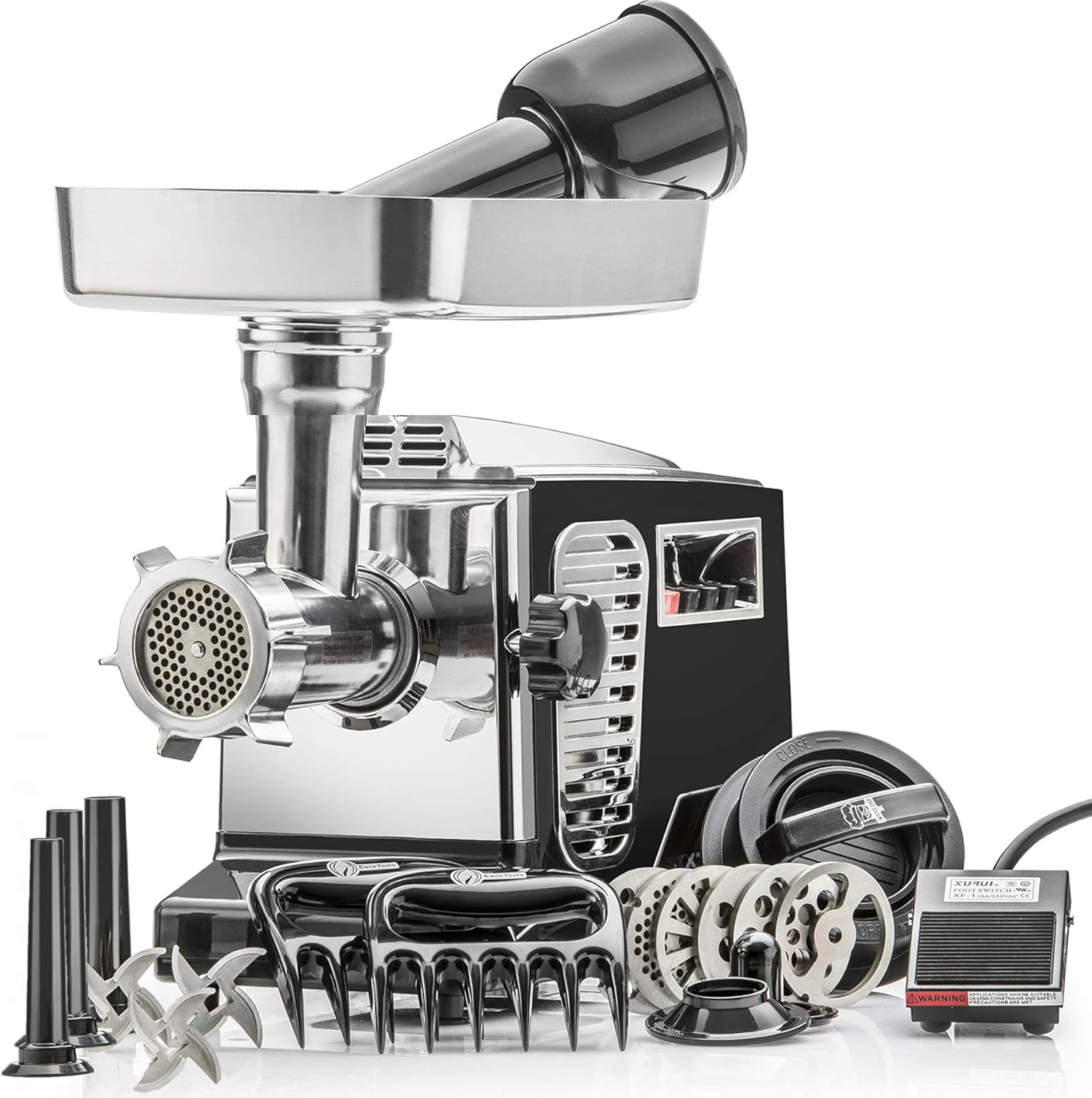
| Wattage | 2000 watts |
|---|---|
| Capacity | 3 pounds |
| Voltage | 120 volts |
| Included Components | Grinding head, meat pusher, 6 plates, 3 blades, sausage tubes, kubbe attachment, foot pedal |
The STX Turboforce II 4000 is a powerful home meat grinder designed for high-volume jobs like making burger blends and sausage at home. It uses a 2000-watt locked motor with a quad air induction cooling system and circuit breaker to sustain long runs, and the size No.12 head plus a 2.5-inch output and large feed tray let you process large amounts of meat quickly. The unit includes multiple grinding plates and stainless steel cutting blades, sausage tubes, a kubbe attachment, meat pusher, meat claws and a foot pedal for easier control. In real-world use it excels at producing consistent ground texture for burgers and can handle soft bones if needed, while the heavy cast and stainless components give it a durable, workshop feel. Expect a learning curve for feeding and cleaning, and the grinder is physically large and loud compared with compact kitchen models, but for someone who wants restaurant-style throughput and robust build quality it delivers reliable performance.
Best for: Buyers who want a durable, high-throughput home grinder to make consistent burger blends and sausages regularly and value power and accessory versatility over a compact footprint.
Less Ideal for: Casual users who only grind small amounts infrequently or need a compact, quiet countertop appliance should consider smaller models instead.
- Very powerful 2000-watt motor and air-cooled design for sustained grinding sessions
- Includes multiple grinding plates, stainless steel blades and sausage/kubbe attachments for versatile use
- Large feed tray and No.12 head allow high throughput suitable for batch burger making
- Foot pedal control frees a hand and improves safety when feeding meat
- Larger, heavier and louder than small home grinders which may be overkill for occasional use
- Requires effort to disassemble and clean after heavy use
Verdict: Choose the STX Turboforce II 4000 if you need a powerful, accessory-rich grinder that can produce consistent, high-volume burger blends at home.
LEM BigBite #5 Meat Grinder
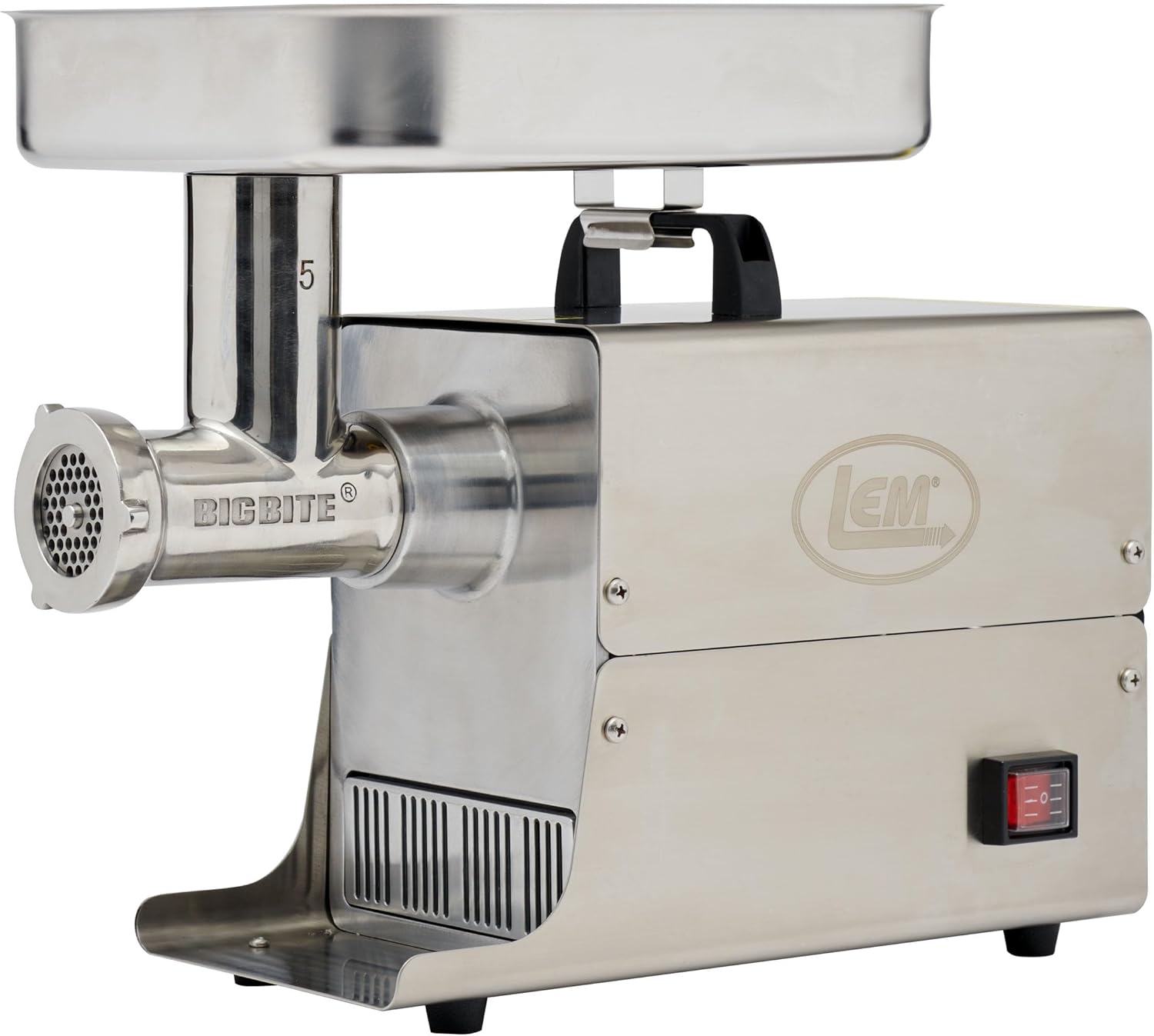
| Horsepower | 0.35 HP |
|---|---|
| Capacity | 4 pounds per minute |
| Material Type | Stainless Steel |
| Power Source | electric |
The LEM BigBite #5 is a compact, performance-oriented electric grinder aimed at home cooks and hunters who want pro-style results without industrial size. Its BigBite auger pulls larger chunks of meat into the head, which combined with a 0.35 HP motor delivers roughly 4 pounds per minute — enough for steady burger and sausage prep. The unit ships with stainless steel knife and head, coarse and fine plates, a stomper, three stuffing tubes and a storage drawer for plates, so you can grind, mix, and stuff sausages right away. Stainless components and a permanently lubricated motor make operation smooth and cleaning straightforward since it disassembles for washing. It is quieter than many consumer grinders thanks to noise-dampening design, but it cannot process bones and is intended for smaller batches rather than continuous heavy commercial use. For burger-making this model offers efficient, consistent grinding and the included plates let you choose coarse or fine textures for patties.
Best for: Buyers who prioritize consistent, efficient grinding for burgers and sausages and want a durable, compact unit that handles game and bulk meat for home meal prep.
Less Ideal for: People who need a commercial-duty grinder for high-volume continuous use or who require bone-crunching capability should look at heavier industrial models.
- BigBite auger design that feeds larger chunks for faster, more efficient grinding
- Stainless steel knife, head, auger and plates for durable, food-safe contact surfaces
- Includes coarse and fine plates plus stuffing tubes for burgers and sausage making
- Noise-dampening design for quieter operation during home food prep
- Easy to disassemble and clean with a built-in storage drawer for accessories
- Not capable of grinding bones, limiting some game processing tasks
- 0.35 HP motor is suitable for home batches but not for continuous commercial workloads
Verdict: If you want a durable, compact grinder that delivers reliable, efficient burger-ready grind and includes sausage-making accessories, the LEM BigBite #5 is a strong home-kitchen choice.
AAOBOSI Meat Grinder MG102A

| Wattage | 3000 watts |
|---|---|
| Capacity | 3 pounds |
| Voltage | 120 volts_of_alternating_current |
The AAOBOSI MG102A is a powerful home meat grinder built to process burgers, sausages, and raw pet food quickly. It uses a motor rated to 3000W max (350W rated) with three speed settings and an auto-reverse mode to clear jams, and the touch color screen makes switching modes straightforward. The unit ships with three grinding plates, two stainless blades, sausage and kibbe attachments and a built-in storage compartment that keeps accessories tidy between jobs. In practice it grinds up to roughly 4 lb per minute when used in short bursts, making it a solid choice for batch burger prep, though the manufacturer warns against continuous runs over 10 minutes to avoid overheating. Cleanup is easier because plates and blades are stainless steel and dishwasher-safe, but hand washing is still recommended for longevity. For home cooks who want a high-capacity grinder for fresh hamburger mixes, the AAOBOSI balances raw throughput and convenience, while requiring some attention to duty cycle to prevent overheating.
Best for: Home cooks who regularly make batches of fresh burgers and want a high-throughput, feature-rich grinder that reduces jamming and stores accessories neatly.
Less Ideal for: People who need a lightweight, ultra-compact grinder for occasional single burgers or users who plan long continuous commercial runs.
- High maximum motor output (3000W peak) for efficient grinding and faster throughput
- Three speed settings plus auto-reverse reduce jams and let you tune texture for burgers
- Includes multiple plates, blades, and sausage/kibbe attachments for recipe versatility
- Built-in storage keeps accessories organized and the countertop neater
- Manufacturer recommends avoiding continuous use over 10 minutes to prevent overheating
- Relatively heavy unit that may be bulky for small kitchens
Verdict: If you make burgers in batches at home and want a powerful grinder with anti-jam controls and onboard storage, the AAOBOSI MG102A is a practical, high-throughput choice.
ALTRA LIFE Meat Grinder MGAC13

| Capacity | 3 pounds |
|---|---|
| Power Source | Corded Electric |
| Included Plates | 3 stainless steel plates (Fine/Medium/Coarse) |
| Included Accessories | Sausage tubes, kubbe attachment, food pusher, cleaning brush |
| Material Type | Metal, Plastic, Stainless Steel |
This ALTRA LIFE electric meat grinder is built for home cooks who want to grind batches for burgers and sausages without a commercial price. The motor claims 350W rated power with up to 2300W peak, letting it process about 3 pounds per minute in practice, and the unit includes three stainless steel plates (fine, medium, coarse) plus two cutting blades so you can adjust grind texture for juicy burgers. Included sausage tubes and a kubbe attachment expand use beyond patties to stuffed sausages and regional recipes. Safety features like overload and overheat protection plus a reverse function help prevent jams and motor damage during heavier loads. Most food-contact parts are stainless steel or BPA-free plastic and are removable for handwashing, though the brand warns some aluminum alloy parts are not dishwasher safe. The machine is marketed for home and light commercial use, but the aluminum components and advised cleaning care mean long-term durability will depend on careful maintenance. For budget-focused buyers making regular burgers, it offers strong grinding versatility and useful accessories at a modest cost.
Best for: Buyers looking to make homemade burgers and sausages on a budget who want a versatile grinder with multiple plates and practical safety features and are willing to do routine hand cleaning and upkeep.
Less Ideal for: People needing a heavy-duty commercial grinder for constant high-volume use or those who want fully dishwasher-safe, all-stainless components without maintenance precautions.
- Powerful peak motor suitable for quick batch grinding (claims up to 2300W peak)
- Three stainless steel grinding plates and two blades for fine to coarse burger textures
- Includes sausage stuffing tubes and kubbe attachment for added versatility
- Safety features such as overload/overheat protection and a reverse function to clear jams
- Removable food-contact parts made from stainless steel and BPA-free plastics for easier cleaning
- Some core parts are aluminum alloy and not dishwasher safe, requiring careful hand drying and maintenance
- Advertised peak power may overstate continuous performance compared with commercial units
Verdict: A budget-friendly grinder that delivers adjustable grind textures and useful sausage accessories, making it a practical choice for home burger makers who accept some hand maintenance.
LEM #8 Countertop Meat Grinder

| Wattage | 575 watts |
|---|---|
| Capacity | 5 pounds |
| Voltage | 120 volts_of_alternating_current |
The LEM #8 Countertop Meat Grinder is a sturdy home grinder built around a 575-watt motor and an aluminum head that locks with a quarter turn for stable operation. It handles typical burger and sausage prep at about 2 to 3 pounds per minute, and includes a stainless steel knife, two plates (8mm and 4.8mm), a food stomper, and a stuffing tube for sausage making. Push-button forward and pulse reverse controls help clear jams, and the unit disassembles easily for cleaning since the head, plates, and knife are washable. The grinder is well suited to processing beef, pork, poultry, and game but is not intended for bone grinding. Practical benefits include a compact footprint for kitchen counters, quieter-than-expected motor noise, and factory support plus available replacement parts. Its limitations are modest throughput compared with commercial units and an aluminum head rather than heavier cast iron construction, which may influence durability under very heavy, frequent use.
Best for: Buyers who prioritize a dependable, easy-to-maintain grinder for making burgers and sausages at home and who want factory support and available replacement parts.
Less Ideal for: Users who need high-volume or commercial-grade grinding or who plan to process bones and very large batches frequently should consider a heavier-duty model.
- 575-watt motor provides reliable power for home grinding tasks
- Includes stainless steel knife and two grinding plates for coarse and fine grinds
- Forward and pulse reverse controls reduce jams and simplify operation
- Disassembles and cleans easily with washable metal components
- Compact countertop design fits small kitchens and includes sausage stuffing accessories
- Not rated for grinding bones so limited to boneless meat and game
- Throughput (2–3 lb/min) is lower than heavier commercial models
Verdict: A solid, home-focused grinder that reliably produces burger-ready ground meat and makes sausage stuffing straightforward with dependable components and service support.
CHEFFANO Meat Grinder AZ-MG091DG

| Capacity | 180 pounds |
|---|---|
| Material Type | Stainless Steel |
| Power Source | Corded Electric |
| Included Components | Sausage maker, food pusher, kubbe attachments, 2 blades, 3 cutting plates |
The CHEFFANO meat grinder is a countertop electric mincer intended for home use that grinds, stuffs sausage, and forms kibbe using the included attachments. It ships with three stainless steel cutting plates (fine, medium, coarse), two blades, kubbe and sausage tubes, and a food pusher, so you can process different textures and finish sausages without buying extras. The unit uses a copper-wound motor rated at 350W normal power with a claimed 2800W peak for heavy starts, and a reversible function to clear jams; the manufacturer quotes about 3 lb of meat per minute in typical use. Most metal parts disassemble for hand washing, which makes cleanup straightforward though parts are not dishwasher safe. Practical strengths are the solid stainless-steel components and the variety of attachments that make it easy to prepare burger mixes and sausages at home, while a dedicated reverse control helps prevent stoppages. Limitations include the need to hand-dry parts to prevent corrosion and that peak wattage claims are marketing-style figures rather than continuous power ratings, so very large or continuous commercial loads are not appropriate.
Best for: Buyers who want a versatile home grinder to make burger blends, sausages, and kibbe with included attachments and who value safety certifications and clear user controls.
Less Ideal for: Those seeking a continuous-duty commercial grinder for heavy restaurant volumes or users who prefer dishwasher-safe parts for faster cleanup.
- Includes three stainless steel cutting plates and two blades for fine to coarse grinds
- Comes with sausage stuffer tubes and kubbe attachments for stuffing and shaping
- ETL-approved unit with copper motor and reversible function to clear jams
- Most components disassemble for hand cleaning, simplifying maintenance
- Not dishwasher safe so attachments require hand washing and quick drying
- Peak wattage specification is not a continuous power rating for heavy commercial use
Verdict: A feature-packed home meat grinder that covers burger grinding, sausage stuffing, and kibbe making with robust stainless-steel parts and safety certification.
Aiheal Meat Grinder MG-2430RB

| Capacity | 44 pounds |
|---|---|
| Material Type | Stainless Steel |
| Power Source | ELECTRIC |
| Included Components | 2 Blades, 3 Plates, 3 Sausage Tubes, Pusher |
The Aiheal meat grinder is a heavy-duty electric unit built for home use that turns large cuts of beef, pork, chicken, venison and fish into ground meat or sausages. It includes three grinding plates (2mm, 5mm, 7mm), two cutting blades and three sausage stuffer tubes, so you can make fine grind for burger mix, coarser grind for chili, or fill casings for sausages. The motor is specified at 300W running power with a 3200W max locked rating and a copper-winding design intended to handle long runs; the unit also features overload protection and a reverse/unclogging button for jams. Most attachments disassemble for hand washing, and the stainless steel construction helps with durability and food safety, though the manufacturer recommends against using a dishwasher. Practical limits are typical for compact home grinders: you need to pre-cut meat into feeding-size pieces and expect some assembly and cleaning work between batches. For buyers focused on making burgers, the included plates and solid feed system make consistent burger grind achievable without commercial space or complexity.
Best for: Home cooks who want a reliable, factory-built grinder to make consistent burger blends and occasional sausages without moving to commercial equipment.
Less Ideal for: Commercial kitchens or users who need a continuous high-capacity production machine, and people who want fully dishwasher-safe cleanup for all parts.
- Comes with three grinding plates and three sausage tubes for versatile grind sizes and stuffing.
- Stainless steel parts and food-grade construction for durability and easier cleaning.
- Copper-wound motor with overload protection and reverse function to handle tougher cuts and clear jams.
- Included pusher and removable cutting assembly simplify feeding and maintenance.
- Manufacturer recommends hand washing attachments rather than dishwasher cleaning.
- Listed running power and a very high "max locked" wattage may confuse buyers comparing continuous performance.
Verdict: Aiheal's stainless steel home grinder gives risk-averse buyers a versatile, safety-minded way to produce consistent burger grind and stuff sausages without commercial complexity.
Choosing the Right Meat Grinder for Burgers: Key Factors to Consider
Grind Consistency and Plate Options
How uniformly the grinder produces ground meat has a direct effect on burger texture, binding, and cook results. Finer, consistent grinds tend to pack together better and hold moisture, while coarser grinds offer a looser crumb and more discernible meat texture. Multiple plate sizes give control over coarseness and let you mix grinds for custom textures.
When shopping for a grinder for burgers, look for models that include or support multiple plate sizes and that have a robust screw/auger design to push meat evenly through the plate. Inconsistent feeding or improperly matched plate geometry can create clumps or uneven particle sizes that change how a patty cooks.
Motor Strength and Continuous Duty
Motor power and duty cycle determine how well a grinder handles larger batches or tougher cuts. Stronger motors with higher duty ratings can run longer without overheating and will process meat with connective tissue or higher fat content more smoothly. For frequent burger makers, a motor rated for sustained use reduces the likelihood of stalls and preserves grind consistency across batches.
Also consider whether the motor is brushed or brushless, the presence of thermal protection, and whether the manufacturer specifies a recommended continuous run time. Those details help you judge whether the unit will handle weekly grind sessions without premature wear.
Ease of Cleaning and Food Safety
Grinding meat increases surface area and the risk of bacterial growth if residues are left behind, so easy teardown and accessible parts are essential. Look for grinders with removable feed tubes, hoppers, augers, and plates that can be disassembled without tools, and that have smooth, nonporous surfaces to reduce trapped meat.
Dishwasher-safe, stainless, or coated components simplify cleanup, but even parts labeled dishwasher-safe should be rinsed promptly. Seals, crevices, and motor housings that are not water-safe should be designed to prevent meat contact. A model that is straightforward to sanitize will save time and improve food safety for frequent burger production.
Throughput, Hopper Size, and Feeding Design
Throughput refers to how much meat the unit can process in a given time. Hopper capacity and how the grinder feeds meat into the auger affect how quickly you can move from raw cuts to formed patties. A larger hopper or efficient feed chute reduces pauses and the need to pre-cut meat into tiny pieces.
Feeding design that minimizes jamming and accepts mixed-fat cuts without clogging will speed the workflow. If you plan to grind for gatherings or batch-cook and freeze patties, prioritize throughput and a feed arrangement that supports continuous processing.
Build Materials and Long-Term Durability
Materials used in the auger, plates, and housing influence both longevity and food contact safety. Stainless steel contact parts resist corrosion and odor retention better than softer metals or untreated alloys. Durable motor housings and reinforced feed mechanisms reduce wear when processing tougher cuts.
Consider warranty coverage and the availability of replacement parts, since frequent use increases the chance of needing spares. A well-built grinder delivers consistent results over years of burger making and can be maintained more easily.
Accessories and Grinding Versatility
Accessories such as multiple plate sizes, sausage stuffing funnels, and kibbe attachments extend what you can do beyond basic burgers. Plate variety lets you choose different patties textures and blend coarse and fine grinds for signature results. Funnels and attachments also let you convert the grinder for other preparations when needed.
Consider whether the grinder accepts common third-party plates or only proprietary accessories, and whether replacement parts are straightforward to source. Versatility can make the unit a more useful tool in a busy home kitchen.
Preparing Meat for the Best Burgers
Start with chilled meat and cold equipment to keep fat from smearing during grinding. Trim large sinew and cut meat into uniform chunks so the auger feeds consistently. Partially freezinge for 20 to 30 minutes firms the meat and improves grind quality, especially when working with fattier cuts.
Mixing different cuts allows control of flavor and fat content. Combine lean and fattier pieces before grinding for consistent distribution. After grinding, handle the meat gently when forming patties to avoid overworking and tightening the texture.
- Keep meat and components cold while grinding
- Cut meat into uniform pieces for steady feeding
- Blend cuts before grinding for balanced fat distribution
- Avoid overworking patties when forming
Maintaining and Sanitizing Your Grinder
Disassemble accessible parts and clean them immediately after use to prevent residue buildup. Use a brush to remove small particles from plates and the auger, and sanitize contact surfaces with a food-safe sanitizing solution.
Dry parts thoroughly before storage to prevent corrosion. Oils or short-term protective coatings can be applied to metal parts if recommended by the manufacturer to prevent rust between uses.
- Rinse large debris before washing
- Use a stiff brush for plates and screens
- Sanitize and dry fully before reassembly
Optimizing Grind Size for Different Burger Styles
Choose plate sizes based on the burger outcome you want. A medium-coarse plate yields a classic, juicy burger with visible meat texture, while a fine plate produces a tighter grind that holds together well for smash-style or thin patties. Experiment with mixing coarse and fine grinds to create complex mouthfeel.
If your grinder supports multiple passes, a two-pass approach can produce a balanced texture: first through a coarse plate, then a finer plate to homogenize the grind without completely removing texture.
- Coarse for chunky, textured burgers
- Fine for dense, uniform patties
- Two-pass grinding for hybrid textures
Common Installation and Setup Tips
Place the grinder on a stable, level countertop and ensure the motor housing vents have clearance. Bolt-down or suction-base models should be secured according to the manual to reduce vibration during high-throughput jobs. Route power safely and avoid extension cords that could introduce voltage drop.
Test the feed with small batches after assembly to confirm plate alignment and auger seating. Proper alignment reduces wear, prevents metal-to-metal contact, and supports consistent grind performance.
- Ensure good ventilation around the motor
- Secure the unit to limit vibration
- Test with a small batch before full use
Troubleshooting Jams and Overheating
If the grinder stalls or jams, stop and clear the feed rather than forcing it. Power down, disassemble the feed parts, and remove obstructions. Reassemble carefully and resume with smaller pieces if necessary.
To prevent overheating, allow the motor to rest per recommended duty cycle and avoid grinding long, continuous batches beyond the unit's specification. If thermal protection trips, let the motor cool fully before attempting another run.
- Clear jams safely by powering down first
- Feed smaller pieces to reduce clogging
- Observe recommended duty cycles to avoid overheating
How We Chose the Best Meat Grinder for Burgers
We shortlisted seven meat grinders based on factors that matter when you make burgers regularly. Primary considerations included grind consistency, which affects patty texture and binding; motor strength and duty cycle, to handle regular batches without overheating; and hopper and feed design, which influence throughput and how easy it is to feed mixed cuts. We also prioritized cleaning and disassembly, since frequent use demands straightforward teardown and parts that resist sticking and odor retention. Build quality and materials were assessed to judge long-term durability under repeated use. Finally, accessory compatibility and grinding plate variety were weighed because plate sizes determine coarseness and finished patty structure. We excluded units designed solely for occasional or very light-duty use and any intended only for non-meat applications. Products lacking clear cleaning instructions or with non-removable food-contact components were removed from consideration. The result is a focused list of grinders that balance consistent burger-ready texture, real-world kitchen durability, and practical maintenance.
Our full evaluation process is outlined in our review methodology.
FAQ
What grind size is best for classic juicy burgers?
Medium-coarse plates are typically best for juicy, textured patties because they retain fat pockets and create a looser crumb that browns well. You can also mix cuts and try a two-pass grind to balance texture and cohesion.
How often should I sharpen or replace grinding plates?
Sharpness depends on frequency of use and the types of meat processed. For regular burger-making, inspect plates periodically for wear or rounded edges and replace them when grind consistency declines. Most home users find plates last many months to years depending on use.
Can I grind a mix of beef and pork for burgers?
Yes, blending beef with pork or other meats is common to adjust fat content and flavor. Mix the cuts chilled and feed them together for an even distribution. Be mindful of overall fat ratio to avoid overly greasy or dry patties.
Is it safe to wash grinder parts in the dishwasher?
It depends on the parts and the manufacturer recommendations. Many stainless removable parts are dishwasher-safe, but small crevices and nonmetal components may degrade. Handwashing with hot, soapy water and prompt drying is a safe default.
How much meat can I grind at once for a batch of burgers?
Throughput depends on hopper size and motor capacity. Small home grinders handle a few pounds per session easily, while larger units process more. Plan batches to match the unit's duty cycle and allow cooling breaks during extended grinding.
Final Verdict
Choosing the right meat grinder for burgers comes down to prioritizing consistent grind texture, sufficient motor duty for your batch sizes, and easy cleaning to maintain food safety. Expect tradeoffs between throughput and compactness, and favor models with durable, stainless contact parts if you plan to grind often. Focus on plate options and a straightforward teardown process so you can dial in the exact patty texture you want and keep the unit sanitary over time.