
Note: This article contains affiliate links. If you click on these links and make a purchase, we may earn a small commission at no extra cost to you. This helps support our research and content. Read our full affiliate disclosure here.
If you run a butcher shop, the right meat grinder keeps production steady, yields consistent texture, and stands up to long hours. You need equipment that handles high volumes without overheating, is simple to maintain, and produces repeatable grind sizes for sausages, retail cuts, and custom orders. This guide shortlists the top meat grinders suited to butcher-shop environments, focusing on throughput, motor robustness, and serviceability. Each pick was evaluated for real-world durability, ease of cleaning, and the capacity to integrate into a busy prep workflow. Read on for the practical criteria we used and clear guidance to match a grinder to your daily output needs.
Top Picks at a Glance
| Best Overall The best all-around choice for most situations | LEM BigBite #22 Meat Grinder |  |
| Best Quality Built to a higher standard if you want something more solid | Weston Pro Series Meat Grinder |  |
| Best Value The sweet spot between price and what you get | AAOBOSI Meat Grinder MG102A |  |
| Best Budget The cheapest option that still gets the job done reliably | Aiheal Meat Grinder MG-2430RB |  |
| Top Rated A top-rated pick with lots of positive feedback | LEM BigBite #8 Meat Grinder |  |
| Most Popular A crowd favorite that many people choose with confidence | CHEFFANO Meat Grinder AZ-MG091DG |  |
| Best Seller A high-volume bestseller chosen again and again | STX Turboforce 3000 Classic |  |
LEM BigBite #22 Meat Grinder
| Horsepower | 1.0 HP |
|---|---|
| Capacity | 13 pounds per minute |
| Material Type | Stainless Steel |
| Power Source | Corded Electric |
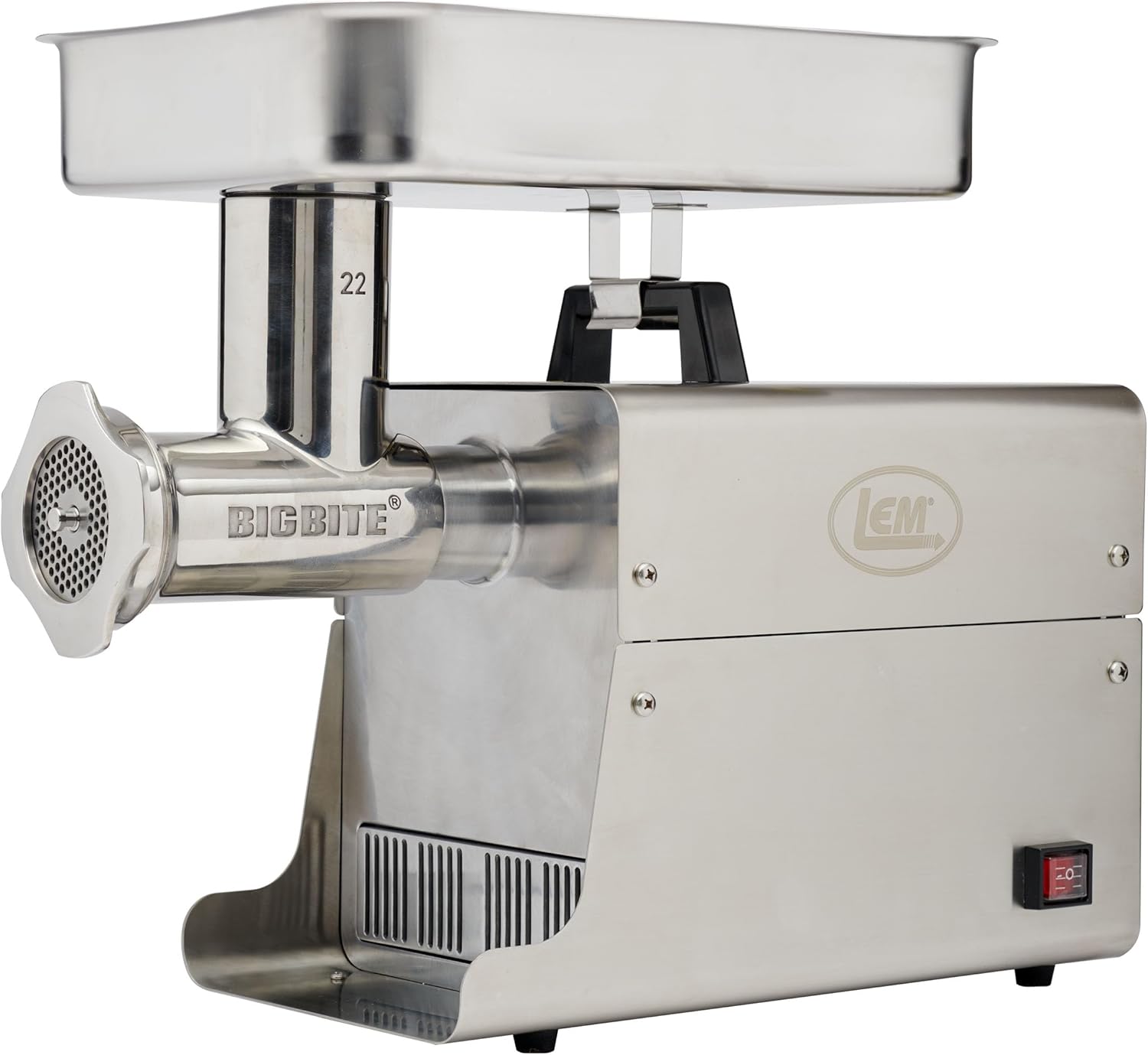
The LEM BigBite #22 is a heavy-duty, stainless steel electric grinder built to handle sustained use in a small butcher or serious home setup. Its 1.0 HP motor and large-diameter throat let the auger pull sizeable cuts through quickly, helping the unit process up to 13 pounds per minute and tackle a range of proteins including beef, pork, lamb, venison and even raw chicken bones. The grinder ships with a knife, coarse and fine plates, stuffing plate and three stuffing tubes, plus a meat stomper and a storage drawer for accessories, so you can grind, stuff sausages, and switch plates without hunting for parts. Permanently lubricated motor bearings and stainless components make operation smooth and simplify cleaning when the head is disassembled. Noise-dampening features reduce sound compared with lighter consumer units, but the machine is large and heavy, so it is best used on a dedicated workbench or counter. This model is focused on throughput and durability rather than compact storage or portability, so plan for a permanent spot in a small shop or processing area.
Best for: Butchers and small-shop operators who need a durable, high-throughput grinder that can process whole cuts and make sausages reliably during regular use.
Less Ideal for: Casual home cooks who need a compact, lightweight unit for occasional grinding or users who need a portable machine for multiple locations.
- Commercial-grade 1.0 HP motor suitable for continuous grinding
- Large-diameter throat and BigBite auger feed large cuts efficiently
- Includes plates, stuffing plate, three stuffing tubes and stomper for sausage making
- Stainless steel construction and permanently lubricated motor for durability and easier cleaning
- Noise-dampening design lowers operating sound compared with lighter grinders
- Substantial weight and footprint require a dedicated workspace
- Not designed for portability or small, occasional household use
Verdict: Choose the LEM #22 BigBite when you need a robust, high-throughput stainless steel grinder built for frequent use in a small butcher shop.
Weston Pro Series Meat Grinder

| Wattage | 1500 watts |
|---|---|
| Capacity | 18 pounds |
| Voltage | 120 volts |
The Weston Pro Series is a heavy-duty electric meat grinder built for high-throughput use in small butcher shops or serious home butchers. Its permanently lubricated 1500 W (2 HP) air-cooled motor and offset throat design are engineered to push 12 to 18 pounds of meat per minute, and precision steel gears and a rifled head help it run fast and quietly. The unit ships with coarse and fine stainless plates, a stainless knife, a sausage stuffing kit with multiple funnels, a patented auger-grabbing stomper for quick disassembly, and a tray-nested storage system with a cover and built-in knife sharpener for prep convenience. Practical benefits include easy teardown for cleaning, non-slip feet for stable operation, and a reverse function to clear jams. Important limitations are its weight and professional footprint that require counter space and the need for regular cleaning and maintenance typical of commercial grinders. The five-year limited warranty and robust construction make it a reliable choice for repeat daily use.
Best for: Butcher shops, small-scale commercial operators, and performance-focused home butchers who need a durable grinder that can handle frequent, high-volume grinding and sausage making.
Less Ideal for: Casual home cooks with limited counter space or those who only grind small amounts occasionally should consider smaller, lighter units instead.
- Powerful 1500 W (2 HP) motor suited for continuous grinding
- Includes coarse and fine stainless steel plates plus sausage stuffing funnels
- Design disassembles quickly for cleaning and has onboard storage and knife sharpener
- Precision steel gears and offset throat provide high-speed, relatively quiet operation
- Commercial size and weight demand dedicated counter space and are less suited to casual kitchen use
- Requires regular cleaning and maintenance after heavy use to keep performance optimal
Verdict: Choose this grinder when you need a rugged, high‑power machine built to handle heavy daily use and on‑site sausage production.
AAOBOSI Meat Grinder MG102A

| Capacity | 3 pounds |
|---|---|
| Wattage | 3000 watts (max) / 350W rated |
| Voltage | 120 volts |
| Included Components | 3 grinder plates, 2 blades, sausage tubes, kibbe kit, food pusher |
The AAOBOSI MG102A is a countertop electric meat grinder designed to move through batches quickly while keeping operation straightforward. It uses a high‑power motor with a quoted 3000W max (350W rated) and three speed modes plus an auto‑reverse to clear jams, which makes it suitable for continuous sausage making, burger mix, and grinding for pet or specialty raw blends when used with proper duty cycles. The touch color screen and built‑in storage keep controls and accessories accessible during busy shifts, and the included plates, two stainless blades, sausage funnels, and kibbe kit broaden what you can produce. Stainless steel parts are dishwasher safe for faster cleanup, though the manufacturer advises hand washing attachments for best results and warns against running continuously over 10 minutes to avoid overheating. For a small butcher setup this grinder offers strong throughput and practical features, but it is intended for light commercial or heavy home use rather than industrial nonstop processing.
Best for: Buyers who want a practical, higher‑output grinder for small butcher shop jobs or heavy home use that balances speed, control, and easy storage while avoiding industrial-scale equipment.
Less Ideal for: Shops needing full‑time, continuous commercial processing or very large daily throughput should choose a dedicated commercial grinder built for nonstop operation.
- Powerful motor with high max output for faster grinding and higher throughput when used in short runs.
- Auto-reverse function and three speed settings reduce jams and allow texture control for sausages and burgers.
- Built‑in storage and included accessories (plates, blades, sausage tubes, kibbe kit) keep tools organized and ready.
- Stainless steel components and dishwasher‑safe plates/blades simplify cleaning and maintenance.
- Not rated for continuous industrial use and manufacturer advises against runs longer than 10 minutes to prevent overheating.
- Capacity listed at 3 pounds may limit efficiency for larger butcher shop batches compared with commercial grinders.
Verdict: A capable, feature‑rich grinder that gives small butcher shops and serious home cooks fast, controlled grinding and built‑in accessory storage without stepping into full commercial machinery.
Aiheal Meat Grinder MG-2430RB

| Capacity | 44 pounds |
|---|---|
| Material Type | Stainless Steel |
| Power Source | Electric |
| Included Components | 2 Blades, 3 Plates, 3 Sausage Tubes, Pusher |
This Aiheal electric meat grinder is a compact, heavy-duty unit intended for home use that tackles bulk grinding with a 300W continuous motor and a 3200W max locked-power rating. It comes with three grinding plates (2mm, 5mm, 7mm), two stainless steel cutting blades, and three sausage-stuffer tubes so you can make fine to coarse grinds and fill sausages without extra accessories. The housing and most attachments are stainless steel for durability and food safety, and the unit includes a pusher, an R reverse/unclog button, and built-in overload protection that shuts the motor off if it overheats. In practice it cleans and disassembles easily for hand washing, and it speeds through batches of beef, pork, chicken or venison for fresh patties, meatballs, or sausage. This model is aimed at high-value home or small-scale use rather than continuous commercial duty, so expect occasional warm-up or pause cycles under very heavy loads and follow the prep guidance on cutting meat to size before grinding.
Best for: Buyers looking for an affordable, versatile grinder to process regular batches of meat and make sausages at home or in a small shop setting where budget matters and occasional pauses for cooling are acceptable.
Less Ideal for: Large butcher shops or operations that need nonstop, industrial-duty grinding for high daily throughput should choose a commercial-grade grinder designed for continuous use.
- Includes three grinding plates for multiple grind sizes
- Comes with three sausage-stuffer tubes for making sausages without extra parts
- Stainless steel components and blades for food safety and durability
- Reverse/unclog function and overload protection improve reliability and safety
- Motor is marketed with a high peak rating but continuous power is lower so not intended for heavy continuous commercial throughput
- Not dishwasher-safe for metal attachments, requiring hand drying after cleaning
Verdict: Aiheal MG-2430RB gives budget-minded buyers a versatile, stainless-steel home grinder with plates and stuffing tubes to handle regular sausage and ground-meat jobs without costly extras.
LEM BigBite #8 Meat Grinder

| Power source | electric |
|---|---|
| Material Type | Stainless Steel |
| Capacity | 7 pounds |
| Horsepower | 0.50 HP |
The LEM BigBite #8 is a heavy-duty electric grinder built from stainless steel and driven by a 0.5 HP motor for steady, repeatable grinding. It is intended for regular use in kitchens or small butcher-shop settings and can process roughly 7 pounds per minute, making it suitable for burgers, sausage, pet food, and bulk meal prep. The unit ships with three grinding plates, a knife, a stomper, and stuffing tubes so you can grind and stuff sausage without buying extras. Its permanently lubricated motor and stainless-steel parts simplify maintenance, and the design disassembles for cleaning. Practical benefits include solid build quality, decent throughput for small batches, and quieter operation than many comparably powered grinders. Limitations are obvious for higher-volume shops: the 0.5 HP motor and 7 lb/min rate are not intended for continuous high-capacity commercial production, and the unit is not rated for bones. For a butcher shop needing a reliable, factory-quality grinder for moderate daily volume or as a secondary unit for specialty tasks, the BigBite #8 is a sensible choice.
Best for: Shops that prioritize a durable, factory-quality grinder for consistent small- to moderate-volume runs or as a reliable secondary unit for specialty grind and sausage work.
Less Ideal for: High-volume butcheries that need continuous heavy throughput or bone-crushing capability should choose a larger industrial grinder instead.
- Stainless-steel construction for durability and easy cleaning
- Includes plates, knife, stomper, and stuffing tubes for immediate use
- Permanently lubricated motor reduces routine maintenance
- Processes about 7 pounds per minute for steady small-batch grinding
- Noise-dampening design yields quieter operation than many bench grinders
- 0.5 HP motor and 7 lb/min throughput are modest for high-volume commercial shops
- Not designed or rated to grind bones
Verdict: A sturdy, easy-to-maintain stainless-steel grinder that delivers reliable, moderate-capacity performance ideal for shops needing a dependable secondary or small-batch primary grinder.
CHEFFANO Meat Grinder AZ-MG091DG

| Material Type | Stainless Steel |
|---|---|
| Power Source | Corded Electric |
| Capacity | 180 pounds |
| Included Components | Sausage maker, food pusher, kubbe attachments, 2 blades, 3 cutting plates |
The CHEFFANO AZ-MG091DG is a stainless steel corded electric meat grinder that converts raw cuts into ground meat, sausages, and kibbe using a set of interchangeable plates, blades, and stuffing accessories. It is powered by a copper motor rated at 350W with a claimed peak of 2800W and uses a three-layer auger designed to reduce heat buildup while grinding. Typical use is straightforward: assemble the head and plate you want, feed meat with the food pusher, and switch to reverse if the feed clogs. The included 2 blades, three plate sizes, kubbe attachments, and sausage tubes extend functionality beyond basic grinding, and removable parts make hand washing and drying simple. For a small shop or high-volume home use the grinder reports roughly 3 lb/min throughput and a large stated capacity, but the unit is positioned toward home and small commercial tasks rather than continuous heavy industrial use. Not dishwasher safe and the motor specifications lean on peak watt claims rather than continuous commercial ratings, so shops that need nonstop, floor-to-floor throughput should consider commercial-rated machines instead.
Best for: Shops or small-scale processors who want a versatile, accessory-rich grinder that handles regular batches and occasional sausage or kibbe work while keeping heat and texture control in mind.
Less Ideal for: High-volume butcheries that require continuous commercial-grade grinders built for nonstop daily throughput and higher continuous motor ratings.
- Includes multiple cutting plates, two blades, kubbe attachments, and sausage stuffer tubes for versatile use
- Stainless steel construction for food-grade contact and easier cleaning of removable parts
- Three-layer auger designed to reduce heat during grinding and help preserve meat texture
- Reverse function helps clear jams without disassembling the unit
- Motor rating emphasizes a peak watt value rather than a continuous commercial horsepower rating
- Not dishwasher safe, so cleaning requires hand-washing and prompt drying
Verdict: Choose this grinder if you need a versatile, accessory-packed stainless steel unit suited to regular small-batch shop tasks rather than nonstop industrial production.
STX Turboforce 3000 Classic

| Wattage | 1800 watts |
|---|---|
| Capacity | 3 pounds |
| Voltage | 110 volts |
The STX Turboforce 3000 Classic is a robust electric meat grinder designed for heavy home use rather than full commercial service. It uses a Size 12 grinding head with a large hopper that holds about 3 pounds of prepped meat and an auger designed for higher intake, letting the unit process roughly 180 to 240 pounds per hour when meat is properly cubed. The package includes five grinding plates, three stainless steel cutting blades, sausage stuffing tubes, a kubbe attachment, shredding claws and a burger press, which makes it versatile for sausage making and various ground-meat recipes. The motor is rated up to 3000W peak but typically draws 800 to 1200W under load, and the unit runs on 110V household power. Important limits: it is not intended for grinding bones, tendons, vegetables or for continuous commercial production, and it is positioned as a heavy-duty home appliance rather than a factory machine. For risk-averse buyers looking for a durable, well-equipped grinder for high-volume home or light-shop tasks, it delivers a lot of capability in one package.
Best for: Buyers who want a heavy-duty, well-equipped grinder for frequent high-volume home use or light shop tasks and who prioritize durable construction and included accessories.
Less Ideal for: This is not a good choice for commercial butcher shops needing continuous industrial throughput or for users who must grind bones and other non-meat materials.
- Size 12 grinding head and large hopper support higher-volume batches
- Includes multiple grinding plates, blades and stuffing tubes for versatile use
- Stainless steel cutting blades and aluminum grinding head for durable food-contact parts
- High throughput when meat is properly prepped (180–240 lb/hr)
- Comes with useful accessories like kubbe attachment and burger press
- Not rated or intended for continuous commercial/industrial use
- Cannot grind bones, tendons, or non-meat items
Verdict: A feature-rich, heavy-duty home grinder that handles large household batches and sausage work without stepping into industrial-grade equipment.
Choosing the Right Meat Grinder for Butcher Shop: Key Factors to Consider
Throughput and Shift Capacity
Throughput is the amount of meat a grinder can process per hour and directly affects how many orders you can handle in a shift. For a butcher shop, peak periods require consistent output without frequent bottlenecks. Estimate your daily and peak-hour volumes to choose a grinder with some headroom rather than matching average demand exactly.
Choosing a machine with higher rated throughput reduces the chance of overheating and avoids long queues during busy morning or weekend periods. Also consider whether your workflow includes batch runs that would benefit from continuous-duty operation versus short intermittent loads.
Motor Power and Duty Cycle
Motor horsepower and the duty-cycle rating indicate whether a grinder can sustain prolonged operation. Commercial environments typically require motors designed for continuous or heavy intermittent duty to prevent thermal shutdown and premature wear. A motor that is powerful enough for the largest grind head and plate you plan to use delivers more consistent results.
Look for grinders with cooling features, serviceable motor assemblies, and clear manufacturer guidance on duty cycles. Units underspecified for commercial use often have lower upfront cost but higher long-term disruption due to downtime and repairs.
Materials and Construction
Contact surfaces made from stainless steel resist corrosion and meet food-safety expectations better than aluminized or plated alternatives. Solid machining and heavy-gauge housings reduce vibration and alignment issues that produce inconsistent grinds. A well-built feed throat and auger alignment also improve throughput and longevity.
Consider welded or bolted frames that allow access to wear parts and prioritize machines designed with replaceable components rather than sealed assemblies to simplify long-term service.
Sanitation and Ease of Cleaning
Butcher shops must follow strict sanitation practices, so grinders that disassemble quickly and have smooth, non-porous surfaces save time during cleaning. Fewer crevices where meat can lodge reduce cross-contamination risk and make inspections easier. Removable augers, heads, and plates that fit standard dishwashing or manual-sanitizing rigs are preferable.
Also check whether the grinder's design allows for rapid reassembly and whether fasteners and seams are accessible with common tools to speed routine cleaning between shifts.
Accessory Compatibility and Versatility
Versatility matters if the shop produces a range of products such as different grind sizes, fresh sausage, and specialty blends. Compatibility with a variety of plates, knives, and stuffing funnels extends the machine's usefulness. Choose a grinder whose accessory ecosystem matches your menu and production methods.
Consider whether the machine accepts larger-diameter heads for coarser grinds or smaller plates for fine textures, and whether auxiliary attachments are easy to change during the workday.
Serviceability and Parts Availability
Minimizing downtime requires a grinder whose consumables and common replacement parts are readily available. Augers, blades, plates, and bearings are typical wear items. Machines that allow simple field replacement without specialized tools reduce repair turnaround and service costs.
Also consider whether the manufacturer or distributor provides clear documentation, exploded parts diagrams, and accessible customer support for technical help. A machine that can be serviced in-house or locally keeps the shop running.
Sizing Your Grinder to Shop Volume
Match the grinder size to your average daily throughput and planned growth. Small commercial grinders fill a niche for low-volume shops or secondary prep stations, while larger-capacity machines suit high-volume retail butchers and wholesale producers.
When sizing, convert expected daily production into hourly peaks to account for busy periods and block scheduling. Give yourself a margin so the machine is not running at its upper limit continuously, which shortens service life.
- Estimate peak-hour lbs/hr rather than daily totals.
- Factor in batch runs for sausage or special orders.
- Allow 20 to 30 percent headroom over typical peak demand.
Workflow Integration and Placement
Consider physical footprint, table or floor mounting, and how the grinder fits into your prep line. A well-placed grinder reduces handling time and cross-contamination risks by minimizing transport between cutting, grinding, and packaging stations.
Plan for adjacent work surfaces, waste handling, and easy access to cleaning stations. If the grinder is on casters, verify stability during operation and lockability to prevent movement while feeding.
- Provide sanitary work surfaces within arm's reach.
- Allow space for feed-in and collection bins.
- Locate near power and drainage or cleaning stations as needed.
Noise, Vibration, and Operator Comfort
Commercial grinders can generate significant noise and vibration that affect staff comfort and concentration. Higher-end builds often include balanced augers and vibration-damping mounts that reduce operator fatigue and tool wear.
Assess whether the machine's operating noise requires hearing protection or whether vibration could loosen fasteners over time. Ergonomic feed trays and reachable controls improve throughput and safety.
- Test or check ratings for noise and vibration where possible.
- Choose ergonomic feed designs to reduce repetitive strain.
- Ensure safety guards and controls are intuitive and reachable.
Sanitation Best Practices for Grinders
Establish a cleaning routine that matches production cycles. Disassemble contact parts at the end of each day and sanitize according to regulatory guidance. Regular inspection of seals and fasteners prevents buildup that compromises hygiene.
Use appropriate sanitizers and drying practices to prevent corrosion. Keep a maintenance log that records part replacements and cleaning cycles to support audits and consistent practices.
- Disassemble and sanitize contact components daily.
- Inspect blades and plates for wear that traps meat.
- Use checklists to ensure consistent sanitation across staff.
Common Maintenance Tasks and Intervals
Routine maintenance keeps a grinder reliable. Common tasks include sharpening or replacing blades, checking plate alignment, lubricating bearings where permitted, and inspecting belts or motor mounts.
Schedule inspections weekly for high-use machines and monthly for lighter commercial use. Track hours of operation if duty cycles are specified and plan part replacement based on manufacturer life estimates.
- Replace cutting knives and plates before major wear affects grind quality.
- Keep a small inventory of consumable parts on hand.
- Document repairs and hours to inform future purchasing decisions.
Safety Features to Prioritize
Safety matters in a busy shop. Look for units with feed guards, emergency stop switches, and interlocks that prevent operation when access panels are open. Stable mounting and secure fasteners reduce the risk of movement during high-load use.
Train staff on safe feeding techniques and lockout procedures for cleaning and maintenance. Machines that are intuitive to operate reduce the chance of operator error.
- Confirm the presence of emergency stop and interlock mechanisms.
- Train all users on lockout/tagout during maintenance.
- Use feed equipment that prevents hand contact with moving parts.
How We Chose the Best Meat Grinder for Butcher Shop
We focused on attributes that matter in a commercial butcher-shop setting rather than hobby or home use. Primary evaluation criteria included continuous throughput capacity and motor power, because these determine how much meat the grinder can process reliably during a shift. Build durability and materials were assessed to ensure units resist wear from frequent use and are serviceable over time. Ease of cleaning and sanitation matters for food-safety compliance and quick turnaround between runs. Versatility and accessory support were considered for shops that switch between grind sizes, sausage stuffing, and specialty tasks. Finally, maintenance and parts availability were part of our selection filter to minimize downtime. Excluded items included consumer-grade grinders intended for occasional home use and units lacking clear specifications for continuous-duty operation. We prioritized models with explicit throughput ratings, robust motor specifications, stainless-steel contact surfaces, and accessible service parts. The criteria above guided inclusion and ranking, emphasizing practical performance metrics a butcher needs day to day.
Our full evaluation process is outlined in our review methodology.
FAQ
How much throughput do I really need for a small butcher shop?
That depends on your daily sales and any wholesale accounts. Convert expected daily pounds into peak-hour demand and add roughly 20 percent margin. Many small shops operate well with moderate-capacity commercial grinders designed for continuous intermittent use.
Can commercial grinders handle bone and connective tissue?
Most grinders designed for butcher-shop use are built to process trimmed cuts and small bones typical of retail prep, but heavy bone-in processing requires machines rated for that purpose. Always follow manufacturer guidance on allowable inputs to avoid damage and contamination.
What sanitation steps prevent cross-contamination between runs?
Disassemble contact parts, remove trapped material, wash with detergent, sanitize with an approved agent, and dry thoroughly. Maintain separate cleaning schedules for allergen or specialty runs and document the process to support food-safety inspections.
How often should cutting plates and knives be replaced or sharpened?
Replacement frequency depends on use intensity and the types of meat processed. Inspect plates and knives regularly for nicks, dulling, and warping. Many shops sharpen or replace knives on a monthly to quarterly cycle, increasing frequency for heavy daily use.
Are parts and service generally available for commercial grinders?
Availability varies, but choosing machines with standardized plate sizes and common parts improves chances of quick replacement. Verify documentation and local service options before purchase to limit downtime.
Final Verdict
When selecting a meat grinder for a butcher shop, prioritize throughput and a motor with an appropriate duty cycle first, then check build materials and ease of cleaning. Balance capacity against footprint and workflow to ensure the machine fits operational needs without overtaxing staff. Finally, consider serviceability and parts availability to reduce downtime. Focus on machines that match your peak-hour demands, simplify sanitation, and offer accessible maintenance. That approach helps you choose confidently and keep production reliable in a busy shop environment.