
Note: This article contains affiliate links. If you click on these links and make a purchase, we may earn a small commission at no extra cost to you. This helps support our research and content. Read our full affiliate disclosure here.
If you plan to make sausage at home, the right meat grinder makes a big difference in texture, yield, and ease of stuffing. You will want a machine that produces a consistent grind, handles variable meat-to-fat ratios, and couples with reliable stuffing attachments so you can form uniform links without frustrating clogging or rebound. This guide shortlists the top meat grinders for sausage making and explains the practical tradeoffs between throughput, grind quality, and cleaning effort. Below you will find our top picks for home sausage production plus the evaluation criteria we used to narrow the field and help you pick the best tool for your volume and workflow.
Top Picks at a Glance
| Best Overall The best all-around choice for most situations | Aiheal Meat Grinder MG-2430RB |  |
| Best Quality Built to a higher standard if you want something more solid | LEM BigBite #8 Meat Grinder |  |
| Best Value The sweet spot between price and what you get | AAOBOSI Meat Grinder MGC04 |  |
| Best Budget The cheapest option that still gets the job done reliably | Oaomi Meat Grinder S8 |  |
| Top Rated A top-rated pick with lots of positive feedback | Kourice Electric Meat Grinder H10 |  |
| Most Popular A crowd favorite that many people choose with confidence | STX Turboforce 3000 Meat Grinder |  |
| Best Seller A high-volume bestseller chosen again and again | KitchenAid Metal Food Grinder KSMMGA |  |
Aiheal Meat Grinder MG-2430RB

| Capacity | 44 pounds |
|---|---|
| Material Type | Stainless Steel |
| Included Components | 2 Blades, 3 Plates, 3 Sausage Tubes, Pusher |
| Power Source | Electric |
| Model Number | MG-2430RB |
This Aiheal electric meat grinder is a heavy-duty home unit aimed at people who want to grind and stuff sausages as well as process a range of meats. It uses a powerful motor (300W nominal, 3200W peak locked power) and a 100% copper motor design to move through bulk batches quickly, and it ships with three grinding plates (2mm, 5mm, 7mm), two cutting blades, and three sausage stuffing tubes for different textures and casings. The stainless steel construction and removable cutting attachments make cleanup and food safety straightforward, though the manufacturer advises hand-washing rather than using a dishwasher. Built-in overload protection and a reverse/unclogging button add practical safety and convenience when dealing with sinewy or cold cuts. Expect a fairly large, purposeful footprint and a unit designed for intermittent home use rather than nonstop commercial runs; following the instructions for cutting meat to size and not overloading will maximize performance and longevity.
Best for: Home cooks who make sausages and want a versatile, higher-power grinder that handles whole joints and produces multiple grind textures for burgers, meatballs, and sausages.
Less Ideal for: Commercial kitchens or users who need continuous, high-volume grinding for long shifts should consider a purpose-built commercial grinder instead.
- Powerful motor for faster grinding of bulk batches
- Comes with three grinding plates and three sausage tubes for versatile textures and sausage sizes
- Stainless steel parts and removable attachments simplify cleaning and maintain food safety
- Built-in overload protection and reverse/unclog button increase safety and ease of use
- Manufacturer advises hand-washing attachments and not using a dishwasher
- Not intended for continuous commercial use despite high peak power rating
Verdict: Aiheal’s MG-2430RB is a strong, well-equipped home meat grinder that gives sausage makers multiple plate options and reliable overload protection for consistent, homemade results.
LEM BigBite #8 Meat Grinder

| Capacity | 7 pounds |
|---|---|
| Material Type | Stainless Steel |
| Power Source | electric |
| Horsepower | 0.50 HP |
The LEM BigBite #8 is a heavy-duty stainless steel electric grinder built for serious home cooks and hunters who need reliable, repeatable grinding for burgers, sausages, and pet food. Its 0.5 HP motor and BigBite feed throat move meat efficiently—about 7 pounds per minute—while included plates, knife, stomper, and stuffing tubes let you switch between coarse grind, fine grind, and sausage stuffing without extra purchases. The unit disassembles for cleaning and uses permanently lubricated motor components to reduce maintenance. It is relatively quiet for its class and feels robust on the counter, making it suited to multiple batches and repeat use. The main limitations are its weight and size, which make it less convenient to store or move, and it is not rated for bone processing. If you plan to grind large whole bones or need a compact countertop unit, consider other options, but for sausage making and frequent batch grinding this model delivers dependable, pro-style performance.
Best for: Buyers who prioritize consistent, high-capacity grinding and want a durable, pro-style machine for making sausages, burgers, or processing game.
Less Ideal for: Casual users with minimal counter space or anyone who needs a lightweight, portable grinder or a unit rated to process bones.
- Stainless steel construction for durability and easy cleaning
- 0.5 HP motor processes about 7 pounds per minute for steady throughput
- Includes grinding plates, knife, stomper, and stuffing tubes for sausage making
- Permanently lubricated motor reduces routine maintenance
- Heavy and bulky which makes storage and transport awkward
- Not suitable for grinding bones
Verdict: Choose the LEM BigBite #8 when you need a rugged, factory-quality grinder that reliably handles frequent sausage-making and batch grinding tasks.
AAOBOSI Meat Grinder MGC04

| Wattage | 2800 watts |
|---|---|
| Capacity | 1.5 kg |
| Voltage | 120 volts |
| Power Source | electric |
This AAOBOSI MGC04 is a multifunctional electric meat grinder aimed at home cooks who make ground meat and sausage. It uses a high-power motor (listed up to 2800W max) and a 1.5 kg capacity to process meat quickly, and includes three grinding plates, two cutting blades, sausage stuffer tubes, a kubbe kit, and slicing/shredding attachments for added versatility. Practical features like an auto-reverse button for unclogging, overload protection and heat-dissipation vents help prevent jams and overheating during heavier batches, and many removable stainless steel parts make cleanup straightforward. The stainless steel housing and included dishwasher-safe blades give it a durable, kitchen-ready feel, though the unit is best used with boneless cuts to avoid jamming. For someone optimizing a home setup for sausage making, the MGC04 balances performance and accessory variety, but users should follow the guidance about avoiding bones and dense connective tissue to keep the motor running smoothly.
Best for: Home cooks who want a practical, all-in-one grinder for making fresh sausage and ground meat without investing in commercial equipment and who value included attachments and safety features.
Less Ideal for: Users who need a commercial-grade grinder for frequent large batches or who plan to process bones and very tough cuts should consider a heavier duty model.
- Comes with multiple accessories including 3 grinding plates, 2 blades, sausage stuffers and kubbe maker for sausage and charcuterie tasks
- High listed wattage and 1.5 kg capacity allow relatively fast home grinding
- Safety features like overload protection and reverse function reduce jamming and motor strain
- Stainless steel construction and removable blades/plates simplify cleaning and durability
- Manufacturer advises against grinding bones, tendons, or skin which limits processing of whole cuts
- Actual continuous power and long-run performance may be lower than the listed maximum wattage under heavy commercial use
Verdict: A versatile home-focused grinder with the accessories and safety features needed to make fresh sausage reliably without stepping up to commercial equipment.
Oaomi Meat Grinder S8

| Included components | Meat Grinder, blades, plates, sausage tubes, Kubbe kit |
|---|---|
| Material Type | Stainless Steel |
| Model Number | S8 |
| Motor Power | 3200W |
The Oaomi S8 is a compact electric meat grinder aimed at home cooks who want to make burgers, sausages, and regional dishes like kubbe. It includes two stainless steel cutting blades, three grinding plates for different textures, three sausage stuffing tubes, and a Kubbe kit so you can experiment with several sausage sizes and shapes. A claimed 3200W pure copper motor and overload protection with a thermostat promise strong, continuous grinding and safety against overheating, while a one-touch on/off plus reverse helps clear jams. Most removable parts detach for handwashing and some dishwasher-safe pieces simplify cleanup. The unit's stainless steel construction looks durable for frequent use, but buyers should note the product dimensions are fairly compact, which suggests it is best for batch work rather than large commercial volumes. The S8 delivers a lot of accessories for the price, making it a practical pick for home sausage makers who want versatility without a big investment.
Best for: Home cooks on a budget who want a feature-rich grinder for making sausages, burgers, and specialty items without paying for a commercial machine.
Less Ideal for: Users who need heavy-duty, high-volume grinding for commercial kitchens or continuous daily production should consider larger commercial-grade equipment.
- Comes with two blades, three grinding plates, three sausage tubes, and a Kubbe kit for versatile sausage and grind options
- Pure copper motor with overload protection and thermostat for sustained performance and safety
- Reverse function and one-touch controls simplify jam clearing and operation
- Many removable parts are dishwasher-safe or easy to detach for cleaning
- Compact footprint limits throughput for very large batches or commercial use
- Some smaller components require hand washing, adding to cleanup time
Verdict: If you want an affordable, accessory-packed grinder for home sausage making, the Oaomi S8 gives the most practical features for the price.
Kourice Electric Meat Grinder H10
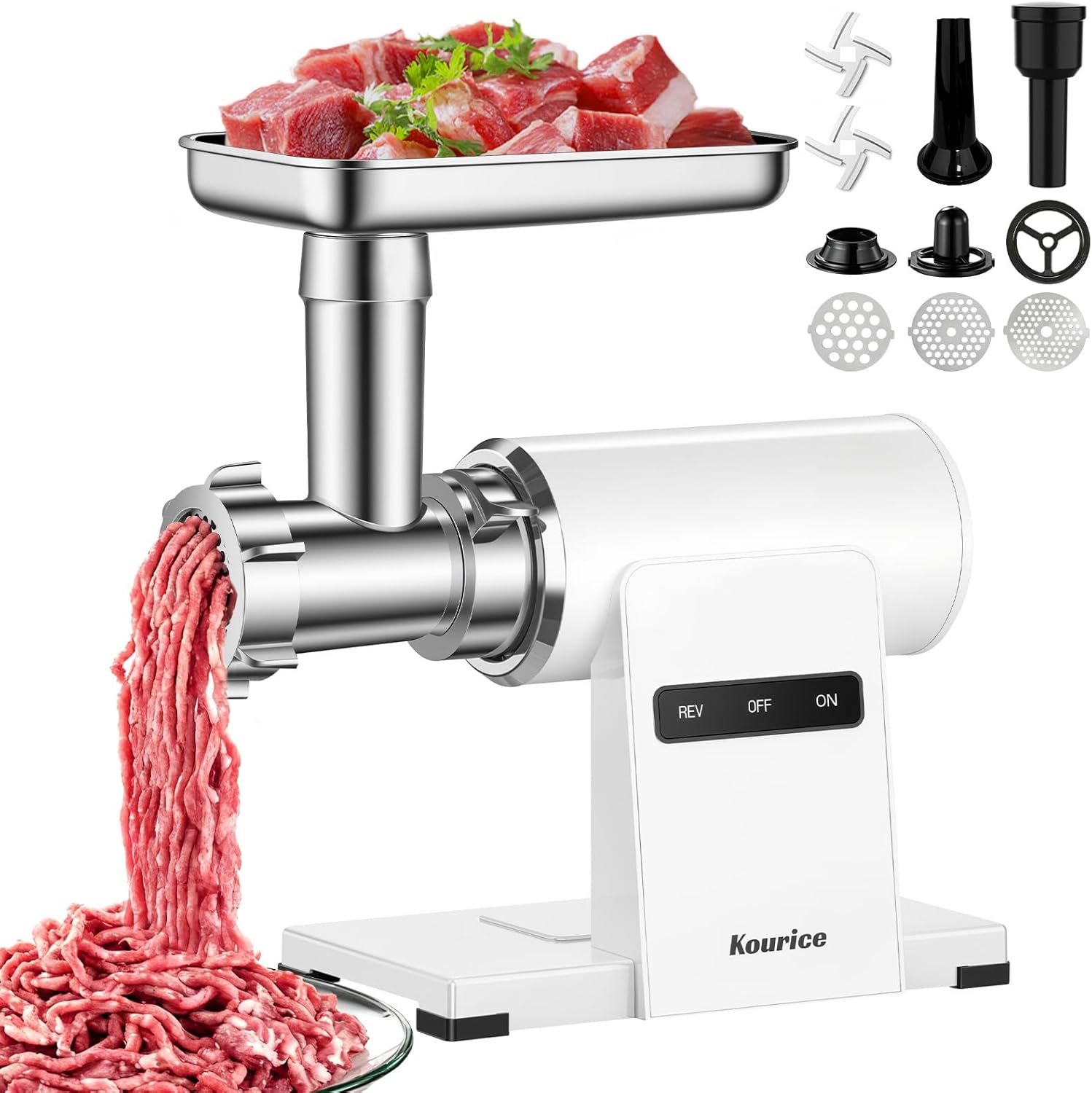
| Peak power | 2800W |
|---|---|
| Capacity | 5.5 pounds |
| Included plates | 3mm, 5mm, 7mm |
| Included attachments | Sausage funnel and kubbe kit |
The Kourice H10 is a metal-bodied electric meat grinder designed for home sausage and kubbe making as well as everyday grinding tasks. Its 2800W peak motor is claimed to grind up to 5.5 pounds per minute and the unit includes two blades, three grinding plates (3mm, 5mm, 7mm), a sausage funnel, a kubbe attachment, and a food pusher so you can make fine to coarse textures and stuff sausages right away. The auto-reverse button helps clear jams and the non-slip base keeps the machine steady during use. Because the cutting parts and plates are metal, the grinder feels durable and handles tougher cuts and game meat reliably, though the manufacturer recommends hand-washing the metal accessories to avoid discoloration. Expect some noise and routine cleaning after use, and be mindful that heavier, continuous workloads may require short breaks to avoid overheating. For home cooks who prioritize solid construction and consistent grinding for sausage projects, this is a practical, ready-to-run option.
Best for: Home cooks who need a robust, factory-quality grinder for regular sausage making and value durable construction and reliable jam-clearing features.
Less Ideal for: Buyers who want a near-silent, low-maintenance appliance or those who only need occasional, very small-volume grinding should consider simpler or quieter alternatives.
- High peak motor power for fast grinding and handling tougher meats
- All-metal body, blades, and plates for greater durability
- Includes multiple plates and sausage/kubbe attachments for immediate sausage making
- Auto-reverse function reduces clogging and simplifies troubleshooting
- Non-slip base improves stability during operation
- Manufacturer recommends hand-washing metal accessories which adds cleaning effort
- May be noisy during high-speed or heavy use
Verdict: Choose the Kourice H10 when you want a sturdy, high-power home grinder that comes ready for serious sausage making out of the box.
STX Turboforce 3000 Meat Grinder

| Capacity | 3 pounds |
|---|---|
| Wattage | 1800 watts |
| Voltage | 110 volts |
| Head size | Size #12 |
The STX Turboforce 3000 is a home-focused electric meat grinder built to handle regular sausage-making and large batches of ground meat. It uses a size #12 grinding head, a large meat hopper that holds about 3 pounds, and an auger with variable intake to process prepped cuts quickly; the manufacturer rates its motor up to 3000W peak while typical grinding power runs between about 800 and 1200W. The unit includes three stainless steel cutting blades, five grinding plates, three sausage tubes, a kubbe attachment, meat claws, and a burger press so you can grind, stuff, and form sausages and patties without buying extras. Practical benefits include a high throughput (the listing states 180 to 240 pounds per hour when meat is properly prepared) and robust accessory set aimed at home sausage makers. Important limitations: it is not designed to grind bones, tendons, produce, or commercial continuous use, and the voltage is 110V only. Expect to prep meat to the recommended size chunks and follow the guidance to avoid jamming or damaging the head.
Best for: Home cooks who plan to make sausages, patties, and large batches of ground meat regularly and want a single unit with the accessories needed to stuff and form products.
Less Ideal for: Those who need a commercial-grade grinder for continuous high-volume production or anyone wanting to grind bones or non-meat ingredients should look at purpose-built commercial machines.
- Large hopper and #12 head accept bigger cuts for higher throughput
- Includes multiple grinding plates, sausage tubes, kubbe maker, and burger press for versatile sausage and patty work
- Stainless steel cutting blades and food-grade polished aluminum head for durable food-contact surfaces
- High claimed output suitable for batch sausage making when meat is properly prepped
- Not designed to grind bones, tendons, vegetables, or nuts
- Intended for home use only and not for commercial continuous operation
- 110V only, so no 220V option for higher-power setups
Verdict: If you want a capable home grinder that comes ready for sausage stuffing and high-throughput batch grinding, the Turboforce 3000 is a complete, accessory-rich choice.
KitchenAid Metal Food Grinder KSMMGA
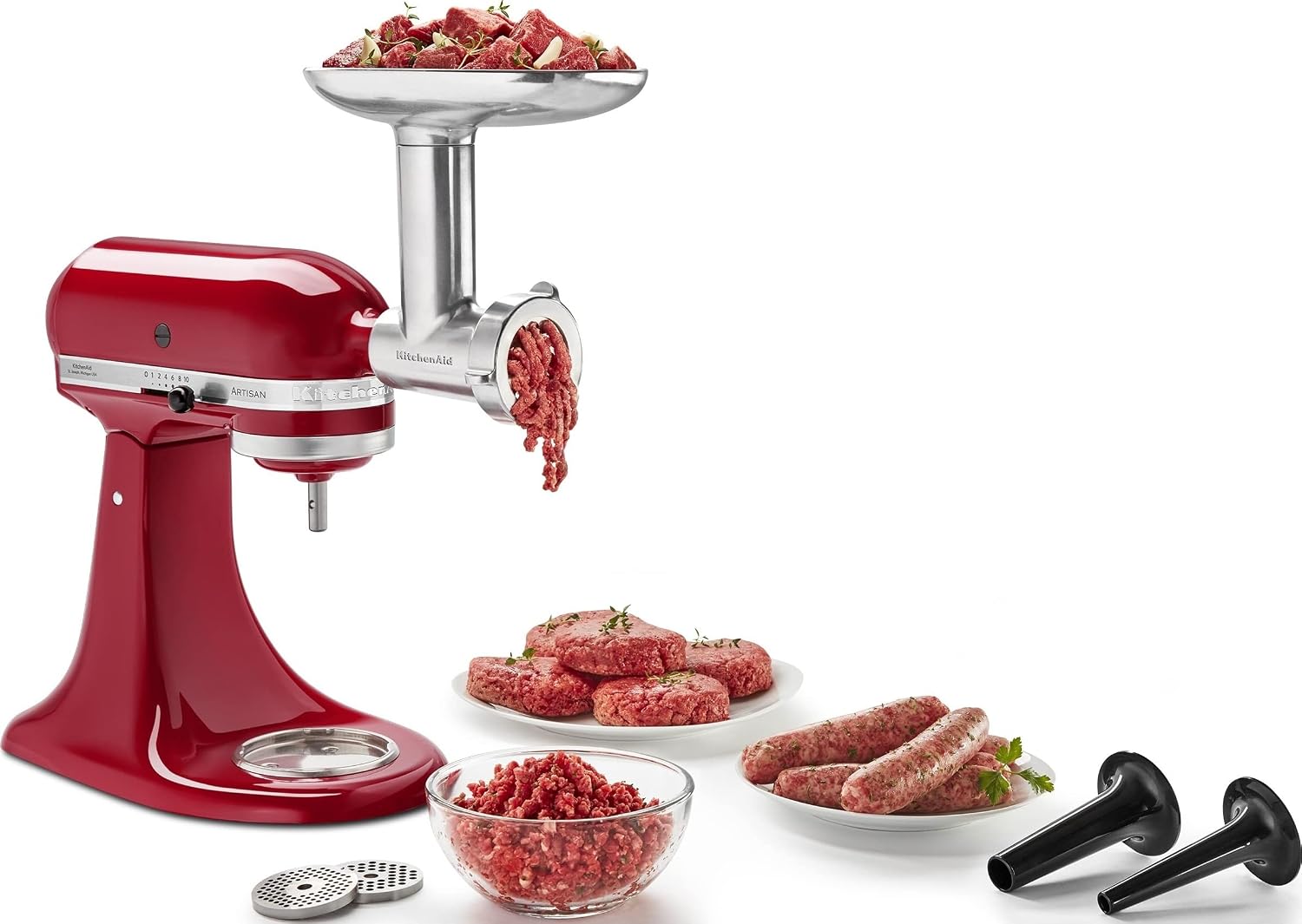
| Included components | Grinder, food tray, fine/medium/coarse plates, brush, pusher, 2 stuffer tubes, stuffer plate |
|---|---|
| Material | Metal |
| Voltage | 110 volts |
| Capacity | 11 kg |
The KitchenAid Metal Food Grinder KSMMGA turns a KitchenAid stand mixer into a capable tabletop grinder for burgers, sausages, and fresh breadcrumbs. It attaches to the mixer power hub and uses the mixer's motor to push ingredients through fine, medium, or coarse plates, and includes two sausage stuffer tubes and a stuffer plate for making links at home. The larger feed tray reduces refilling during batches and the all-metal construction feels sturdy for regular use, while the removable plates and food pusher make cleaning and switching grind sizes straightforward. For best results chill meat before grinding to keep a clean cut and prevent smearing. Because it relies on the stand mixer rather than an independent motor and lacks electric speed control of dedicated grinders, it is best for home cooks making small to medium batches rather than high-volume commercial work. The included storage case helps keep parts organized between uses, which is handy for occasional sausage makers.
Best for: Home cooks who want a reliable, factory-quality grinder attachment to make burgers and sausages in small to moderate batches without buying a separate appliance.
Less Ideal for: People who need a heavy-duty standalone grinder for frequent large-volume or commercial sausage production should look at dedicated motorized grinders instead.
- Attaches to KitchenAid stand mixers using the power hub so no separate motor is needed.
- Includes fine, medium, and coarse grinding plates for versatile texture control.
- Comes with two sausage stuffer tubes and a stuffer plate for making links at home.
- Larger food tray reduces refilling and speeds batch processing.
- All-metal construction and a storage case for organized, durable storage.
- Depends on the mixer's motor and lacks independent speed control found on standalone grinders.
- Not intended for high-volume commercial grinding or continuous heavy-duty use.
Verdict: If you already own a KitchenAid stand mixer and want a durable, ready-made way to grind meat and stuff sausages at home, this metal attachment is the practical choice.
Choosing the Right Meat Grinder for Sausage Making: Key Factors to Consider
Grind Consistency and Plate Options
A consistent grind is the foundation of well-textured sausage. Irregular or shredded pieces lead to poor binding and an uneven mouthfeel. Look for grinders that come with a range of plate sizes and produce uniform particle shapes with minimal smearing. Multiple plate sizes let you fine-tune texture for different sausage styles, from coarse country blends to fine breakfast links.
Also consider whether the feed geometry encourages straight, even passes through the auger. Augers that pack or deform meat increase the need for regrinding and make casing filling less predictable. For best results, choose a grinder with robust plate options and a design that maintains consistent pressure across the meat column.
Stuffing Compatibility and Tube Design
Sausage making requires more than grinding—the machine must reliably push ground meat into casings. Evaluate whether the grinder includes a set of stuffing tubes in multiple diameters and whether the machine's output flange supports aftermarket stuffing accessories. Tubes that are poorly tapered or too short can cause backpressure and tearing of natural casings.
Check the clearance between the auger and the tube entrance. A smooth transition minimizes jamming and reduces the hand pressure required when forming links. If you plan to make large-diameter sausages or charcuterie-style coils, confirm the availability of suitably sized tubes and whether the unit can maintain steady flow for longer stuffing runs.
Motor Power, Torque, and Duty Cycle
Power rating alone does not tell the whole story; torque and the unit's duty cycle determine how well the grinder handles dense or fatty mixes and continuous batches. Higher torque reduces stalling when the auger meets tougher connective tissue or larger bones when using sausage-friendly recipes. A grinder with a short duty cycle will overheat during extended stuffing sessions, forcing cool-down periods that slow production.
For frequent sausage makers or those who produce larger batches, choose a grinder with higher continuous operating capacity and thermal protection. Also look for features like reverse functions that can clear jams without disassembly, which saves time during production runs.
Build Materials and Food-Safety Considerations
Components that contact meat should be constructed from food-safe materials that resist corrosion and staining. Stainless steel housings and grinding parts are preferable for hygiene and durability. Plastic augers or housings can be acceptable if they are high-grade and marked food-safe, but they often do not match the longevity of metal components.
Pay attention to seams, threads, and joints where meat and juices can collect. Smooth, well-machined parts reduce bacterial harborage sites and simplify sanitizing. Replaceable or serviceable seals and bearings are useful to maintain performance and safety over time.
Ease of Cleaning and Maintenance
Frequent sausage production requires a grinder that disassembles easily and can be cleaned thoroughly between batches. Complex assemblies with hard-to-reach crevices increase the risk of contamination and add to your cleanup time. Removable plates, augers, and feed hoppers that fit typical sink spaces make daily maintenance practical.
Consider whether parts are dishwasher-safe or require hand washing, and whether replacement parts are readily accessible. Regular maintenance tasks such as lubricating gears, replacing seals, or sharpening plates should be straightforward without specialized tools.
Throughput and Workspace Integration
Throughput determines how much meat you can process in a session and affects workflow in the kitchen. Match grinder capacity to how much sausage you actually plan to make in a sitting. Larger-capacity models speed up production but may require a larger footprint and more storage.
Also consider how the grinder integrates with your workspace. A stable, low-vibration base and manageable weight make feeding and stuffing safer and less tiring. If you plan to use separate bowls, trays, or casings, ensure there is adequate counter space and that the grinder's hopper height aligns well with your work surfaces.
Preparing Meat and Fat for Best Results
How you prep meat and fat before grinding has a major influence on texture and stuffing performance. Trim sinew and silver skin that can tangle in the auger and cause inconsistent particle size. Cut meat and fat into uniform cubes so the auger can feed evenly.
Chill meat and equipment thoroughly. Cold meat reduces smearing, helps the fat stay coherent with the muscle, and produces a firmer grind which makes stuffing smoother. Run refrigerated batches rather than room-temperature meat for cleaner cuts and better binding.
- Trim connective tissue to prevent stringy results and jams
- Cube meat to similar sizes for even feeding
- Keep meat and parts cold to minimize smearing
- Alternate meat and fat during feeding for consistent distribution
Common Sausage-Making Workflows
Typical workflows vary with volume, but most sausage makers follow a repeatable sequence: refrigerate and cube ingredients, grind to the desired plate size (often two-stage grinding for very fine textures), mix with seasoning and binders, and then stuff directly into casings. Planning each step minimizes downtime and reduces the risk of meat warming during handling.
For small-batch or single-link production, a single-pass coarse plate followed by a final finer plate can be sufficient. For larger runs or emulsified sausages, multiple passes and a dedicated bowl mixer may be preferable to achieve uniform seasoning distribution and proper protein extraction.
- Two-stage grinding for precise texture control
- Prep seasoning and casings before you start to maintain continuous stuffing
- Use a cooling strategy between batches to prevent overheating
Sanitation Best Practices
Sausage production involves raw meat and moisture, so strict sanitation is essential. Disassemble grind plates, auger, and stuffing tubes after each use and wash in hot, soapy water. Sanitize surfaces and let parts air dry before reassembly to prevent bacterial growth.
Inspect seals and crevices regularly for trapped residues. Replace worn gaskets or badly pitted plates promptly to maintain hygienic conditions. If parts are dishwasher-safe, use the top rack only and verify manufacturer guidance for maximum temperatures.
- Disassemble and wash all meat-contact parts after each use
- Sanitize with food-safe solutions and allow thorough drying
- Replace worn seals and scratched plates to reduce contamination risks
Attachments and Add-Ons Worth Considering
Beyond standard plates and tubes, some grinders support helpful attachments that speed production or expand capability. Consider clamp-on or separate hoppers that increase feeding volume, specialized stuffing tubes for various casing diameters, and adapters that allow direct mounting of mixing bowls or sausage linkers.
Also look for optional accessories that assist with cleanup, such as dedicated brushes sized for plates and tubes, or storage trays that keep parts organized and reduce time between batches.
- Multiple stuffing tube sizes for range of link diameters
- Larger hoppers or feed chutes for higher throughput
- Cleaning brushes and organized storage trays to simplify maintenance
Troubleshooting Jams and Poor Stuffing Flow
Jams are often caused by overfilled tubes, warm fatty mixes, or stray connective tissue. If flow slows or stalls, switch the grinder to reverse if available, or stop and clear the tube to avoid stressing the motor. Avoid forcing frozen chunks or oversized cuts through the hopper.
If casings split during stuffing, try a slightly larger tube or reduce the packing pressure. Adjusting grind size or chilling the mix further will often restore smooth stuffing without tearing.
- Use reverse function or stop to clear jams rather than forcing
- Chill mix and casings to reduce splitting
- Check for and remove long strands of sinew before grinding
How We Chose the Best Meat Grinder for Sausage Making
We focused on capabilities and real-world usability for sausage making rather than generic specs alone. Key evaluation criteria included grind consistency, stuffing compatibility, motor capacity and duty cycle, build materials and hygiene, and ease of cleaning and maintenance. Grind consistency addresses how evenly the unit cuts muscle and fat across multiple passes and grind plates. Stuffing compatibility looks at included or supported stuffing tubes, hopper-to-tube feed geometry, and how reliably the grinder pushes meat into casings without excessive hand pressure. Motor capacity and duty cycle are essential for throughput and for avoiding overheating during batch runs. Build materials and hygiene evaluate food-safe components, corrosion resistance, and whether parts disassemble for cleaning. Ease of cleaning and maintenance considers how many tools are required to strip the unit, how accessible food paths are, and whether seals or bearings are serviceable. We excluded heavy industrial equipment and single-use novelty devices that cannot sustain repeated sausage batches or lack proper food-safe construction. The final selection favors units that balance performance with practical upkeep and that support the attachments and torque required for consistent sausage stuffing.
Our full evaluation process is outlined in our review methodology.
FAQ
What grind plate sizes should I use for different sausages?
Coarse plates are good for country-style or smoked sausages where a chunky texture is desired. Medium and fine plates work better for breakfast links and emulsified sausages. Many makers use a two-pass approach: coarse then fine to balance texture and bind.
Can I use a meat grinder for stuffing natural casings?
Yes, most grinders designed for sausage making include or accept stuffing tubes sized for natural casings. Proper tube fit and chilled meat make stuffing easier and reduce the risk of tearing.
How do I prevent my grinder from overheating during long batches?
Match grinder capacity to your batch size and allow cool-down periods if the unit reaches its duty cycle. Chilling meat and working in shorter intervals reduces load. Models with thermal protection will shut off before damage occurs.
How do I keep my grinder sanitary between uses?
Disassemble all meat-contact parts after each session, wash with hot soapy water, sanitize with a food-safe solution, and air dry. Inspect and replace worn or pitted parts to avoid bacterial harborage.
Is higher motor wattage always better for sausage making?
Higher wattage can indicate greater capacity, but torque and duty cycle matter more for sustained stuffing and dense mixes. A well-engineered motor with good torque and cooling outperforms a higher-wattage unit with poor thermal management.
Final Verdict
Choosing the right meat grinder for sausage making comes down to balancing grind quality, stuffing reliability, and practical upkeep. Prioritize machines that deliver uniform particle size, offer suitable stuffing tubes, and have the motor capacity to handle your batch sizes without excessive cooling breaks. Durable, food-safe materials and easy disassembly will save time and reduce contamination risk. Decide first on your typical batch volume and preferred sausage textures, then select a grinder that aligns with that workflow. Emphasizing consistent grind and stuffing performance will produce the most reliable, flavorful sausages over time.