
Note: This article contains affiliate links. If you click on these links and make a purchase, we may earn a small commission at no extra cost to you. This helps support our research and content. Read our full affiliate disclosure here.
If you sew frequently and tackle complex projects, a mechanical sewing machine built for advanced sewers gives you the tactile control and durability you need. The right machine makes it easier to manage heavy fabrics, multiple layers, and precision stitching without unnecessary fuss. This guide covers six shortlisted mechanical sewing machines chosen for durability, stitch quality, and advanced control features that experienced sewists value. We explain the evaluation criteria and what to prioritize so you can match a machine to your typical projects and workflow.
Top Picks at a Glance
| Best Overall The best all-around choice for most situations | Elna 3210 Jeans Sewing Machine |  |
| Best Quality Built to a higher standard if you want something more solid | Juki TL-2010Q Sewing Machine |  |
| Best Budget The cheapest option that still gets the job done reliably | Brother FB1757X Sewing Machine |  |
| Top Rated A top-rated pick with lots of positive feedback | SINGER Heavy Duty 4423 |  |
| Most Popular A crowd favorite that many people choose with confidence | SINGER Heavy Duty 4432 |  |
| Best Seller A high-volume bestseller chosen again and again | VEVOR Lockstitch Sewing Machine JK9808 |  |
Elna 3210 Jeans Sewing Machine

| Stitches | 19 built-in stitches |
|---|---|
| Buttonhole | One-step buttonhole |
| Max stitch width | 6.5 mm |
| Power source | Electric |
The Elna 3210 Jeans is a mechanically focused sewing machine built to tackle denim and other heavy fabrics while remaining usable for lightweight and stretch materials. It offers 19 built-in stitches including utility, stretch, and decorative options plus a one-step buttonhole, making it suitable for garment construction and finish work. Practical touches aimed at reliable performance include strong needle penetration, adjustable presser foot pressure, an extra-high presser foot lifter, drop feed dogs and a free arm for sewing sleeves and trousers. The machine uses a top-loading horizontal rotary hook bobbin with a clear cover to reduce jams and a built-in needle threader to speed setup. Elna bundles a generous set of presser feet and accessories stored under the top cover and includes a denim bag that doubles as a cover and transport solution. Expect a mechanically straightforward machine that emphasizes durability and control rather than computerized automation, so users comfortable with manual stitch selection and mechanical controls will get the most from it.
Best for: Advanced hobbyists and sewists who value a durable, mechanically reliable machine for garment construction and heavy-fabric projects and prefer hands-on control over computerized features.
Less Ideal for: Users who want touchscreen menus, automated stitch customization, or the lightest portable option should consider a computerized or more compact model instead.
- Built for heavy fabrics with strong needle penetration and adjustable foot pressure
- 19 built-in stitches plus one-step and extra-large buttonhole options for versatile garment work
- Jam-proof horizontal rotary hook bobbin and clear bobbin cover for smoother sewing
- Generous accessory kit with multiple presser feet and onboard storage
- Free arm and extra-high presser foot lifter simplify sewing cuffs, sleeves, and thick seams
- Mechanical controls lack computerized stitch programming or LCD guidance
- Relatively heavy and bulky compared with compact portable machines
Verdict: Choose the Elna 3210 Jeans when you need a mechanically robust, no-frills machine built to handle denim and heavy garment work with professional-feeling control.
Juki TL-2010Q Sewing Machine
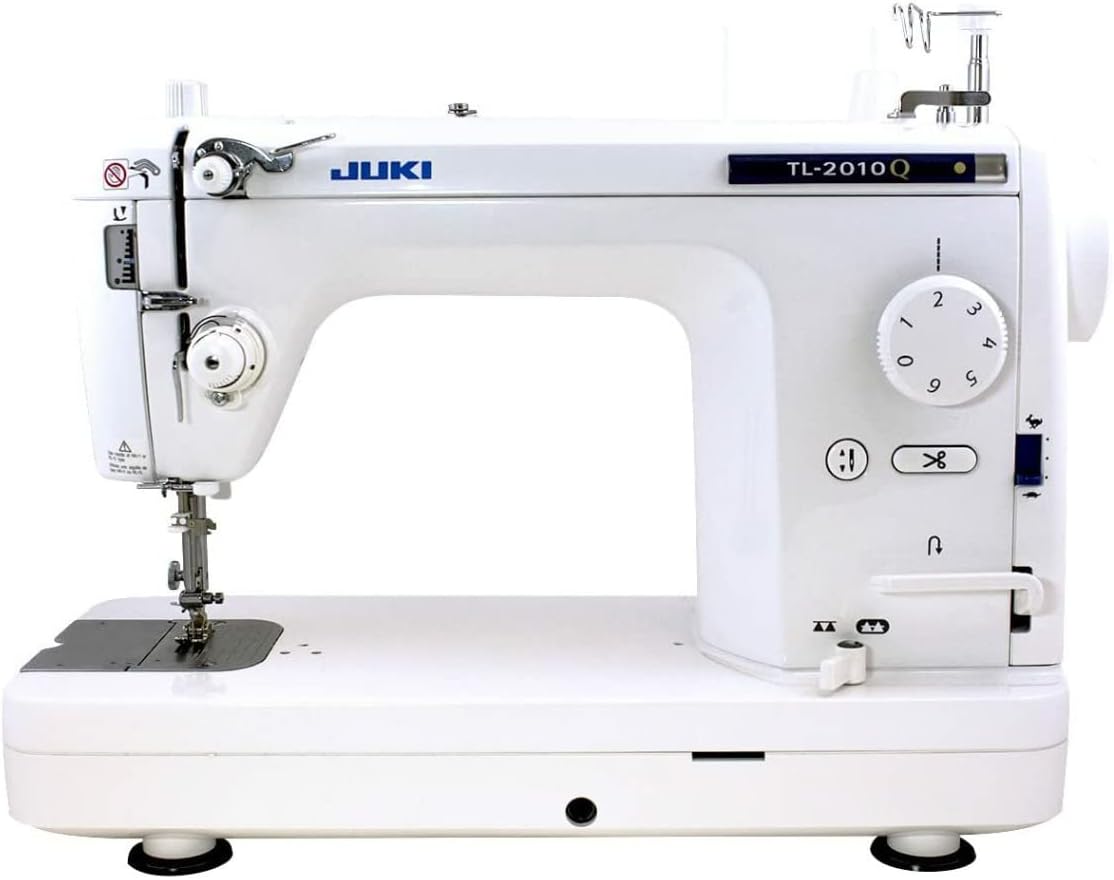
| Power Source | Treadle Powered |
|---|
The Juki TL-2010Q is a workhorse mechanical sewing machine built for heavy use in quilting and tailoring. It delivers consistent straight lockstitches on a wide range of fabrics and includes an automatic thread trimmer and automatic needle threader that speed setup and reduce downtime. The knee lifter lets you raise the presser foot hands-free for thick seams and smooth fabric handling, while a generous presser-foot lift accommodates light to heavyweight materials. Its portable cast-aluminum body and built-in handle make it easy to move between workspaces or mount into a table or quilting frame. Practical limits include a focus on straight stitching rather than decorative or zigzag stitches and a treadle power listing that means users should confirm their preferred power setup; there is no multi-stitch or computerized patterning on this model. For experienced sewers who need reliable, high-speed straight stitching and quilting capability, this machine brings factory-quality performance in a compact package.
Best for: Experienced, performance-oriented sewists who prioritize fast, reliable straight stitching and robust handling of multiple fabric weights for quilting or tailoring projects.
Less Ideal for: Casual crafters or beginners who want a wide range of built-in decorative stitches, automated patterning, or a fully computerized machine.
- Consistent high-performance straight lockstitch suitable for quilting and tailoring
- Automatic thread trimmer and needle threader speed setup and finishing
- Knee lifter provides hands-free presser-foot control for working with thick layers
- Portable, cast-aluminum construction that can be table-mounted or used on a quilting frame
- Designed mainly for straight stitching so lacks built-in decorative or zigzag stitch functions
- Specification lists treadle power which may require confirming power configuration for some users
Verdict: Buy this if you need a compact, factory-quality straight-stitch machine that delivers consistent, high-performance sewing for quilting and tailoring.
Brother FB1757X Sewing Machine

| Built-in stitches | 17 |
|---|---|
| Buttonhole styles | 4 one-step auto-size |
| Power source | AC |
| Frame material | Metal |
The Brother FB1757X is a straightforward mechanical sewing machine made for reliable everyday use. It offers 17 built-in stitches and four one-step auto-size buttonhole styles accessed via a dial, so setup is simple for routine garment and home-sewing work. A jam-resistant drop-in bobbin and clear cover make thread management easier, and the included wide extension table plus a free arm expand capability for larger pieces and sleeves. The metal frame and adjustable tension help it handle heavier fabrics like denim and light leather, while the bright LED work light improves visibility for detail work. It comes with useful feet and basic accessories so you can start sewing right away. Limitations for advanced sewers include the absence of computerized stitch programming, a limited stitch library compared with computerized machines, and manual selection via dials rather than a screen, which reduces precision for decorative or specialty stitching. For advanced users who need extensive stitch customization, embroidery, or automated features, a higher-end computerized model will be a better match.
Best for: A cost-conscious advanced sewer who values a sturdy, no-frills mechanical machine for heavy-duty piecing and basic garment construction and prefers reliable manual controls over touchscreen features.
Less Ideal for: Sewers who require extensive decorative stitch libraries, embroidery, or programmable computerized functions for complex design work should consider a computerized machine instead.
- Simple dial controls make stitch selection quick and intuitive.
- Jam-resistant drop-in bobbin with clear cover for easy thread monitoring.
- Durable metal frame handles heavier fabrics and frequent use.
- Included wide extension table and multiple feet expand project versatility.
- Bright LED work area improves visibility for detailed sewing.
- Limited to 17 built-in stitches and manual dial selection, lacking computerized customization.
- No advanced automated features like embroidery or extensive stitch memory.
Verdict: A rugged, budget-friendly mechanical machine that gives experienced sewists dependable basic performance for heavy-duty sewing without computerized bells and whistles.
SINGER Heavy Duty 4423

| Built-in stitches | 23 (97 applications) |
|---|---|
| Max sewing speed | 1,100 stitches per minute |
| Power source | Corded Electric |
| Bobbin type | Top drop-in bobbin |
The SINGER Heavy Duty 4423 is a mechanical sewing machine designed for fast, reliable stitching on everything from lightweight sheers to thick denim and canvas. It delivers 1,100 stitches per minute from a stronger motor and a stainless steel bed plate that keeps fabric feeding smooth, while the internal metal frame reduces skip and wobble during heavy use. The machine includes 23 built-in stitches with 97 stitch applications and a one-step buttonhole, plus an automatic needle threader and top drop-in bobbin for easier setup and fewer interruptions. Four presser feet and a basic accessory kit are supplied for common tasks, and the LED work light improves visibility for detailed work. The practical trade-offs are its mechanical controls, which favor durability and speed but lack computerized stitch programming or touchscreen conveniences, and the unit is heavier and less portable than lightweight hobby machines. For experienced sewers who prioritize consistent power and long-term dependability, the 4423 is a straightforward, hard-working option.
Best for: Experienced or reliability-minded sewists who need a rugged, high-speed machine that handles dense fabrics and frequent use without electronic complexity.
Less Ideal for: If you want computerized stitch selection, embroidery features, or a lightweight travel-friendly machine, consider a computerized model instead.
- Powerful motor with 1,100 stitches per minute for fast, consistent sewing
- Heavy-duty internal metal frame and stainless steel bed plate for stability and skip-free stitching
- Top drop-in bobbin and automatic needle threader simplify threading and reduce interruptions
- Includes multiple presser feet and accessories for common sewing tasks
- Mechanical feature set lacks computerized stitch customization and advanced programming
- Relatively heavy compared with portable hobby machines
Verdict: Buy this if you want a no-nonsense, high-speed mechanical machine that reliably powers through heavy fabrics for long-term, workshop-style use.
SINGER Heavy Duty 4432

| Built-in stitches | 32 |
|---|---|
| Stitch applications | 110 |
| Top drop-in bobbin | Yes |
| Power source | Corded Electric |
| Max stitches per minute | 1,100 |
The SINGER Heavy Duty 4432 is a mechanically driven sewing machine built around a metal frame and a powerful motor that handles both lightweight and thick fabrics. It offers 32 built-in stitches and more than 100 stitch applications, a top drop-in jam-proof bobbin with clear view cover, a one-step buttonhole, and a built-in reverse lever for reinforcing seams. Typical use ranges from garment construction and mending to quilting and home-decor projects; the stainless steel bed plate and high stitch speed (up to 1,100 SPM) make long seams and heavy fabrics easier to run. Included presser feet and accessories cover common tasks out of the box. Practical limits are its mechanical control layout, which gives less automated stitch adjustment than computerized models, and the heavier weight that makes it less portable for frequent transport. For experienced sewers who want a durable, fast workhorse that stays serviceable over years, the 4432 balances power and simplicity well.
Best for: Experienced home sewists who prioritize a rugged, high-speed machine for demanding projects and long run-time reliability, and who weigh proven user feedback when choosing gear.
Less Ideal for: Users who need lightweight, highly portable machines or who prefer computerized, touchscreen controls with automatic stitch programming.
- Robust metal frame and powerful motor for sewing thick fabrics.
- High sewing speed up to 1,100 stitches per minute for faster project completion.
- Top drop-in jam-proof bobbin with clear cover for easy monitoring and less downtime.
- One-step buttonhole and included presser feet for common sewing tasks right away.
- Mechanical controls lack the fine automated stitch customization of computerized machines.
- Heavier build reduces ease of frequent transport or travel.
Verdict: Buy this when you want a proven, heavy-duty mechanical sewing machine that delivers high speed and reliable performance for demanding projects.
VEVOR Lockstitch Sewing Machine JK9808

| Power Source | ac |
|---|---|
| Material | Aluminum |
| Included Components | Industrial Sewing Machine Set, User Manual |
This VEVOR JK9808 lockstitch machine is built for heavy, repetitive sewing tasks thanks to a 550W servo motor that drives up to 5000 stitches per minute and can handle as many as ten layers of denim. It sits in a metal frame and ships as a complete table set that includes an adjustable-height work surface, LED light, storage drawer, and oil window for maintenance. The LCD panel and soft-start control let you set sewing speed, needle up/down position, and use one-touch reverse stitching, while a knee lifter keeps both hands free for guiding fabric. Practical benefits include quiet operation under 80 dB, automatic lubrication for longer life, and a widened table that helps with large projects like bags, upholstery, and tents. Trade-offs are the machine's industrial footprint and weight, which make it less portable and better suited to a dedicated workspace, and the learning curve for users new to servo controls and high-speed sewing. For experienced sewists needing a durable, high-throughput lockstitch workhorse, this model covers the essentials well.
Best for: Experienced sewists or small production shops that need a durable, high-speed lockstitch machine for heavy fabrics and frequent use and want a stable, factory-style workstation.
Less Ideal for: Hobbyists who need a compact, portable machine or beginners looking for an easy plug-and-play home sewing machine.
- High 5000 SPM speed powered by a 550W servo motor for fast, consistent stitching
- Metal frame with automatic lubrication for durable, long-term use
- LCD controls for precise speed and needle position adjustments
- Widened table, adjustable height, and LED light to support large or detailed projects
- Heavy and large footprint, not suitable for casual portability
- Industrial setup requires some technical familiarity to install and maintain
Verdict: Choose the VEVOR JK9808 if you need a rugged, high-speed lockstitch workstation built to handle heavy fabrics and production-level sewing.
Choosing the Right Mechanical Sewing Machine for Advanced Sewers: Key Factors to Consider
Stitch Quality and Variety
A mechanical sewing machine for advanced sewers should deliver even, consistent stitches across a wide range of fabrics. Accurate stitch formation reduces puckering, skipped stitches, and uneven tension when working with fine silks or heavy denim. Machines that offer multiple stitch lengths and widths and that maintain stitch integrity under load give you more technique options, from decorative topstitching to subtle reinforcement seams.
Look for clearly marked stitch selectors and mechanisms that resist drift during prolonged use. When stitch variety is limited, you may be forced into workarounds that add time and reduce finish quality.
Build Durability and Materials
Durability matters for sewists who use their machines heavily or on dense materials. Metal components in the chassis and drive train stand up to high-torque sewing and minimize long-term alignment issues. A sturdier build also reduces vibration and contributes to a steadier stitch, which improves accuracy for precision work.
Durable machines typically have heavier motors and reinforced needle bars and feed dogs. Consider how often you plan to sew and the toughest materials you will use because frequent heavy-duty use demands a machine with industrial-grade tolerances even if it is mechanically operated.
Tension Accuracy and Adjustability
Precise thread tension is essential for balanced seams and professional-looking finishes. Advanced sewists often switch thread types and needle sizes, so a machine that allows fine-grain tension adjustments saves time and improves results. Mechanical machines usually provide tactile tension dials and easy manual corrections that experienced users prefer to automatic systems.
Good tension control also makes it simpler to handle layered seams and decorative threads without frequent rethreading or tedious trial-and-error.
Presser Foot and Feed System
The presser foot and feed dog configuration determine how well a machine moves fabric under the needle. For advanced sewing, you need reliable fabric transport that can handle slippery, stretchy, and heavy materials without pulling or misfeeding. Adjustable presser-foot pressure and a strong, consistent feed action let you control fabric handling for precise stitching and specialty techniques.
Also consider compatibility with a range of presser feet. A machine that accepts common specialty feet enables tasks such as blind hems, quilting, and edge finishing without complicated modifications.
Ease of Maintenance and Repairability
Mechanical machines are often preferred by advanced sewists because they are straightforward to maintain and repair. Machines with accessible internal components, removable faceplates, and simple lubrication points reduce downtime. Clear serviceable parts and replaceable components extend the machine's useful life and reduce the need for professional servicing.
Think about the availability of basic user-serviceable parts like bobbins, feed-dog screws, and needle plates. Machines that allow owners to perform routine maintenance reliably will be more cost-effective over time.
Why Advanced Sewists Choose Mechanical Machines
Experienced sewists often prefer mechanical machines because they provide direct, tactile control over every setting. Mechanical controls let you feel adjustments and make fine corrections without navigating menus or electronic interfaces.
Mechanical machines also tend to be simpler to troubleshoot and maintain. The straightforward mechanisms make it easier to replace parts or address timing issues yourself, which is valuable for sewists who use their machines for long sessions or for demanding projects.
- Immediate tactile feedback from knobs and dials
- Fewer electronic components to fail
- Simpler routine maintenance and repairs
Matching Machine Features to Your Projects
Start by listing the types of materials and techniques you use most. If you frequently sew heavy fabrics or multiple layers, prioritize a machine with a strong motor and reinforced throat plate. If precision and fine detail work are common, look for machines with tight stitch regulation and fine tension control.
Consider accessories you will actually use, such as walking feet, zipper feet, or quilting guides. Machines that accept a wide range of presser feet without special adapters will save time and expand technique options.
- Heavy fabrics: prioritize motor torque and metal chassis
- Precision tailoring: prioritize tension accuracy and stitch control
- Decorative stitching: check stitch length/width range
Common Maintenance Tips for Mechanical Machines
Keep the machine clean and lightly oiled according to the manufacturer guidance. Remove lint buildup around the feed dogs and bobbin area after extended sessions to prevent skipped stitches and drag. Use a soft brush and recommended machine oil, applying sparingly to moving parts only.
Change needles frequently and use the correct needle size and type for your fabric. Bent or dull needles lead to poor stitch formation and can damage the feed dog over time. Also check bobbin cases for burrs and ensure the bobbin is wound evenly.
- Clean lint from the bobbin area after long projects
- Oil only designated points with machine oil
- Replace needles every 6 to 8 hours of active sewing or sooner for heavy use
Accessories and Feet That Expand Capability
A few well-chosen presser feet and attachments can expand what a mechanical sewing machine can do. A walking foot improves handling of multiple layers and slippery fabrics. A zipper foot lets you sew close to bulky zippers without distortion. Hem and blind-stitch feet speed up finishing tasks.
Advanced sewists should also consider specialty guides and tables that improve stability for large projects like quilts or upholstery pieces. Ensure the machine you choose accepts these accessories without complicated adapters for the best workflow.
- Walking foot for layered fabrics
- Zipper foot for close topstitching
- Extension table for large work surfaces
Noise, Vibration, and Workspace Setup
Mechanical machines can vary in noise and vibration depending on build quality and motor mounting. If you sew for long stretches, a machine with minimal vibration helps reduce hand fatigue and improves stitch precision. Look for machines with a solid base and stable mounting points to reduce movement.
Think about your workspace layout. A dedicated sewing table with proper height and lighting makes it easier to manage larger projects. Placement near a sturdy surface reduces perceived vibration and improves control over fabric handling.
- Use a solid table to minimize movement
- Position lighting to reduce shadows over the needle area
- Consider sound-dampening pads if noise is a concern
How We Chose the Best Mechanical Sewing Machine for Advanced Sewers
We focused on capabilities that matter to experienced sewists and excluded entry-level units that lack robust metal components or precise controls. Selection emphasized mechanical models with proven durability, fine stitch regulation, and reliable feed systems. Key evaluation criteria included stitch quality and range, build materials and durability, presser foot and feed system control, tension accuracy and adjustability, and maintenance accessibility. Machines were excluded if they relied primarily on plastic gears, offered a very limited stitch selection that would constrain advanced techniques, or lacked straightforward manual adjustments for tension and presser-foot pressure. We also prioritized models with stout motors and smooth mechanical drive trains that sustain heavy or layered fabrics. Documentation quality and availability of common user adjustments informed the final picks, along with how well each machine supported common advanced tasks such as topstitching, tailoring, and working with specialty feet.
Our full evaluation process is outlined in our review methodology.
FAQ
Can a mechanical machine handle heavy fabrics like denim or canvas?
Yes, many mechanical machines can handle heavy fabrics if they have a strong motor, metal drive train, and reinforced feed system. Confirm that the model specifies heavy-duty capability and ensure you use the correct needle and thread for those materials.
How often should I change needles when using a mechanical machine frequently?
Advanced sewists who sew regularly should change needles every 6 to 8 hours of active sewing or sooner if sewing heavy or abrasive materials. Regular needle changes prevent skipped stitches and protect fabric and machine components.
Are mechanical machines harder to learn than computerized ones?
Mechanical machines have fewer automated features, so there is a steeper learning curve for manual adjustments. However, many sewists find the direct controls intuitive and appreciate the tactile feedback once they understand basic settings.
What maintenance should I perform myself versus a service technician?
You can handle routine cleaning, light oiling at designated points, needle changes, and bobbin-area lint removal. Complex timing adjustments, major motor work, or repair of internal gears is best left to a qualified technician.
Do mechanical machines support specialty presser feet?
Most mechanical machines accept a wide range of common specialty presser feet, though compatibility varies. Check that the machine uses a standard shank system or provides clear foot compatibility so you can add walking feet, hemmers, and other accessories.
Final Verdict
Advanced sewists should prioritize machines that deliver precise stitch control, robust build quality, and straightforward tension adjustments. Expect to trade off some automated conveniences for greater tactile control, repairability, and sustained torque under load. Focus on the specific techniques and materials you use most and choose a machine whose features align with those demands. With the right priorities, you can select a mechanical sewing machine that supports professional-level work and lasts for years.