
Note: This article contains affiliate links. If you click on these links and make a purchase, we may earn a small commission at no extra cost to you. This helps support our research and content. Read our full affiliate disclosure here.
Choosing the right microwave for restaurants matters because kitchens need consistent, repeatable heating under heavy use. A commercial microwave affects ticket times, food quality, and equipment uptime, so the decision is both operational and financial. This guide shortlists the top professional microwaves for restaurants across common service styles and explains the tradeoffs between power, capacity, and reliability. Below you will find our top picks and a clear explanation of the factors we evaluated, so you can match a commercial microwave to your kitchen's volume, menu needs, and maintenance capabilities.
Top Picks at a Glance
| Best Overall The best all-around choice for most situations | Sharp R-CD2200M Commercial Microwave |  |
| Best Quality Built to a higher standard if you want something more solid | Panasonic NE-17523 Commercial Microwave |  |
| Best Value The sweet spot between price and what you get | Farberware 1.1 Cu. Ft. Microwave |  |
| Best Budget The cheapest option that still gets the job done reliably | Smad Countertop Microwave 0.7 Cu. Ft. | 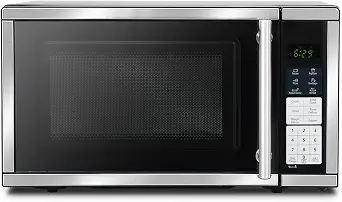 |
| Top Rated A top-rated pick with lots of positive feedback | Sharp R-21LCFS Microwave |  |
| Most Popular A crowd favorite that many people choose with confidence | COMFEE' Countertop Microwave 0.7 cu ft |  |
| Best Seller A high-volume bestseller chosen again and again | Chefman Countertop Microwave 1.1 cu ft |  |
Sharp R-CD2200M Commercial Microwave

| Wattage | 2200 watts |
|---|---|
| Voltage | 208 volts |
| Number of Programs | 10 |
| Capacity | 0.7 cubic feet |
The Sharp R-CD2200M is built for fast, repeatable cooking in busy foodservice settings, delivering 2200 watts through a 0.7 cubic‑foot cavity. Its TwinTouch dual touchpads and 10 preprogrammed memory pads—plus room for up to 100 custom memories—make routine tasks like reheating, defrosting, and multi‑portion heating quick and consistent. Four‑stage programming and double/triple quantity pads let you chain power levels or scale times automatically for two or three portions, which reduces operator guesswork during peak service. The all‑stainless interior and exterior stand up to heavy use and the unit includes self‑diagnostics and an interior exhaust fan for reliability. Expect a solid countertop footprint that fits a commercial pass but note it runs on 208 volts and targets professional installs, so kitchen electrical planning and sufficient clearance are required. This model emphasizes speed, programmability, and durability rather than space for oversized trays or low‑power, delicate cooking cycles.
Best for: Restaurant and catering operators who need a fast, programmable countertop microwave that delivers consistent reheating and portioned cooking during busy service periods.
Less Ideal for: Home cooks without 208V commercial electrical or kitchens needing large-capacity ovens for oversized pans should consider other options.
- High 2200 watt output for fast heating and shorter cycle times
- Extensive programmable memory (10 presets plus up to 100 user memories) for repeatable results
- Double/triple quantity pads automatically adjust times for multiple portions
- Durable stainless steel interior and exterior suited for commercial use
- Self-diagnostics and interior exhaust fan support reliable daily operation
- Requires 208 volt supply typical of commercial kitchens, not standard household outlet
- Relatively small 0.7 cu ft capacity limits use with large pans or bulk trays
Verdict: Choose the Sharp R-CD2200M when you need a durable, high‑power countertop microwave with advanced programmability to keep restaurant service moving smoothly.
Panasonic NE-17523 Commercial Microwave
| Wattage | 1700 watts |
|---|---|
| Voltage | 240 volts |
| Capacity | 0.6 cubic feet |
| Number of Power Levels | 15 |
| Number of Programs | 90 |
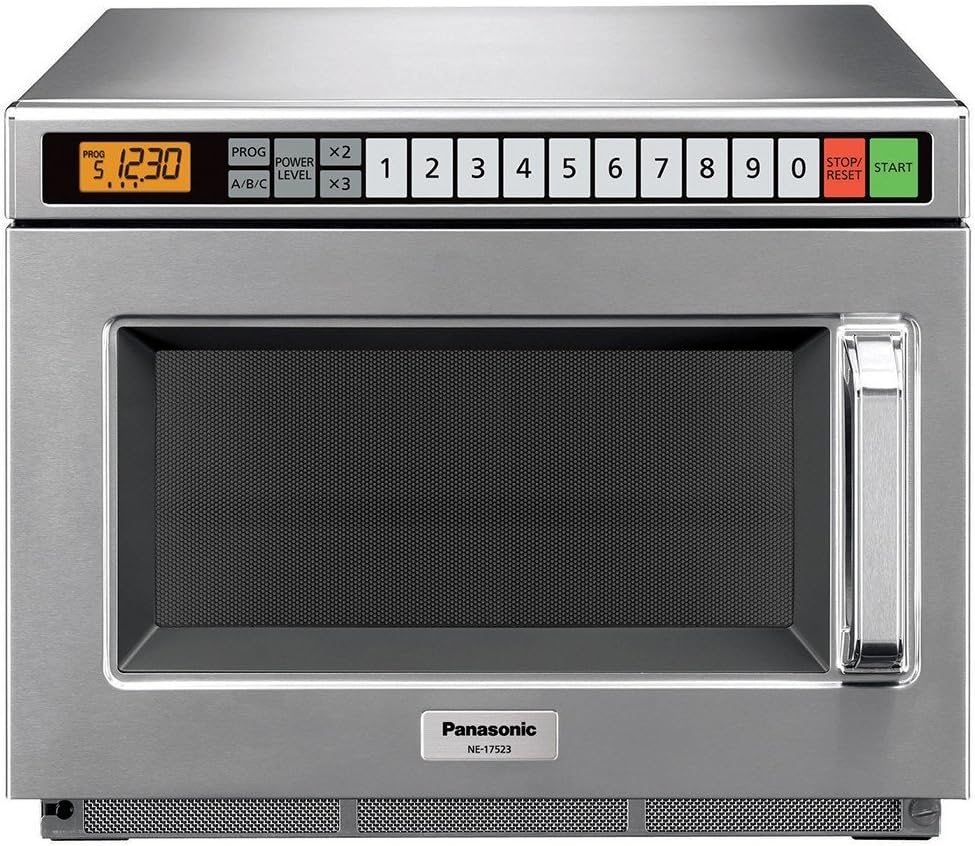
The Panasonic NE-17523 is a compact commercial microwave built for high-throughput kitchens where power and programmability matter. It delivers 1700 watts on 240V with 15 power levels and three-stage cooking, letting staff sequence high-heat and low-heat steps or run preset memory pads for repeatable menu items. The unit includes 90 programmable memory pads and a button controller that keep common recipes consistent across shifts, and its stainless steel interior and turntable are practical for frequent use and cleaning. At 0.6 cubic feet it fits tight cookline spaces but limits the size of plates and batches, so it is best for rapid single-plate reheating, portioned entrees, and prep tasks rather than large pans. Installation is over-the-range and the robust construction and high wattage make it suited to continuous commercial operation, though the compact cavity means you must plan layout and workflow around smaller capacity.
Best for: Kitchen operators seeking a compact, high-power microwave that delivers fast cycles and repeatable results for plated service and prep tasks.
Less Ideal for: Large-volume operations that need to cook oversized plates or multi-item batches at once should consider larger capacity cooking equipment.
- High 1700W power for fast heating and quick cycle times
- 90 programmable memory pads for consistent, repeatable cooking
- 15 power levels and 3-stage cooking enable flexible recipe control
- Stainless steel interior built for commercial cleaning and durability
- Small 0.6 cu ft cavity limits plate size and batch throughput
- Requires 240V installation which may need electrical modifications
Verdict: A compact, high-power commercial microwave that speeds service with extensive programmability for consistent restaurant cooking.
Farberware 1.1 Cu. Ft. Microwave
| Wattage | 1000 |
|---|---|
| Capacity | 1.1 cubic feet |
| Number of Power Levels | 10 |
| Cooking Program | 6 |
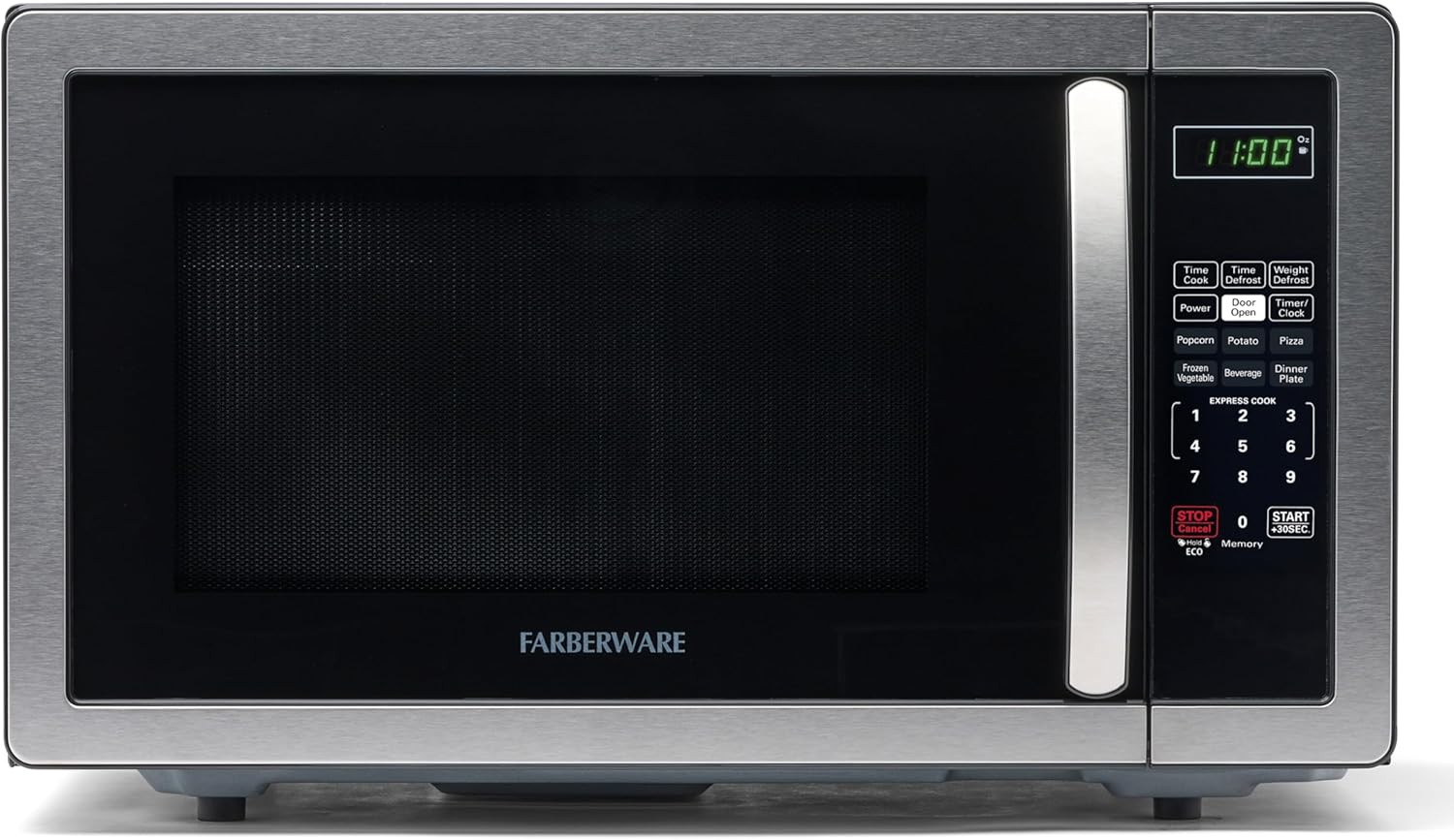
This Farberware countertop microwave delivers straightforward, reliable cooking with 1000 watts of power and a 1.1 cu ft cavity that fits standard plates and prep for a small commercial break room or busy back-of-house prep station. Controls are touch-button with a numeric keypad, a clear LED display, and express 1–6 minute quick-start keys plus six one-touch presets for popcorn, potato, pizza, frozen vegetables, dinner plate, and beverages, which speed routine reheating tasks. It supports weight or time defrost and offers ten power levels and multi-stage programming for more control over delicate items. The interior is stainless steel for easier cleaning and the child-safety lock and large handle improve safety in shared spaces. Trade-offs are its countertop design and home-focused warranty, which means it lacks the heavy-duty duty-cycle rating and commercial certifications of full commercial microwaves, and long continuous high-volume use may exceed its intended residential duty cycle.
Best for: Small restaurants, cafes, or foodservice operators seeking an affordable, compact microwave for occasional front- or back-of-house reheating and prep who prioritize easy controls and quick, consistent results.
Less Ideal for: High-volume commercial kitchens that need continuous-run, NSF-rated commercial microwaves or models built for nonstop heavy-duty service should look at purpose-built commercial units instead.
- 1000 watts with ten power levels allows flexible cooking and reheating control
- Six one-touch presets and express keys speed common reheating tasks
- Stainless steel interior simplifies cleaning
- Child safety lock and clear LED display improve safe shared use
- Designed for residential countertop use rather than continuous commercial duty
- No commercial-grade certifications or heavy-duty duty-cycle specifications provided
Verdict: A practical, easy-to-use 1000W countertop microwave that suits small restaurant or cafe stations needing reliable reheating without commercial-grade expense.
Smad Countertop Microwave 0.7 Cu. Ft.
| Wattage | 700 watts |
|---|---|
| Number of Power Levels | 10 |
| Number of Programs | 6 |
| Capacity | 20 liters |
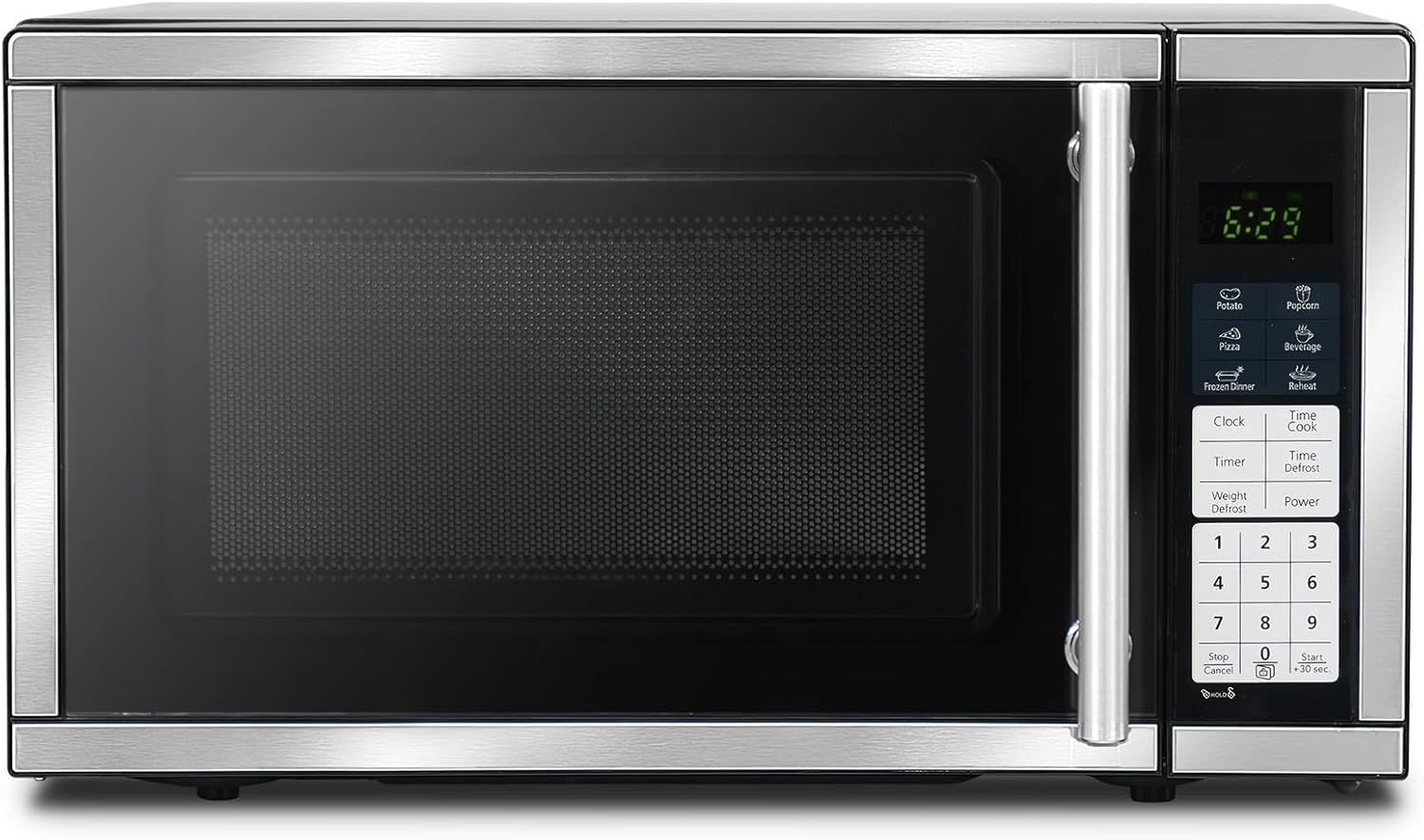
This small countertop microwave is built for straightforward, everyday reheating and light cooking. With 700 watts and 10 power levels it handles basics like reheating meals, defrosting by weight or time, and one-touch presets for popcorn, potato, pizza and similar items. The 9.6 inch glass turntable and interior LED light make it easy to monitor food while the child safety lock adds simple security in busy environments. Controls are button-based and the cavity has an easy-clean interior that wipes down quickly after spills. The unit is compact enough for tight counters but still offers usable capacity for plates and small containers. Expect longer cook times compared with higher-wattage commercial models and avoid heavy continuous use since 700 watts is suited to light-duty tasks rather than high-throughput restaurant service.
Best for: Shoppers prioritizing a low-cost, space-saving microwave for light back-of-house tasks or occasional service where budget and counter space matter more than speed and heavy-duty performance.
Less Ideal for: High-volume restaurants or kitchens that require fast, continuous heating and commercial-grade durability should choose a more powerful, purpose-built unit.
- Compact footprint fits small counters and tight back-of-house spaces.
- Ten power levels and 6 presets give flexible control for common items.
- LED interior light and 9.6" glass turntable make it easy to monitor cooking.
- Child safety lock and simple button controls reduce accidental use.
- Easy-clean interior simplifies maintenance after spills.
- 700-watt output is lower than commercial microwaves, so cook and reheat times are longer.
- Not designed for heavy continuous restaurant use or high-volume throughput.
Verdict: A compact, budget-friendly countertop microwave that delivers simple, reliable reheating and light cooking when space and cost are the priority.
Sharp R-21LCFS Microwave
| Wattage | 1000 |
|---|---|
| Voltage | 120 volts |
| Capacity | 1 cubic feet |
| Turntable Diameter | 13.5 inches |
| Controller Type | Electronic Dial |
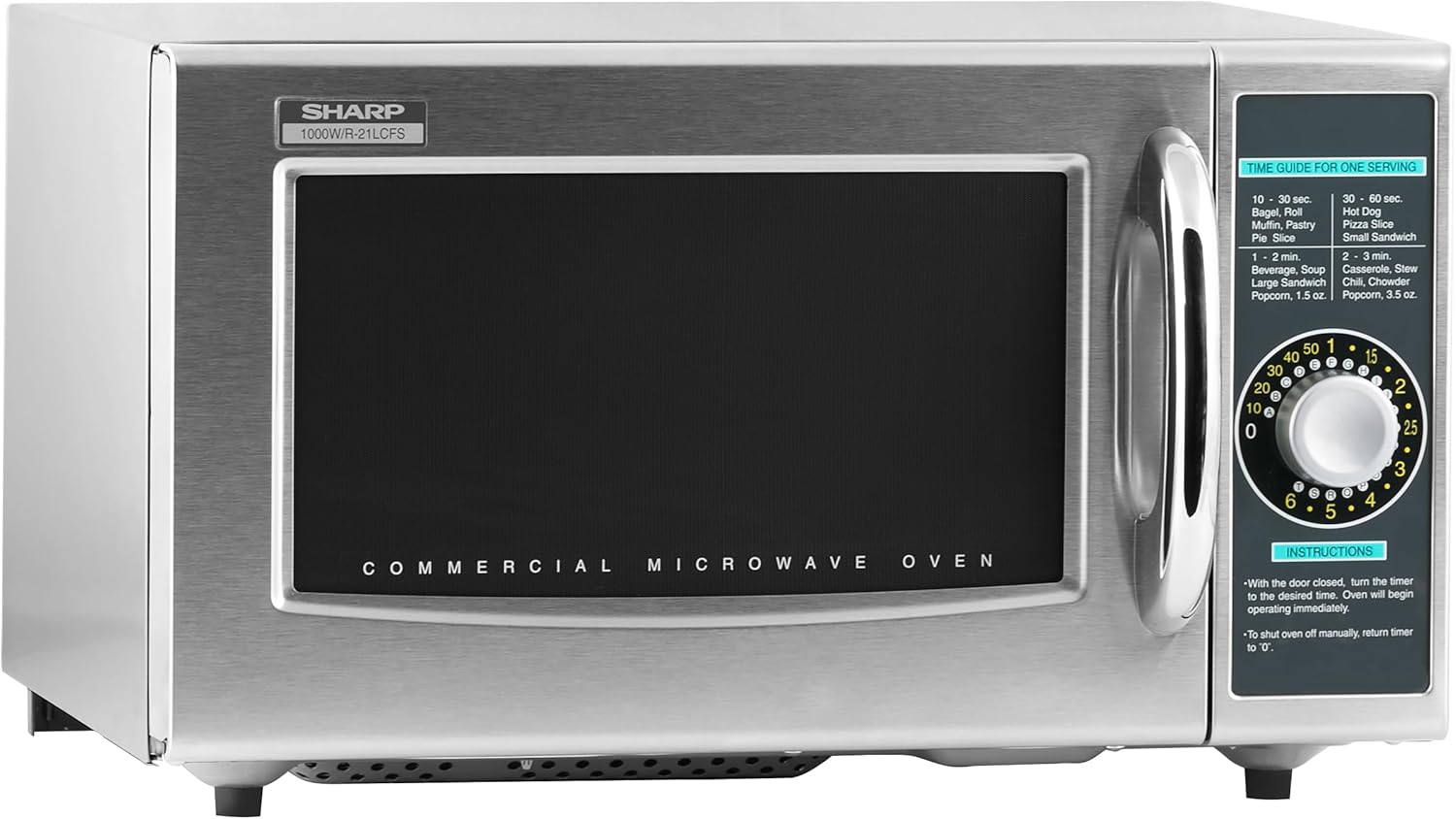
The Sharp R-21LCFS is a straightforward, reliability-oriented commercial countertop microwave built for basic foodservice tasks. It delivers 1000 watts of microwave power to quickly reheat prepackaged foods, single servings, and half-size pans inside its 1.0 cubic foot cavity and 13.5-inch turntable. Controls are intentionally simple: a classic electronic dial timer adjustable from 10 seconds to 6 minutes with bright LED indicators and an auto-cancel feature that stops timing when the door opens. The stainless steel interior and exterior help with cleanup and withstand heavy daily use, and the manual defrost and single power level design keep operation uncomplicated for busy staff. Expect consistent, fast reheating without programmable complexity, and a three-year limited magnetron warranty adds to the product's long-term dependability. The trade-off is minimal automation and only one power setting, so it is not suited to tasks that require precise low-power cooking or multiple programmed cycles.
Best for: Kitchen operators who prioritize a robust, no-frills oven that starts quickly, is easy to train staff on, and holds up to frequent commercial use.
Less Ideal for: Operations needing programmable cycles, multiple power settings, or precise low-power defrosting should consider more feature-rich commercial units.
- 1000-watt output for quick reheating in commercial settings
- Durable stainless steel interior and exterior for easy cleaning
- Simple dial timer with bright LED indicators for rapid staff training
- Auto-cancel timer when door opens helps protect the magnetron
- 1.0 cu. ft. capacity fits 13.5-inch platters and half-size pans
- Single power level limits low-power cooking and delicate defrosting
- No programmable presets or digital controls for repeatable cycles
Verdict: Choose this Sharp microwave when you need a tough, easy-to-use countertop oven that delivers reliable, fast reheating for a busy commercial kitchen.
COMFEE' Countertop Microwave 0.7 cu ft

| Capacity | 0.7 cubic feet |
|---|---|
| Wattage | 700 watts |
| Number of Power Levels | 11 |
| Number of Programs | 9 |
The COMFEE' 0.7 cubic foot countertop microwave is a small, straightforward unit intended for reheating, defrosting, and simple cooking tasks. It offers 700 watts of power, 11 power levels and nine preset programs including popcorn, potato and pizza, plus two defrost modes by weight or time. The large LED makes timing visible and an ECO mode reduces standby energy while a mute button silences beeps for quieter operation. A removable 10-inch turntable and child safety lock add basic convenience and safety. Practical limits are its modest capacity and 700W output, which means longer cook times for large portions or high-heat tasks compared with commercial or full-size residential microwaves; this model is best for single-serve meals, office or dorm use rather than heavy restaurant use. Controls are button-based and easy to use, but the unit lacks advanced features such as inverter power delivery or high-power presets that speed commercial workflows.
Best for: Buyers who prioritize a small, reliable microwave for light-duty environments like offices, dorms, or satellite kitchenettes and who value quiet operation and energy savings.
Less Ideal for: Not suitable for restaurant kitchens or high-volume foodservice settings that need faster cook times, larger capacity, or commercial-grade durability.
- Compact footprint suitable for tight counters or small break rooms
- Multiple power levels and nine presets cover common reheating and simple cooking needs
- Mute and ECO modes reduce noise and standby energy use
- Child safety lock and removable turntable for safer everyday use
- 700W output and 0.7 cu ft capacity limit cooking speed and batch size
- No inverter technology or commercial-grade features for high-throughput use
Verdict: A compact, energy-conscious countertop microwave that works well for single-serve and light-duty food prep where quiet, simple operation matters.
Chefman Countertop Microwave 1.1 cu ft
| Wattage | 1000 watts |
|---|---|
| Capacity | 1.1 cubic feet |
| Number of Power Levels | 10 |
| Cooking Program | Beverages, Pizza, Popcorn, Potatoes, Veggies, Leftovers |
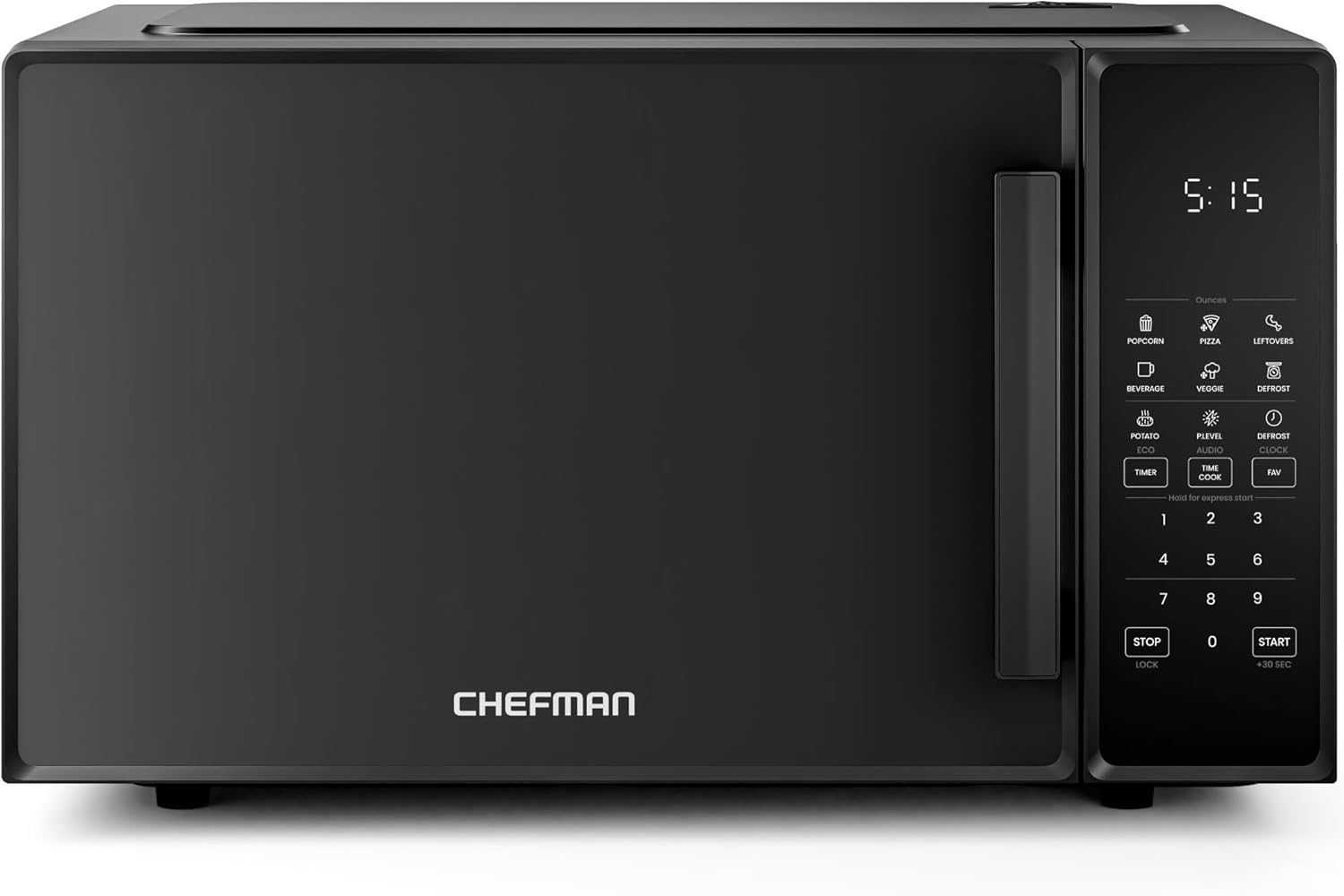
The Chefman Countertop Microwave is a compact 1.1 cubic foot microwave that delivers 1000 watts of cooking power for quick reheating, defrosting, and simple cooking tasks. It uses a numeric keypad and touch controller to set time, choose from 10 power levels, or launch one of six one-touch presets for popcorn, pizza, beverages, veggies, potatoes, and leftovers. The unit includes a memory function to save frequent settings, an audible mute option, and an Eco Mode to dim or disable the display when not in use. The ceramic enamel interior and removable glass turntable make cleanup straightforward, and the child safety lock helps prevent accidental use. Practical limits for heavier commercial use include its countertop size and consumer-grade construction, so it is best for light-duty, back-of-house warming or limited prep rather than continuous high-volume restaurant cooking. For small kitchens or low-volume foodservice tasks it offers easy controls and predictable performance, but full commercial ovens or higher-capacity microwaves are preferable where durability and throughput matter most.
Best for: A cautious buyer who values reliable, easy-to-use kitchen equipment for light-duty food warming and occasional prep in small restaurants, break rooms, or catering stations.
Less Ideal for: High-volume restaurant kitchens or operations that need industrial-strength continuous-use microwaves and larger cooking capacity should choose a commercial-grade unit instead.
- 1000W power for fast reheating and cooking
- Ten power levels and six preset programs for flexible everyday use
- Memory function for saving frequently used settings
- Mute and Eco Mode reduce noise and display power draw
- Ceramic enamel interior and removable glass turntable for easy cleaning
- Designed for household countertop use so not built for continuous heavy commercial cycles
- Capacity and turntable format limit use with larger plates or bulk batches
Verdict: A reliable, user-friendly 1000W countertop microwave well suited to low-volume restaurant warming and occasional prep tasks.
Choosing the Right Microwave for Restaurants: Key Factors to Consider
Power Output and Consistency
Wattage determines how quickly a microwave heats and how well it holds temperature under repeated cycles. In a restaurant setting you need a unit that can deliver consistent power from the first order to the last so food quality and timing remain predictable.
Look beyond the nominal wattage number and consider how the unit maintains output during long service periods. Some commercial microwaves are engineered with components and cooling to minimize power sag, which matters when you run continuous short-cycle heating all night.
Duty Cycle and Commercial Construction
Commercial microwaves are built to handle frequent starts, extended daily runtime, and heavier loads than consumer models. Duty cycle ratings and the use of industrial-grade magnetrons, bearings, and fans indicate whether a unit is designed for restaurant use.
Choosing a microwave with a suitable duty rating reduces the risk of premature failure and avoids hidden costs from downtime and emergency repairs.
Interior Capacity and Workflow Fit
Interior size, door type, and turntable or flatbed layout determine what portions and containers fit and how the unit integrates into prep and plating workflows. A larger cavity lets you reheat bulk items or multiple plates, while a compact unit may be better where counter space is limited.
Consider how staff will load, monitor, and unload the microwave during peak service. Features like removable trays, easy-to-clean interiors, and accessible door handles improve speed and reduce handling errors.
Controls, Programmability, and Repeatability
Programmable settings let staff recall exact cook times and power levels for menu items, improving consistency across shifts and users. Look for intuitive interfaces with clearly labeled programmable pads, memory slots, and lockout features to prevent accidental changes.
Advanced controls can include multi-stage cooking sequences or sensor-based inputs that cut down on oversight, but simplicity is often preferable in high-turnover kitchens where staff training time is limited.
Serviceability and Parts Availability
Fast access to replacement parts and straightforward service procedures reduce downtime when components fail. Units designed with modular parts, clear access panels, and widespread parts availability are easier and cheaper to repair.
Factor in local service networks or in-house technician capabilities. A microwave that is slightly more expensive upfront but easier to service can be cheaper over its operational life because it spends less time out of service.
Ventilation, Heat Management, and Noise
Commercial kitchens are hot and noisy environments, so a microwave's ventilation and heat rejection affect both performance and staff comfort. Insufficient cooling can accelerate wear on internal components, while excessive noise can hinder communication in the kitchen.
Check how the unit manages exhaust and whether it requires additional clearance or dedicated ventilation. Lower operating temperatures and quieter fans improve longevity and make the kitchen environment more manageable.
Matching Microwave Type to Restaurant Volume
Different restaurant volumes demand different microwave approaches. Low-volume operations that need occasional reheating can do well with compact commercial countertop units, while high-volume kitchens often require higher-wattage or drawer-style microwaves to keep up with continuous orders.
Consider average tickets per hour during peak times and plan for peak-plus safety margin. A microwave that handles average load but fails at peak creates bottlenecks. If you expect sustained back-to-back use, prioritize units rated for heavy commercial duty and higher continuous runtime.
- Low-volume: compact countertop commercial models with moderate wattage
- Mid-volume: higher-watt countertop or cavity designs with programmable memory
- High-volume: high-wattage commercial units or models designed for repeated short cycles
Placement and Integration in a Busy Kitchen
Where you place the microwave affects flow. Mounting height, clearance for ventilation, and proximity to plating stations all influence how quickly staff can move food through the line.
Integrate the microwave into an organized station with trays, timers, and labeled programs. Make sure the door swing and access work with the physical constraints of the kitchen and that the chosen location provides adequate clearance for heat dissipation.
- Keep microwave near the service line but not where steam or grease can accelerate wear
- Allow manufacturer-recommended clearances for ventilation
- Provide stable, level surfaces and easy access for routine cleaning
Cleaning, Sanitation, and Food Safety
Commercial microwaves should be easy to clean to meet sanitation standards. Smooth, corrosion-resistant interiors and removable trays reduce the time it takes to wipe down between shifts. Crevices and poorly sealed control panels can trap food debris and bacteria.
Schedule regular cleaning and inspect seals and door gaskets frequently. Proper cleaning procedures both extend equipment life and reduce the risk of food safety issues in a high-turnover environment.
- Choose interiors with rounded corners and removable components where possible
- Use foodservice-safe cleaners and follow manufacturer maintenance guidance
- Log cleanings and inspect gaskets and door latches for wear
Programmable Shortcuts and Staff Training
Preprogrammed cook cycles speed service and reduce user error, but they require initial setup and regular review. Invest time in configuring memory buttons to match common menu items and train staff on which programs to use for consistent results.
Keep a laminated quick-reference near the unit and rotate training during busy onboarding. Simpler control schemes reduce mistakes during peak service, while more advanced programming can pay off if staff are trained and turnover is low.
- Set up program buttons for top-selling items
- Document which power levels and time settings work for common portion sizes
- Include a lock or supervisor mode to prevent accidental program changes
Energy Use and Operational Costs
While upfront cost matters, daily energy use and maintenance impact total operating cost. Higher-wattage units cook faster but may draw more electricity; however, quicker cycles can improve throughput and reduce per-item energy use in some setups.
Consider expected daily run time and the kitchen's electrical capacity. Select units that balance speed with reasonable energy draw and that match the business's operating hours and budget for utility usage.
- Estimate kW usage based on rated wattage and expected runtime
- Plan electrical circuits and breakers according to local codes
- Weigh faster cycle times against higher instantaneous power draw
How We Chose the Best Microwave for Restaurants
We prioritized criteria that reflect the demands of a professional kitchen. Key evaluation dimensions included sustained power delivery and wattage consistency to ensure even, repeatable heating during back-to-back service; duty cycle and components designed for commercial duty to handle frequent starts and long shifts; interior capacity and turntable or tray options to match portion sizes and prep workflows; control precision and programmability for repeatable cook times across staff; and serviceability plus parts availability to minimize downtime when repairs are needed. We excluded consumer-grade countertop models and units not explicitly designed for commercial foodservice duty. We also filtered out microwaves without clear ventilation or duty specifications and those lacking programmable memory or robust control panels. The final shortlist balances throughput needs, durability, and ease of use for busy restaurant environments. Where relevant, we gave extra weight to models with proven service support and clear component-level replacement pathways.
Our full evaluation process is outlined in our review methodology.
FAQ
What wattage is appropriate for a restaurant microwave?
Appropriate wattage depends on throughput. Low-volume kitchens can use moderate-watt units around typical commercial countertop ranges, while high-volume operations should choose higher-wattage units that sustain fast reheating without power sag. Consider peak ticket rates when deciding.
Do commercial microwaves need special electrical circuits?
Many commercial microwaves have higher power draws than residential models and may require dedicated circuits or specific breaker sizes. Check the equipment's electrical specifications and coordinate with an electrician to ensure safe installation and reliable operation.
How often should a restaurant microwave be serviced?
Service frequency depends on usage. For high-use units, schedule preventive inspections every 6 to 12 months to check fans, magnetrons, and door seals. Routine cleaning and quick parts replacement help avoid unplanned downtime.
Can I use any containers in a commercial microwave?
Use containers rated for microwave use and appropriate for foodservice. Avoid metal and containers without heat-tolerant labeling. Choose commercial-grade trays and dishes that withstand frequent heating and cleaning to reduce breakage and safety risks.
Is a turntable or flatbed better for restaurant use?
Turntables are simple and work well for many portion sizes, but flatbed designs provide more usable interior space and easier cleaning. Flatbeds are often preferred where odd-shaped containers or multiple items need reheating simultaneously.
How important is ventilation for a commercial microwave?
Ventilation is important to manage internal temperatures and extend component life. Adequate airflow prevents overheating, reduces wear on the magnetron and fan, and can lower noise. Follow clearance recommendations and avoid installing the unit in confined, hot spaces.
Final Verdict
For restaurants, prioritize microwaves that match your service volume: choose higher-watt and heavy-duty units for continuous, fast-paced kitchens and compact commercial designs for lower-volume needs. Emphasize sustained power consistency, programmable controls for repeatability, and models that are easy to service and clean. Balancing throughput, reliability, and maintainability will give you the best long-term value. Focus on the duty cycle and serviceability first, then match capacity and controls to your menu and staff skills to choose confidently.