
Note: This article contains affiliate links. If you click on these links and make a purchase, we may earn a small commission at no extra cost to you. This helps support our research and content. Read our full affiliate disclosure here.
If you live or travel in an RV, the right mini-split air conditioner can make long trips and overnight stays far more comfortable without overloading onboard power. Mini-splits designed for RV use provide zoned cooling, quieter operation, and better efficiency than many portable options, but choosing one requires attention to capacity, electrical limits, and installation constraints. This guide shortlists the top mini-split air conditioners for RVs and explains the practical tradeoffs that matter for life on the road. Read on for the key criteria we used to evaluate the picks and to figure out which unit will suit your RV layout and power setup.
Top Picks at a Glance
| Best Overall The best all-around choice for most situations | Cooper & Hunter MIA 12,000 BTU | 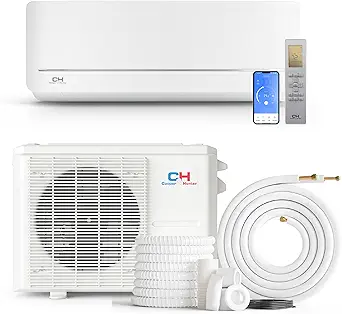 |
| Best Quality Built to a higher standard if you want something more solid | Garvee 12000 BTU Mini Split |  |
| Best Value The sweet spot between price and what you get | CAAIR 12,000 BTU Mini Split |  |
| Best Budget The cheapest option that still gets the job done reliably | Rellytech Mini Split 9000 BTU |  |
| Top Rated A top-rated pick with lots of positive feedback | Senville LETO 12000 BTU Mini Split |  |
| Most Popular A crowd favorite that many people choose with confidence | Albott 12,000 BTU Mini Split SAC001 |  |
| Best Seller A high-volume bestseller chosen again and again | Senville LETO 9000 BTU Mini Split | |
Cooper & Hunter MIA 12,000 BTU
| Cooling Power | 12000 british thermal units |
|---|---|
| SEER | 21.2 |
| Voltage | 115 volts |
| Refrigerant | R-454B |
| Floor Area | 550 square_feet |
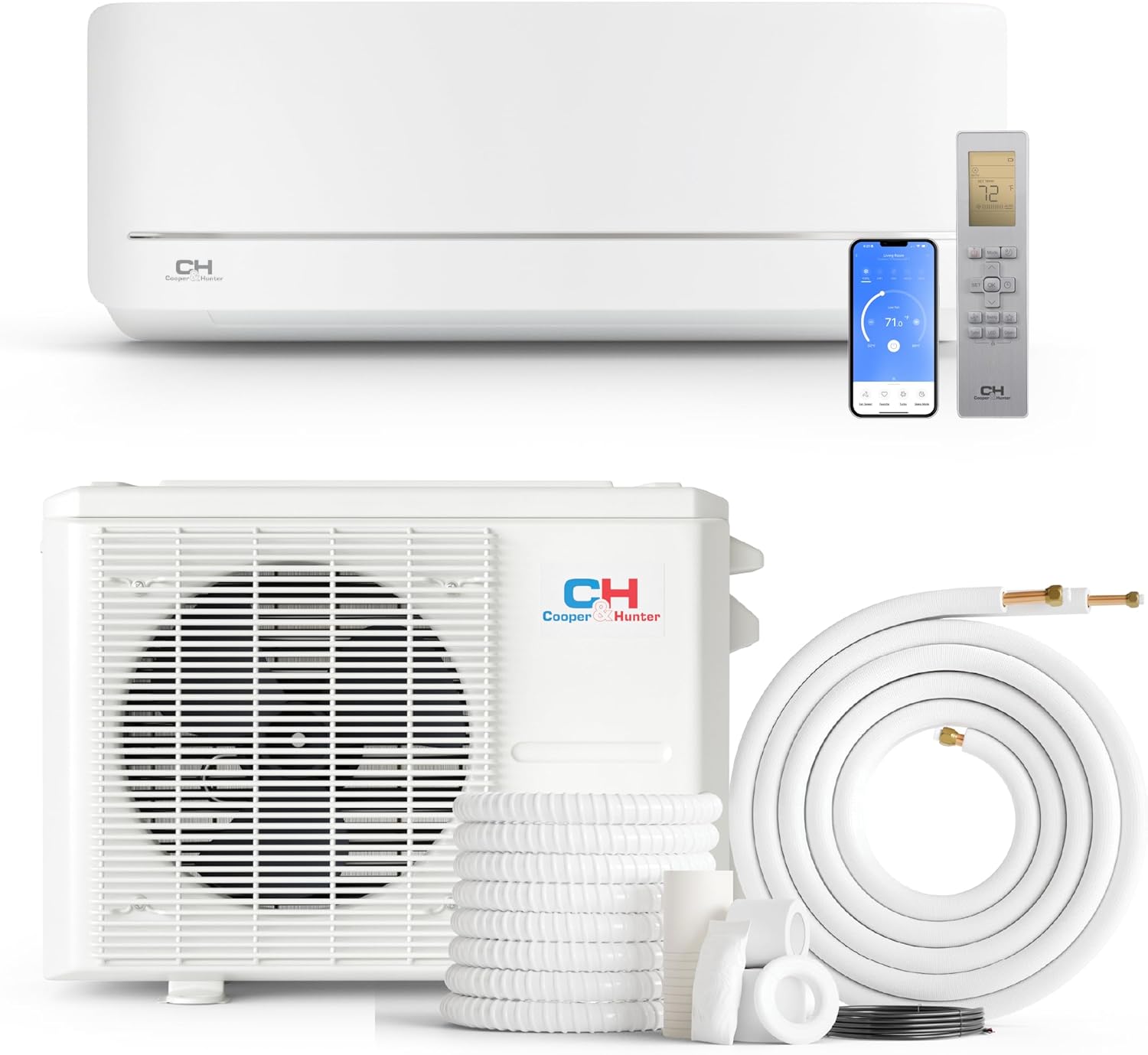
The Cooper & Hunter MIA 12,000 BTU mini-split is a single-zone wall-mounted heat pump that delivers efficient cooling and heating for a range of small spaces. It uses inverter compressor technology to vary output for steady temperatures and improved energy use, and the 21.2 SEER2 rating indicates strong seasonal efficiency. The unit ships with a 16 ft pre-charged installation kit and a smart control kit so you can schedule and adjust settings via app or voice assistants, while remote control is also included. Noise is marketed as low (about 26 dB) so it is suitable for bedrooms or confined living spaces. Important limitations are that professional installation is required to keep the warranty valid and the outdoor condensing unit must be installed new and paired with the indoor unit, which makes retrofit into an existing RV more involved. For RV use you should confirm space, mounting, and power compatibility with an HVAC technician before purchase.
Best for: Buyers seeking an efficient, quiet single-zone mini-split with smart controls for year-round comfort who value energy savings and reliable factory-quality components.
Less Ideal for: Anyone wanting a simple DIY or plug-and-play RV air conditioner or a direct retrofit that reuses an existing outdoor condenser should look elsewhere.
- Inverter compressor and 21.2 SEER2 deliver strong seasonal energy efficiency
- Smart kit plus app and voice control for remote scheduling and temperature adjustments
- Includes 16 ft pre-charged installation kit with line set, communication wire, and drain extension
- Quiet operation suitable for sleeping areas
- Requires professional installation and system registration to preserve warranty
- Needs a new outdoor unit, adding complexity for retrofit projects
Verdict: A quiet, energy-efficient 12,000 BTU mini-split with smart controls that suits buyers who want reliable year-round heating and cooling with strong efficiency.
Garvee 12000 BTU Mini Split

| Cooling Power | 12000 british thermal units |
|---|---|
| SEER | 22 |
| Voltage | 230 |
| Floor Area | 750 square_feet |
| Noise | 42 db |
This Garvee 12,000 BTU mini-split is a compact ductless heat pump that delivers rapid climate control for spaces up to about 750 sq ft, using an inverter compressor to hold setpoints tightly while improving efficiency. It supports cooling, heating, dry, and fan-only modes with 4-way swing for even distribution and offers remote and voice control for convenient operation. The unit advertises fast response times—rapid cooling in roughly 30 seconds and turbo heating quickly—while a stated 22 SEER2 rating and an AI-driven vector inverter promise lower energy use compared with conventional systems. Noise is kept relatively low, with sleep-mode levels down near 23 dB, making it suitable for quiet environments. Installation requires a professional and the system runs on 230 V power, so it needs proper electrical provisioning in an RV application or dedicated hookup. The outdoor unit is smaller than typical models, which helps fit tight exterior spaces, but full RV compatibility depends on available power and an installer comfortable integrating split systems into vehicle platforms. For owners prioritizing performance and efficiency, this unit offers strong climate control; buyers should plan installation logistics and electrical supply before committing.
Best for: Buyers seeking a high-performance, efficient ductless split that holds tight temperature control and delivers fast heating/cooling in a small living space and who are willing to manage professional installation and electrical setup.
Less Ideal for: Travelers who need a simple, self-contained rooftop or plug-and-play RV air conditioner or those without access to 230 V service and professional HVAC installation.
- High 12,000 BTU capacity with fast cooling and rapid turbo heating response
- Inverter compressor with AI-driven vector control for precise temperature hold and improved efficiency
- Quiet operation with low sleep-mode noise suited to bedrooms or small living spaces
- Compact outdoor unit size helps fit constrained exterior mounting locations
- Remote and voice control for convenient operation
- Requires professional installation and 230 V electrical supply which may not be available on all RVs
- Not a plug-and-play RV rooftop unit so integration can be more complex and may need custom mounting or electrical work
Verdict: If you want strong, precise climate control and energy-efficient performance in a compact split that can be fitted to tight exterior spaces, this 12,000 BTU inverter mini-split is a performance-focused choice for RV setups with proper electrical and professional installation.
CAAIR 12,000 BTU Mini Split

| Cooling Power | 12000 BTU |
|---|---|
| SEER | 17 SEER2 |
| Floor Area | 750 square_feet |
| Voltage | 230 volts |
| Noise | 25 db |
This CAAIR 12,000 BTU mini-split is a year-round inverter heat pump that delivers cooling and heating for a single-zone space. It pairs an indoor wall-mounted unit with a pre-charged outdoor condenser and is designed for professional installation rather than DIY setup. The unit uses a DC inverter compressor and achieves a 17 SEER2 rating for better part-load efficiency, and the system includes Wi-Fi control plus a backlit remote for convenient temperature adjustments. Useful modes include Cool, Heat, Fan, and Dry, with 4-way auto-swing and a ZoneSense remote sensor to improve airflow distribution. Practical features such as washable filters, a high-temperature self-clean cycle, automatic outdoor defrost, and R32 refrigerant help keep performance reliable and indoor air cleaner. For an RV the size and power requirements matter: this floor-area rating and 230V power source mean you need a suitable electrical setup and professional installer, and the outdoor unit compatibility requires a new outdoor unit rather than reusing an existing condenser.
Best for: Buyers who prioritize efficient, quiet year-round comfort and are willing to arrange professional installation and appropriate electrical support to fit a compact living space.
Less Ideal for: Small RV owners without 230V service, limited exterior space for an outdoor condenser, or those seeking a DIY-friendly plug-and-play air conditioner.
- Inverter compressor with 17 SEER2 improves part-load energy efficiency
- Wi-Fi and remote control let you manage temperature remotely
- Self-cleaning cycle and washable filters reduce mold and odor risk
- Runs very quietly at about 25 dB, suitable for sleeping areas
- Includes pre-charged outdoor unit and installation kit for faster setup
- Requires professional installation and a 230V supply, which may not fit standard RV electrical systems
- Outdoor condenser is required new, so it is not a simple swap-in for existing outdoor units
Verdict: Choose this unit if you want a quiet, energy-efficient 12,000 BTU inverter mini-split and can provide professional installation and a 230V supply for an RV conversion or single-zone space.
Rellytech Mini Split 9000 BTU
| Cooling Power | 9000 BTU |
|---|---|
| Voltage | 115 volts |
| SEER | 19 |
| Refrigerant | R-32 |
| Noise | 42 db |
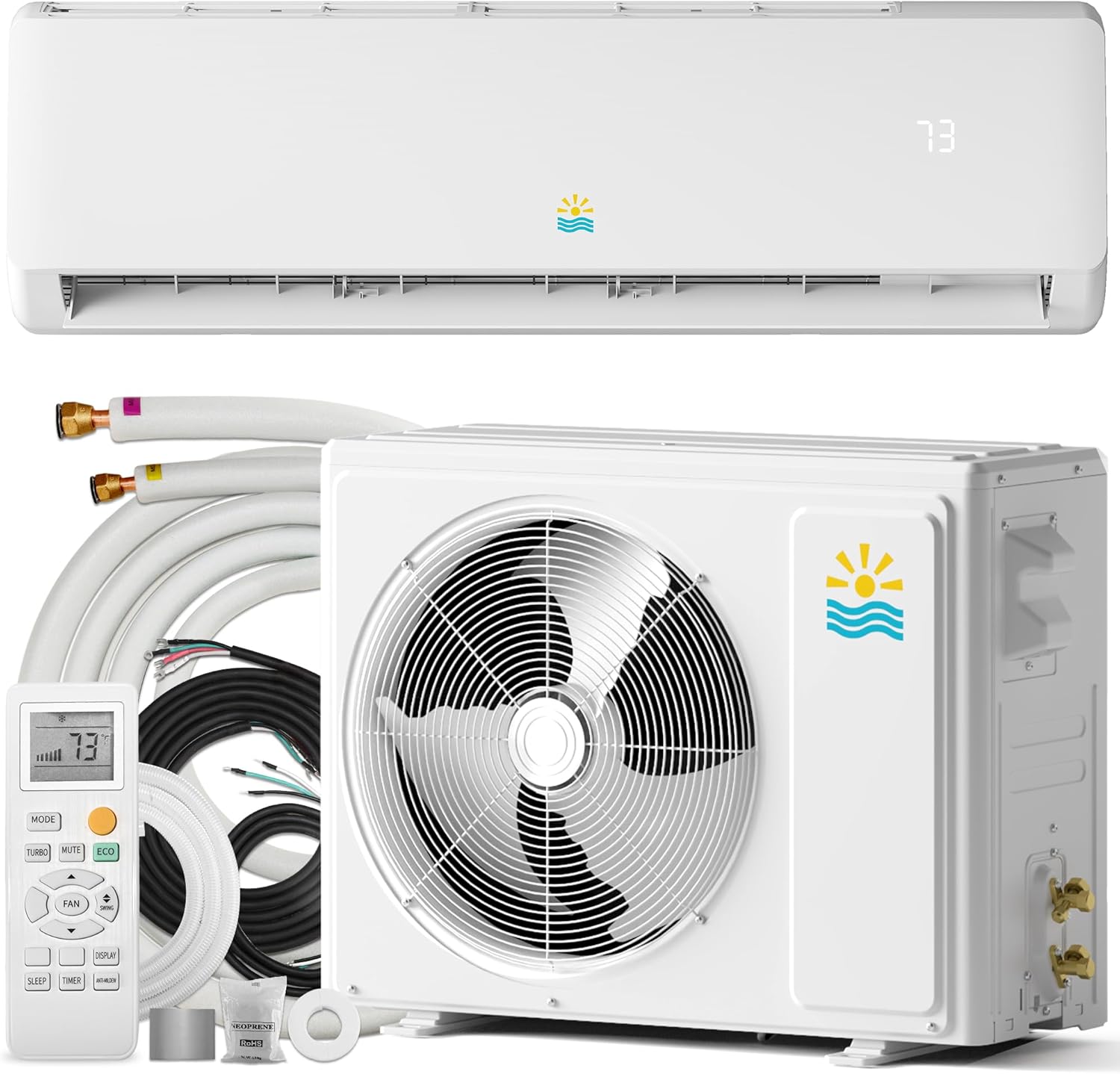
The Rellytech 9000 BTU mini-split is a compact ductless heat pump intended to cool or heat a single small space using inverter technology and a remote control. It offers cooling, heating, fan, and dry modes plus four fan speeds and a 24-hour timer, so you can set steady temperatures and run quiet overnight operation at about 42 dB. The unit ships with an indoor and outdoor unit and an installation kit that includes connecting pipes and wiring, but professional installation is recommended for refrigerant handling and wall mounting. Efficiency is reasonable for its class with a 19 SEER2 rating and HSPF2 8.5, which helps lower energy draw compared with non-inverter ACs. Practical limitations for RV use include the need to verify compatible 115V power and confirm outdoor unit mounting and clearances on a vehicle, and professional installation may be harder or costlier in mobile setups. The unit is best where a compact, quieter heat pump is needed for a small interior space and where a semi-permanent exterior condenser can be mounted.
Best for: Budget-minded buyers who want a compact, energy-efficient ductless heat pump to temper a single small living area and are willing to arrange professional installation and exterior mounting.
Less Ideal for: Owners who need a plug-and-play rooftop RV air conditioner or cannot accommodate a fixed outdoor condenser and professional HVAC work on their vehicle.
- Both cooling and heating in one inverter heat-pump package for year-round use.
- Relatively quiet operation at about 42 dB suitable for sleeping areas.
- Includes indoor and outdoor units plus an installation kit with pipes and cables.
- Inverter technology and 19 SEER2 rating improve energy efficiency versus non-inverter systems.
- Requires professional installation and refrigerant-handling which complicates RV retrofit projects.
- Outdoor unit needs a secure, ventilated mounting location that may be difficult on some RVs.
Verdict: If you want a quiet, energy-efficient mini-split to heat and cool a small RV interior and can handle professional installation and exterior condenser mounting, this 9000 BTU Rellytech unit is a cost-conscious choice.
Senville LETO 12000 BTU Mini Split

| Cooling Power | 12000 british thermal units |
|---|---|
| Voltage | 110 volts |
| SEER | 20.8 |
| Capacity | 1 tons |
| Noise | 28 db |
The Senville LETO 12000 BTU mini split is a ductless wall-mounted heat pump that provides year-round climate control with cooling, heating (to about 5F), dehumidifying, and fan modes. It uses a DC inverter compressor for efficient, variable-speed operation and includes an indoor air handler, outdoor condenser, a remote, and a 16 ft precharged line set for straightforward professional installation. Practical benefits include a high SEER (20.8) that keeps operating energy lower than many window units, quiet operation rated around 28 dB indoors, and smart features such as app and Alexa control for remote scheduling and geofencing. For RV use the unit's 110/120V power and compact mini-split form factor make it a realistic option for larger, stationary RVs or park models where a split system can be mounted and hardwired by a technician. Important limitations are that this is a full mini-split requiring professional installation, it is sized for about 700 sq ft so it is oversized for most living-space-only RVs, and the listed weight and outdoor unit footprint mean it is best suited to RVs with adequate structural support and space for an exterior condenser.
Best for: Buyers prioritizing a reliable, energy-efficient split system with smart controls who plan to install a permanent, professionally mounted solution in a stationary RV or park model.
Less Ideal for: Traveling or lightweight RV owners who need a portable, plug-and-play air conditioner or who cannot accommodate an exterior condenser.
- Inverter-driven compressor for efficient, variable-speed performance and higher SEER.
- Works with Alexa and app control for remote scheduling and geofencing.
- Includes indoor handler, outdoor condenser, remote, and a precharged 16 ft line set for installer convenience.
- Quiet indoor operation around 28 dB, suitable for sleeping areas.
- Requires professional installation and a suitable exterior mounting location for the condenser.
- Rated capacity (~700 sq ft) is large for most RV interiors and may be oversized for many units.
- Outdoor unit and overall system weight require adequate structural support and space.
Verdict: Choose the Senville LETO 12000 BTU mini split if you want a reliable, efficient, smart-controlled ductless HVAC solution for a stationary RV that can accommodate a permanently mounted condenser.
Albott 12,000 BTU Mini Split SAC001

| Cooling Power | 12000 british thermal units |
|---|---|
| SEER2 | 18 |
| Voltage | 115 volts |
| Power Source | Corded Electric |
| Refrigerant | R32, GWP: 675 |
The Albott 12,000 BTU SAC001 is a ductless mini-split heat pump that provides cooling, heating, dehumidifying and fan modes through an inverter compressor and app or remote control. In practice it behaves like a standard residential mini-split: the indoor wall unit mounts inside the cabin while a new outdoor condenser is required and precharged refrigerant is supplied, and a licensed HVAC technician is recommended for proper install. Notable features include built-in WiFi for app control, a self-cleaning mode, mesh filter and a SEER2 18 efficiency rating that helps limit seasonal energy use. The unit is quiet in operation (listed near 29 dB) and can operate across a wide temperature range, which is useful for variable conditions. Important trade-offs for RV use are size and installation: this is a full split system that needs a separate outdoor unit and professional installation rather than a rooftop RV A/C, so it requires space for the condenser and a proper electrical and refrigerant hookup. It also lists 115 V/980 W power and annual consumption figures that matter when planning RV electrical capacity.
Best for: Buyers who prioritize efficient, quiet year-round climate control and are comfortable arranging professional installation and allocating space for an outdoor condenser on an RV or tow-behind setup.
Less Ideal for: Nomads or owners who need a plug-and-play rooftop RV air conditioner with no external condenser or who cannot provide upgraded electrical capacity and professional installation access.
- Inverter compressor for steadier temperature control and improved efficiency
- Built-in WiFi and included remote for convenient remote and app control
- Self-cleaning function and removable mesh filter make routine maintenance easier
- Quiet operation around 29 dB suitable for sleeping areas
- SEER2 18 rating indicates above-average seasonal efficiency for lower operating costs
- Requires a separate outdoor condenser and professional HVAC installation rather than a simple rooftop install
- Not designed as an RV rooftop unit so physical fit and space for the outdoor unit must be planned
- Power and annual energy figures may exceed typical RV shore or generator capacity without upgrades
Verdict: Choose this mini-split if you want a quiet, energy-efficient inverter heat pump and can accommodate a separate outdoor condenser and professional installation for an RV climate-control upgrade.
Senville LETO 9000 BTU Mini Split
| Cooling Power | 9000 british thermal units |
|---|---|
| Capacity | 0.75 tons |
| Voltage | 110 volts |
| SEER | 21.5 |
| Included Components | Indoor Unit, Outdoor Unit and 16 Ft. Copper Line Set |
The Senville LETO 9000 BTU mini-split is a compact ductless heat pump intended to cool, heat, dehumidify, and circulate air in a single room. It pairs an indoor wall unit with an outdoor compressor and uses a DC inverter to modulate output for quieter, more efficient operation. Typical use involves professional installation using the included 16 ft. line set and communication wire; once installed you can control the system via remote, the mobile app, or Alexa voice commands. Notable features include a claimed 21.5 SEER rating, a low noise floor (about 25 dB), and app-based scheduling and geo-fencing for hands-off temperature control. Practical benefits for small, enclosed spaces are steady temperature control, improved efficiency compared with window units, and year-round heating down to about 5 F. Important limitations: this is a split system that requires a matching outdoor unit and licensed installation rather than a plug-and-play RV rooftop unit, and the listed voltage and fitment are aimed at residential 110/120V service rather than typical RV shore power without modification. Buyers should plan for professional assessment of power and mounting needs before purchase.
Best for: Buyers who prioritize a reliable, energy-efficient mini-split for a small enclosed space and want hands-off smart controls and quiet operation, provided they will arrange professional installation and confirm electrical compatibility.
Less Ideal for: People seeking a ready-to-install rooftop RV air conditioner or a plug-and-play unit that works with standard RV shore power without electrical modifications should look elsewhere.
- Multi-function: cools, heats, dehumidifies and circulates from one compact indoor unit
- Inverter compressor for more consistent temperatures and higher seasonal efficiency (21.5 SEER)
- Quiet indoor operation around 25 dB suitable for sleeping areas
- Smart controls with app, Alexa integration, remote control and geo-fencing
- Includes indoor unit, outdoor unit and 16 ft. line set for a single-room install
- Requires a new outdoor condenser and professional installation rather than simple plug-in setup
- Designed for residential 110/120V service which may not match typical RV electrical systems
- Not a rooftop RV unit so additional mounting, clearance, and power planning are necessary
Verdict: If you want a quiet, efficient single-room mini-split with smart controls and are prepared to handle professional installation and power planning, this 9000 BTU LETO unit is a sensible choice.
Choosing the Right Mini-Split Air Conditioner for RVs: Key Factors to Consider
Correct Cooling Capacity
Matching cooling capacity to your RV's interior volume is essential. An undersized unit will run continuously without reaching set temperature, wasting energy and increasing wear. An oversized unit will cycle too frequently, causing humidity control problems and uneven comfort.
To estimate needed capacity, consider total cabin cubic footage and insulation levels. Take into account large glass areas, roof vents, and heat sources such as cooking appliances or direct sun exposure. In many RVs, a modestly higher capacity helps on very hot days, but you must balance that against available electrical supply and startup current limits.
Electrical Load and Startup Demand
RVs have constrained electrical systems that often rely on shore power or onboard generators. Both continuous operating wattage and startup surge current matter because compressors can draw several times their running amps at startup.
Check the RV's breaker, inverter, and generator ratings before selecting a unit. Consider whether soft-start technology or variable-speed compressors are present, since those features reduce peak demand. Also plan wiring and breaker sizing with an eye toward safe continuous loads and headroom for other appliances.
Space, Weight, and Installation Constraints
Mini-split components must be sited where the indoor evaporator and outdoor condenser fit without interfering with living space or vehicle systems. Rooftop clearance, exterior wall thickness, and available wall or ceiling mount locations all influence placement options.
Weight distribution and mounting hardware are important for road safety and long-term durability. Choose units with compact footprints or low-profile outdoor sections when roof or sidewall space is limited. Confirm whether the line set and electrical runs can be routed without cutting excessive structure or compromising weather seals.
Noise and Vibration Control
Noise matters more in an RV than in permanent homes because of smaller interiors and closer proximity to noise sources. Compressor whine, fan noise, and vibration transmitted through flimsy mounts can reduce comfort, especially at night.
Look for units with low-decibel indoor blowers and outdoor sections designed to isolate vibration. Consider the placement of the outdoor unit relative to sleeping areas and the sleeping arrangement inside the RV. Additional anti-vibration pads and insulated mounting can mitigate transmission on older coaches.
Repairability and Parts Accessibility
In-field serviceability is a practical concern for people who travel far from specialized service centers. Units with accessible filters, common electrical components, and straightforward refrigerant service points are easier to maintain and repair on the road.
Consider how easy it is to clean or replace the indoor filter, access the control board, and reach refrigerant service valves. Units that require complex or proprietary tools for routine maintenance should be avoided when frequent travel is expected.
Control Features and Zoning Options
Controls affect comfort and efficiency in tight RV layouts. Thermostat precision, remote control options, programmable timers, and multi-zone capability let you cool only occupied areas and reduce energy use.
Evaluate whether a unit supports variable fan speeds, sleep modes, and simple user interfaces that are practical while driving or camping. Integration with the RV's existing control panels or smart monitoring systems can be convenient but should not complicate basic operation.
Assessing Your RV's Cooling Needs
Start by measuring the spaces you want to cool and note insulation, window area, and common solar exposure. Small differences in volume or insulation can change the recommended capacity by 20 percent or more.
Also account for heat-generating activities like cooking or prolonged sun exposure when parked. If you camp in very hot climates, prioritize a slightly higher capacity and efficient airflow management to prevent hot spots.
- Measure cabin cubic feet rather than just square footage
- Note roof insulation R-value and window tinting
- Plan airflow so the evaporator distributes cool air through living and sleeping areas
Soft-Start and Variable-Speed Advantages
Soft-start technology reduces compressor startup current, which can be decisive when your RV is limited to a standard shore power pedestal or smaller onboard generator. Variable-speed compressors also modulate output to maintain temperature without frequent cycling.
These features typically improve comfort, lower in-use wattage, and reduce the chance of tripping breakers. For RV owners with modest electrical capacity, soft-start or inverter-driven systems often unlock the ability to run a larger cooling capacity reliably.
- Soft-start eases startup surge
- Variable-speed reduces frequent on-off cycling
- Both can improve humidity control
Routing Line Sets and Electrical Safely
Plan the route for refrigerant line sets and electrical runs before selecting a unit. Shorter, straighter runs reduce installation complexity and potential leak points. Keep penetrations to a minimum and use appropriate grommets or flashing to maintain weatherproofing.
Use marine-grade or RV-rated wiring and conduit where available. If you are uncertain about structural penetrations or wiring capacities, consult a qualified RV technician to confirm that the recommended unit can be installed without compromising the coach.
- Avoid long, convoluted line set runs
- Seal all exterior penetrations against water
- Follow RV electrical code and breaker sizing
Managing Condensate in Mobile Installations
Condensate management differs in moving vehicles. Some mini-split setups use internal drain pans with pumps to lift condensate to a roof drain or exterior outlet. Others rely on gravity drains, which require careful siting and consistent vehicle pitch.
Select a unit and drain arrangement that matches how you use the RV. If you boondock on uneven ground or frequently travel, a condensate pump with a reliable float sensor reduces the risk of interior water issues.
- Consider a condensate pump for roof-mounted coils
- Use check valves or traps to prevent backflow
- Regularly inspect drain lines for blockage
Insulation and Airflow: Complementary Upgrades
Improving insulation and blocking direct sun with awnings or reflective covers often yields as much comfort gain as upgrading a cooling unit. Enhancements to roof and window insulation reduce runtime and help smaller mini-splits perform better.
Also focus on interior airflow: well-placed vents, small ducting, or directional louvers help distribute air from a single indoor unit to sleeping and living zones without needing multiple compressors.
- Upgrade roof insulation where possible
- Use reflective window coverings in direct sun
- Optimize indoor unit placement for balanced airflow
How We Chose the Best Mini-Split Air Conditioner for RVs
We prioritized products that suit the unique constraints of recreational vehicles rather than residential installations. Our selection process emphasized units with cooling capacities appropriate for typical RV interiors, low idle and operating power draw, and clear installation pathways for compact coach walls and roof attachments. We also favored models with proven noise control features, straightforward maintenance access, and controls suitable for mobile use. Reliability considerations included component accessibility for field service and commonality of replacement parts. Exclusions: we excluded products that require major structural modification or dedicated high-voltage shore power beyond what most RVs provide. The specific evaluation dimensions that guided selection were cooling capacity versus cabin volume, continuous and startup power draw, installation flexibility and footprint, noise levels during operation, ease of routine servicing, and control options for zoned or multi-room setups.
Our full evaluation process is outlined in our review methodology.
FAQ
Can a mini-split run from a typical RV shore power connection?
Often it can, but it depends on the unit's running watts and startup surge relative to your shore power rating. Choose models with lower startup draw or soft-start features if your pedestal or inverter has limited capacity.
Do mini-splits require major structural changes to install in an RV?
Most RV mini-split installations use compact wall or ceiling mounts with small penetrations for line sets. Significant structural changes are usually unnecessary, but some coaches may need reinforcement or custom flashing to ensure a weatherproof mount.
How is condensate handled when the RV is parked on uneven ground?
A condensate pump is the most reliable option for uneven conditions because it forces water to an exterior drain regardless of vehicle pitch. Gravity drains can work but require careful routing to maintain downhill flow.
Are inverter compressors worth it in an RV application?
Inverter compressors typically offer better efficiency, quieter operation, and reduced startup current, which can be particularly beneficial in RVs with limited electrical capacity. They also provide smoother temperature control in small spaces.
What maintenance should I plan for an RV mini-split?
Routine tasks include cleaning or replacing indoor filters, checking condensate lines for blockages, and inspecting exterior coils for debris. Periodic professional checks of refrigerant charge and electrical connections are also advisable.
Final Verdict
When choosing a mini-split air conditioner for an RV, balance cooling capacity with the vehicle's electrical limits and installation constraints. Prioritize units with low startup demands or soft-start technology if your shore power or generator capacity is modest. Consider noise, condensate handling, and ease of maintenance because those factors affect day-to-day comfort and reliability on the road. With a clear view of cabin volume, wiring capacity, and installation options, you can select a system that delivers comfortable, efficient cooling without frequent service interruptions.