
Note: This article contains affiliate links. If you click on these links and make a purchase, we may earn a small commission at no extra cost to you. This helps support our research and content. Read our full affiliate disclosure here.
Finding the right window air conditioner deal matters because a poorly chosen unit can undercool the room, spike energy bills, or create noisy, short-lived service. You want a balance of reliable cooling power, energy efficiency, and features that match the space you need to condition. This guide shortlists the top options for Window air conditioners under the Deals scope and explains how they perform on key buyer concerns like cooling capacity, energy use, and installation simplicity. Below are our recommended picks and the evaluation criteria we used to narrow them to the best deals for typical home use.
Top Picks at a Glance
| Best Overall The best all-around choice for most situations | Frigidaire 8,000 BTU Window Air Conditioner |  |
| Best Quality Built to a higher standard if you want something more solid | GE Profile ClearView 8,300 BTU |  |
| Best Value The sweet spot between price and what you get | Midea EasyCool 5,000 BTU Window AC |  |
| Best Budget The cheapest option that still gets the job done reliably | GarveeHome 6000 BTU Window AC |  |
| Top Rated A top-rated pick with lots of positive feedback | Frigidaire FFRA051WAE 5,000 BTU |  |
| Most Popular A crowd favorite that many people choose with confidence | Amazon Basics 5000-BTU Window AC |  |
| Best Seller A high-volume bestseller chosen again and again | GE 5,000 BTU Window Air Conditioner |  |
Frigidaire 8,000 BTU Window Air Conditioner

| Cooling Power | 8000 BTU |
|---|---|
| Floor Area | 350 square_feet |
| Wattage | 714 watts |
| SEER | 10.9 |
| Refrigerant | R-32 |
The Frigidaire 8,000 BTU window air conditioner is a smart, mid-size unit that cools spaces up to roughly 350 square feet and offers convenient remote and app control. It provides three fan speeds, multi-directional airflow, a 24-hour timer, and modes for Eco, Sleep, and Dry to tailor comfort and conserve energy. The washable dust filter and filter-alert light make routine maintenance straightforward, and the unit supports voice assistants for hands-free adjustments. At about 714 W power draw and a SEER of 10.9, it balances cooling performance and efficiency for a typical bedroom or small living area. Noise is in the mid-50 dB range, so it is noticeable but not unusually loud for window ACs. Installation requires a standard window kit and the unit is not inverter-based, so it uses a conventional compressor that cycles to maintain temperature. For buyers focused on easy smart control, solid cooling for moderate-sized rooms, and simple upkeep, this Frigidaire model is a practical choice; those who need ultra-quiet operation or higher efficiency may prefer other technologies.
Best for: Buyers who want a straightforward, smart-controlled window AC that reliably cools a bedroom or similar-sized space while offering easy maintenance and practical energy-saving modes.
Less Ideal for: People seeking the quietest possible operation, the highest energy efficiency, or variable-speed inverter performance should consider other options.
- Wi‑Fi and app control plus remote and voice assistant compatibility for convenient operation
- Custom modes (Eco, Sleep, Dry) and a 24‑hour timer to tailor comfort and save energy
- Washable dust filter with a Clean Filter alert for easy maintenance
- Multi‑directional airflow and three fan speeds for flexible room circulation
- Noise level around mid‑50 dB may be noticeable in very quiet rooms
- Not an inverter model, so compressor cycles rather than providing variable-speed operation
Verdict: A practical, Wi‑Fi‑enabled 8,000 BTU window AC that delivers reliable cooling and easy smart control for bedrooms and similar-sized rooms.
GE Profile ClearView 8,300 BTU
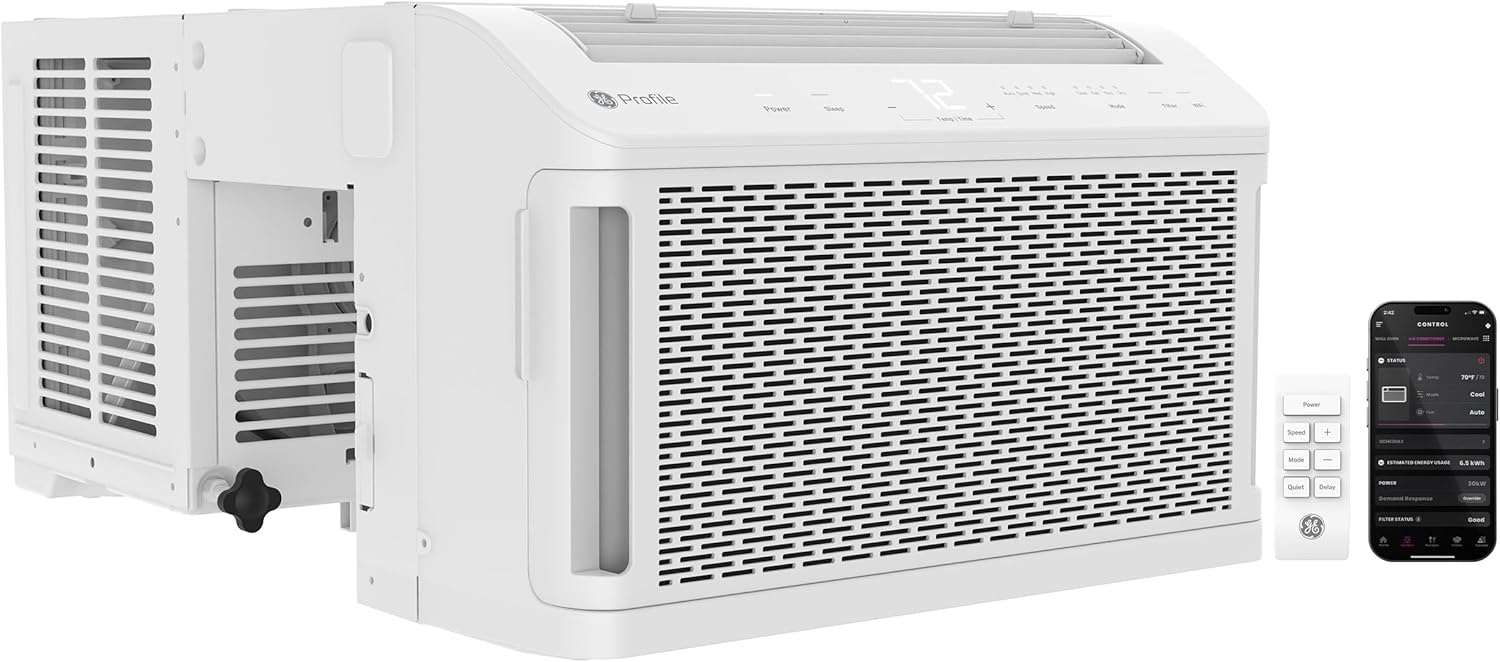
| Cooling Power | 8300 BTU |
|---|---|
| Floor Area | 350 square_feet |
| Noise | 41 db |
| Power Source | Corded Electric |
| Controller Type | App Control, Remote Control, Touch Control, Voice Control |
The GE Profile ClearView 8,300 BTU is a window air conditioner built to deliver quiet, connected cooling for medium rooms. It cools spaces up to about 350 square feet, offers three fan speeds and multiple modes including an eco mode and dehumidifier function, and integrates with the SmartHQ app plus voice assistants for remote scheduling and control. The ClearView sits below the window sill so you keep a full outside view and its flex-depth design adjusts to wall thicknesses for an easier fit without a mounting bracket in many installations. Practical touches include a washable/removable filter, a built-in pump to move condensate outside, and a 24-hour timer with power-interruption restart. Trade-offs are that it is not an inverter model and its efficiency rating and annual consumption reflect typical window-AC power use, so electricity costs will matter with heavy use; the unit is also fairly heavy and sized for double-hung windows only. For buyers who prioritize quiet, app-enabled cooling and an easier in-window install, this unit hits those points well.
Best for: Buyers who want a quiet, app-controlled window AC that preserves the window view and offers straightforward installation and smart scheduling for medium rooms.
Less Ideal for: People needing the absolute highest energy efficiency or variable-speed inverter performance or who require a portable solution that moves between rooms.
- Very quiet operation suitable for bedrooms and living areas
- Wi‑Fi and voice control with SmartHQ app for remote scheduling and monitoring
- Flex-depth design and below-sill placement preserve full window view and simplify fitment
- Built-in condensate pump removes water outside and washable filter eases maintenance
- Not an inverter compressor, so it uses conventional on/off operation
- Relatively high power consumption for continuous heavy cooling
Verdict: Choose this unit if you want quiet, smart-controlled cooling and a below-sill design that preserves your window view for medium-sized rooms.
Midea EasyCool 5,000 BTU Window AC
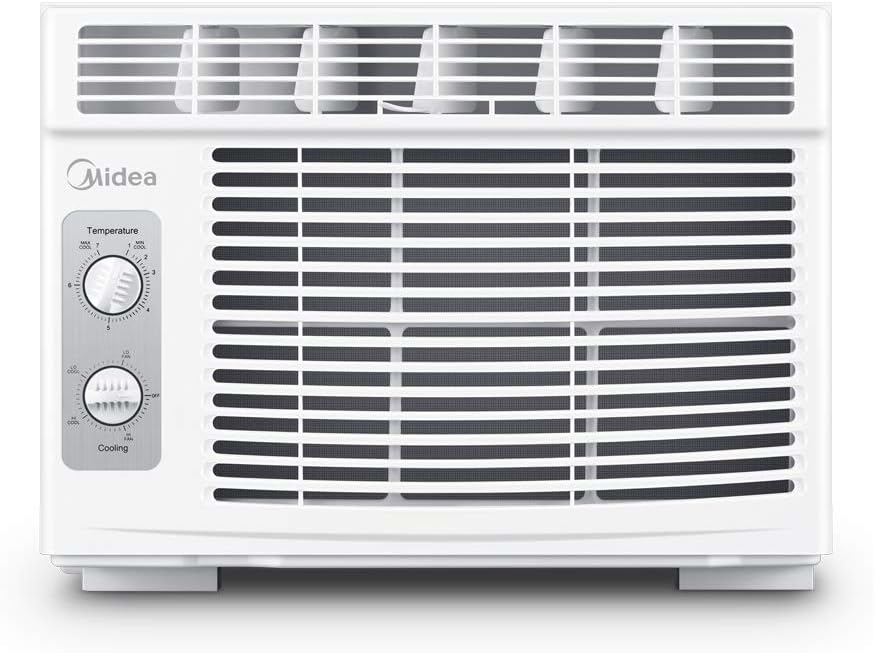
| Cooling Power | 5,000 BTU |
|---|---|
| Floor Area | 150 square_feet |
| Refrigerant | R-32 |
| Control Method | Push Button |
| Wattage | 450 watts |
The Midea EasyCool 5,000 BTU window air conditioner is a no-frills unit meant for small rooms, dorms, and home offices. It uses mechanical push-button controls to select from multiple temperature settings, two cooling speeds, and two fan-only speeds, and its 2-way outlet helps direct airflow where you need it. The washable, reusable filter keeps dust and pet hair out of the air and is easy to remove for cleaning. Installation mounts into a standard window and includes the necessary bracket, so setup is straightforward for a DIYer with a screwdriver. On the plus side the unit runs quieter than many room appliances and uses R-32 refrigerant with a CEER/SEER-style efficiency rating listed at 11, so it is reasonably efficient for its class. Expect basic performance but limited advanced features — there is no inverter, no smart controls or remote, and the compressor type is a simple rotary design, which keeps cost down but limits precise temperature modulation. For buyers prioritizing simplicity, straightforward operation, and low upkeep, this unit delivers reliable small-room cooling.
Best for: Buyers who want an affordable, easy-to-install window AC that reliably cools a small room with simple controls and low maintenance.
Less Ideal for: If you need smart/home automation features, precise temperature control, or the highest energy efficiency, this basic mechanical unit is not the best choice.
- Compact 5,000 BTU capacity suitable for rooms up to ~150 sq ft
- Simple mechanical push-button controls that are easy to use
- Washable reusable air filter for low-maintenance cleaning
- Includes window bracket for straightforward DIY installation
- Relatively quiet operation for a window unit
- No smart features or remote control for convenience
- Not an inverter unit so cooling and efficiency are less refined than inverter models
- Annual energy consumption figures are relatively high compared with ENERGY STAR models
Verdict: A budget-friendly, easy-to-install window AC that gives straightforward, low-maintenance cooling for small rooms.
GarveeHome 6000 BTU Window AC
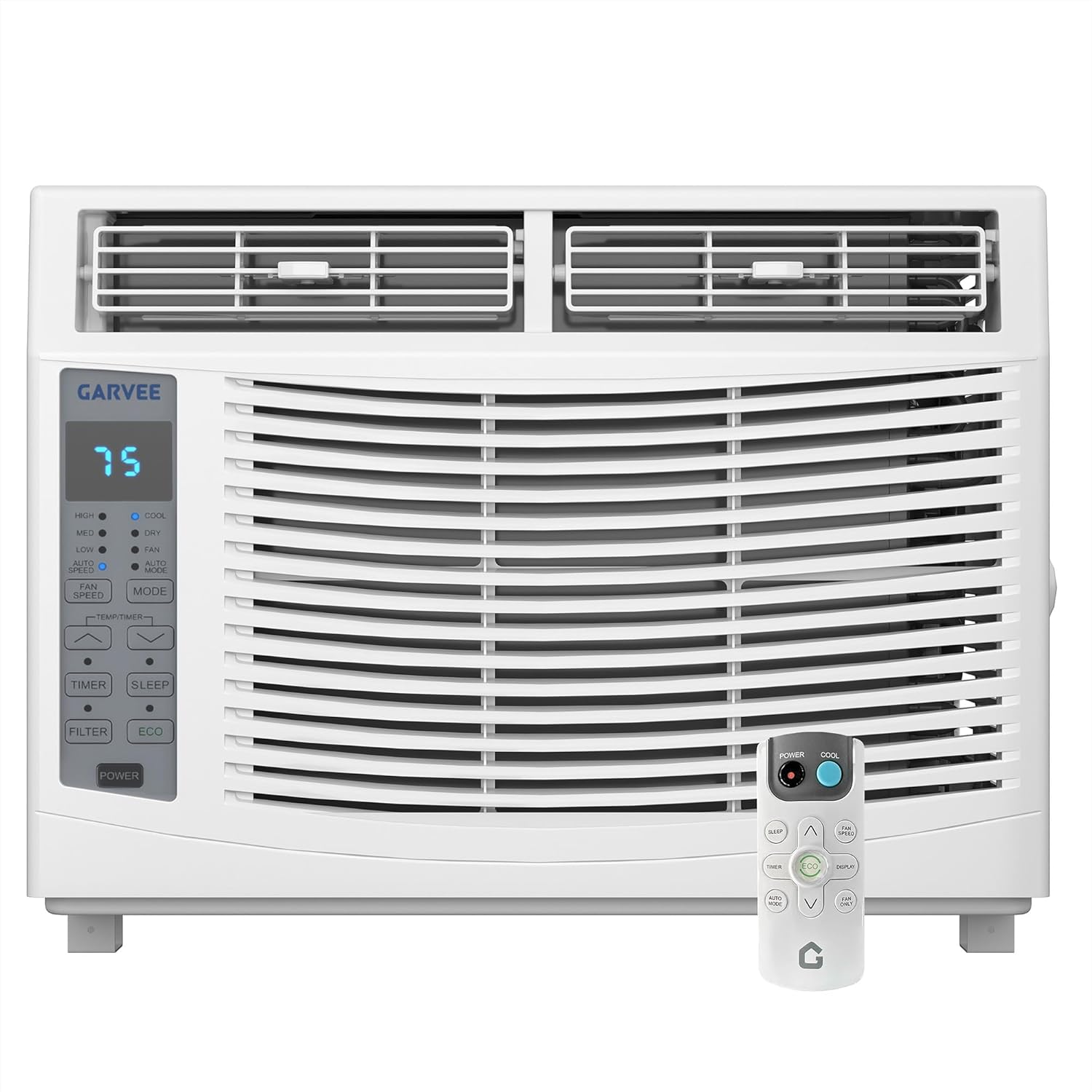
| Cooling Power | 6000 BTU |
|---|---|
| Noise | 42 db |
| Power Supply | 115 V |
| Wattage | 850 |
| Floor Area | 250 square_feet |
This GarveeHome 6000 BTU window air conditioner provides straightforward, budget-oriented cooling for medium rooms such as bedrooms, small living rooms, and home offices. It uses a rotary compressor to deliver quick cooling and offers three cooling speeds plus a fan-only mode and Auto‑Cool to adjust fan speed based on room temperature. Controls include an LED digital display and a full-function remote for convenient adjustments from across the room, and an auto‑restart restores settings after power outages. The unit runs on standard 115V power and lists 850 watts annual consumption, so it is suitable for typical household circuits. Practical benefits include included mounting panels and hardware for standard double-hung windows and a compact window form factor that keeps installation relatively simple. Limitations for buyers: noise and efficiency are typical of value window units rather than premium inverter models, and the 6000 BTU capacity is best for single rooms up to ~250 sq. ft., not for multi-room cooling or large open plans.
Best for: Buyers seeking an inexpensive, no-frills window AC to cool a single medium room and who prioritize straightforward installation and remote control convenience.
Less Ideal for: People looking to cool larger open-plan areas, multiple rooms, or who want the higher efficiency and lower noise of an inverter model should consider a different option.
- Appropriate 6000 BTU cooling for medium rooms up to ~250 sq. ft.
- Remote control and LED digital display for easy operation from across the room.
- Multiple fan and cooling speeds including Auto‑Cool for hands-off temperature control.
- Includes mounting panels and hardware for standard double-hung window installation.
- Auto-restart preserves settings after power outages.
- Not an inverter unit, so it may be less efficient and noisier than inverter-style models.
- 6000 BTU capacity is limited to a single medium room, not suitable for large or multiple connected spaces.
Verdict: A practical, budget-friendly 6000 BTU window air conditioner that delivers simple, reliable cooling and easy installation for a single medium-sized room.
Frigidaire FFRA051WAE 5,000 BTU

| Cooling Power | 5000 BTU |
|---|---|
| Floor Area | 150 square_feet |
| Noise | 52 db |
| Wattage | 450 |
| Refrigerant | R-32 |
The Frigidaire FFRA051WAE is a straightforward window-mounted 5,000 BTU air conditioner for small rooms and bedrooms. It provides basic cooling and air circulation with two fan speeds and Effortless Temperature Control to hold a set temperature, while a washable dust filter helps keep the unit running efficiently with minimal upkeep. Installation is typical for window units and the adjustable side panels plus the long three-prong cord simplify fitting most windows without an extension. At 52 dBA it runs quietly enough for overnight use but is noticeably audible if placed close to a bedside. The unit uses R-32 refrigerant, a rotary scroll compressor and draws about 450 watts on 115V, so it is energy-efficient for its size with an SEER of 11. There are no advanced smart features on this model, and its 150 sq. ft. cooling capacity limits it to small spaces; buyers needing more precise climate control or larger-zone cooling should consider a higher-capacity model. For simple, low-maintenance cooling in a single room, this Frigidaire is a reliable choice.
Best for: Buyers who prioritize a dependable, low-maintenance window AC for a single bedroom or small living area and want straightforward operation without extra features.
Less Ideal for: People who need whole-room or multi-room cooling, advanced smart controls, or higher-capacity units for large spaces should look elsewhere.
- Compact 5,000 BTU unit suitable for small rooms up to 150 sq. ft.
- Washable dust filter for simple, low-cost maintenance.
- Adjustable side panels and extra-long power cord simplify window installation.
- Relatively quiet operation at 52 dBA for overnight use.
- Moderate energy use with 450W power draw and SEER of 11.
- Limited cooling capacity restricted to small rooms.
- No advanced smart connectivity or remote control included.
- Not intended for large open-plan spaces or whole-apartment use.
Verdict: A dependable, easy-to-maintain 5,000 BTU window AC that delivers quiet, efficient cooling for a single small room.
Amazon Basics 5000-BTU Window AC
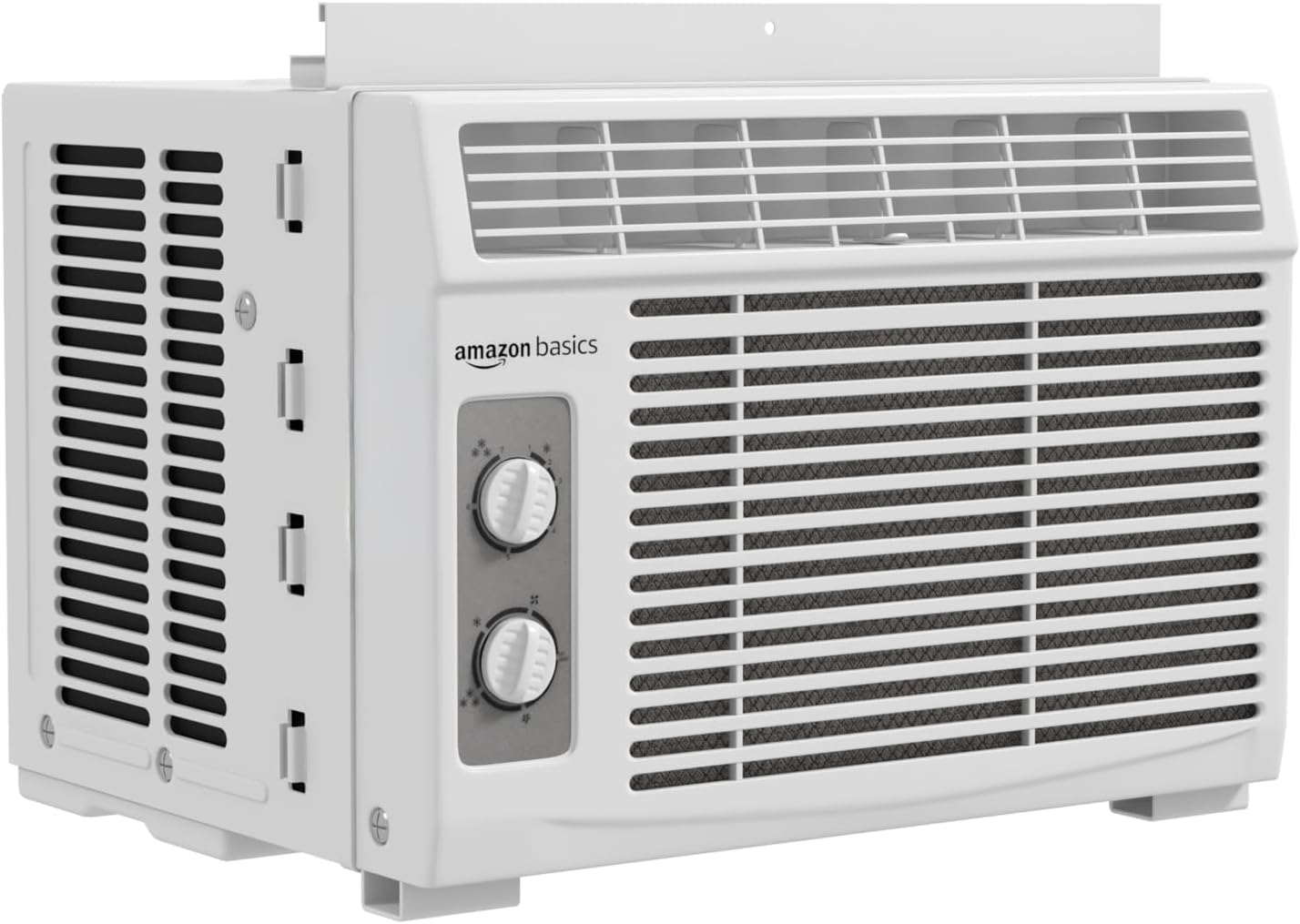
| Cooling Power | 5000 British thermal units |
|---|---|
| Floor Area | 150 square_feet |
| Noise | 56 db |
| Wattage | 450 watts |
| Control Method | Touch |
This Amazon Basics 5000-BTU window air conditioner is a straightforward, no-frills unit for cooling small rooms such as bedrooms, home offices, or dorms. It offers two primary modes—cooling and fan-only—with seven temperature settings and two fan speeds so you can tune comfort without digital complexity. Installation uses the included adjustable window kit and expandable side panels to fit most standard windows, and the front-access washable pre-filter is easy to remove and clean, which helps reduce dust and allergen buildup. The unit runs fairly quietly for its class at up to 56 dB and draws about 450 watts, so it is suitable for overnight use or in workspaces where loud compressors are a nuisance. Expect practical, basic controls via touch button panels rather than advanced smart features, and the rotary compressor design means steady performance but without inverter efficiency or advanced humidity control. For buyers prioritizing simple, reliable cooling for small spaces, this unit delivers core functionality; those needing larger capacity, remote connectivity, or the highest energy efficiency should look elsewhere.
Best for: Buyers who want an affordable, reliable window AC that is easy to install and maintain for cooling single small rooms and who value straightforward mechanical controls over smart features.
Less Ideal for: People seeking the highest energy efficiency, Wi-Fi or remote control features, or cooling for medium to large rooms should consider other options.
- Adequate cooling for rooms up to 150 sq ft with 5000 BTU capacity
- Simple installation with adjustable window kit and expandable side panels
- Washable front pre-filter for easy maintenance and dust capture
- Seven temperature settings and two fan speeds allow basic customization
- Relatively quiet operation up to 56 dB suitable for sleeping or working
- No inverter technology so it is less efficient than variable-speed models
- Controls are basic touch/buttons with no remote or smart connectivity
- Not suited for larger rooms beyond the listed coverage
Verdict: A practical, easy-to-install 5000-BTU window AC that delivers reliable cooling for single small rooms with low-maintenance washable filter.
GE 5,000 BTU Window Air Conditioner

| Cooling Power | 5000 BTU |
|---|---|
| Floor Area | 150 square_feet |
| Wattage | 440 watts |
| Refrigerant | R-32 |
| Control Method | Push Button |
This GE 5,000 BTU window air conditioner provides straightforward cooling for bedrooms, dorms, and small living spaces up to about 150 square feet. It uses a rotary compressor and two cooling modes with two fan speeds so you can choose quieter low airflow for night or higher output for faster cooling, and the mechanical push-button/dial controls keep operation intuitive without apps or Wi‑Fi. The unit includes an EZ mount installation kit and side panels for easy DIY setup and has an auto-restart feature that restores settings after power outages. Energy-wise it draws about 440 watts and has an 11 SEER rating, while the washable filter reduces ongoing filter replacement costs. Trade-offs are its basic feature set—no remote, smart controls, or inverter technology—and it is designed strictly for small rooms, so it will struggle in larger or open-plan spaces. Noise at higher settings is noticeable compared with premium quiet models, but the low setting is suitable for sleeping.
Best for: Buyers who prioritize a reliable, easy-to-use cooling unit with simple controls and low maintenance for a small room or temporary living space.
Less Ideal for: Those who want smart controls, ultra-quiet operation, or a unit sized for medium to large rooms should look at higher-capacity or inverter models instead.
- Compact footprint fits narrow windows and small rooms up to 150 sq ft.
- Simple mechanical controls that are easy to use with no Wi‑Fi or apps required.
- Washable filter reduces consumable costs and is easy to clean.
- EZ mount installation kit and included side panels make DIY install fast.
- Auto-restart resumes settings after power outages.
- No remote control or smart/Wi‑Fi features for remote management.
- Not inverter-equipped, so less efficient under variable loads compared with inverter models.
- Higher fan/cooling setting produces noticeable noise (up to 56 dB).
Verdict: A no-frills, easy-to-install window AC that reliably cools small rooms while keeping operation and maintenance simple.
Choosing the Right Window Air Conditioner Deals: Key Factors to Consider
Cooling Capacity Vs Room Size
Matching cooling capacity to room size is the single most important factor for a window air conditioner. Capacity is typically expressed in BTUs and directly determines how quickly and effectively the unit can lower temperature in a given space.
If you choose a unit with too low a capacity for the room, it will run constantly, fail to reach set temperatures, and consume more power over time. Oversized units cycle on and off more frequently, which can harm dehumidification performance and increase wear. Measure the room and select a BTU range appropriate for the square footage and typical sun exposure to ensure the deal you get actually delivers comfortable cooling.
Energy Efficiency and Operating Cost
Upfront price reductions are attractive, but energy efficiency determines operating cost over the life of the unit. Look for published energy consumption figures and efficiency metrics to estimate running costs under realistic conditions.
Features such as variable-speed compressors, efficient fans, and programmable thermostats improve real-world efficiency. If a deal lacks efficiency information, treat it with caution because long-term electricity expense may negate the initial savings. In climates with long cooling seasons, small efficiency differences can add up substantially.
Installation Requirements and Fit
Window air conditioners vary in size, weight, and mounting hardware needed for proper installation. Consider the window type, sill depth, and whether you have a single- or double-hung window when evaluating deals.
Some units include universal kits and easy-tilt brackets that simplify setup, while others require additional support or professional help. A seemingly great deal may become costly if you must buy extra hardware or pay for installation. Verify measurements and included accessories before committing.
Noise Level During Operation
Noise is an everyday comfort factor that many buyers overlook when chasing low prices. Measured sound levels matter most during sleeping hours or in home offices where quiet operation is essential.
Look for published decibel ratings or user-focused descriptions of quiet modes. Features like multi-speed fans and sleep settings reduce audible disruption. If noise information is absent, anticipate some variability and prioritize models with clear noise specifications for bedrooms or study areas.
Durability, Maintenance, and Warranty
A low initial cost can be offset by early failures or frequent maintenance. Consider build quality indicators such as compressor type, cabinet materials, and availability of washable or replaceable filters.
Regular maintenance tasks like filter cleaning and occasional coil checks keep an air conditioner efficient. Warranty length and coverage give insight into expected durability and manufacturer confidence. When evaluating deals, factor in expected upkeep and the convenience of accessing replacement parts or service.
Sizing Your Window Air Conditioner: Quick Guide
Start by measuring the room's square footage and noting ceiling height and sun exposure. Standard sizing charts correlate BTU ratings to room sizes, but adjust upward for rooms with large windows or high ceilings and downward for shaded spaces.
Consider the typical use pattern. For rooms used intermittently, a slightly smaller, more efficient unit with programmable controls may be preferable to a larger, constantly running unit. Match the chosen unit to the most frequent use case rather than occasional extremes.
- Measure length × width to get square footage.
- Account for high ceilings by increasing estimated BTU.
- Add capacity for sun-drenched rooms and kitchens.
- Choose programmable features if the room is used at variable times.
Understanding Efficiency Labels and Specs
Energy efficiency is conveyed through specific metrics and consumption numbers. Learn to read the published wattage and any efficiency ratings provided, and use these figures to estimate running cost for your local electricity rate.
Features like multiple fan speeds, eco modes, and precise thermostatic control improve real-world efficiency beyond headline BTU numbers. A deal that includes advanced control features can reduce lifetime cost even if the sticker price is modestly higher.
- Compare wattage at different fan settings for realistic consumption.
- Look for explicit energy-saving modes and programmable timers.
- Note whether the unit supports a precise temperature setpoint rather than simple high/low switches.
Installation Tips to Avoid Extra Costs
Careful pre-measurement prevents surprise purchases of mounting brackets or support hardware. Verify the window frame can safely support the unit weight and check that the included kit fits your window type.
If the unit is heavy or awkward, enlist help for safe lifting and leveling. Proper sealing around the unit prevents drafts and improves efficiency, so plan for insulating materials or side panels if they are not included.
- Confirm sill depth and window opening dimensions before buying.
- Plan for a helper and basic tools to ensure safe installation.
- Seal gaps with weatherstripping or foam panels to prevent air leaks.
Maintaining Performance Over Time
Routine maintenance extends service life and preserves efficiency. Regularly cleaning or replacing filters, checking for condensate drainage, and keeping outdoor coils free of debris all help the unit operate as designed.
Keep an eye on minor performance changes such as longer run times or increased noise, which can indicate that a filter cleaning or simple tune-up is needed rather than an immediate replacement.
- Clean or replace filters every 1 to 3 months in active seasons.
- Inspect and clear condensate lines to prevent water issues.
- Store the unit or cover the exterior properly during the off-season.
When a Deal Might Not Be a Good Value
Extremely low-priced units may omit critical specifications or skimp on insulation, controls, and durable components. If key details like efficiency ratings or installation hardware are missing, the apparent savings can evaporate in higher energy bills or retrofit costs.
Consider total cost of ownership, not just the sticker price. Factor in estimated electricity use, potential installation expenses, and likely maintenance needs to decide whether a deal truly saves money.
- Check for missing specification details before assuming value.
- Estimate annual energy cost using published wattage and local rates.
- Avoid models that require frequent filter replacements with uncommon sizes.
How We Chose the Best Window Air Conditioner Deals
We prioritized criteria that directly affect long-term satisfaction and operating cost when selecting the Window air conditioners included in this list. Key evaluation dimensions were cooling capacity matched to room size, measured by BTU rating and effective coverage; energy efficiency tracked by energy consumption and any relevant efficiency ratings; ease of installation and mounting hardware included; noise levels during typical operation; and durability factors such as compressor type and build quality. We also considered available control features like thermostatic control and programmable timers because they influence both comfort and efficiency. Units were excluded if they lacked basic safety or efficiency information, had unclear installation requirements, or were clearly undersized for common room types. Our shortlist reflects a balance between upfront deal value and long-term operating cost and reliability.
Our full evaluation process is outlined in our review methodology.
FAQ
How do I pick the right BTU rating for my room?
Measure the room area and use standard BTU-per-square-foot guidelines as a starting point. Adjust upward for high ceilings, heavy sun exposure, or kitchens, and down if the room is shaded or well insulated.
Are energy-efficient units worth paying more for?
Often yes. Higher efficiency reduces operating cost, especially in climates with long cooling seasons. Calculate expected annual energy use to compare lifetime costs rather than judging solely by upfront price.
Can I install a window air conditioner myself?
Many units are designed for DIY installation with included brackets and instructions, but heavy units or unusual windows may require assistance or additional hardware. Confirm included mounting kits and measure carefully before attempting installation.
What maintenance keeps a window air conditioner performing well?
Regularly clean or replace filters, keep the outdoor-facing coils clear of debris, and ensure condensate drainage is functioning. Seasonal inspections catch small issues before they become costly failures.
How noisy are window air conditioners typically?
Noise varies by model and cooling setting. Look for published decibel ratings or quiet modes if sound is a priority. In bedrooms, choose units with lower-rated operating noise and sleep settings to minimize disturbance.
Final Verdict
Prioritize matching capacity to room size and confirming energy efficiency when choosing a Window air conditioner deal. Factor in installation requirements and likely maintenance to avoid surprise costs. Balance upfront savings against estimated operating cost and durability to choose an option that keeps your space comfortably cool without costly tradeoffs.