
Note: This article contains affiliate links. If you click on these links and make a purchase, we may earn a small commission at no extra cost to you. This helps support our research and content. Read our full affiliate disclosure here.
If you want to preserve fruits, vegetables, herbs, or jerky without relying on electricity, a non electric food dehydrator can be a practical solution. These passive dehydrators use airflow, solar heat, or heat-retaining materials to remove moisture and extend shelf life while keeping energy use to zero. Choosing the right non electric model matters because drying times, capacity, and consistency vary widely and determine both food safety and final texture. This guide highlights our top shortlisted non electric food dehydrators for home use. We focus on factors like drying consistency, airflow design, construction materials, and ease of use so you can pick a durable unit that fits your typical batch sizes. Read on for the evaluation criteria and practical buying guidance before the product list.
Top Picks at a Glance
| Best Overall The best all-around choice for most situations | TANOVCEP 4-Layer Drying Net |  |
| Best Quality Built to a higher standard if you want something more solid | Cedilis Stackable Wood Drying Rack (2-Pack) |  |
| Best Budget The cheapest option that still gets the job done reliably | RVXlRDN 3‑Layer Herb Drying Rack |  |
| Top Rated A top-rated pick with lots of positive feedback | Lehman's Handmade Wood Dehydrator 4-Tray |  |
| Most Popular A crowd favorite that many people choose with confidence | VIVOSUN 2-Layer Mesh Drying Rack |  |
| Best Seller A high-volume bestseller chosen again and again | Desy & Feeci 4-Layer Herb Drying Rack |  |
TANOVCEP 4-Layer Drying Net
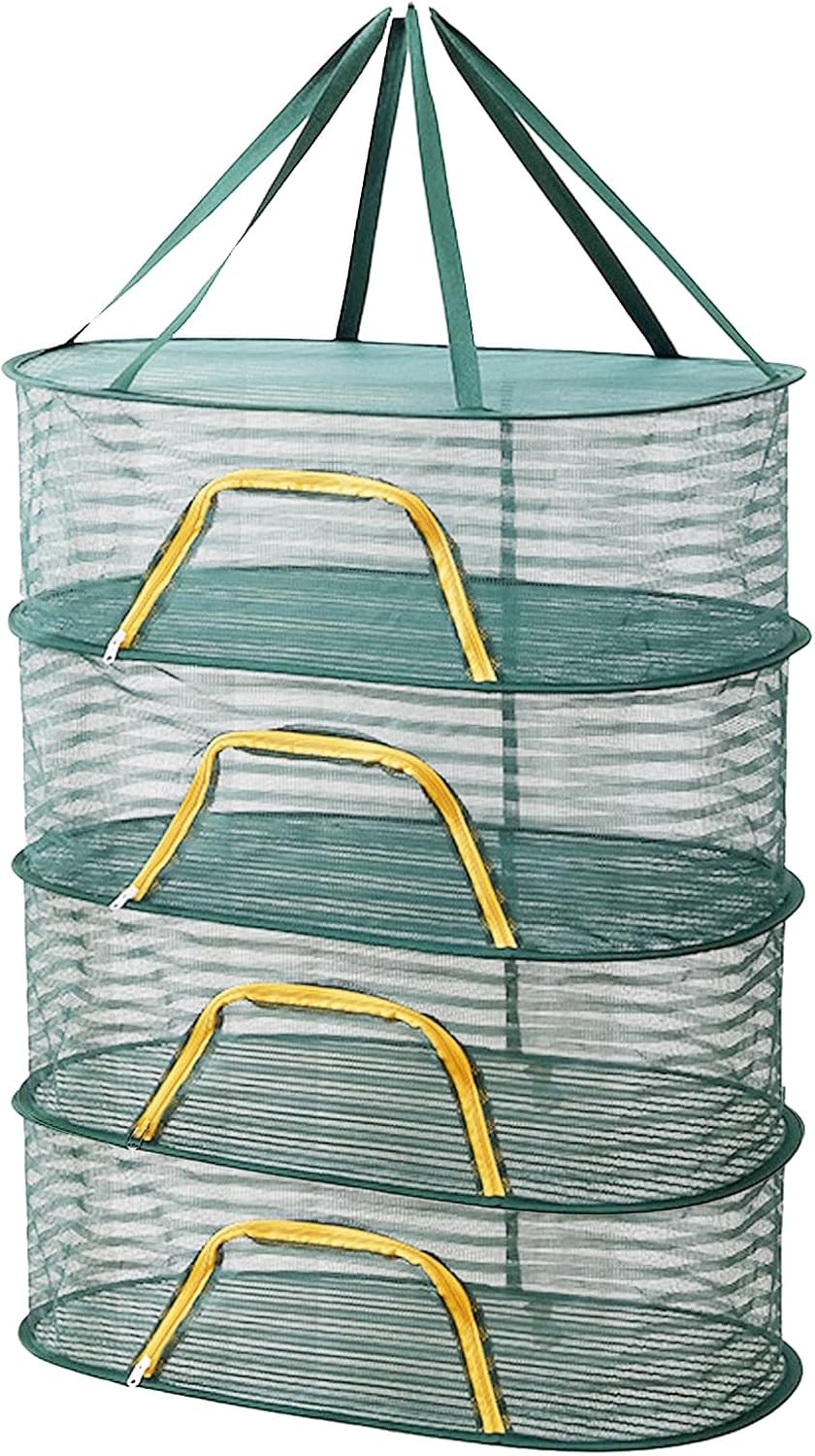
| Material Type | Nylon |
|---|---|
| Mounting Type | Ceiling Mount |
| Additional Features | Foldable |
| Size | 4 Layer |
This 4-layer drying net is a simple, non-electric solution for dehydrating small batches of food and keeping items protected while they dry. It hangs from a ceiling or hook and provides four mesh tiers so you can separate different foods or batches without them touching. The nylon mesh is breathable and lightweight, and a zippered cover plus windproof hook help keep insects and gusts out of the chamber while you dry herbs, fruit slices, small fish, or delicate vegetables. Because it folds flat it is easy to store when not in use and is portable enough to move between indoor and sheltered outdoor spots like garages or grow tents. It is best for low-volume, passive sun or air-drying rather than high-volume preservation, and drying times will depend on weather and humidity since there is no fan or heat source built in. If you need a compact, inexpensive tool to organize and protect batches while they air-dry, this net does the job cleanly and simply.
Best for: Buyers who want a low-cost, non-electric way to air-dry herbs, fruit, and small quantities of fish or vegetables and who value compact, easy storage and insect protection.
Less Ideal for: People who need fast, large-capacity dehydration or precise temperature and airflow control should choose an electric dehydrator instead.
- Four-tier design separates batches and maximizes usable drying surface
- Lightweight breathable nylon mesh that is easy to fold and store
- Zippered cover and windproof hook reduce insect exposure and prevent the rack from blowing away
- Ceiling-mount/hanging design works indoors or in sheltered outdoor spaces
- No built-in heat or airflow so drying depends on ambient conditions and takes longer than electric dehydrators
- Best suited to small batches rather than high-volume food dehydration
Verdict: A compact, insect‑protected four-tier drying net that gives balanced, low-tech air drying for small batches without electricity.
Cedilis Stackable Wood Drying Rack (2-Pack)

| Unit Count | 2 Count |
|---|---|
| Material Type | Wood |
| Mounting Type | Countertop Mount |
| Additional Features | Stackable |
These two stackable beech-wood racks convert into a two-tier drying stand for herbs, pasta, fruits, vegetables and small cuts of meat without electricity. Each tier sits on 3-inch legs for stable airflow, and the 3mm food-grade plastic mesh holds small items securely while allowing faster drying by promoting ventilation. The racks fold flat for compact storage and use threaded rods that make assembly and disassembly straightforward. For performance-focused drying, the ability to stack tiers raises capacity without needing extra countertop space and the natural wood frame keeps the system lightweight and easy to move. Limitations are that the mesh area is modest in size, so large batches require multiple cycles or both racks stacked, and wooden parts will need occasional hand cleaning and gentle care to avoid warping over time. Overall this is a practical, non-electric solution for someone who wants reliable airflow and modular capacity for small-scale dehydrating projects.
Best for: Buyers who want a compact, performance-focused non-electric drying solution for small-batch herbs, pasta, and produce and who value adjustable capacity and good airflow over large industrial throughput.
Less Ideal for: Not a good fit for users who need to dry large quantities at once or who prefer fully washable all-plastic racks that tolerate machine cleaning and heavy-duty commercial use.
- Stackable two-tier design increases drying capacity without extra footprint
- 3mm food-grade plastic mesh balances airflow with secure support for small items
- Folds flat for compact storage when not in use
- Threaded rods simplify assembly and disassembly for quick setup
- Mesh area is relatively small for large batches so throughput is limited
- Wood construction requires hand cleaning and careful drying to avoid warping over time
Verdict: A compact, performance-minded non-electric drying setup that boosts capacity with stackable tiers for efficient small-batch dehydrating.
RVXlRDN 3‑Layer Herb Drying Rack

| Mounting Type | Ceiling Mount |
|---|---|
| Weight Capacity Maximum | 3 kg |
| Additional Features | Foldable |
| Material Type | Fabric |
This three-layer mesh drying rack is a simple, low-cost solution for air-drying herbs, fruits, vegetables, jerky and small seafood or flowers. It hangs from a ceiling or hook and uses breathable fabric mesh and stacked trays to keep items separated while allowing good airflow, so things dry more evenly than a single flat surface. Setup is quick and the whole unit folds flat for compact storage or travel. The zipper panels make it easy to access trays while protecting contents from birds and insects. It is lightweight and best suited to small batches rather than large-scale dehydration, and the listed 3 kg weight capacity limits how much you can load per tier. Expect drying times to match passive air-drying methods rather than electric dehydrators, and results depend on humidity and airflow in your drying space.
Best for: Buyers looking for an inexpensive, no-power way to dry small batches of herbs, produce, or jerky who prioritize portability and simple storage over speed.
Less Ideal for: People who need fast, large-volume or temperature-controlled dehydration or commercial-scale drying should choose an electric dehydrator or larger equipment.
- Foldable, compact design for easy storage and transport
- Three stacked mesh trays increase usable drying area while preserving airflow
- Zippered enclosure protects food from insects and birds
- Breathable fabric material promotes even air-drying without power
- Not suitable for large or heavy loads due to 3 kg maximum capacity
- Drying is passive so it takes significantly longer than electric dehydrators
Verdict: A very affordable, portable non-electric drying solution for small batches of herbs and produce where convenience and storage are the priority.
Lehman's Handmade Wood Dehydrator 4-Tray

| Number of Trays | 4 |
|---|---|
| Material | fiberglass screens, oak frame |
| Made in | USA |
This simple, non-electric dehydrator is handcrafted from solid oak and uses four fiberglass drying screens to air-dry fruits, herbs, and jerky without electricity. It stacks four rectangular trays to give nearly four square feet of drying surface and can be used on its own, placed near a heat source, or inside a warm oven with the light on. The unit is lightweight and made in the USA, with smooth mitered corners and a basic instruction manual included. Its main strengths are durability from solid wood construction and a low-tech, long-lasting design that avoids motors and electronics. Limitations are its lack of active airflow or temperature control, so drying times depend on ambient conditions and may be slower than electric models, and the wooden frame requires occasional care to avoid warping or staining. For those who want a reliable, minimalist dehydrator built to last, this is a straightforward choice.
Best for: Buyers who prioritize tried-and-true reliability and low-tech durability and want a simple, long-lasting dehydrator for preserving food without electricity.
Less Ideal for: People who need fast, precise drying with adjustable temperature and built-in fans or those who prefer plug-and-play electric dehydrators with digital controls.
- Solid oak construction offers durable, long-lasting build quality
- Fiberglass food-safe screens provide ample drying surface across four trays
- Completely non-electric design avoids mechanical failures and is usable off-grid
- Handmade in the USA with simple, serviceable components
- No active airflow or temperature control, so drying is slower and weather-dependent
- Wood frame needs occasional care to prevent staining or warping
Verdict: Choose this handcrafted wood dehydrator if you want a reliable, non-electric unit built to last for off-grid or low-tech food preservation.
VIVOSUN 2-Layer Mesh Drying Rack

| Material Type | Nylon |
|---|---|
| Additional Features | Foldable |
| Mounting Type | Wall Mount |
| Weight Capacity Maximum | 4.4 pounds |
| Size | 2 Layer |
This VIVOSUN 2-layer mesh drying rack is a simple, non-electric solution for air-drying herbs, flowers, and small food batches indoors or outdoors. It uses black nylon mesh panels and an enclosed zippered cover to promote airflow while keeping debris and insects out, and each layer is rated to hold about 2.2 pounds. The kit arrives with an S-hook for hanging, a carrying pouch for compact storage, and pruning shears for trimming before drying, so it works as a compact all-in-one setup for small harvests. The foldable frame and lightweight construction make it easy to move or stow when not in use, and the dark mesh helps absorb sunlight if you hang it outdoors to speed drying. Limitations are its modest capacity and 4.4-pound total weight limit, so it is best for small batches rather than bulk dehydrating, and the lightweight frame can be less stable in windy outdoor conditions unless securely hung.
Best for: Buyers who want a compact, non-electric drying solution for small herb or food batches and who prefer a ready-to-use kit with storage and trimming accessories.
Less Ideal for: People who need to dry large volumes at once or require a stable, heavy-duty drying system for commercial or high-yield use.
- Enclosed mesh design keeps insects and debris off drying material.
- Foldable and lightweight for easy storage and transport.
- Includes practical accessories: S-hook, carrying bag, and pruning shears.
- Ventilated nylon mesh allows steady airflow and the black fabric helps absorb heat when used in sunlight.
- Low total capacity and 4.4 lb per-rack loading limit make it unsuitable for large batches.
- Lightweight frame can be unstable in breezy outdoor conditions if not securely hung.
Verdict: An affordable, portable non-electric drying rack that bundles hanging, trimming, and storage features for small-batch dehydrating.
Desy & Feeci 4-Layer Herb Drying Rack

| Mounting Type | Hang |
|---|---|
| Weight Capacity Maximum | 2.2 pounds |
| Additional Features | Foldable |
| Size | 4 Layer |
| Material Type | Carbon Steel |
This Desy & Feeci 4-layer herb drying rack is a simple, non-electric solution for air-drying herbs, flowers, and small garden harvests. It hangs from the included S-hook and uses breathable nylon mesh trays supported by steel wire rings to keep airflow moving around plant material for even drying. Each tier closes with a zipper to protect contents from birds and dust, and the set includes garden shears and a storage bag so you can clip, load, collapse, and store the unit without extra tools. The collapsible design makes it easy to fold flat when not in use and the lightweight frame is straightforward to move between an indoor closet, garage, or covered outdoor spot. Limitations are the modest per-layer weight capacity and reliance on ambient conditions for drying times, so it is not a fast dehydrator and requires a dry, ventilated location for best results. For anyone wanting a low-cost, low-maintenance way to dry small batches without electricity, this rack is practical and easy to use.
Best for: Buyers who prefer a low-risk, non-electric method to dry small batches of herbs or flowers and value an easy-to-use, portable solution they can hang indoors or in a covered outdoor spot.
Less Ideal for: People who need fast, controlled dehydration for large harvests or precise temperature and humidity control should look at electric dehydrators instead.
- Breathable nylon mesh and steel wire rings promote even air circulation for gentle drying
- Zippered enclosures protect drying contents from birds, dust, and pests
- Collapsible design folds flat for compact storage when not in use
- Includes S hang buckle, garden shears, and storage bag for immediate use
- Each layer supports only light loads, limiting large or heavy harvests
- Drying depends on ambient humidity and airflow so processing times can be long
Verdict: A compact, non-electric hanging dryer that makes batch-by-batch herb and flower drying simple and storage-friendly for cautious, low-maintenance users.
Choosing the Right Non Electric Food Dehydrator: Key Factors to Consider
Drying Consistency
Even moisture removal across trays determines food safety and final texture. Non electric dehydrators rely on passive airflow and temperature gradients, so tray arrangement and vent placement have an outsized effect on drying times.
Look for designs that promote uniform airflow from bottom to top or that include internal baffling to reduce hotspots. Inconsistent drying forces you to rotate trays more often or results in unevenly preserved food that spoils faster.
Airflow and Ventilation
Air movement is the engine of a passive dehydrator. Natural convection, solar chimney effects, or wind-driven vents are the mechanisms that remove humid air from the drying chamber.
Consider how vents are positioned, whether the unit can be angled toward prevailing sunlight or breeze, and if adjustable openings let you control drying rate. More reliable passive airflow reduces drying time and lowers the chance of trapped moisture.
Materials and Food Safety
Materials affect durability, heat retention, and whether the dehydrator is safe for direct food contact. Food-safe plastics, stainless steel meshes, and untreated hardwoods are typical choices, each with tradeoffs in weight and heat behavior.
Ensure all surfaces that contact food are nonreactive and easy to clean. Avoid units with questionable finishes or coatings that could degrade under sun or heat exposure.
Capacity and Tray Layout
Capacity determines how much you can dry per batch and influences how often you need to cycle produce. Tray size, stackability, and spacing all contribute to usable capacity without blocking airflow.
Pick a tray layout that matches your typical batch sizes. A tall stack with narrow trays may hold more volume but reduce airflow, while wider trays with tower spacing may dry more evenly at the cost of footprint.
Ease of Use and Maintenance
Practical features like removable trays, accessible vents, and straightforward assembly affect daily usability. Cleaning is especially important because sugars and oils can accumulate and promote spoilage or odors.
Choose units where trays and screens are simple to remove and rinse, and where the interior surfaces can be wiped down. Consider how easy it is to check progress and rotate trays when drying is in process.
Weather and Site Suitability
Because non electric dehydrators depend on ambient conditions, the typical weather and placement options you have will shape performance. Sunlight, humidity, and temperature all influence drying time and effectiveness.
If you live in a humid climate, you may need larger airflow capacity or to time drying for drier days. Units designed for outdoor solar use may require secure mounting or protection from pests and rain.
How Passive Dehydration Works
Passive dehydration removes moisture using natural air movement and heat rather than an electric heating element. Sunlight-warmed air rises through vents or chimneys, drawing drier air in and gradually lowering moisture in the food. The process is slower than powered drying but can be reliable when airflow and temperature are well managed.
Understanding the basic physics helps you plan batches. Thinly sliced pieces dry faster and more evenly. Placing the unit where it gets steady, indirect sun and unobstructed airflow improves results without introducing food-safety risk.
- Natural convection draws moist air upward if vents are placed correctly
- Solar-warmed chambers speed drying but require protection from direct rain
- Regularly checking and rotating trays improves uniformity
Best Foods to Dry Without Power
Not every food dehydrates equally well in passive systems. Fruits and herbs are the most forgiving because their sugar and fiber content let them dry slowly without spoiling. Thin fruit slices, apple rings, banana chips, and herb bunches are ideal candidates.
Meats and high-risk foods require longer drying and careful temperature control to avoid bacterial growth. If you plan to make jerky or dry thick meats, only do so in consistently warm, dry conditions and follow safe curing and drying practices.
- Good: thinly sliced fruit, herbs, mushrooms, nuts, and thin vegetable chips
- Use caution: meats and dairy need reliable higher temperatures and longer times
Positioning and Seasonal Use
Placement matters. For solar-driven units, orienting the intake toward the sun and providing a gentle slope for airflow increases efficiency. Units used in shaded or windy areas may still work but can take much longer to finish a batch.
Seasonal variation affects usability. Summer provides the shortest drying times, while humid or cool seasons will extend them. Plan larger runs for peak-dry months and small, quick batches when conditions are marginal.
- Aim for a well-ventilated, sunny spot when possible
- Avoid areas where rain or pests can enter the drying chamber
- Monitor local humidity to choose optimal drying days
Cleaning and Long-Term Care
Routine maintenance keeps a dehydrator sanitary and functional. Remove food residue after each batch, wash or wipe trays and screens, and let parts dry completely before storage to prevent mold.
Inspect vents and seals seasonally for blockages or wear. For wooden components, occasional oiling or light sanding may prolong life, while metal meshes might need gentle brushing to clear stuck particles.
- Wash removable parts promptly after use
- Store in a dry place to avoid mold
- Check for pest ingress points and seal if needed
Safety Tips for Non Electric Drying
Because passive drying can be slower and more dependent on ambient conditions, you must be conservative with high-risk foods. Use thin, uniform cuts and avoid crowding trays to ensure thorough moisture removal. For meats, follow established curing and drying guidelines and favor only reliably warm, low-humidity conditions.
Keep the drying area clean and protected from insects and animals. If you notice odd odors, sticky residues, or visible mold, discard the batch and sanitize the unit before the next use to prevent cross-contamination.
- Avoid overcrowding trays
- Discard batches with mold or off-odors
- Use caution with meats and dairy unless conditions are ideal
How We Chose the Best Non Electric Food Dehydrator
We shortlisted non electric food dehydrators by prioritizing practical, measurable qualities that affect drying performance and long-term usability. Key evaluation criteria included drying consistency across trays, which determines even moisture removal; airflow and passive ventilation design, since these systems depend on natural convection or solar-driven circulation; material durability and food-safe construction, because long-term exposure to heat and humidity requires stable, nonreactive surfaces; capacity relative to footprint, to match typical batch sizes without wasting space; and ease of cleaning and maintenance, as residue buildup reduces effectiveness and safety. We excluded electric or hybrid units and any designs that require a continuous external heat source beyond normal sunlight or safe passive insulation. We also filtered out models with insufficient user-accessible ventilation or materials that are not explicitly suitable for repeated food contact. The final selection reflects a balance of consistent drying performance, build quality, user convenience, and suitability for everyday food preservation without power.
Our full evaluation process is outlined in our review methodology.
FAQ
How long does food take to dry in a non electric dehydrator?
Drying times vary widely based on ambient temperature, humidity, airflow, and slice thickness. Expect anything from several hours on a hot, dry day to multiple days in marginal conditions. Plan to check progress regularly and rotate trays when drying is uneven.
Can I safely dry meat without electricity?
You can dry thinly sliced meat in consistently warm, dry environments, but meats carry higher microbial risk. Use proper curing steps, ensure steady heat and airflow, and only dry meats when conditions allow thorough dehydration over a reasonable timeframe.
What is the best way to arrange trays for even drying?
Leave space between pieces for airflow and avoid stacking dense layers. Rotate trays periodically if the design has a vertical temperature gradient. Arranging items in a single layer with uniform thickness yields the most consistent results.
How do I prevent pests from accessing my drying food?
Place the unit in a protected area, use fine mesh screens, and avoid leaving the chamber open for long periods. If using an outdoor solar setup, elevate the unit and secure covers to deter insects and small animals.
Can I use a non electric dehydrator year-round?
Year-round use depends on your climate. In warm, dry months these units perform well. In cool or humid seasons, drying times increase and success rates drop. Many users adapt by scheduling larger drying runs in optimal months and smaller batches or indoor alternatives during poor conditions.
Final Verdict
Non electric food dehydrators are a sensible option if you want energy-free preservation for fruits, herbs, and low-risk snacks. Prioritize consistent airflow, food-safe materials, and a tray layout that matches your typical batch sizes. Be realistic about weather limits and the extra attention passive drying requires. When choosing, weigh drying consistency and capacity against ease of cleaning and site suitability. That will help you pick a unit that reliably turns seasonal produce into long-lasting, tasty preserves without electricity.