
Note: This article contains affiliate links. If you click on these links and make a purchase, we may earn a small commission at no extra cost to you. This helps support our research and content. Read our full affiliate disclosure here.
When you want to preserve fresh herbs for cooking, tea, or homemade remedies, the right small food dehydrator makes a big difference. A unit designed for herbs dries leaves quickly and evenly while protecting delicate essential oils that give herbs their aroma and flavor. In this guide we shortlist the top small dehydrators specifically for herbs and evaluate each on relevant criteria like drying speed, temperature accuracy, and airflow. Below you will find compact, herb-focused options that suit small-batch drying and countertop use. Use the evaluation notes to match a machine to how you plan to dry, store, and use your dried herbs.
Top Picks at a Glance
| Best Overall The best all-around choice for most situations | Magic Mill Food Dehydrator MFD-5000 |  |
| Best Quality Built to a higher standard if you want something more solid | Magic Mill Pro Food Dehydrator MFD-7700 |  |
| Best Value The sweet spot between price and what you get | OSTBA Food Dehydrator GGJ-261B |  |
| Best Budget The cheapest option that still gets the job done reliably | vassillias Food Dehydrator 5-Tray |  |
| Top Rated A top-rated pick with lots of positive feedback | Elite Gourmet 5‑Tray Dehydrator EFD329WD |  |
| Most Popular A crowd favorite that many people choose with confidence | NESCO Snackmaster FD-75A |  |
| Best Seller A high-volume bestseller chosen again and again | Cosori Stainless Steel Dehydrator P501 |  |
Magic Mill Food Dehydrator MFD-5000

| Wattage | 240 watts |
|---|---|
| Voltage | 110 volts |
| Number of Trays | 5 |
| Temperature Range | 95-167 °F |
The Magic Mill MFD-5000 is a compact countertop dehydrator designed for everyday home use. It uses a 240W heating system and top-to-bottom air flow with a digital control panel to set temperatures between 95 and 167°F and a timer up to 48 hours, which makes it suitable for delicate herbs as well as thicker cuts for jerky. The unit includes five stainless steel, adjustable-height trays that accept different thicknesses and are dishwasher safe for easy cleanup. The BPA-free plastic housing and stainless base keep the unit lightweight while the digital controls make repeatable drying cycles simple to run. For herb drying you can use lower temperatures and shorter cycles to preserve aroma and volatile oils, and the compact footprint fits small kitchens or countertop workspaces. The main limitations are its modest 240W power, which means longer run times for large batches, and the relatively small tray area compared with larger cabinet dehydrators, so plan multiple cycles for bigger herb harvests.
Best for: Home cooks who want a compact, easy-to-use dehydrator for drying herbs, small fruit batches, and occasional jerky while prioritizing simple controls and easy cleanup.
Less Ideal for: People who need to dry large volumes at once or want the fastest commercial-style drying times should consider larger, higher-power cabinet dehydrators.
- Five stainless steel, adjustable trays let you dry multiple herb types or thicknesses at once
- Digital temperature control from 95 to 167°F and 48-hour timer for repeatable results
- Dishwasher-safe trays and removable design make cleaning straightforward
- Compact footprint suits small kitchens and limited counter space
- BPA-free housing with food-safe materials on contact surfaces
- 240W motor is modest, so large loads take longer to dehydrate
- Smaller tray area requires multiple batches for big herb harvests
Verdict: A small, user-friendly dehydrator with adjustable stainless trays and precise temperature control that fits limited counter space and handles herbs and small batches reliably.
Magic Mill Pro Food Dehydrator MFD-7700

| Wattage | 600 |
|---|---|
| Voltage | 120 |
| Number of Trays | 7 |
| Material | Stainless Steel |
The Magic Mill Pro is a performance-focused countertop dehydrator built for repeatable, even results. Its rear-mounted 600W fan and rear-heat design push consistent airflow across seven full-size stainless steel trays so you can dry herbs, fruit, or jerky without rotating trays or chasing hot spots. The precise digital control lets you set temperatures in 1°F increments from 95 to 176°F, which is especially handy for delicate herbs and low-temp recipes, and the 48-hour timer with auto shutoff plus a 24-hour keep-warm mode make long runs feel safe and unattended. All interior surfaces and trays are stainless steel, reducing plastic contact and easing cleanup, while included mesh screens and a fruit roll tray add flexibility for small leaves and purees. The unit is ETL listed and includes overheat protection for extra safety. Trade-offs are typical of high-performance dehydrators: the size is aimed at batch drying rather than single-serving countertop snacking, and a 600W motor will draw noticeable power during long cycles compared with lower-watt hobby units.
Best for: Buyers who prioritize consistent, repeatable drying and precise temperature control for herbs, small batches, and mixed recipes and who want a durable, stainless-steel machine built for regular use.
Less Ideal for: If you only need to dry a few handfuls of herbs occasionally or want the smallest possible footprint, a compact hobby dehydrator or single-tray unit would be a better choice.
- Rear-mounted 600W fan and heating system for even drying across all trays
- Precise digital temperature control in 1°F increments from 95 to 176°F
- Seven full-size stainless steel trays plus mesh and fruit roll accessories included
- ETL listed with overheat protection and automatic shutoff for safety
- Designed for multi-batch use so it may be larger than needed for very small herb-only drying
- Higher power draw during long cycles compared with low-watt hobby dehydrators
Verdict: Choose this Magic Mill Pro when you want a sturdy, high-performance dehydrator that delivers precise low-temperature control and even drying for herbs and multi-batch projects.
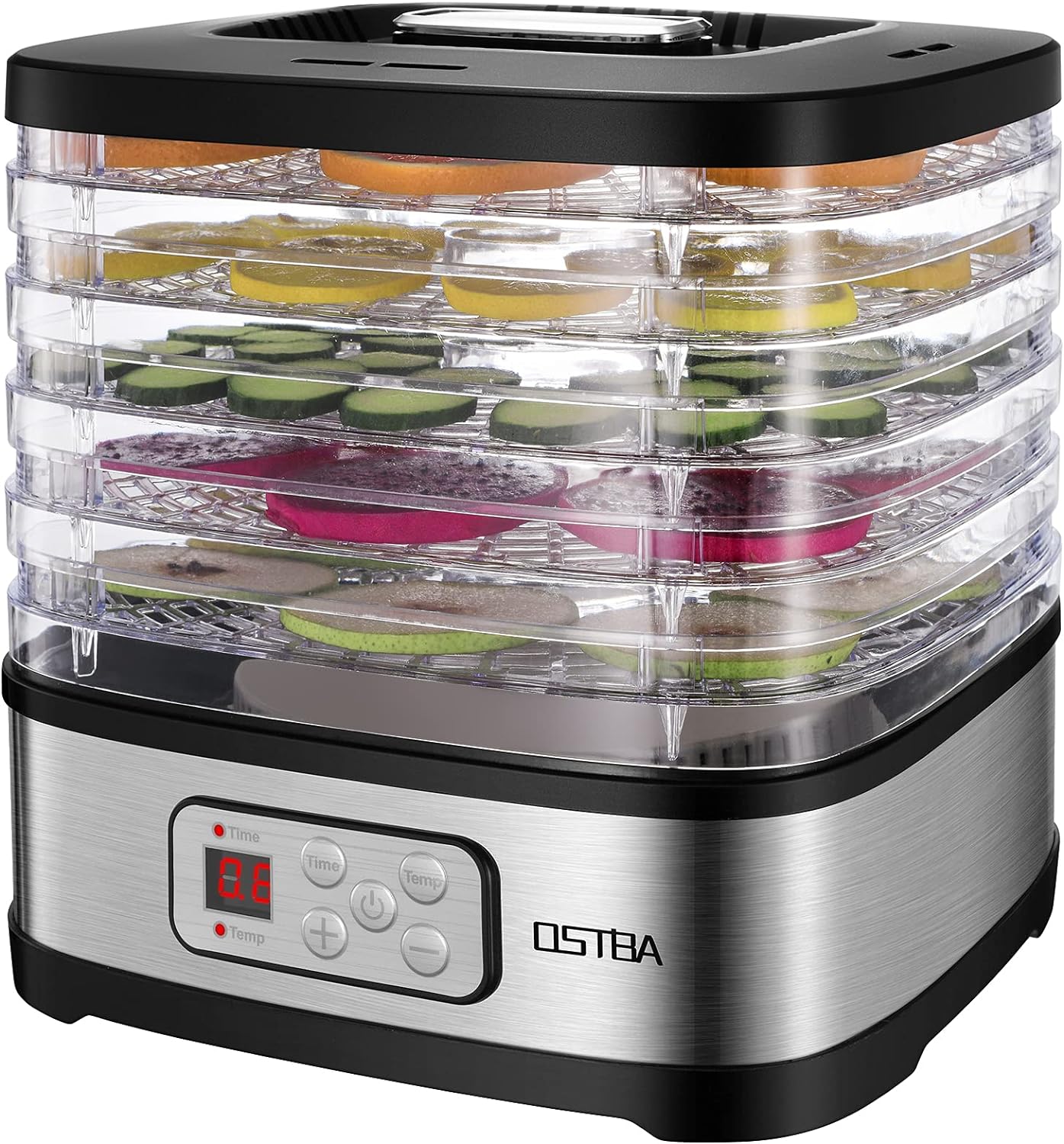
OSTBA Food Dehydrator GGJ-261B
| Wattage | 240 watts |
|---|---|
| Voltage | 120 volts |
| Number of Trays | 5 |
| Temperature Range | 95℉ to 160℉ |
| Operating Frequency | 60 hertz |
The OSTBA GGJ-261B is a small, stackable dehydrator aimed at home cooks who want reliable drying without a large appliance footprint. It uses a rear-mounted 240W heater and 360 degree air circulation to distribute heat across five BPA-free trays, and the LED touchscreen lets you set temperatures from 95 to 158°F and a 1–72 hour timer so delicate herbs and tougher fruits both dry predictably. The clear window makes it easy to check progress and the trays are dishwasher-safe for straightforward cleanup. Practical extras include an included recipe booklet and built-in overheating protection. Expect modest power and capacity—this is best for small batches of herbs, single trays of fruit leather, or jerky for occasional use rather than large-volume preservation. Noise is low but not silent, and the plastic/stainless construction is functional rather than premium. For countertop herb drying the unit is accurate and space-efficient, but heavy daily or commercial workloads will quickly push its limits.
Best for: Home cooks and herbalists who want a compact, easy-to-use dehydrator for regular small-batch herb drying and occasional snacks, prioritizing precise temperature control and simple cleanup.
Less Ideal for: People who need to dehydrate large volumes regularly or require a commercial-grade, heavy-duty machine should look at larger-capacity or higher-wattage models.
- Compact five-tray design saves countertop space and handles multiple small batches
- Adjustable 95–158°F thermostat and 1–72 hour timer for precise drying control
- 360 degree airflow promotes even drying across trays
- Dishwasher-safe BPA-free trays simplify cleaning
- Clear window and LED touchscreen make monitoring and programming easy
- 240W power and five-tray capacity limit throughput for large batches
- Primarily plastic construction feels utilitarian rather than high-end
Verdict: A compact, user-friendly dehydrator that delivers precise temperature control and even airflow ideal for drying herbs and small home batches.
vassillias Food Dehydrator 5-Tray

| Wattage | 280 |
|---|---|
| Number of Trays | 5 |
This compact dehydrator is designed for small-batch drying of herbs, fruit, vegetables and jerky using five removable trays and a rear-mounted fan to promote even airflow. Temperature is adjustable from 104°F to 158°F, which covers delicate herbs at low heat up to meat and jerky at higher settings, and the unit includes an automatic shutdown for overheating protection. Trays are BPA-free and removable for straightforward cleaning, and the slim footprint makes it easy to store on a kitchen counter. The 280W motor gives a reasonable balance of drying speed and energy use for a unit this size, but the all-plastic construction means it is not as durable as metal-bodied models and the 5-tray capacity limits large batches. For herb drying specifically, the low temperature range and consistent airflow make it practical for preserving flavor and aroma, though you will need multiple runs for larger harvests.
Best for: Buyers on a tight budget who want a compact countertop dehydrator for small herb batches and occasional fruit or jerky drying.
Less Ideal for: Those who need to dry large volumes at once or want a heavy-duty, metal-bodied machine for daily commercial use should consider larger or commercial-grade units instead.
- Adjustable temperature from 104°F to 158°F suitable for sensitive herbs and tougher foods
- Rear fan with layered trays promotes even airflow across shelves
- Five removable BPA-free trays make loading and cleaning easy
- Compact footprint fits small kitchens and countertop spaces
- Plastic body is less robust than metal alternatives
- Limited batch size may require multiple cycles for large herb harvests
Verdict: A budget-friendly, compact dehydrator that reliably dries small herb batches with low-temperature control and easy-to-clean trays.
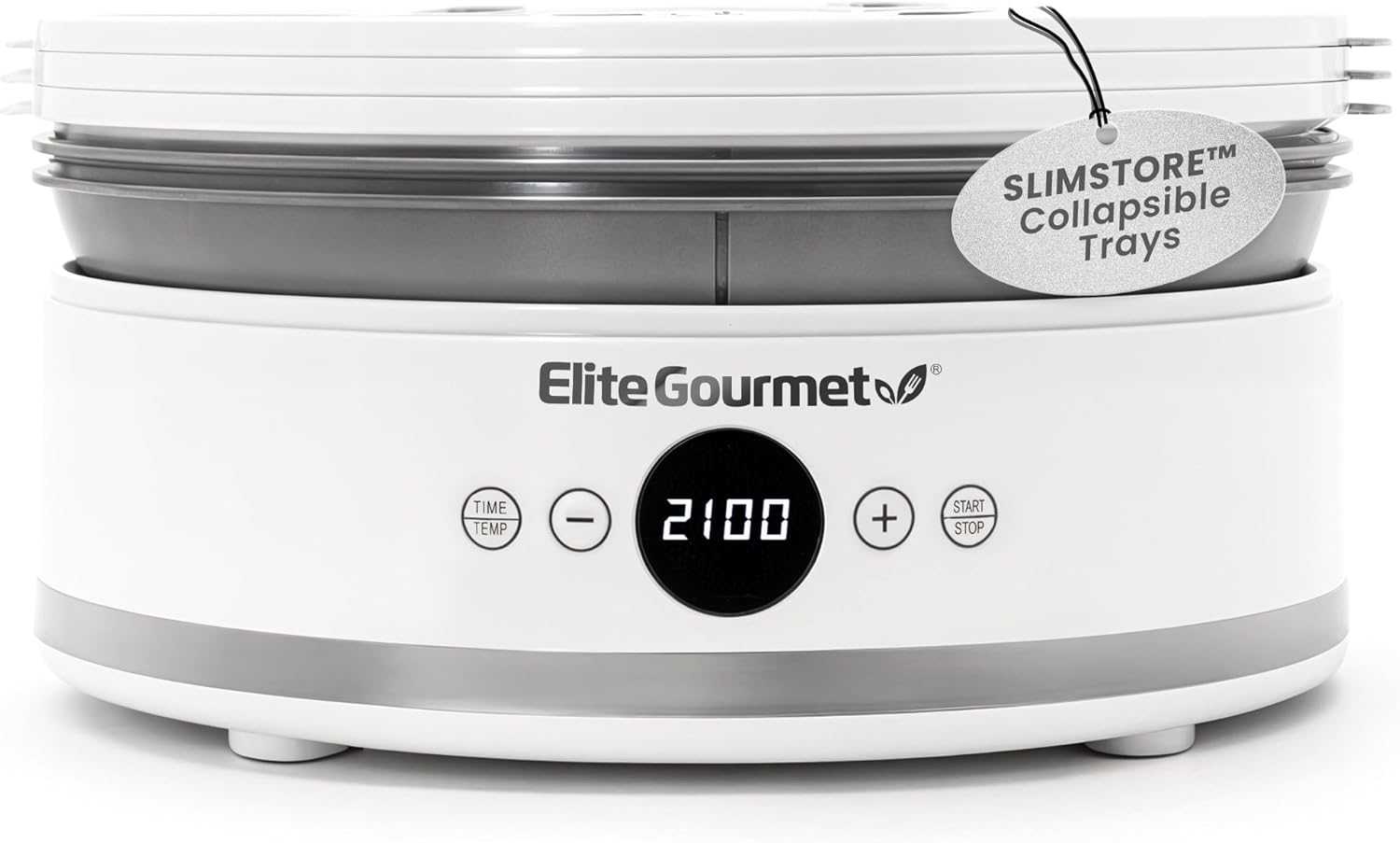
Elite Gourmet 5‑Tray Dehydrator EFD329WD
| Wattage | 350 watt-hours |
|---|---|
| Number of Trays | 5 |
| Temperature Range | 95 to 158 °F |
The Elite Gourmet 5‑Tray Digital Dehydrator is a countertop unit meant for everyday home drying of fruits, herbs, vegetables and jerky. It uses a 350 W heater and a base-mounted fan to push warm air upward through five SlimStore BPA‑free trays, which collapse and nest for compact storage. Temperature is adjustable from 95 to 158 F and a digital timer runs up to 48 hours in 30‑minute steps, so you can dial in low temperatures for delicate herbs or higher settings for thicker slices and jerky. Each tray offers about 82 square inches of space, giving roughly 410 square inches total for small batches. Trays and lid are dishwasher safe, and the plastic construction keeps the unit lightweight and easy to move. Limitations include the modest overall capacity for serious batch drying and the plastic build, which may feel less durable than metal alternatives, but for routine herb drying and occasional snacks it is simple to use and stores neatly.
Best for: Home cooks who want a reliable, easy‑to‑use unit for drying herbs, small batches of fruit and occasional jerky with straightforward controls and compact storage.
Less Ideal for: People who need to process large quantities regularly or who prefer heavier-duty metal construction for commercial or continuous use.
- Adjustable 95–158 F temperature range for delicate herbs and tougher foods
- Digital timer up to 48 hours with 30‑minute increments for unattended drying
- SlimStore collapsible BPA‑free trays nest for compact storage
- Base‑mounted fan design promotes even upward air circulation
- Dishwasher‑safe trays and lid simplify cleanup
- Plastic construction may feel less sturdy than metal models
- Limited total drying area for larger batches or continuous use
Verdict: A compact, dependable dehydrator with precise temperature control and collapsible trays that makes drying herbs and small batches simple and convenient.
NESCO Snackmaster FD-75A

| Wattage | 600 watts |
|---|---|
| Voltage | 120 volts |
| Number of Trays | 5 |
| Temperature Range | 95°F–160°F |
The NESCO FD-75A Snackmaster is a small home dehydrator built for making fruit leathers, herbs, jerky, and small-batch snacks. It uses a top-mounted fan and the brand's Converga-Flow system to push air across each tray so you get consistent drying without rotating trays, and the adjustable thermostat (95 to 160°F) gives the control needed for delicate herbs or higher-temperature jerky. Five BPA-free trays come included and the machine expands up to 12 trays if you need larger batches; it also ships with fruit roll sheets, clean-a-screen inserts for tiny items, and jerky seasoning to get started. The top fan design keeps liquids away from the heating element and the opaque exterior helps protect nutrients from light. At 600 watts it dries fairly quickly for its size, but the unit is plastic and compact so it is meant for countertop use rather than heavy commercial loads. For herb drying specifically, the clean-a-screen trays and precise low-temperature control make it easy to preserve aroma and color, though larger herb harvests will require purchasing extra trays or running multiple cycles.
Best for: Buyers who want a reliable countertop dehydrator to preserve herbs, make small batches of fruit leather, or experiment with jerky and value even airflow and precise temperature control.
Less Ideal for: Those needing a heavy-duty or commercial dehydrator for very large harvests or continuous daily production should consider larger-capacity or commercial models.
- Converga-Flow top-mounted airflow provides even drying without rotating trays.
- Adjustable thermostat from 95°F to 160°F for delicate herbs to jerky.
- Expandable tray system (5 included, up to 12) for scaling batch size.
- Includes clean-a-screen inserts and fruit roll sheets useful for drying small herbs and semi-liquids.
- Top-mounted fan design prevents drips into the heating element for safer long runs.
- Plastic construction may feel less durable than metal-bodied units.
- Not designed for continuous heavy commercial use; best for home or hobby batches.
Verdict: A compact, user-friendly dehydrator with precise low-temperature control and included screens that make it a strong choice for preserving herbs and small home batches.
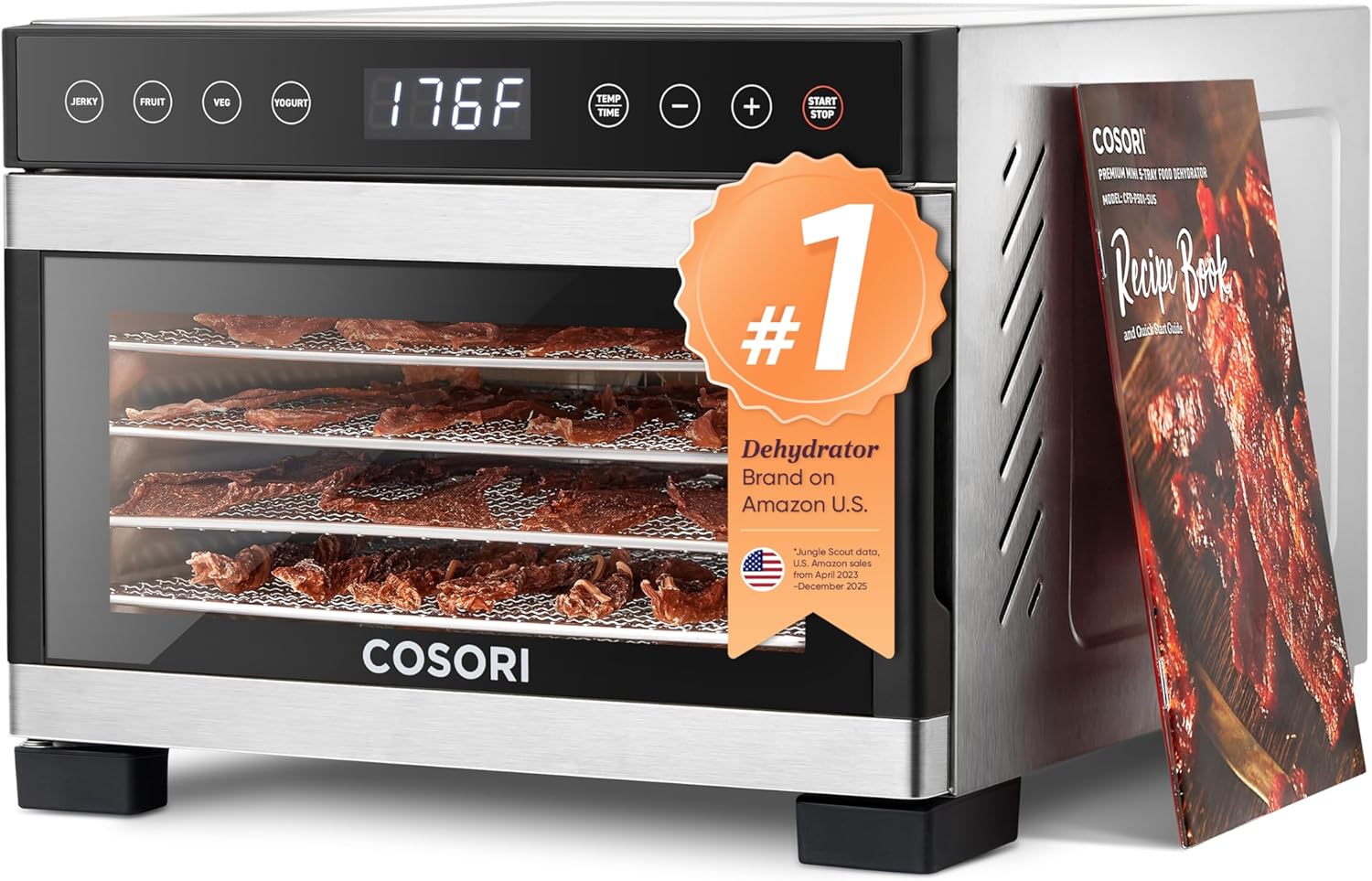
Cosori Stainless Steel Dehydrator P501
| Number of Trays | 5 |
|---|---|
| Temperature Range | 95-176 F |
| Wattage | 480 watts |
| Voltage | 110 volts |
The Cosori P501 is a countertop dehydrator built around five stainless steel trays and a rear-mounted fan that promotes even horizontal airflow across the shelves. It runs 95 to 176°F in 1°F increments and includes four presets for jerky, fruit, vegetables, and yogurt, which makes it straightforward to dry herbs, fruit slices, or small jerky batches. The stainless steel construction and the claim of no plastic contact with food are reassuring for anyone worried about food-safe surfaces, and the included mesh screen and fruit roll sheet expand its usable items beyond just sliced produce. At 480 watts it dries efficiently without being excessively power hungry, and the 48-hour timer covers long herb-drying cycles. Limitations include a modest 3.1 ft² drying area that fits small to medium batches and a boxy footprint that still needs countertop space; this is not for large-scale dehydrating. For everyday household use the unit balances control, safety, and simple presets, making routine herb drying and small-batch snacks easy and predictable.
Best for: Buyers who prioritize food-safe materials and predictable, safe drying results for herbs and small batches will appreciate the precise temperature control and stainless steel trays.
Less Ideal for: This is not the best choice for users who need to dehydrate large volumes at once or for commercial use where much larger drying capacity is required.
- Five stainless steel trays reduce plastic contact and are easy to clean
- Precise temperature control from 95 to 176°F in 1°F increments for safe herb and jerky drying
- Rear fan with horizontal airflow helps produce even dehydration across trays
- Includes mesh screen and fruit roll sheet for delicate items and versatility
- 3.1 ft² drying area is best suited to small to medium batches rather than large bulk drying
- Takes countertop space and has a boxy footprint that may not suit very small kitchens
Verdict: A compact, food-safe dehydrator with precise temperature control that makes small-batch herb drying reliable and worry-free.
Choosing the Right Small Food Dehydrator for Herbs: Key Factors to Consider
Temperature Range and Precision
Herbs are delicate and often lose essential oils and color at excessively high temperatures. A dehydrator that offers low-temperature settings and fine-grain control lets you dry at the ideal range for most herbs, typically between 95°F and 125°F. Precision matters because a thermostat that swings wildly can overcook edges while leaving stems under-dried.
When evaluating units, look for models with clearly labeled temperature markings and, if possible, digital readouts or thermostats rated for low-temperature accuracy. This reduces guesswork and helps preserve flavor and potency.
Airflow Design and Tray Layout
Even airflow prevents pockets of dampness that cause mold or uneven drying. Vertical or horizontal airflow designs behave differently: rear-mounted fans with horizontal airflow can keep leaf layering consistent across stackable trays, while top-mounted systems may be better for shallow trays. Consider how trays stack and whether the design promotes uniform circulation across all levels.
Also check for tray spacing and whether trays are easy to rearrange. For herbs you will typically use fewer, shallower trays to allow leaves to spread thinly, so a layout that supports single-layer drying is ideal.
Capacity and Batch Size
A small dehydrator should match the scale of your herb harvests and kitchen space. If you dry herbs occasionally, a compact unit with a few shallow trays is usually sufficient. If you harvest larger amounts seasonally, a slightly larger small-format dehydrator with more tray area will save time by letting you dry more per cycle.
Think in terms of usable tray area rather than tray count. A wide, single-layer tray that lets you lay leaves flat often dries faster and more evenly than stacking multiple crowded trays.
Materials and Food-Safety
Materials that contact herbs should be food-safe and easy to clean. BPA-free plastics, stainless steel trays, or dishwasher-safe inserts reduce the risk of lingering tastes or contaminants. Nonporous surfaces also resist staining from herb oils and simplify cleanup.
Avoid units with hard-to-reach crevices where debris and oils can accumulate. Removable, washable trays and a simple interior shape help maintain hygiene over repeated drying cycles.
Noise Level and Countertop Footprint
You may run a dehydrator for many hours, so noise and the appliance footprint affect where you can use it. A compact, low-noise unit can sit on a kitchen counter or in a pantry without being disruptive. If you have limited bench space, check the unit depth and height to ensure it fits where you plan to operate it.
Noise specs are useful, but real-world noise varies with fan design and motor mounting. Look for units with dampened mounts or low-RPM fans for quieter operation during long drying cycles.
Ease of Cleaning and Maintenance
Frequent herb drying requires a dehydrator that disassembles easily for cleaning. Removable trays that are dishwasher-safe or wipe-clean surfaces reduce time spent on upkeep and help prevent cross-contamination between different herb varieties.
Also consider how easy it is to access the fan and heating elements for occasional dusting. Units that require minimal tools for maintenance will stay hygienic with less effort.
Why Low-Temperature Drying Matters for Herbs
Drying herbs at low temperatures preserves volatile oils that carry aroma and flavor. High heat strips these compounds quickly, leaving dull, bitter herbs. Low, steady heat combined with good airflow allows moisture to leave plant tissues gradually without cooking them.
For delicate leaves and flowers, err on the side of gentler settings and longer run times. Monitor early batches to learn how your chosen herb responds to the unit you select.
- Aim for a steady low range rather than maximum heat.
- Smaller leaves dry faster; flowers and thicker stems take longer.
- Rotate trays or rearrange loads mid-cycle if the dehydrator lacks fully even airflow.
Preparing Herbs for Best Results
Start with clean, dry herbs and remove any discolored or damaged bits. Rinse lightly if needed and dry thoroughly with a salad spinner or paper towels to remove surface water before loading trays. Excess surface moisture lengthens drying time and increases the risk of uneven drying.
Strip larger stems from leaves and spread leaves in a single layer without overlap. For very fine herbs, use mesh trays or parchment to prevent small pieces from falling through and to keep airflow consistent.
- Harvest herbs in mid-morning after dew evaporates for best oil content.
- Avoid bunching; give leaves room to breathe on the tray.
- Label trays by herb and date to keep dried supplies organized.
Storage Tips to Maintain Potency
Once herbs are brittle and dry, cool them to room temperature before storing in airtight containers. Light, heat, and humidity are the main enemies of stored herbs, so use opaque containers and keep them in a cool, dark place to slow degradation.
Don't crush herbs until you are ready to use them. Whole dried leaves retain oils longer than crumbled material, so storing leaves intact preserves flavor over months.
- Use small opaque jars or vacuum-sealed pouches for long-term storage.
- Check stored herbs periodically for residual moisture or off-odors and re-dry if necessary.
- Label containers with the herb name and drying date for rotation.
Common Mistakes When Drying Herbs
The most frequent errors are overcrowding trays and using heat that is too high. Overcrowding traps moisture and increases drying time, often resulting in uneven texture or mildew. Excessive heat can brown and degrade flavor within minutes for some herbs.
Another common issue is inconsistent loading. Putting a full load on one cycle and a nearly empty load on another produces different conditions and inconsistent results. Aim for consistent batch sizes until you learn how your unit behaves.
- Avoid stacking leaves more than one layer thick.
- Do not use the maximum temperature setting for delicate herbs.
- Allow herbs to cool completely before sealing in containers.
Using a Dehydrator for Culinary Vs. Medicinal Herbs
Culinary herbs are usually dried for flavor, so appearance and aroma are priorities. For medicinal herbs where active compounds matter, low-temperature settings and gentler air movement can help preserve potency. Your drying approach should match the end use.
Consider drying shorter cycles at lower temperatures for medicinal preparations to reduce the loss of thermolabile constituents. For culinary herbs that will be used in cooked dishes, slightly higher temperatures can speed processing without noticeably harming flavor.
- Adjust temperature and time based on whether aroma or potency is the top priority.
- Test small batches when trying a new herb or a new temperature setting.
- Document settings that worked well so you can replicate results later.
How We Chose the Best Small Food Dehydrator for Herbs
We focused on features that matter to people drying small batches of herbs for culinary or medicinal use. Primary evaluation criteria included temperature control accuracy, airflow design for even drying, and capacity suited to small herb harvests. We also considered build quality and materials because food-safe surfaces and durable trays reduce off-flavors and avoid contamination. Ease of cleaning and tray access were weighed for regular use, plus footprint and noise level to ensure the unit works well in typical home kitchens. Energy efficiency and run-time reliability were included to reflect longer drying cycles that herbs sometimes require. We excluded oversized agricultural dehydrators and units meant primarily for jerky or commercial use because those are not appropriate for delicate herbs. Units without adjustable low-temperature settings or with poor airflow were filtered out. The resulting picks focus on compact, herb-friendly designs with measurable temperature control, consistent circulation, and easy maintenance.
Our full evaluation process is outlined in our review methodology.
FAQ
What temperature is best to dry most herbs?
Most culinary herbs dry well between 95°F and 125°F. Start at the lower end for delicate leaves and increase slightly if drying is extremely slow. The goal is gentle dehydration without browning.
How do I know when herbs are fully dry?
Herbs are done when leaves and stems are brittle and crumble easily between your fingers. Thicker stems may remain flexible; strip leaves off stems and check for dryness rather than relying on stem feel alone.
Can I dry herbs directly on trays without lining them?
You can dry herbs directly on many tray surfaces, but for fine herbs or flowers a mesh tray or parchment sheet prevents loss through openings and makes cleanup easier. Ensure any lining allows adequate airflow.
How long does drying typically take?
Drying time varies by herb type, humidity, and load size, but small batches often finish in 2 to 6 hours at low temperatures. Denser leaves and humid conditions extend drying time, so plan for longer runs during wet seasons.
Is it better to dry herbs in a full load or partial load?
Aim for consistent, not overcrowded loads. A full load that allows single-layer spreading dries evenly and efficiently. Extremely sparse loads may dry faster but can behave differently, so keeping batch size consistent helps predictable results.
Final Verdict
Choose a small food dehydrator for herbs that provides accurate low-temperature control, even airflow, and an easy-to-clean tray system. Prioritize units with a tray area that matches how much you harvest and with materials that are food-safe. Remember the tradeoff: lower temperatures protect aroma and potency but require longer drying times. By aligning the dehydrator features with whether you value culinary aroma or medicinal potency, you will get consistent, usable dried herbs for months.