
Note: This article contains affiliate links. If you click on these links and make a purchase, we may earn a small commission at no extra cost to you. This helps support our research and content. Read our full affiliate disclosure here.
Choosing the right manual sharpening tool has a direct effect on how well your knives cut, how long their edges last, and how much metal you remove during maintenance. Non electric knife sharpeners cover a range of handheld steels, guided pull-through devices, and stone-based systems, and the wrong choice can make routine maintenance slow or risky. This guide shortlists the top non electric knife sharpeners available for home cooks and pros who prefer a controlled, low-noise approach. We evaluated options for ease of use, grit options, and edge geometry support to help you pick the tool that fits your skill level and knife collection. Read on for the editorial criteria and what matters most when maintaining sharp blades.
Top Picks at a Glance
| Best Overall The best all-around choice for most situations | HENCKELS Handheld Knife Sharpener |  |
| Best Quality Built to a higher standard if you want something more solid | KEENBEST 400/1000 Whetstone |  |
| Best Value The sweet spot between price and what you get | AnySharp Hands-Free Knife Sharpener |  |
| Best Budget The cheapest option that still gets the job done reliably | Smith's 2-Step Knife Sharpener CCKS |  |
| Top Rated A top-rated pick with lots of positive feedback | Sharp Pebble 1000/6000 Whetstone |  |
| Most Popular A crowd favorite that many people choose with confidence | KitchenIQ Edge Grip 2-Stage Sharpener |  |
| Best Seller A high-volume bestseller chosen again and again | KITCHELLENCE 3-Stage Knife Sharpener |  |
HENCKELS Handheld Knife Sharpener

| Included Components | Handheld Knife Sharpener |
|---|---|
| Material Type | Plastic |
| Grit Type | Coarse,Fine |
The HENCKELS Handheld Knife Sharpener is a compact, two-stage pull-through tool that restores knife edges using coarse and fine ceramic grits. You use it by drawing the blade through the coarse slot to reprofile dull edges, then through the fine slot to refine and polish the bevel. The molded ergonomic handle and safety grip keep fingers away from the blade while a rubberized non-slip base helps steady the unit on countertops during use. Its simple labeled slots make it easy for beginners to follow a basic sharpening sequence and maintain everyday kitchen knives without stones or machines. Limitations include fixed sharpening angles and no ability to repair heavily damaged or chipped blades the way a whetstone or professional grinder can, and it is best suited for standard straight-edge knives rather than specialty blades. For routine at-home touch-ups the tool is fast, safe, and easy to store, though serious enthusiasts will still prefer stones for precision work.
Best for: Home cooks who want a safe, straightforward way to keep everyday kitchen knives reasonably sharp without learning whetstone techniques or using electric sharpeners.
Less Ideal for: Collectors, knife hobbyists, or professionals seeking precise angle control and full blade restoration should choose a whetstone or professional sharpening service instead.
- Two-stage coarse and fine ceramic grits for basic re-profiling and polishing
- Ergonomic contoured handle and safety grip to keep fingers clear
- Rubberized non-slip base for stable sharpening on countertops
- Simple labeled slots make it easy for beginners to use and store
- Fixed angle sharpening cannot replace precision whetstone work
- Not suitable for repairing severely chipped or damaged blades
Verdict: A simple, safe two-stage handheld sharpener that quickly restores everyday kitchen knives to usable sharpness for buyers who want easy maintenance without stones.
KEENBEST 400/1000 Whetstone

| Grits | 400/1000 |
|---|---|
| Material Type | Stone |
| Number of Items | 1 |
This KEENBEST whetstone pairs a 400-grit coarse face for repairing and re-profiling edges with a 1000-grit fine face for smoothing and polishing. You soak the stone in water for 10–15 minutes, then use the coarse side to remove nicks or restore a bevel and finish on the 1000 grit to refine the edge and burnish a keen cutting surface. The silicon carbide/white corundum construction cuts relatively quickly and the included rubber base keeps the stone stable during use. It ships with a short guide aimed at beginners, so even users new to freehand sharpening can get consistent results after a few passes. Limitations: as a manual stone it requires learning proper angles and consistent strokes to avoid uneven wear, and it does not include angle guides or a flattening tool, so routine maintenance and skill matter for best performance.
Best for: Buyers who prioritize fast, performance-focused manual sharpening and are willing to learn freehand technique to restore and polish edges will get the most from this stone.
Less Ideal for: Those who want a fully guided, foolproof sharpening system with angle presets or a self-contained jig should choose a guided sharpener instead.
- Two grit faces (400 and 1000) cover re-profiling through final honing.
- Silicon carbide/white corundum material offers relatively fast cutting action for quick edge repair.
- Includes a non-slip rubber base for safer, steadier sharpening.
- Water-ready design removes the need for oil and simplifies setup.
- No angle guide or jig included, so consistent technique is required for best results.
- No flattening/dressing stone provided, so the user must maintain a flat surface over time.
Verdict: If you want a fast-cutting, two-sided water stone for rebuilding and refining edges by hand, this KEENBEST 400/1000 whetstone delivers strong performance.
AnySharp Hands-Free Knife Sharpener

| Material Type | Plastic, Tungsten Carbide |
|---|---|
| Grit Type | Fine |
| Included Components | 1 x Knife Sharpener |
The AnySharp hands-free sharpener is a simple manual tool that restores edge on kitchen knives with a few controlled pulls. You secure the unit to a smooth surface using the PowerGrip suction base, then draw the blade through its tungsten carbide slots set at a factory 20-degree angle, which makes it easy to use for cooks who do not want to fuss with stones or guided systems. It works on most kitchen knives and is small enough to store in a drawer, so it is convenient for frequent touch-ups rather than heavy re-profiling. The fine grit carbide creates a noticeably sharper edge quickly, and the plastic housing keeps the tool lightweight and low maintenance. Limitations are that the angle is fixed so it is not ideal for users seeking multiple bevels or professional-level reprofiling, and the suction works best on very smooth counters. For routine home use this sharpener is fast, safe, and accessible.
Best for: Buyers who want a low-skill, reliable way to keep kitchen knives sharp at home and prefer a quick, hands-free tool for regular maintenance.
Less Ideal for: Users who need adjustable angles, professional reprofiling, or sharpening of specialty blades that require nonstandard bevels.
- PowerGrip suction base holds the sharpener steady for safe hands-free use
- Pre-set 20-degree tungsten carbide edges deliver quick, repeatable sharpening
- Compact, lightweight design stores easily in a drawer and requires no power
- Fine grit carbide produces a usable, sharp edge with minimal effort
- Fixed 20-degree angle prevents adjusting for different blade bevels
- Suction base may not adhere firmly to textured or uneven countertops
Verdict: An easy, hands-free non-electric sharpener that delivers quick, repeatable touch-ups for everyday kitchen knives.
Smith's 2-Step Knife Sharpener CCKS

| Included Components | 1 sharpener |
|---|---|
| Material Type | Synthetic |
| Grit Type | Coarse,Fine |
Smith's 2-Step Knife Sharpener is a pocket-friendly pull-through tool that restores and refines knife edges using preset tungsten carbide and ceramic stages. In practice you run a dull blade three to four times through the carbide slot to reshape the edge, then finish with the crossed ceramic rods for a smoother, keener edge. The unit is lightweight, has non-slip rubber feet for stability, and a lanyard hole so it can attach to a pack or keychain for outdoor use; it even floats if dropped in water. Because the angles are preset, sharpening is quick and consistent without user adjustment, which makes it useful for anglers, hunters, and home cooks who need a fast tune-up in the field. Limitations include its simple plastic housing and fixed angles, so it will not replace full-length stones or precision systems for professional reprofiling or high-precision kitchen work.
Best for: Buyers looking for an inexpensive, portable sharpener to quickly restore knife edges while camping, fishing, hunting, or for casual home use where ease and speed matter most.
Less Ideal for: Users who need precision edge work, custom bevel angles, or a tool to replace bench stones for professional knife maintenance should consider higher-end sharpening systems.
- Two preset stages (tungsten carbide coarse and ceramic fine) for quick edge restoration and finishing
- Compact, lightweight design with lanyard hole makes it easy to carry in pockets, packs, or tackle boxes
- Non-slip rubber feet add stability during use and the unit floats, useful for outdoor environments
- Requires no setup or angle knowledge thanks to pre-set sharpening guides
- Fixed preset angles limit control for advanced edge profiles or professional reprofiling
- Plastic housing is basic and less durable than metal-bodied sharpeners
Verdict: A very affordable, no-fuss two-stage sharpener that delivers fast, consistent edge touch-ups for outdoor and everyday use.
Sharp Pebble 1000/6000 Whetstone

| Grits | 1000/6000 |
|---|---|
| Material Type | Corundum |
| No Oil Required | Yes |
| Included Components | Angle guide, bamboo base, instructions |
The Sharp Pebble 1000/6000 whetstone is a two-sided waterstone built for regular kitchen use, combining a 1000-grit side for edge repair and a 6000-grit side for polishing to a razor finish. It ships with a non-slip bamboo base and an angle guide that holds the blade at a consistent angle, which makes it much easier for beginners to get repeatable results and for experienced users to refine edges. Because it is a waterstone there is no oil required and the stone cuts efficiently while leaving a smooth finish when used with the finer grit. The manufacturer says the corundum composition resists chipping and stays flatter longer than cheaper stones, which supports long-term reliability for maintenance cycles. Limitations to note: waterstones wear and produce slurry so occasional flattening is necessary, and effective sharpening still requires some technique and patience compared with electric sharpeners. For those who prefer a low-tech, durable sharpening method, this kit provides the essentials to keep blades performing well at home.
Best for: Home cooks or meticulous owners who want a reliable, long-lasting manual sharpening solution and value consistent, pro-quality edges without electricity.
Less Ideal for: People who need very fast, one-pass sharpening or who prefer fully automated electric machines for convenience should look elsewhere.
- Dual 1000/6000 grits cover edge repair through razor polishing
- Included angle guide simplifies consistent sharpening for beginners
- Non-slip bamboo base holds the stone steady during use
- Water-based system requires no oil and is easy to rinse
- Stone will develop slurry and requires occasional flattening to maintain a flat surface
- Sharpening with a whetstone takes more time and practice than using an electric sharpener
Verdict: A dependable dual-grit waterstone kit that makes repeatable, professional-quality sharpening possible at home without electricity.
KitchenIQ Edge Grip 2-Stage Sharpener

| Material Type | Plastic |
|---|---|
| Grit Type | Fine |
| Model Number | 50009 |
The KitchenIQ Edge Grip 2-Stage Sharpener is a simple pull-through tool that restores and hones kitchen knives without electricity. Use the carbide slot first to re-establish an edge on dull or nicked straight blades, then finish with the ceramic rod slot for polishing and touch-ups. Its patented V-grip lets you anchor the sharpener on a countertop edge while the non-slip rubber feet and soft-grip handle add steadiness for safe one-direction pulls. The unit is small enough to tuck in a drawer and quick to use when you need faster edge maintenance than stones require. It works on many straight-edge and some serrated blades but is not designed for precise angle control or professional reprofiling. Because it uses preset angles and abrasive slots, aggressive metal removal can shorten blade life if used excessively, and it's less suitable for high-end knives needing custom sharpening angles.
Best for: Buyers who want a fast, low-effort way to keep everyday kitchen knives sharp and who value proven user feedback over experimental or specialty gear.
Less Ideal for: Sharpening enthusiasts seeking precise angle control, professional knife technicians, or owners of expensive specialty blades requiring custom honing should look elsewhere.
- Two-stage system (carbide coarse then ceramic fine) for both edge-setting and polishing
- V-grip base allows safe use on a countertop edge without blade tip damage
- Compact, lightweight design stores easily in a drawer
- Non-slip rubber feet and soft-grip handle improve stability and user control
- Preset angles limit precision compared with stones or guided systems
- Not intended for in-depth reprofiling or high-end custom edges
Verdict: A compact, easy-to-use manual sharpener that reliably restores and maintains everyday knife edges without electricity.
KITCHELLENCE 3-Stage Knife Sharpener
| Material Type | Plastic |
|---|---|
| Item Type Name | 4-in-1 Kitchen Knife Accessories |
| Included Components | Yes |
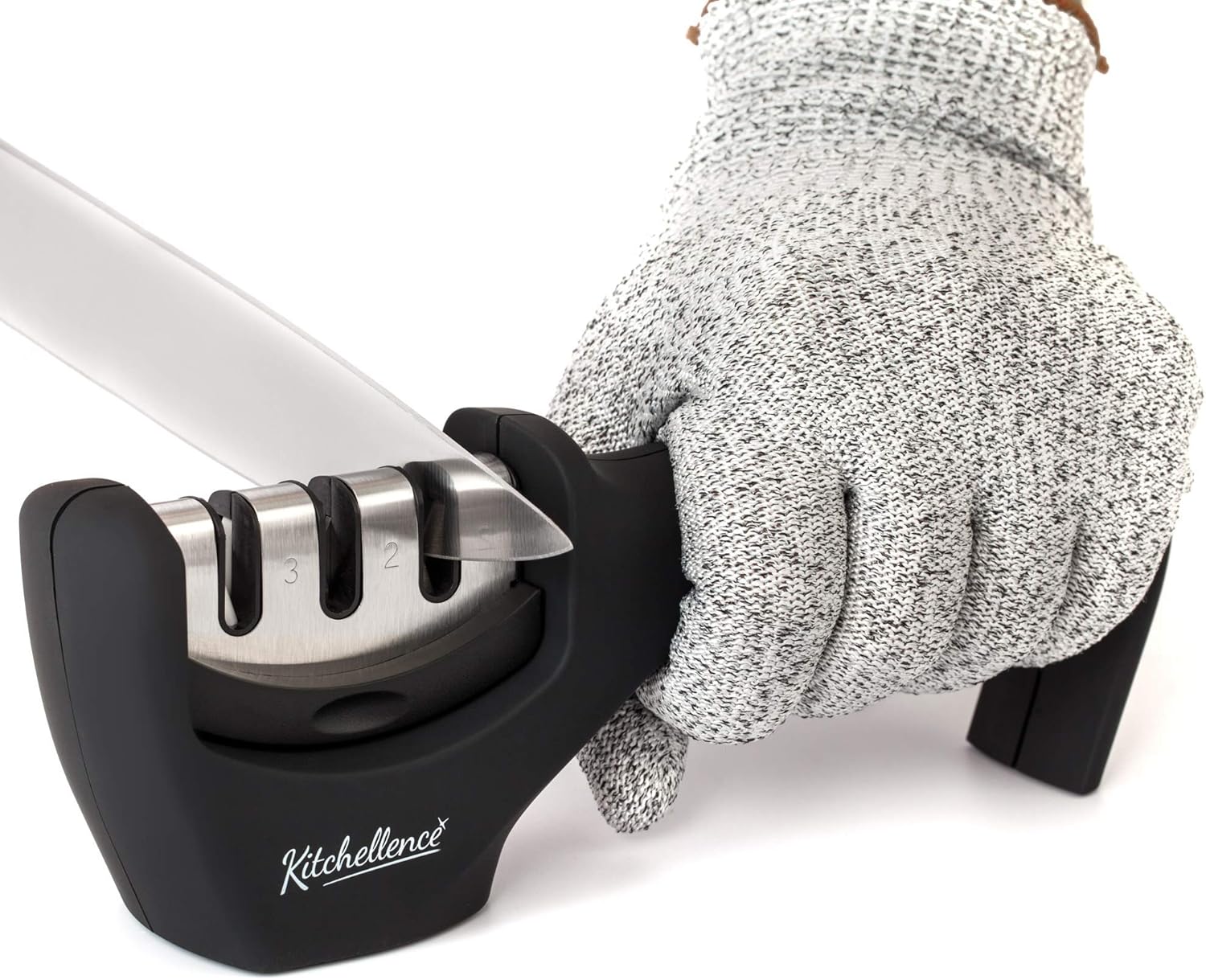
This compact 3-stage sharpener is designed to repair, restore and polish kitchen knives without power. Start with the diamond rod slot to realign nicked or dull edges, pass the blade through the middle sharpening slot to re-form the V-bevel, then finish in the fine polishing slot for a cleaner edge; each stage is quick and simple to use with the ergonomic handle and non-slip base for one-handed operation. The included cut-resistant glove is a useful safety addition for less confident users. Construction is mostly ABS plastic with built-in ceramic/diamond elements, so it is lightweight and easy to store but not as heavy-duty as a metal-bodied sharpening system. This tool is best for routine maintenance of standard kitchen knives rather than for repairing severely damaged or premium high-end steels that need professional stones and honing. Overall it is a user-friendly, safe non-electric option for keeping everyday knives reasonably sharp.
Best for: Buyers who want a simple, safe non-electric sharpener to maintain everyday kitchen knives without learning stone techniques and who value ease of use and built-in safety features.
Less Ideal for: Users who need professional-level reprofiling or who routinely work with very hard or specialty knife steels should look at whetstones or pro sharpening services instead.
- Three distinct sharpening stages (repair, sharpen, polish) cover common maintenance steps
- Ergonomic handle and non-slip base make single-handed use stable and safe
- Includes cut-resistant glove to reduce accidental cuts during sharpening
- Lightweight plastic construction is easy to store and transport
- ABS plastic body is less durable than metal housings for heavy frequent use
- Not suitable for restoring severely damaged blades or specialty high-end steels
Verdict: A straightforward, safe three-stage manual sharpener that keeps everyday kitchen knives serviceable without electricity or skill.
Choosing the Right Non Electric Knife Sharpener: Key Factors to Consider
Abrasive Type and Grit Progression
The abrasive material and available grit progression determine how quickly and cleanly a sharpener can restore a damaged edge and then refine it to a keen finish.
Coarse grits remove metal fast and are necessary for repairing chips and reshaping bevels. Medium grits are the workhorse for restoring a working edge, while fine and extra-fine grits polish and refine the burr for longer-lasting sharpness. Choose a system that offers multiple stages if you plan to reprofile or repair knives occasionally. Single-stage tools can work for light touch-ups but will not perform heavy edge repair well.
Angle Control and Edge Geometry
Consistent angle control matters because it preserves intended edge geometry and ensures even wear across the blade.
Some manual sharpeners have fixed angle guides or V-shaped slots tuned to common kitchen angles. These reduce user error and are faster for repeated maintenance. Sharpening stones and guided rods allow more flexibility for custom angles but demand steady technique. Think about the types of knives you own and whether you need a tool that enforces a specific angle or one that allows fine adjustments.
User Skill and Learning Curve
Your experience level should influence the type of manual sharpener you pick because different tools require varied technique and practice.
Beginners benefit from guided pull-through systems and angle-stable devices that produce consistent edges with minimal skill. Intermediate and advanced users may prefer stones, ceramic rods, or guided jigs that allow more nuanced control and higher-quality finishes. Factor in the time you are willing to spend learning proper sharpening strokes and maintaining whetstones or rods.
Stability, Safety, and Clamp Features
A stable sharpening surface and secure blade handling reduce the chance of slips and accidental cuts during maintenance.
Look for non-slip bases, secure clamps for bench-mounted stones, and well-designed housings that keep fingers away from the abrasive. Devices that lock the blade or that provide generous hand clearance make repeated passes safer and more predictable. Stability also affects the uniformity of the edge, so consider how the tool mounts or sits during use.
Compatibility With Knife Types
Not all sharpeners work equally well across blade styles, including thin western chef knives, thicker Asian knives, serrated edges, or specialty steels.
Some manual sharpeners are optimized for straight-edge kitchen blades and struggle with serrations or very hard stainless alloys. Others include dedicated slots or accessories for serrated edges and shears. Verify the tool's intended compatibility to avoid damaging fine-toothed edges or hard steels that require ultra-fine abrasives or diamond-based media.
Longevity, Replaceable Parts, and Maintenance
Consider how long the abrasive surfaces will last and whether parts are replaceable, because this affects cost and performance over time.
Stones can be flattened and resurfaced, while some bonded abrasives or ceramic rods eventually wear down and may need replacement. Check whether the manufacturer supplies replacement media or if the device supports user maintenance like flattening stones. Ease of cleaning and corrosion resistance of any metal components also matter for long-term reliability.
Manual Sharpening Methods Compared
Manual sharpeners fall into three main practical categories: bench stones and whetstones, guided rod or jig systems, and pull-through or V-slot sharpeners. Each method balances control, learning curve, and speed.
Whetstones offer the most control and potential for the finest polish but require technique and stone maintenance. Guided rod systems simplify angle control and are good for consistent maintenance. Pull-through units are fastest and easiest for users who want repeatable, low-effort results without mastering hand skills.
- Whetstones: Maximum control, best finish, needs flattening and practice.
- Guided rods/jigs: Good angle control, moderate learning curve, portable.
- Pull-through devices: Fast and repeatable, great for quick touch-ups.
How to Use a Whetstone Safely
Start with a stable setup: clamp the stone or place it on a non-slip mat so it will not move during strokes. Use the appropriate lubricating medium called for by the stone, usually water or oil, and follow the manufacturer's guidance.
Maintain a consistent angle and push the blade through the abrasive with even pressure. Use the full length of the stone for each pass to avoid creating dips in the bevel. Finish with higher-grit passes and remove the burr with alternating light strokes.
- Soak water stones if required before use.
- Keep wrist motion steady and avoid applying excessive force.
- Flatten the stone periodically to maintain an even surface.
Maintaining Pull-Through and Guided Systems
Pull-through and guided sharpeners are low-maintenance relative to stones, but they still need occasional cleaning and inspection. Remove metal filings after each use and wipe abrasive surfaces according to the tool's care instructions.
Inspect angle guides and replace or service worn abrasive inserts when cutting performance declines. Tighten any loose mounting hardware and store the tool in a dry place to prevent corrosion of metal parts.
- Brush away filings and wipe down with a dry cloth.
- Replace worn cartridges or rods to maintain consistent results.
- Store in a stable, dry location to preserve components.
When to Reshape Versus When to Touch Up
A reshaping pass is necessary if a blade has chips, a rolled edge, or if the bevel angle has been altered. This requires coarser abrasives and more aggressive stock removal. Regular touch-ups use finer abrasives to maintain the edge without removing much material.
Frequent light honing preserves cutting performance and extends the time between heavy grit sessions. Reserve coarse work for when the knife cannot be restored with fine grits alone.
- Reshape: use coarse to medium abrasives, controlled heavy passes.
- Touch up: use fine grits or honing rods for quick maintenance.
- Monitor blade performance to decide the right intervention.
Caring for Specialty Edges
Serrated knives, scalloped blades, and certain thin-bevel Asian knives can require different approaches. Some manual sharpeners include dedicated serration tools or adapters designed to maintain the scalloped geometry without damaging teeth.
For delicate edges, use narrower stones, tapered rods, or specialty guides that match the profile. Avoid aggressive, broad abrasives that can round off specialized geometries.
- Use tapered diamond rods for serrations and single-bevel edges.
- Match the abrasive width to the edge profile to avoid over-polishing.
- Consider professional servicing for complex re-profiling.
How We Chose the Best Non Electric Knife Sharpener
We prioritized tools that deliver repeatable results across common kitchen blade types while minimizing unnecessary metal removal. Key evaluation criteria included abrasive progression and grit range to assess how well a sharpener can repair dull edges and refine a polished bevel. We also tested stability and user guidance features, such as non-slip bases and angle guides, which reduce user error and improve safety. Ease of use and learning curve were important for everyday cooks, so we favored designs with clear operation and predictable outcomes. Durability and maintenance were considered next, focusing on construction materials and whether the abrasive surfaces are replaceable or long-lived. Finally, versatility was assessed by checking compatibility with common blade profiles and edge angles. We excluded tools that rely on electric motors or that require professional-only fixtures because the goal was strictly manual sharpening. We also filtered out inexpensive devices that showed obvious safety or durability problems. The result is a set of practical, well-supported non electric sharpeners that suit a range of skill levels and blade conditions.
Our full evaluation process is outlined in our review methodology.
FAQ
How often should I use a non electric knife sharpener on my kitchen knives?
It depends on use. Frequent home cooking often benefits from light touch-ups every few uses and a more thorough sharpening every few months. High-use kitchen knives may need more frequent attention.
Can I safely sharpen serrated knives with manual sharpeners?
Some manual systems include narrow tapered rods or serration-specific tools suitable for serrated edges. Use the right tool and gentle strokes to avoid altering the tooth geometry; otherwise, seek specialized maintenance.
Are whetstones better than pull-through sharpeners?
Whetstones offer more control and a finer finish but require practice and maintenance. Pull-through sharpeners are faster and more consistent for basic upkeep. The best choice depends on your skill level and desired finish.
Will manual sharpening damage my knives?
Not if done correctly. Excessive pressure, incorrect angles, or overly coarse grit without progression can remove more metal than necessary. Following proper technique and using appropriate abrasives preserves blade life.
How do I remove the burr after sharpening by hand?
After working both sides of the edge, use light alternating strokes on a fine abrasive or a leather strop to remove the burr. Finish with light, controlled passes and check the edge by a gentle paper test if needed.
Do I need special tools for very hard or high-performance steels?
Very hard steels often benefit from diamond abrasives or ultra-fine stones. Manual tools that include diamond rods or plates are better suited to abrasives that cut hard alloys effectively.
Final Verdict
When selecting a non electric knife sharpener, prioritize the abrasive progression and the level of angle control you need for your knives. Beginners should favor guided systems that produce consistent results with minimal technique, while more experienced users will benefit from stones or jigs that allow finer control and better finishes. Consider the types of blades you own and how often you plan to maintain them so you choose a tool whose maintenance and longevity match your routine. Balance speed, ease, and long-term blade health when making a decision. With the right manual sharpener and a little practice, you can keep kitchen knives performing at peak cutting ability without relying on powered equipment.