
Note: This article contains affiliate links. If you click on these links and make a purchase, we may earn a small commission at no extra cost to you. This helps support our research and content. Read our full affiliate disclosure here.
If you spend warm months outdoors, the right outdoor evaporative cooler can make a big difference in comfort without the operating cost of refrigerated air conditioning. You want a unit that delivers strong airflow, long run time, and easy maintenance while fitting the size and ventilation of your outdoor space. This guide narrows the market to seven shortlisted outdoor evaporative coolers that suit patios, decks, garages, and covered porches. We evaluated cooling output, water use, ease of setup, and durability to help you find the right fit. Read on to see the top picks and the practical criteria we used to evaluate them.
Top Picks at a Glance
| Best Overall The best all-around choice for most situations | Uthfy 4000CFM Swamp Cooler |  |
| Best Quality Built to a higher standard if you want something more solid | Big Ass Fans Cool-Space 350 |  |
| Best Value The sweet spot between price and what you get | Auertech 8.5 Gal Swamp Cooler |  |
| Best Budget The cheapest option that still gets the job done reliably | Arctic Air Outdoor Evaporative Cooler |  |
| Top Rated A top-rated pick with lots of positive feedback | Beautyfan Evaporative Air Cooler |  |
| Most Popular A crowd favorite that many people choose with confidence | Hessaire MC18M Evaporative Cooler |  |
| Best Seller A high-volume bestseller chosen again and again | SYUDTY GDS-820 Evaporative Cooler |  |
Uthfy 4000CFM Swamp Cooler

| Air Flow Capacity | 4000 cfm |
|---|---|
| Reservoir Capacity | 13.5 gallons |
| Floor Area | 700 square_feet |
| Wattage | 120 watts |
| Noise | 45 db |
The Uthfy 4000CFM Swamp Cooler is an evaporative cooler built for patios, garages, and large indoor rooms where ventilation is available. It pushes up to 4000 CFM through upgraded three-sided cooling pads and a 120 degree oscillation to move a strong, wide breeze across open spaces. The unit offers three speeds and three modes, a 13.5 gallon detachable tank with multiple refill options, and four included ice packs to extend run time; a 12-hour timer, remote control, ambient LED light, and casters make it convenient to position and operate. At 120 watts and roughly 45 dB on its spec sheet, it aims to be energy efficient and reasonably quiet for evening use. Important limits are inherent to evaporative cooling: it performs best in dry, well-ventilated environments and will be far less effective in humid climates, and it does not provide refrigerant-style temperature control. For buyers who need wide-area, low-cost airflow outdoors or in ventilated garages, it is a capable choice; those after true air conditioning should look to different technologies.
Best for: Buyers who want strong, low-power airflow for outdoor spaces, garages, or well-ventilated rooms and prioritize long run time and flexible controls over refrigerant cooling.
Less Ideal for: Users in humid climates or anyone who needs true refrigerated air conditioning or precise temperature control should choose a different product.
- High airflow rated at 4000 CFM for moving large volumes of air over wide areas
- Large 13.5 gallon detachable water tank with three refill methods extends run time
- Remote control, 12-hour timer, and 120° oscillation add convenient, flexible operation
- Energy-efficient 120 watt draw and relatively low reported noise of 45 dB
- Evaporative cooling effectiveness drops significantly in high-humidity conditions
- Not a refrigerant air conditioner so it cannot precisely lower room temperature
Verdict: Choose this evaporative cooler if you need powerful, energy-efficient airflow for large outdoor or ventilated indoor spaces where low-humidity conditions allow evaporative cooling to work well.
Big Ass Fans Cool-Space 350

| Air Flow Capacity | 350 cfm |
|---|---|
| Reservoir Capacity | 50 gallons |
| Number of Speeds | 11 |
| Noise | 69 db |
| Recommended Uses For Product | Light Commercial |
The Cool-Space 350 is a heavy-duty portable evaporative cooler built to move a lot of air in workshops, garages, and outdoor event spaces. It uses resin-treated GreenGuard Gold cooling media and an adjustable-speed fan with 11 settings to tailor airflow, and it can run from its built-in tank or continuous water feed for longer sessions. Practical features include a low-water indicator, timer, remote control, built-in wheels for repositioning, and a tower form factor that focuses airflow across large floor areas. In use it provides rapid sensible cooling via evaporation and uses far less electricity than refrigerated air conditioning, making it well suited for spot-cooling people and work areas rather than precise temperature control. Expect noticeable noise at higher speeds given the 69 dB spec, and the unit is large and heavy which limits frequent repositioning despite the wheels. The Cool-Space balances industrial-grade airflow and durability for buyers who need robust, energy-efficient evaporative cooling outdoors or in semi-open commercial spaces.
Best for: Buyers who prioritize high-performance, energy-efficient cooling for large open or semi-open outdoor and light-commercial spaces and need a rugged unit that runs long shifts.
Less Ideal for: People who need quiet, compact indoor air conditioning or precise temperature control in high-humidity climates should consider refrigerated AC or smaller quiet units instead.
- High airflow capacity rated at 350 cfm for effective spot and area cooling
- Multiple speeds (11) and variable control let you dial airflow to conditions
- Remote, timer, low-water indicator and continuous-fill option add convenience for long runs
- Durable resin-treated GreenGuard Gold cooling media suited to heavy use
- Built-in wheels and tower form factor make placement and targeted airflow easier
- Relatively loud at higher speeds (listed 69 dB) which can be disruptive in quiet settings
- Very heavy and bulky which reduces portability despite wheels
- Evaporative cooling is less effective in high-humidity environments and does not provide refrigerated-style temperature control
Verdict: Choose the Cool-Space 350 when you need rugged, high-airflow evaporative cooling for large outdoor or semi-open commercial spaces where energy efficiency and continuous operation matter.
Auertech 8.5 Gal Swamp Cooler

| Air Flow Capacity | 2800 cfm |
|---|---|
| Reservoir Capacity | 8.5 gallons |
| Floor Area | 650 square_feet |
| Wattage | 150 watts |
| Number of Speeds | 3 |
This portable evaporative cooler uses water evaporation to lower air temperature and is best for dry outdoor or semi-open spaces like patios, garages, and porches. It ships mostly assembled, rolls on four casters (two lockable), and features a top-fill 8.5 gallon tank with side handles for spill-free refills. The unit delivers strong airflow for its size with a 2800 CFM rating, 120 degree horizontal sweep, vertical tilt and three speed settings so you can direct cooled air where you need it. Controls are available on a digital panel or with the included remote, and there is a 12 hour timer for scheduled run times. The 150 watt motor keeps energy use low compared with window ACs and the package includes six ice packs to boost short-term cooling. Limitations are inherent to evaporative cooling: performance drops in high humidity and it adds moisture to the air, so it is a practical outdoor or dry-climate solution rather than a replacement for refrigerated air conditioning indoors in humid regions.
Best for: Buyers who want an efficient, low-power cooler for outdoor or semi-open spaces in dry climates and prioritize easy refilling, portability, and strong directed airflow.
Less Ideal for: People who need consistent indoor dehumidified cooling or live in high-humidity climates should consider refrigerated air conditioners instead.
- Large 8.5 gallon top-fill tank for longer run times between refills
- High airflow at 2800 CFM with 120° oscillation and vertical tilt for targeted cooling
- Remote control and digital panel plus a 12 hour timer for convenient operation
- Included ice packs and a 150 W motor provide stronger cooling while keeping energy use low
- Built-in casters and side handles make it easy to move and refill without heavy lifting
- Less effective in high-humidity environments since it relies on evaporative cooling
- Not a replacement for refrigerant-based AC for true indoor temperature control
Verdict: Auertech 8.5 Gal Swamp Cooler is a portable, energy-efficient outdoor cooling choice for dry climates when you need strong, directed airflow and easy refills.
Arctic Air Outdoor Evaporative Cooler

| Air Flow Capacity | 350 cfm |
|---|---|
| Number of Speeds | 4 |
| Wattage | 30 watts |
| Noise | 58 db |
| Operation Mode | Manual |
The Arctic Air Outdoor Evaporative Cooler is a compact, battery-powered evaporative cooler made for outdoor use like patios, decks, poolside or camping. It draws air across wet cooling pads using three 8" blades and two high-capacity jets to deliver up to 350 cfm of airflow, and offers four speeds including a turbo setting for extra push. The unit runs on an internal rechargeable battery for roughly six hours on a full charge and can also be powered by USB, giving cordless convenience for short outings or locations without outlets. Practical touches include a built-in carry handle, weather-resistant plastic housing, optional garden-hose hookup for continuous water, and seven LED mood lights. Trade-offs are typical for evaporative coolers: it works best in dry conditions and does not cool like a compressor AC, and the 6-hour runtime limits all-day cordless use without recharging or external power. Noise is moderate at the published 58 dB, so it is noticeable but not overly loud in outdoor settings.
Best for: Buyers who need an inexpensive, easy-to-carry outdoor cooling solution for occasional use on patios, camping trips, or poolside where dryness allows evaporative cooling to be effective.
Less Ideal for: Those wanting whole-area or humid-climate cooling or all-day cordless operation should consider powered portable air conditioners or larger systems instead.
- Portable, cordless design with built-in handle for easy outdoor placement
- Rechargeable battery provides about 6 hours of runtime and USB charging for flexible power
- High airflow (350 cfm) with four speeds including turbo for stronger breeze
- Weather-resistant construction and optional hose hookup enable extended outdoor use
- Performs best in dry climates and does not match cooling power of compressor air conditioners
- Limited 6-hour battery life may require recharging or external power for longer outings
Verdict: A lightweight, budget-friendly outdoor evaporative cooler that delivers portable, cordless personal cooling best suited for dry conditions and short outings.
Beautyfan Evaporative Air Cooler

| Water tank capacity | 10 gallon |
|---|---|
| Controls type | Touch |
| Oscillation | 120° |
| Speeds | 3 |
This Beautyfan evaporative air cooler is a portable, plug-and-play swamp cooler built for open, dry spaces like patios, garages and outdoor dining areas. It combines a brushless motor and optimized fan with a 10 gallon removable water tank to deliver long run times without frequent refills, and the detachable tank simplifies deep cleaning to reduce odors. Controls include a touch panel, remote and sleep mode, and 120 degree oscillation spreads cooled, humidified air across wider areas while the unit also offers three speeds and an aromatherapy pad for scenting outdoor seating. Practical benefits include ultra-quiet operation around 30 dB, wheels and a handle for easy relocation, and a timer for scheduled shutoff. Important limitations are inherent to evaporative cooling: it works best in dry, well-ventilated environments and is not suitable for small enclosed or high-humidity spaces where cooling performance drops. For outdoor or semi-open use this unit provides long-lasting, low-noise cooling without a window or hose.
Best for: Buyers who need a reliable, low-noise cooler for outdoor or semi-open spaces and value long, maintenance-friendly run times and simple, hose-free setup.
Less Ideal for: People seeking powerful refrigerated air conditioning or those who need effective cooling in small, high-humidity, fully enclosed rooms should consider alternative solutions.
- Extra-large 10 gallon removable water tank for extended run time and easier deep cleaning
- Windowless, hose-free plug-and-play setup that is easy to move with wheels and handle
- Ultra-quiet operation (~30 dB) with sleep mode and timer for low-noise cooling
- 120° oscillation and three fan speeds to disperse cool, humidified air across open areas
- Performance declines in humid or small enclosed spaces because it relies on evaporative cooling
- Not a direct substitute for refrigerated air conditioning on very hot, humid days
Verdict: A quiet, easy-to-maintain evaporative cooler built for reliable, long-duration outdoor and open-area cooling without a hose or window.
Hessaire MC18M Evaporative Cooler
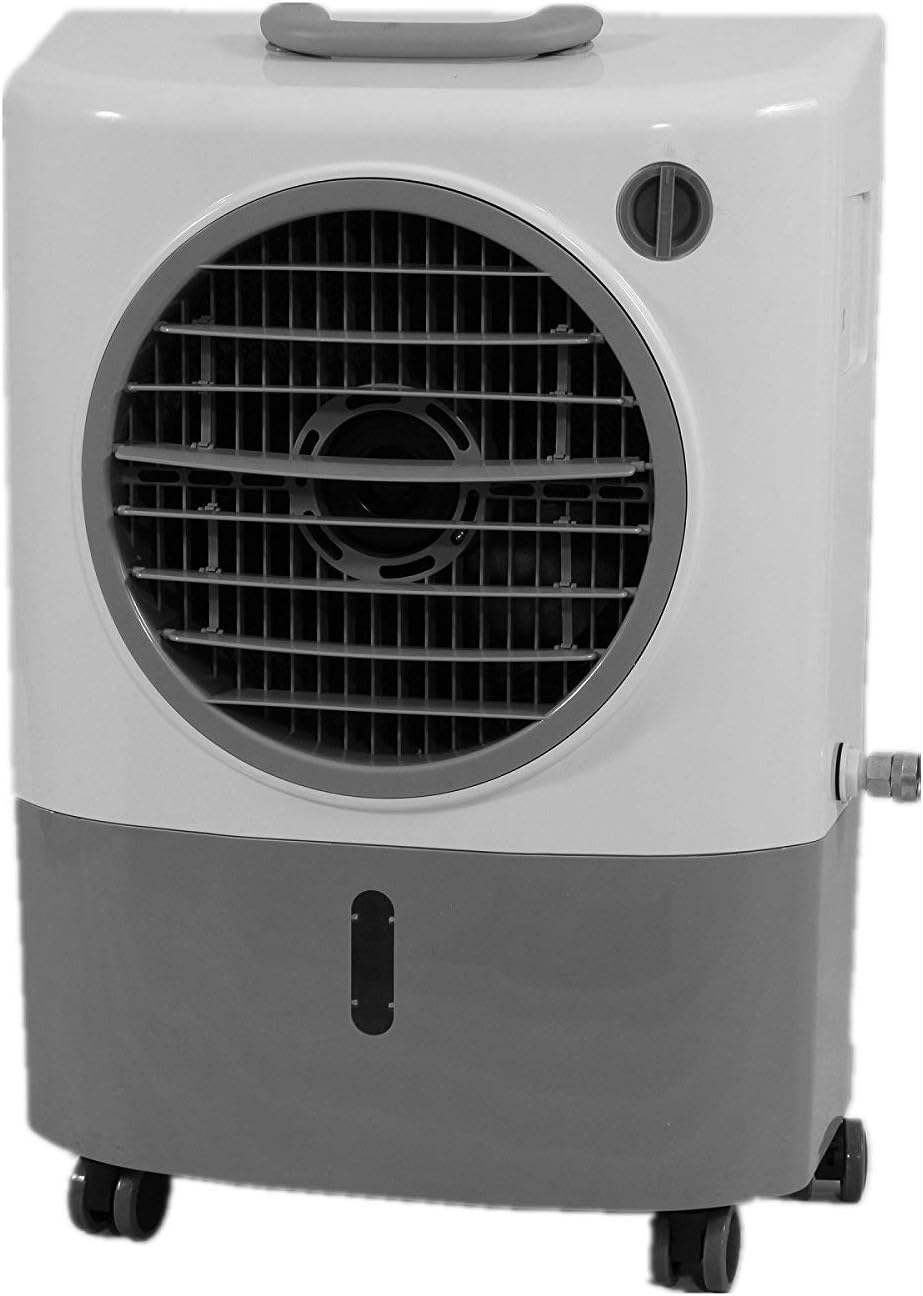
| Air Flow Capacity | 1300 cfm |
|---|---|
| Reservoir Capacity | 4.8 gallons |
| Floor Area | 500 square_feet |
| Wattage | 85 watts |
| Noise | 53.4 db |
The Hessaire MC18M is a freestanding evaporative cooler built for outdoor and open-area use, delivering 1,300 CFM through high-density XeL50 media and an axial propeller. It is typically used on patios, at tailgates, or in workshop and garage settings where cross-ventilation is possible; the 4.8 gallon tank provides about 3 to 4 hours of continuous cooling and can be kept topped via a garden-hose adapter and float valve. Controls are simple: a knob with two pump-on speeds and two fan-only speeds, plus a quiet low-vibration design rated around 53 dB. Practical benefits include lightweight portability with casters and a handle, low electrical draw near 82–85 watts, and durable polypropylene construction for outdoor use. Limitations are inherent to evaporative cooling: it needs an open exhaust path to work well and loses effectiveness in humid climates, and its manual knob controls lack timers or remote convenience. Assembly is required but the unit is otherwise ready to run with minimal setup.
Best for: Buyers who want an energy-efficient, portable outdoor cooling solution backed by many real-user reviews and a known brand, and who plan to use it where doors or windows can remain open for airflow.
Less Ideal for: People needing reliable indoor air conditioning, users in high-humidity climates, or those who require smart controls and precise temperature regulation.
- High airflow at 1,300 CFM suitable for large open areas
- Large 4.8-gallon reservoir with garden-hose adapter for extended runtime
- Low power consumption (about 82–85 watts) compared with refrigerant AC
- Lightweight, portable design with casters and handle for easy moving
- Durable polypropylene construction designed for outdoor use
- Effective only with good cross-ventilation and in low-humidity environments
- Simple manual controls with no timer, remote, or smart features
- Tank provides limited runtime between fills without continuous hose hookup
Verdict: A portable, energy-sipping evaporative cooler that delivers strong airflow for outdoor and well-ventilated spaces, ideal if you want powerful, low-cost cooling where humidity is low.
SYUDTY GDS-820 Evaporative Cooler

| Air Flow Capacity | 3000 cfm |
|---|---|
| Reservoir Capacity | 6.87 gallons |
| Wattage | 150 watts |
| Noise | 52 db |
| Number of Speeds | 3 |
The SYUDTY GDS-820 is a windowless evaporative cooler intended to deliver fast, portable cooling in dry indoor spaces. It uses a high-density cooling pad, a large 6.87 gallon reservoir and a 2026-upgraded motor to push up to 3000 CFM of air, and it offers three fan speeds plus four modes (Normal, Natural, Sleep, Cooling). Controls are available on a top touch panel or via the included remote, and a 1–15 hour timer and 120° oscillation help distribute airflow across a room. Setup is simple: add water or ice packs to the tank, snap on the four 360° casters and plug it in, then adjust fan speed or mode. Practical benefits include added humidity in dry climates, lower energy draw compared with standard portable ACs, and easy mobility between rooms. Important limitations are that this is an evaporative cooler, so performance drops in high-humidity environments and it will not dehumidify or match the low temperatures of compressor-based air conditioners; it also produces noticeable noise at higher fan speeds.
Best for: Buyers who want an energy-efficient, mobile cooling option for dry climates and value easy setup and proven user feedback when choosing cooling gear.
Less Ideal for: People in humid regions or anyone who needs true refrigerated air conditioning or room dehumidification should consider compressor-based ACs instead.
- Very high airflow (3000 CFM) for fast air movement
- Large 6.87 gallon reservoir reduces refill frequency
- Multiple modes, 3 speeds and 120° oscillation improve distribution and comfort
- Remote and touch controls plus 1–15 hour timer add convenience
- Effectiveness decreases in high-humidity climates because it relies on evaporation
- Does not cool to same low temperatures as refrigerated portable air conditioners
- Noise can reach around 52 dB on higher settings
Verdict: Pick the SYUDTY GDS-820 if you need a high-airflow, energy-efficient windowless cooler that moves a lot of air and is easy to set up and move around in dry indoor spaces.
Choosing the Right Outdoor Evaporative Cooler: Key Factors to Consider
Airflow Capacity
Airflow capacity determines how quickly an evaporative cooler can move air through a space and is often expressed in cubic feet per minute. Higher airflow is essential for larger patios, garages, or semi-enclosed areas because it increases the volume of air passing across the cooling media, which in turn lowers perceived temperature.
When choosing, match the unit's rated airflow to your target space. Remember that outdoor and semi-open spaces lose cooled air faster than enclosed rooms, so choose a higher capacity than you would for indoor use. Consider how wind and ventilation patterns around your outdoor area will affect circulation and the cooler's effective coverage.
Water Efficiency and Reservoir Size
Water efficiency affects how long a cooler will run between refills and how much water it consumes per hour of operation. Larger reservoirs give longer run times but add weight and take more space; efficient pumps and pad designs can reduce hourly consumption without sacrificing cooling.
Think about your access to water and whether you prefer manual refilling or the option to connect to a continuous supply. For occasional daytime use on dry days, a mid-sized reservoir may be sufficient, while frequent or overnight use benefits from larger tanks or more efficient designs.
Durability and Outdoor Resistance
Outdoor evaporative coolers are exposed to sun, dust, and occasional moisture, so materials and construction matter. UV-stabilized plastics, powder-coated metal, and rust-resistant fasteners prolong service life. A design that shields mechanical components from direct weather helps prevent premature failure.
Check that serviceable parts like cooling pads and pumps are easy to replace and that the unit can be winterized or stored without specialized tools. Durability considerations also affect resale value and how often you will need to perform repairs or part replacements.
Ease of Setup and Maintenance
Quick assembly and straightforward maintenance reduce friction between purchase and comfortable operation. Look for units with clear instructions, tool-free assembly, and accessible water tanks. Removable, washable cooling pads and accessible pumps make seasonal upkeep faster and help sustain cooling performance.
Maintenance also includes how simple it is to winterize, drain, and store the cooler. Fewer trapped cavities where water can stagnate and fewer proprietary parts simplify long-term ownership and lower the effort required to keep the unit running optimally.
Portability and Placement Options
Many buyers need to move their cooler between patio, garage, and storage. Wheels, handles, and a compact footprint increase placement flexibility. Portability also affects where you can deploy the unit; lighter models can be positioned on raised decks while heavier units may need a firm ground surface.
Consider how fragile the unit is when lifting and whether the design allows for directional airflow adjustments. Portable units that also secure safely in windy conditions give you more confidence when leaving them in semi-exposed outdoor areas.
Sizing Your Outdoor Space
Estimate the square footage of the area you want to cool and consider how open the space is to ambient air. Covered patios and enclosed garages will retain cooled air better than fully open decks, so effective coverage varies with the degree of enclosure.
When in doubt, choose a unit with higher airflow capacity than the bare square footage suggests because outdoor settings dilute cooling. Also decide whether you need spot cooling for seating areas or to lower overall ambient temperature across a larger zone.
- Measure the footprint of the area and note any openings or prevailing breezes.
- Prioritize airflow for open spaces and reservoir size for extended use.
- Account for obstacles like furniture or grills that can disrupt air movement.
Running Requirements and Power
Check the electrical requirements and make sure you have appropriate outdoor-rated outlets or extension options. Most portable evaporative coolers run on standard household current, but cord length and GFCI protection matter for safe outdoor operation.
Also consider the unit's power draw relative to your desired runtime. A model with variable fan speeds can conserve energy and water when full power is not necessary.
- Ensure outdoor outlets are weather protected and GFCI-protected.
- Use heavy-duty, outdoor-rated extension cords if needed.
- Prefer variable-speed fans to balance cooling and consumption.
Placement and Airflow Direction
Position the cooler so it pulls air from a direction that brings in fresh, dry air and blows toward the area you occupy. For covered patios, face the discharge toward seating; for garages, orient the unit to create a cross-breeze between openings.
Avoid placing the cooler where direct sun will heat its exterior or where overspray could affect nearby wood or electronics. Small positional changes can significantly improve perceived cooling without increasing water use.
- Place the unit near an open side for best airflow intake.
- Keep at least a few feet clearance around intake and discharge.
- Angle the airflow or use simple deflectors to target specific zones.
Maintenance Schedule and Winter Storage
Set a regular maintenance schedule to drain and clean the reservoir, rinse or replace cooling pads, and inspect the pump. Frequent inspection prevents mineral buildup and bacterial growth, which degrade cooling performance and odor control.
For the off-season, drain all water, clean the pads and interior, and store the unit in a dry, sheltered place. Label any small parts you remove for storage so reassembly is straightforward next season.
- Drain and clean at least once a month during heavy use periods.
- Replace pads per manufacturer guidance or when they show wear.
- Store the cooler elevated and covered to prevent moisture damage.
Water and Climate Considerations
Evaporative cooling is most effective in hot, dry climates where low humidity allows water evaporation to lower air temperature. In humid environments, the cooling effect is limited and units mainly move air without much temperature drop.
If you are in a region with hard water, plan for more frequent pad and pump maintenance. Consider using filtered water or periodic vinegar rinses to reduce scale buildup and extend component life.
- Prioritize evaporative coolers in low-humidity areas for best results.
- Expect reduced cooling efficiency as ambient humidity rises.
- Use routine scale-control measures in hard-water locations.
How We Chose the Best Outdoor Evaporative Cooler
We focused our selection on units that perform reliably in outdoor, semi-enclosed, and covered spaces where evaporative cooling is appropriate. Key evaluation criteria included airflow capacity, measured in CFM or comparable manufacturer ratings to estimate how effectively a unit can circulate and cool a given area. Water efficiency and reservoir capacity were examined to determine realistic run times between refills while cooling at typical outdoor temperatures. Durability was another primary filter, including corrosion-resistant housing, UV-resistant materials, and designs meant for occasional outdoor exposure. We also prioritized ease of setup and maintenance, such as tool-free assembly, accessible water reservoirs, and washable cooling pads. Portability features like caster wheels and carry handles were considered for buyers who move units seasonally. We excluded units intended strictly for indoor use or those lacking basic weather-resistant features. Products that required permanent plumbing or professional installation were not considered, since most buyers need flexible, portable cooling. The final list balances cooling performance, water management, durability, and user-friendly maintenance.
Our full evaluation process is outlined in our review methodology.
FAQ
How large an outdoor evaporative cooler do I need for a covered patio?
Choose a unit with higher airflow than the patio square footage alone suggests because outdoor spaces exchange air quickly. Match airflow ratings to the effective usable area and prioritize units that list coverage for semi-enclosed spaces.
Can I leave an evaporative cooler outside in light rain?
Occasional light exposure might be tolerated by some outdoor-rated designs, but prolonged wet conditions accelerate corrosion and electrical risks. It is safer to shelter the unit or move it under cover when rain is expected.
How often do I need to change the cooling pads?
Pad replacement depends on water quality and usage. Inspect pads monthly during heavy use and replace them when they are torn, heavily mineralized, or no longer wet uniformly. Regular rinsing can extend pad life.
Will an evaporative cooler work in high humidity?
Effectiveness decreases as humidity rises because the cooling process relies on evaporation. In high-humidity conditions, the unit will primarily increase air movement and provide some comfort through evaporation from skin, but temperature reduction will be limited.
What maintenance prevents odors in my cooler?
Regularly draining and cleaning the reservoir, rinsing or replacing pads, and running the fan briefly after shutdown to dry internal surfaces help prevent musty smells. Occasional cleaning with a mild vinegar solution removes mineral and biological buildup.
Final Verdict
When selecting an outdoor evaporative cooler, prioritize airflow capacity, water efficiency, and durability for the specific outdoor setting you plan to cool. Match reservoir size and portability to how often and where you will use the unit, and be realistic about performance limits in humid conditions. Balance run-time needs against weight and maintenance requirements. If you focus on robust materials, easy maintenance, and sufficient airflow for your space, you will end up with a practical, long-lasting cooler that improves comfort without complicated installation.