
Note: This article contains affiliate links. If you click on these links and make a purchase, we may earn a small commission at no extra cost to you. This helps support our research and content. Read our full affiliate disclosure here.
If you need hot water quickly at a single sink, shower, or appliance without reworking your whole plumbing system, a point-of-use electric water heater can be the simplest fix. These compact units sit close to the fixture and cut wait time and wasted water while delivering enough capacity for short tasks like handwashing, shaving, or a quick wash cycle. Choosing the right unit matters because size, recovery speed, and installation requirements determine whether the heater meets your daily use and fits where you plan to mount it. This guide presents seven shortlisted point-of-use electric water heaters that represent the best balance of performance, size, and reliability. Read on to understand the evaluation criteria and practical considerations before the product list.
Top Picks at a Glance
| Best Overall The best all-around choice for most situations | Rheem RTEX-13 Tankless Electric Heater |  |
| Best Quality Built to a higher standard if you want something more solid | Bosch Tronic 3000 T ES4 |  |
| Best Value The sweet spot between price and what you get | CAMPLUX 4.5kW Tankless Water Heater |  |
| Best Budget The cheapest option that still gets the job done reliably | xwdzswgs Tankless Water Heater | 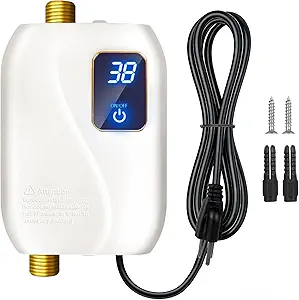 |
| Top Rated A top-rated pick with lots of positive feedback | thermomate Tankless Water Heater ET045CAN4 |  |
| Most Popular A crowd favorite that many people choose with confidence | xwdzswgs 3000W Tankless Water Heater |  |
| Best Seller A high-volume bestseller chosen again and again | Rheem RTEX-04T 3.5 kW |  |
Rheem RTEX-13 Tankless Electric Heater

| Power Source | Electric |
|---|---|
| Wattage | 13 KW |
| Voltage | 240 volts |
| Flow Rate | 4.8 gpm |
| Maximum Temperature | 140 °F |
The Rheem RTEX-13 is a compact 240V tankless electric unit designed to deliver on-demand hot water for a single point of use or small multiple applications. It uses two field-serviceable copper immersion heating elements and self-modulating power control to provide steady temperature output while keeping energy use efficient. Installation is straightforward for a qualified electrician and plumber, with 1/2 NPT adapters and 1/2 inch compression water connections included and a wall-mount form factor that fits tight spaces. The external digital thermostatic control with LED display lets you dial temperature in 1°F increments for precise control, and the unit is rated to handle up to about 3.17–4.8 gallons per minute depending on listed flow context, which is suitable for a sink, compact shower, or small laundry use. Expect professional-style performance with very high claimed efficiency, but it requires a 240V, 54 A-capable circuit and professional electrical hookups, so it is not a drop-in replacement for standard 120V plumbing. For point-of-use heating where space and efficiency matter, the RTEX-13 is a practical choice.
Best for: Buyers who want a compact, efficient point-of-use electric heater that delivers precise temperature control and reliable hot water for a sink, small shower, or laundry without needing a storage tank.
Less Ideal for: Homes that need whole-house hot water or that cannot accommodate a 240V high-amperage electrical circuit should choose a different solution.
- Compact wall-mount design fits tight spaces and point-of-use locations.
- External digital thermostatic control with LED allows 1°F adjustment accuracy.
- Copper immersion heating elements are durable and field-serviceable.
- Self-modulating power control improves temperature stability and efficiency.
- Requires a dedicated 240V, high-amperage circuit and professional installation.
- Flow rate is limited to single-point or small multi-point applications, not whole-house supply.
Verdict: A compact, high-efficiency 240V point-of-use tankless heater that delivers precise, on-demand hot water for single sinks and small showers.
Bosch Tronic 3000 T ES4
| Capacity | 4 gallons |
|---|---|
| Wattage | 1440 watts |
| Voltage | 120 volts |
| Maximum Temperature | 140 °F |
| Water Pressure Range | 150 psi |
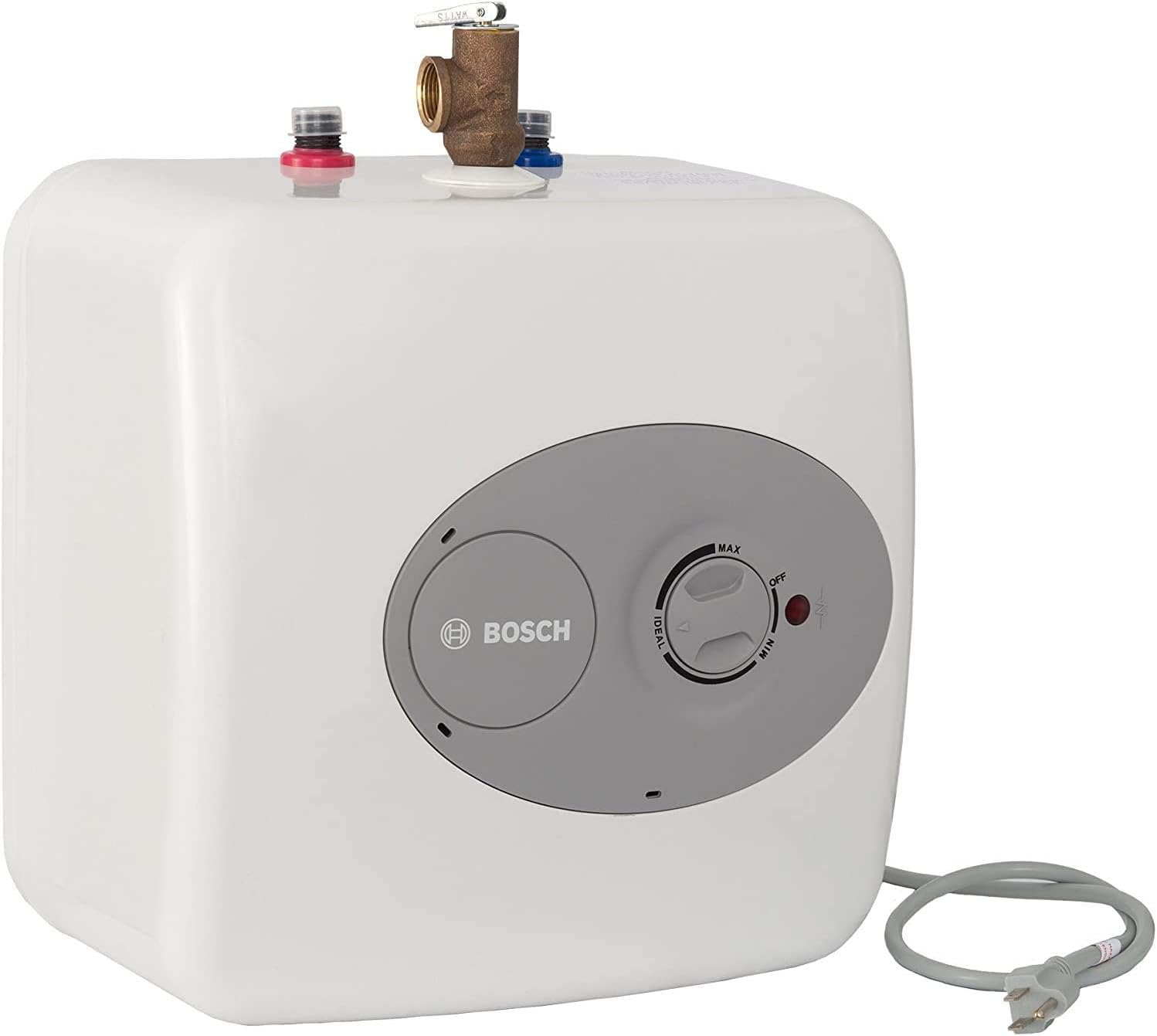
The Bosch Tronic 3000 T ES4 is a compact 4-gallon electric mini-tank designed to provide near-instant hot water at a point of use. It plugs into a standard 120 V outlet and can be shelf-, wall- or floor-mounted, making it easy to install under a sink or in tight utility spaces. The glass-lined tank and thick foam insulation improve durability and thermal efficiency, while an external temperature dial and included temperature/pressure relief valve give simple control and safety. With a 1440 W element and a rated 98% thermal efficiency, the ES4 recovers quickly enough to serve one or two nearby fixtures without long waits. It is most useful where running a new hot line would be costly or to reduce cold-water lag from distant water heaters. Limitations include the small 4-gallon capacity, which is intended for short draws and not continuous high-flow use, and the unit requires annual anode-rod checks per manufacturer guidance to avoid premature tank issues.
Best for: Buyers who want a performance-focused point-of-use heater to eliminate cold-water wait time at a sink and prefer a compact, easy-to-install unit that recovers quickly for short hot-water demands.
Less Ideal for: Homes or users needing hot water for continuous high-flow tasks like showers or multiple simultaneous large draws should choose a larger tank or dedicated whole-house solution.
- Provides hot water quickly at the point of use to reduce wait time at sinks
- Plug-in 120 V connection allows independent installation without hardwiring
- Glass-lined tank and thick insulation improve longevity and heat retention
- Multiple mounting options (shelf, wall or floor) suit varied installation locations
- Small 4-gallon capacity limits use to brief draws or one/two fixtures
- Requires periodic inspection/replacement of the anode rod to maintain tank life
Verdict: A compact, fast-recovering point-of-use mini-tank built to deliver near-instant hot water for a sink or small fixture with easy plug-in installation.
CAMPLUX 4.5kW Tankless Water Heater

| Power | 4.5 KW |
|---|---|
| Voltage | 120 volts |
| Maximum Temperature | 131 °F |
| Maximum Pressure | 150 psi |
| Mount Type | Wall |
This CAMPLUX 4.5 kW tankless unit heats water on demand for a single sink, producing a quick temperature rise at low flow so you get hot water in seconds without a storage tank. It mounts to the wall and is intended as a point-of-use solution for kitchens, wet bars, RVs, or utility sinks. The unit includes dry combustion protection, a self-modulating heating system that scales power to flow and set temperature, and a simple LED display for adjustments. Installation requires hardwiring to a 120V circuit with a 40 A breaker and 8 AWG wiring, so plan for an electrician; the package includes a mounting kit and the heater but not full plug-and-play wiring. Performance is best at low flow rates—the spec sheet and Q&A note it is not suitable for showers—so expect reliable single-fixture hot water but not whole-home use. Its small footprint saves space under cabinets, and construction uses aluminum and stainless steel for corrosion resistance, but buyers should confirm electrical capacity and flow requirements before purchase.
Best for: Buyers who want a compact, energy-efficient under-sink heater to deliver fast hot water for a single fixture and who are willing to arrange proper electrical hardwiring.
Less Ideal for: Homes needing whole-house hot water or users who want to run showers or multiple fixtures simultaneously should choose a higher-capacity or whole-home model.
- Heats on demand for near-instant hot water at a single sink
- Self-modulating control reduces energy use by adjusting power to flow and set temperature
- Compact wall-mount design saves under-sink space
- Built-in dry combustion protection and LED display for simple control
- Requires a dedicated 40 A breaker and 8 AWG hardwired connection, not a simple plug-in
- Not rated or recommended for shower use or multiple fixtures
Verdict: A space-saving, energy-conscious point-of-use heater that reliably delivers instant hot water to one sink when your electrical circuit can support a 40 A hardwired installation.
xwdzswgs Tankless Water Heater
| Power Source | AC |
|---|---|
| Power | 3000W |
| Maximum Temperature | 131 °F |
| Special Features | Dry Combustion Protection, LED Display, Lightweight |
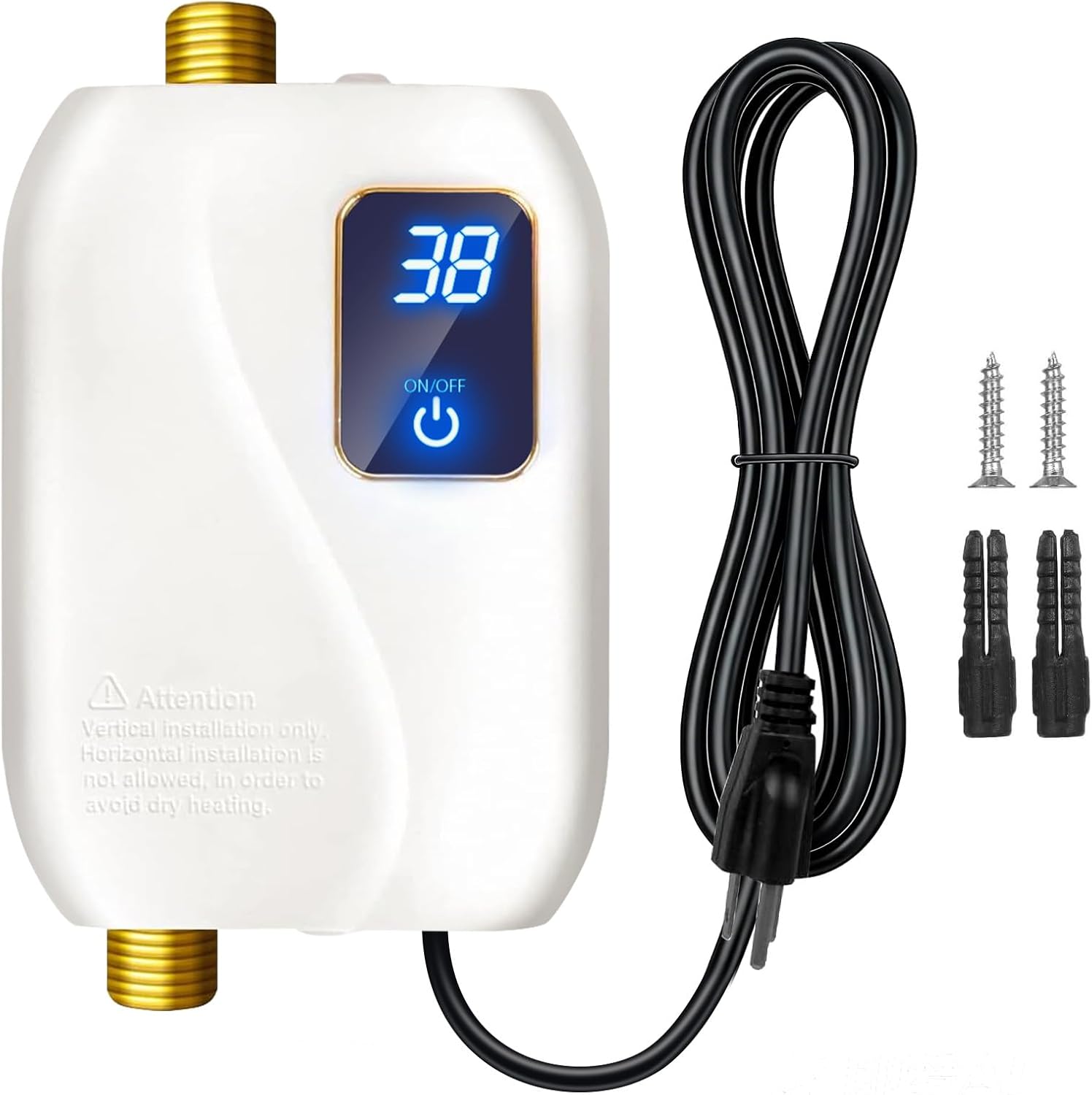
This compact 110V tankless water heater is a point-of-use unit meant for under-sink, kitchen, RV, or small-apartment installs where space is limited and instant hot water is needed. It uses 3000W heating with an LED digital display that switches between Celsius and Fahrenheit and offers protections like IPX4 splash resistance, dry-fire protection, leakage protection, and automatic shutoff on over-temperature. Installation is vertical only and uses 1/2-inch NPT fittings with pre-drilled screw holes, and the unit requires a dedicated circuit and heavier gauge wiring as recommended in the manual. Practical benefits include near-instant hot water without a storage tank, compact wall-mounted footprint, and a simple digital interface to set temperature. Limitations are obvious for larger demands: flow rates are low so it is not suitable for showers and outlet temperature depends heavily on flow, and proper electrical setup is required for safe operation. For buyers who need a low-cost, space-saving point-of-use heater, this covers basic needs reliably; it is not a whole-house solution.
Best for: Buyers on a tight budget who need a compact, low-cost point-of-use heater for a sink, RV, or small apartment where occasional hot water is required and space is at a premium.
Less Ideal for: Homes that need hot water for showers, multiple fixtures at once, or anyone unwilling to upgrade wiring or install a dedicated circuit should look at higher-capacity solutions.
- Compact wall-mounted design saves under-sink or countertop space
- LED digital display with °C/°F switching for simple temperature control
- Multiple safety protections including IPX4 splash resistance, dry-fire protection, and automatic over-temperature shutoff
- Includes standard 1/2-inch NPT connections and basic mounting hardware for quicker installation
- Low flow capacity makes it unsuitable for showers or simultaneous multi-fixture use
- Requires vertical-only installation and a dedicated electrical circuit with recommended wiring
- Temperature rise varies significantly with flow rate, limiting outlet temperature at higher flows
Verdict: A budget-friendly, compact point-of-use tankless heater that delivers quick under-sink hot water when you need a low-cost, space-saving solution.
thermomate Tankless Water Heater ET045CAN4

| Wattage | 4500 watts |
|---|---|
| Power Source | ac |
| Maximum Temperature | 131 °F |
| Special Features | Self-modulating Power, Cast Aluminum Heating Element, Stainless Steel Water Tube, Touch Control Panel, Waterproof |
The thermomate ET045CAN4 is a 4,500W, 120V point-of-use electric tankless heater designed to supply instant hot water for a single sink or similar low-flow fixture. It installs near the fixture and uses self-modulating power to heat only the water you use, with a temperature range up to 131°F shown on a digital display and touch controls for 1° adjustments. The unit emphasizes durability with a cast aluminum heating element isolated from the water path and a 304 stainless steel water tube to reduce scale and corrosion. It is compact and IP25 splash-resistant, making it practical under cabinets or behind vanities. Important considerations: it requires a 40A double-pole breaker and at least 8 AWG wiring for hardwired 120V installation, and its flow rates are best suited to low-demand sinks (0.26–1.0 GPM, ~0.85 GPM at a 35°F rise), so it will not supply multiple fixtures or high-flow showers. For buyers wanting a reliable, long-lasting instant sink heater, it balances efficiency and build quality but is not a whole-house solution.
Best for: Buyers who prioritize a durable, efficient point-of-use solution for a single sink and want precise temperature control and low maintenance over time.
Less Ideal for: Homes needing hot water for multiple fixtures, high-flow faucets, or showers should choose a higher-capacity or whole-house unit instead.
- Rapid on-demand heating for a single sink with digital temperature display and 1° control increments
- Self-modulating power improves efficiency by using only the energy needed to heat flowing water
- Cast aluminum heating element separated from the water and 304 stainless steel water tube reduce scale and corrosion risk
- Compact, splash-resistant IP25 design fits tight spaces under sinks and includes a mounting kit
- Requires hardwiring to a 40A double-pole breaker and 8 AWG minimum conductors, so professional electrical work is likely
- Low maximum flow rate makes it unsuitable for supplying multiple fixtures or high-flow applications
Verdict: A compact, reliability-focused point-of-use tankless heater that delivers precise, low-maintenance hot water for a single sink.
xwdzswgs 3000W Tankless Water Heater

| Power Source | ac |
|---|---|
| Special Features | Dry Combustion Protection, LED Display, Lightweight |
| Maximum Temperature | 122 °F |
| Heat Output | 131 °F |
| Mount Type | Wall |
This compact 3000W tankless unit is designed as a point-of-use under-sink heater to deliver near-instant hot water for sinks and small fixtures. It mounts vertically and heats water on demand, with the outlet temperature varying by flow rate so low-flow taps produce hotter water while higher flows reduce output. The LED display shows set temperature in Celsius or Fahrenheit and the unit includes protections such as dry-boil cutoff, leakage isolation, IPX4 splash resistance, and automatic shutdown for overheating. Installation is straightforward for a qualified DIYer or plumber: it uses a 1/2-inch NPT interface, premade fixing holes, and requires a dedicated circuit and appropriately sized wiring per the manual. Practical limitations are that it is not intended for showers or high-flow uses and must be installed vertically; output is constrained at typical household flows so expect lukewarm water if several fixtures run simultaneously. For small kitchens, RVs, or single-sink setups it provides fast, space-saving hot water with useful safety features.
Best for: Buyers wanting a small, proven point-of-use heater to supply immediate hot water to a single sink, RV, or compact kitchenette who value safety features and visible temperature control.
Less Ideal for: Homes needing hot water for showers, multiple simultaneous fixtures, or whole-room supply should choose a larger-capacity or whole-house solution instead.
- Compact, space-saving form for under-sink or point-of-use installs
- 3000W heating that produces near-instant hot water at low flow rates
- Digital LED display with Celsius/Fahrenheit selection for easy temperature monitoring
- Multiple safety features including dry-boil protection, leakage isolation, IPX4 splash resistance, and automatic overheat shutdown
- Includes mounting holes and standard 1/2-inch NPT interface for straightforward plumbing connections
- Not suitable for showering or high-flow applications due to limited flow-to-temperature performance
- Requires vertical installation and a dedicated properly sized electrical circuit
Verdict: A compact, safety-focused 110V tankless unit that reliably delivers on-demand hot water for single-sink and other low-flow point-of-use needs.
Rheem RTEX-04T 3.5 kW

| Wattage | 3500 watts |
|---|---|
| Voltage | 120 volts |
| Flow Rate | 0.9 gpm |
| Maximum Temperature | 140 °F |
| Mount Type | Wall |
The Rheem RTEX-04T is a small, wall-mounted tankless electric unit meant for point-of-use applications such as a basement sink, garage workshop, or single bathroom fixture. It heats on demand using 3.5 kW at 120 volts and offers digital thermostatic controls adjustable in 1 degree increments from 80°F to 140°F, so you can tune outlet temperature precisely. Because it requires no venting and is compact, installation is flexible and it frees up space compared with a traditional tank. Practical benefits include lower standby energy waste and fast hot water at nearby fixtures, and the unit can deliver about 0.9 gpm maximum flow depending on inlet water temperature. Limitations are its low flow and modest heat output, so it is not suitable where multiple fixtures or high-flow showers are needed and it requires the specified electrical breaker and wiring for safe operation. The unit carries simple controls and a 5-year leak warranty with 1-year parts coverage, making it a straightforward, conservative choice for single-fixture hot water.
Best for: Homeowners who want a conservative, space-saving solution to provide near-instant hot water for one sink or small single-fixture uses and prefer a simple, proven electric option.
Less Ideal for: Households needing hot water for multiple fixtures, full showers, or higher flow rates should choose a larger point-of-use or whole-home model instead.
- Compact wall-mounted design suitable for installation near the fixture to reduce wait time for hot water
- Thermostatic digital control with 1°F increments for precise outlet temperature
- No venting required, simplifying indoor installation
- Heats on demand to reduce standby energy consumption compared with tank heaters
- Low maximum flow rate (around 0.9 gpm) limits use to single low-flow fixtures
- Requires dedicated 120V wiring and a 30-amp breaker which may need electrical work
Verdict: Buy this if you need a reliable, compact electric point-of-use heater to deliver precise, on-demand hot water to a single low-flow fixture.
Choosing the Right Point-Of-Use Electric Water Heater: Key Factors to Consider
Tank Capacity and Delivered Hot Water
Tank capacity determines how much immediately available hot water the unit can supply for a single use. Smaller tanks work well for a single sink or appliance, but they can run out quickly under continuous use like a long shower or running a small dishwasher. Consider how many consecutive minutes of hot water you need at the fixture and choose a capacity that covers that use case.
Also account for usable drawdown versus nominal capacity. Some of the water remains below the thermostat set point and is not usable at the selected temperature. Planning for this difference prevents surprises where the heater runs out sooner than expected.
Recovery Rate and Heat-Up Time
Recovery rate, usually expressed as how fast the heater can reheat its tank or deliver a specified flow at a target temperature, influences how the unit performs with repeated or back-to-back uses. Faster recovery is important if the fixture gets frequent use during the day, such as a busy laundry prep sink or an en-suite bathroom.
If you expect intermittent but frequent use, prioritize units with higher wattage or better heat exchanger efficiency. For occasional use where long recovery is acceptable, a lower-power unit may be fine and easier to integrate with existing circuits.
Electrical Requirements and Circuitry
Point-of-use electric heaters vary in voltage and amperage needs. Some require dedicated 240V circuits and significant breaker capacity, while smaller models may run on 120V branches. Evaluate your current electrical panel capacity and how much new wiring or breaker space an installation will require.
If you cannot add a dedicated circuit easily, choose a unit with lower amperage that matches available circuits. Also check whether the unit needs a double-pole breaker, ground-fault protection, or other electrical safety features to comply with local codes.
Installation Access and Physical Fit
The heater must fit in the available space and be mountable in a way that allows plumbing and electrical connections. Under-sink cupboards, narrow utility closets, or wall-mounted locations impose different constraints on footprint and piping runs. Measure height, depth, and clearance for valves when planning an install.
Consider also service access. Units with accessible elements, drain valves, and removable panels make routine maintenance and future service simpler. Tight, hard-to-reach installs increase labor costs and complicate repairs.
Temperature Range, Controls, and Safety Features
Accurate temperature control ensures you get consistent hot-water temperatures at the tap and reduces scald risk. Look for thermostats with clear adjustment ranges and safety limiters that prevent overheating. Some units include diagnostic lights, built-in tempering valves, or anti-scald features which add useful protection for households with children or elderly users.
Safety certifications and thermal cutoffs are also important. Units with automatic shutoff or redundant thermostats lower the risk of thermal damage if a control fails.
Durability and Corrosion Resistance
Because point-of-use heaters often sit in humid, cramped spaces, tank and component materials affect service life. Look for corrosion-resistant linings, sacrificial anode protection, and robust external housings to resist dents and moisture. Durable components in the plumbing connections and valves reduce leak risk over time.
Maintenance needs such as an accessible drain for flushing mineral buildup also matter in areas with hard water. Choosing a unit that accounts for the local water quality will extend usable life and preserve performance.
Where Point-Of-Use Heaters Make the Most Sense
Point-of-use electric water heaters are ideal for locations far from a central water heater or for adding hot water to a single fixture without rerouting whole-house plumbing. Typical use cases include a basement bar sink, a bathroom vanity, a small laundry room sink, or a dedicated tap for a pet-washing station.
They are also useful during renovations where running long hot-water lines would be disruptive or expensive. For short, frequent draws at a single location, a compact heater can reduce wasted cold-water run time and lower water waste.
- Useful for sinks and single fixtures with frequent short draws
- Practical retrofit solution where plumbing reroutes are impractical
- Reduces wait time and water waste for localized hot-water needs
Planning Installation: Plumbing and Piping Tips
Keep plumbing runs short to minimize heat loss and delay. Use appropriately sized shutoff valves and include a pressure-relief valve as required by code. Insulate short stretches of hot-water piping if they pass through unconditioned spaces to retain heat after a draw.
Ensure proper drain access for occasional flushing and account for any expansion or relief valve discharge routing. For under-sink installs, leave clearance for the drain valve and periodic service rather than tucking the unit into a tight corner where servicing would be difficult.
- Install a shutoff valve and pressure-relief valve per local code
- Keep hot-water runs short and insulated where needed
- Provide access for draining and maintenance
Electrical Practicalities and Code Considerations
Match the unit to your available electrical supply. Many point-of-use electric heaters require 240V and a dedicated double-pole breaker, while some low-capacity models operate on 120V. Confirm breaker space, gauge of wiring, and whether ground-fault protection is required in the installation location.
Plan for safe routing of wiring and proper access to the junction box. If your panel lacks free slots or you are unsure about capacity, consult a qualified electrician to avoid overloaded circuits and to ensure compliance with local electrical code.
- Verify voltage and amperage requirements before purchase
- Use correct wire gauge and breaker size per manufacturer specs
- Consider GFCI protection where required
Maintenance Basics to Extend Service Life
Regular maintenance preserves performance and prevents premature failure. Flush the tank periodically to remove mineral buildup if you have hard water. Inspect and test the pressure-relief valve annually and verify the thermostat functions as expected.
Replace sacrificial anodes where applicable and check plumbing connections for corrosion or leaks. Routine checks are simple and prevent larger repairs down the road.
- Flush tank on a schedule based on water hardness
- Test pressure-relief valve annually
- Inspect fittings and anodes for corrosion
Sizing a Unit for Different Fixtures
Estimate typical flow at the fixture and desired temperature rise to select a heater that delivers adequate output. For a single bathroom sink or a small bar sink, small-capacity units suffice. For a shower, prioritize higher delivered flow and faster recovery.
If you plan to serve more than one nearby fixture, account for simultaneous draws. In borderline cases, a slightly larger unit provides more margin for short bursts of use without running cold.
- Match capacity to fixture flow and expected duration
- Prioritize recovery for frequent or back-to-back use
- Add a margin if serving multiple nearby fixtures
How We Chose the Best Point-Of-Use Electric Water Heater
We focused on objective, homeowner-relevant metrics that predict real-world performance for point-of-use electric water heaters. Primary evaluation criteria included first-hour recovery and hot-water delivery to judge usable output for short tasks; physical footprint and mounting options to ensure the unit fits under sinks and in small closets; electrical requirements and wiring complexity to assess installation feasibility for typical residential circuits; temperature control accuracy and safety features such as thermostats and thermostatic limiters; build quality and corrosion resistance for longevity in humid under-sink environments; and warranty and documentation quality to reflect manufacturer support and ease of service. Units were excluded if they required uncommon voltages or professional-only installation that would make them impractical for most DIY or simple retrofit installs. We also filtered out products that lacked clear spec transparency about tank capacity, recovery rates, or electrical draw. The final picks balance compact dimensions with realistic hot-water output and practical installation demands, so buyers can match a heater to a specific fixture and household electrical setup.
Our full evaluation process is outlined in our review methodology.
FAQ
Can a point-of-use electric water heater serve a shower?
It depends on the unit's capacity and recovery rate. Many small point-of-use heaters are sized for sinks and brief tasks and may not sustain the higher flow rates a shower requires. Choose a model with adequate delivered flow and recovery if you plan to use it for a shower.
Do I need a dedicated circuit for a point-of-use electric heater?
Often yes, especially for units that run on 240V and draw higher amperage. Smaller 120V models may fit existing circuits, but you should verify breaker capacity and wiring gauge. Consult an electrician if you are unsure.
How often should I flush a point-of-use tank?
Frequency depends on water hardness and usage. In hard-water areas, flushing once or twice a year helps prevent mineral buildup. In soft-water locations or low-use scenarios, annual flushing may be sufficient.
What safety features should I look for?
Prioritize accurate thermostats, thermal cutoffs, and pressure-relief valves. Anti-scald controls or compatibility with a tempering valve are also useful when the heater supplies fixtures used by children or elderly household members.
Can I install a point-of-use heater myself?
If you have plumbing and basic electrical skills, some installations are straightforward. However, units that require new 240V wiring, breaker changes, or code-specific safety devices are best handled by a licensed electrician and plumber to ensure compliance and safety.
Final Verdict
When choosing a point-of-use electric water heater, prioritize the combination of capacity, recovery rate, and electrical compatibility that matches the fixture you intend to serve. Smaller tanks work well for sinks and occasional use, while higher recovery and wattage are important for showers or frequent draws. Balance installation complexity against performance needs and plan for access and maintenance to maximize lifespan. By matching a unit to the specific flow, temperature rise, and electrical constraints at the install site, you can add reliable hot water with minimal disruption.