
Note: This article contains affiliate links. If you click on these links and make a purchase, we may earn a small commission at no extra cost to you. This helps support our research and content. Read our full affiliate disclosure here.
Upgrading to a high efficiency water heater can reduce monthly utility bills and deliver more consistent hot water for household use. The right unit matters because capacity, recovery rate, and installation type directly affect comfort and long-term running costs. This guide highlights the top shortlisted high efficiency water heaters across common capacities and configurations. We evaluate units on measurable efficiency, installation demands, and long-term reliability so you can pick the option that fits your home and budget. Read on for a concise breakdown of the evaluation criteria before the product list.
Top Picks at a Glance
| Best Overall The best all-around choice for most situations | Senville SENWH-HP50US 50-Gallon Hybrid |  |
| Best Quality Built to a higher standard if you want something more solid | Rinnai RXP199iN Tankless Water Heater |  |
| Best Value The sweet spot between price and what you get | Titan N-85 Tankless Water Heater |  |
| Best Budget The cheapest option that still gets the job done reliably | Orbek 14kW Tankless Water Heater |  |
| Top Rated A top-rated pick with lots of positive feedback | ThermoMate RTC68iN Tankless Water Heater |  |
| Most Popular A crowd favorite that many people choose with confidence | EcoSmart ECO 11 Tankless Water Heater |  |
| Best Seller A high-volume bestseller chosen again and again | Rheem RTEX-18 Tankless Electric |  |
Senville SENWH-HP50US 50-Gallon Hybrid

| Capacity | 50 gallons |
|---|---|
| Uniform Energy Factor | 3.75 UEF |
| First Hour Rating | 69 Gal FHR |
| Power Source | dc |
The Senville SENWH-HP50US is a 50-gallon hybrid heat pump water heater designed to cut electricity use by moving heat from surrounding air into the tank rather than relying solely on resistive heating. It is typically installed in a basement, garage, or mechanical closet where ambient air is available and serves medium to large households with a 69-gallon first hour rating so multiple showers, laundry and dishwashing can run without quickly depleting hot water. Key features include ENERGY STAR certification, a 3.75 UEF for strong efficiency, UL and AHRI certification for safety and performance, and a hybrid mode that prioritizes heat-pump operation to maximize savings. Practical benefits are much lower operating costs compared with standard electric heaters and reliable hot water output for everyday home use. Important limitations are the need for adequate surrounding air and space for heat-pump airflow and the heavier, taller profile compared with conventional tanks which may affect siting and installation requirements.
Best for: Buyers who want lower long-term operating costs and steady household hot water and are willing to site the unit where it can access ambient air for the heat-pump to work effectively.
Less Ideal for: Those with very small cramped utility spaces, poorly ventilated locations, or buyers who need the simplest plug-and-play replacement for a compact tankless setup.
- High efficiency 3.75 UEF reduces energy consumption compared with standard electric heaters
- ENERGY STAR, UL, and AHRI certifications indicate verified performance and safety
- 69-gallon first hour rating supplies reliable hot water for medium to large households
- Hybrid heat pump operation can cut electricity use by a large percentage in appropriate spaces
- Requires sufficient ambient air space for the heat pump to operate efficiently
- Larger and heavier footprint may complicate installation in tight utility closets
Verdict: Choose this hybrid unit if you want an ENERGY STAR certified 50-gallon water heater that cuts operating costs with heat-pump efficiency while delivering reliable hot water for a medium to large household.
Rinnai RXP199iN Tankless Water Heater

| Power Source | Natural Gas or Propane |
|---|---|
| Flow Rate | 11 gpm |
| Heat Output | 199000 british thermal units |
| Maximum Temperature | 140 °F |
| Wattage | 98 watts |
The Rinnai RXP199iN is a compact, condensing tankless water heater designed to deliver continuous hot water for larger households while minimizing energy use. It produces up to 11.1 gallons per minute and a 199k BTU output, so it can run multiple fixtures simultaneously without the volume and standby losses of a tank. Notable features include a Smart Sense gas control, Smart-Circ intelligent recirculation with an internal pump to reduce wait time for hot water, Versa Vent for indoor or outdoor installation, and a Quick Flush routine that simplifies maintenance. The unit reaches a very high UEF of 0.98, which translates to strong operating efficiency and lower fuel consumption compared with conventional models. It also supports Wi-Fi control with an optional module for remote monitoring. Important trade-offs are that professional installation is recommended due to gas and venting requirements and the upfront cost and complexity are higher than non-condensing or standard tank heaters. For buyers focused on peak performance and efficiency, this model balances powerful flow rates with advanced controls.
Best for: Buyers who prioritize peak performance and year-round efficiency and need a tankless heater capable of supplying several fixtures simultaneously while cutting fuel use.
Less Ideal for: Those who want a simple, low-cost replacement or who prefer to avoid professional gas and venting installation should consider simpler non-condensing or tank models instead.
- Very high UEF 0.98 for strong energy efficiency
- Up to 11.1 gpm flow rate supports multiple fixtures at once
- Built-in Smart-Circ recirculation pump reduces hot-water wait times
- Convertible design for natural gas or propane and indoor or outdoor venting
- Quick Flush feature and compact footprint simplify maintenance and installation space
- Requires professional installation and proper venting adaptations
- Higher upfront cost and system complexity compared with non-condensing tank heaters
Verdict: Choose the Rinnai RXP199iN if you want a high-flow, super-efficient tankless heater that minimizes energy use while supplying multiple fixtures reliably.
Titan N-85 Tankless Water Heater

| Wattage | 8500 watts |
|---|---|
| Voltage | 240 volts |
| Flow Rate | 2.5 gpm |
| Efficiency | 99.5% |
| Mount Type | Wall |
The Titan N-85 SCR2 is a wall-mounted electric tankless water heater designed to provide continuous hot water for point-of-use or small whole-house needs. It heats water on demand using an 8.5 kW element at 240 volts and is rated for about 2.5 gallons per minute, so it works best for single fixtures like a bathroom sink or low-flow shower. The unit advertises high efficiency and thermostatic temperature control, which helps reduce standby losses compared with tank systems and keeps outlet temperature steady under light loads. Its shallow 2.75-inch depth and titanium material make it space-saving and corrosion-resistant for indoor installations. Limits to consider are the modest flow rate and power: the 8.5 kW output will struggle to supply multiple high-flow fixtures or long simultaneous showers, and it requires a 38 amp/240V circuit for installation. For buyers wanting a compact, efficient solution to replace a small electric tank or to serve a single point, it is a practical, energy-conscious choice.
Best for: Buyers who prioritize energy efficiency and a compact footprint for supplying a single fixture or a small point-of-use application will appreciate this unit.
Less Ideal for: Homes needing simultaneous hot water for multiple showers or larger households should choose a higher-capacity or whole-house model instead.
- On-demand heating reduces standby energy loss compared with tanks
- Space-saving wall mount and very shallow profile for tight installations
- Thermostatic control helps maintain consistent outlet temperature
- Titanium construction offers good corrosion resistance for longevity
- Low maximum flow rate around 2.5 gpm limits simultaneous use of multiple fixtures
- 8.5 kW power requires a dedicated 240V/38A circuit which may need electrical upgrades
Verdict: A compact, high-efficiency electric tankless unit ideal for single fixtures or small point-of-use installations where space and energy savings matter.
Orbek 14kW Tankless Water Heater

| Wattage | 14 KW |
|---|---|
| Voltage | 240 volts |
| Maximum Temperature | 140 °F |
| Heat Output | 14 KW |
| Water Connections | 1/2" NPT |
The Orbek 14kW tankless water heater is a compact, wall-mounted electric unit designed to provide instant hot water for one shower or a couple of sink fixtures. It heats water on demand with a claimed 3.38 GPM maximum flow, a 14 kW output, and a digital LED that lets you set temperature between 86°F and 140°F with reported ±1°F stability. The unit is ETL certified and includes safety features such as overheat, dry-fire, and leakage protection plus a separation of water and electricity design. Because it requires a 240V/60A circuit and #6 AWG wiring, installation needs a licensed electrician and plumber, which adds upfront cost. The compact footprint saves space compared with tanks and Orbek advertises modest energy savings versus conventional heaters. For budget-focused buyers this model offers a straightforward, efficient on-demand solution, but its lower flow rate means it is best for point-of-use or small households rather than whole-home replacement in cold climates.
Best for: Buyers who prioritize upfront savings and high efficiency for a single bathroom or point-of-use installation and want a compact, certified electric tankless unit.
Less Ideal for: Homes that need high simultaneous hot water flow for multiple showers or large households in very cold climates should consider higher-capacity options.
- Compact wall-mounted design saves space compared with tank heaters
- Digital LED temperature control with ±1°F stability for precise settings
- ETL certification and multiple built-in safety protections
- Provides instant hot water on demand for small point-of-use needs
- Maximum flow of 3.38 GPM limits simultaneous fixture use
- Requires a 240V/60A circuit and professional electrical/plumbing installation
Verdict: A compact, ETL‑certified 14 kW electric tankless heater that delivers precise, on‑demand hot water for budget‑minded buyers needing point‑of‑use efficiency.
ThermoMate RTC68iN Tankless Water Heater

| Power Source | Natural Gas |
|---|---|
| Flow Rate | 9.38 gpm |
| Heat Output | 163000 BTU |
| Efficiency | 0.91 UEF |
| Mount Type | Wall |
The ThermoMate RTC68iN is a condensing natural gas tankless heater built for continuous whole-house hot water delivery. It uses a dual heat-exchange design—stainless steel condensing exchanger plus an oxygen-free copper exchanger—to reclaim waste heat and reach a 0.91 UEF, which reduces energy use compared with conventional units. The unit is wall-mounted and rated to deliver up to 9.38 gallons per minute under favorable inlet temperatures, enough to run multiple showers and appliances at once; an intelligent mixing valve aims to hold temperature steady during simultaneous draws. Safety features include flame-out protection, freeze protection, overheat and high-temp lock protections, and sealed combustion to lower noise. Being a condensing model it produces mildly acidic condensate that requires a drain and ideally a neutralizer. Installation requires separate local-supplied valves and a condensate solution, so plan for plumbing and venting work. For buyers prioritizing efficient, reliable hot water and modern safety controls, this model offers strong performance and lower operating cost, but expect professional installation and condensate handling as part of ownership.
Best for: Buyers who want a durable, energy-efficient whole-house hot water solution and prioritize consistent temperature control and modern safety features over a simple drop-in replacement.
Less Ideal for: People seeking a plug-and-play replacement with minimal plumbing changes or those unwilling to budget for professional venting and condensate handling.
- High 0.91 UEF condensing efficiency reduces annual hot water energy use
- Dual heat exchangers (stainless steel and oxygen-free copper) for effective heat recovery
- Up to 9.38 GPM flow suitable for running multiple showers and appliances concurrently
- Comprehensive safety protections including flame-out, freeze, and overheat safeguards
- Sealed combustion design for quieter operation and improved efficiency
- Produces mildly acidic condensate that requires a drain and usually a neutralizer kit
- Does not include some installation hardware such as gas shut-off and isolation valves, requiring additional parts and plumber time
Verdict: Choose this ThermoMate condensing tankless heater if you want a reliable, high-efficiency whole-house unit that cuts energy use while delivering steady multi-fixture hot water.
EcoSmart ECO 11 Tankless Water Heater

| Wattage | 13000 watts |
|---|---|
| Voltage | 220 volts |
| Flow Rate | 3.1 gpm |
| Maximum Temperature | 140 °F |
| Heat Output | 11 KW |
The EcoSmart ECO 11 is a compact electric tankless heater built for point-of-use needs like a single bathroom or a sink. It heats water on demand using self-modulating technology so it only draws the energy required to reach the set temperature, and it offers digital temperature control with 1 degree increments and an LED display. Typical use is wall-mounted near the fixture to cut wait time and reduce standby energy loss compared with tank heaters. At 13 kilowatts and a 240-volt configuration it produces roughly 1.3 to 3.1 gallons per minute depending on incoming water temperature, which is enough for a shower in warmer climates or a sink and low-flow fixture in colder regions. Practical benefits include a very small footprint, consistent temperature within a degree, and claimed high thermal efficiency. Important limits are its modest flow rate and substantial electrical requirement (single 60 A double-pole breaker recommended), so it must be sized and wired correctly for the intended application and climate. This model suits point-of-use replacement or supplemental hot water but is not sized for whole-house high-demand setups.
Best for: Buyers who want a compact, energy-efficient point-of-use heater with proven user feedback and predictable on-demand performance for a single bathroom or sink.
Less Ideal for: Homes seeking a whole-house solution with multiple simultaneous high-flow demands or those without the necessary 240V electrical capacity should look elsewhere.
- Compact wall-mounted design saves floor space and enables point-of-use installation.
- Self-modulating technology adjusts power use to meet demand, improving energy efficiency.
- Digital temperature control and LED display allow precise setpoint adjustments.
- Produces up to about 3.1 gpm depending on inlet temperature, suitable for one shower or sink.
- Lifetime warranty on core components provides long-term coverage for electronics and heating parts.
- Limited maximum flow rate makes it unsuitable for larger simultaneous hot water demands.
- Requires a high-current 240V electrical supply and appropriate breaker/wiring.
- Performance depends on inlet water temperature, so output varies by climate.
Verdict: Choose the ECO 11 when you need a compact, energy-efficient point-of-use electric tankless heater that reliably delivers on-demand hot water for one low-flow fixture.
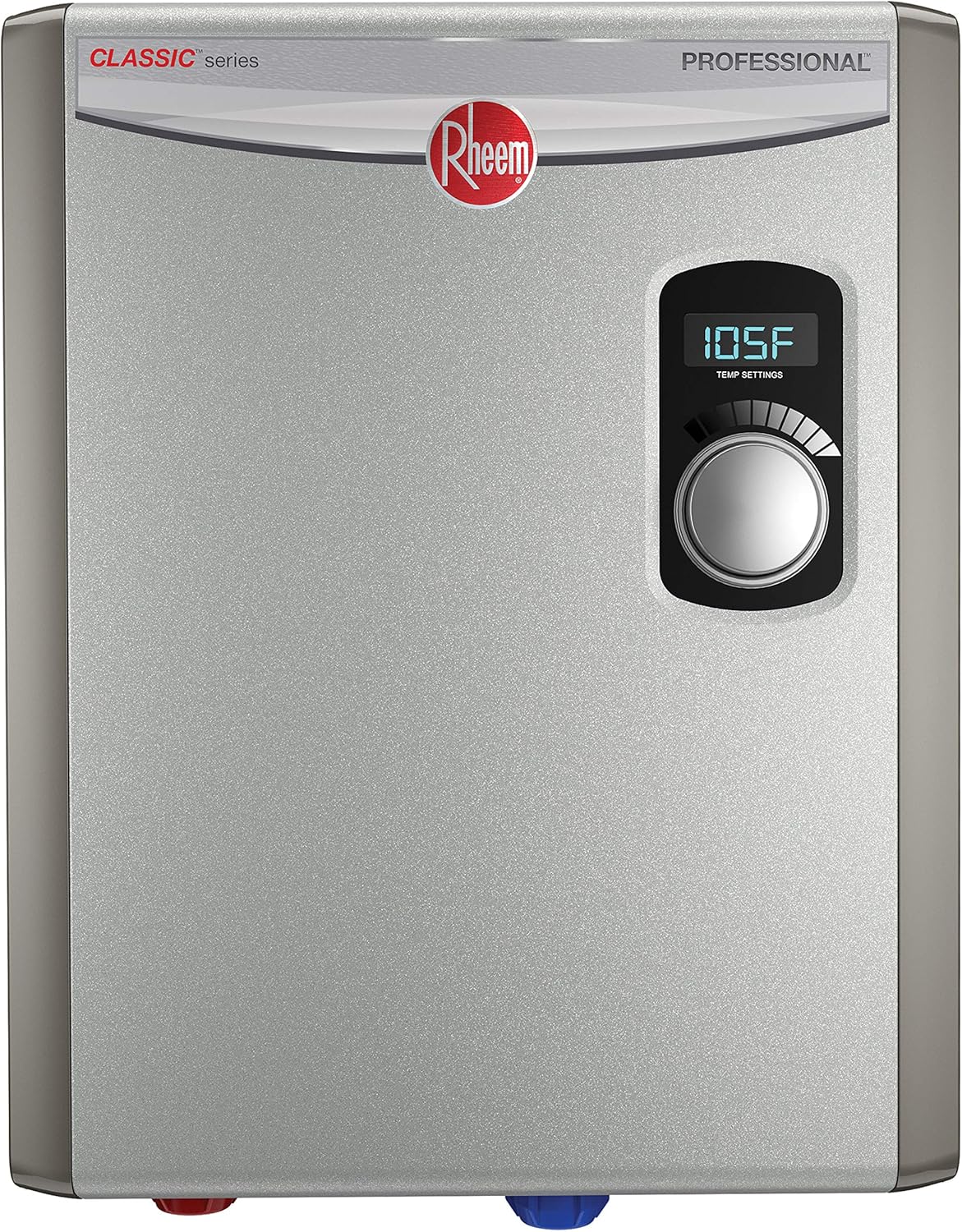
Rheem RTEX-18 Tankless Electric
| Wattage | 18000 watts |
|---|---|
| Voltage | 240 volts |
| Flow Rate | 4.4 gpm |
| Maximum Temperature | 140 °F |
| Efficiency | 99.8% |
The Rheem RTEX-18 is a wall-mounted tankless electric water heater that provides on-demand hot water for mid-range whole-home applications. It uses self-modulating electronics and two field-serviceable copper heating elements to adjust power to match flow, which helps maintain set temperature while reducing energy use compared with a tank heater. The front LED thermostatic control gives precise temperature adjustment to the degree and the unit requires no venting, simplifying placement. Practical benefits include a continuous supply of hot water for a shower and sinks, a compact footprint that saves space, and a claimed efficiency near 99.8 percent that should lower operating costs versus a storage tank. Important limitations are the 4.4 GPM maximum flow, which means performance depends on inlet water temperature and may not support multiple high-flow fixtures simultaneously in cold climates, and the need for substantial electrical service (240V, multi-breaker configuration) for proper installation.
Best for: Buyers who prioritize reliable, energy-efficient hot water and want a compact factory-quality replacement that lowers running costs and frees up space in a mainstream, low-risk way.
Less Ideal for: Homes that need high concurrent hot-water flow for multiple showers in cold climates or properties without adequate 240V electrical capacity should consider higher-capacity or different solutions.
- Self-modulating power adjusts energy use to demand for better efficiency
- Digital LED thermostatic control with +/-1 degree accuracy for precise temperature
- Compact wall-mounted design frees up space compared with tank heaters
- No venting required, allowing flexible indoor installation
- Maximum flow rate of 4.4 GPM may limit simultaneous high-demand fixtures
- Requires 240V electrical supply and significant breaker capacity for installation
Verdict: Choose the RTEX-18 if you want a compact, highly efficient tankless electric heater that delivers precise, on-demand hot water for typical whole-home needs while cutting energy use.
Choosing the Right High Efficiency Water Heater: Key Factors to Consider
Energy Efficiency Rating
Efficiency ratings indicate how much of the fuel or electricity is converted into usable hot water. Higher ratings typically mean lower monthly energy costs but may require a different technology such as condensing gas, hybrid heat pump, or enhanced insulation on storage tanks.
When comparing units, look for standardized metrics like the Uniform Energy Factor or Annual Fuel Utilization Efficiency. Consider how real-world usage patterns affect expected savings; a highly efficient unit saves more when a household draws large volumes of hot water regularly.
Capacity and Recovery Rate
Capacity determines how much hot water is available at any one time, while recovery rate measures how quickly a unit can replenish hot water after heavy use. Both matter for families with overlapping showers, dishwashers, and laundry loads.
Select a capacity and recovery combination that matches your peak demand. Undersizing a unit leads to cold-water interruptions, while oversizing can add unnecessary equipment and installation cost without commensurate benefits.
Installation Requirements
Some high efficiency technologies need special venting, condensate drains, or higher electrical service. Installation complexity affects total cost and feasibility in retrofit situations. Consider whether the unit fits the available space and existing utility connections.
Assess local code requirements and whether additional permits or trades (HVAC, plumbing, electrical) will be required. If major modifications are needed, the increased upfront expense may offset long-term energy savings.
Operating Costs and Maintenance
Long-term costs include fuel or electricity consumption, routine maintenance, and potential repairs. Heat pump or condensing units usually save energy but can require more involved maintenance than simple storage tanks.
Factor in service accessibility and the availability of replacement parts. Annual maintenance tasks such as anode replacement, condensate management, and filter changes can influence the true lifecycle cost.
Durability and Warranty
Durability affects how long a water heater will deliver reliable service before a major repair or replacement. Warranty length and coverage details are helpful indicators of expected lifespan and manufacturer confidence.
Pay attention to warranty exclusions, such as limits on corrosion protection, heat exchanger coverage, or labor. Longer and clearer warranty terms reduce risk and can be especially valuable if installation is costly.
Safety Features and Controls
Modern high efficiency units include safety devices and control systems to prevent scalding, overpressure, and combustion issues. Good controls also help optimize efficiency through adaptive cycles or programmable schedules.
Confirm the presence of pressure relief valves, temperature cutoffs, and accessible service panels. Simpler, reliable controls often result in fewer service calls over the life of the heater.
Sizing a High Efficiency Water Heater for Your Household
Correct sizing balances capacity with recovery to meet daily peak demands. Start by estimating peak hour demand using typical fixture flows and the number of simultaneous uses, then match that to the first-hour delivery and recovery specification of the unit.
For smaller households, a unit with a modest capacity and fast recovery may be the most efficient choice. For larger households or homes with high simultaneous demand, prioritize models with higher first-hour delivery or consider multiple point-of-use units to avoid distribution losses.
- Calculate peak hour demand from showers and appliances
- Check first-hour delivery rather than tank size alone
- Factor in future household changes like added bathrooms
Retrofits Versus New Construction
Retrofitting an existing home can limit your options because of space, venting, and fuel connection constraints. Identify what upgrades the home will tolerate and budget for venting, condensate discharge, or electrical service changes when necessary.
In new construction you have more flexibility to specify optimal venting, choose centralized or distributed systems, and install insulation or circulation loops to reduce distribution losses.
- Inspect available venting pathways and condensate routing
- Verify electrical service capacity before choosing heat pump types
- Plan for future maintenance access during installation
Common Installation Pitfalls to Avoid
Incorrect vent sizing, inadequate condensate disposal, and underspecified combustion air can all impair performance and safety. Work through the installation checklist for the chosen technology and ensure local codes are followed.
Placing units in unconditioned spaces without addressing cold-weather impacts can reduce efficiency and increase the risk of freeze damage for components and condensate lines.
- Avoid tight ducting and improper vent termination locations
- Ensure condensate drains are sloped and trapped correctly
- Allow service clearance around the unit for routine maintenance
How Controls and Scheduling Save Energy
Programmable schedules, vacation modes, and adaptive controls reduce wasted energy by matching operation to household patterns. For example, running a heat pump water heater during off-peak electricity hours lowers operating cost when time-of-use pricing applies.
Look for simple, reliable controls that integrate well with existing home automation or utility demand-response programs if those are relevant in your area.
- Use scheduling to avoid heating during low-demand periods
- Enable vacation or setback modes when away
- Consider controls compatibility with smart thermostats or home automation
Assessing Long-Term Performance and Serviceability
A unit that is easy to service will cost less over its life. Check access to common wear items like anodes, filters, or condensate traps and how straightforward routine tasks are for a service technician.
Reliability in real-world use depends on material choices and how components perform in your local water chemistry and climate. Consider the ease of finding replacement parts and qualified service personnel when making a choice.
- Confirm access points for routine maintenance
- Consider local water quality when evaluating corrosion protections
- Ask about typical service intervals for high-efficiency components
How We Chose the Best High Efficiency Water Heater
We focused on concrete, homeowner-relevant attributes that predict in-use performance and lifetime operating cost. Our selection emphasized thermal efficiency ratings and practical delivery metrics rather than marketing claims alone. We screened models by energy factor or Uniform Energy Factor where available, measured first-hour delivery and recovery rates for capacity planning, and checked compatibility with common household fuel and venting configurations. Installation complexity and retrofit costs were an explicit filter because a technically efficient unit can be a poor choice if it requires extensive piping, venting, or electrical upgrades. We also prioritized build quality indicators such as tank insulation thickness for storage models and component durability for heat-exchanger or burner assemblies. Safety and code compliance features were included as minimum requirements, and warranty terms were evaluated as a proxy for expected longevity. Excluded from the shortlist were models lacking verifiable efficiency data, products with known widespread installation compatibility issues, and units without adequate service documentation. In sum, our picks are based on efficiency, capacity delivery, installation practicality, durability, and safety.
Our full evaluation process is outlined in our review methodology.
FAQ
How much can I expect to save with a high efficiency water heater?
Savings vary widely depending on household hot water use, local energy costs, and the technology chosen. Typically, more efficient units reduce energy consumption, but payback depends on installation cost and usage patterns.
Are high efficiency water heaters harder to maintain?
Some high efficiency technologies require specific maintenance tasks, such as condensate management or periodic filter replacement. Maintenance is generally straightforward if service access is planned during installation.
Can I replace my existing unit with a more efficient model without major changes?
Sometimes you can, but many high efficiency models need different venting, condensate drains, or electrical capacity. Have a professional assess existing connections to determine retrofit feasibility.
Do high efficiency units require special venting or drains?
Yes. Condensing units and some high-efficiency gas units produce acidic condensate that must be routed correctly. Proper venting is also essential to maintain efficiency and safety.
How does cold climate affect high efficiency water heaters?
Cold climates can reduce efficiency and increase frost control or condensate freezing risks. Placing equipment in conditioned spaces or insulating external lines helps maintain performance and prevent damage.
Final Verdict
Prioritize energy efficiency metrics and realistic hot water delivery when selecting a high efficiency water heater. Balance projected operating savings against installation complexity and maintenance needs to identify the best fit for your home. Concentrate on proper sizing, straightforward service access, and compliance with local codes. That approach will help you choose a durable, efficient unit that meets daily demand while keeping long-term costs and disruptions to a minimum.