
Note: This article contains affiliate links. If you click on these links and make a purchase, we may earn a small commission at no extra cost to you. This helps support our research and content. Read our full affiliate disclosure here.
Living and traveling in an RV exposes the interior to frequent humidity swings, condensation, and the risk of mold in tight spaces. The right Portable Dehumidifier for RVs removes excess moisture quickly, protects fabrics and cabinetry, and keeps air feeling fresher on long trips or during storage. This guide covers a shortlist of top compact units suited to recreational vehicles, with attention to removal capacity, footprint, power use, and noise. Below you will find the best portable dehumidifiers selected for RV use and the evaluation criteria that mattered. Use the quick summaries to match a unit to your rig and routine.
Top Picks at a Glance
| Best Overall The best all-around choice for most situations | EasyAcc Q22 Dehumidifier |  |
| Best Quality Built to a higher standard if you want something more solid | GoGuess YC3 34-Pint Dehumidifier |  |
| Best Value The sweet spot between price and what you get | Levoair Mini Dehumidifier |  |
| Best Budget The cheapest option that still gets the job done reliably | TABYIK 35OZ Dehumidifier DH-CS01 |  |
| Top Rated A top-rated pick with lots of positive feedback | KeepGlad RX02-B Dehumidifier |  |
| Most Popular A crowd favorite that many people choose with confidence | Pro Breeze PB-02 Mini Dehumidifier |  |
| Best Seller A high-volume bestseller chosen again and again | BEDRED CT11 Dehumidifier |  |
EasyAcc Q22 Dehumidifier

| Tank Volume | 68 fluid ounces |
|---|---|
| Dehumidification Capacity | 1.33 liters_per_day |
| Number of Speeds | 2 |
| Other Special Features of the Product | Automatic Shutoff, Quiet Mode(<35 db), Auto Defrost |
| Floor Area | 1100 square_feet |
The EasyAcc Q22 is a compact portable dehumidifier made for small rooms and RVs where excess moisture causes odors or mildew. It uses a semiconductor refrigeration system and a triple-sided intake to boost airflow, allowing the unit to remove up to about 40 ounces (1.3 liters) per day while channeling collected water into a 68 ounce tank with auto shutoff to prevent overflows. Controls are simple with two speeds, a quiet sleep mode under 35 dB and a seven-color LED night light that can be turned off for overnight use. The unit also includes auto defrost so it continues operating in cooler temperatures and a larger tank that reduces how often you need to empty it during travel or short-term use. Trade-offs are that this is intended for small spaces up to roughly 350 sq ft and will release slightly warm air during operation, so it is not a replacement for whole-home dehumidification but rather a convenient spot solution for bathrooms, closets, or RV cabins.
Best for: RVers or travelers who need a portable, low-noise unit to control humidity and smells in small enclosed areas and prefer a larger tank to reduce maintenance frequency.
Less Ideal for: People needing high-capacity or whole-house dehumidification, or buyers who need the highest energy efficiency for very humid climates.
- Large 68 oz water tank reduces emptying frequency during travel or extended use
- Removes up to about 40 oz (1.3 L) per day, stronger than typical mini dehumidifiers
- Quiet sleep mode under 35 dB suitable for overnight use
- Auto shutoff and auto defrost improve safety and reliability in varying temperatures
- Designed for small spaces only and not suitable as a whole-home dehumidifier
- Semiconductor-style units typically have lower efficiency than compressor models in very humid conditions
Verdict: A quiet, travel-friendly dehumidifier with a large tank and auto features that makes controlling moisture in RVs and small rooms easy and low-maintenance.
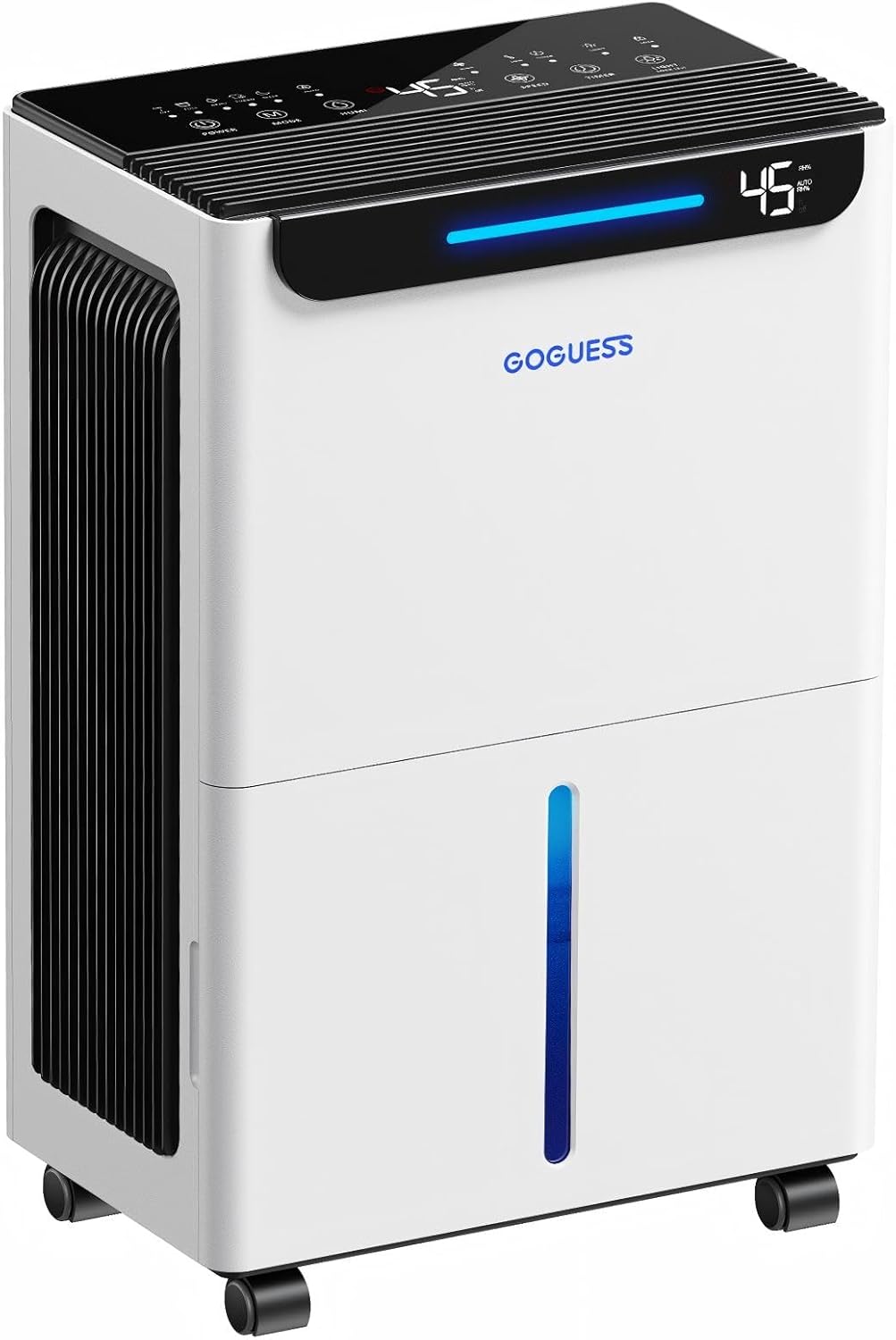
GoGuess YC3 34-Pint Dehumidifier
| Capacity | 34 pints_per_day |
|---|---|
| Floor Area | 2500 square_feet |
| Tank Volume | 2.3 liters |
| Number of Speeds | 3 |
| Wattage | 75 watts |
The GoGuess YC3 is a compressor-style portable dehumidifier designed to pull substantial moisture from enclosed spaces, rated at 34 pints per day (tested at high temperature and humidity). It is typically used in basements, garages, laundry areas and RVs where persistent dampness and condensation are a problem. The unit offers three fan speeds and multiple modes including DEHU (set a target humidity between 30% and 80%), Turbo for faster drying, and Sleep for quieter overnight operation. Practical conveniences include a 2.3 L tank with full-tank auto shutoff, a 3.28 ft drain hose for continuous unattended draining, a washable filter, child lock, timer and an LED humidity readout that uses color to indicate conditions. At about 40 dB in operation it is relatively quiet for a compressor unit, and built-in protections such as auto-defrost and auto-restart improve reliability in variable conditions. Expect a compressor dehumidifier to be heavier and less energy-efficient than tiny Peltier units, and performance will drop in cool temperatures common in some RVs or unheated spaces, so plan placement and power accordingly.
Best for: Buyers who prioritize strong moisture removal for damp RVs or storage areas and need a robust compressor unit that can run continuously with a drain hose.
Less Ideal for: Those who need an ultra-lightweight, low-power dehumidifier for very small camper spaces or for use in consistently cold environments should consider alternative technologies.
- High rated dehumidification capacity (34 pints/day) suitable for very damp spaces
- Adjustable humidity control with DEHU, Turbo and Sleep modes for flexible use
- Continuous drainage option with included hose for long unattended runs
- Relatively quiet operation (~40 dB) and LED humidity display for easy monitoring
- Safety features including auto-defrost, auto-restart and full-tank auto shutoff
- Compressor units lose efficiency and dehumidification rate at low ambient temperatures
- Tank capacity (2.3 L) requires frequent emptying if not using continuous drain
- Likely heavier and bulkier than thermoelectric models, which can matter in small RVs
Verdict: If you need a performance-oriented portable dehumidifier for an RV or damp small space, the GoGuess YC3 delivers strong daily extraction with continuous-drain convenience.
Levoair Mini Dehumidifier

| Capacity | 2 liters |
|---|---|
| Dehumidification Capacity | 1 liters_per_day |
| Wattage | 48 watts |
| Floor Area | 650 square_feet |
The Levoair Mini Dehumidifier is a lightweight, Peltier-based unit intended to remove excess moisture from small spaces such as RVs, bathrooms, closets, and bedrooms. It uses semiconductor refrigeration (no compressor) to quietly extract moisture and stores it in a 2‑liter (68 oz) tank, or you can attach the included 5 ft drain hose for continuous unattended draining. The unit is simple to operate with one-button control, a lift handle for carrying, and an auto shutoff and full-tank indicator to prevent overflow. In humid, warm conditions it can remove up to about 1000 ml per day (measured at 86°F and 80% RH), and its low power draw makes it suitable for extended use in motorhomes and small living spaces. Limitations: performance drops at lower temperatures and lower humidity levels, and Peltier dehumidifiers are slower than compressor models for large damp areas. For confined, frequently used RVs or small rooms where noise and portability matter, this unit is a practical choice; for very cold or very large spaces a compressor model will be more effective.
Best for: Buyers who need a quiet, lightweight dehumidifier for an RV or other small living spaces and value easy portability and hands-off continuous draining.
Less Ideal for: People needing rapid moisture removal in cold garages, large basements, or very damp environments should choose a compressor dehumidifier instead.
- Quiet Peltier operation under 40 dB suitable for sleeping and living areas
- Two draining options: 2 L removable tank or 5 ft continuous drain hose for unattended use
- Lightweight with lift handle and one-button control for easy portability and simple operation
- Auto shutoff and full-tank indicator protect against overflow and preserve the unit
- Reduced dehumidification effectiveness at temperatures below about 59°F
- Peltier technology provides lower daily extraction compared with compressor dehumidifiers in large or very humid spaces
Verdict: A compact, quiet, and portable dehumidifier with a 2 L tank and continuous drain that fits RVs and small spaces where low noise and easy, unattended operation are the priority.
TABYIK 35OZ Dehumidifier DH-CS01

| Water tank capacity | 1000 ml |
|---|---|
| Max dehumidification | 0.45 liters per day |
| Power | 40 watts |
| Noise level | 28 dB |
The TABYIK 35OZ DH-CS01 is a small, portable Peltier dehumidifier intended for tight spaces such as RVs, bathrooms, closets, and bedrooms. It runs continuously on a single-button control, collects up to roughly 16 ounces (450 ml) in 24 hours under warm, humid conditions, and stores moisture in a 35 oz (1000 ml) transparent tank with an auto shut-off that stops the unit when the tank nears full. The unit emphasizes quiet operation at about 28 dB and includes a seven-color light you can switch off for night use. At 40 watts it uses little electricity and is easy to move thanks to a built-in handle and compact footprint. Because it is a Peltier (thermoelectric) unit, performance declines at lower temperatures and it is best suited for small, enclosed areas rather than whole RV interiors; its single fan speed limits how aggressively it dries. Maintenance is straightforward: empty the tank and clean the rear intake filter periodically. For someone who needs a low-cost, low-noise way to control humidity in a small RV compartment, this is a practical choice, but do not expect rapid dehumidification in cold or very large spaces.
Best for: Buyers on a tight budget who need a quiet, energy-efficient dehumidifier for small, enclosed RV spaces or single-room use and prioritize portability over high capacity.
Less Ideal for: People looking to dry large RV interiors, cold-season moisture control, or rapid dehumidification should choose a compressor-based or higher-capacity unit instead.
- Compact and lightweight for easy placement and transport in an RV
- Low power draw (40 watts) suitable for limited electrical budgets
- Very quiet operation (~28 dB) so it will not disturb sleep or driving rest stops
- Transparent 1000 ml tank with auto shut-off adds convenience and safety
- Peltier-style dehumidification yields modest water removal and performs poorly at low temperatures
- Single speed fan limits dehumidifying power and control
Verdict: A budget-friendly, very quiet portable dehumidifier that fits small RV spaces and runs on minimal power when you need simple humidity control.
KeepGlad RX02-B Dehumidifier

| Capacity | 98 fluid ounces |
|---|---|
| Floor Area | 1000 square_feet |
| Wattage | 90 watts |
| Number of Speeds | 3 |
The KeepGlad RX02-B is a small, portable dehumidifier designed to remove moisture from rooms up to about 1,000 square feet and can be used with its tank or a drain hose for continuous operation. It uses a dual semiconductor design and 90 W of power to run three fan speeds and a digital humidity display, plus a timer for 4/8/12-hour runs. Practical features for everyday use include an ergonomic handle, removable tank, washable air filter, automatic shutoff when the tank is full and a continuous drain option that is handy for unattended use in places like an RV or laundry area. The unit is quiet in low and sleep modes and offers a 7-color ambient light that can be turned off for nighttime. Limitations are modest dehumidification capacity compared with compressor models and a listed dehumidification rate that is relatively low for very damp spaces, so it is best for maintenance or moderate humidity rather than heavy water removal.
Best for: Buyers who prioritize a dependable, easy-to-maintain portable dehumidifier for controlled spaces like an RV or small rooms and want simple digital controls and continuous drain capability.
Less Ideal for: Users needing fast, high-volume moisture removal in very damp basements or large rooms should consider a compressor dehumidifier instead.
- Continuous drain option with included hose for hands-free, unattended operation
- Washable air filter and removable tank simplify maintenance
- Digital humidity display and timer let you schedule and monitor runtime
- Quiet sleep/low mode suitable for overnight use
- Declared moisture removal rate is low compared with compressor-based dehumidifiers
- Not intended for heavy-duty or very large damp spaces
Verdict: A compact, low-power portable dehumidifier with continuous drain and washable filter that suits RVs and small spaces where reliable, low-maintenance moisture control is the priority.
Pro Breeze PB-02 Mini Dehumidifier

| Floor Area | 215 square_feet |
|---|---|
| Capacity | 16 fluid ounces |
| Tank Volume | 17 fluid ounces |
| Wattage | 21 watts |
| Dehumidification Capacity | 0.25 liters_per_day |
The Pro Breeze PB-02 is a small, portable dehumidifier that uses thermoelectric (Peltier) cooling to pull moisture from the air in compact spaces such as an RV, bathroom, closet, or small bedroom. It collects up to roughly 9 ounces (0.25 liters) per day into a 16–17 ounce tank and will auto shut off and light an LED when the tank is full. With very low power draw (around 21–23 W) and whisper-quiet operation, it is practical for continuous overnight use without drawing much battery or disturbing sleep. The unit is best deployed in a single small zone under recommended operating temperatures (above about 41–59°F), and its modest daily extraction rate means it is intended for light humidity control or condensation prevention rather than drying very damp spaces. The compact footprint and included power adaptor make it easy to move and position inside an RV, but users with persistent high humidity or larger areas will need a higher-capacity model to see faster results.
Best for: Buyers who prioritize compact, low-noise dehumidification for an RV or other small living space and want a unit that runs continuously without high power draw.
Less Ideal for: Not a good choice for drying water-damaged areas, large rooms, or situations where fast moisture removal is required; those needs call for a higher-capacity dehumidifier.
- Very low power consumption suitable for limited-power environments
- Ultra-quiet Peltier operation good for overnight use
- Auto shut-off with LED indicator prevents overflow
- Small, lightweight and easy to move and place in tight RV spaces
- Low daily extraction rate not suitable for very damp or large areas
- Performance limited at low temperatures below about 41°F
Verdict: A tiny, whisper-quiet unit that provides low-power, light-duty humidity control ideal for RVs and other small spaces.
BEDRED CT11 Dehumidifier

| Floor Area | 1000 square_feet |
|---|---|
| Tank Volume | 95 fluid ounces |
| Capacity | 5.9 pounds |
| Operation Mode | Intermittent |
| Other Special Features of the Product | 7 Color Ambient Light, Automatic Shutoff, Sleep Mode |
The BEDRED CT11 is a compact thermoelectric dehumidifier intended to reduce humidity in small spaces such as bedrooms, bathrooms, and modest basements up to about 1000 sq ft. It uses semiconductor cooling rather than a compressor, so it runs quietly and is simple to operate with an intermittent operation mode and an automatic shutoff when the 95 oz tank fills. Sleep Mode turns off the lights and lowers noise for overnight use, and the seven-color ambient light gives an optional mood-lighting feature. Practical benefits include easy emptying from the included tank, portability thanks to a lightweight design, and low sound levels that suit living spaces. Important limitations are inherent to semiconductor units: lower capacity compared with compressor dehumidifiers, reduced performance in very cold or very damp basements, and a smaller tank that requires more frequent emptying in high-humidity conditions.
Best for: Buyers who prioritize quiet, low-maintenance dehumidification and want a compact unit that is easy to move and run in living spaces or small basements without frequent intervention.
Less Ideal for: People needing heavy-duty moisture control for large, cold, or very damp basements should choose a higher-capacity compressor dehumidifier instead.
- Quiet thermoelectric operation suitable for bedrooms and living rooms
- Automatic shutoff protects against overfill and simplifies unattended use
- 95 oz removable tank for straightforward water removal
- Sleep Mode and ambient light options for low‑noise nighttime use
- Compact and lightweight for easy placement or moving between rooms
- Semiconductor cooling gives lower moisture removal capacity than compressor models
- Performance drops in cold basement conditions and very high humidity areas
Verdict: Choose the BEDRED CT11 if you want a quiet, portable dehumidifier with auto‑shutoff and sleep‑friendly operation for small basements or living spaces.
Choosing the Right Portable Dehumidifier for RVs: Key Factors to Consider
Moisture Removal Capacity
How many pints or liters a unit can extract in 24 hours directly affects how quickly it will reduce humidity inside an RV. Higher capacity shortens run times during damp conditions, but over-specifying for a very small space wastes energy. Consider typical conditions you face: condensation after cooking or showering, humid climates, or wet storage. Match capacity to the interior volume and expected moisture load rather than only to the manufacturer's room-size claims.
Also consider that dehumidifier performance often varies with ambient temperature. Many compact models use thermoelectric or refrigerant-based systems that slow down in cooler temperatures, so choose a capacity that still performs in the seasons you use the RV.
Power Use and Electrical Compatibility
RV electrical systems differ from household circuits. A dehumidifier's power draw determines whether it can run on shore power, generator, or inverter without draining batteries. Check rated wattage and whether the unit requires a dedicated circuit or can be used with common RV outlets. Lower power consumption helps when you are boondocking or relying on limited generator run time.
Also evaluate startup current and whether the unit cycles frequently. Units with efficient compressors or Peltier elements use less energy but may remove moisture more slowly. Balance energy use with required moisture removal and how you power the RV while camping.
Noise and Vibration
Noise matters in a small, shared living space. A loud fan or compressor can disturb sleep and make living aboard uncomfortable. Look for decibel ratings measured at a typical distance, and prefer models designed with vibration isolation or soft-mount feet to reduce rattles against RV walls and cabinets.
Also think about placement options that minimize perceived noise, such as placing the unit in a vented cabinet or under a seat. Quieter units may cost more or remove moisture more slowly, so weigh noise against capacity for your priorities.
Size, Weight and Placement Flexibility
Available real estate in an RV is limited, so the dehumidifier's footprint and weight influence where it can go. Slim or stackable designs can tuck into closets or under counters. Lightweight units are easier to move between compartments or levels of your rig.
Consider how the unit will be secured while driving if it needs to be stored. A model with handles, simple anchoring points, or a small footprint that fits a fixed shelf reduces the chance of movement when traveling.
Drainage Options and Maintenance
Emptying a tank repeatedly is inconvenient on the road. Models with continuous drain fittings let you route water to a larger holding container or an appropriate drain point. Auto-pump features help when the drain point is higher than the unit. If relying on a collection bucket, check capacity and how easy it is to empty without spilling.
Maintenance considerations include filter access and whether the unit has washable filters or requires replacement parts. Simpler maintenance is better for owners who travel often and may not have time for frequent service.
Durability and Build Quality
RVs expose appliances to road vibration, temperature swings, and variable storage conditions. Durable construction, corrosion-resistant materials, and solid HVAC seals extend the life of a dehumidifier in this environment. Components that are easy to access for repair or replacement also add long-term value.
Look for units with protective features like frost or thermal protection if you will use them in cool storage conditions. Rugged design choices help the appliance survive motion and repeated packing.
Where to Place a Dehumidifier in an RV
Placement affects effectiveness. Central locations with good airflow remove moisture more evenly, but access for emptying and power matters too. Avoid placing the unit in a completely closed cabinet unless you provide ventilation.
Bathrooms and areas near cooking surfaces are common hotspots, so a small unit placed nearby can stop condensation before it contacts woodwork. If you have only one unit, position it where mold risk and dampness are highest, and use fans to circulate air to adjacent spaces.
- Place on a level, stable surface to avoid spills and vibration noise.
- Keep intake and exhaust clear by leaving a few inches of space.
- Use a drip line or pump if the unit will be placed below a drain point.
Running a Dehumidifier While Boondocking
When dry camping, power is limited and you must balance moisture control against battery life. Choose a unit with low steady-state power draw and consider running it only during the most humid hours or overnight. Timers and built-in humidity setpoints help conserve energy by cycling the unit intelligently.
If you operate from an inverter, confirm startup current and continuous draw to avoid tripping protective devices. Pairing the dehumidifier with energy-efficient ventilation, such as intermittent vent fans, reduces total power needs.
- Use a timer or humidity controller to limit runtime.
- Monitor battery voltage when running other loads simultaneously.
- Consider short bursts of operation after showers or heavy cooking.
Storage Season Tips
During long-term storage, condensation and mold can form quickly in enclosed, unheated RVs. A small dehumidifier with a continuous drain or a desiccant solution can maintain safe humidity levels without frequent intervention.
Place the unit near known problem areas and route drain lines to a safe collection container. If power is unavailable, consider passive moisture absorbers as a temporary supplement, but recognize they do not actively remove moisture like powered units.
- Empty or disconnect tanks before travel to avoid spills.
- Use humidity monitors to check conditions remotely if possible.
- Combine dehumidification with ventilation on dry days to purge stale air.
Installation and Venting Considerations
Most portable dehumidifiers for RVs require no permanent installation, but you should still plan for secure placement and safe drainage. Avoid routing drain lines where they could freeze or cause leaks inside the coach.
If using an auto-pump or wall-mount option, ensure fasteners and mounting points are rated for mobile use. Seal any through-wall penetrations professionally and keep electrical connections protected from moisture.
- Secure hoses and cords to prevent tripping or snagging while driving.
- Check for manufacturer guidelines about vent clearance and airflow.
- Inspect seals and fittings periodically for wear from vibration.
When to Use a Desiccant Instead
Desiccant packs or small silica-based units can be useful when power is unavailable or when you need short-term moisture control without a powered appliance. They are lightweight and silent but have limited capacity and require replacement or regeneration.
Use desiccants as a supplement during storage or inside small locked compartments rather than as the primary method for active, continuous dehumidification in a lived-in RV.
- Best for small compartments, closets, and drawers.
- Not ideal for high-moisture events like post-shower condensation.
- Check replacement or regeneration intervals before relying on them.
How We Chose the Best Portable Dehumidifier for RVs
We focused on factors that matter specifically for dehumidifiers used inside recreational vehicles, where space, power availability, and vibration-prone mounts change the purchase calculus. Primary filters included compact footprint and mounting or placement flexibility to fit limited cabinet and sleeping areas. We required reliable moisture-removal performance rated for small to medium enclosed volumes typical of RV interiors. Energy efficiency and reasonable draw on 12V-to-120V setups or inverter-fed outlets were prioritized to avoid overtaxing the coach electrical system. Quiet operation thresholds were applied so the unit can run overnight without disturbing sleep. Durability and simple maintenance were also essential: accessible water collection or auto-drain options and washable filters reduce upkeep while on the road. Excluded were large household basement units and models intended only for whole-house HVAC integration, since those do not suit RV space or power constraints. We also excluded units lacking clear capacity specs for enclosed small spaces or with documented excessive noise. The evaluation emphasized measurable specs and user-facing practicalities rather than brand perception alone.
Our full evaluation process is outlined in our review methodology.
FAQ
How big a dehumidifier do I need for my RV?
Match capacity to the interior volume and typical moisture load. Smaller rigs and occasional dampness may be fine with a compact unit rated for small rooms, while larger coaches or persistent condensation need higher daily removal ratings. Consider climate and storage conditions too.
Can I run a portable dehumidifier from my RV batteries?
You can run some low-wattage models from batteries via an inverter, but check startup and continuous current draw first. Running a dehumidifier for many hours will drain batteries quickly unless you have substantial battery capacity or a generator.
Is continuous drain necessary for RV use?
Continuous drain is convenient for long runs or during storage because it removes the need to empty a bucket. It is especially helpful if you place the unit where accessing the tank is awkward. If you do not have a suitable drain, choose a unit with a large tank or easy-empty design.
Will a dehumidifier prevent mold completely?
A dehumidifier reduces the risk by keeping relative humidity at safer levels, often below thresholds where mold thrives. It does not remove existing mold or address all causes, such as leaks. Combine dehumidification with ventilation, prompt drying of wet items, and addressing water intrusion for best results.
How noisy are these units inside an RV?
Noise varies by design and capacity. Small Peltier-based units tend to be quieter but remove less moisture, while compressor models can be louder during operation. Look at decibel ratings and choose quieter models for sleeping areas or place units in adjacent spaces if possible.
Final Verdict
Choosing the right Portable Dehumidifier for RVs comes down to balancing moisture-removal capacity, energy draw, and where you will place the unit in your coach. Prioritize a model sized for your interior volume and the humidity you face, while keeping power compatibility and noise in mind. For storage or occasional use, continuous-drain features or desiccants can reduce hands-on maintenance. Ultimately, focus on practical tradeoffs: select a unit that you can power reliably during your typical trips, that fits the available space, and that you will actually run when humidity climbs. That approach gives the best protection for surfaces, fabrics, and the overall comfort of life on the road.