
Note: This article contains affiliate links. If you click on these links and make a purchase, we may earn a small commission at no extra cost to you. This helps support our research and content. Read our full affiliate disclosure here.
If you live with seasonal or year-round allergy symptoms, indoor humidity can make spores and dust mites more active and your home less comfortable. Choosing the right dehumidifier for allergies helps you control moisture, reduce mold risk, and create an environment that eases breathing and allergy triggers. This guide shortlists the top options in the category and explains the practical features that matter for allergy control and everyday use. Below you will find concise evaluations of each shortlisted dehumidifier plus the criteria used to compare them, factors to consider when buying, and answers to common user questions. The picks focus on reliable moisture removal, quiet operation, and user-friendly maintenance.
Top Picks at a Glance
| Best Overall The best all-around choice for most situations | Midea 22 Pint Dehumidifier |  |
| Best Quality Built to a higher standard if you want something more solid | Hisense 50 Pint Dehumidifier |  |
| Best Value The sweet spot between price and what you get | NineSky CT2 Dehumidifier |  |
| Best Budget The cheapest option that still gets the job done reliably | TABYIK 35OZ Dehumidifier DH-CS01 |  |
| Top Rated A top-rated pick with lots of positive feedback | hOmeLabs 32-Pint Dehumidifier |  |
| Most Popular A crowd favorite that many people choose with confidence | Eva-Dry E-333 Mini Dehumidifier |  |
| Best Seller A high-volume bestseller chosen again and again | ToLife Dehumidifier TZ-C2 |  |
Midea 22 Pint Dehumidifier

| Coverage | 1500 square_feet |
|---|---|
| Dehumidification Capacity | 22 pints_per_day |
| Tank Volume | 0.8 gallons |
| Noise Level | 47 dBA |
| Energy | ENERGY STAR Certified |
The Midea 22 Pint Dehumidifier removes up to 22 pints of moisture per day and is sized for basements, bedrooms, and other residential spaces up to about 1,500 square feet. It offers adjustable humidity from 35% to 85%, a reusable washable filter, and both a 0.8 gallon tank or a continuous drain hose option for unattended use. Smart features include Wi-Fi control via the SmartHome app and voice commands through Alexa or Google Assistant, which make remote scheduling and monitoring straightforward. Practical touches like a programmable timer, turbo mode for faster moisture removal, auto defrost, auto restart after power loss, and four rotating wheels improve usability and reliability. At 47 dBA it runs quietly enough for living spaces and its ENERGY STAR certification helps reduce running costs. Limitations are its midrange capacity—larger very damp basements may need a higher‑capacity unit—and the continuous drain requires a hose and nearby drain to avoid manual emptying.
Best for: Buyers seeking a balanced, energy-efficient dehumidifier with smart controls and quiet operation for typical home rooms and basements who value convenience and moderate capacity.
Less Ideal for: People needing maximum moisture removal for large, extremely damp basements or commercial spaces should choose a higher-capacity unit designed for heavy-duty use.
- Removes up to 22 pints per day suitable for rooms up to 1,500 sq ft
- Wi‑Fi and voice control for remote monitoring and scheduling
- Washable reusable air filter reduces replacement costs
- Energy Star certified for lower energy use than standard models
- Quiet 47 dBA operation with caster wheels and handle for easy placement
- 22‑pint capacity may be insufficient for very damp or large basements
- Continuous drain requires a separate hose and access to a drain
Verdict: A smart, energy-efficient 22‑pint dehumidifier that balances quiet operation, remote control, and portability for typical home allergy-prone rooms.
Hisense 50 Pint Dehumidifier

| Capacity | 50 pints |
|---|---|
| Coverage | 4500 square_feet |
| Dehumidification Capacity | 50 pints_per_day |
| Number of Speeds | 3 |
| Operation Mode | Auto, Continuous, Manual |
The Hisense 50 Pint Dehumidifier is built to remove large amounts of moisture from big, problem rooms such as basements, garages, and whole-floor spaces. It offers Auto, Continuous, and Manual modes plus three fan speeds so you can prioritize fast dehumidification or quieter operation; Auto mode adjusts runtime based on sensed humidity while Continuous keeps it running non-stop for persistent dampness. The unit is rated for up to 4,500 sq. ft. and handles low-temperature environments down to 38°F, which helps control moisture where allergies often originate. A bucket full indicator prevents overflows and the ENERGY STAR rating helps keep long-term energy use lower than non-efficient models. Practical limitations include a relatively heavy chassis for a portable machine and the need to manually empty the tank unless you set up a continuous drain, and it does not list built-in air filtration for particulate or allergen removal. For allergy-focused buyers the key benefit is strong moisture control across large, cool spaces, which reduces mold and dust-mite growth when paired with separate air filtration.
Best for: Buyers who prioritize strong, reliable moisture removal in large or cool spaces and want an energy-efficient unit that can run continuously when needed.
Less Ideal for: People who need an integrated allergen or particulate filtration solution or those who plan to move the dehumidifier between many rooms frequently.
- High 50‑pint daily dehumidification capacity suitable for large rooms or whole floors
- Three operation modes and three fan speeds for flexible control of humidity versus noise
- Low-temperature operation down to 38°F keeps it effective in cool basements and crawl spaces
- ENERGY STAR certification for more efficient long-term energy use
- Bucket full indicator prevents accidental overflows
- No built-in air or HEPA filtration for capturing allergens or particulates
- Relatively heavy unit which can make frequent relocations less convenient
- Tank requires manual emptying unless you install a continuous drain setup
Verdict: Choose this Hisense unit when you need powerful, energy-efficient moisture removal across large or cool spaces to reduce conditions that drive allergies.
NineSky CT2 Dehumidifier
| Floor Area | 1000 square_feet |
|---|---|
| Tank Volume | 95 fluid ounces |
| Capacity | 5.9 pounds |
| Other Special Features | Automatic Shutoff |
| Operation Mode | Automatic |
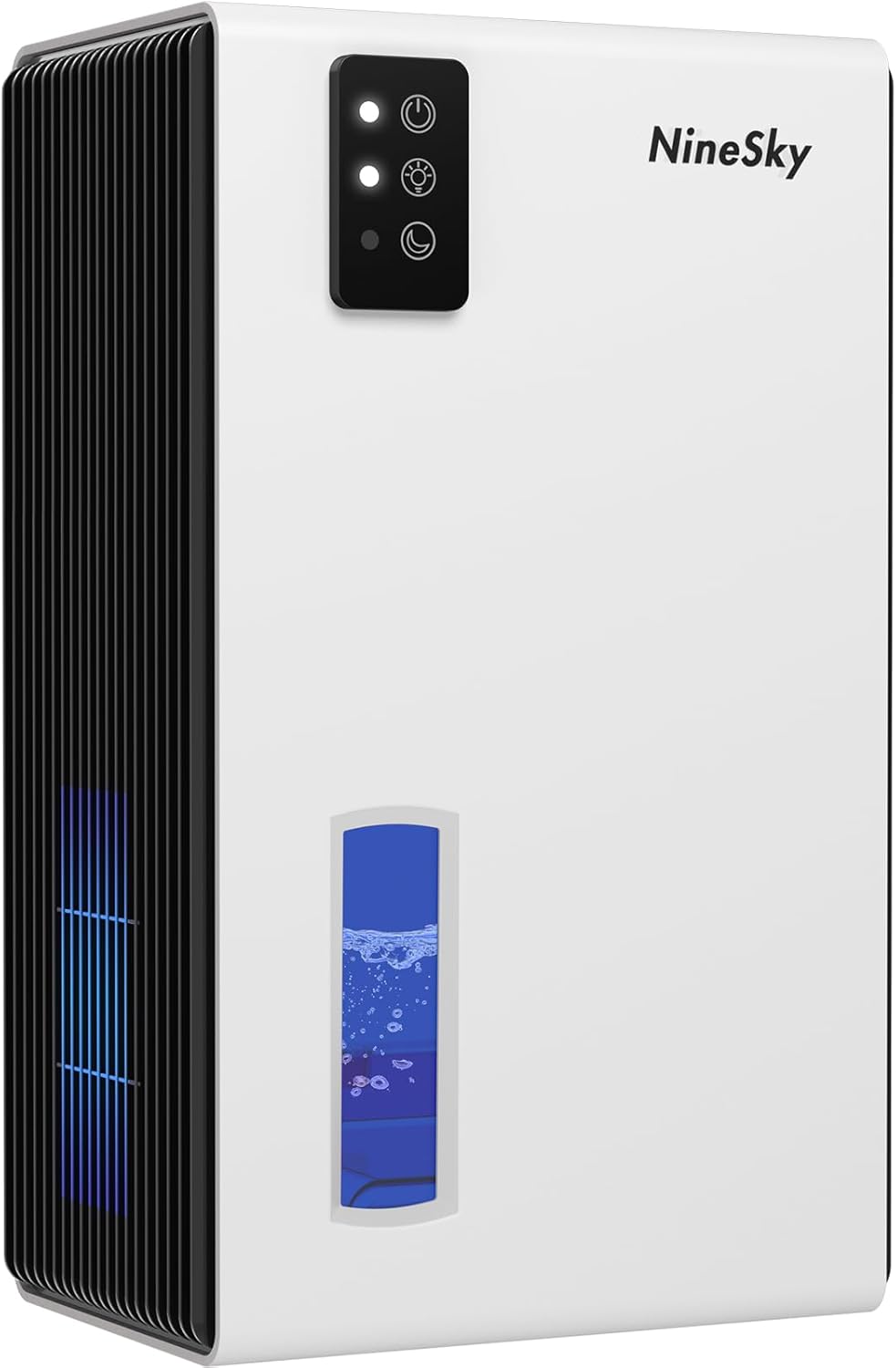
The NineSky CT2 is a small, quiet dehumidifier that uses an upgraded semiconductor system to remove moisture from rooms up to about 1,000 sq ft while producing low operating noise. It is typically used in bedrooms, bathrooms, closets, basements, and RVs where space is limited; the unit offers a high-speed mode for faster moisture extraction and a night mode that dims the LEDs for undisturbed sleep. The 95 oz removable tank and smart auto shutoff stop operation when the tank is full or not seated correctly, reducing spill risk when you are away. A 7-color ambient LED provides a gentle night light and selectable color-change mode, which is pleasant but not necessary for moisture control. Because this model relies on semiconductor dehumidification rather than a compressor, it performs best in moderately humid environments and at warmer indoor temperatures, and it will remove moisture more slowly than larger compressor units in very damp spaces. For allergy-focused buyers it helps reduce indoor humidity that can worsen mold and dust mite growth, but very large or extremely damp rooms may need a heavier-duty compressor dehumidifier.
Best for: Buyers who want a compact, low-noise unit to control humidity in bedrooms, bathrooms, or small basements while minimizing fuss and maintenance.
Less Ideal for: People needing rapid dehumidification for large, very damp areas or basements with persistent moisture problems should choose a larger compressor-style model.
- Compact footprint fits small rooms, closets, and RVs
- 95 oz removable water tank with automatic shutoff prevents spills
- Low-noise semiconductor operation with night mode for bedroom use
- High-speed mode for faster moisture removal when needed
- 7-color ambient LED doubles as a gentle night light
- Semiconductor dehumidification removes moisture more slowly than compressor units in very damp conditions
- Not ideal for very large or extremely humid spaces despite the 1,000 sq ft claim
Verdict: A compact, quiet dehumidifier that reduces bedroom and small-room humidity with a large removable tank and automatic shutoff, making it a practical pick for daily allergy prevention in small spaces.
TABYIK 35OZ Dehumidifier DH-CS01

| Tank Volume | 1000 ml |
|---|---|
| Wattage | 40 watts |
| Dehumidification Capacity | 0.45 liters_per_day |
| Applicable Area | 280 square_feet |
| Number of Speeds | 1 |
The TABYIK 35OZ dehumidifier is a small Peltier-style unit meant for bedrooms, bathrooms, RVs and closets where excess humidity can worsen allergies. It runs continuously at low power (about 40 watts) and collects up to roughly 16 oz (450 ml) in 24 hours under warm, very humid conditions, routing moisture into a transparent 1000 ml tank that is easy to remove and clean. The unit is very quiet at about 28 dB and includes a multi-color night light with a separate control, plus an auto shut-off that stops operation when the tank nears capacity. Setup is one-button simple and maintenance involves occasional cleaning of the rear air intake filter. Expect modest dehumidification performance suited to small, enclosed spaces rather than whole rooms or basements, and know that Peltier devices are slower than compressor models in cooler or less humid environments. For allergy relief this model can reduce dampness that encourages dust mites and mold in small areas, but it will not replace a larger-capacity dehumidifier for whole-room moisture control.
Best for: Buyers looking for an inexpensive, low-noise dehumidifier to reduce dampness in small enclosed spaces and help limit mold and dust-mite triggers near sleeping or storage areas.
Less Ideal for: People who need fast, whole-room humidity control or who have consistently cold rooms should choose a higher-capacity compressor dehumidifier instead.
- Low energy draw around 40 watts for continuous operation
- Very quiet operation (~28 dB) suitable for bedrooms
- Transparent 35 oz (1000 ml) tank with easy removal and auto shut-off
- Simple one-button operation and removable filter for basic maintenance
- Limited dehumidification rate (about 0.45 L/day) not suitable for large or very damp rooms
- Peltier technology is less effective in cool or low-humidity environments
Verdict: A budget-friendly, ultra-quiet small-space dehumidifier that lowers local humidity to help with allergy triggers in bedrooms and closets.
hOmeLabs 32-Pint Dehumidifier

| Dehumidification Capacity | 35 pints_per_day |
|---|---|
| Capacity | 1.8 gallons |
| Tank Volume | 1.6 gallons |
| Number of Speeds | 2 |
| Floor Area | 4500 square_feet |
This hOmeLabs unit is a straightforward, room‑scale dehumidifier built for large spaces like basements and open living areas. It removes up to 32 pints per day under typical conditions (and higher at very warm, humid extremes), and offers both a removable 1.6 gallon water tank with auto shutoff and a continuous drain outlet for hands‑free operation. The machine includes washable filter media, two fan speeds plus a TURBO mode for faster moisture removal, and smart features such as Wi‑Fi control and voice assistant compatibility so you can monitor and change humidity from your phone. Mobility is simple thanks to built‑in casters and a handle, and safety conveniences include automatic defrost and auto restart after power interruptions. Expect practical, reliable performance for basement humidity control, though it is a single‑hose portable unit so performance will vary with room layout and extreme cold conditions can reduce extraction rates. For buyers who want easy setup, remote control, and reliable daily dehumidification, this model covers the essentials without complex installation.
Best for: Buyers who want a reliable, easy‑to‑use dehumidifier for a basement or large room and value remote control, straightforward maintenance, and portability.
Less Ideal for: People seeking a hard‑plumbed or whole‑house solution or those who need maximum extraction in consistently cold spaces should consider other types of systems.
- Removes up to 32 pints per day with higher capacity at very high temperature and humidity
- Wi‑Fi control and compatibility with Alexa and Google Assistant for remote monitoring and adjustments
- Continuous drain option plus a removable tank with auto shutoff reduces manual emptying
- Washable air filter and caster wheels make maintenance and relocation simple
- Performance drops in cold environments since rated capacity is specified at warmer test conditions
- Only two fan speeds may limit fine control of noise versus extraction rate
Verdict: A portable, Wi‑Fi enabled dehumidifier that delivers dependable moisture removal and easy maintenance for large basements and open rooms.
Eva-Dry E-333 Mini Dehumidifier

| Floor Area | 333 square_feet |
|---|---|
| Capacity | 6 ounces |
| Dehumidification Capacity | 0.38 pints_per_day |
| Operation Mode | Continuous |
| Voltage | 110 volts |
The Eva-Dry E-333 is a cordless, renewable mini dehumidifier that uses crystallized silica gel beads to absorb moisture in small spaces like closets, cars, gun safes, and bathrooms. You hang or set the unit where humidity is a problem and the indicator beads change color to show when the unit is saturated and needs recharging. It removes roughly 4 to 6 ounces of water per cycle and runs without power while in use, then recharges for continued service; the manufacturer estimates the silica packs last years with periodic recharges. The design is compact and spill-free, and the included hanging hook makes placement flexible. Because it is not an active compressor or refrigerant dehumidifier, air volume treated is limited to small enclosed areas and it does not continuously lower room humidity like an electric unit. Its low absorption rate also means it is best for preventative moisture control rather than drying very damp spaces. For allergy-focused buyers it helps reduce dampness that can promote mold and dust-mite growth in tight spaces but will not replace a whole-room dehumidifier for high-humidity homes.
Best for: Buyers who want a low-maintenance, cordless solution to control moisture in small enclosed areas and who value proven user feedback when choosing reliable products.
Less Ideal for: Households needing continuous dehumidification for whole rooms, basements, or very damp situations should choose a powered room dehumidifier instead.
- Cordless and non-electric so it is safe to use in enclosed areas and near fabrics
- Rechargeable silica gel beads offer a renewable solution that can last years
- Compact, lightweight design with hanging hook for versatile placement
- Visible moisture indicator beads show when recharge is needed
- Small absorption capacity suitable only for tiny enclosed spaces, not whole rooms
- Must be recharged periodically rather than operating continuously
Verdict: A compact, cordless silica-gel dehumidifier ideal for preventing moisture and mold in small enclosed spaces where a simple, renewable solution is preferred.
ToLife Dehumidifier TZ-C2

| Floor Area | 1000 square_feet |
|---|---|
| Capacity | 95 fluid ounces |
| Number of Speeds | 2 |
| Wattage | 93 watts |
| Operation Mode | Comfort |
The ToLife TZ-C2 is a compact portable dehumidifier that uses semiconductor condensation technology to pull moisture from small spaces such as bedrooms, bathrooms, closets, RVs and basements. It offers two speeds including a low-noise sleep mode rated under 30 dB for overnight use and a higher-power mode for faster moisture removal, and a 95 oz removable tank with automatic shutoff when full or improperly seated. The unit includes a seven-color ambient LED you can lock as a night light and a carry handle for moving between rooms. Practical benefits include quiet overnight operation, simple controls, and built-in safety from the auto-shutoff to prevent overflows. Limitations are that its listed dehumidification rate is modest and the spec sheet suggests best performance in small, enclosed spaces with doors and windows closed, so it will struggle to control humidity in large, leaky rooms or very damp basements without supplemental capacity.
Best for: Buyers who prioritize quiet, easy-to-use humidity control for bedrooms, bathrooms, closets or small living areas and want a safe, low-maintenance unit.
Less Ideal for: People needing heavy-duty moisture removal for large, very damp basements or whole-house dehumidification should choose a higher-capacity compressor model instead.
- Quiet sleep mode under 30 dB suitable for bedrooms
- Removable 95 oz tank with automatic shutoff to prevent overflow
- Two-speed operation for either faster drying or low-noise running
- Portable and easy to move with built-in handle
- Modest dehumidification capacity suited to small spaces, not heavy-duty drying
- Uses semiconductor condensation which is generally less powerful than compressor units
Verdict: A quiet, portable choice that gives risk-averse buyers simple, safe humidity control for bedrooms and other small spaces.
Choosing the Right Dehumidifier for Allergies: Key Factors to Consider
Moisture Removal Capacity
Capacity determines how quickly a dehumidifier can lower relative humidity in a space. For allergy control you want a unit sized to the room and typical humidity load so it reaches and holds the target RH without running constantly.
Underestimating capacity leads to prolonged run times and higher energy use, while oversizing for a small bedroom can cause short cycling and inadequate dehumidification at lower temperatures. Check rated pints per day at conditions close to your home environment rather than only ideal lab numbers.
Performance at Lower Temperatures
Many allergy problems stem from basements or cooler rooms where mold and dust mites persist. Dehumidifiers vary in how well they extract moisture as air temperature falls; some models lose efficiency or ice up when it gets chilly.
Choose a unit with documented low-temperature performance or an auto-defrost feature if you plan to run it in cooler areas. Reliable low-temp operation prevents unexpected downtime and keeps allergen sources suppressed year-round.
Noise and Daily Comfort
Since dehumidifiers may run continuously for days or weeks during humid periods, noise level affects comfort and sleep. Fans and compressors are primary noise sources; higher-capacity units often run louder when operating at full speed.
Look for models with multiple fan speeds, quiet modes, or measured decibel ratings. Consider placement options to minimize bedroom disturbance while ensuring adequate air circulation for effective moisture removal.
Filtration and Allergen Control
A dehumidifier is not an air purifier, but a washable prefilter and accessible intake screen can capture dust and some spores before they circulate. Easy-to-remove filters make maintenance less likely to be skipped, which helps keep airborne allergen loads down.
Some units include antimicrobial coatings on reservoirs or washable filters that slow biological growth. Prioritize designs that limit user exposure during cleaning and that avoid traps where water and debris can stagnate.
Drainage Options and Maintenance
How a dehumidifier handles collected water affects both convenience and hygiene. Manual bucket emptying increases contact with captured water and may be impractical for continuous operation. Continuous drainage via a hose or pump avoids frequent handling.
Also consider how easy the bucket and filter are to access and clean. Models with clear buckets, splash guards, or simple release latches reduce spills and make it easier to keep the machine sanitary for allergy-sensitive households.
Controls and Humidistat Accuracy
Accurate humidity sensing and intuitive controls let you target an RH level that reduces dust mite activity without over-drying the air. Many allergy recommendations fall in the 45 percent RH or lower range; a precise humidistat prevents unnecessary runtime.
Programmable timers, digital readouts, and reliable auto-shutoff at the setpoint mean less manual oversight and steadier indoor conditions, which is particularly helpful if you manage allergies proactively.
What Humidity Level Reduces Allergy Triggers
For many common allergens, maintaining indoor relative humidity in the mid-40s percent range or lower limits dust mite proliferation and reduces mold spore viability. Extremely low humidity can create other comfort issues, so aim for a balance that suppresses biological growth without drying skin and mucous membranes excessively.
Use a separate hygrometer to verify the dehumidifier's readout, especially during initial setup. Placement matters: measure humidity at breathing height in the room where you spend the most time to ensure the setting is effective where it matters.
- Target roughly 40 to 50 percent RH for general allergy control
- Avoid sustained RH below about 30 percent to prevent dryness problems
- Verify with an independent hygrometer for accuracy
Placement and Airflow for Best Allergen Reduction
Proper placement ensures the unit processes the room's air efficiently. Keep intake and exhaust unobstructed and place the dehumidifier where it sees the most active airflow, not tucked in a corner behind furniture. For open-plan areas, central placement improves circulation.
If controlling humidity for a basement, position the unit close to known damp sources while leaving enough clearance for air movement. In bedrooms, place the unit where noise is acceptable but airflow remains unobstructed so it can reach the full room volume.
- Allow manufacturer-recommended clearance on all sides
- Avoid placing directly against walls, curtains, or thick carpets
- Consider multiple smaller units for zoned control in large homes
Maintenance Habits That Keep Allergens Down
Regular maintenance is essential. Empty and clean water buckets on a schedule, wash or vacuum filters, and inspect intake screens for dust buildup. Forgotten maintenance can create a breeding ground for mold and bacteria that undermines allergy control.
Set calendar reminders or use an app to keep up with filter cleaning and descaling if you live in hard-water areas. When handling the water bucket, use gloves or wash hands afterward to minimize exposure to trapped allergens.
- Clean filters every 2 to 4 weeks during heavy use
- Disinfect buckets monthly or as recommended
- Keep replacement parts like filters accessible to avoid skipped maintenance
Using Continuous Drainage and Pumps
Continuous drainage eliminates the need to manually empty the reservoir and reduces contact with collected water, which is helpful when managing allergen exposure. Gravity-drain setups require a hose routed to a floor drain at a lower elevation than the unit; check that your space can accommodate the routing.
For installations without convenient drains, look for units with built-in condensate pumps. Pumps allow flexible placement and automatic removal of water to higher drain points, though they add mechanical complexity that may require periodic inspection.
- Use a pump if the drain outlet is higher than the unit
- Ensure hose connections are tight to prevent leaks
- Inspect drain lines periodically for clogs or algae buildup
Energy Use and Long-Term Operation
Dehumidifiers can run for extended periods when targeting allergy control. Look for energy-efficient compressors and Energy Star or equivalent performance ratings where available. Even small differences in efficiency add up over a season of heavy use.
Timed operation and accurate humidistats reduce unnecessary runtime. Consider running a dehumidifier at a conservative setpoint with a timer or smart plug schedule to balance comfort, allergen control, and operating cost.
- Compare kWh usage for realistic operation scenarios
- Use timers and correct setpoints to avoid continuous, unnecessary runs
- Service coils and filters to maintain peak efficiency
How We Chose the Best Dehumidifier for Allergies
We evaluated dehumidifiers specifically for allergy control with an emphasis on measurable, buyer-relevant criteria. Key filters included real-world moisture removal capacity at typical indoor temperatures, built-in features that reduce allergen growth, and practical usability for people managing sensitivities. We prioritized units that deliver consistent pints-per-day performance at lower room temperatures, because many homes with allergies need dehumidification in cool basements and living areas. Other selection criteria included noise output during normal operation, filtration or washable filter access that helps capture dust and spores, and ease of water management such as continuous-drain options or easy-access buckets. Energy efficiency and a reliable humidistat were considered because long run times are common when targeting allergen control. We excluded units that lack adequate capacity for the rooms they claim to serve, models without user-accessible filtration, and devices with maintenance steps that increase exposure to collected allergens. These standards produced a shortlist that balances moisture control, allergen reduction features, and practical upkeep.
Our full evaluation process is outlined in our review methodology.
FAQ
Will a dehumidifier remove pollen from the air?
A dehumidifier is designed to remove moisture, not airborne pollen. However, lowering humidity can reduce pollen adhesion to surfaces and decrease conditions that promote mold growth. For direct pollen removal, use a HEPA air purifier in conjunction with a dehumidifier.
How often should I clean the dehumidifier filter when controlling allergies?
During heavy use, check and clean the filter every two to four weeks. Regular cleaning prevents dust and spores from accumulating and keeps airflow strong, which improves moisture removal and reduces allergen circulation.
Can I run a dehumidifier all day to control mold and dust mites?
Running a dehumidifier for extended periods is often necessary to control mold and dust mites, especially in humid climates or damp basements. Use an accurate humidistat and aim for a moderate setpoint so the unit cycles appropriately rather than running continuously at full power.
Is continuous drainage better than emptying the bucket manually?
Continuous drainage reduces manual handling of collected water and lowers the risk of reintroducing allergens during emptying. It is a practical choice for allergy-sensitive households if you can route the hose safely to a drain or use a pump for higher outlets.
Does a dehumidifier help with asthma symptoms?
Lowering indoor humidity can reduce mold and dust mite populations, which may help some people with asthma. Results vary, and it is best used alongside other environmental controls and any medical treatments recommended by a healthcare professional.
Final Verdict
When choosing a dehumidifier for allergies, prioritize reliable moisture removal at the temperatures where you need it, accessible filtration, and maintenance features that reduce contact with captured contaminants. Balance capacity with room size to avoid constant runtime or short cycling, and choose drainage and noise characteristics that fit your living spaces. Focus on models that make upkeep straightforward and that include accurate humidistats so you can maintain a steady mid-40s percent RH. With the right combination of capacity, low-temperature performance, and easy maintenance, you can significantly reduce indoor allergen pressure and improve comfort.