
Note: This article contains affiliate links. If you click on these links and make a purchase, we may earn a small commission at no extra cost to you. This helps support our research and content. Read our full affiliate disclosure here.
If you live in a small apartment, travel frequently, or need a backup laundry option, choosing the right portable dryer on a budget matters. A compact dryer can cut drying time compared with air-drying, protect delicate fabrics from over-drying, and free up time without requiring a full-size laundry hookup. On a budget, you still want reliable heat delivery, decent capacity for your needs, and acceptable energy use. This guide shortlists the top portable dryers under budget constraints and evaluates them across practical criteria like drying speed, footprint, and energy efficiency. Read on to see the compact options we considered and why each metric matters when you need inexpensive, effective drying for small loads.
Top Picks at a Glance
| Best Value The sweet spot between price and what you get | Rolitwils Portable Clothes Dryer GYJ-002 |  |
| Best Budget The cheapest option that still gets the job done reliably | ElarMelon Portable Dryer |  |
| Top Rated A top-rated pick with lots of positive feedback | EUHOMY 1.5 Cu.Ft. Portable Dryer |  |
| Most Popular A crowd favorite that many people choose with confidence | MOJOCO Portable Dryer MJC-T03 |  |
| Best Seller A high-volume bestseller chosen again and again | Nesugar H3 Portable Clothes Dryer |  |
Rolitwils Portable Clothes Dryer GYJ-002

| Form Factor | Freestanding |
|---|---|
| Access Location | Top Load |
| Capacity | 33024.5 cubic centimeters |
| Included Components | Bag |
| Specification Met | UL |
This compact portable dryer is built to handle small, lightweight loads when space or plumbing for a full-size dryer is unavailable. It uses a foldable drum and drying bag to circulate warm air and includes a remote for starting, stopping, and adjusting settings from across the room. The unit is intended as an assistive dryer—items should be spin-dried first and limited to about 4–6 lightweight garments for typical 45–120 minute cycles, with halfway redistribution to promote even drying. Notable features include a UV LED hygiene function and a lightweight, durable construction claimed to use plastic and metal alloy steel. Practical benefits are easy storage for apartments, RVs, or travel and simple operation without installation. Important limitations are capacity and drying power: heavy items and large loads will not dry well and will take much longer, so this is best for delicates and quick refreshes rather than full laundry loads.
Best for: Buyers prioritizing compact, low-cost laundry solutions for apartments, RVs, or travel who need a lightweight, stowable dryer for small delicate loads and quick refreshes.
Less Ideal for: Households needing to dry full loads, heavy fabrics like towels or jeans, or anyone who expects fast, heavy-duty drying performance.
- Foldable, space-saving design for easy storage and travel
- Remote control lets you operate the dryer without being next to it
- Built-in UV LED intended to reduce microbes and freshen garments
- Durable construction materials claimed for regular use
- Small capacity and limited drying power unsuitable for heavy fabrics
- Requires pre–spin-drying and mid-cycle item redistribution for best results
Verdict: A budget-friendly, foldable dryer that makes quick, small-load drying and travel storage simple for people who need occasional, lightweight drying.
ElarMelon Portable Dryer

| Power | 600W |
|---|---|
| Capacity | 9 load |
| Timer | 1–4 hours |
| Form Factor | Portable |
This compact ElarMelon portable dryer is a lightweight, foldable unit intended to dry small loads quickly with a 600W motor and vertical 7-slot rail system. It is typically used in apartments, dorms, RVs, or hotel rooms where space and portability matter — you hang garments on the vertical rails, set the timer from 1 to 4 hours, and the unit circulates warm air to speed drying while limiting wrinkles. Notable features include a claimed sub-45 dB quiet operation, a storage bag for travel, universal clips and hooks for easy mounting, and a design that targets delicate items, gym wear, and shoes. Practical benefits are fast drying for a few garments without needing a full-size dryer and minimal storage footprint when folded. Important limitations are small capacity suited for up to about nine pieces at a time and dependence on the 600W heater which will be slower than full-size electric dryers for heavy or bulky items; the unit also lacks advanced cycle controls or sensors so timing may need manual adjustment for different fabrics.
Best for: Buyers looking for an inexpensive, portable solution to dry a few garments while living in tight spaces or traveling, and who prioritize compactness and quiet operation over full-size dryer speed.
Less Ideal for: Households that need to dry large or heavy loads regularly or expect fast turnaround for bulky items should choose a full-size dryer instead.
- Compact foldable design that stores in a included bag for travel or small spaces
- 600W motor and vertical 7-slot rail system for faster drying of small loads and reduced wrinkling
- Quiet operation rated under 45 dB suitable for shared living spaces
- Adjustable 1–4 hour timer for simple, set-and-forget use
- Universal clips and hooks allow quick mounting without tools
- Limited capacity intended for small loads only, not full loads or bulky items
- No moisture sensors or advanced cycle selection so dry times require manual monitoring
- Heater power is modest compared with full-size dryers, so heavy items take much longer
Verdict: A cheap, compact portable dryer that reliably dries small loads and travels well, ideal for budget-minded users in small living spaces.
EUHOMY 1.5 Cu.Ft. Portable Dryer
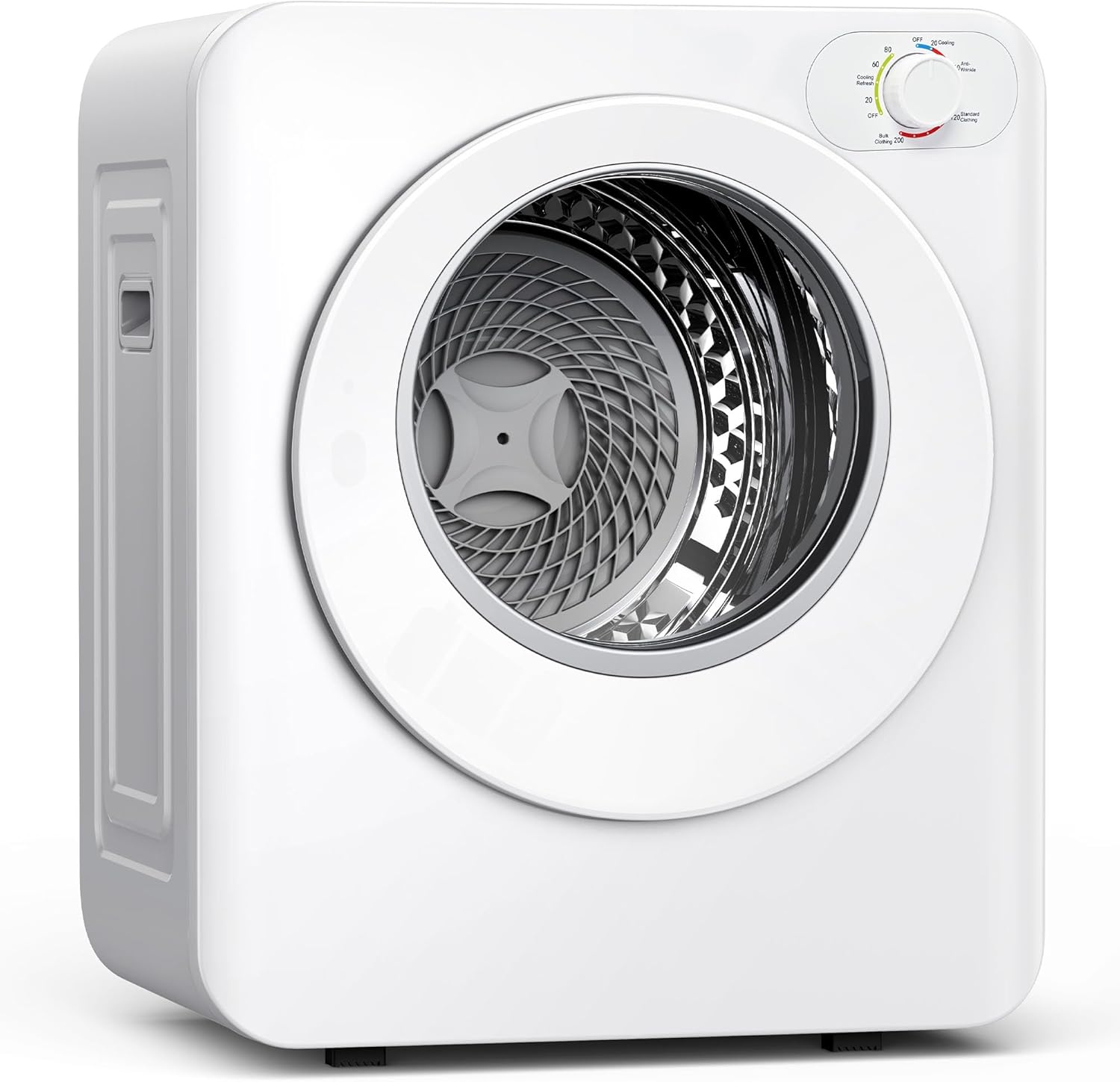
| Capacity | 1.5 cubic feet |
|---|---|
| Power | 850 W |
| Form Factor | Front Load |
| Safety | ETL certified |
The EUHOMY 1.5 cu.ft. portable dryer is a compact front-load electric dryer built for apartments, dorms, and RVs where space is limited. It uses an 850W heater to reach temperatures up to about 140°F and offers five knob-controlled modes for cooling, anti-wrinkle, standard drying, bulk drying, and refreshing, which makes it flexible for small mixed loads. The reversible stainless steel drum and transparent door help keep garments from tangling and let you monitor progress, while a cotton lint filter and automatic door-stop safety add practical reliability. Its small footprint and lower wet-clothes capacity mean it handles light loads quickly but will need multiple cycles for larger families or heavy items. Expect the best results with partially spun laundry and smaller garments; drying times lengthen if items are very wet. For buyers prioritizing dependable, simple operation and compact sizing on a budget, this unit provides straightforward drying without complicated controls, though it is not a substitute for full-size household dryers when capacity or speed is critical.
Best for: Buyers who need a reliable, no-frills dryer for small living spaces and prioritize consistent, easy operation over large capacity.
Less Ideal for: Households that regularly dry large loads, heavy items, or need fast turnaround should choose a higher-capacity or higher-power dryer instead.
- Compact front-load design fits small spaces like dorms and RVs
- Five simple modes cover cooling, anti-wrinkle, standard and bulk drying, and refreshing
- Reversible stainless steel drum and transparent door reduce tangles and let you monitor loads
- ETL certified with basic safety features including automatic stop when the door opens
- Low wet-load capacity limits it to small or partial loads
- 850W power means longer drying times compared with higher-wattage full-size dryers
Verdict: A dependable, budget-friendly compact dryer that delivers straightforward drying for small spaces and light laundry needs.
MOJOCO Portable Dryer MJC-T03

| Form Factor | Top Load |
|---|---|
| Capacity | 22 pounds |
| Included Components | Dryer, Dryer Bag |
The MOJOCO Portable Dryer is a lightweight, top-load folding dryer designed for small loads and spaces where a full-size dryer is impractical. It uses a 600W heating system with two temperature modes and a timer to dry lightweight garments, baby clothes, or underwear; the brand claims light items can finish in about 1–2 hours and heavier pieces may take longer. The unit is notable for its built-in UV LED sanitizing and automatic overheat protection, and it is engineered for quiet operation and portability with a carrying bag included. In practice this dryer is best for finishing a few items quickly or refreshing clothes while traveling, camping, or living in a small apartment, and it avoids the energy use of a conventional dryer. Its limitations are obvious: drying times are longer for heavier fabrics, and the appliance is intended for small loads only, so it cannot replace a full-size dryer for regular family laundry. Expect to manage airflow and avoid overstuffing for even results.
Best for: Buyers who need an inexpensive, space-saving dryer for occasional small loads, travel, or apartment living and who prioritize portability and low energy use over fast, large-capacity drying.
Less Ideal for: Households that regularly need to dry large loads, bulky items, or fast turnaround should choose a full-size dryer instead.
- Compact, foldable design with included carrying bag for easy storage and travel
- Two heat modes and timer let you tailor drying to delicate or quicker cycles
- Built-in UV LED provides an added sanitizing step
- Quiet operation suitable for small living spaces
- 600W power and compact form mean longer drying times for heavier garments
- Designed for small loads only and cannot handle full-family laundry
Verdict: A budget-friendly, highly portable dryer that works well for small loads, travel, and tight spaces when you need a low-energy drying option.
Nesugar H3 Portable Clothes Dryer

| Form Factor | Portable |
|---|---|
| Included Components | Portable Dryers |
| Warranty Description | 1 year |
The Nesugar H3 is a compact portable dryer designed for small spaces, travel, and dorm use. It uses a foldable fabric drying bag and an internal heating and airflow module to dry multiple light garments at once, and the manufacturer claims it can handle about 6 to 10 pieces per cycle. The unit emphasizes quiet operation with a reported noise level around 36 dB and offers four drying modes plus a 65 degree drying setting for gentle heat. Its global voltage design means it will adapt to different international outlets without a separate converter, which is useful for travelers. Practical benefits include easy storage thanks to the foldable bag, simple snap-on straps for hanging, and low noise so it can run overnight in shared living spaces. Limitations are inherent to the form factor: it is intended for small, lightweight items rather than large towels or heavy loads, and drying times will be longer than a full-size dryer. For buyers seeking a compact, low-noise solution for occasional or travel drying, the H3 is a sensible budget option.
Best for: Buyers who want a low-risk, space-saving dryer for small loads, travel, or dorm living and prioritize quiet, simple operation over full-size capacity.
Less Ideal for: Households that need to routinely dry large or heavy laundry loads or replace a standard home dryer should look at full-size models instead.
- Global voltage support for use in multiple countries without a converter
- Very quiet operation (around 36 dB) suitable for shared spaces or overnight use
- Foldable fabric drying bag and compact housing for easy packing and storage
- Four drying modes and a gentle 65 degree option for delicate items
- Not suited for heavy items or large loads like bath towels
- Drying takes longer than a full-size machine and performance depends on load type
Verdict: A quiet, compact budget portable dryer that is ideal for travelers and small-space users who need occasional, lightweight load drying.
Choosing the Right Portable Dryer on a Budget: Key Factors to Consider
Capacity and Load Size
Capacity directly affects how many garments you can dry per cycle and how often you will need to run the unit. Portable dryers generally handle small to medium loads, so pick a capacity that matches how you typically wash: single-person households need less capacity than families or frequent travelers.
Choosing a size that is too small leads to more cycles and higher cumulative energy use. Conversely, oversizing a portable dryer defeats its point by increasing footprint and energy consumption. Look for realistic usable drum volume rather than marketing claims, and consider whether you usually dry bulky items like towels or just clothing and delicates.
Drying Method and Efficiency
Portable dryers use vented, condenser, or heat-pump-like methods to remove moisture. The drying method impacts energy use and where you can place the unit indoors. Condenser systems collect water in a tank and work without external venting, which is handy for apartments. Vented styles may dry faster but require a window or vent option.
Efficiency matters on a budget because energy costs add up. Look for models with multiple heat settings or moisture sensors that prevent over-drying. Even small efficiency differences will matter over many cycles, so prioritize features that reduce run time while protecting fabrics.
Footprint, Installation, and Portability
Physical size and how the unit installs affect where it can live in your home. Many buyers choose portable dryers to save space or avoid hookups, so compact footprint and easy stowage are essential. Check height and width for apartment closets, bathrooms, or kitchen counters.
Also consider the weight and whether the dryer has casters or handles for movement. Simple plug-in power and minimal assembly are advantages. If you plan to move the unit frequently, prioritize lighter builds and secure doors or lids to avoid damage in transit.
Controls and Cycle Options
Clear, reliable controls make operation predictable and reduce wasted cycles. Basic timers and heat settings are common on budget models; some include dedicated cycles for delicates, synthetics, or quick-dry sessions. Moisture sensors or automatic shutoff are especially valuable to prevent over-drying and extend garment life.
Consider how intuitive the controls are and whether any digital displays or indicators will be useful over time. Simpler interfaces can be more durable and cheaper to repair, while additional cycle variety can protect different fabrics and speed up drying when you are in a hurry.
Maintenance, Drainage, and Longevity
Maintenance factors determine the long-term cost and convenience of ownership. Many portable dryers require emptying a condensate tank after each cycle or routing a drain hose to a sink. Consider how easy it is to access and clean lint traps, condensers, or filters to maintain performance and fire safety.
Durability of seals, door latches, and internal drum finishes affects how long a budget unit will remain useful. Cheaper materials may show wear sooner, so weigh perceived short-term savings against likely repair or replacement intervals. Ease of finding replacement parts or simple user-serviceable components is another plus.
Where Portable Dryers Make Sense
Portable dryers are ideal when space, hookups, or budget rule out a full-size machine. They are practical for studio apartments, seasonal use in vacation homes, RVs, or as a secondary unit in a home without a dedicated laundry room.
In these settings, look for units that minimize installation needs and offer clear condensate handling. Prioritize models that fit your storage options and can be moved or stowed easily when not in use.
- Good for small loads and delicates
- Useful as a backup or travel-friendly unit
- Works where external venting is unavailable
How to Measure Real-World Drying Performance
Real-world drying depends on load type, initial moisture level, and chosen cycle. To estimate performance, test with typical loads you plan to dry, such as a mix of shirts and underwear or a single towel, and time how long the unit takes to reach comfortable dampness or fully dry.
Track energy use where possible or use the manufacturer's stated wattage to compare relative consumption. Faster cycles sometimes use more power but may be more efficient overall if they finish sooner.
- Test with your typical laundry mix
- Note initial spin-dry moisture to set expectations
- Use shorter cycles plus sensor features when available
Space Planning and Venting Alternatives
If you cannot vent outdoors, choose condenser-style units or models designed to collect water. Plan for access to an electrical outlet and a place to empty the condensate tank if needed. Consider door swing and clearance when positioning the dryer in a closet or bathroom.
For vented units, ensure you have a safe path for exhaust air and avoid running long ductwork that limits performance. Remember to account for airflow and avoid blocking intake or exhaust openings to preserve efficiency and safety.
- Measure door clearance and storage space first
- Prefer condensers for no-vent installs
- Avoid tight enclosures that restrict airflow
Noise and Daily Use Considerations
Noise level affects where you can comfortably run a portable dryer. If the machine will run while you sleep or work from home, check decibel ratings or user reports about operational sound. Smaller units often have higher pitched noise from fans and motors, so test placement to minimize disturbance.
Also consider run times and convenience features such as timers, delayed start, or quick cycles that fit daily routines. Easy-to-empty water tanks and accessible lint filters reduce friction in regular use.
- Check noise if running near living areas
- Look for easy emptying and lint access
- Use quick or timed cycles for small urgent loads
How We Chose the Best Portable Dryer on a Budget
We focused on portable dryers that deliver consistent drying performance while keeping purchase and operating costs low. Our editorial filters prioritized models with compact footprints and straightforward setup so they work in small living spaces, temporary housing, or for RV and travel use. We required evidence of temperature control or cycle variety to protect different fabric types and a clear method of water extraction or condensation to avoid awkward installations. Evaluation criteria included real-world drying speed on small to medium loads, measured energy use or stated energy-saving modes, unit footprint and storage ease, build quality and ease of maintenance, and operational noise levels. We excluded overly large or permanently plumbed units, machines lacking basic safety features, and devices with inconsistent user controls. The picks reflect units that balance affordability with performance, durability, and low ongoing energy or maintenance demands.
Our full evaluation process is outlined in our review methodology.
FAQ
Can a portable dryer fully dry towels and heavy items?
Often portable dryers struggle with very bulky or heavy items compared with full-size machines. Small towels and lightweight bath sheets can come out dry on higher heat, but large bath towels or thick blankets may remain damp and require multiple cycles.
Do portable dryers need an external vent?
Not all models require external venting. Condenser-style portable dryers collect moisture in a tank or drain hose, making them suitable for apartments. Vented models typically need an exhaust path to work efficiently and avoid increasing room humidity.
How much will a budget portable dryer add to my energy bill?
It depends on frequency of use and cycle length. Budget portable dryers are generally less efficient than full-size heat-pump machines but using shorter cycles, higher spin speeds on your washer, and moisture-sensing features can reduce runtime and cumulative energy consumption.
Are portable dryers safe to run unattended?
Many portable dryers have basic safety features like automatic shutoff and thermal cutoffs, but you should follow the manufacturer maintenance guidance, keep lint traps clean, and avoid leaving the unit blocked or stored in confined, unventilated spaces when operating.
How do I maintain a portable condenser dryer?
Regular maintenance usually includes emptying and rinsing the condensate tank, cleaning lint filters after each load, and occasionally wiping the drum and seals to prevent odor. Check for accessible filters and follow any recommended descaling steps if the unit's manufacturer suggests them.
Final Verdict
When shopping for a portable dryer on a budget, focus on the combination of realistic capacity, drying method, and energy use rather than just upfront cost. Balance footprint and portability with the features that matter most to you, such as moisture sensing, drain options, and cycle variety. Expect tradeoffs: more compact units save space but may require more cycles for bulky items. Prioritize models that match your typical load types and living situation, maintain lint and condensate systems regularly, and plan placement to allow adequate airflow. With the right priorities, you can find an affordable portable dryer that delivers reliable drying without wasting energy or space.