
Note: This article contains affiliate links. If you click on these links and make a purchase, we may earn a small commission at no extra cost to you. This helps support our research and content. Read our full affiliate disclosure here.
When heat hits and you do not want to overspend, a well-chosen portable fan can deliver targeted cooling, lower energy use, and quieter operation than a space heater or HVAC boost. Choosing the right budget portable fan matters because small differences in airflow pattern, noise, and efficiency determine whether a unit keeps your bedroom, office, or dorm comfortable without becoming annoying or costly to run. This guide shortlists seven affordable portable fans that excel in the features that matter most to cost-conscious buyers. We evaluate factors like airflow performance, power draw, noise levels, and build quality to help you pick the best option for your space. Read on for the evaluation criteria and practical buying guidance before the product list.
Top Picks at a Glance
| Best Overall The best all-around choice for most situations | Otlonpe Portable Desk Fan S-F16B |  |
| Best Quality Built to a higher standard if you want something more solid | Diveblues Fanzy D6036 |  |
| Best Value The sweet spot between price and what you get | AUIIAH GS30 Handheld Turbo Fan |  |
| Best Budget The cheapest option that still gets the job done reliably | Mini Portable Handheld Fan |  |
| Top Rated A top-rated pick with lots of positive feedback | Bearwind S40 Handheld Fan |  |
| Most Popular A crowd favorite that many people choose with confidence | Honeywell TurboForce HT-900 |  |
| Best Seller A high-volume bestseller chosen again and again | PlayHot Portable Turbo Fan |  |
Otlonpe Portable Desk Fan S-F16B

| Power Source | USB & Battery Powered |
|---|---|
| Battery Capacity | 4000mAh |
| Number of Speeds | 4 |
| Noise Level | 30 db |
| Connector Type | USB Type C |
The Otlonpe S-F16B is a compact rechargeable desk fan meant for personal cooling at a desk, bedside, or while traveling. It runs from its built-in 4000mAh battery or USB-C power and offers four speed settings, letting you choose anything from a quiet breeze for sleeping to a stronger airflow for warm rooms. The head folds 180 degrees and the front grille snaps off for easy cleaning, and a 4‑LED battery indicator helps you track remaining run time. A brushless motor and claimed noise level around 30 dB make it unobtrusive for work or sleep, and the included USB-C cord doubles as a way to run the fan continuously when outlets are available. Limits are its small footprint and modest airflow compared with larger fans, so it is best for personal spot cooling rather than cooling a full room, and the plastic construction is utilitarian rather than premium. For a low-cost, portable solution that balances runtime, quiet operation, and simple upkeep, this model performs well.
Best for: Buyers who want a portable, no‑frills personal fan that balances long battery runtime, quiet operation, and simple maintenance for travel, desk, or bedside use.
Less Ideal for: People needing strong airflow to cool larger rooms or who prefer heavier, premium-feeling appliances should consider a larger tabletop or tower fan instead.
- Long rechargeable battery life up to claimed 23 hours on low power
- Foldable 180° head and snap‑off front cover for easy aiming and cleaning
- Quiet brushless motor with low noise suitable for sleep or work
- USB‑C charging and ability to run on USB power for continuous use
- Small size limits effective cooling to one person or a small area
- Mostly plastic build that feels budget rather than premium
Verdict: A budget-friendly portable desk fan that delivers long battery runtime and quiet, adjustable airflow for reliable personal cooling on the go.
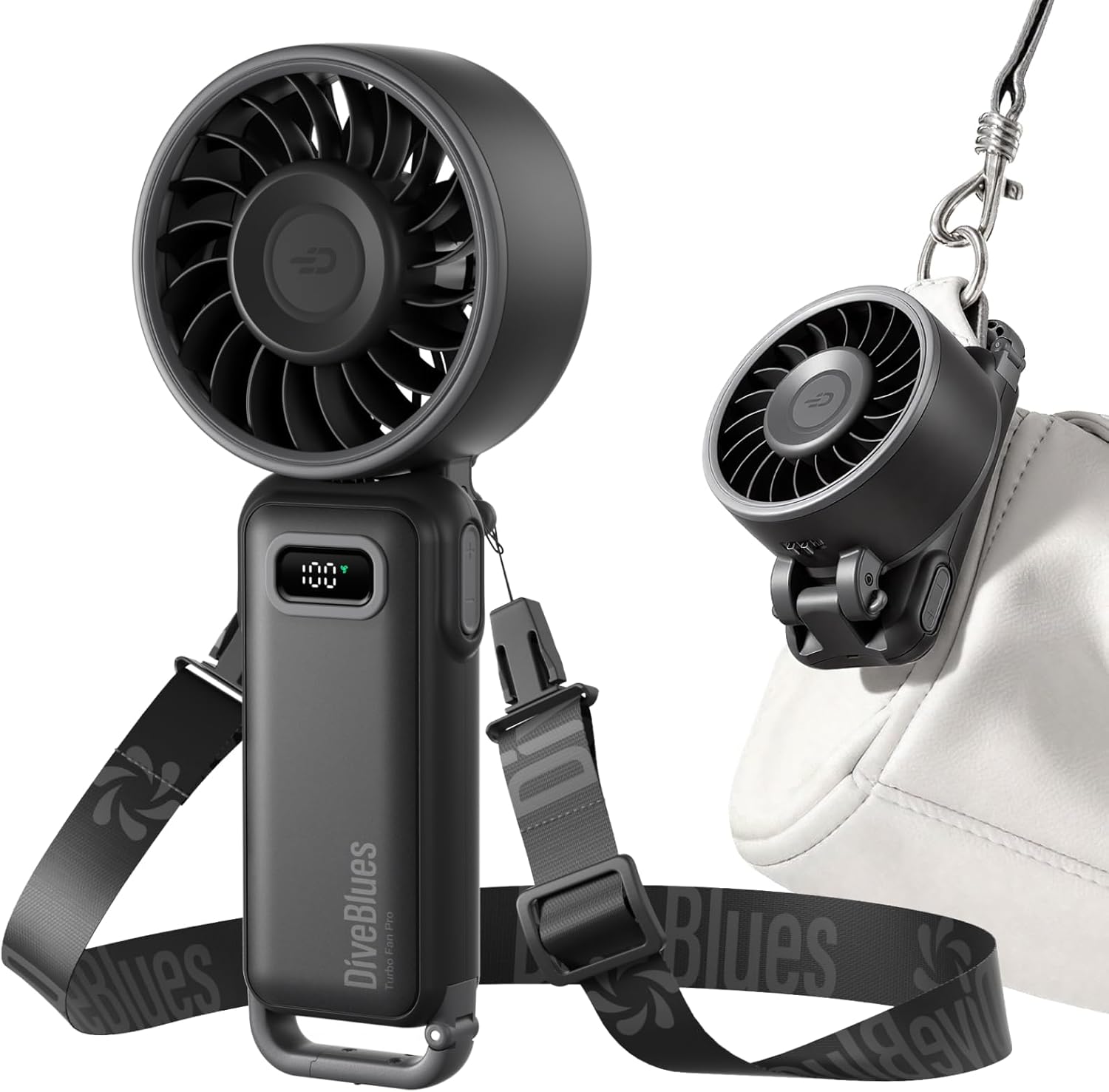
Diveblues Fanzy D6036
| Power Source | Battery Powered |
|---|---|
| Number of Speeds | 100 |
| Noise Level | 50 db |
| Wattage | 5 watts |
| Number of Blades | 6 |
The Diveblues Fanzy D6036 is a lightweight, fold-flat portable turbo fan designed for personal cooling on the go. It delivers a wide range of airflow with stepless 1–100 speed control and a 6-blade turbo design that reaches high RPMs for strong short‑burst cooling while lower settings stay relatively quiet. Its 3600mAh battery supports up to about 12 hours of runtime on low, and the USB-C port makes recharging convenient. The fan folds 180 degrees so you can use it handheld, set it on a desk with a stable base, wear it around your neck, or clip it to bags with the built-in hook. An HD display shows speed and battery level so you can dial in performance precisely. Practical trade-offs are typical for this class: maximum airflow will cut battery life significantly and the smallest form factor limits how much room it can cool compared with larger fans. For buyers who want strong, adjustable personal airflow in a travel-ready package, the Fanzy balances power, portability, and clear controls.
Best for: Buyers who prioritize strong, adjustable personal airflow in a compact, travel-ready package and want precise speed control for portable use.
Less Ideal for: People needing a fan to cool rooms or multiple occupants or those who require very quiet operation at maximum airflow.
- Stepless 1–100 speed control for precise airflow adjustments
- Fold-flat design supports handheld, desk, neck-worn, or clipped use
- 3600mAh battery with up to 12 hours runtime on low and USB-C charging
- HD display that shows real-time speed and battery level
- High speeds produce noticeable noise and drain battery faster
- Small personal fan cannot cool larger spaces or multiple people
Verdict: If you need a high-performance, pocketable personal fan with precise speed control and multiple wearing options, the Fanzy D6036 delivers strong cooling in a travel-ready form.
AUIIAH GS30 Handheld Turbo Fan

| Power Source | Battery Powered |
|---|---|
| Number of Speeds | 5 |
| Motor Type | Brushless |
| Wattage | 5 watts |
| Control Method | Push Button |
The GS30 is a small but powerful rechargeable handheld fan that aims to cover multiple summer needs without extra bulk. It uses a 3-phase brushless motor and a six-blade rotor to produce up to 10 m/s of airflow and offers five speed levels shown on an LED display, so you can choose whisper-quiet low settings for sleep or a turbo blast for outdoor use. The body folds 180 degrees and includes an adjustable strap so it converts easily between handheld, desk, and neck configurations, and USB-C charging recharges the battery in roughly three hours. In real-world use it is lightweight and easy to carry in a bag, the low speeds are quiet enough for focused work, and the top speeds deliver noticeably stronger airflow than typical pocket fans. Expect the highest speeds to be louder and to drain battery faster, and there is no mention of an IP rating for wet environments. For buyers seeking a budget portable fan that balances runtime, strong airflow, and flexible mounting, the GS30 is a practical option.
Best for: Buyers who want a compact, no-frills portable fan that delivers stronger-than-average airflow and flexible mounting for travel, commuting, and outdoor events while prioritizing runtime and adjustability.
Less Ideal for: People needing a fully waterproof fan or those who require near-silent maximum cooling for very quiet environments.
- Brushless motor with six blades for stronger airflow (up to 10 m/s)
- Five speed settings with LED display for precise control
- Foldable 3-in-1 design and adjustable strap for handheld, desk, or neck use
- USB-C charging with roughly three-hour full recharge time
- Lightweight and highly portable for travel and outdoor activities
- High speed setting is noticeably louder and reduces battery runtime
- No listed water resistance rating for use in wet conditions
Verdict: AUIIAH GS30 gives budget-minded buyers a compact, rechargeable fan with strong airflow and versatile mounting that works well for travel and outdoor use.
Mini Portable Handheld Fan

| Power source | 2 x AAA batteries |
|---|---|
| Primary use | Personal portable handheld fan |
This mini portable handheld fan is a simple, battery-operated personal cooler intended for on-the-go use. It runs on two AAA batteries (not included) and its compact lightweight design makes it easy to tuck into a bag or hold for quick relief at outdoor events, commuting, or while hiking. The basic controls and small fan head deliver a modest airflow suitable for cooling one person at close range, and the plastic construction keeps weight and cost down. Because it uses replaceable batteries it is convenient where USB power is unavailable, but battery life will depend on battery type and fan speed. There are no advanced features such as variable high-capacity batteries, rechargeable pack, or adjustable tilting base, so expect straightforward, no-frills performance. For buyers prioritizing the lowest purchase cost and portability, this fan offers an inexpensive way to stay cooler in short bursts, though it is not meant to replace larger or quieter table fans for extended home use.
Best for: Buyers looking for the cheapest, most portable personal cooling solution for occasional outdoor or travel use who value simplicity over runtime or power.
Less Ideal for: People who need powerful, quiet, or long-run cooling for indoor or continuous use should choose a larger rechargeable or plug-in fan instead.
- Very compact and lightweight for easy carrying
- Runs on two common AAA batteries so replacement cells are widely available
- Low-cost, straightforward design with simple controls
- Good for short-term, personal cooling outdoors or while traveling
- Modest airflow that only cools directly in front of the fan
- Battery-powered operation can become costly over long use and requires replacing batteries
Verdict: An ultra-affordable, pocketable handheld fan that delivers basic personal cooling for short outdoor or travel use.
Bearwind S40 Handheld Fan

| Power Source | Battery Powered |
|---|---|
| Number of Speeds | 5 |
| Noise Level | 40 db |
| Wattage | 10 watts |
| Reusability | Rechargeable |
The Bearwind S40 is a small rechargeable handheld fan built for on-the-go cooling. It uses a 7-blade turbo design and brushless motor to deliver up to five adjustable speeds and a peak airflow speed of about 9 m/s, which makes it effective for personal use at outdoor events, commuting, or near a desk. The 180 degree foldable body and included lanyard let you use it as a handheld, neck, or desk fan, while USB-C fast charging fills the 4000mAh battery in roughly three hours and can run low settings for many hours. Controls are simple push-button/touch inputs and the unit is lightweight and easy to stow in a bag. Expect a modest noise floor around 40 dB on mid to lower settings and noticeably louder output at top speed, and the plastic construction is standard for this price class. For a budget portable fan that prioritizes dependable run time and straightforward operation, the S40 performs well, though it is best for personal cooling rather than whole-room ventilation.
Best for: Buyers who prioritize reliable, long-lasting portable cooling for travel, outdoor activities, or daily carry and want a simple, fuss-free fan with solid battery life.
Less Ideal for: People seeking a quiet fan for shared indoor spaces or a unit capable of cooling multiple people or larger areas should consider larger desk or room fans instead.
- Strong airflow for a handheld unit thanks to 7-blade turbo design and brushless motor
- Five speed settings for fine tuning comfort from gentle breeze to high output
- Long battery life from a 4000mAh rechargeable pack with USB-C fast charging
- Foldable 180° design and lanyard let you use it handheld, worn, or set on a desk
- Plastic build is lightweight but less durable than higher-end materials
- Top speed is noticeably louder than lower settings
Verdict: A durable-feeling, easy-to-use rechargeable handheld fan that delivers reliable battery life and strong personal airflow on a budget.
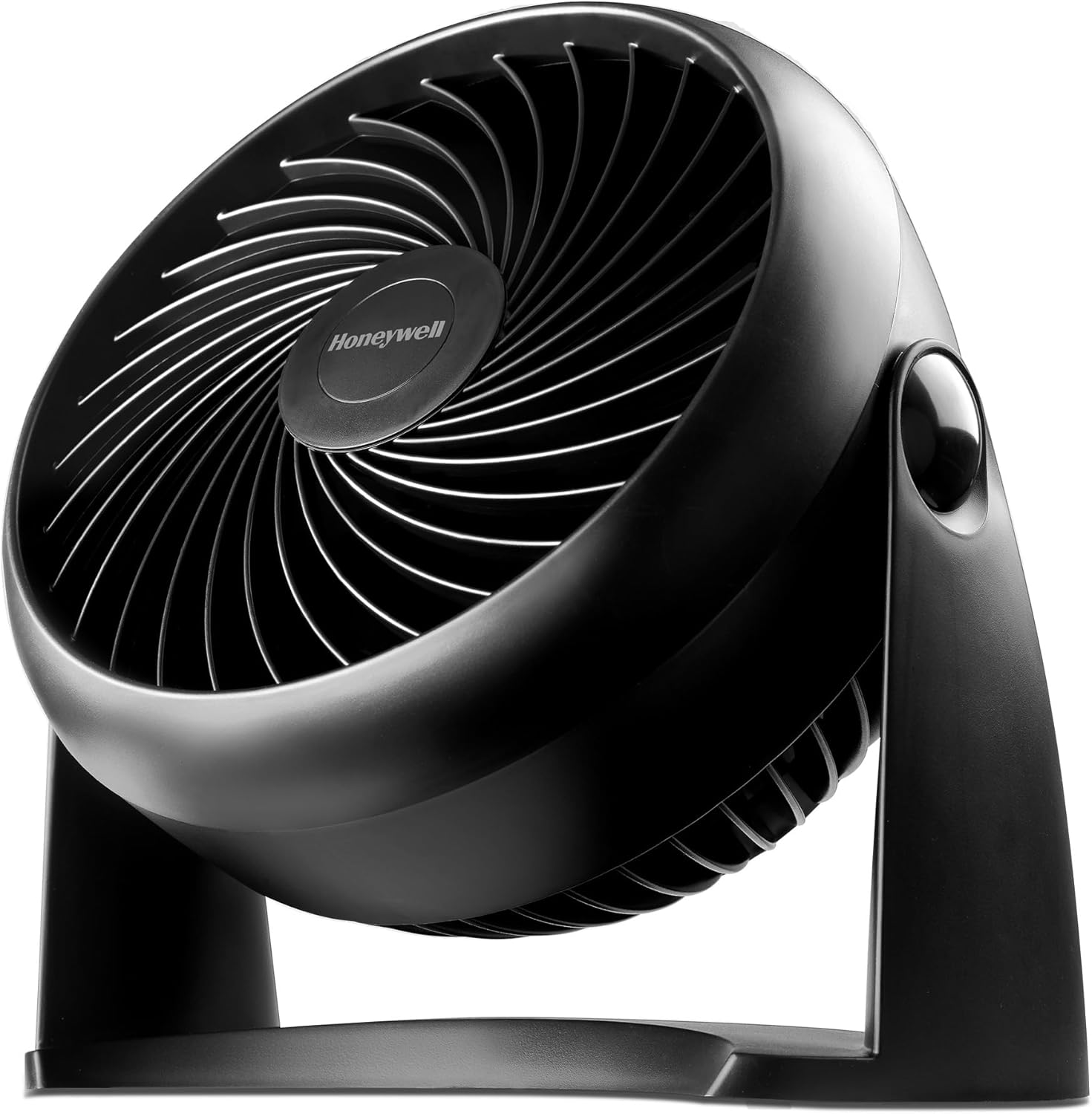
Honeywell TurboForce HT-900
| Power Source | Corded Electric |
|---|---|
| Number of Speeds | 3 |
| Wattage | 35 watts |
| Air Flow Capacity | 185 cfm |
| Motor Type | brushless |
The Honeywell TurboForce HT-900 is a small tabletop air circulator built to deliver focused airflow from a compact footprint. It uses an aerodynamic turbo design and a brushless motor to push air up to about 25 feet, and three push-button speed settings let you dial in gentle to stronger circulation. The head pivots 90 degrees so you can direct the breeze at a desk, bed, or mounted on a wall, and the plastic housing keeps it lightweight and easy to move. Practical benefits include low noise operation for bedroom or office use and an energy-efficient 35-watt motor that can supplement or reduce reliance on air conditioning. Limitations are its small size and single-head design, which means it is best for spot cooling or improving room circulation rather than cooling large open areas, and the basic controls lack timers or remote operation.
Best for: Buyers who want a proven, quiet small fan that provides reliable spot cooling and benefits from large-scale user satisfaction when choosing a budget portable fan.
Less Ideal for: People who need whole-room cooling for large open spaces or who want smart features such as remotes, timers, or app control.
- Compact, lightweight design easy to move or wall-mount
- Aerodynamic TurboForce design delivers strong airflow for its size
- Three clearly labeled speed settings for simple control
- 90-degree pivoting head lets you aim airflow precisely
- Brushless motor and low noise suitable for bedrooms or offices
- Small footprint limits effective coverage to small and medium rooms
- No timer, remote, or advanced control features
Verdict: A compact, low-noise table fan that delivers surprisingly strong spot airflow for buyers prioritizing reliable, budget-friendly performance backed by broad user approval.
PlayHot Portable Turbo Fan

| Power Source | Battery Powered |
|---|---|
| Number of Speeds | 5 |
| Noise Level | 45 db |
| Motor Type | brushless |
| Reusability | Rechargeable |
The PlayHot Portable Turbo Fan is a compact rechargeable handheld fan that converts between handheld, desk, and neck positions thanks to its 180 degree foldable body. It uses a brushless motor and a 7-blade aerodynamic design to push strong airflow across five speed settings, and the LED display shows battery level and speed. Typical uses include on-the-go cooling for travel, outdoor activities, or focused desktop airflow, plus quick tasks like makeup or eyelash drying. Practical benefits include a USB-C recharge that finishes in about three hours, low weight for stashing in a bag, and nearly silent operation at lower speeds; the brushless motor and up to 12-hour runtime make it reliable for day trips. Limits are its small physical size and plastic construction, which means it cannot move air like a full-size fan and is best for one-person personal cooling rather than cooling a room. Noise at the highest setting is noticeable and runtime falls with heavier use of top speeds.
Best for: Buyers who prioritize a reliable, easy-to-use personal fan for travel, outdoor activities, and everyday carry and want a familiar, low-risk purchase with clear battery and speed readouts.
Less Ideal for: People who need to cool multiple people or entire rooms, or who want a heavy-duty, long-lived desktop fan for continuous home use.
- Foldable 3-in-1 design for handheld, desk, or neck use
- Brushless motor with 7-blade aerodynamic head for strong personal airflow
- USB-C rechargeable with up to 12 hours runtime and 3-hour charge time
- Clear LED display for battery level and speed selection
- Lightweight and pocketable for travel or outdoor use
- Small form factor suitable only for single-person cooling
- Plastic construction limits durability compared with heavier-duty fans
- Top speed is louder and reduces battery runtime significantly
Verdict: A compact, travel-ready rechargeable handheld fan that delivers strong personal airflow and simple controls at a budget-friendly, low-risk choice.
Choosing the Right Portable Fan on a Budget: Key Factors to Consider
Airflow Pattern and Coverage
A fan's airflow pattern determines how effectively it moves air across a room. For small rooms or desks, look for models that concentrate airflow into a directed stream rather than diffusing it too broadly. Directed airflow produces more noticeable cooling at a distance and can be aimed at a sleeping area or workspace.
Coverage matters because a fan that performs well on a desk may not circulate air adequately in a 10 by 12 foot bedroom. Check the airflow description for angle adjustability and oscillation options. Oscillation helps distribute air across a wider area but may lower the perceived wind at any one point, so think about whether you need focused cooling or room-wide circulation.
Energy Use and Estimated Running Cost
Budget buyers often prioritize low operating costs since a fan may run for hours each day. Look at the wattage and consider how it translates to daily energy consumption. Lower-watt models are cheaper to run, but very low wattage sometimes corresponds with weak airflow, so balance efficiency with effectiveness.
Some fans offer multiple speeds that let you trade airflow for power draw. Choosing a model with a reasonable maximum airflow but efficient low and medium settings gives flexibility to cool while keeping electricity use down. Also consider voltage compatibility and whether USB power or standard AC suits your typical outlets and usage patterns.
Noise Level and Acoustic Comfort
Noise is a primary quality-of-life factor for bedside or office fans. A budget fan that produces a strong breeze but also a high-pitched whine or loud motor will become intrusive over time. Seek fans with measured decibel ratings at each speed when available, and favor designs that use larger blades or smoother motor operation to reduce motor strain and tonal noise.
If you plan to use the fan while sleeping or on conference calls, prioritize quieter models or those with a very low-noise low setting. Remember that some oscillation mechanisms and plastic housings can add rattles; build quality influences noise as much as motor design.
Size, Portability, and Placement Options
Portable fans should be easy to move and place. Consider weight, handle design, and footprint. Very small fans are convenient for travel but may not deliver enough airflow for a whole room. Mid-size units strike a balance between portability and performance.
Also think about vertical vs tabletop mounting, height adjustment, and whether the fan can tilt or clip to furniture. A compact fan that clips onto a shelf or fits on a narrow nightstand increases flexibility. Assess where you will most often use the fan and choose a form factor that matches that location.
Build Quality and Ease of Maintenance
Budget fans vary widely in construction quality. Durable materials, a stable base, and a securely fastened grille mean the fan will last longer and be safer around children or pets. Look for straightforward assembly and parts that can be cleaned without removing many screws.
Cleaning the blades and grille regularly keeps airflow high and prevents motor strain. Models that allow quick access to the blades or have tool-free grille releases reduce hassle. Also check for replacement parts or easily serviceable motors if long-term maintenance is a concern.
Control Options and Usability
Controls affect how you interact with the fan daily. Simple rotary dials or push-button speed settings are reliable and easy to use, while a touchscreen or complicated remote may be unnecessary for budget buyers. Consider whether you prefer an oscillation toggle, a timer, or a low-profile control layout for bedside use.
Intuitive controls also reduce the risk of accidentally changing settings. Sturdy physical controls generally outlast cheap membrane buttons, so for frequent use favor tactile switches and clearly labeled speed steps.
Where a Budget Portable Fan Works Best
Budget portable fans excel in small to medium rooms, personal cooling zones, and situations where you need intermittent airflow rather than whole-house ventilation. They are especially useful at a desk, bedside, or in a dorm room where supplemental cooling is more cost-effective than running central air.
Use portable fans to enhance comfort by creating a directed breeze or improving cross-ventilation when windows are open. They can also lower perceived temperature when aimed properly, allowing you to raise thermostat setpoints and save on cooling energy overall.
- Ideal for personal spots and small rooms
- Good for supplementing natural ventilation
- Use with oscillation for broader coverage or tilt for focused cooling
Best Placement and Positioning Tips
Placement affects how effectively a fan moves air. For cooling people, position the fan so the airflow strikes the torso or face at an angle rather than directly from below. For circulating room air or expelling hot air, place the fan near a window or doorway to create a directional flow.
In bedrooms, set the fan on a low, stable surface and point it slightly upward to mix cool air without blowing directly on your face all night. When combining with open windows, consider using two fans to pull cool air in and push warm air out for faster temperature changes.
- Aim for a 30 to 45 degree angle for personal cooling
- Place near window/opening to assist ventilation
- Avoid unstable surfaces that could tip or vibrate
Noise Management Strategies
To reduce perceived noise, operate the fan at the lowest effective speed and use oscillation sparingly when you need a steady breeze. Placing a fan on a soft mat can reduce vibrational noise transferred to furniture. If a unit produces rattles, check that the grille and base are tight and that nothing is contacting the blades.
If sleeping with a fan, test different speeds for a balance of airflow and acoustic comfort. White-noise masking can help, but a quieter fan at a slightly lower setting usually provides the best long-term comfort without raising volume.
- Run at lowest effective speed
- Tighten grilles and secure loose parts
- Use soft pads to reduce vibration noise
Power Options: AC Vs USB
Budget portable fans may be powered by standard AC or USB. AC-powered fans typically offer higher maximum airflow and are suitable for continuous room use. USB fans are convenient for desk setups, travel, or when you want to run off a laptop or power bank, but they usually trade peak airflow for portability.
Consider how and where you will use the fan most. If you need reliable room cooling for hours at a time, AC power is preferable. If you want a travel-friendly or desk-oriented solution, a USB-powered model provides flexibility with lower power draw.
- AC for sustained, higher airflow
- USB for desktop and travel convenience
- Check cable length or included adapters for placement needs
Safety and Child-Friendly Features
Safety matters in homes with children and pets. Look for fans with tight grilles that prevent fingers from reaching blades, a stable weighted base, and tip-over resilience. Some budget units include auto-shutoff or thermal protection to guard the motor against overheating.
Even without advanced safety features, choosing a low-profile fan with minimal exposed moving parts and a sturdy build reduces common hazards. Avoid placing fans on high, unstable surfaces or where cords create trip hazards.
- Prefer tight mesh grilles and stable bases
- Look for thermal protection or auto-shutoff features
- Keep cords secured and out of walkways
How We Chose the Best Portable Fan on a Budget
We prioritized real-world performance metrics that matter to budget buyers and excluded premium features that add cost without delivering consistent everyday benefits. The shortlist focused on measurable airflow output, steady energy consumption, and audible noise at usual fan speeds. We also considered durability signals in the design, such as sturdier housings, simple but reliable controls, and customer-service friendly construction, because cheaper units can fail sooner if built poorly. Concrete evaluation criteria included measured airflow and coverage, wattage and estimated operating cost, noise level at typical settings, ease of cleaning and maintenance, and physical stability or portability for moving between rooms. We excluded high-end tower features, integrated smart-home connectivity, and complex multi-function combos that push up price without improving basic cooling. Only units that balanced low purchase cost with acceptable performance, reasonable power draw, and straightforward maintenance were advanced to the final list.
Our full evaluation process is outlined in our review methodology.
FAQ
Will a budget portable fan noticeably reduce my room temperature?
A portable fan does not lower air temperature but increases perceived cooling by moving air across your skin and enhancing evaporation. Proper placement and airflow direction make a noticeable comfort difference even if the thermostat reading does not change.
How loud should I expect a budget fan to be at night?
Noise varies by model, but quiet low and medium settings are common on well-designed budget fans. Expect higher speeds to produce more noise. Look for models with published decibel ratings or choose ones with larger blades and smoother motors for lower tonal noise.
Are USB-powered fans powerful enough for a bedroom?
USB fans are best for personal cooling at a desk or bedside when close to the user. They rarely provide the coverage needed for an entire bedroom unless placed close to the sleeping area and used to supplement other ventilation.
How often do I need to clean a portable fan?
Clean a portable fan every few weeks with regular use to remove dust buildup on blades and the grille. Dust reduces airflow and can increase motor strain. Models with tool-free grille removal make cleaning quicker and safer.
What maintenance extends the life of a budget fan?
Regular cleaning, avoiding continuous operation at maximum speed, and ensuring stable placement reduce wear. If possible, use the fan on varied speeds and protect it from power surges and moisture to prolong motor life.
Final Verdict
When shopping for a budget portable fan, prioritize the combination of usable airflow and low operating cost while keeping noise and build quality in mind. Airflow pattern and energy efficiency determine day-to-day usefulness, while durable construction and easy cleaning affect longevity. Balance the tradeoffs: a slightly larger, more efficient AC-powered model may cost a little more upfront but deliver better cooling and lower runtime costs, while USB or compact fans are ideal for targeted, portable use. Choose the form factor and control style that match where you will use the fan most, and focus on solid airflow, acceptable noise, and practical portability to get the best value.