
Note: This article contains affiliate links. If you click on these links and make a purchase, we may earn a small commission at no extra cost to you. This helps support our research and content. Read our full affiliate disclosure here.
When you head into the field, a blunt knife is a safety hazard and a frustration. A compact, dependable sharpener keeps your blade functional for skinning, slicing cordage, and basic camp chores without carrying bulky equipment. This guide covers the top shortlisted portable hunting knife sharpeners that are rugged enough for outdoors use and easy enough to operate under variable conditions. We evaluated each option on edge retention, speed of sharpening, user safety, and how well it works with common hunting-knife grinds. Read on to find a field-ready sharpener that matches your skill level and hunting routine.
Top Picks at a Glance
| Best Overall The best all-around choice for most situations | SHARPAL 210N Knife Sharpener |  |
| Best Quality Built to a higher standard if you want something more solid | Work Sharp Guided Field Sharpener Elite |  |
| Best Value The sweet spot between price and what you get | AccuSharp Knife Sharpener ACCU-001C |  |
| Best Budget The cheapest option that still gets the job done reliably | Smith's 2-Step Knife Sharpener CCKS |  |
| Top Rated A top-rated pick with lots of positive feedback | Work Sharp Guided Field Sharpener |  |
| Most Popular A crowd favorite that many people choose with confidence | SHARPAL 101N Pocket Sharpener |  |
| Best Seller A high-volume bestseller chosen again and again | KITCHELLENCE 3-Stage Knife Sharpener KS37 P |  |
SHARPAL 210N Knife Sharpener

| Included components | 2 coarse diamond rods (325 grit), 2 extra-fine diamond rods (1000 grit), 2 ceramic rods, tapered diamond rod, 2 cowhide leather strops |
|---|---|
| Adjustable angle range | 15°–30° |
| Material type | Monocrystalline diamond, ceramic, genuine cowhide leather |
| Model number | 210N |
The SHARPAL 210N is a portable, all-in-one sharpening kit that combines monocrystalline diamond rods, ceramic rods, a tapered diamond rod, and leather strops to take a blade from dull to polished. It uses an adjustable angle guide (15°–30°) so you can set a consistent bevel for kitchen blades, hunting knives, and edged tools, and the interchangeable abrasives cover coarse shaping through extra-fine honing. The design stores most components inside the handle for compact carry, and the tapered rod plus small ceramic rods make it possible to address serrations, gut hooks, and other nonstandard edges. In practice it is handy on hunting trips and for general outdoor use because it replaces multiple single-purpose stones and strops. Expect straightforward assembly and durable diamond abrasives, but realize a learning curve for holding angles and working delicate convex or very large blades compared with bench stones or guided bench systems.
Best for: Buyers who want a single portable sharpening system to maintain a variety of outdoor and hunting blades in the field or at home and value compact, multi-step sharpening over single-purpose stones.
Less Ideal for: Users who need very rapid material removal on large blades or who prefer stationary bench systems for precision reprofiling should consider a bench sharpener instead.
- Comprehensive abrasive set from coarse diamond through extra-fine ceramic and leather strops
- Adjustable angle guide (15°–30°) for repeatable bevels
- Compact self-storage design suited for travel and field use
- Includes tapered rod and small rods useful for serrations, gut hooks and arrowheads
- Requires user practice to master consistent pressure and angle compared with fixed bench systems
- Not as fast for heavy stock removal on large knives as dedicated bench grinders
Verdict: A compact, travel-ready sharpening system that covers shaping, honing, and polishing for hunters and outdoor users who want one kit to maintain many blade types.
Work Sharp Guided Field Sharpener Elite

| Included components | Guided Field Sharpener, 220 and 600 diamond plates, 3-grit ceramic rod, leather strop, case |
|---|---|
| Angle | 20-25 degrees |
| Material type | Ceramic |
| Unit count | 1 Count |
The Work Sharp Guided Field Sharpener Elite is a compact, angle-guided sharpening system built for outdoor use and quick field touch-ups. It uses five abrasive stages—removable 220 coarse and 600 fine diamond plates, three-grit ceramic rod (coarse, fine, and fish-hook groove), and a leather strop—to take a dull edge to a usable, polished edge without tools or setup. The guided angles (about 20–25 degrees) make it easy to hold consistent bevels on hunting, pocket, and fillet knives, and the ceramic rod's grooved section handles fish hooks and small blades. Everything nests into a durable zippered travel case so the kit stays organized in a pack. Practical benefits include fast stock removal with the diamond plates, repeatable bevels for performance-oriented users, and an integrated strop for final polishing. Limitations are that the system is manual and user technique affects ultimate sharpness compared with powered systems, and very damaged blades may need more aggressive bench stones or professional regrinding to restore geometry.
Best for: Buyers who want a rugged, portable sharpening kit to maintain hunting and field knives reliably while prioritizing consistent, performance-ready edges on the trail or at camp.
Less Ideal for: People who need a full rebuild for badly nicked or warped blades or who prefer motorized sharpeners for the fastest stock removal.
- Five-stage system covers coarse shaping through stropping for a finished edge
- Angle-guided design promotes consistent bevels without advanced skill
- Includes removable diamond plates and multi-grit ceramic rod for versatile sharpening tasks
- Compact, durable travel case keeps components organized for field carry
- Manual system relies on user pressure and motion so results vary by skill
- Not intended for heavy stock removal or repairing severely damaged blades
Verdict: A compact, five-stage guided kit that gives hunters and outdoorsmen repeatable, field-ready edges without tools.
AccuSharp Knife Sharpener ACCU-001C

| Material Type | Acrylonitrile Butadiene Styrene |
|---|---|
| Grit Type | Coarse |
| Included Components | Sharpener |
The AccuSharp ACCU-001C is a simple, portable pull-through sharpener built for quick edge restoration in the field or kitchen. It uses diamond-honed tungsten carbide blades in a guarded, ergonomic handle that fits right- or left-handed users and protects fingers during use. Typical use is a few light pulls through the V-shaped carbide slot to re-establish a keen edge on chef, paring, fillet, hunting, and serrated blades in about 10 seconds. The reversible carbide blades extend service life and are easy to clean by hand or in a dishwasher, and the compact ABS body makes it easy to stash in a pack or tackle box. It is not a full-service sharpening system for reprofiling badly damaged or chipped blades, and repeated heavy use will eventually require blade replacement. For hunters and outdoor users who need a fast, no-fuss touch-up tool, AccuSharp offers reliable sharpening with minimal skill required.
Best for: Buyers who want a low-skill, portable sharpener for quick touch-ups while hunting or camping and who prioritize speed and convenience over precision regrinding.
Less Ideal for: Users who need professional-level sharpening, blade reprofiling, or fine honing to razor polish should choose a stone-based or guided sharpening system instead.
- Fast edge restoration in roughly 10 seconds for common blade types
- Diamond-honed tungsten carbide blades provide aggressive, consistent sharpening
- Ergonomic, ambidextrous handle with full-length guard improves safety during use
- Reversible blades extend service life and are replaceable
- Compact ABS construction is lightweight and easy to carry in the field
- Not suitable for repairing large chips or for setting new blade geometry
- Coarse grit carbide can remove material quickly if overused, requiring cautious technique
Verdict: A compact, user-friendly pull-through sharpener that delivers fast, dependable touch-ups for hunters and outdoor users who need a sharp blade on the go.
Smith's 2-Step Knife Sharpener CCKS

| Included Components | 1 sharpener |
|---|---|
| Material Type | Synthetic |
| Grit Type | Coarse,Fine |
Smith's CCKS 2-Step Knife Sharpener is a tiny, purpose-built pull-through sharpener that brings dull blades back to life quickly and then refines the edge with ceramic rods. Intended for outdoor and field use, you run a blade through the tungsten carbide coarse slot three to four times to re-establish a bevel, then finish with the crossed ceramic rods for a smoother, keener edge. The unit is lightweight, floats in water, and includes a lanyard hole so it rides on a pack or keychain for fishing, hunting, or campsite tasks. Non-slip rubber feet help stabilize the sharpener during use, and the preset angles mean consistent results without skillful stropping. Because it is a small plastic pull-through tool, it cannot replace a full-size stone or guided system for precision reprofiling, and repeated carbide use removes steel more aggressively than finer abrasives. Still, for a budget portable option that delivers fast edge restoration and easy maintenance in the field, it performs exactly as advertised.
Best for: Hunters, anglers, and campers who want an inexpensive, no-fuss sharpener they can keep on a pack or keyring for fast edge touch-ups in the field.
Less Ideal for: Users seeking a precision sharpening system for reprofiling, high-end kitchen knives, or those who prefer whetstones and guided honing tools.
- Two preset stages (tungsten carbide coarse and crossed ceramic fine) for quick restoration and finishing
- Very compact and lightweight with a lanyard hole so it is easy to carry on packs or keychains
- Floats in water and has non-slip rubber feet for safer use outdoors
- Delivers consistent results without needing sharpening skill or angle-setting
- Small pull-through design is more abrasive than stones and not suited for precision reprofiling
- Plastic housing and preset angles limit repair options for heavily damaged blades
Verdict: A lightweight, budget-friendly two-stage pull-through sharpener that reliably restores and hones blades on the go for outdoor users.
Work Sharp Guided Field Sharpener

| Material Type | Diamond and Ceramic Sharpener |
|---|---|
| Grit Type | Coarse, Fine |
| Included Components | WSGFS221 |
The Work Sharp Guided Field Sharpener is a purpose-built, travel-friendly sharpening system for hunters and outdoorsmen who need a reliable edge in the field. It combines removable diamond plates, a rotatable ceramic honing rod with coarse and fine surfaces and a grooved section for fish hooks, plus a leather strop and sharpening guides set to 20 and 25 degrees. The guided system keeps bevel angles consistent, while the self-contained case and tool-free setup make it simple to use on a trail or at camp. Practical benefits include quick re-profiling with diamond abrasives, touch-up honing with the ceramic rod, and a strop for polishing the final edge. It handles pocket, fillet, and hunting knives and includes a broadhead wrench for faster field repairs. The main limitations are the fixed guided angles, which narrow the range of edge geometry compared with a full bench system, and the 1-inch abrasive size that is smaller than bench stones, so heavy material removal is slower. For reliable, repeatable sharpening away from home it performs very well.
Best for: Hunters and outdoor users who prioritize a durable, easy-to-carry sharpener that consistently restores and hones edges while away from home.
Less Ideal for: Sharpening specialists who need highly adjustable angles or who do frequent heavy stock removal that is better handled by larger bench stones or powered systems.
- Compact, self-contained kit ideal for field and travel use
- Removable diamond plates for fast material removal and re-profiling
- Rotating ceramic rod with coarse, fine, and hook grooves for versatile honing
- Guided sharpening at 20° and 25° for consistent edge angles
- Fixed guided angles limit custom edge geometries compared with bench systems
- Small abrasive plates mean heavier sharpening tasks take longer
Verdict: Choose this guided field sharpener when you need a dependable, portable kit that consistently restores knife edges while hunting or camping.
SHARPAL 101N Pocket Sharpener

| Included Components | 6-In-1 Knife Sharpener & Tool |
|---|---|
| Material Type | Tungsten carbide, Ceramic, Monocrystalline Diamonds |
| Grit Type | Fine,Medium,Coarse |
The SHARPAL 101N is a small, rugged multi-tool built around quick edge restoration and basic survival features for field use. It combines a carbide V-notch for rapid re-profiling, a ceramic slot for honing a finer edge, and a tapered diamond rod plus a grooved rod for serrations and fishhooks, so it handles both very dull blades and serrated teeth. The unit also integrates a ferro rod for striking sparks and a high-pitched whistle for emergencies, with a lanyard hole for easy carry. Its abrasive materials are listed as tungsten carbide, ceramic, and monocrystalline diamonds, which explains why it feels durable in repeated use and maintains sharpening performance. Because it is a preset-angle pocket tool, it is fastest for routine touch-ups rather than precision knife-making or full reprofiling on larger blades. The ferro rod and whistle add practical value on hunts or camps, but the compact size means you will still want a larger stone for heavy reshaping. For hunters wanting a field-ready, reliable sharpener with survival extras, this covers the essentials effectively.
Best for: Hunters and outdoors users who prioritize a proven, compact field sharpener with survival extras and want a unit that reliably restores an edge on the trail.
Less Ideal for: People seeking a high-precision whetstone or a full-size sharpening system for major blade reprofiling should choose a larger, dedicated stone or multi-stage grinder instead.
- Multiple abrasive types (carbide, ceramic, diamond rod) let you quickly reprofile and hone straight and serrated edges
- Integrated ferro rod and whistle provide useful emergency and survival capabilities
- Compact, pocketable design with lanyard hole for easy carry on hunts and in packs
- Durable abrasive materials rated for heavy field use and designed to resist wear
- Preset sharpening angles limit precision reprofiling or custom edge geometry
Verdict: A compact, field-ready multi-sharpener that reliably restores straight and serrated edges while doubling as a basic survival tool for hunters.
KITCHELLENCE 3-Stage Knife Sharpener KS37 P
| Material Type | Plastic |
|---|---|
| Included Components | Cut-resistant glove |
| Item Weight | 180 g |
| Number of Items | 1 |
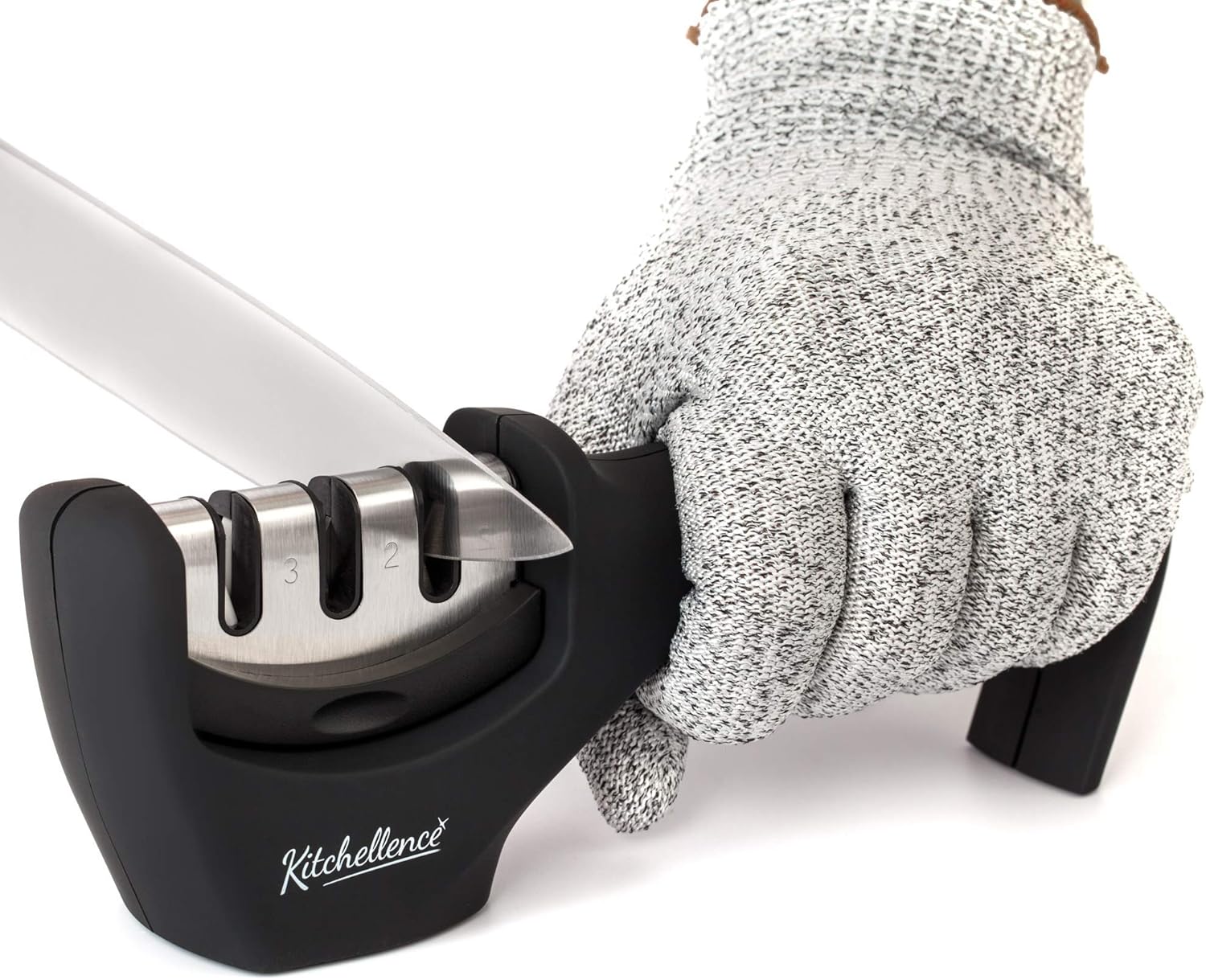
This KITCHELLENCE three-stage sharpener is a compact, user-friendly tool for restoring and polishing pocket and kitchen blades in minutes. The first stage uses a diamond rod to reshape damaged edges, the second slot reestablishes a V-shaped bevel, and the third fine-tunes and polishes the edge for smoother cuts. It is held steady by a non-slip base and an ergonomic handle so both right- and left-handed users can pull blades through the slots safely and consistently. The included cut-resistant glove increases safety while you work, and the ABS plastic body keeps the unit lightweight and portable for field or camp use. It is best suited to straight-edged knives rather than serrations, and aggressive re-profiling on very dull or chipped blades may require more passes or a professional service. For hunters who want a simple, low-risk way to maintain a sharp edge on the go, this kit balances speed, safety, and convenience.
Best for: Buyers who prioritize safe, straightforward edge maintenance in the field or kitchen and want a low-risk, easy-to-use sharpening solution.
Less Ideal for: Those needing a tool for serrated knives, heavy chip removal, or professional-grade reprofiling should choose a dedicated bench grinder or guided sharpening system instead.
- Three-stage system (diamond rod, sharpening slot, polishing slot) restores and refines edges efficiently
- Ergonomic handle and non-slip base make one-handed sharpening stable for right- or left-handed users
- Includes cut-resistant glove for added safety during use
- Lightweight ABS construction is easy to carry for field or camping use
- Not designed for serrated blades or heavy-duty blade re-profiling
- Plastic construction may feel less durable than metal-bodied sharpeners
Verdict: A compact, safe three-stage sharpener that gives hunters and outdoors users a fast, low-risk way to restore and polish straight edges on the go.
Choosing the Right Portable Hunting Knife Sharpener: Key Factors to Consider
Edge Restoration Speed
How quickly a sharpener brings a dull blade back to usable condition matters when you are on a hunt and need a working edge fast. A tool that re-profiles and refines an edge in a few passes reduces downtime and limits exposure to the elements.
Faster abrasive action usually comes from coarser stones or carbide elements, but that can remove more steel. Consider how aggressive the sharpening method is relative to how often you want to reprofile your knives.
Angle Consistency
Maintaining a consistent edge angle is critical for both cutting performance and blade longevity. Devices with fixed angle guides or simple, repeatable reference points help preserve the original grind and prevent oversteeping or creating a weak burr.
For hunters, who may be sharpening in low light or on uneven surfaces, a sharpener that enforces angle repeatability reduces the chance of accidental edge damage and maintains predictable cutting behavior.
Durability & Construction
A field sharpener should survive drops, moisture, and repeated use without losing alignment or having parts fail. Look for corrosion-resistant materials, secure fastenings, and abrasion elements that are bonded or easily replaced.
Poor construction can lead to wobble or uneven abrasion, which compromises the edge. Durability also affects long-term value when you rely on the tool season after season.
Field Portability
Portability covers size, weight, and how the sharpener packs with your gear. A compact tool that stows in a pack pocket or attaches to a belt is more likely to be carried consistently than a bulky unit.
Consider whether the sharpener needs additional accessories or liquids to function. The fewer loose parts and consumables, the better for remote outings.
Ease of Use
In-the-field sharpening often occurs in uncomfortable positions and without a stable bench. Tools that are intuitive, provide good hand clearance, and include non-slip grips make safe sharpening more likely.
Also assess whether the sharpener can be used one-handed or requires a second hand to steady the knife, since hunting tasks sometimes demand multitasking. Simple, repeatable motions matter more than advanced but fiddly systems when conditions are harsh.
Compatibility With Knife Types
Hunting knives vary: fixed blades, clip points, drop points, and some folding knives have different grinds and thicknesses. A good portable sharpener should handle common bevel angles and edge geometries without forcing modifications to your technique.
If you carry multiple knives, prioritize a tool with a broad compatibility range or easily changeable guides to avoid carrying multiple sharpening devices.
Common Portable Sharpener Types
Portable sharpeners generally fall into a few families: carbide or ceramic pull-throughs, guided rod systems, folding stone systems, and compact diamond plates. Each approach balances speed, control, and packability differently.
Carbide or ceramic pull-throughs are fast and easy but can be aggressive. Guided rod systems give more control over bevel angle and are good for re-profiling or maintaining a precise edge. Folding stones and diamond plates offer the most control and ability to refine an edge but may take more passes and technique.
- Carbide/ceramic pull-through: Quick touch-ups, simple.
- Guided rod systems: Better angle control and re-profiling.
- Folding stones: Low profile, versatile abrasives.
- Diamond plates: Long-lasting abrasives that cut fast.
How to Sharpen a Hunting Knife Safely in the Field
Secure the knife or maintain a firm grip and work on a stable surface when possible. Keep your fingers behind the edge path and make measured, consistent strokes according to the sharpener type. If using guided systems, follow the guide to maintain angle consistency across the blade length.
Start with coarser abrasive only when the edge is noticeably dull or nicked, then progressively move to finer abrasives to remove the burr and polish the edge. Wipe away metal particles and re-check the edge on thumb or paper tests to avoid over-sharpening.
- Work slowly and check progress frequently.
- Use light pressure on finishing passes to avoid overheating or over-thinning the edge.
- Keep the blade dry and clean before sharpening to prevent clogged abrasives.
Maintaining Your Sharpener in Outdoor Conditions
Keep abrasive surfaces free from grit and metal filings by tapping them gently or wiping with a dry cloth. For diamond plates, a quick brush can remove embedded metal. Avoid leaving components in prolonged wet conditions to minimize corrosion or bonding failures.
If the sharpener has replaceable parts or lubricants, carry only what you need for routine maintenance and know how to reassemble the unit correctly. Storing the sharpener in a small protective pouch helps prevent damage and keeps abrasive surfaces clean.
- Dry the sharpener after exposure to moisture before storage.
- Inspect guides and fasteners periodically for looseness.
- Replace consumable abrasives before they become ineffective in the field.
Choosing the Right Grit Progression
A practical field progression starts with a medium-coarse grit to remove edge deformation, followed by a medium to fine grit to refine the bevel, and an extra-fine finish only when you need a razor-sharp edge. Coarse-only systems are fine for quick repairs but will leave a toothy edge that dulls faster.
Consider whether the sharpener's grits are integrated or if you can add or swap stones. Systems that let you carry a compact fine abrasive for finish passes provide the best long-term cutting performance without excess bulk.
- Medium-coarse for rapid re-profiling.
- Medium-fine for everyday edge restoration.
- Fine for clean cuts and hair-shaving sharpness.
Practical Tips for Different Knife Steels
Harder steels retain a sharper edge longer but often take longer to re-sharpen. Softer steels are quicker to sharpen but lose their edge sooner. Match the aggressiveness of your abrasive to steel hardness to avoid unnecessary material removal.
If you are unsure of your knife steel, use a gentler approach and multiple light passes rather than aggressive pressure. This conservative method reduces the risk of ruining the edge geometry.
- Hard steels: use diamond or ceramic abrasives for efficiency.
- Softer steels: water stones or fine ceramic work well.
- When in doubt, use more passes with less pressure.
How We Chose the Best Portable Hunting Knife Sharpener
We focused on tools designed specifically for outdoor knife upkeep and tested selection criteria that matter in hunting contexts. Key evaluation factors included how quickly a sharpener restores a keen edge on typical hunting-knife steels, how well the device preserves blade geometry and edge angle, and how durable the construction is for repeated field use. We also prioritized usability features such as intuitive guides, one-handed operation, and secure blade retention to reduce the risk of slips while sharpening in low-light or cold conditions. Portability and weight were weighed heavily, since pack space and carry comfort matter on long treks. Finally, we assessed maintenance needs and whether the sharpener requires consumables that are hard to replace in remote areas. We excluded general-purpose kitchen or industrial sharpeners that are not optimized for hunting knives or that require mains power. We also filtered out devices that perform well only with very specific blade profiles, since hunters often carry a range of fixed and folding knives. The resulting list emphasizes practical balance between speed, safety, portability, and long-term edge life.
Our full evaluation process is outlined in our review methodology.
FAQ
Can I sharpen a serrated hunting knife with a portable sharpener?
It depends on the sharpener. Some portable kits include tapered files or special rods sized for serrations. If your tool lacks these, avoid forcing a serrated edge on a flat abrasive, since that can round or ruin the serration profile.
How often should I sharpen a hunting knife in the field?
Often it depends on use. Light maintenance can be done after a few days of heavy fieldwork, while full re-profiling is only necessary when cutting performance noticeably declines. Frequent light touch-ups preserve steel and reduce the need for aggressive grinding.
Will a compact sharpener handle both folding and fixed hunting knives?
Usually yes. Most portable sharpeners accommodate common blade thicknesses and bevels, but very thick or unusually ground blades might be awkward. Check that the device provides safe clearance for handles and guards on both folding and fixed designs.
Are diamond abrasives overkill for hunting knives?
Not necessarily. Diamond abrasives cut fast and last a long time, making them well suited for hard steels and field use. They can be more aggressive, so use finer grits for finishing to avoid over-thinning the edge.
Can I use lubricants like oil or water with portable sharpeners in the field?
Some systems are designed to be used dry while others recommend light lubrication. Check the tool's instructions. In the field, minimal or no lubricant is often more practical, but you should remove metal filings and keep surfaces clean to maintain abrasive effectiveness.
Final Verdict
Prioritize a sharpener that balances portability, angle control, and durability for hunting use. If you value speed and simple touch-ups, a compact pull-through or carbide-assisted option may suit you. If you want precision and the ability to reprofile edges, choose a guided rod or folding stone system that enforces angle consistency. Think about how you carry gear, the steels you commonly use, and whether you need a tool that requires little maintenance. The right field sharpener will keep knives safe and effective without adding unnecessary bulk to your pack.