
Note: This article contains affiliate links. If you click on these links and make a purchase, we may earn a small commission at no extra cost to you. This helps support our research and content. Read our full affiliate disclosure here.
If you bake frequently or work with dense doughs, a Powerful Countertop Mixer can save time and reduce fatigue. The right mixer matters because underpowered machines stall or overheat, while oversized units can be awkward for everyday use. This guide shortlists the top countertop mixers built for heavy-duty mixing and consistent results. We evaluated models with an eye toward motor strength, bowl capacity, attachment versatility, build quality, and user-friendly maintenance. Below you will find the best options for intensive home baking alongside clear reasons each made the cut, followed by practical buying guidance to help you match a mixer to the tasks you bake most often.
Top Picks at a Glance
| Best Overall The best all-around choice for most situations | Bosch Universal Plus 6.5-Quart Mixer |  |
| Best Quality Built to a higher standard if you want something more solid | Cuisinart Stand Mixer SM-50BC |  |
| Best Value The sweet spot between price and what you get | Hamilton Beach 4‑Quart Stand Mixer |  |
| Best Budget The cheapest option that still gets the job done reliably | Dash Everyday Stand Mixer |  |
| Top Rated A top-rated pick with lots of positive feedback | KitchenAid Classic Series K45SS |  |
| Most Popular A crowd favorite that many people choose with confidence | KitchenAid Artisan 5-Quart Mixer |  |
| Best Seller A high-volume bestseller chosen again and again | Kitchen in the box 3.2QT Stand Mixer | 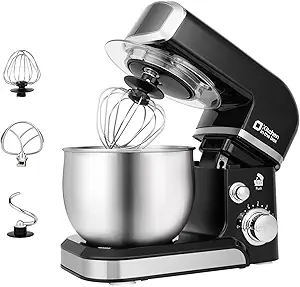 |
Bosch Universal Plus 6.5-Quart Mixer

| Wattage | 500 watts |
|---|---|
| Voltage | 230 volts |
| Number of Speeds | 4 |
| Capacity | 6.5 quarts |
The Bosch Universal Plus is a torque-focused countertop mixer designed for serious home bakers who want a workhorse rather than a compact appliance for light tasks. Its bottom-drive 500-watt motor delivers high torque directly into a 6.5-quart bowl, which the manufacturer says can handle very large batches including up to 14 loaves of dough or dozens of cookies. The machine ships with dual wire whips that produce a triple-whip action for fast volume building, a heavy-duty dough hook with an extender for small batches, and a splash ring with lid for messy mixes. Four suction feet add stability during kneading and the simple knob controls offer four speeds plus pulse for straightforward operation. The plastic bowl and removable drive shaft make cleanup easier and several parts are dishwasher safe, though the body is mostly plastic which keeps weight down but may feel less premium than metal-bodied competitors. Expandability is strong thanks to many optional attachments for grinding, slicing, and pasta making, but those extras are sold separately.
Best for: Buyers who want a powerful, high-torque mixer for frequent batch baking and heavy doughs and who value capacity and expandability over premium metal construction.
Less Ideal for: If you need a compact, lightweight mixer for occasional small tasks or prefer an all-metal premium finish, this unit is not the best match.
- High-torque bottom-drive motor suited to heavy doughs and large batches
- Large 6.5-quart bowl handles big recipes for families or batch baking
- Triple-whip dual-beater design efficiently whips small and large volumes
- Stable operation with four suction feet reduces movement during kneading
- Dishwasher-safe removable bowl and parts simplify cleanup
- Body and bowl are plastic rather than metal, which may feel less durable
- Only four speeds plus pulse might limit fine speed control compared with some competitors
Verdict: Choose this mixer if you need a high-torque, large-capacity countertop machine built to handle heavy doughs and big batches.
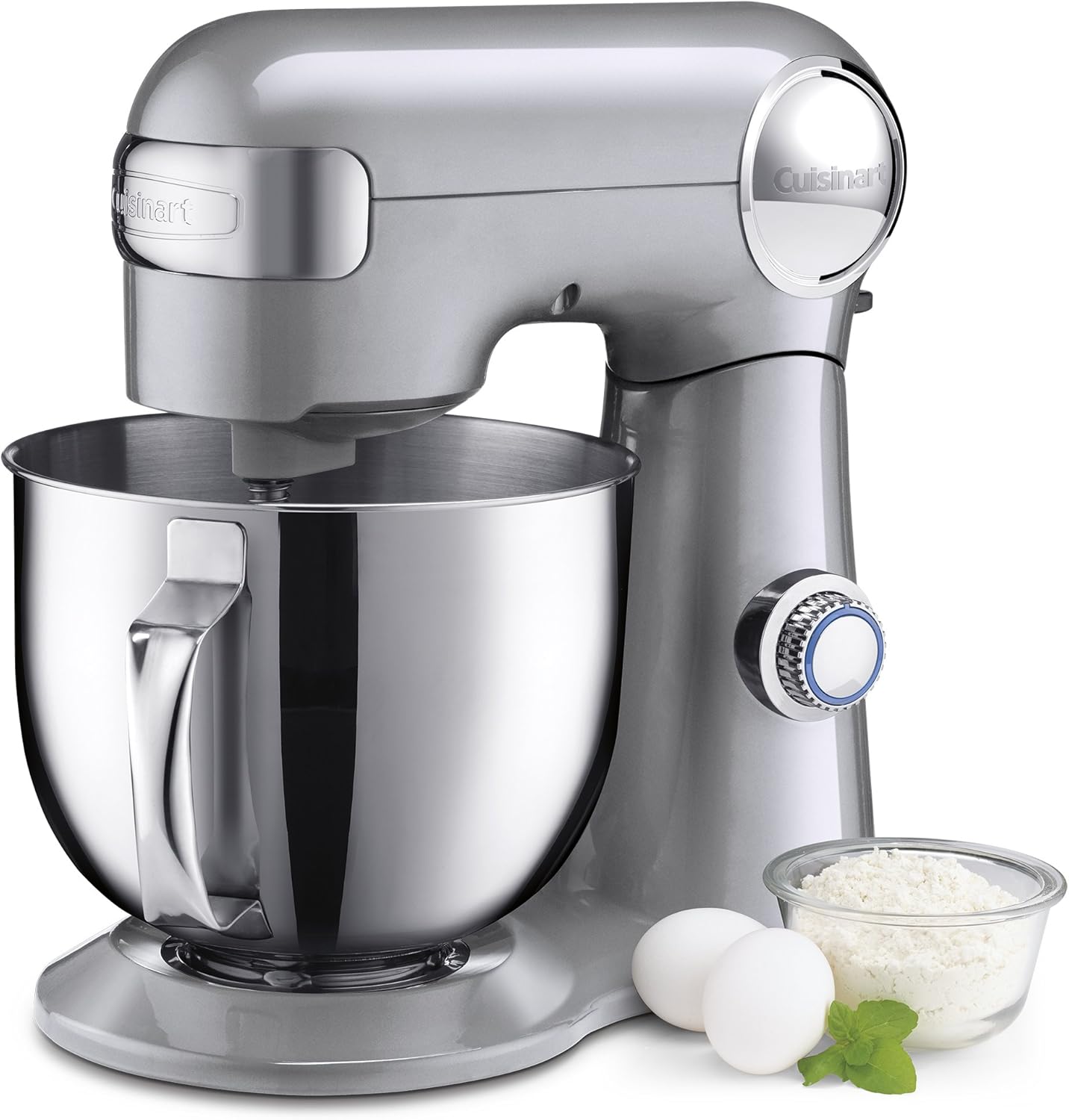
Cuisinart Stand Mixer SM-50BC
| Capacity | 5.5 quarts |
|---|---|
| Wattage | 500 watts |
| Number of Speeds | 12 |
| Controls Type | Knob |
| Voltage | 110 volts |
The Cuisinart SM-50BC is a metal-bodied tilt-head stand mixer built for everyday and serious home baking tasks. Its 500-watt motor and 12-speed knob control cover everything from slow dough kneading to whipping egg whites, while the 5.5-quart stainless steel bowl handles medium to large batches. Included accessories—the chef's whisk, flat paddle, and dough hook—are dishwasher safe and work well for batters, doughs, and whipped creams, and the splash guard with pour spout keeps counters cleaner during high-speed mixing. The mixer accepts a range of optional attachments for pasta, meat grinding, and frozen desserts, which expands its capability beyond basic mixing. The die-cast metal construction feels stable during heavier mixes, though the tilt-head design means accessing the bowl is straightforward rather than tool-free like some bowl-lift models. If you value motor power, a roomy bowl, and a rugged build for regular baking, this mixer delivers solid, consistent performance for home kitchens.
Best for: Buyers who prioritize strong motor performance and a durable, no-nonsense mixer for frequent baking and larger batch prep. Ideal for home bakers who want a machine that handles heavy doughs, whipping, and multi-step recipes reliably.
Less Ideal for: People who need a commercial-grade mixer or who prefer bowl-lift machines with digital controls and built-in timers for precision professional workflows.
- 500-watt motor provides strong, consistent power for heavy mixes
- 12-speed control offers fine speed adjustment for different recipes
- Die-cast metal construction gives a stable, durable feel during use
- 5.5-quart stainless steel bowl suits medium to large batches and is dishwasher safe
- Includes whisk, paddle, dough hook, and splash guard with pour spout for cleaner mixing
- Tilt-head design can be less stable than bowl-lift designs for very heavy, high-volume doughs
- No timer or digital controls for precise timing
Verdict: Choose this Cuisinart if you want a powerful, metal-built stand mixer that delivers reliable heavy-duty performance for frequent home baking.
Hamilton Beach 4‑Quart Stand Mixer

| Wattage | 300 watts |
|---|---|
| Capacity | 4 quarts |
| Number of Speeds | 7 |
| Voltage | 110 |
The Hamilton Beach 4‑Quart Stand Mixer is a straightforward countertop mixer aimed at home bakers who want reliable, hands-free mixing without spending on premium brands. Its 300-watt motor and planetary mixing action deliver even coverage across the stainless steel 4‑quart bowl, making it useful for batters, cookie dough and light bread dough. The unit offers seven speeds plus a slow first speed to reduce splatter when combining wet and dry ingredients, and a simple knob control with a mixing guide on the head helps pick the right setting. It ships with a whisk, flat beater, dough hook and a splash guard, and the bowl and attachments are dishwasher safe for easy cleanup. Carry handle and a compact footprint make it easy to lift and store. Keep in mind the motor is sized for household use rather than heavy commercial batches, so very large or extremely dense doughs may strain it and require shorter cycles or smaller batches.
Best for: Home bakers who want a capable, no-frills stand mixer that handles everyday batters, cookies and small-to-medium bread doughs without a premium price or complexity.
Less Ideal for: Those baking very large batches regularly or needing commercial-grade power should choose a higher-wattage, professional model instead.
- Planetary mixing action for even bowl coverage
- Includes whisk, flat beater, dough hook and splash guard
- Seven speed settings plus slow first speed to reduce splatter
- Dishwasher-safe stainless steel bowl and attachments
- 300-watt motor may struggle with very large or very dense doughs
Verdict: A practical, budget-friendly stand mixer that delivers reliable everyday mixing for home bakers looking to optimize countertop performance without paying for pro power.
Dash Everyday Stand Mixer

| Wattage | 250 |
|---|---|
| Number of Speeds | 6 |
| Capacity | 3 liters |
| Controls Type | Knob |
| Voltage | 110 |
The Dash Everyday Stand Mixer is a lightweight, space-saving countertop machine aimed at routine home baking and cooking tasks. Its 250W motor and six speed settings cover common jobs from stirring batter and whipping cream to kneading small batches of dough, while the tilt-head design makes it easy to add ingredients and swap the included dough hooks and beaters. The 3-quart stainless steel bowl locks in place for stable mixing and all non-electric attachments are dishwasher safe, which keeps cleanup simple. Because the unit is compact and weighs under 5 pounds it is easy to move and stores neatly under cabinets, but that lighter construction also means it is best suited to small to medium batches rather than heavy, continuous commercial use. The mixer is programmable and uses simple knob controls, so it is approachable for beginners yet functional enough for regular home cooks who want a reliable, no-frills appliance for everyday recipes.
Best for: Buyers looking for an affordable, easy-to-use stand mixer for everyday home baking and small to medium batch recipes who prioritize compact size and simplicity.
Less Ideal for: Users who need a heavy-duty mixer for large batches, frequent bread baking, or continuous high-torque commercial use should look at larger, more powerful models.
- Compact, lightweight design that fits easily on most countertops and stores under cabinets
- Includes a 3-quart stainless steel bowl plus dough hooks and beaters for common mixing tasks
- Six speeds and a tilt-head make it simple to handle everything from gentle stirring to whipping
- Dishwasher-safe non-electric parts speed cleanup after use
- 250W motor and compact size limit performance on very large or heavy doughs
Verdict: A budget-friendly, compact stand mixer that handles everyday mixing and small-batch baking with straightforward controls and easy cleanup.
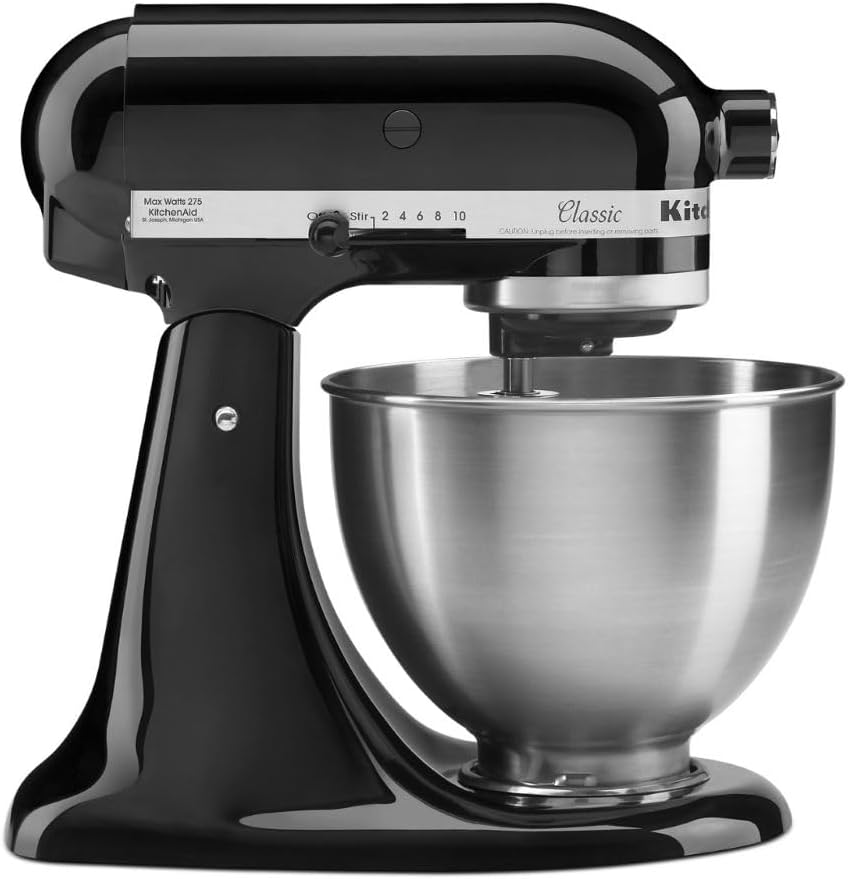
KitchenAid Classic Series K45SS
| Capacity | 4.5 quarts |
|---|---|
| Number of Speeds | 10 |
| Wattage | 275 watts |
| Included Components | Flat beater, dough hook, 6-wire whip, stainless steel bowl |
The KitchenAid Classic Series K45SS is a straightforward, durable tilt-head stand mixer built for routine baking and home kitchen tasks. Its 4.5-quart stainless steel bowl and 10-speed motor handle mixing, whipping, and light to medium doughs, while the included flat beater, dough hook, and 6-wire whip cover most common recipes. The metal construction and the mixer's many contact points around the bowl help produce consistent mixing results, and the tilt-head design makes adding ingredients and changing tools easy. The power hub accepts optional attachments for grinding, pasta making, and other tasks if you want to expand functionality. At 275 watts it is not the most powerful professional machine, so very heavy or large-volume bread doughs will take longer or require smaller batches, but for cookie batters, cakes, whipped cream, and everyday baking it is reliable and simple to use. Controls are basic and intuitive, and the stainless steel bowl is dishwasher safe for cleanup.
Best for: Buyers who prioritize a dependable, no-frills mixer for everyday home baking and value longstanding build quality over professional-level power.
Less Ideal for: Those who routinely mix very large batches or heavy artisanal bread doughs should consider a higher-power, commercial-style mixer instead.
- Durable metal construction designed for long-term use
- 4.5-quart stainless steel bowl suits most household batches
- Includes flat beater, dough hook, and 6-wire whip for common tasks
- Tilt-head design and removable bowl make ingredient access and cleanup easy
- 275-watt motor is modest for very heavy or very large doughs
Verdict: A reliable, well-built 4.5-quart stand mixer that delivers consistent everyday performance for home bakers who value durability.
KitchenAid Artisan 5-Quart Mixer

| Capacity | 5 quarts |
|---|---|
| Wattage | 350 |
| Number of Speeds | 10 |
| Voltage | 120 volts |
The KitchenAid Artisan 5-Quart Tilt-Head Stand Mixer is a full-featured countertop mixer built for home bakers who make anything from cookies to bread and whipped creams. It uses a metal, long-lasting housing and a 350W motor to drive a planetary mixing action across 10 speeds, and the tilt-head gives easy access for adding ingredients or swapping attachments. The included polished stainless steel bowl, coated flat beater, dough hook, and 6-wire whip cover most mixing needs, and the bowl handles and pouring shield make larger batches less messy. Its capacity is large enough for multi-dozen cookie batches or family-sized doughs, and the hub accepts optional powered attachments for grinding or pasta making. The mixer is heavier and more substantial than compact models, so it stays stable during heavy duty mixing, but it is not a lightweight for storage or frequent countertop moves. This model focuses on durability and versatility rather than minimal footprint, making it a solid choice for cooks who want a dependable, long-lived kitchen workhorse.
Best for: Buyers who prioritize a proven, durable mixer for frequent home baking and want confidence from a widely used model with lots of social proof.
Less Ideal for: If you need a lightweight, highly portable mixer for occasional use or require a commercial-grade motor for continuous heavy production, consider other options.
- Sturdy metal construction designed for long-term use
- 5-quart stainless steel bowl handles large batches including multi-dozen cookies
- Ten speed settings cover stirring, mixing, kneading, and whipping tasks
- Includes essential attachments: flat beater, dough hook, 6-wire whip and pouring shield
- Tilt-head design provides easy access for adding ingredients and changing tools
- Relatively heavy and bulky compared with compact or portable mixers
- 350W motor may be less powerful than some professional-grade, higher-watt models
Verdict: A reliable, heavy-duty home mixer that delivers versatile, consistent performance for serious home bakers.
Kitchen in the box 3.2QT Stand Mixer

| Capacity | 3.2QT |
|---|---|
| Power | 300 watts |
| Number of Speeds | 6 |
| Included Components | Whisk, Beater, Dough Hook |
| Special Features | Dishwasher Safe accessories |
This Kitchen in the box stand mixer is a lightweight, space-saving machine aimed at everyday home baking for one to two people. It uses a 300W motor with planetary rotation and six speed settings to handle tasks from gentle stirring to whipping cream and mixing thicker batters; included attachments are an aluminum dough hook, flat beater, and stainless steel whisk. The tilt-head design and removable 3.2QT stainless bowl make loading and cleaning straightforward, and a transparent splash guard helps prevent messes. Four suction feet stabilize the unit during use, and accessories are dishwasher-safe for easier cleanup. Limits are its small bowl capacity and modest power, so it is not built for large batches or heavy commercial dough; the mechanical speed control can produce a stronger initial torque at startup so beginners should start on low speed. For buyers wanting a compact, inexpensive mixer for routine home baking, it offers practical performance and simple maintenance in a small footprint.
Best for: Buyers who prioritize a compact, easy-to-use mixer for daily home baking or small-batch recipes and want a reliable, low-cost appliance that fits limited counter or cabinet space.
Less Ideal for: Serious bakers or households that regularly mix large batches, heavy bread doughs, or need commercial-level power and capacity should look at larger, higher-wattage machines.
- Compact, lightweight design for easy storage and small kitchens
- Removable 3.2QT stainless steel bowl with tilt-head access for simple loading and cleaning
- Three durable attachments (dough hook, flat beater, stainless whisk) cover common mixing tasks
- Six speed settings with planetary rotation let you mix everything from stirring to whipping
- Dishwasher-safe accessories and splash guard reduce cleanup time
- Small 3.2QT capacity is unsuitable for large batches or frequent heavy dough mixing
- 300W motor is modest and may struggle with very stiff doughs
Verdict: A compact, user-friendly stand mixer that delivers practical everyday performance for small-batch home baking and tight kitchens.
Choosing the Right Powerful Countertop Mixer: Key Factors to Consider
Motor Power And Continuous Duty
Motor power determines how easily a countertop mixer handles thick doughs and large batches. Look for machines with motors specified for continuous or rated duty cycles rather than short-burst ratings. Higher wattage and good torque at low speeds reduce the chance of stalling when mixing bread or dense cookie dough.
Continuous-duty motors run cooler under load and often include thermal protection. Buyers who frequently knead or make high-hydration doughs should prioritize motor specs and any manufacturer guidance on recommended batch sizes to avoid premature wear.
Bowl Capacity And Accessibility
Bowl volume and shape affect how much you can mix at once and how evenly ingredients incorporate. Larger bowls let you scale recipes up without overcrowding, but very large bowls can be heavy to lift and may require more storage space. Tilt-head and bowl-lift designs influence operator comfort and how easy it is to add ingredients during mixing.
Consider the typical batch sizes you make. If you often bake multiple loaves or large cakes, choose a mixer with extra capacity. Also evaluate how the bowl locks and how easy it is to remove and clean, since frequent use increases the importance of quick handling.
Attachment Compatibility And Usefulness
A mixer is more useful when its attachments cover the tasks you need. Standard beaters, dough hooks, and whisks are essential, but optional accessories like pasta rollers, meat grinders, or flexible spatulas expand functionality. Attachment fit and connection robustness matter: poorly fitting tools can wobble or strip drive gears when stressed.
Check whether the unit supports commercially available attachments or uses proprietary fittings. For many home bakers, solid dough hooks and a reliable whisk are the highest priority; specialty accessories are bonus features.
Build Materials And Serviceability
Durable materials and solid construction extend a mixer's working life. Metal gear housings, die-cast heads, and stainless-steel bowls typically outlast plastic-heavy designs. Serviceability matters too: accessible grease points, replaceable drive belts or gears, and readily available replacement parts reduce downtime and long-term ownership cost.
If you plan to use the mixer heavily, favor designs with clear maintenance guidance and a track record of durable components. Consider whether routine wear parts are user-replaceable or require professional service.
Noise, Vibration, And Stability
Powerful motors can produce significant noise and vibration if not properly isolated. Excessive vibration affects mixing consistency and can be annoying in an open kitchen. Stable feet, low center of gravity, and internal damping reduce movement during high-torque cycles.
For frequent bakers, choose a mixer that balances power with noise control. Look for machines that remain steady on countertops and include anti-slip pads or a heavy base to minimize movement when handling dense doughs.
Ease Of Cleaning And Daily Use
A mixer that is easy to clean encourages regular use. Removable bowls and dishwasher-safe attachments speed cleanup, while smooth surfaces and accessible crevices reduce trapped batter. Controls that are simple to operate and detachable parts that do not require tools save time between bakes.
Consider how often you will use the mixer and whether quick cleanup is essential. If you bake daily, prioritize designs that minimize fiddly parts and allow fast disassembly.
Matching Mixer Size To Your Baking Habits
Choosing the right mixer size starts with assessing how much you typically bake. If you produce multiple loaves, large batches of cookies, or frequent sheet cakes, a larger bowl and stronger motor will make repetitive tasks faster and less taxing.
For occasional small-batch recipes, a compact but robust mixer may be preferable to save counter space. Think about storage and lifting when the bowl is full, and whether you want the flexibility to scale up recipes later.
- Small batches: compact mixers with 3 to 4.5 quart bowls.
- Regular family baking: 5 to 6 quart bowls balance capacity and footprint.
- Large or frequent batches: 6.5 quart and larger for serious home bakers.
Common Attachments Worth Investing In
Beyond the basic paddle, hook, and whisk, some attachments provide real time savings. A splash guard keeps flour contained when adding dry ingredients, while a flexible spatula or scraper attachment reduces manual cleanup between speed changes.
Specialty tools such as pasta rollers or food grinders can extend a mixer's usefulness, but only if attachment coupling is robust and the motor can handle the additional load. Prioritize durable, well-made accessories that match the mixer's power rating.
- Essential: dough hook, flat beater, whisk.
- Helpful: splash guard, additional bowls, flexible paddles.
- Optional: specialty rollers or grinders if motor capacity allows.
Maintaining Your Mixer For Long Life
Regular maintenance keeps a countertop mixer performing well. Clean attachments and bowls after each use and wipe the head and base to prevent buildup. Follow manufacturer guidance on lubrication intervals for gear housings where applicable.
Monitor unusual noises or changes in performance, which can indicate worn gears or motor strain. Replace worn attachments and seals promptly to avoid further mechanical damage.
- Wipe down the exterior after each use to prevent residue buildup.
- Hand-wash attachments if recommended and dry thoroughly before storage.
- Inspect drive couplings and replace worn parts rather than forcing heavy loads.
Noise And Kitchen Comfort Considerations
Powerful mixers can be loud, particularly at high speeds. If you live in a small space or use the mixer early in the morning, look for models with noise reduction features or better motor insulation. The mixer's base design also affects how much vibration transfers to the countertop.
Simple steps like placing the machine on a rubber mat or choosing a sturdier counter can reduce transmitted vibration and improve perceived noise levels.
- Consider anti-vibration mats or dedicated baking stations.
- Check user documentation for recommended speed ranges to minimize noise.
- Avoid running at top speed unnecessarily when lower speeds suffice.
Power Use And Electrical Requirements
High-power mixers draw more current than lightweight models. Verify that your kitchen circuits can handle the mixer's continuous draw, especially if you run other appliances at the same time. Using an outlet on a dedicated circuit reduces the chance of tripped breakers during long mixing sessions.
Also consider cord length and placement so you can position the mixer safely without stretching or routing power cables across counters where they can snag.
- Check the mixer's rated wattage and recommended circuit type.
- Avoid sharing a circuit with heavy-load appliances during mixing.
- Ensure cord routing keeps the workspace safe and uncluttered.
How We Chose the Best Powerful Countertop Mixer
We focused on real-world mixing needs for home bakers who regularly work with thick batters and heavy doughs. Selection began with machines designed for frequent use rather than occasional baking. We prioritized models with motors rated for continuous operation under load, robust drive trains, and thermal protection features that prevent shutdowns during long mixing sessions. Key evaluation criteria included motor power and torque, bowl size and shape, attachment design and compatibility, build materials and durability, and serviceability for common wear items. We also considered noise and vibration management, since comfortable operation matters in a home kitchen. Models that lacked clear motor-duty ratings, had flimsy attachments, or poor user-accessible maintenance features were excluded. We did not include small hand mixers, light-duty hobby machines, or units intended only for occasional use. Our final picks reflect combinations of power, capacity, and day-to-day reliability that match heavier baking workloads.
Our full evaluation process is outlined in our review methodology.
FAQ
How much motor power do I really need for bread dough?
It depends on batch size and dough hydration. For regular home bread loaves, a mixer with higher torque and a motor rated for continuous duty will knead reliably. Larger batches or frequent kneading sessions benefit from a more powerful motor to avoid stalling and overheating.
Can I use a powerful countertop mixer for pasta and meat grinding?
Often yes, if the mixer supports optional specialty attachments and the motor is rated for additional loads. Check the attachment coupling strength and any manufacturer guidance about permissible accessory use to avoid strain.
Is a bowl-lift design better than a tilt-head for heavy use?
Bowl-lift mechanisms generally provide more stability and handle heavier loads better, which helps with large doughs. Tilt-head mixers are easier to access for small tasks but can be less rigid under high torque.
How do I reduce vibration when my mixer runs at high speed?
Make sure the mixer is on a level, solid surface and use anti-slip pads or a rubber mat. Secure the bowl properly and avoid overloading the mixer, since uneven ingredient distribution can increase vibration.
Are metal bowls always preferable to glass or plastic?
Stainless-steel bowls are durable, lighter to handle when full, and often dishwasher-safe, making them a practical choice for heavy use. Glass or plastic may be fine for occasional tasks but can chip or warp over time.
Final Verdict
Prioritize motor strength, bowl capacity, and durable attachments when choosing a powerful countertop mixer. Consider how often you bake, the batch sizes you plan to make, and whether you want extra functionality from accessories. Be mindful of tradeoffs between size and storage, and favor models with clear maintenance guidance and solid construction. Focus on the mixer's continuous-duty capabilities and practical daily-use features to ensure reliable performance for heavy baking tasks. Choosing based on those criteria will help you select a machine that meets both capacity needs and long-term durability.