
Note: This article contains affiliate links. If you click on these links and make a purchase, we may earn a small commission at no extra cost to you. This helps support our research and content. Read our full affiliate disclosure here.
If you bake frequently or make large loaves, a powerful dough mixer changes the game. You want a machine that can handle dense, sticky dough without bogging down, finish kneads faster, and stand up to repeated use. This guide rounds up the top shortlisted powerful dough mixers that suit home bakers aiming for consistent results and less manual effort. We assess machines by motor strength, bowl capacity, build durability, and practical features like speed control and ease of cleaning. Below are the best options we vetted for heavy dough tasks, followed by detailed buying factors and common user questions to help you pick the right model for your kitchen.
Top Picks at a Glance
| Best Overall The best all-around choice for most situations | Cuisinart Stand Mixer SM-50R |  |
| Best Value The sweet spot between price and what you get | Hamilton Beach 4-Quart Stand Mixer |  |
| Best Budget The cheapest option that still gets the job done reliably | Dash Everyday Stand Mixer |  |
| Top Rated A top-rated pick with lots of positive feedback | KitchenAid Classic Series K45SS |  |
| Most Popular A crowd favorite that many people choose with confidence | KitchenAid Artisan 5-Qt Mixer |  |
| Best Seller A high-volume bestseller chosen again and again | Kitchen in the box 3.2QT Stand Mixer | 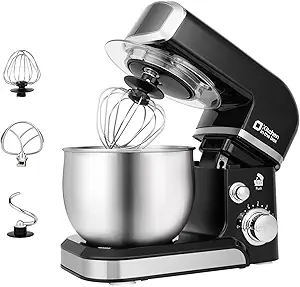 |
Cuisinart Stand Mixer SM-50R

| Capacity | 5.5 quarts |
|---|---|
| Motor power | 500-watt motor |
| Number of speeds | 12 |
| Included components | Whisk, dough hook, flat paddle, splash guard |
The Cuisinart SM-50R is a metal-bodied tilt-head stand mixer built for everyday baking and heavier dough tasks thanks to its 500-watt motor and 12-speed control. It handles mixing, whipping, and kneading in the included 5.5-quart stainless bowl and comes with a whisk, flat paddle, dough hook, and a splash guard with pour spout so you can work with wet batters without messy countertops. Controls are simple: a knob for choosing one of 12 speeds, which gives enough range for slow kneading up through high-speed whipping. The mixer accepts optional attachments for pasta, meat grinding, and frozen desserts if you want to expand beyond basic mixing. Practical benefits include dishwasher-safe accessories and a durable die-cast metal build that stays stable during heavier batches. The tilt-back head makes bowl access and accessory changes easy, but the unit is relatively heavy and takes some counter space, so it is best suited where it will be a long-term kitchen fixture rather than a frequently moved appliance.
Best for: Home bakers who want a powerful, stable all-purpose mixer that can handle regular bread doughs, cakes, and expanded attachments over time.
Less Ideal for: People who need an ultra-compact or very lightweight mixer for occasional use or those who plan to frequently move the appliance between locations.
- 500-watt motor and 12 speeds handle heavy dough and delicate whipping
- Durable die-cast metal construction for stability during mixing
- Includes stainless steel 5.5-quart bowl and three common attachments
- Tilt-back head and splash guard with pour spout for convenient access and cleaner mixing
- Accessories and bowl are dishwasher-safe for easier cleanup
- Relatively heavy and requires dedicated counter space
- Wattage listed inconsistently in product fields (110 watts vs 500-watt motor) which may confuse buyers
Verdict: A solid, metal-bodied 5.5-quart mixer with a 500-watt motor and 12 speeds that delivers dependable performance for regular dough and baking tasks.
Hamilton Beach 4-Quart Stand Mixer

| Capacity | 4 quarts |
|---|---|
| Wattage | 300 watts |
| Number of Speeds | 7 |
| Voltage | 110 |
The Hamilton Beach 4-quart stand mixer is a compact, no-frills machine aimed at everyday home baking tasks. Its 300 watt motor and planetary mixing action give consistent, full-bowl coverage for batters, cookie dough and moderate bread doughs, while the seven-speed knob and a deliberately slow first speed help reduce splatter and make kneading more controlled. The package includes a stainless steel 4-quart bowl with handles, a splash guard, dough hook, flat beater and whisk, and those parts are dishwasher safe which keeps cleanup simple. The built-in handle on the mixer head makes lifting and moving the unit easier than many countertop competitors. Limits are practical: the 300W motor and 4-quart capacity mean it is best for small to medium batches rather than heavy commercial loads or very large loaves. For home bakers who want dependable mixing without premium pricing, it covers the core functions and accessories you actually use day to day.
Best for: Buyers who prioritize practical, reliable home baking performance and want a compact mixer that handles typical batches of cookies, cakes and small bread loaves without extra bells.
Less Ideal for: Bakers who regularly make large-volume doughs, commercial quantities, or oversized loaves should choose a higher-capacity, higher-power machine instead.
- Planetary mixing action for even, full-bowl mixing
- Seven speeds including a slow first speed to reduce splatter and aid kneading
- Includes stainless steel 4-quart bowl and common attachments (dough hook, flat beater, whisk)
- Dishwasher-safe bowl and attachments for easy cleanup
- Compact design with a built-in handle for easier lifting and storage
- 300 watt motor is not ideal for very large or frequent heavy dough batches
- 4-quart capacity limits batch size for serious home bakers
Verdict: A straightforward, dependable 4-quart mixer that gives even, hands-free mixing for small to medium home baking batches.
Dash Everyday Stand Mixer

| Capacity | 3 liters |
|---|---|
| Wattage | 250 |
| Number of Speeds | 6 |
| Controls Type | Knob |
| Container Material | Stainless Steel |
The Dash Everyday Stand Mixer is a lightweight, space-saving tilt-head mixer designed for routine baking and small-batch dough work. It uses a 250 watt motor with six speed settings to handle tasks from stirring and whipping to kneading, and it ships with two dough hooks, two beaters, and a 3-quart stainless steel bowl so you can mix bread dough, cookie batter, frosting, and cream reliably. The compact plastic housing keeps the footprint small and the unit easy to move, while the removable stainless bowl and attachments are dishwasher safe for fast cleanup. Practical limits are its modest motor power and 3-quart capacity, which make it best for small to medium batches rather than heavy commercial doughs or very large loaves. The tilt-head design makes adding ingredients and swapping attachments simple, and the knob controls are intuitive for beginners. For everyday home bakers after a budget-friendly, easy-to-store mixer, this model covers the common tasks without unnecessary complexity.
Best for: Home bakers shopping on a tight budget who need a compact, easy-to-use mixer for small to medium batches and everyday baking tasks.
Less Ideal for: Those who routinely make large batches, commercial quantities, or very dense doughs should choose a larger, more powerful mixer instead.
- Compact, lightweight design that fits on most countertops and is easy to store
- Comes with two dough hooks and two beaters plus a 3-quart stainless steel bowl
- Six speed settings provide control for whipping, mixing, and kneading
- Dishwasher-safe attachments and removable bowl simplify cleanup
- 250W motor and 3-quart capacity limit performance on very heavy or large dough batches
- Plastic housing may feel less durable than heavier metal-bodied mixers
Verdict: If you want an affordable, compact mixer that handles everyday baking and small-batch doughs, the Dash Everyday Stand Mixer is a practical, space-saving choice.
KitchenAid Classic Series K45SS
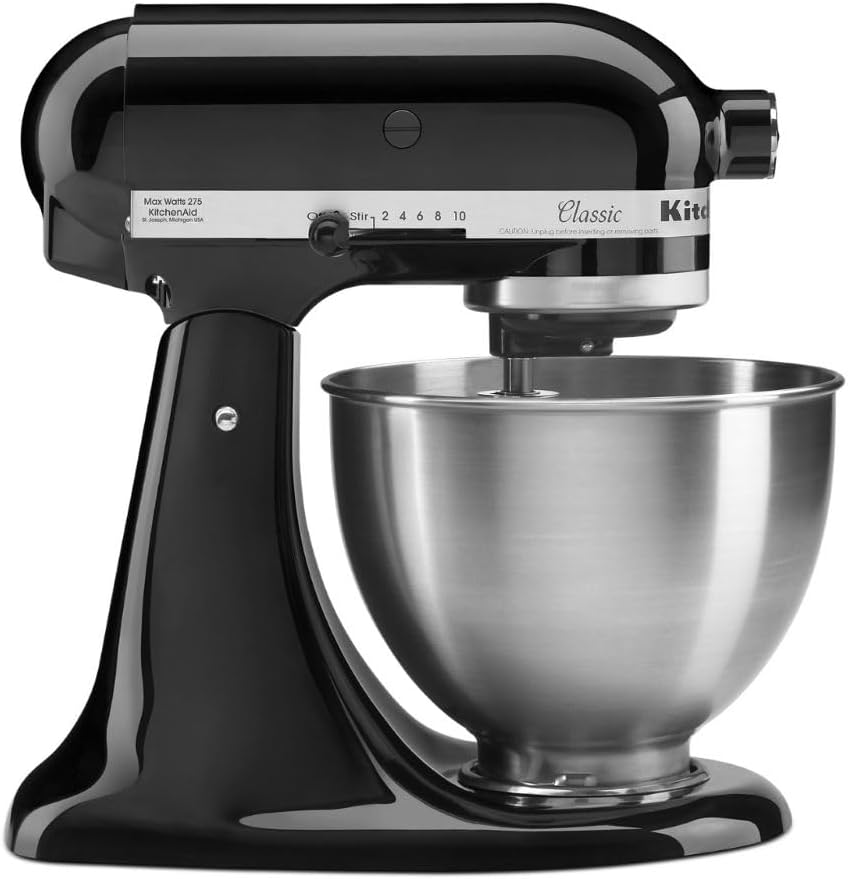
| Capacity | 4.5 quarts |
|---|---|
| Wattage | 275 watts |
| Number of Speeds | 10 |
| Included Components | Flat beater, dough hook, 6-wire whip, stainless steel bowl |
The KitchenAid Classic Series K45SS is a straightforward, heavy-duty tilt-head stand mixer built for regular home baking and dough work. It pairs a 4.5-quart stainless steel bowl with a 275-watt motor and 10 speed settings to handle mixing, whipping, and light-to-moderate dough kneading; the tilt-head design makes adding ingredients and swapping included tools simple. The metal construction and 59 bowl touchpoints improve ingredient incorporation and give the mixer a solid, long-lived feel, and the power hub accepts optional attachments to extend functionality beyond the basic accessories. Practical benefits include dishwasher-safe bowl and easy-to-clean coated beaters, hooks, and whisk, plus a compact footprint that fits most counters. Limitations are that the 275-watt motor and 4.5-quart capacity are aimed at home bakers rather than commercial or very heavy-duty dough batches, and very stiff or very large-volume doughs may strain the unit. For cooks who want a reliable, durable mixer for everyday and occasional specialty attachments, this model delivers consistent performance.
Best for: Home bakers who prioritize a reliable, long-lasting mixer for regular cookie, cake, and small-to-medium dough batches and who value a mixer that accepts optional attachments for extra versatility.
Less Ideal for: People who regularly need to mix very large volumes or very stiff commercial doughs should consider higher-capacity, heavier-duty models instead.
- Durable metal construction with 59 touchpoints for consistent mixing
- 10 speed settings cover stirring, whipping, and most kneading tasks
- Includes stainless steel 4.5-quart bowl and common mixing tools
- Power hub supports optional attachments for added versatility
- 275-watt motor and 4.5-quart capacity are not ideal for commercial or very large dough batches
- Tilt-head design can limit clearance for very tall bowls or attachments
Verdict: A durable, reliable 4.5-quart stand mixer well suited to everyday home baking and occasional specialty attachments.
KitchenAid Artisan 5-Qt Mixer

| Capacity | 5 quarts |
|---|---|
| Wattage | 325 watts |
| Number of Speeds | 10 |
| Voltage | 120 volts |
The KitchenAid Artisan 5-Quart Tilt-Head Stand Mixer is a heavy-duty home mixer built to handle everything from cookie dough to whipped cream. It uses a durable metal construction and a 325-watt motor to drive a 5-quart stainless steel bowl, and the tilt-head design makes it easy to add ingredients or swap attachments. The mixer ships with a coated flat beater, dough hook, 6-wire whip and a pouring shield, and the ten-speed knob provides slow stir through high-speed whipping for a wide range of recipes. In practice the Artisan can mix large batches—KitchenAid cites up to nine dozen cookies—and the solid build and 59 touchpoints around the bowl promote consistent results and long life. The mixer accepts hub-driven attachments for tasks like pasta or grinding when you want to expand usage. It is a substantial, heavier appliance and takes counter or storage space, and buyers focused only on occasional light tasks may find it more than they need. For bakers who value reliability and broad capability, it performs predictably and feels like a long-term kitchen tool.
Best for: Buyers who want a dependable, long-lasting home mixer for frequent baking and large batches and who prioritize proven performance and real-user results.
Less Ideal for: If you need a lightweight, ultra-compact machine for occasional single-serve mixing or a commercial mixer for continuous professional use, this is not the best fit.
- Robust metal construction for long-term durability
- 5-quart stainless steel bowl that handles large batches
- Comes with flat beater, dough hook, wire whip and pouring shield
- Ten-speed control for precise mixing from stir to high-speed whip
- Tilt-head design for easy access when adding ingredients or changing tools
- Relatively heavy and requires dedicated counter or storage space
- No motor power spec beyond wattage; not marketed as a commercial-grade mixer
Verdict: Choose the KitchenAid Artisan if you want a proven, heavy-duty home mixer that reliably handles large doughs and frequent baking sessions.
Kitchen in the box 3.2QT Stand Mixer

| Capacity | 3 liters |
|---|---|
| Wattage | 300 watts |
| Number of Speeds | 6 |
| Included Components | Whisk, Beater, Dough Hook, Mixing Bowl |
This Kitchen in the box stand mixer is a space-saving, lightweight option for casual bakers or small households. Its 3.2 qt stainless steel bowl and tilt-head design make it easy to load and remove ingredients, and the included aluminum dough hook, flat beater, and stainless-steel whisk cover most baking basics from whipped cream to cookie dough. Six speed settings give control from gentle stirring to faster whipping, while four suction feet help keep the unit stable during mixing. The anti-splash lid and gasket at the head reduce mess and make cleanup easier, and the accessories are dishwasher safe. Power is modest at 300 watts, so the mixer handles small-to-medium batches well but is not intended for heavy, frequent commercial dough work or very large loaves. The compact, under-7-pound body is convenient for storage and older users, but the small bowl capacity means you will need to split larger recipes. For everyday home baking where space and simplicity matter, this machine is practical and straightforward.
Best for: Buyers who prioritize a compact, easy-to-use mixer for everyday home baking and want a reliable, low-complexity appliance for small batches.
Less Ideal for: People who regularly mix large volumes or dense bread doughs or who need a high-powered mixer for frequent heavy-duty use should choose a larger, more powerful model.
- Compact, lightweight design that stores easily in small kitchens
- Removable 3.2 qt stainless steel bowl suitable for 1–2 person batches
- Comes with three upgraded attachments: aluminum dough hook, flat beater, and stainless-steel whisk
- Six speed settings and a tilt-head make ingredient access and speed control simple
- Anti-splash lid, gasket, and dishwasher-safe accessories simplify cleanup
- 300-watt motor is underpowered for large or heavy doughs
- Small bowl capacity requires splitting larger recipes
Verdict: A small, user-friendly stand mixer that is a practical, space-saving choice for everyday home baking and small-batch doughs.
Choosing the Right Powerful Dough Mixer: Key Factors to Consider
Motor Power and Torque
A mixer intended for heavy dough needs a robust motor and good torque. Higher wattage or horsepower ratings usually indicate the unit can maintain kneading under load without overheating or stalling. Torque matters more than top RPM because kneading dense dough is a low-speed, high-resistance task.
When assessing power, consider the duty cycle and whether the manufacturer rates continuous versus peak power. A motor built for sustained loads will tolerate longer kneading times required by artisan or large-batch breads.
Bowl Capacity and Shape
Bowl size determines how much dough you can make in a single batch. For frequent bread baking, a larger capacity reduces the need for multiple mixes. Pay attention to recommended flour capacities rather than just liter or quart markings because heavy dough is denser and fills the bowl differently.
The bowl shape also affects mixing efficiency. Taller, narrower bowls help contain flour clouds and keep ingredients centered, while wider bowls give more room for very large batches. Consider whether the bowl material is stainless steel for durability and temperature neutrality.
Attachment Quality and Compatibility
Durable, well-fitted attachments transmit power efficiently and resist bending or warping during heavy kneading. Look for reinforced dough hooks and secure locking mechanisms on attachment hubs. Attachments that are easy to install and remove reduce downtime and simplify cleaning.
Some mixers use proprietary attachment fittings; if you rely on a range of accessory types, check compatibility and whether extra tools are sold or included. Metal attachments typically outlast plastic ones in constant dough use.
Stability and Drive Design
A high-torque mixer must remain steady during operation. Heavy-duty motors create reaction forces that can cause the unit to walk or vibrate. Weighted bases, rubber feet, and low centers of gravity improve stability during long kneads.
Drive designs matter too. Direct-drive systems tend to be more efficient and quieter than belt-driven setups, but well-engineered belt drives can absorb shock and protect the motor. Evaluate how the mixer handles sudden load changes without excessive noise or movement.
Speed Range and Controls
Kneading benefits from precise low-speed control to incorporate ingredients before increasing intensity. A mixer with multiple speed settings and a gradual ramp avoids splatter and reduces strain on the motor. Timers or programmable settings are useful for repeatable dough recipes.
Look for tactile controls that are easy to adjust during use. Electronic speed control can provide smoother transitions than stepped mechanical dials, but robust mechanical systems are often more repairable.
Maintenance and Serviceability
Regular cleaning and occasional maintenance keep a heavy-use mixer reliable. Consider how easily the bowl and attachments detach, whether components are dishwasher-safe, and how accessible the gearbox or motor housing is for service.
Availability of replacement parts and clear service guidance helps prolong the mixer's useful life. A design that allows users to replace wear items like seals or belts without professional help is an advantage for long-term ownership.
How Much Power Do You Really Need?
Power ratings give a baseline, but real-world performance depends on torque and duty cycle. For regular artisan loaves or multiple loaves in one session, aim for a mixer designed to run longer kneading cycles without thermal shutdown.
If you bake occasionally or mostly make soft doughs, a lower-power unit can suffice. However, frequent bakers will notice the difference when a machine handles stiff dough with minimal noise increase and no hesitation.
- Consider duty cycle ratings to understand continuous operation limits
- Higher torque helps when starting from sticky, unincorporated ingredients
- Watch for overheating during long or repeated kneads
Choosing the Right Bowl Size for Your Baking
Match bowl capacity to the typical batch size you make. Small households may prefer compact bowls that are easier to store and clean. Larger families or those who sell baked goods will value bigger capacity to reduce batch counts.
Think about storage and counter space. Larger bowls add weight and take more room, so ensure your kitchen layout accommodates the mixer when in use and when stored.
- Estimate flour capacity per batch rather than relying solely on liters
- Check whether the bowl is dishwasher-safe or hand-wash only
- Consider additional bowls if you need to switch between doughs quickly
Attachment Types and When to Use Them
Standard dough hooks are designed for kneading; spiral hooks often work faster and more efficiently for high-hydration or stiff doughs. Paddle attachments are useful for initial mixing of ingredients before kneading begins. A wire whip is not suitable for dough but is helpful for other tasks.
Attachments that lock securely reduce wobble and improve torque transfer. If you plan to use the mixer for a variety of tasks, check the range of included or optional attachments and whether they match your workflow.
- Spiral hooks for efficient, high-torque kneading
- Paddles for mixing enriched doughs and initial incorporation
- Avoid using whips for dough; they are for aeration tasks
Noise, Heat, and Longevity
Expect some noise with powerful mixers, but well-damped machines and insulated housings can keep sound manageable. Heat buildup indicates the motor is working hard; good ventilation and thermal protection extend longevity. Long-term durability depends on materials and engineering quality. Metal gears and reinforced housings typically last longer under repeated heavy use than plastic components.
- Look for ventilation design that prevents overheating
- Metal gear trains are preferable for heavy-duty use
- Consider where you will run the mixer to manage noise
Kitchen Fit and Practical Usage Tips
Plan for space while the mixer is operating. A stable surface near an outlet with room to access the bowl and attachments makes the process smoother. If counter space is limited, consider whether the mixer can be stored tucked away and brought out when needed.
Use short, frequent kneading cycles on very heavy doughs to reduce continuous strain. Scrape the bowl periodically and check the attachment fit to avoid binding. Regularly clean and dry components to prevent buildup that can impair performance.
- Keep the mixer on a non-slip mat to improve stability
- Allow the motor to rest between long mixes for durability
- Store attachments together to avoid losing pieces
How We Chose the Best Powerful Dough Mixer
Our selection focused on machines designed to knead dense bread and large batches reliably. We prioritized motor power and torque because those determine whether a mixer stalls or completes long, sticky kneads. Bowl capacity and shape were evaluated to ensure the device can handle typical home-baking batch sizes, including doubled recipes. Build quality and materials were considered to predict durability under frequent heavy use. Controls and speed ranges were checked to confirm you can start slow for ingredient incorporation and finish at steady kneading speeds without excessive heat or strain. Practical maintenance factors such as how easy attachments are to fit and remove, and how simple surfaces are to clean, also influenced inclusion. We excluded lightweight, small-capacity hobby mixers and machines intended only for light batters or whipping. Products that lacked sufficient torque specifications or had limited user-serviceability were not considered. The list favors mixers whose specifications and features match heavy dough performance rather than general-purpose or decorative convenience features.
Our full evaluation process is outlined in our review methodology.
FAQ
How do I tell if a mixer has enough torque for stiff bread dough?
Look for higher motor power ratings and explicit torque or duty cycle specifications. Reviews and manufacturer documentation that mention continuous kneading or professional-grade use are good indicators. Also check for robust build elements like metal gears and reinforced attachment hubs.
Can a powerful dough mixer handle high-hydration doughs used in artisan bread?
Yes, mixers with good torque and stable speed control typically handle high-hydration doughs, but the right attachment and bowl shape help keep ingredients centered. Slow, steady kneading and occasional bowl scraping improve results with wet doughs.
Is it better to choose a direct-drive or belt-drive mixer for heavy kneading?
Direct-drive systems are often more efficient and transfer power with less loss, while belt drives can absorb shocks and protect the motor. Both designs can be suitable if engineered for continuous heavy use; focus on build quality and cooling rather than drive type alone.
How often should I service or replace attachments on a heavy-use mixer?
Inspect attachments regularly for bending, wear, or coating degradation. With frequent use, plan to check them quarterly and replace worn hooks or paddles as needed. Follow the manufacturer's maintenance guidance for lubrication or gearbox checks.
Will running my mixer for long kneading cycles shorten its lifespan?
Extended heavy use can increase wear, especially if the mixer lacks adequate cooling or is not rated for continuous duty. Choosing a model designed for longer kneading sessions and allowing rest periods will minimize stress and prolong life.
Final Verdict
Choose a powerful dough mixer by balancing motor torque, bowl capacity, and durable construction against the space and maintenance demands of your kitchen. Prioritize torque and a design rated for sustained kneading if you bake dense or frequent batches. Think about attachments and serviceability as long-term factors. With the right combination of power, stability, and practical features, you can reduce manual effort and produce more consistent bread without overworking the machine.