
Note: This article contains affiliate links. If you click on these links and make a purchase, we may earn a small commission at no extra cost to you. This helps support our research and content. Read our full affiliate disclosure here.
When you need to move a lot of air quickly, choosing the right powerful fan for cooling makes a practical difference in comfort and efficiency. A high-output fan can reduce perceived temperature, improve airflow in stagnant rooms, and keep humid spaces more pleasant without running building systems harder. This guide shortlists the top options for high-airflow cooling, focusing on units that balance raw airflow, noise, and usability. Below we cover the best powerful fans for cooling across common room setups and use cases, explain the most important selection criteria, and highlight features that matter in everyday home use. Start with the quick picks, then read the buying factors to match a fan to your space and priorities.
Top Picks at a Glance
| Best Overall The best all-around choice for most situations | DREO TurboPoly Pedestal Fan DR-HPF013 |  |
| Best Quality Built to a higher standard if you want something more solid | DEWALT 20V MAX Jobsite Fan DCE512B |  |
| Best Value The sweet spot between price and what you get | Amazon Basics 20" High Velocity Fan |  |
| Best Budget The cheapest option that still gets the job done reliably | Amazon Basics 20-Inch Box Fan DK1901 |  |
| Top Rated A top-rated pick with lots of positive feedback | Huilynsen Blower Fan ABT-S1 |  |
| Most Popular A crowd favorite that many people choose with confidence | Honeywell TurboForce HT-900 |  |
| Best Seller A high-volume bestseller chosen again and again | DREO Tower Fan DR-HTF018 |  |
DREO TurboPoly Pedestal Fan DR-HPF013

| Power Source | Corded Electric |
|---|---|
| Number of Speeds | 8 |
| Noise Level | 28.2 db |
| Air Flow Capacity | 1000 cfm |
| Motor Type | Brushless |
The DREO DR-HPF013 is a powerful pedestal air circulator built to move a lot of air quietly around a room. It uses a brushless DC motor and a three-blade TurboPoly design to deliver up to 1000 CFM and reach air distances of roughly 90 feet, making it suitable for circulating air through bedrooms, living rooms, or kitchens. Controls are flexible: a top touch panel plus an included remote let you pick from eight speeds, three modes and a selectable 90° horizontal oscillation while the head tilts up to 105° and the height adjusts between about 38 and 42 inches. Practical features like an 8-hour timer, a mute function for the remote beep, detachable grills for cleaning and a small aroma pad add convenience. The fan runs quietly thanks to the DC motor, but buyers should note it is a plastic, freestanding unit and does not include advanced app or voice control. For anyone seeking a high-airflow, low-noise standing fan that is easy to operate and maintain, this model delivers strong room-scale cooling without complicated setup.
Best for: Buyers who want a strong, quiet standing fan that prioritizes raw airflow and simple controls for cooling whole rooms without fuss.
Less Ideal for: People seeking a heavy-duty metal fan or integrated smart-home control should consider other options.
- High airflow rated at about 1000 CFM for whole-room circulation
- Quiet, efficient brushless DC motor for lower noise during operation
- Eight speed settings plus auto mode and 90° oscillation for flexible airflow control
- Detachable blade and grills for easier cleaning and a built-in aroma pad for scent
- Construction is primarily plastic which may feel less durable than metal alternatives
- No smart app or voice control for remote operation
Verdict: Choose this fan if you want a simple, quiet pedestal unit that delivers very high airflow for fast whole-room cooling.
DEWALT 20V MAX Jobsite Fan DCE512B

| Power Source | Battery Powered |
|---|---|
| Air Flow Capacity | 650 cfm |
| Motor Type | Brushless |
| IP Rating | IP54 |
| Number of Speeds | 3 |
The DEWALT 20V MAX Jobsite Fan (tool only) is a cordless blower-style fan built to move a lot of air in demanding work environments. It produces up to 650 CFM from an axial three-blade design and offers variable speed control so you can dial in stronger airflow for cooling or lower output to conserve battery. IP54 dust and water resistance and a brushless motor make it durable for jobsite use, and the integrated hook plus freestanding or wall-mount options give flexible placement. Runtime depends on the battery you pair with it, but DEWALT rates up to 4.5 hours on compatible 20V batteries, which keeps it useful for long shifts without cord clutter. At around 65 dB it is audible but not excessively loud for a high-output fan. Limitations are that the unit is sold without battery or charger and its handheld/form factor is optimized for spot cooling rather than wide-room circulation, so plan battery capacity and placement for longer coverage.
Best for: Buyers who prioritize raw cooling power and rugged, cordless portability for jobsite or workshop use and who already invest in DEWALT 20V batteries.
Less Ideal for: People seeking a quiet, whole-room household fan or a complete plug-and-play unit with included power sources should consider other models.
- High airflow up to 650 CFM for strong spot cooling
- Variable speed control for adjustable output and battery management
- IP54 rating and brushless motor for durability on job sites
- Multiple mounting options including integrated hook and freestanding use
- Battery and charger are not included so runtime depends on separately purchased batteries
- Designed for concentrated jobsite airflow rather than whole-room circulation
Verdict: Choose this cordless DEWALT fan when you need rugged, high-CFM spot cooling on the job and already use 20V batteries.
Amazon Basics 20" High Velocity Fan

| Power Source | Corded Electric |
|---|---|
| Number of Speeds | 3 |
| Wattage | 125 watts |
| Air Flow Capacity | 3542 cfm |
| Material | Aluminum |
This Amazon Basics 20" high-velocity floor fan is built for moving large volumes of air in garages, workshops, gyms, and other commercial or large residential spaces. Its three heavy-duty aluminum blades and metal housing produce up to 3,542 CFM at high speed, and the three-speed rotary control plus an adjustable tilt head make it easy to direct strong airflow where you need it. The fan is free-standing and quick to assemble without tools, and ETL listing provides basic electrical safety reassurance for heavy-use environments. At 125 watts it offers a high CFM-to-watt ratio for efficient cooling by displacement rather than spot chilling. Trade-offs are typical for industrial fans: it is loud at high speed and lacks remote or smart controls and oscillation, so you must position it manually to cover a wider area. The build prioritizes durability and airflow over decorative design and whisper-quiet operation, making it a straightforward choice when raw cooling power matters most.
Best for: Buyers who prioritize raw cooling power and durable construction for large garages, workshops, or commercial spaces and who need a practical, no-frills solution to move a lot of air.
Less Ideal for: People seeking a quiet, decorative, or smart-controlled home fan for living rooms or bedrooms should consider lower-speed or connected alternatives.
- Very high airflow capacity (3,542 CFM) suitable for large indoor spaces
- Durable metal housing and aluminum blades for commercial use
- Adjustable tilt head and three speed settings for directional control
- Tool-free assembly for quick setup
- ETL listed for electrical safety compliance
- No remote, timer, or smart connectivity
- Can be noisy at high speed compared with household fans
Verdict: Choose this fan when you need sturdy, high-CFM airflow to cool large indoor spaces quickly and reliably.
Amazon Basics 20-Inch Box Fan DK1901

| Power Source | Corded Electric |
|---|---|
| Number of Speeds | 3 |
| Wattage | 67 watts |
| Number of Blades | 5 |
| Voltage | 120 volts |
This Amazon Basics 20-inch box fan is a straightforward, no-frills airflow solution for cooling and ventilating small to medium rooms. It offers three front-facing speed settings—low, medium, high—so you can dial in gentle circulation or stronger airflow when you need it. The lightweight plastic housing and top carry handle make moving the fan between bedrooms, living areas, or a home office easy, and the recessed cord wrap and removable large feet help with compact storage. The unit runs on a standard 120V cord and uses a simple knob control, which keeps operation intuitive but means there are no timers, remote control, or advanced features. Build and materials are basic plastic, so expect functional performance rather than premium dampening of noise or heavy-duty longevity. For a budget-focused buyer who wants reliable, powerful airflow without extras, this fan delivers consistent air movement at a low-cost entry point.
Best for: Buyers prioritizing low cost and straightforward performance who need a portable fan to boost airflow in bedrooms, living rooms, or workspaces.
Less Ideal for: Users who want premium build quality, quiet operation, or smart/programmable features should consider higher-end models.
- Three speed settings for adjustable airflow
- Lightweight with a top carrying handle for easy portability
- Recessed cord wrap and detachable large feet for neat storage and stability
- Simple knob control that is easy to operate
- Plastic construction is basic and may not absorb vibration or last as long as metal fans
- No advanced features such as a timer, remote, or oscillation
Verdict: A budget-friendly, portable 20-inch box fan that delivers dependable adjustable airflow for basic room cooling.
Huilynsen Blower Fan ABT-S1

| Number of Speeds | 3 |
|---|---|
| Noise Level | 54 db |
| Wattage | 130 watts |
| Air Flow Capacity | 325 cfm |
| Voltage | 120 volts |
The Huilynsen Blower Fan ABT-S1 is a compact air mover built to push a lot of air from a small footprint. It offers three speeds and a 325 cfm rating, so it works well for cooling a garage or workshop, ventilating a stuffy room, or accelerating drying of carpets and wet floors. The housing is lightweight plastic with a built-in handle and an adjustable 185 degree tilt that directs airflow where you need it. Practical safety features include a grounded three-prong plug and a resettable circuit breaker, and the 130 watt motor is quiet enough at normal use levels while still producing strong airflow. Because it is a focused blower rather than an oscillating floor fan, it is best used for targeted airflow and drying rather than whole-room gentle circulation. The plastic construction keeps weight down for portability but means it is less rugged than metal commercial blowers. For reliability-focused buyers this model balances dependable controls and safety features with straightforward performance for job-site and home use.
Best for: Buyers who prioritize a dependable, no-frills air mover for job-site or garage use and want straightforward safety features and strong targeted airflow.
Less Ideal for: People seeking a decorative or silent living-room fan for broad, gentle airflow or those who need heavy-duty metal construction for industrial environments.
- High airflow at 325 cfm for fast drying and targeted cooling
- Three-speed control for matching airflow to the task
- Adjustable 185-degree tilt to aim air where needed
- Built-in resettable circuit breaker and grounded plug for safer operation
- Lightweight with an integrated handle for easy carrying and storage
- Plastic body less impact-resistant than industrial metal blowers
- Not designed for whole-room gentle circulation due to its focused blower output
Verdict: A reliable, portable high-velocity blower that delivers strong, targeted airflow and built-in safety features for cooling, drying, and ventilating tasks.
Honeywell TurboForce HT-900
| Power Source | Corded Electric |
|---|---|
| Number of Speeds | 3 |
| Air Flow Capacity | 185 cfm |
| Wattage | 35 watts |
| Motor Type | brushless |
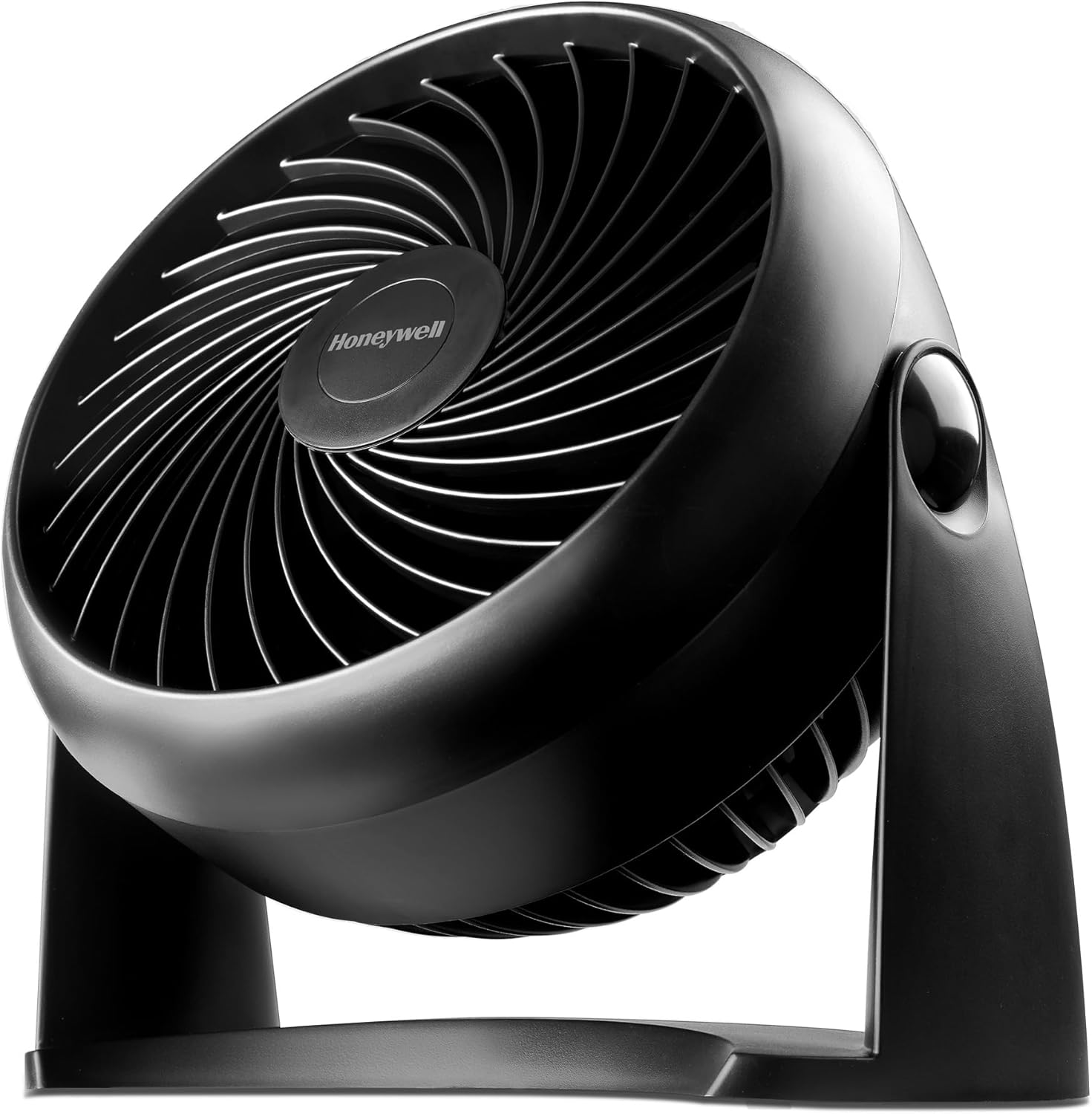
The Honeywell TurboForce HT-900 is a small, corded tabletop fan designed to move a surprising amount of air for its size. It uses an aerodynamic turbo blade and a brushless motor to produce up to 185 cfm and can project airflow up to about 25 feet, making it useful for desk, bedside, or small-room cooling. Controls are simple push-button switches for three speeds, and the head pivots 90 degrees so you can direct the breeze where you need it. Its plastic housing keeps the unit lightweight and portable and it can also be wall-mounted if you want it off a surface. The fan is relatively quiet compared with similar small circulators, and its modest 35-watt draw makes it an energy-friendly option to supplement an air conditioner. Limitations include basic manual controls with no remote or timer and a compact footprint that is best suited to close-range cooling rather than whole-room circulation.
Best for: Buyers who prioritize proven performance and many user reviews when choosing a compact, powerful desk fan for bedrooms, home offices, or small living spaces.
Less Ideal for: Those wanting a feature-rich smart fan with remote control, timers, or large-room circulation should consider larger or more advanced models instead.
- Strong airflow for a compact tabletop fan (185 cfm)
- Three easily accessed speed settings and 90-degree pivot for directional airflow
- Brushless motor and aerodynamic blade design for efficient, relatively quiet operation
- Lightweight plastic body that can be used on a table or mounted on a wall
- No remote, timer, or advanced controls beyond three manual speeds
- Plastic construction limits premium feel and long-term ruggedness
Verdict: A compact, no-frills desk fan that delivers impressive airflow and reliable performance backed by strong user approval.
DREO Tower Fan DR-HTF018

| Power Source | Corded Electric |
|---|---|
| Number of Speeds | 9 |
| Noise Level | 25 db |
| Wattage | 35 watts |
| Air Flow Capacity | 1473 cfm |
The DREO Tower Fan DR-HTF018 is a 42-inch standing fan built around a brushless DC motor that prioritizes steady, efficient airflow for living rooms, bedrooms, and home offices. It delivers up to 1473 CFM and a top airflow speed of 28 ft/s, with 9 discrete speeds and four modes (Standard, Natural, Sleep, Turbo) so you can choose anything from a whisper-quiet breeze to strong cooling. The fan oscillates 90 degrees, has a 12-hour timer, and comes with a remote and electronic touch controls for convenient operation; the display also auto-dims for nighttime use. Practical touches include a removable rear grille for easy cleaning and an ETL listing. Expect modest power draw at 35 watts thanks to the DC motor, and very low noise figures at its quieter settings, making it suitable for overnight use. Limitations are typical for tower fans: it cools by moving air rather than lowering room temperature, and while the airflow specs are high for the size, it cannot replace conditioned air in very large, open spaces.
Best for: Buyers who want a reliable, low-noise fan that delivers strong circulation and easy controls for bedrooms or home offices and prioritize predictable performance and simple upkeep.
Less Ideal for: People seeking true room temperature reduction or whole-house cooling should consider air conditioners or larger HVAC solutions instead.
- High reported airflow (1473 CFM) and up to 28 ft/s top speed for strong room circulation.
- Brushless DC motor provides efficient power use and quiet operation.
- Nine speeds and four modes plus 90° oscillation let you tailor airflow to different needs.
- Remote control, touch panel, and 12-hour timer add convenience and easy night use.
- Removable rear grille simplifies cleaning and maintenance.
- Moves air but does not cool air temperature like an air conditioner.
- Performance will be limited in very large or high-ceiling spaces compared with whole-room cooling systems.
Verdict: If you want a dependable, quiet tower fan that delivers powerful air circulation with simple controls and low power draw, this DREO model is a strong choice.
Choosing the Right Powerful Fan for Cooling: Key Factors to Consider
Airflow Output and Distribution
A fan's cooling usefulness depends largely on how much air it moves and how that air is distributed through a room. Higher CFM values generally indicate stronger airflow, but design matters: a focused, directional airstream can cool a person more effectively than a weak wide pattern. Consider how far the fan throws air and whether it provides concentrated or diffuse flow.
For whole-room cooling you may prefer a fan that oscillates or can be angled to promote circulation from one side of the room to another. For spot cooling, a stronger directional stream with longer reach is better. Think about furniture layout, ceiling height, and room shape when matching a fan's airflow characteristics to your space.
Noise Performance Across Speeds
Stronger fans often generate more noise, so balance airflow needs with acceptable sound levels for the intended room. Pay attention to measured or reported decibel levels, especially on medium and high speeds. Bedrooms and home offices benefit from models with quieter high-speed performance or a low-noise high-output mode.
Noise character matters too: a steady, smooth sound is easier to tolerate than a rattling or whistling noise. If you plan to run the fan at night, look for multiple speed steps or sleep modes designed for lower noise while maintaining airflow.
Controls, Oscillation, and Adjustability
Controls determine how easy it is to tailor airflow to changing conditions. Fans with multiple speeds, adjustable tilt, and oscillation patterns give more flexibility for targeted cooling or whole-room circulation. Remote control, timers, and programmable modes add convenience when you want to change settings without getting up.
Consider whether you need presets or smart controls to integrate with schedules. Physical controls should be intuitive and durable, and removable grills or simple fasteners make cleaning and maintenance much easier.
Build Quality and Motor Type
A robust frame and a reliable motor extend a fan's useful life and maintain consistent airflow. Look for sturdily built housings, stable bases or mounting brackets, and motors with thermal protection to avoid overheating in heavy use. Brushless DC motors typically run cooler and more efficiently than older AC motors, and they often offer finer speed control and longer lifespan.
Construction quality also affects vibration and long-term noise. Metal housings and thicker plastic can reduce flex and rattling, while secure blades and balanced assemblies help preserve smooth operation over time.
Energy Use and Operating Cost
High airflow does not have to mean high power consumption. Compare airflow-per-watt metrics where available and consider whether a fan can replace or reduce reliance on air conditioning during moderate heat. Energy-efficient motors and multiple speeds help you tailor power draw to actual needs.
If you plan to run a fan for many hours daily, small differences in wattage add up. Look for energy-conscious features like eco modes, programmable timers, and low-power circulation settings to keep operating costs down.
Size, Placement, and Portability
A fan that is too large or too small for your intended spaces will underperform or be inconvenient. Floor fans with larger blades typically move more air but require more floor space and may be louder. Tower and bladeless designs can be more compact and easier to position in tight rooms, though their airflow patterns differ.
Portability factors include weight, handles, and whether the fan can be mounted on a wall or ceiling. Consider storage needs and the frequency with which you will move the unit between rooms when choosing size and form factor.
Choosing the Right Fan Type for Your Room
Different fan types deliver airflow in different ways. Floor and pedestal fans produce strong, direct airflow that is ideal for spot cooling or pushing air across a room. Box fans and high-velocity units are compact and often inexpensive, but their sound profile and mounting options vary. Tower and bladeless fans tend to be quieter and take up less floor area, though they may feel less forceful at distance.
Match the fan type to how you use the space. For open-plan living areas, a unit with wide oscillation and higher throw helps move air across long sightlines. For small bedrooms or offices, a compact fan with focused output and low noise is often the better choice.
- Floor/pedestal: strong directional flow, good for targeting.
- High-velocity/box: compact footprint, high output for short bursts.
- Tower/bladeless: quieter, space-saving, gentler circulation.
Placement Tips to Maximize Cooling
Placement has a bigger effect on perceived cooling than you might expect. Position a fan near a doorway or window at night to pull cooler outside air into the room, or point it across the room to set up a cross-breeze. For circulating air in a multiroom layout, place the fan so it moves air toward a return or open doorway.
Avoid blocking airflow with furniture and keep the fan at a height that aligns with where people are sitting or sleeping. Slightly elevating a fan can help spread airflow more evenly, while floor-level placement concentrates cooling at ground level.
- For intake, aim a fan toward an open window during cooler evening hours.
- To circulate, place fans opposite each other to create a flow path.
- Keep at least a few inches clearance from walls and furniture for best performance.
Maintaining Peak Performance
Regular maintenance preserves airflow and reduces noise. Dust accumulation on blades and grills reduces effective CFM and can unbalance the rotor, producing vibration. Clean accessible blades and filters on a schedule based on use and air quality, and tighten fasteners if the unit develops new rattles.
Store fans in a dry place when not in use and follow any motor-care recommendations in the manual. For long-term serviceability, choose units with replaceable parts and clear instructions for disassembly to simplify repairs.
- Clean blades and grills every few weeks during heavy use.
- Check mounts and screws for vibration-related loosening.
- Replace worn cords or damaged switches promptly for safety.
Smart Features and Automation
Modern fans increasingly include timers, sleep modes, and smart-home compatibility. Timers and schedules let you run the fan only when needed, saving energy. Smart integration can enable voice control or routines tied to temperature sensors, which helps automate cooling without manual intervention.
Weigh the convenience of smart features against complexity. If you prefer a simple plug-and-play experience, basic manual controls may be more reliable long term. If automation will change how often the fan runs, smart features can improve comfort and reduce wasted runtime.
- Timers reduce unnecessary runtime and save energy.
- Smart controls add convenience but may require app setup.
- Sleep modes combine lower speed with quieter operation for night use.
Safety and Child-Friendly Design
Safety features matter in family homes. Look for grills with small spacing, stable wide bases to prevent tipping, and automatic shutoffs for overheating. Wall- or ceiling-mounted options keep moving parts out of reach in households with small children or pets.
Consider cord length and placement relative to play areas. Lightweight units should still have tip-over protection and secure grills to prevent accidental contact with blades.
- Tip-over switches reduce risk if the fan falls.
- Tightly spaced grills protect small fingers and paws.
- Thermal cutoffs guard the motor during prolonged heavy use.
How We Chose the Best Powerful Fan for Cooling
We selected fans that demonstrate strong, usable airflow without sacrificing basic daily convenience. Our evaluation prioritized measurable output and real-world performance over marketing claims. Key evaluation dimensions included airflow delivery and distribution, noise performance at multiple speeds, build quality and durability, control and convenience features, and energy efficiency. Airflow was judged by manufacturer-rated CFM and by how well the unit moves air across typical room distances. Noise was assessed across speed settings to find units that offer high output while remaining tolerable for living spaces or bedrooms. Build and durability covered construction, motor type, and warranty indicators that predict long life under frequent use. Controls and convenience looked at speed range, oscillation, tilt, remote or app controls, and ease of maintenance. Energy efficiency examined power draw relative to airflow to identify models that cool effectively without excessive electricity use. We excluded units that are purely decorative or intended only for very light circulation. Very heavy industrial blowers and specialty HVAC equipment were not considered because they are outside normal home use. The final list represents a balance between raw cooling power and practical home usability.
Our full evaluation process is outlined in our review methodology.
FAQ
How big of a fan do I need to cool a medium-sized living room?
It depends on the room layout and how you plan to use the fan. For a medium living room, choose a fan with higher CFM and good throw so air reaches seating areas. Oscillation or placement to create cross-breezes helps circulate air more effectively than a small low-output unit.
Can a powerful fan actually lower room temperature?
A fan does not lower air temperature significantly but increases perceived cooling by accelerating evaporation of sweat and moving warm air away from skin. Strategic placement to move cooler night air or to enhance cross-ventilation can indirectly reduce indoor temperatures over time.
Are brushless DC motors worth it for home fans?
Often yes. Brushless DC motors tend to run cooler, offer finer speed control, and use less power at equivalent airflow compared with some AC motors. They can also be quieter and longer lasting, which matters for frequent use.
How loud will a high-output fan be in a bedroom?
Noise varies by design and speed. High-output models can be noticeable on top speeds, but many modern designs minimize harsh tones and provide tolerable sound at night. Look for measured noise figures and models with sleep modes if quiet night operation is important.
Can a fan reduce my air conditioning use?
Yes, in many situations a well-placed fan can make a room feel cooler so you can raise the thermostat setting without losing comfort. This can reduce AC runtime, especially during milder heat, though fans do not replace AC in extreme temperatures.
Final Verdict
Prioritize airflow and noise when choosing a powerful fan for cooling. Select a fan with the airflow reach and distribution needed for your room, while ensuring noise levels and build quality suit everyday use. Consider control options, energy efficiency, and safety features based on where the fan will be used. Balance the tradeoffs between raw output and tolerable sound. With the right match of type, placement, and features you can get fast, comfortable cooling without excessive energy use or intrusive noise. Use the evaluation criteria above to narrow choices and select the unit that best fits your space and routine.