
Note: This article contains affiliate links. If you click on these links and make a purchase, we may earn a small commission at no extra cost to you. This helps support our research and content. Read our full affiliate disclosure here.
When you need to move a lot of air across a big room, not all fans are up to the task. A powerful oscillating fan delivers higher airflow, broader sweep, and more consistent circulation than a small desk model, which matters for cooling, humidity control, and improving HVAC efficiency. In this guide we shortlisted seven top options that prioritize raw airflow, efficient oscillation, and usable noise levels. Below you will find concise evaluations focused on motor strength, airflow coverage, noise, and real-world usability so you can pick a fan that performs where it counts. Read on for the criteria we used and practical tips for placement and maintenance.
Top Picks at a Glance
| Best Overall The best all-around choice for most situations | Lasko Cyclone 1843 Pedestal Fan |  |
| Best Quality Built to a higher standard if you want something more solid | HiCFM 30" Pedestal Fan |  |
| Best Value The sweet spot between price and what you get | DREO DR-HPF013 Pedestal Fan |  |
| Best Budget The cheapest option that still gets the job done reliably | Lasko 2520 Oscillating Pedestal Fan | 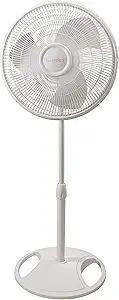 |
| Top Rated A top-rated pick with lots of positive feedback | DREO Tower Fan 307 |  |
| Most Popular A crowd favorite that many people choose with confidence | Honeywell QuietSet Tower Fan HYF290B |  |
| Best Seller A high-volume bestseller chosen again and again | Honeywell TurboForce HT-900 |  |
Lasko Cyclone 1843 Pedestal Fan

| Air Flow Capacity | 1854 cfm |
|---|---|
| Number of Speeds | 3 |
| Wattage | 96 watts |
| Blade Diameter | 18 inches |
| Power Source | Corded Electric |
The Lasko Cyclone 1843 is a tall, freestanding pedestal fan built to move a lot of air across a room while offering simple controls. It uses a five-blade, 18-inch head driven by an AC motor to deliver high airflow (listed at 1854 cfm) and widespread oscillation, and the head tilts while the stand adjusts up to 54 inches so you can target airflow where you need it. Three quiet speed settings and a 4-hour timer make it suitable for bedroom or living-room use, and the included remote lets you change power and speed from across the room. Construction is primarily plastic, which keeps the unit lightweight and easy to assemble but feels less premium than metal alternatives. Safety features include ETL listing and a fault-cutoff Blue Plug. If you want powerful, no-frills circulation with straightforward controls and remote convenience, this fan delivers; buyers seeking variable-speed precision, very low noise at high output, or metal-bodied construction may prefer higher-end models.
Best for: Buyers who want a powerful, easy-to-use standing fan that reliably moves air through medium to large rooms and value a remote and adjustable height for flexible placement.
Less Ideal for: Those who prioritize premium metal construction, very quiet high-output operation, or multi-speed/digital controls should consider higher-end fans instead.
- High airflow capacity (1854 cfm) for strong room circulation
- Adjustable height and tilt-back head let you direct airflow precisely
- Remote control and 4-hour timer add convenience for living and sleeping spaces
- Simple three-speed operation and AC motor for reliable, low-maintenance use
- Basic three-speed control lacks finer speed steps or digital presets
- Plastic construction is lightweight but feels less durable than metal builds
Verdict: A powerful, no-frills pedestal fan that delivers strong room circulation with remote control and adjustable height for versatile placement.
HiCFM 30" Pedestal Fan

| Power Source | Corded Electric |
|---|---|
| Number of Speeds | 3 |
| Wattage | 230 watts |
| Air Flow Capacity | 8300 cfm |
| Oscillation | 80° |
The HiCFM 30" Pedestal Fan is a purpose-built high-velocity floor fan aimed at moving large volumes of air in garages, workshops, and commercial spaces. It uses a 1/3 HP brushed motor that delivers up to 8300 CFM and 1150 RPM on high, an 80° oscillation sweep, and a 15° tilt so you can direct steady airflow across a wide area. The metal construction, aluminum turbo blades, metal gearbox, and powder-coated finish give it a rugged feel and make it suitable for heavy use, while built-in wheels and a spring-assisted pole make height adjustment and repositioning manageable despite the fan's heft. Controls are simple push-button switches with three speeds, and the unit runs on standard 120V power. Expect noticeable noise at higher speeds typical of industrial fans and limited electronic controls or remote features, but the trade for that is raw airflow and durable build quality. The fan is designed for indoor, dry environments and carries OSHA and UL specifications for safety.
Best for: Buyers who prioritize raw airflow and durable construction for cooling large indoor or commercial spaces and need a fan that can run hard for extended periods.
Less Ideal for: Those seeking quiet, decorative, or feature-rich home fans with remote control or smart features should consider quieter consumer models instead.
- Very high airflow capacity (8300 CFM) suitable for large spaces
- Robust all-metal construction and aluminum turbo blades for durability
- 80° oscillation and 15° tilt provide wide, adjustable coverage
- Spring-assisted height adjustment and wheels make it movable despite heavy build
- Simple three-speed push-button control that is easy to operate
- Limited controls with no remote or timer features
- Brushed motor and industrial design produce noticeable noise at higher speeds
Verdict: Choose this fan when uncompromising high airflow and industrial-grade durability are the top priorities for cooling large indoor spaces.
DREO DR-HPF013 Pedestal Fan

| Power Source | Corded Electric |
|---|---|
| Number of Speeds | 8 |
| Noise Level | 28.2 db |
| Wattage | 36 |
| Air Flow Capacity | 1000 cfm |
The DREO DR-HPF013 is a tall pedestal air circulator built to push air across a room rather than just provide a local breeze. It uses a brushless DC motor and a three-blade TurboPoly design to deliver up to 1000 CFM and a claimed 90 ft throw, with eight speeds, an auto mode that changes speed with temperature, and 90° horizontal oscillation plus a 105° vertical pivot for broad coverage. Controls are available on a top touch panel and from the included remote, and features like an 8-hour timer, mute beep, detachable grill for cleaning and an aroma pad add convenience. At lower settings the fan is quiet thanks to the DC motor, while higher speeds produce noticeably stronger airflow and more noise. The fan is lightweight and plastic-bodied, so it is easy to move but not as rugged as metal models. If you need strong whole-room circulation with flexible placement and simple controls, this model delivers; if you want weatherproofing, heavy-duty construction or linkable smart-home controls, look elsewhere.
Best for: Buyers who prioritize powerful, adjustable whole-room airflow with quiet operation and straightforward controls for bedrooms or living spaces.
Less Ideal for: Avoid this fan if you need heavy-duty industrial construction, outdoor use, or integrated smart-home automation and voice control.
- High airflow performance up to 1000 CFM for whole-room circulation
- Brushless DC motor for quieter operation and energy efficiency
- Multiple speed settings, auto mode and 90° oscillation plus wide vertical pivot for flexible air direction
- Remote and top touch controls with an 8-hour timer for convenient operation
- Detachable front/rear grill for easier cleaning and built-in aroma pad for scent
- Plastic construction is lightweight but less durable than metal alternatives
- No listed app, voice or smart-home integration for remote scheduling or ecosystem control
Verdict: Choose the DREO DR-HPF013 if you want a lightweight, quiet DC pedestal fan that reliably delivers strong whole-room airflow and flexible directional control.
Lasko 2520 Oscillating Pedestal Fan

| Blade Length | 16 inches |
|---|---|
| Number of Speeds | 3 |
| Wattage | 91 watts |
| Motor Type | AC |
| Power Source | Corded Electric |
The Lasko 2520 is a straightforward pedestal fan that delivers reliable airflow for bedrooms, living rooms, or home offices. It uses a 16-inch four-blade head driven by an AC motor and offers three quiet speed settings plus widespread oscillation and a tilt-back head so you can aim airflow where it is needed. The stand adjusts up to 47 inches, and the fan assembles without tools for fast setup and easy portability. Safety-focused features include ETL listing and Lasko Blue Plug technology that cuts power if an electrical fault is detected. Practical benefits are simple manual controls, low weight for moving between rooms, and broad circulation from the oscillation—good for spot cooling or improving room air circulation. Limitations are minimal feature set compared with higher-end models: there is no remote, timer, or digital controls, and the motor is a basic AC design rather than a quieter, more efficient DC motor. For buyers prioritizing straightforward, affordable performance, this fan gives dependable cooling without extras.
Best for: Buyers who want a low-cost, no-frills standing fan that provides dependable room circulation and easy portability for spot cooling in bedrooms or common areas.
Less Ideal for: Shoppers who need programmable features, app or remote control, ultra-quiet operation, or the highest energy efficiency should consider higher-end models instead.
- Adjustable height up to 47 inches and tilt head for targeted airflow
- Three quiet speeds and widespread oscillation for versatile circulation
- Tool-free assembly and lightweight design for easy portability
- ETL listed with safety Blue Plug technology for added electrical protection
- No remote control, timer, or digital settings
- Uses an AC motor so it is less energy-efficient and potentially louder than DC motor fans
Verdict: A budget-friendly pedestal fan that offers dependable, adjustable airflow and essential safety features for straightforward room cooling.
DREO Tower Fan 307

| Number of Speeds | 8 |
|---|---|
| Modes | Normal, Natural, Sleep, Auto |
| Oscillation | 90° |
| Wattage | 36 watts |
| Motor Type | brushless DC motor |
The DREO Tower Fan 307 is a compact 36-inch oscillating floor fan built around an upgraded brushless DC motor that pushes strong airflow while keeping noise low. It offers eight speed settings and four modes including Normal, Natural, Sleep, and Auto, so you can dial in anything from a gentle bedroom breeze to a higher-velocity boost; the unit supports remote and touchpad control for easy adjustments. With 90 degree oscillation and a claimed airflow capacity for broad room coverage, it pairs well with an air conditioner to circulate cool air more effectively. Practical touches include a timer, removable rear grille and impeller for easier cleaning, and ETL safety certification. On the downside the fan runs on standard corded power and lists voltage at 240 volts which may matter for some regions, and the plastic construction means it is lightweight but less premium-feeling than metal alternatives. For buyers focused on quiet, adjustable oscillating cooling in bedrooms or living rooms, this model balances airflow and low noise in a small footprint.
Best for: Buyers who want a quiet, adjustable tower fan that delivers wide oscillating coverage and easy remote control for bedrooms and living spaces backed by strong customer feedback.
Less Ideal for: People seeking a heavy-duty, industrial-strength fan or a premium metal build should consider sturdier floor or bladeless alternatives.
- Brushless DC motor for efficient, high-velocity airflow with lower noise
- Eight speed levels and four modes for flexible comfort settings
- 90° oscillation spreads air across a wide area for better room coverage
- Includes remote and touch controls plus a timer for convenient operation
- Removable rear grille and impeller simplify cleaning and maintenance
- Plastic construction feels less durable compared with metal fans
- Corded operation and listed voltage may limit regional compatibility
Verdict: A feature-rich, quiet oscillating tower fan that gives flexible speeds and modes for effective bedroom and living-room cooling.
Honeywell QuietSet Tower Fan HYF290B

| Power Source | Corded Electric |
|---|---|
| Number of Speeds | 8 |
| Special Features | Oscillating, Remote Controlled, Timer |
| Noise Level | 45 db |
| Motor Type | Brushless |
The Honeywell QuietSet HYF290B is a portable tower fan designed to move air through medium to large rooms while keeping noise low. It offers eight selectable speed levels from a near-silent sleep setting up to a strong power-cool mode, and the unit oscillates to distribute airflow across a room. The included remote nests in a rear slot for storage and controls the fan, timer, and light dimming options, while a digital 8-hour auto-off timer adds convenience. The brushless motor and reported 45 dB noise level make it a reasonable choice for bedrooms or living spaces where quiet is important, and the slim footprint helps in tighter layouts. Trade-offs include a primarily plastic construction and basic manual features rather than smart connectivity or advanced air-cleaning functions, so it acts strictly as an air circulator rather than a multi-function appliance. For buyers who want dependable, quiet airflow without complexity, this delivers practical performance and easy daily use.
Best for: Buyers who want a straightforward, quiet tower fan that provides adjustable whole-room airflow and easy remote operation without extra smart features.
Less Ideal for: People seeking integrated air purification, app control, or a premium metal build should look at other product types.
- Eight quiet speed settings let you fine-tune airflow from sleep to power-cool
- Oscillating mode spreads air across a whole room for better circulation
- Remote control that stores in a rear nesting slot for convenient operation
- Brushless motor with low reported noise makes it suitable for bedrooms
- No smart home connectivity or air-purifying features
- Mainly plastic construction may feel less premium than metal alternatives
Verdict: Choose the Honeywell QuietSet HYF290B if you want a no-frills, quiet tower fan that delivers adjustable whole-room airflow with a handy remote and timer.
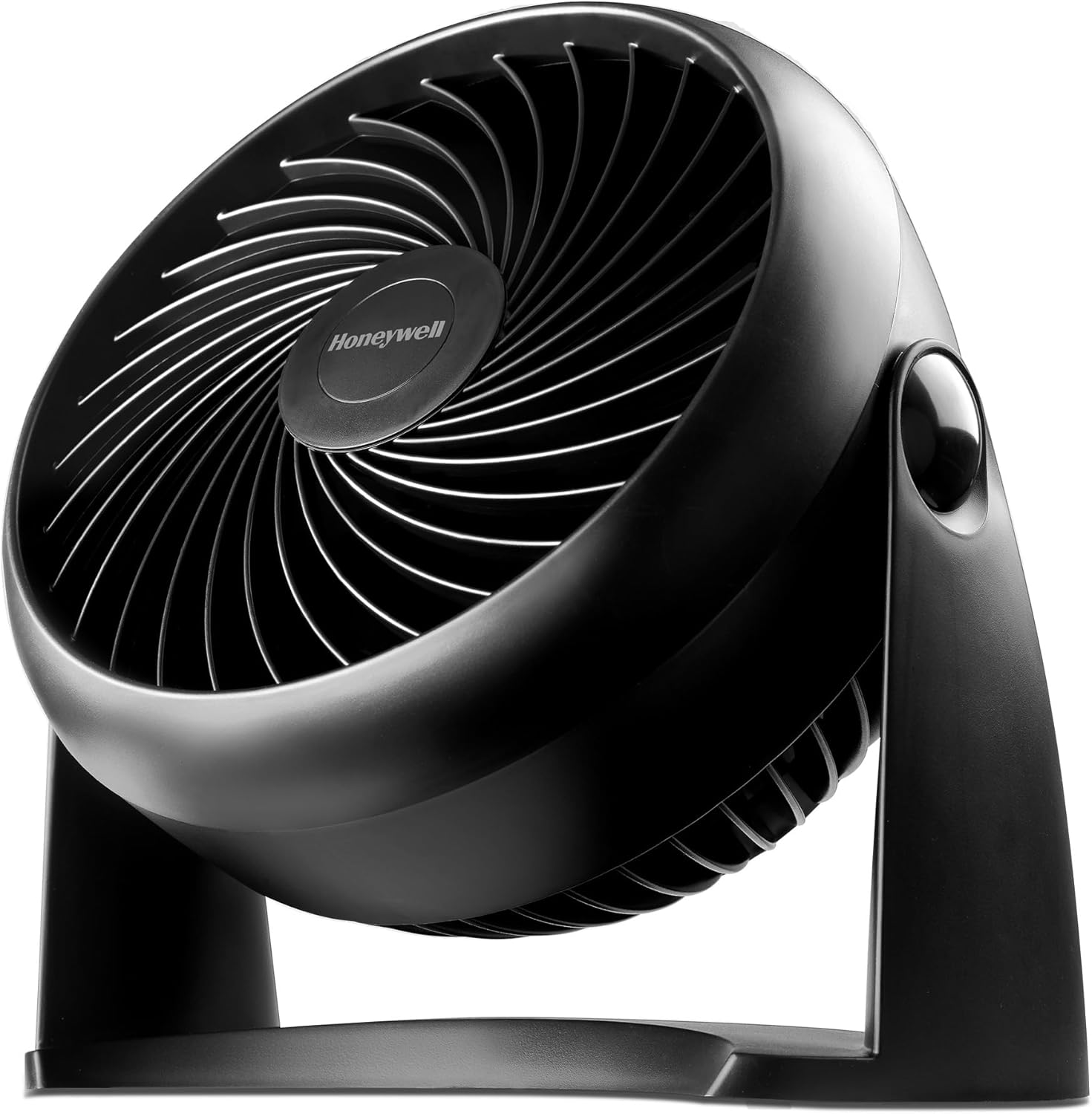
Honeywell TurboForce HT-900
| Power Source | Corded Electric |
|---|---|
| Number of Speeds | 3 |
| Air Flow Capacity | 185 cfm |
| Wattage | 35 watts |
| Motor Type | brushless |
The Honeywell TurboForce HT-900 is a small, corded tabletop fan built to move a surprising amount of air for its size. It uses an aerodynamic turbo-style blade and a brushless motor to deliver up to 185 cfm, and the 90-degree pivoting head and three push-button speeds make it easy to aim airflow where you need it. Typical uses are desktop cooling, bedroom circulation, or mounting on a wall to supplement room airflow and reduce HVAC load. The fan is lightweight and portable, so it is simple to reposition around a home office or bedside. Notable features include a durable plastic build, energy-efficient 35-watt operation, and a low-noise design meant for quiet environments. Limitations are its small footprint, which is best for personal to small-room use rather than whole-room circulation, and a basic manual control layout with no timer or remote. For buyers who want reliable, no-frills airflow in small spaces, the HT-900 is a straightforward, effective choice.
Best for: Buyers who want a dependable, easy-to-use personal air circulator to quietly boost airflow around a desk, bedside, or small room and prefer a low-risk, proven product.
Less Ideal for: People seeking whole-room or large-space cooling, advanced controls, or smart features should consider larger oscillating fans or models with remote/timers instead.
- High airflow for size (listed 185 cfm) providing strong directed breeze
- Three simple speed settings and 90-degree pivot for straightforward aiming
- Brushless motor and 35-watt power give efficient, durable operation
- Lightweight and portable for tabletop or wall-mounted use
- Designed for personal or small-room use rather than large-room circulation
- Controls are basic push-button only with no timer or remote
Verdict: A compact, reliable personal air circulator that delivers strong directed airflow with simple controls, ideal for buyers who want low-risk, effective cooling in small spaces.
Choosing the Right Powerful Oscillating Fan: Key Factors to Consider
Airflow Output and Measured CFM
Airflow output, usually reported in cubic feet per minute, directly indicates how much air the fan can move. Higher CFM values translate to faster cooling and better circulation in larger rooms. When comparing powerful oscillating fans, look for clear CFM figures or manufacturer testing data so you can estimate how quickly the fan will change the air in a given space.
CFM matters for real-world use because a fan with strong concentrated airflow but limited sweep will perform poorly for whole-room comfort. Consider both peak output and how that output is distributed across the sweep angle to match the fan to your room size.
Oscillation Angle and Sweep Width
The oscillation angle determines how broadly the fan moves air across a room. Wider sweep spreads airflow more evenly and reduces hot spots, while limited oscillation keeps strong airflow focused in one direction. For living areas and open-plan rooms, a broad sweep with adjustable angles is preferable.
Also check whether oscillation is smooth and steady at higher speeds. Some heavy-duty fans can stutter or produce uneven movement if the oscillation mechanism is underpowered relative to the motor. Adjustable sweep settings let you prioritize concentrated cooling or wide-area circulation as needed.
Noise Level at Realistic Speeds
A truly powerful fan can create noticeable noise, so you should weigh airflow gains against acceptable sound levels for the room's uses. Noise ratings or decibel numbers are useful, but subjective perception matters: some fans produce lower-frequency sound that is less distracting, while others generate high-frequency whine.
Consider where the fan will operate—bedrooms require quieter operation at night, while garages or workshops tolerate louder output. Fans with multiple speed steps and a low-but-effective setting give more flexibility to balance airflow and noise.
Build Quality and Stability
Durable motors and a stable base are essential for safe, long-term operation. Heavy-duty fans should resist tipping when oscillating and feel solid during use. Metal housings and reinforced grills add longevity, while a well-designed base or pedestal reduces wobble and vibration.
Check for secure blade attachment and guarded fan cages to minimize safety risks. Ease of maintenance such as accessible grills for cleaning also contributes to lasting performance since dust buildup can reduce airflow and strain the motor.
Adjustability and Controls
Controls and adjustability affect how useful the fan is across different rooms and seasons. Look for straightforward speed controls, tilt and height adjustment, and either multiple preset modes or a variable speed dial. A remote control or programmable timer can increase convenience, especially for fans mounted high or placed across the room.
Sturdier control interfaces and clearly marked settings make it easier to dial in the right balance of airflow and noise. Features like memory settings or gradual ramp-up can improve comfort and reduce start-up jolt.
Energy Efficiency and Motor Type
Energy use matters when a fan runs for long periods. Brushless DC motors are often more efficient and quieter than traditional AC motors and can deliver comparable airflow at lower power consumption. Check rated wattage at typical operating speeds to estimate running cost and choose models that balance airflow and efficiency.
Efficient fans also generate less heat and usually enjoy longer motor life. For sustained use in warm climates or during extended ventilation periods, energy-efficient designs reduce both operating cost and environmental impact.
Best Placement Tips for Maximum Room Coverage
Positioning has a large effect on how well a powerful oscillating fan cools a space. For most rooms, placing the fan near a central walkway or at a midpoint along a wall helps air move across the entire area rather than just circulating in one corner. Slight elevation on a sturdy stand directs airflow above furniture and encourages mixing with room air.
In rooms with windows, align the fan to either pull cooler outside air inward or push hot indoor air toward an exhaust point. Avoid placing the fan directly against soft surfaces that block intake. When using multiple fans, stagger them to create a gentle cross-breeze rather than opposing flows that cancel each other.
- Elevate the fan slightly to avoid furniture obstruction
- Angled tilt helps target breathing or seating zones
- Use oscillation to move air across the whole room, not just one spot
Maintaining Peak Performance
Regular cleaning preserves airflow and reduces motor strain. Dust and lint accumulated on blades and grills can significantly cut performance over time. Most grills are removable for quick wipe-downs or vacuuming; consult the manual for disassembly steps to avoid damaging cages or fasteners.
Lubricate moving parts only if the manufacturer recommends it. Avoid over-tightening adjustment knobs and check mounting hardware occasionally for looseness to prevent wobble. For fans running continuously in dusty environments, consider a brief inspection every month and deeper cleaning every three months.
- Remove and clean grills according to instructions
- Inspect blades for damage and balance issues
- Check base and fasteners periodically for stability
When a Fan Replaces or Supplements HVAC
A powerful oscillating fan can lower perceived temperature and reduce reliance on air conditioning by improving air mixing and enhancing evaporation from skin. Use fans to circulate cool night air or to push conditioned air into rooms that the HVAC system struggles to reach. This approach can make a space feel several degrees cooler without changing thermostat settings.
Keep in mind that fans cool people, not rooms. Turn fans off when the room is unoccupied to save energy. Combining fans with targeted HVAC use often yields the best balance of comfort and efficiency.
- Use fans to assist HVAC in hard-to-reach areas
- Operate fans with windows open strategically to ventilate
- Turn fans off in empty rooms to conserve energy
Safety Considerations for Powerful Fans
Stronger fans can cause more damage if they tip or if fingers reach the blades. Ensure grills meet robust safety standards and that the unit is placed on a flat, level surface. Keep fans away from edges where pets or children might knock them over.
Unplug fans before cleaning or servicing and follow all manufacturer instructions for replacing parts. Avoid running an oscillating fan where cords could be tripped over or where moisture exposure is likely unless the unit is rated for damp locations.
- Use a dedicated outlet and route cords safely
- Place on stable surfaces away from foot traffic
- Follow maintenance safety steps in the manual
Matching Fan Features to Use Case
Different homes and rooms have distinct needs. For bedrooms, prioritize low-noise performance and variable speed control. For garages or workshops, favor raw output and rugged construction. Open-plan spaces benefit most from higher sweep angles and pedestal or tower designs that project airflow across longer distances.
Consider additional features such as a timer for overnight use, remote control for convenience, and programmable modes for automatic adjustments. The feature set you choose should align with where and how long the fan will run.
- Bedrooms: quiet, multiple low-speed steps
- Living rooms: broad sweep and mid-to-high CFM
- Workshops: durable housing and high output
How We Chose the Best Powerful Oscillating Fan
We focused on measurable performance and practical durability to assemble this list of powerful oscillating fans. Selection began with models designed to deliver high airflow and wide sweep, then filtered by motor type, build quality, and the availability of multiple speed settings. We prioritized fans with clearly stated airflow metrics or repeatable real-world evidence of strong circulation, along with adjustable oscillation angles and reliable speed control. Safety and durability were key filters: we favored units with solid housings, stable bases or stands, and well-protected blades. Usability factors such as tilt range, easy-to-reach controls, remote or timer features, and straightforward assembly also influenced inclusion. Quiet high-output performance was another critical criterion; options that sacrificed extreme noise for airflow were downgraded. We excluded compact desk fans and specialty units intended only for focused spot cooling rather than room-scale circulation. The final picks balance peak airflow, usable coverage, reasonable noise, and long-term reliability to meet the needs of users seeking genuinely powerful oscillating fans.
Our full evaluation process is outlined in our review methodology.
FAQ
How much CFM do I need for a large living room?
It depends on room volume, but for general guidance aim for higher CFM ratings when covering larger spaces. Estimate room cubic feet and choose a fan with airflow sufficient to circulate that volume multiple times per hour. Wider oscillation reduces the need for extreme CFM by spreading airflow.
Are quieter high-output fans available?
Yes, some high-output fans use motor and blade designs that prioritize lower noise at given airflow levels. Look for decibel ratings and motor type information, and consider models with variable speeds so you can run a quieter setting when full power is unnecessary.
Can I leave a powerful oscillating fan running all day?
Many fans are designed for extended operation, but continuous running increases wear and energy use. Ensure the fan is well-ventilated, clean it regularly to prevent dust buildup, and follow manufacturer guidelines for duty cycle to avoid premature motor stress.
Will a fan really cool a room without AC?
Fans do not lower air temperature but improve comfort by increasing evaporative cooling from skin and by moving cooler air into occupied zones. In mild climates or at night they can make a room feel significantly cooler even without lowering thermostat settings.
How do I reduce wobble on an oscillating fan?
Tighten loose fasteners, check that the base or stand sits level, and inspect blade balance and mounting. Cleaning dust from blades and ensuring the grill is properly seated often reduces vibration. If wobble persists, stop using the fan until repairs or part replacements are made.
Final Verdict
Prioritize measurable airflow, stable oscillation, and acceptable noise for the best balance of power and livability. Match the fan's sweep and CFM to your room size, and favor models with sturdy construction and convenient controls for everyday use. Decide which tradeoffs matter most—maximum raw airflow versus quiet operation and energy efficiency—and choose a fan whose strengths align with how and where you plan to run it. With the right selection and placement, a powerful oscillating fan can be a cost-effective way to improve comfort and ventilation.