
Note: This article contains affiliate links. If you click on these links and make a purchase, we may earn a small commission at no extra cost to you. This helps support our research and content. Read our full affiliate disclosure here.
Picking a truly powerful fan for home use matters when you need fast room cooling, better air circulation, or supplemental ventilation in tight spaces. A high-performance fan reduces hot spots, helps HVAC systems run less, and can make living areas more comfortable without constant temperature adjustments. This guide focuses on a curated shortlist of the top options built for strong airflow and practical home use. We evaluate each fan on airflow output, noise performance, build quality, and ease of use so you can quickly compare the best choices for different room sizes and setups. Read on to find the type of high-airflow fan that fits your space and priorities.
Top Picks at a Glance
| Best Overall The best all-around choice for most situations | Vornado Model 80 Box Fan |  |
| Best Quality Built to a higher standard if you want something more solid | DEWALT 20V MAX Jobsite Fan DCE512B |  |
| Best Value The sweet spot between price and what you get | Lasko Wind Machine 20" 3300 |  |
| Best Budget The cheapest option that still gets the job done reliably | Amazon Basics 20-Inch Box Fan DK1901 |  |
| Top Rated A top-rated pick with lots of positive feedback | Honeywell TurboForce HT-900 |  |
| Most Popular A crowd favorite that many people choose with confidence | DREO DR-HPF013 Pedestal Fan |  |
| Best Seller A high-volume bestseller chosen again and again | DREO Tower Fan DR-HTF018 |  |
Vornado Model 80 Box Fan

| Number of Speeds | 5 |
|---|---|
| Wattage | 120 watts |
| Motor Type | Brushless |
| Speed | 1400 rpm |
| Power Source | ac |
The Vornado Model 80 is a 20-inch high-velocity box fan built to move strong, focused airflow around a room. It offers five speed settings controlled by tactile buttons and uses a brushless motor rated at 1400 rpm to deliver sustained circulation for cooling, drying, or general air movement. The fan's removable grille and integrated handle make cleaning and repositioning straightforward, and the steel construction feels durable for regular use. Practical benefits include effective whole-room circulation rather than a narrow breeze, cord storage for tidier placement, and ETL safety certification for U.S. use. Expect noticeable noise on higher settings because the unit emphasizes power over whisper-quiet operation, and it is a floor-mounted fan so it lacks tilt or oscillation features found on some standing circulators. In short, it's a robust, no-frills solution when you need reliable, powerful airflow across a bedroom, home office, or living area but are willing to accept louder operation at top speeds.
Best for: Buyers who want a dependable, high-output floor fan that reliably circulates air across medium to large rooms and who prioritize performance and durability over ultra-quiet operation.
Less Ideal for: Those seeking a near-silent bedroom fan, a compact desk fan, or a unit with advanced directional controls and oscillation should look at other form factors.
- Strong airflow for whole-room circulation with five speed settings
- Durable alloy steel construction and integrated handle for portability
- Removable grille simplifies cleaning and maintenance
- Brushless motor designed for sustained operation and efficiency
- Can be noisy on higher speeds compared with quieter circulators
- No oscillation or advanced directional tilt features
Verdict: Choose the Model 80 when you need a sturdy, high-velocity floor fan that delivers powerful whole-room airflow and simple, serviceable design.
DEWALT 20V MAX Jobsite Fan DCE512B

| Power Source | Battery Powered |
|---|---|
| Air Flow Capacity | 650 cfm |
| Motor Type | Brushless |
| Number of Speeds | 3 |
| Specification Met | IP54 |
The DEWALT 20V MAX Jobsite Fan is a cordless blower-style fan built to push a lot of air where you need it. Designed for jobsite or heavy-duty home use, it uses a brushless motor and an axial 3-blade design to deliver up to 650 CFM and three speed settings controlled by a dial. It runs from DEWALT 20V batteries (battery and charger sold separately) and is rated for up to about 4.5 hours of runtime on a charged battery, so you can move it around without cords for cooling, ventilation, or drying tasks. IP54 dust and water resistance plus an integrated hook and optional freestanding or wall-mount installation make it durable and versatile in rough conditions. Noise is noticeable at higher speeds and the unit is sold tool-only, so plan to budget for batteries and a charger if you do not already own them. The fan concentrates airflow rather than quietly circulating a whole room, making it best for focused cooling or jobsite ventilation rather than silent living-room use.
Best for: Buyers who prioritize raw airflow and durable, portable performance for jobs, workshops, or targeted home ventilation and who likely already use DEWALT 20V tools or batteries.
Less Ideal for: People who need a quiet, wide-area household fan for living rooms or bedrooms or who want a complete plug-and-play fan without purchasing batteries.
- High airflow up to 650 CFM for strong, focused cooling and drying
- Brushless motor for efficient power use and longer motor life
- IP54 dust and water resistance suitable for tough environments
- Variable speed control and multiple mounting options for flexible placement
- Battery and charger not included, adding to total cost
- Relatively loud at high speed compared with household fans
Verdict: Choose this fan when you need cordless, high-volume airflow and rugged, jobsite-ready durability for focused cooling and ventilation.
Lasko Wind Machine 20" 3300

| Number of Speeds | 3 |
|---|---|
| Air Flow Capacity | 1985 cfm |
| Wattage | 107 watts |
| Noise Level | 35 db |
| Power Source | Corded Electric |
The Lasko Wind Machine 20" (model 3300) is a straightforward high-velocity floor fan built to move a lot of air in rooms, garages, or workspaces. It offers three manual speeds and a pivoting head so you can aim airflow where you need it, and the large carry handle makes it easy to relocate. On high the motor produces up to 1,985 CFM, which is useful for cooling large spaces quickly or for drying paint and carpets. The fan's mostly plastic construction keeps it lightweight and moisture resistant for jobsite or garage use, while the rotary controls are simple and durable. Expect noticeable white noise on higher settings, which some users find helpful for sleep but may be intrusive in quiet environments. There are no fancy extras like remote control, timers, or smart features, but the fan is ETL listed and uses a fused safety plug for electrical protection. If you want a no-nonsense, hard-working air mover that focuses on raw airflow, this model delivers; if you need quieter, feature-rich operation you will want to look at other designs.
Best for: Buyers who prioritize practical, high-output airflow for cooling, drying, or ventilating large or work areas and want a simple, portable fan that just performs.
Less Ideal for: Those seeking a quiet, feature-rich fan with remote control, timers, or smart connectivity should consider other models optimized for low noise and convenience.
- Very high airflow capacity up to 1,985 CFM for rapid cooling or drying
- Pivoting head lets you direct air where needed
- Large integrated carry handle for easy portability
- Durable, mostly plastic construction resists moisture and is easy to move
- Only three manual speeds and no remote or timer options
- Higher-speed operation produces noticeable noise
Verdict: Choose the Lasko Wind Machine 3300 when you need a straightforward, highly portable fan that delivers powerful airflow for cooling or drying large indoor spaces.
Amazon Basics 20-Inch Box Fan DK1901

| Number of Speeds | 3 |
|---|---|
| Wattage | 67 watts |
| Number of Blades | 5 |
| Power Source | Corded Electric |
| Voltage | 120 volts |
This Amazon Basics 20-inch box fan is a simple, no-frills option for moving air through small to medium rooms. It uses a five-blade design driven by a 67-watt motor and offers three front-facing speeds controlled by a knob, which makes it easy to adjust airflow while sitting or sleeping. The fan is built from plastic, includes a recessed cord wrap and a top carry handle, and ships with optional large feet for added stability. In practice it is quick to reposition between bedrooms, home offices, and living spaces and provides noticeably stronger circulation than small tabletop fans. Expect basic performance rather than quiet or ultra-efficient operation; the plastic construction keeps weight down but also means it is not as durable or premium-feeling as heavier metal models. There are no advanced features like timers, remote control, or oscillation, so it works best as a straightforward, budget-friendly airflow booster rather than a feature-rich comfort device.
Best for: Buyers looking to maximize airflow on a tight budget who need a portable, easy-to-use fan for cooling or ventilating bedrooms and living areas.
Less Ideal for: Users who want quiet operation, premium build materials, or advanced controls and scheduling features should consider higher-end models instead.
- Clear three-speed control for quick airflow adjustments
- Lightweight with a built-in carry handle for easy room-to-room portability
- Large footprint and optional feet improve stability during use
- Recessed cord wrap helps keep storage tidy
- Five-blade design delivers stronger circulation than small desk fans
- Made of plastic so it feels budget-grade compared with metal fans
- No advanced features such as timer, remote, or oscillation
Verdict: A straightforward, affordable 20-inch box fan that delivers strong, portable airflow for budget-conscious home use.
Honeywell TurboForce HT-900
| Power Source | Corded Electric |
|---|---|
| Number of Speeds | 3 |
| Air Flow Capacity | 185 cfm |
| Motor Type | brushless |
| Installation Type | Tabletop or Wall Mount |
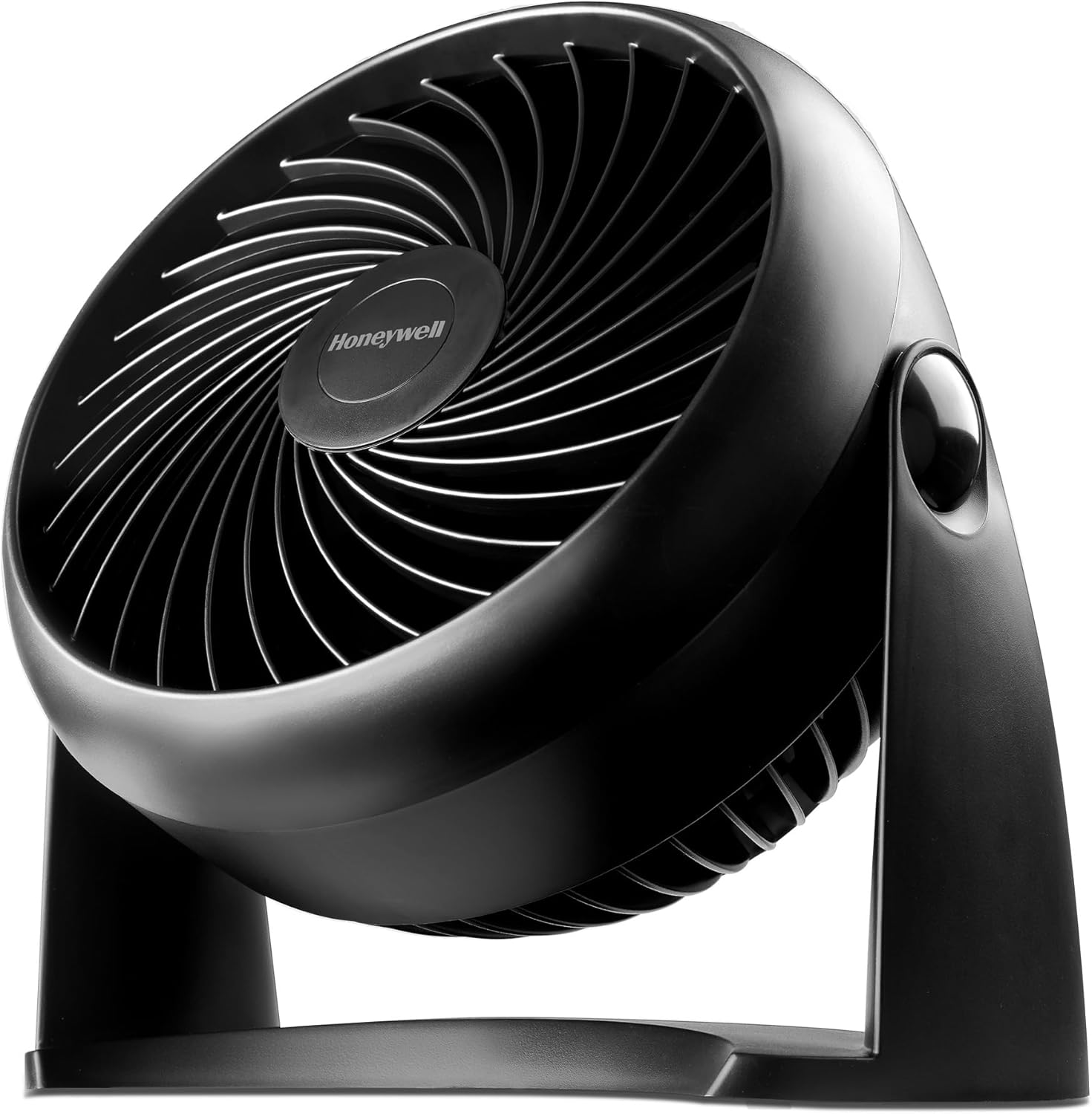
The Honeywell TurboForce HT-900 is a small, corded tabletop air circulator designed to move a surprising amount of air for its size. It is typically used on desks, bedside tables, or wall-mounted to boost room circulation or provide direct cooling; the aerodynamic turbo design and 185 cfm rating let you feel airflow across a room and up to about 25 feet in practical use. Controls are simple push buttons for three speeds and the head pivots 90 degrees so you can direct the breeze precisely. The unit is lightweight plastic with a brushless motor, which contributes to quieter operation and energy-efficient standby behavior. Practical benefits include easy placement, simple controls, and dependable continuous operation without complicated features. Limitations are its small footprint and basic manual controls, so it does not replace larger oscillating fans for whole-room circulation and has no timer, remote, or advanced speed settings.
Best for: Buyers who prioritize a reliable, no-frills fan that consistently delivers focused airflow for desktops, bedrooms, or small home offices and prefer simple controls over smart features.
Less Ideal for: People who need whole-room oscillation, variable precision speed control, or built-in timers and remotes should choose a larger or more feature-rich fan instead.
- Compact tabletop or wall-mount design fits small spaces and desks
- Aerodynamic turbo design delivers strong directed airflow up to about 25 feet
- Three straightforward speeds and a 90-degree pivoting head for precise airflow direction
- Brushless motor and lightweight construction keep operation relatively quiet and energy efficient
- Basic feature set with no timer, remote, or oscillation
- Plastic construction limits durability feel compared with heavier-duty fans
Verdict: A dependable, compact air circulator that reliably delivers strong directed airflow with simple controls for small-room cooling.
DREO DR-HPF013 Pedestal Fan

| Number of Speeds | 8 |
|---|---|
| Noise Level | 28.2 db |
| Wattage | 36 |
| Air Flow Capacity | 1000 cfm |
| Control Method | Remote, Touch |
The DREO DR-HPF013 is a tall pedestal air circulator designed to move a lot of air quietly around a bedroom or living area. It uses a brushless DC motor and a three-blade TurboPoly design to deliver up to 1000 CFM and claimed reach up to 90 feet, while offering eight speeds, an auto mode that steps speed with rising temperature, and 90° horizontal oscillation plus 105° vertical tilt. Controls come via the top touch panel and included remote, and an 8-hour timer and mute function simplify night use. The fan disassembles for cleaning and includes a small aroma pad for light fragrance. Practical downsides are modest: the body is plastic so it feels less premium than metal competitors, and some advanced features like app or voice control are not present. Noise is low at the stated 28.2 dB on low settings, but expect audible wind at higher speeds given the high airflow. For buyers seeking a powerful yet quiet DC pedestal fan for whole-room circulation, this model balances strong airflow and convenient controls without complex smart features.
Best for: Buyers who prioritize strong, fast whole-room airflow with quiet operation and simple remote/touch controls and who value social proof from high-rated, well-reviewed products.
Less Ideal for: If you need a metal-built premium finish, full smart-home integration, or a fan specifically for outdoor use, consider other options instead.
- High airflow capacity up to 1000 CFM for rapid whole-room circulation
- Brushless DC motor for efficient, quieter operation
- Eight-speed range plus auto mode and 8-hour timer for flexible control
- Remote and top-panel touch controls for convenient operation
- Detachable grill and blades for easier cleaning
- Plastic construction feels less sturdy than metal fans
- No app or voice control for smart-home integration
Verdict: Choose the DREO DR-HPF013 when you want powerful, quiet whole-room airflow controlled easily by remote or touch.
DREO Tower Fan DR-HTF018

| Power Source | Corded Electric |
|---|---|
| Number of Speeds | 9 |
| Special Features | 9 Speeds 4 Modes, Oscillating, Timer |
| Wattage | 35 watts |
| Air Flow Capacity | 1473 cfm |
The DREO Tower Fan DR-HTF018 is a freestanding 42-inch cooling fan built around a brushless DC motor that delivers high airflow with relatively low noise. It offers nine speed settings and four modes (Standard, Natural, Sleep, Turbo), plus 90° oscillation and a 12-hour timer for scheduled running. The unit is typically used in living rooms, bedrooms, or home offices where you want strong directional airflow without bulky floor fans; the remote and electronic touch controls make it easy to change speeds from across the room. Practical benefits include a long airflow reach (advertised up to 28 ft/s and 1473 CFM) for moving heat out of corners and a removable rear grille that simplifies dust removal. On the downside it is a plastic-bodied tower so it is lighter than metal fans and the control panel display is bright until it auto-dims, which may still be noticeable to very light sleepers. It consumes modest power for its output, and the included remote and simple assembly keep operation straightforward for everyday use.
Best for: Buyers who prioritize reliable, strong airflow delivered quietly across medium to large rooms and want a fuss-free plug-and-play fan with remote control and easy maintenance.
Less Ideal for: People seeking an industrial‑grade metal fan or a unit primarily intended for outdoor use should consider other options.
- Brushless DC motor for high airflow with lower noise
- Nine speeds and four modes for precise control from gentle to turbo
- 90° oscillation and high CFM to move air across larger rooms
- Remote control and touchscreen panel for convenient operation
- Removable rear grille for easy cleaning and maintenance
- Plastic construction is lighter but feels less solid than metal alternatives
- Display may still emit light before dimming, which could bother very light sleepers
Verdict: Choose this DREO tower fan if you want powerful, quiet room cooling with flexible speed and mode control plus easy maintenance.
Choosing the Right Powerful Fan for Home: Key Factors to Consider
Airflow Capacity and Room Size
Airflow capacity, typically expressed in cubic feet per minute or an equivalent metric, determines how quickly a fan can move and refresh air in a room. For larger living rooms and open-plan areas you want significantly higher airflow ratings than for a small bedroom. A fan specified with higher CFM values will reduce stagnant air and hot spots faster, but also tends to use more power and may produce more noise at top speeds.
Noise Performance
Noise matters for any fan used in living spaces, especially bedrooms, home offices, and media rooms. Look for published decibel ratings at different speed settings or reviews that measure sound output. Lower decibel levels at useful higher speeds indicate better engineering balance between motor power and blade design.
Keep in mind that perceived noise also depends on blade type, housing resonance, and mounting. A fan that is technically loud at high speed can still be acceptable if it delivers the required cooling at a lower, quieter setting.
Motor Type and Power Efficiency
The motor determines sustained performance and long-term reliability. Brushless DC motors typically offer better efficiency and longer service life than older shaded-pole or universal motors, and they often provide finer speed control with lower power draw. For frequent or continuous operation, a more efficient motor reduces electricity use and heat buildup.
Check whether the manufacturer or spec sheet includes wattage at different speeds. A fan that delivers high airflow with lower power input represents a better tradeoff for ongoing running costs.
Mounting, Placement, and Coverage
Consider where the fan will operate: on the floor, a table, mounted on a wall, or ceiling. Each placement changes how air circulates and what features matter. Floor fans with wide tilt and oscillation can move air across longer distances, while wall-mounted fans free up floor space and deliver targeted airflow.
Also think about coverage pattern. Some fans concentrate airflow into a narrow, long-range stream for spot cooling, while others spread air broadly for whole-room circulation. Match the fan style to your typical use cases.
Controls, Speed Range, and Convenience
Effective control options let you run the fan at the right balance of airflow and noise. Look for multiple speeds, variable or digital controls, remote operation, and programmable timers if you plan to use the fan overnight or on a schedule. Smooth speed transitions and memory settings add convenience.
Physical durability of switches and the availability of intuitive controls matter when the fan will be adjusted often.
Maintenance and Ease of Cleaning
Dust buildup on blades and motor housings reduces airflow and increases noise over time, so maintenance accessibility is important. Fans with tool-free grills, removable blades, or simple access panels make regular cleaning straightforward. Consider how often you will need to clean the fan based on your home environment and whether replacement parts like filters or grills are easy to service.
Better designed fans also minimize crevices where dust can accumulate, which helps preserve performance between cleanings.
Types of High-Power Fans and Where They Excel
High-power fans come in several common formats, each suited to different uses. Floor and pedestal fans provide flexible placement and strong directional airflow for cooling people or guiding air toward vents. Tower fans are sleeker and can still move a surprising amount of air in a compact footprint, though peak airflow is usually more diffused.
Box and drum-style fans are workhorse options that produce long-range, concentrated airflow ideal for large open rooms or garages. Wall-mounted fans save floor space and are good for targeted circulation along a specific airflow path. Choose the form factor that matches your room layout and the circulation pattern you need.
- Floor/Pedestal: Good for directional cooling and adjustable height.
- Tower: Space-saving, quieter at moderate speeds, broader airflow.
- Box/Drum: High thrust and long reach for large areas.
- Wall-Mounted: Keeps floor clear and directs airflow along a fixed path.
Placement Tips to Maximize Cooling
Positioning a powerful fan correctly can greatly increase perceived cooling without raising its speed. For spot cooling, place the fan so the airflow reaches seating areas or sleeping surfaces directly. For whole-room circulation, aim the fan toward the center of the room or create a circulation loop by pairing a fan with an HVAC return or another fan.
In multi-room or open-plan layouts, using several lower-speed fans placed strategically often yields better comfort and lower noise than running one fan at full blast.
- Direct airflow toward occupants for immediate cooling.
- Use oscillation or gentle sweep to avoid overly focused wind in one spot.
- Combine with HVAC returns to improve whole-home circulation.
Noise-Reducing Strategies
If noise is a primary concern, look beyond stated decibel figures and consider fan speed selection. Running a fan at a mid setting that still provides sufficient airflow is often the best compromise. Blade design, motor mount isolation, and a rigid housing reduce rattles and tonal noise.
Physical placement also influences perceived sound. Position a fan farther from a bed or workspace and point it so the primary airflow path crosses the room rather than directly toward the quietest spot.
- Choose designs with balanced blades and isolated motor mounts.
- Run at lower speeds when possible and increase only as needed.
- Place on soft or vibration-damping surfaces to reduce resonance.
Energy Use and Long-Term Running Considerations
Powerful fans can run for many hours, so energy efficiency and motor longevity are important. Look for fans that provide higher airflow per watt. Brushless motors typically consume less energy for the same airflow compared with older motor types and generate less heat during long runtime.
Consider whether you will use the fan intermittently for spot cooling or continuously as part of a circulation strategy. Continuous use favors more efficient motors and durable construction to avoid premature wear.
- Check wattage at different speed settings.
- Prioritize fans designed for continuous operation if you will run them often.
- Consider the tradeoff between higher airflow and higher energy draw.
Safety and Child-Friendly Features
For homes with children or pets, grille design and blade safety are key. Tighter grille spacing, recessed blades, or designs that prevent easy access to moving parts reduce the risk of accidental contact. Stable bases and tip-over protection also matter for taller pedestal or tower units.
Look for models with automatic shutoff on tipping or overheating protection in the motor. Those features do not increase airflow, but they make a high-power fan safer for daily family use.
- Prefer grills with small gaps and secure fastenings.
- Check for tip-over and thermal cutout protections.
- Place tall units away from high-traffic edges to reduce knock-over risk.
How We Chose the Best Powerful Fan for Home
We shortlisted fans that deliver verifiable high airflow while remaining practical for everyday home use. Our selection filtered for units with clear specifications for cubic feet per minute (CFM) or equivalent airflow metrics, robust motor designs, and durable housings suitable for continuous or frequent operation. Key evaluation criteria included airflow output versus power consumption, measured or stated noise levels at typical speeds, build quality and durability for long-term use, and usability features such as speed controls, oscillation, tilt adjustments, and mounting or placement flexibility. We also prioritized fans that are easy to clean and maintain, since dust buildup significantly reduces long-term performance. We excluded novelty or single-purpose fans that sacrifice airflow for style, devices intended only for outdoor use, and units lacking clear technical specifications. Our approach favored models that combine strong, documented airflow with sensible noise control and practical features homeowners rely on day to day.
Our full evaluation process is outlined in our review methodology.
FAQ
How do I tell if a fan is powerful enough for my room?
Estimate your room volume and compare it to the fan's airflow rating. Higher CFM values move more air and are better for larger spaces. Also consider whether you need targeted spot cooling or whole-room circulation when deciding on required airflow.
Will a more powerful fan always be louder?
Not necessarily. Noise depends on motor design, blade shape, and housing. Some high-efficiency motors and aerodynamic blades produce strong airflow at moderate noise levels. Look for measured decibel ratings at different speeds to judge likely noise performance.
Can a powerful fan replace air conditioning?
A fan does not lower air temperature but increases evaporative and convective cooling on the skin, which makes you feel cooler. In mild conditions or for spot cooling, a powerful fan may reduce reliance on air conditioning, but it will not substitute for temperature control on very hot days.
How often should I clean a high-power fan?
Frequency depends on dust levels in your home, but plan on inspecting and cleaning grills and blades every one to three months. Regular cleaning preserves airflow efficiency and reduces motor strain and noise from imbalance.
Are brushless motors worth the extra cost?
Brushless motors usually offer better efficiency, lower operating temperatures, and longer lifespan, which can justify higher upfront cost for frequent or continuous use. For occasional spot cooling, a simpler motor type can still be adequate.
Final Verdict
Choose a powerful fan by balancing airflow needs against noise, energy use, and placement constraints. Prioritize airflow capacity and motor efficiency for larger spaces or continuous use, and focus on noise performance and controls for bedrooms or home offices. Consider mounting and safety features if floor space is limited or if children and pets are present. Weigh the tradeoffs between raw thrust and audible comfort to find a fan that provides the cooling you need without creating new annoyances. Use the evaluation criteria above to narrow choices and pick a model that matches your typical room size and daily usage patterns.