
Note: This article contains affiliate links. If you click on these links and make a purchase, we may earn a small commission at no extra cost to you. This helps support our research and content. Read our full affiliate disclosure here.
A precise edge transforms how knives perform for prep, carving, and finishing. Choosing the right precision knife sharpener matters because small changes in bevel angle or grit progression produce big differences in cut quality and edge life. In this guide we shortlisted the top options tuned for controlled angle settings, repeatable stones or abrasives, and user-friendly jigs that help you restore or refine kitchen and specialty knives. You will find choices aimed at repeatable accuracy, ease of use, and durable abrasive systems. Below are our top picks followed by the practical criteria we used to evaluate them.
Top Picks at a Glance
| Best Overall The best all-around choice for most situations | Work Sharp Precision Adjust Elite |  |
| Best Quality Built to a higher standard if you want something more solid | KME Precision Knife Sharpener |  |
| Best Value The sweet spot between price and what you get | Sharp Pebble Precision Adjust Sharpener |  |
| Top Rated A top-rated pick with lots of positive feedback | Chef'sChoice Trizor 15XV Sharpener |  |
| Most Popular A crowd favorite that many people choose with confidence | Work Sharp Precision Adjust Knife Sharpener |  |
| Best Seller A high-volume bestseller chosen again and again | Intelitopia Knife Sharpening Stone Set |  |
Work Sharp Precision Adjust Elite

| Included components | Leather strop, ceramic rod for serrations |
|---|---|
| Material Type | Plastic, Stainless Steel |
| Angle range | 15° to 30° |
| Diamond grits | 320 coarse, 600 fine |
The Work Sharp Precision Adjust Elite is a guided, fixed-angle sharpening system designed to restore and refine edges on a wide range of knives. You clamp the blade, set the angle between 15 and 30 degrees, and use the coarse and fine diamond plates for stock removal and edge refinement, then finish with the ceramic rod or leather strop for a polished bevel. A conical ceramic rod handles serrations and a tri-abrasive attachment helps with curved blades, so you can service kitchen, hunting, and EDC knives without sending them out. The angle guide removes guesswork, making it approachable for beginners, while the range of abrasives and strop let experienced users take edges to a finer level. It is a benchtop tool so it is steadier than handheld systems but requires some bench space and setup; heavy or unusually shaped tools may need patience to position. Overall it delivers repeatable, professional-style edges for home cooks and hobbyists who want precision without complex freehand skill.
Best for: Buyers who want a reliable, all-purpose sharpening station that produces repeatable, precise edges for kitchen, hunting, and everyday knives without needing freehand skill.
Less Ideal for: If you need a compact, travel-ready sharpener or a pure handheld quick-touch solution, this benchtop system is not the best choice.
- Adjustable angle guide from 15° to 30° for blades with different bevels
- Includes coarse 320 and fine 600 grit diamond plates for effective stock removal and honing
- Dedicated ceramic rod and tri-abrasive attachment for serrations and curved blades
- Leather strop and finishing rod included for a polished, burr-free edge
- Guided clamping system makes sharpening consistent and beginner-friendly
- Benchtop footprint requires counter or workbench space
- Not fully portable compared with compact handheld sharpeners
Verdict: A versatile guided benchtop sharpener that delivers professional-quality, repeatable edges for home cooks and knife enthusiasts seeking precision without freehand skill.
KME Precision Knife Sharpener

| Grit Type | Extra Fine,Extra-coarse,Coarse,Fine |
|---|---|
| Material Type | Wood |
The KME Precision Knife Sharpener is a controlled-angle, rod-guided sharpening system aimed at achieving repeatable, razor-edge results on kitchen and field knives. It ships with four 1 x 4 inch Gold Series diamond hones (140 XC, 300 C, 600 F and 1500 XF), a rotating neoprene-lined clamp, and a base, all stored in a hard carry case for portability. The spherical bearing guide and single-degree angle markings let you set continuous angles from 17 to 30 degrees, so you can tune bevels precisely and re-create the same edge across multiple passes. The large stones and knurled thumb-screw stone carrier make swapping grits fast, and the included cloth and water bottle cover basic maintenance. Because it is a manual, guided system it requires some hands-on time and setup compared with pull-through sharpeners, but that effort pays off in control and edge quality. This is a practical choice for users who want fine-tuned, repeatable sharpening results and a durable, field-capable system without moving to electric machines.
Best for: Buyers who prioritize repeatable, high-performance edges and want a compact guided system for both kitchen and field knives.
Less Ideal for: People who need a quick, no-skill sharpening solution or who prefer electric sharpeners for very fast stock removal.
- Precise angle control from 17 to 30 degrees with single-degree markings
- Includes four diamond hones spanning extra-coarse to extra-fine for full reprofile to polish
- Spherical rod guide and rotating clamp maintain consistent, repeatable sharpening motion
- Portable hard case and integrated base make it convenient for field or home use
- Manual operation requires time and practice to use efficiently
- No motorized assistance for very rapid stock removal on extremely dull blades
Verdict: Choose this system if you want a portable, guided sharpener that delivers precise, repeatable edges using a full set of diamond hones.
Sharp Pebble Precision Adjust Sharpener
| Material Type | Acrylonitrile Butadiene Styrene, Rubber |
|---|---|
| Grit Type | Coarse, Medium, Fine |
| Included Components | Knife Sharpener |
| Item Type Name | knife sharpener |
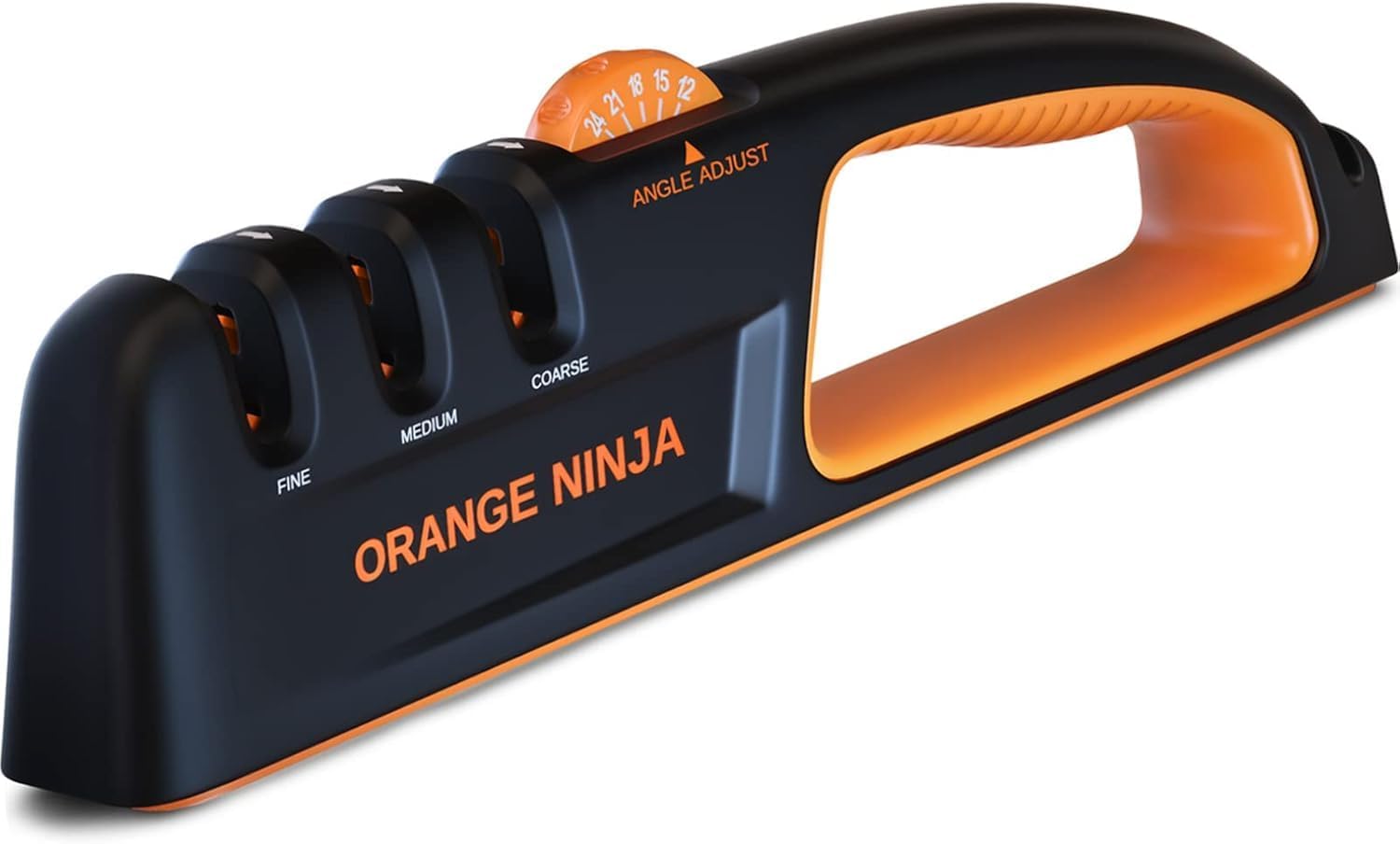
The Sharp Pebble Precision Adjust Sharpener is a compact manual sharpener designed to restore and maintain straight-edge kitchen knives and small outdoor blades. It uses three grit stages—coarse, medium, and fine—and an adjustable angle mechanism that lets you set common sharpening angles (12°, 15°, 18°, 21°, and 24°) so you can match the factory edge on a variety of blades. In practice you insert the blade into the appropriate slot and pull through a few times; the ergonomic ABS body and rubber grip make that simple and stable. The coarse stage quickly repairs chips and reshapes a very dull edge, the medium sets the bevel, and the fine polishes to a usable razor edge without needing stones or power tools. It is lightweight and portable, so it fits in a kitchen drawer or a knife kit. Limitations are that it only works with straight edges, not serrated blades or scissors, and like most preset-angle manual systems it is less flexible than freehand sharpening for custom bevels or very high-end knives.
Best for: Buyers who want an easy, repeatable way to keep everyday straight-edge kitchen knives sharp without learning freehand sharpening or using electric tools.
Less Ideal for: Users seeking a tool for serrated knives, scissors, or those who want full control for custom bevels and professional sharpening work should look elsewhere.
- Adjustable angle settings to match common blade bevels
- Three distinct grit stages (coarse, medium, fine) for repair through polishing
- Ergonomic ABS body with rubberized base for stable, non-slip use
- Simple pull-through operation requires no skill with stones or guided jigs
- Lightweight and portable for kitchen or field use
- Not suitable for serrated blades or scissors
- Preset guides limit ability to create nonstandard bevels or pursue advanced sharpening techniques
Verdict: Choose this sharpener if you want a compact, no-fuss tool that delivers consistent, adjustable-angle sharpening for everyday straight-edge knives.
Chef'sChoice Trizor 15XV Sharpener

| Sharpening stages | 3-stage |
|---|---|
| Abrasive material | 100% diamond abrasives |
| Edge angle | 15-degree |
| Compatible blade types | Straight-edge and serrated knives |
The Chef'sChoice 15XV Trizor is a three-stage electric sharpener designed to convert and maintain a 15-degree edge for kitchen knives using 100 percent diamond abrasives. You run the blade through stage 1 to form the primary bevel with medium diamonds, stage 2 to refine the edge with finer diamonds, and stage 3's patented stropping disks to polish and finish the edge. Built-in precision angle guides and flexible spring guides keep the blade centered and remove guesswork, so even users without sharpening skill get consistent results. It handles straight-edge and serrated knives and can convert more common 20-degree factory edges to a sharper 15-degree profile for finer slicing. The unit is quick for routine touch-ups and takes about a minute for an initial sharpening. The machine is focused on repeatable, factory-quality edges and is best for users who prioritize durability and predictable performance rather than manual control over bevel angle.
Best for: Someone who values consistent, factory-quality sharpening and wants a low-effort way to maintain razor-sharp 15-degree edges on everyday kitchen knives.
Less Ideal for: Users who need variable bevel angles, who prefer full manual sharpening control, or who sharpen oversized specialty blades frequently.
- Uses 100% diamond abrasives for fast, long-lasting material removal
- Three-stage system (sharpen, hone, stropping polish) produces a refined, polished edge
- Precision angle and spring guides deliver consistent, repeatable results with little user skill
- Works on both straight-edge and serrated knives and can convert 20-degree edges to 15 degrees
- Fixed 15-degree primary angle limits flexibility for users who prefer wider angles
- Electric system provides less hands-on control compared with whetstones
- Not suitable for very large blades beyond typical kitchen knife sizes
Verdict: Buy this if you want a reliable, low-skill electric sharpener that consistently delivers a polished 15-degree edge.
Work Sharp Precision Adjust Knife Sharpener

| Included Components | 320 & 600 grit Tri-Brasive, diamond, fine ceramic, adjustable chassis, benchtop base, knife clamp |
|---|---|
| Sharpening Angle Range | 15–30 degrees in 1-degree increments |
| Material Type | Acrylic, Ceramic, Neoprene, Plastic, Steel |
| Manufacturer Warranty Description | 3 YEAR |
The Work Sharp Precision Adjust is a benchtop guided sharpening system designed to restore and refine kitchen and pocket knives with repeatable angle control. You clamp the blade into the v-block, set the angle from 15 to 30 degrees in one-degree steps, then slide the abrasive rod across the edge using the adjustable chassis and bench base. It ships with tri-brasive rods (coarse diamond, medium diamond, and fine ceramic) so you can reprofile a damaged edge, then refine and polish it without changing systems. The angle indexing and clamp make it faster and more consistent than freehand stones, and the benchtop base stabilizes the work for small blades. Downsides are the learning curve for dialing in angles and setup time compared with a guided pull-through or electric sharpener, and it does not replace full-size motorized systems for heavy-duty reprofiling. For someone who values control and a repeatable, sharp finish, it delivers precise, professional results in a compact package.
Best for: Buyers who want a reliable, repeatable manual sharpening system that delivers precise edges and are comfortable spending a little time learning setup and technique.
Less Ideal for: People who need a no-learning, ultra-fast sharpening method for lots of very dull or damaged blades or who prefer fully motorized systems for heavy-duty work.
- Angle-adjustable jig with 1-degree increments for precise, repeatable bevels
- Includes three abrasive rods (coarse diamond, fine diamond, fine ceramic) for reprofiling and polishing
- V-block clamp and benchtop base provide secure, stable sharpening
- Compact benchtop design that fits kitchen counters and small workspaces
- Requires some setup and practice to use accurately
- Not as fast for heavy stock removal as motorized sharpeners
Verdict: Choose this precision-guided benchtop sharpener when you want repeatable, angle-accurate edges and a compact, professional manual system.
Intelitopia Knife Sharpening Stone Set

| Included components | Sharpening Stones |
|---|---|
| Grits | 400/1000 and 3000/8000 |
| Flattening stone | Coarse flattening stone |
| Strop material | Genuine cowhide leather |
This kit supplies everything a careful homeowner needs to keep kitchen and pocket blades sharp. It pairs a dual-sided 400/1000 grit stone for repairing and sharpening with a 3000/8000 grit stone for refining and polishing, plus a coarse flattening stone to maintain a flat sharpening surface. A bamboo non-slip base and angle guide make it easier to hold consistent angles while the leather strop removes burrs and polishes the edge. The stones are aluminum-oxide corundum, which is durable and effective on a wide range of steels, and the included manual helps nonexperts get started. Expect to use the coarse grits when repairing nicks or restoring very dull edges and the fine grits for regular maintenance and a razor finish. The set is versatile for kitchen knives, outdoor blades, and scissors, but real-world results depend on technique and time spent practicing; beginners should follow the guide and take care to keep stones flattened and lubricated for best results.
Best for: Someone who wants a full, durable sharpening system to learn and maintain precise edges at home and prefers a ready-made kit that guides technique.
Less Ideal for: Users who need a quick, no-skill automatic sharpener or who prefer a compact travel tool for frequent carry use.
- Complete kit includes coarse and fine dual-sided whetstones plus flattening stone and strop
- Non-slip bamboo base and angle guide help maintain consistent sharpening angles
- Leather strop removes burrs and polishes for a finer edge finish
- Aluminum-oxide (corundum) stones work on a wide range of knife steels
- Effective sharpening requires practice and regular stone flattening
- No standalone storage case included to protect stones between uses
Verdict: A full, practice-friendly whetstone kit that gives risk-averse buyers the tools to achieve precise, factory-quality edges at home.
Choosing the Right Precision Knife Sharpener: Key Factors to Consider
Angle Control
Accurate angle control determines the edge geometry and cutting performance. A small deviation of a few degrees can change how the knife slices and how quickly the edge dulls. Look for devices with positive stops, indexed angle settings, or micrometer-style adjustment so you can consistently reproduce the same bevel across multiple passes.
Consistent angle control also matters when you need to match factory or custom bevels. If you plan to sharpen a variety of knives, ensure the system covers the typical household range and allows fine adjustments toward higher or lower edge angles.
Abrasive Progression
A sharpening system should offer a logical sequence of abrasives from coarse to fine. Coarse grits remove nicks and reestablish bevel geometry, while medium and fine grits refine the edge and prepare it for polishing. Systems with dedicated finishing stones, strops, or high-grit options produce a keener, longer-lasting edge.
Consider whether abrasives are replaceable or reconditionable. Hardened or bonded stones wear differently than ceramic or diamond surfaces, so maintenance needs and long-term performance are tied directly to the abrasive materials provided.
Blade Support And Safety
How the sharpener holds the blade affects both safety and the consistency of the stroke. Robust clamps or jigs that prevent blade movement reduce chatter and the chance of uneven sharpening. Non-slip bases and secure mounts protect your hands and the work surface, especially when you are working with thin or flexible blades.
Also evaluate how easy it is to load and unload knives. A design that keeps fingers away from the cutting edge during setup and use reduces the risk of accidental cuts and encourages careful technique.
Ease Of Use
The learning curve matters for everyday use. A system that indexes angles clearly, requires minimal tool setup, and guides you through consistent strokes will save time and reduce mistakes. Look for intuitive clamping, straightforward abrasive changes, and clear instructions or markings.
If multiple users will handle the sharpener, consider how easy it is to convert between right- and left-handed use and whether the mechanism is tolerant of slight user variation while still delivering repeatable results.
Portability And Maintenance
Consider whether you need a bench-mounted system or a compact, portable setup for occasional sharpening. Portable units favor lighter construction but must still maintain registration and stability. Maintenance items include cleaning debris from stones, dressing or flattening abrasive surfaces, and replacing consumables.
Evaluate how straightforward those tasks are and whether replacement parts or stones are available. A tool that is easy to maintain will give reliable performance year after year.
Types Of Precision Sharpeners
Precision sharpeners come in several formats including guided-angle stone systems, rod-and-guided-jig combinations, and belt-based fixtures. Guided-angle stone systems use a fixed geometry jig to hold the blade while you move the abrasive, which is ideal for reproducing exact bevels.
Belt systems can remove metal quickly and are useful for re-profiling a blade, but they require careful control and good dust management. Rod-and-jig tools combine portability with decent control and are a middle ground for hobbyists who want accuracy without a heavy bench unit.
- Guided-angle stone systems: Best for repeatable, fine finishing
- Belt systems: Fast material removal and re-profiling
- Rod-and-jig systems: Portable with good control for varied blades
Setting Up And Using A Precision Sharpener
Start by securing the blade in the clamp so it does not shift. Set the angle according to the knife type and desired edge; many kitchen knives sit between low and mid angles while specialty knives may require steeper settings.
Work through a progression of abrasives, beginning with a coarser grit only if you need to repair damage or change the profile. Use consistent, even strokes and count passes per side to maintain symmetry. Finish with a fine grit or strop to remove burrs and polish the edge.
- Check blade alignment before the first pass
- Use light, controlled pressure on finer grits
- Alternate sides regularly and keep pass counts equal
Maintaining Stones, Belts, And Jigs
Regular maintenance keeps a sharpener working accurately. Stones may need flattening with a lapping plate or dressing stone to remove grooves and restore a flat surface. Diamond plates are low-maintenance but still benefit from occasional cleaning to remove metal particles.
Belts should be inspected for glazing and replaced when they lose abrasive cut. Clean clamping surfaces and check mechanical adjustments for play. Tightening loose fittings and storing components in a dry place reduces corrosion and preserves precision.
- Dress stones periodically to maintain flatness
- Replace belts when cutting performance drops
- Keep adjustment threads clean and lightly lubricated
Sharpening Different Blade Shapes
Flat blades, hollow-ground blades, and slightly curved blades each present different challenges. A guided jig handles flat and slightly curved profiles well because it holds the blade at a set angle across the length. For very curved or pointed blades, choose a system with adaptable support or smaller abrasives to follow the contour.
Thin, flexible blades require gentler pressure and finer finishing grits to avoid rolling the edge. Thicker, tougher steels may need more aggressive abrasives initially but finish with high-grit surfaces to regain sharpness.
- Use smaller abrasive contact patches for pointed tips
- Take extra care with flexible blades to avoid edge rolling
- Match grit progression to steel hardness
Stropping And Polishing For Final Edge Refinement
After abrasives, stropping on leather or a fine abrasive compound removes the last burr and aligns the microscopic edge. Stropping improves initial bite and reduces tear during slicing. Many sharpeners include or support dedicated strops for a polished finish.
When stropping, use light pressure and pull the blade away from the cutting edge across the strop. Reassess the edge by testing on soft produce or paper to confirm the desired sharpness.
- Strop after the finest abrasive step
- Use compound only sparingly to build a mirror polish
- Test edges on soft materials to check bite
How We Chose the Best Precision Knife Sharpener
Our shortlist focused on tools that let home cooks and hobbyists produce repeatable, well-controlled edges without needing professional training. We prioritized precise angle control systems, abrasive range and replaceability, stability and clamping that protect the blade and user, and overall usability for both straight and slightly curved edges. Wear resistance and the availability of finer grits mattered because a sharp edge also needs good refinement and honing steps. We excluded general pull-through or sharpening-steel-only devices that do not allow exact angle adjustment or fine-grit finishing. Concretely, we evaluated each sharpener on angle repeatability and setup, abrasive progression and grit options, clamp and jig design for safety and blade support, and long-term maintenance including replaceable stones or belts. We also considered user accessibility features such as clear guides, tool-free adjustments, and portability. Products that lacked precise angle control, offered no fine finishing options, or had unstable blade holding were filtered out.
Our full evaluation process is outlined in our review methodology.
FAQ
How often should I sharpen my knives with a precision system?
It depends on use, but many home cooks sharpen with a precision system when the knife shows cutting drag or fails basic slicing tasks. Light maintenance stropping can be done more frequently, while full abrasive sharpening is typically needed less often.
Will a precision sharpener work on serrated knives?
Serrated blades usually require specialty tools because the teeth have individual gullets. Some precision systems have attachments or fine rods to address serrations, but many users prefer dedicated serration-specific tools for best results.
Can I change the bevel angle to suit different knives?
Yes. Most guided precision sharpeners allow you to set a range of angles to match different knife types. Choose an angle appropriate for the knife's intended use and steel hardness and keep settings consistent between sides.
Is it safe to sharpen very thin or flexible blades with a guided system?
Guided systems are generally safe for thin blades if the clamp supports the blade firmly and you use lighter pressure. Avoid heavy material removal on flexible blades to prevent rolling the edge and use finer grits for finishing.
How do I know when to replace abrasives or stones?
Replace or recondition abrasives when cutting speed decreases noticeably or the surface becomes glazed or uneven. Stones that develop deep grooves or lose flatness should be dressed or replaced to maintain consistent sharpening results.
Final Verdict
Prioritize repeatable angle control, a logical abrasive progression, and a stable clamping system when choosing a precision knife sharpener. Those three dimensions determine how accurately you can reprofile, refine, and maintain a knife edge over time. Consider portability and maintenance needs as secondary tradeoffs: heavier bench systems offer maximum stability while lighter units trade some rigidity for convenience. Focus on the criteria that match your sharpening frequency and the types of blades you own to choose a system you will use consistently.