
Note: This article contains affiliate links. If you click on these links and make a purchase, we may earn a small commission at no extra cost to you. This helps support our research and content. Read our full affiliate disclosure here.
Picking the right printer under $1,000 matters because you want a machine that balances speed, output quality, and running cost without overspending. Whether you print lots of documents, occasional photos, or a mix for a small office, the right choice affects daily workflow, consumable expenses, and long-term reliability. This guide shortlists the top printers in this price range and explains why each type can suit different needs. We evaluated options with an eye on print speed, color and text quality, connectivity, and ongoing operating costs. Read on for help matching features to your typical workloads before the product list.
Top Picks at a Glance
| Best Overall The best all-around choice for most situations | HP Color LaserJet Pro MFP 3301sdw |  |
| Best Quality Built to a higher standard if you want something more solid | Epson EcoTank Photo ET-8550 |  |
| Best Value The sweet spot between price and what you get | Brother DCP-L2640DW Laser Printer |  |
| Best Budget The cheapest option that still gets the job done reliably | Canon PIXMA TS3720 | 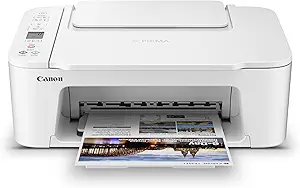 |
| Top Rated A top-rated pick with lots of positive feedback | HP LaserJet Pro MFP 3101sdw |  |
| Most Popular A crowd favorite that many people choose with confidence | Canon PIXMA TR4720 |  |
| Best Seller A high-volume bestseller chosen again and again | Epson EcoTank ET-2800 |  |
HP Color LaserJet Pro MFP 3301sdw

| Printer Type | Laser |
|---|---|
| Duplex | Automatic |
| Color Pages per Minute | 30 |
| Maximum Sheet Capacity | 250 |
| Printer Connectivity Type | USB, Wi-Fi |
The HP Color LaserJet Pro MFP 3301sdw is an office-focused all-in-one laser that delivers fast color and black-and-white output while handling everyday scanning and copying tasks. It prints at up to 30 pages per minute and supports automatic two-sided printing and a 250-sheet input capacity, so it can keep up with small-team workloads without constant paper refills. The built-in flatbed scanner and automatic document feeder make multi-page scanning and copying straightforward, and Ethernet, USB and Wi-Fi plus smartphone support let you print from a variety of devices. Print quality is typical for a color laser at 600 x 600 dpi, producing sharp text and serviceable color for reports and marketing handouts rather than high-end photo work. The MFP also ties into the HP app for remote printing and has security features aimed at office use. Expect recurring costs tied to original HP toner and occasional firmware behavior that limits use of non-HP cartridges, which is important to factor into ongoing operating cost. For offices that need reliable, fast color output and basic MFP features, this model covers the essentials well.
Best for: Buyers who need a dependable, workhorse color MFP for a small office or team and prioritize speed, duplexing, and networked printing in a compact footprint.
Less Ideal for: Users who require photo-grade color prints or the lowest possible ongoing toner costs should look at other printer types or suppliers.
- Fast print speeds up to 30 ppm for both color and B&W
- Automatic duplex printing reduces paper use and manual intervention
- 250-sheet input capacity supports moderate office print volumes
- Multi-function features: flatbed scanner plus automatic document feeder for scanning/copying
- Multiple connectivity options including Wi-Fi, USB and Ethernet and smartphone printing
- Print resolution of 600 x 600 dpi is fine for documents but not for high-detail photo output
- Uses HP-original toner with chip restrictions which can increase ongoing consumable costs
Verdict: A fast, networkable all-in-one color laser that delivers reliable office-grade prints and essential MFP features for small teams.
Epson EcoTank Photo ET-8550

| Printer Type | Inkjet |
|---|---|
| Printer Output Type | Color |
| Maximum Media Size | 13 x 19 inch |
| Color Pages per Minute | 12 pages_per_minute |
| Duplex | auto |
The Epson EcoTank Photo ET-8550 is a wide-format inkjet all-in-one that swaps cartridges for refillable high-capacity ink bottles, letting you print large, lab-quality photos and everyday documents at a much lower ink cost. It handles borderless 13 x 19 inch media, cardstock up to 1.3 mm, and can print directly to CDs and DVDs, so it fits creative home studios and hobbyists who need larger output. The six-color Claria ET Premium ink set and high-resolution printhead deliver sharp detail and rich colors for photos, while a built-in scanner and copier add basic repro capabilities. Connectivity is straightforward with USB and mobile support, and automatic duplexing and respectable color/BW speeds make it usable for mixed workflow. The main trade-offs are size and weight compared with compact photo printers, and it benefits from using genuine Epson inks to maintain color accuracy and avoid warranty issues. For buyers focused on photo quality and low ongoing ink cost under $1,000, this printer balances output quality and economical running costs.
Best for: Buyers who prioritize high-quality, large-format photo output and low ongoing ink costs for a home studio or creative hobby use and who accept a larger footprint for better print capability.
Less Ideal for: Those who need a small, lightweight printer for occasional document printing or who prefer a simple compact photo printer with minimal setup and space requirements.
- Cartridge-free EcoTank system significantly lowers ink cost per page and reduces waste
- Six-color Claria ET Premium inks and high maximum resolution for detailed, vibrant photo prints
- Supports wide-format borderless printing up to 13 x 19 inches and thicker media up to 1.3 mm
- Includes scanner and copier functions for basic studio workflows
- Automatic duplexing and mobile/USB connectivity simplify everyday use
- Relatively large and heavy for home use compared with compact photo printers
- Requires genuine Epson ink to ensure optimal color and avoid warranty issues
Verdict: If you want wide-format, lab-quality photos with very low ink running costs under $1,000, the EcoTank Photo ET-8550 is a strong performance-oriented pick.
Brother DCP-L2640DW Laser Printer

| Printer Type | Laser |
|---|---|
| Printer Output Type | Monochrome |
| Print Speed | 36 pages_per_minute |
| Paper Capacity | 250-sheet tray |
| Connectivity | Ethernet, USB, Wi-Fi |
The Brother DCP-L2640DW is a compact black-and-white laser multifunction designed for small offices and busy home workspaces. It prints up to 36 ppm and supports automatic duplexing, a 250-sheet tray, and a 50-page automatic document feeder to speed multi-page jobs. Connectivity includes dual-band Wi-Fi, Ethernet, and USB so multiple devices can print or scan from desktops and mobile devices using the Brother Mobile Connect app. Toner save mode and eligibility for Brother Refresh subscription simplify supply management and lower per-page costs for regular users. Practical limits include monochrome-only output and a modest LCD rather than a large touchscreen, so photo or color tasks are out of scope and some advanced controls are more menu-driven. For routine document workflows—drafts, reports, invoices, and batch scanning—the DCP-L2640DW delivers fast, dependable output in a small footprint while keeping running costs reasonable with Brother genuine toners.
Best for: Buyers who prioritize fast, reliable black-and-white printing and streamlined supply management for regular document workflows in small offices or home workspaces.
Less Ideal for: Those who need color printing, photo-quality output, or advanced touchscreen controls should consider a different model.
- Fast monochrome printing up to 36 pages per minute for high-volume document tasks
- Automatic duplexing reduces paper use and manual flipping
- 50-sheet auto document feeder for efficient multi-page scanning and copying
- Multiple connectivity options including dual-band Wi‑Fi, Ethernet, and USB for flexible setups
- Compatible with Brother Refresh subscription and genuine TN830/TN830XL toners to simplify supplies
- Prints only in black and white so it cannot handle color documents or photos
- In-box toner yield is limited compared with some higher-end models, requiring more frequent cartridge replacement
Verdict: A fast, compact monochrome MFP built to lower operating hassle and costs for high-volume document printing under $1,000.
Canon PIXMA TS3720

| Printer Type | Inkjet |
|---|---|
| Connectivity | USB, Wi-Fi |
| Compatible Cartridge | Canon CL-276, Canon PG-275 |
| Maximum Media Size | 8.5 x 14 inch |
| Color Pages per Minute | 4 pages_per_minute |
The Canon PIXMA TS3720 is a small all-in-one inkjet aimed at everyday home tasks like documents, photos and occasional scanning and copying. It uses a two-cartridge hybrid FINE ink system with pigment black for sharp text and dye-based color for photos, and supports borderless photos up to 5" x 7" and media up to 8.5" x 14". Setup is straightforward and you can print from phones and tablets via the Canon PRINT app, AirPrint or Mopria, with dual-band Wi-Fi or a single USB port for direct connection. Its rear tray holds up to 60 sheets and print speeds are modest at about 7.7 ppm black and 4 ppm color, which is fine for light home use but not suited to heavy daily volumes. The 1.5" LCD and simple controls make basic copying and scanning easy, while lack of automatic duplex and a two-cartridge system mean higher running costs and more manual handling compared with higher-end models. For a compact, wallet-friendly home printer the TS3720 covers the essentials with reliable wireless convenience.
Best for: Buyers seeking an inexpensive, space-saving all-in-one for occasional home printing, photo printing and mobile-first workflows who prioritize ease of use and wireless convenience.
Less Ideal for: Users who need fast, high-volume printing, automatic duplexing, or the lowest long-term ink costs should consider more robust office-oriented models.
- Compact footprint with simple setup for quick home use
- Wireless printing from mobile devices via Canon PRINT, AirPrint and Mopria
- Two-cartridge hybrid ink system for sharp text and vivid photos
- Supports borderless photos and variety of media up to 8.5 x 14 inches
- Single-sided printing only with no automatic duplex capability
- Modest print speeds and small 60-sheet tray limit suitability for high-volume use
Verdict: An affordable, compact all-in-one that handles basic home printing and mobile workflows well for buyers on a budget.
HP LaserJet Pro MFP 3101sdw

| Printer Type | Laser |
|---|---|
| Print Speed (B&W) | 40 ppm |
| Resolution | 1200 x 1200 dpi |
| Automatic Duplex | Yes |
| Input Capacity | 250 sheets |
The HP LaserJet Pro MFP 3101sdw is a compact monochrome laser multifunction designed for small offices and teams that need steady, business-ready output. It prints at up to 35–40 pages per minute and delivers crisp 1200 x 1200 dpi black-and-white text, while the built-in flatbed plus 50-sheet ADF handles routine scanning and copying tasks. A 250-sheet input tray and automatic duplex printing reduce paper handling, and wired and wireless options including Ethernet, AirPrint, Mopria, USB, and mobile printing make it simple to connect from laptops and phones. Management features and HP app control help keep multiple locations or users organized. The unit is intended to work with HP toner cartridges and includes an introductory cartridge yielding about 1,000 pages; factory firmware enforces cartridge compatibility. Practical limitations are its monochrome-only output and the usual ongoing cost of OEM toner, and features like fax or advanced finishing are not highlighted. For teams that prioritize steady, fast black-and-white throughput and straightforward connectivity, this MFP covers the essentials without unnecessary complexity.
Best for: Buyers who need a dependable, workhorse monochrome MFP for a small office or team and value fast, consistent text printing and easy connectivity.
Less Ideal for: Home users who need color printing or photographers requiring high-quality color output should look at color inkjet or color laser alternatives.
- Fast monochrome printing up to 35–40 ppm for quick document throughput
- 1200 x 1200 dpi print resolution for sharp text and business documents
- 50-sheet ADF plus flatbed scanner for multi-page scanning and copying
- 250-sheet input tray and automatic duplex to cut paper handling and manual intervention
- Multiple connectivity options including Ethernet, Wi‑Fi, AirPrint, Mopria and USB for flexible setup
- Monochrome only so no color printing or photo output
- Relies on HP-chipped toner cartridges which can increase ongoing consumable cost
Verdict: Choose this MFP if you want a reliable, fast monochrome laser all-in-one that handles everyday office printing and scanning with minimal fuss.
Canon PIXMA TR4720

| Printer Type | Inkjet |
|---|---|
| Printer Output Type | Color |
| Maximum print Resolution Color | 4800 x 1200 |
| B&W Pages per Minute | 8.8 |
| Printer Connectivity Type | USB, Wi-Fi |
The Canon PIXMA TR4720 is a compact 4-in-1 inkjet that covers basic home and small-office tasks with a small footprint and straightforward setup. It prints, scans, copies and sends faxes, and includes an auto document feeder and automatic two-sided printing to save time and paper on multi-page jobs. The front 100-sheet tray and borderless photo capability let you handle everyday documents and occasional photo prints without frequent reloads. Connectivity is flexible: USB and Wi-Fi support mobile printing through the Canon Print app and basic cloud workflows. Print quality is good for text and casual color prints thanks to Canon's hybrid ink system, though color photo speeds are modest. Expect slower color output and consumer-level ink costs compared with laser alternatives, and the modest 8.8 ipm black print speed means it is not suited for heavy daily volumes. The simple 2-line LCD and app control keep operation easy for nontechnical users. For buyers who value a small, all-in-one machine for typical home or light office duty, it delivers the essential features in a compact package.
Best for: Buyers who want an easy-to-use, space-saving all-in-one for home or small-office tasks and who prioritize straightforward setup and reliable everyday printing over high-volume throughput.
Less Ideal for: Anyone needing fast, high-volume monochrome or color output on a tight per-page budget should consider a small business laser or a higher-capacity ink system instead.
- All-in-one functions: print, copy, scan and fax in one compact unit.
- Auto document feeder and automatic duplex reduce manual steps for multi-page jobs.
- Wireless and USB connectivity with Canon Print app support for mobile/cloud printing.
- 100-sheet front paper tray with borderless photo printing up to 8.5 x 11".
- Low standby power draw (7W active) for energy-conscious setups.
- Color print speed and throughput are modest compared with business laser printers.
- Uses consumer ink cartridges which can be expensive for high-volume color printing.
Verdict: A compact, user-friendly all-in-one that reliably handles typical home and light office printing needs while keeping setup and operation simple.
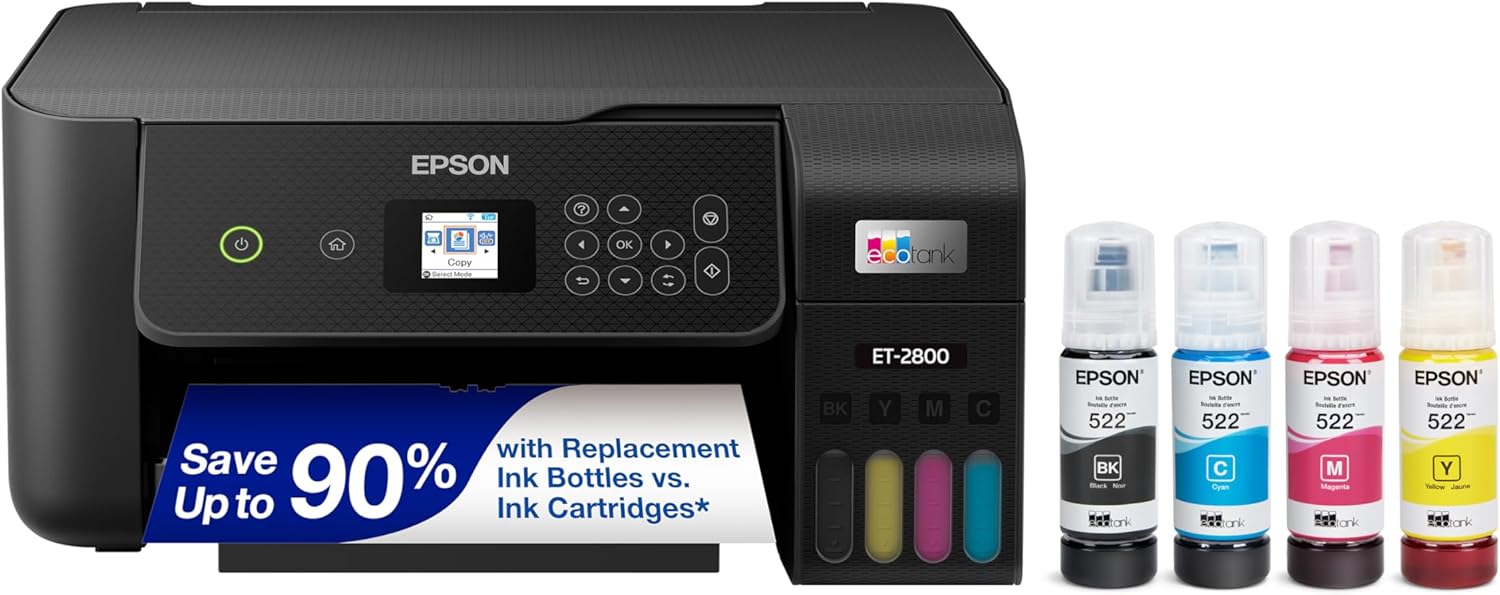
Epson EcoTank ET-2800
| Printer Type | Inkjet |
|---|---|
| Print Output Type | Color |
| Connectivity | USB, Wi-Fi |
| Maximum print Resolution Color | 5760 x 1440 dpi |
| B&W Pages per Minute | 10 |
The Epson EcoTank ET-2800 is a home-focused all-in-one inkjet that replaces cartridges with refillable high-capacity ink tanks, so you can print large volumes without frequent cartridge swaps. It prints, scans and copies, offers wireless and USB connectivity, and supports mobile and voice-activated printing for hands-free tasks. Photo and document resolution is high thanks to Epson's PrecisionCore/Micro Piezo technology, and the flatbed scanner and color LCD make everyday scanning and copying straightforward. Expect modest speed—about 10 pages per minute for black and 5 ppm for color—so it is better suited to household jobs than busy offices. The printer is simplex only, so manual double-sided printing is required if you need two-sided output. Setup and refillable bottles simplify recurring ink costs and reduce cartridge waste, but Epson recommends genuine inks to maintain performance and warranty protection. Overall it is a practical, lower-running-cost choice for families and home offices that print regularly and want to avoid cartridge hassles.
Best for: Buyers who want a low-maintenance home printer that minimizes recurring ink purchases and provides reliable everyday printing, scanning and copying with straightforward wireless setup.
Less Ideal for: Users who need fast, high-volume color production or built-in automatic duplexing for heavy double-sided workloads should consider more office-oriented models.
- Cartridge-free EcoTank system greatly reduces frequency of ink replacement
- High print resolution for sharp documents and good photo prints
- Wireless, mobile and voice printing for convenient home use
- Includes flatbed scanner and color LCD for easy copying and scanning
- Relatively slow color print speed compared with higher-end models
- No automatic duplexer for two-sided printing
Verdict: Choose the ET-2800 if you want a dependable home all-in-one that cuts ink hassles and running costs with refillable EcoTank tanks.
Choosing the Right Printer: Key Factors to Consider
Print Speed and Throughput
Print speed matters when you regularly produce multi-page documents or operate in a small office setting. Faster pages per minute reduce wait times and prevent print queues from building during busy periods.
Throughput also relates to how the printer handles continuous jobs. A unit rated for higher monthly volumes will manage long print runs without overheating or slowing down, which matters if you often print reports, handouts, or batches of marketing materials.
Color and Photo Quality
Color accuracy influences how professional your output looks, especially for presentations, client-facing materials, or photo prints. Color management, the number of color cartridges, and print resolution all affect saturation, gradient smoothness, and skin tones.
If you print photos or color graphics often, prioritize models with proven color reproduction and optional photo paper settings. For document-focused use, strong black text rendering and crisp linework are often more important than ultra-high photo fidelity.
Consumables and Cost Per Page
Initial purchase price is only part of owning a printer. Toner or ink cartridges, drum units, and maintenance parts determine the ongoing cost per page. High-yield consumables typically lower per-page cost but raise replacement sticker price.
Consider estimated yield and whether the printer supports high-capacity cartridges or subscription refill programs. Also account for color versus monochrome workloads, because heavy color printing increases total consumable expense significantly.
Connectivity and Software Features
How a printer connects and integrates with your devices affects daily convenience. Look for robust wired and wireless networking, duplex printing, and support for mobile printing standards. A dependable web interface or management app simplifies setup and recurring tasks.
Advanced features such as automatic document feeders, secure printing, and cloud integration can streamline workflows in small offices. Ensure the software supports the operating systems and mobile devices you use most often.
Paper Handling and Media Support
Paper capacity and the variety of media a printer accepts shape how flexible it is for different jobs. Larger input trays and additional cassettes reduce refill frequency for high-volume printing.
If you plan to print photos, labels, envelopes, or cardstock, confirm the printer accepts these sizes and weights. Duplex capability and reliable feed mechanisms prevent jams and reduce manual intervention.
Reliability and Maintenance
A dependable printer minimizes downtime and maintenance costs. Look at the recommended monthly duty cycle, user-replaceable parts, and how easy it is to clear jams or perform routine cleaning.
Consider warranty coverage and available service options. Machines intended for heavier use should offer robust build quality and clear maintenance access to reduce interruptions in your workflow.
Choosing Between Inkjet and Laser Technologies
Understanding the core technology helps match a printer to your needs. Inkjet printers excel at high-quality photo and color document printing with smooth gradients, while laser printers typically deliver faster text and sharper monochrome output with lower cost per page for heavy document workloads.
For hybrid needs, consider color lasers that balance document speed with acceptable color quality, or high-capacity inkjets that offer photo-capable output and low running costs when using pigment or high-yield inks.
- Inkjet: best for photos and mixed media
- Laser: best for heavy document volumes and sharp text
- Hybrid: good for balanced color output and reasonable throughput
Optimizing Print Quality for Different Media
Print settings and paper selection greatly influence final output. Use the correct paper type profile for glossy photo paper, plain office paper, or heavyweight cardstock to avoid banding, smudging, or color shifts.
Regular maintenance like printhead alignment and nozzle checks prevents quality degradation. For critical color work, consider running color calibration tools and soft-proofing from image-editing software before printing.
- Match paper profile to media type
- Run alignment and nozzle checks periodically
- Calibrate color when accurate reproduction is essential
Managing Ongoing Costs and Supplies
Track consumable yield and set reminders for cartridge replacement to avoid mid-job failures. Buying in bulk or choosing high-yield cartridges often reduces per-page expense for frequent printing.
Also examine maintenance items like drums and waste toner containers, which can add surprise costs. If your output is largely monochrome, pick a model with separate black consumables to keep color replacements from driving up expenses.
- Use high-yield cartridges for heavy printing
- Monitor maintenance parts beyond just ink or toner
- Prefer models with separate color and black supplies when possible
Setup, Security, and Network Integration
A straightforward setup and secure network options protect documents and simplify multi-user access. Look for printers that support WPA3 or equivalent wireless security, user authentication for sensitive jobs, and firmware that can be updated easily.
Integrations with cloud services, scanning to email, and managed print features help small offices centralize printing tasks and enforce usage policies.
- Prefer strong wireless security and firmware updates
- Enable user authentication for shared devices
- Use cloud or server integrations for centralized management
When to Prioritize Speed Over Quality
If your daily workflow is dominated by multi-page reports, prioritize print speed and duty cycle over ultra-fine photo quality. Faster first-page-out times and higher IPM ratings reduce bottlenecks during peak hours.
Conversely, if presentations and client-facing materials are a priority, accept slightly lower throughput for better color fidelity and photo handling.
- Choose speed and duty cycle for heavy document output
- Choose quality for photo and design-centric printing
- Balance based on which task occupies most of your print time
How We Chose the Best Printer
We focused on selecting printers that deliver consistent output and reasonable long-term running costs within the under $1,000 budget. Our filters favored machines designed for frequent document or photo use rather than single-purpose devices. Key evaluation criteria included sustained print speed under typical office loads, color and black text accuracy across common paper types, and monthly duty cycle ratings that indicate real-world reliability. We also weighed connectivity and workflow features such as wireless networking, mobile printing support, and duplexing for efficient document handling. Consumable yield and cost per page were included to reflect how affordable the printer remains during regular use. Ease of setup and maintenance were assessed to minimize downtime and service headaches. Excluded from the list were niche or industrial production printers that exceed typical consumer or small-business capabilities, and inexpensive entry-level models not built for steady throughput. The resulting shortlist favors well-rounded machines that match the needs of home users and small offices seeking speed, color fidelity, and manageable operating costs.
Our full evaluation process is outlined in our review methodology.
FAQ
How often should I replace ink or toner in a printer under $1,000?
Replacement frequency depends on your monthly page volume and whether you use color extensively. Heavy document users may replace supplies monthly, while occasional home users might need replacements every few months. Choosing high-yield cartridges stretches intervals between changes.
Can a printer under $1,000 handle photo-quality prints reliably?
Yes, many models in this price range produce good photo prints, especially pigment-based inkjet designs. For the best results, use recommended photo papers, enable the correct print profile, and perform routine maintenance to keep printheads aligned.
Is wireless printing secure enough for a small office?
Wireless printing can be secure if the printer supports modern encryption, firmware updates, and user authentication. Enable strong network security, keep firmware current, and restrict access to trusted users to reduce risk.
What is a realistic monthly duty cycle for a reliable home or small office printer?
A practical duty cycle varies by model, but printers intended for small offices often support several thousand pages per month. Match the duty cycle to your expected usage and allow headroom to avoid stressing components with sustained high-volume jobs.
Should I buy high-yield cartridges or standard ones?
High-yield cartridges usually lower the cost per page and are a better choice for regular printing. If you print infrequently, standard cartridges reduce upfront spending but cost more per page over time.
Final Verdict
Focus on the workload the printer will handle most often. Prioritize print speed and duty cycle for heavy document jobs, and prioritize color accuracy and media support for photo or client-facing materials. Factor in consumable yields and connectivity features to avoid surprises in operating cost and daily convenience. Balance those tradeoffs against the under $1,000 budget to select a machine that provides the right mix of throughput, quality, and manageable maintenance for your home or small office needs.