
Note: This article contains affiliate links. If you click on these links and make a purchase, we may earn a small commission at no extra cost to you. This helps support our research and content. Read our full affiliate disclosure here.
If you rely on sharp blades for precise prep, a professional knife sharpener is one of the most impactful tools you can add to your kitchen. The right sharpener restores a clean bevel, prolongs edge life, and reduces the effort needed for daily maintenance. This guide covers seven shortlisted professional knife sharpeners, each selected for common workshop and commercial kitchen tasks. We evaluated options for edge geometry control, abrasive quality, and user safety so you can pick a tool that fits your skill level and workload. Read on to see which sharpeners earned a spot and why those evaluation criteria matter.
Top Picks at a Glance
| Best Overall The best all-around choice for most situations | Work Sharp Precision Adjust Elite |  |
| Best Quality Built to a higher standard if you want something more solid | EDGE Pro Apex 4 Plus Kit #4 |  |
| Best Value The sweet spot between price and what you get | Intelitopia Knife Sharpening Stone Set |  |
| Best Budget The cheapest option that still gets the job done reliably | Grihot VN3 Knife Sharpener |  |
| Top Rated A top-rated pick with lots of positive feedback | Work Sharp MK2 Knife Sharpener |  |
| Most Popular A crowd favorite that many people choose with confidence | Presto EverSharp Electric Knife Sharpener |  |
| Best Seller A high-volume bestseller chosen again and again | Chef'sChoice 15XV Trizor |  |
Work Sharp Precision Adjust Elite

| Included components | Leather strop, ceramic rod for serrations |
|---|---|
| Material type | Plastic, Stainless Steel |
| Model number | WSBCHPAJ-ELT-ATL |
The Work Sharp Precision Adjust Elite is a guided, fixed-angle benchtop sharpener built to quickly restore a wide variety of blades. You clamp the knife, dial the angle between 15 and 30 degrees, and draw the blade across the abrasive plates and finishing rods to remove nicks and set a consistent edge. The kit includes coarse and fine diamond plates for material removal, a ceramic finishing rod and a conical rod for serrations, plus a tri-brasive attachment for curved edges, which makes it useful for kitchen, hunting, and EDC knives. The guided system removes most of the guesswork, so beginners can get repeatable results while experienced users can control edge geometry precisely. It is a benchtop unit with a solid motor and durable plates, so you get faster edge restoration than stones alone, but it is not a freehand sharpener and does not replace technique-based honing for some professionals. Expect good durability and a complete accessory set, though it requires bench space and electricity for operation.
Best for: Buyers who want one versatile, easy-to-use benchtop sharpener that produces consistent, professional-quality edges across kitchen, hunting, and everyday knives without learning complex freehand techniques.
Less Ideal for: Users seeking a compact, pocketable sharpener or those who prefer practicing freehand whetstone skills for custom edge work should consider other options.
- Adjustable angle guide from 15° to 30° for precise, repeatable edge geometry
- Includes coarse and fine diamond plates plus ceramic finishing and serration rods
- Guided clamping system makes sharpening straightforward for beginners
- Accessories cover straight, serrated, and curved blades so it handles many knife types
- Requires bench space and power, so not ideal for truly portable use
- Not a substitute for freehand whetstone technique preferred by some sharpening purists
Verdict: If you want a reliable benchtop sharpener that makes professional, repeatable edges easy for both beginners and experienced users, this kit is a top pick.
EDGE Pro Apex 4 Plus Kit #4

| Included grits | 120, 220, 400, 600, 1000, 2000 & 3000 |
|---|---|
| Mounting options | C-Clamp, weighted base, pre-drilled for permanent mount |
| Materials | Alloy steel, aluminum, ceramic |
| Made in | USA |
The EDGE Pro Apex 4 Plus Kit #4 is a guided sharpening system built around a stiffer A-Plus frame that clamps or bolts to a workstation or pairs with a weighted base for extra stability. It uses a set of waterstones from 120 to 1000 grit plus 2000 and 3000 grit polishing tapes and an 8" ceramic hone to take a straight-edge blade from shaping through mirror finishing. The guided rod and dial-in angle control deliver repeatable bevels, while the flip-up hold-down and elevated work height make longer sessions more comfortable. Practical benefits include precise, consistent results with minimal metal removal when used correctly, and the frame design reduces flex compared with tabletop models. The system is not instantaneous the first time: beginners will spend a little time learning stroke technique and abrasive progression to get ideal results, and the kit is focused on straight edges only, so serrated knives require different care. Overall, this is a durable, professional-focused sharpening station that rewards users who prioritize control and repeatability over quick, one-step solutions.
Best for: Buyers who demand precision edges and repeatable results for professional or serious home use and who are willing to invest time learning a guided sharpening workflow.
Less Ideal for: Casual users who want a quick, no-learning-curve fix or anyone who primarily needs to sharpen serrated or heavily damaged blades without time for staged stone work.
- Rigid A-Plus frame with multiple mounting options for reduced flex and improved control
- Comprehensive abrasive progression: 120–1000 grit waterstones plus 2000 and 3000 grit polishing tapes
- Guided angle control and dial-in adjustment for repeatable bevels
- Includes ceramic hone, mounting blanks, clamp, and accessories for full edge restoration and finishing
- Designed for straight-edge blades only, not for serrated edges
- Requires practice to master stroke technique and abrasive progression
Verdict: If you want factory-quality, repeatable edges and professional control, this A-Plus Apex kit delivers a complete, stable sharpening workflow.
Intelitopia Knife Sharpening Stone Set

| Included components | Sharpening Stones, strop, flattening stone, angle guide, bamboo base |
|---|---|
| Grits | 400/1000 and 3000/8000 |
| Material Type | Stone |
| Model Number | MDS00A |
This kit supplies everything a practical user needs to sharpen and polish kitchen and outdoor blades. It includes a dual-sided 400/1000 grit stone for repairing and sharpening dull edges and a 3000/8000 grit stone for refining and polishing, plus a coarse flattening stone to restore flatness, a leather strop to remove burrs, non-slip rubber bases with a bamboo holder, and an angle guide. Typical use is simple: soak the whetstone, work the bevel on the coarse grit, move to finer grits for a razor finish, then strop for a polished edge. The included bases and angle guide make getting consistent angles easier for nonprofessionals, and the flattening stone helps maintain stone performance over time. Limitations: the stones require soaking and regular flattening like any natural abrasive, and true professional users may prefer larger single-grade stones or higher-end abrasive materials for heavy reprofiling. For most home cooks and hobbyists this kit covers sharpening, polishing, and routine maintenance in one affordable package.
Best for: Buyers who want a single, practical kit to sharpen, polish, and maintain a wide range of kitchen and pocket knives without assembling separate tools or advanced stone setups.
Less Ideal for: Professional sharpeners who need oversized bench stones, fast-cutting diamond plates, or industrial reprofiling equipment should look at higher-end specialty tools.
- Dual-sided stones covering coarse to ultra-fine grits for edge repair through polishing
- Includes flattening stone and leather strop for maintenance and burr removal
- Non-slip rubber bases and bamboo holder improve stability during sharpening
- Angle guide simplifies achieving consistent bevel angles for less experienced users
- Stones must be soaked and periodically flattened, adding maintenance time
- Not optimized for heavy industrial reprofiling compared with single large professional stones
Verdict: A complete, budget-friendly whetstone kit that gives practical users the grits, accessories, and stability needed to sharpen and polish most knives at home.
Grihot VN3 Knife Sharpener
| Material Type | High quality stainless steel & Himalayan tungsten carbide |
|---|---|
| Grit Type | Fine, Coarse ,Medium |
| Included Components | Spare replacement |
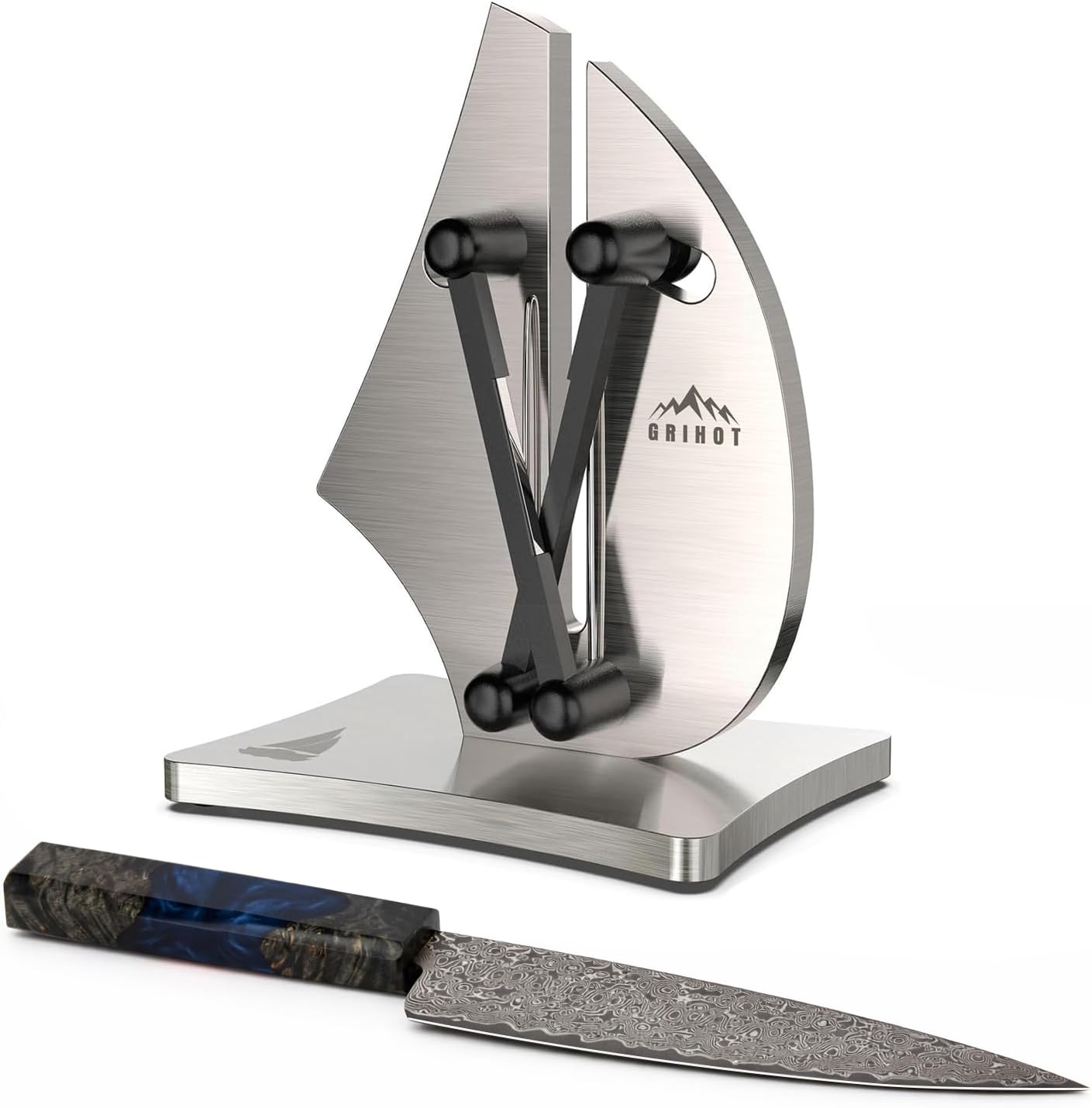
The Grihot VN3 is a compact, manual three-action sharpener designed to restore and sharpen kitchen and pocket knives. It uses tungsten carbide spring arms with automatic angle adjustment plus additional stages for repair and fine honing, so you can move a very dull blade through restoration into a refined edge in a few passes. The stainless steel housing and included replacement parts give the tool a durable, professional feel and an upright, ergonomic sailboat shape that is easy to hold while drawing blades through the slots. In practice the coarse stage removes nicks quickly and the finer stages create a usable kitchen edge without needing stones or lots of technique, making it practical for home cooks and busy pros who need fast results. It is a manual device so it does not produce the ultra-fine, factory-level polish that a high-grit whetstone or guided abrasive system can, and repeated carbide sharpening will remove metal faster than gentle honing, so it is best for maintenance and repair rather than frequent ultra-precise finishing.
Best for: Practical cooks and cost-conscious professionals who want a durable, easy-to-use sharpener that quickly restores dull kitchen knives without learning stone sharpening.
Less Ideal for: Users seeking the highest-precision edge or frequent, delicate resurfacing should choose stones or guided sharpening systems instead.
- Three-action system covers coarse repair, intermediate sharpening, and fine honing for versatile edge work
- Tungsten carbide spring arms with automatic angle adjustment simplify setup and keep a consistent bevel
- Solid 304 stainless steel body and included replacement components improve durability and lifespan
- Ergonomic sailboat shape provides a stable grip for controlled, repeatable strokes
- Carbide stages remove metal relatively quickly and are not ideal for polishing a mirror-finish edge
- Manual slot sharpeners cannot match the ultra-fine control or finish of water stones or guided systems
Verdict: Choose the Grihot VN3 when you need a rugged, no-fuss sharpener that restores and sharpens knives quickly with repeatable results.
Work Sharp MK2 Knife Sharpener

| Included components | Abrasive Belts, Knife Sharpener |
|---|---|
| Material Type | Plastic |
| Grit Type | Medium |
| Model Number | WSKTS2 |
The Work Sharp MK2 is an electric bench sharpener that uses flexible abrasive belts and an adjustable two-speed motor to bring edges back quickly and consistently. It is typically used on kitchen and outdoor blades as well as scissors and small tools—set the edge guide, choose the belt grit and run the blade across the moving belt for controlled bevel shaping and polishing. The belts conform to curved or serrated profiles and can act as a light grinder for heavier tasks like lawnmower blades or axes. Notable features include the edge guide for repeatable angles, medium-grit included belts, and a more powerful motor setting for tougher jobs. Practical benefits are speed, versatility across a wide range of tools, and repeatable results that make maintenance routine rather than a chore. Important limitations are that belt consumables must be replaced periodically and the unit requires a stable bench or surface and basic setup to hit precise angles compared with jig-based systems.
Best for: Buyers who prioritize a reliable, workshop-ready sharpener that delivers fast, repeatable edge restoration across many tool types and prefer a powered system over manual honing.
Less Ideal for: Users looking for the smallest, travel-friendly sharpening solution or those who prefer fully manual, low-consumable methods for occasional touch-ups.
- Flexible abrasive belts conform to varied blade profiles including serrations and curved edges
- Two-speed motor gives control for light honing or heavier grinding tasks
- Edge guide provides repeatable sharpening angles for consistent results
- Works on a wide range of tools from kitchen knives to axes and lawnmower blades
- Belts are consumables and will need periodic replacement
- Requires a solid bench and initial setup to achieve precise bevels
Verdict: Choose the Work Sharp MK2 when you want a dependable, powered sharpener that quickly restores and maintains edges across kitchen and outdoor tools.
Presto EverSharp Electric Knife Sharpener

| Material Type | Plastic, Sapphirite wheels |
|---|---|
| Grit Type | Fine |
| Included Components | knife sharpener |
| Item Type Name | Electric Knife Sharpener |
The Presto EverSharp is a simple two-stage electric sharpener that uses sapphirite grinding wheels to quickly restore a precise bevel and then fine-hone the edge. You insert the blade into guided slots and draw it slowly toward you; the Stage 1 coarse grind sets a consistent angle and Stage 2 polishes to a razor finish, which makes it handy for home cooks who want a fast, repeatable result without hand sharpening skills. The unit includes three suction cups for stable countertop use and catches metal filings in two removable receptacles. It works on alloy, carbon, and stainless blades and can also handle some non-electric serrated knives that are serrated on one side. Limitations include fixed preset angles so you cannot change the bevel, and it is not suitable for fully serrated blades or very thin specialty knives, so professional tuners may prefer a stone or guided system with adjustable angles. For routine at-home maintenance this delivers consistent, shop-like edges with minimal fuss.
Best for: Buyers who want a reliable, low-effort way to get professional-style edges at home and who value consistent results backed by many user reviews and a long-standing brand.
Less Ideal for: Sharpeners who need adjustable-angle control for custom bevels, or users who regularly service fully serrated, ultra-thin, or high-end specialty knives.
- Two-stage system (coarse grind and fine hone) for a consistent, razor-sharp edge
- Uses sapphirite wheels similar to professional shop material
- Precision blade guides ensure correct angle and easy, repeatable sharpening
- Suction-cup base and removable filings receptacles improve stability and cleanup
- Fixed preset angles prevent custom bevel selection
- Not suitable for fully serrated or very thin specialty blades
Verdict: For home cooks who want fast, shop-style sharpening with minimal skill, this two-stage electric sharpener delivers consistent, razor edges reliably.
Chef'sChoice 15XV Trizor

| Stages | 3 |
|---|---|
| Abrasive Type | 100% Diamond Abrasives |
| Edge Angle | 15-degree Trizor edge |
| Suitable Knife Types | Straight-edge and serrated knives |
The Chef'sChoice 15XV Trizor is a compact three-stage electric sharpener designed to convert or maintain a 15-degree performance edge on household and professional-style knives. It guides the blade through medium and fine diamond-plated stages to form and hone the primary bevels, then finishes with patented stropping disks that polish the edge for smoother slicing. Setup is simple: place the unit on a countertop, plug in, and draw the blade through each stage using the built-in angle guides and spring-loaded slots for consistent results. The 100-percent diamond abrasives cut quickly, so first-time sharpening takes about a minute and touch-ups just seconds. It handles straight-edge and serrated blades and can convert a 20-degree factory edge to a sharper 15-degree profile. Trade-offs are typical of electric systems: it removes steel relatively quickly compared with manual honing and is sized for handheld kitchen knives rather than very large blades. For buyers who want repeatable, near-professional edges with minimal skill required, this unit delivers dependable, fast sharpening.
Best for: Buyers who want a low-effort, reliable way to get near-professional sharpness on kitchen knives without mastering manual sharpening techniques.
Less Ideal for: Users who prefer to preserve factory bevels with minimal metal removal or who need to sharpen oversized specialty blades should consider manual systems or professional services instead.
- Three-stage system with diamond abrasives for fast, consistent edge formation and honing
- Patented stropping disks produce a polished, razor-like finish
- Precision angle guides and spring-loaded slots remove guesswork for repeatable results
- Capable of sharpening both straight-edge and serrated knives and converting 20° edges to 15°
- Removes more metal than light honing methods, so frequent use will shorten blade life
- Designed for standard kitchen blades and may not suit very large or specialty knives
Verdict: Choose the 15XV Trizor when you want fast, repeatable, professional-grade 15-degree edges with minimal skill or setup.
Choosing the Right Professional Knife Sharpener: Key Factors to Consider
Angle Control And Repeatability
Consistent bevel angle is critical for achieving predictable cutting performance. A sharpener that holds a repeatable angle lets you reproduce the same edge geometry across multiple knives, which matters more when you operate in a professional kitchen or workshop where many blades need uniform performance.
Look for systems with clear angle markings, robust guides, and minimal play in the clamping or positioning components. Micro-adjustability is useful when you work with different blade profiles, while simple preset guides can speed up work when you need the same angle frequently.
Abrasive Range And Progression
A complete sharpening system offers a coarse grit for re-profiling, one or more medium grits for refining the bevel, and a fine or honing stage for polish. The abrasive materials themselves influence how quickly metal is removed and how fine the final edge will be.
Carbide or diamond abrasives remove material fast but can be aggressive, while ceramic or fine stones produce a keener polish. Consider whether the sharpener supports swapping or combining abrasives so you can move from heavy repair to mirror finish without replacing the whole tool.
Edge Retention And Hardness Compatibility
Edge retention depends on both the blade steel and how the edge is formed. A sharpener that produces the proper microbevel and removes burrs effectively helps maximize how long an edge stays functional between touch-ups.
Confirm that the abrasive system is compatible with the hardness range of knives you use most often. Some abrasive types perform poorly on very hard steels, while others cut quickly but leave a rough finish that requires extra honing.
Build Quality And Serviceability
Professional environments demand tools that withstand daily use. Durable housings, corrosion-resistant guides, and replaceable abrasive elements extend service life and reduce downtime.
Also consider how easy it is to clean and maintain the sharpener. Systems with replaceable components, readily available consumables, and straightforward teardown for cleaning will be less likely to be sidelined during a busy shift.
Speed Versus Precision
High-volume settings often need fast abrasive removal, while specialty knives require delicate finishing. The best professional sharpeners strike a balance, allowing users to remove material quickly when re-profiling and to slow down for a fine edge when needed.
Think about your typical workload. If you frequently repair damaged bevels, a faster abrasive that still permits fine finishing will save time. If you work primarily with high-end knives, precision and finish quality may be more important than raw removal rate.
User Safety And Ergonomics
Sharpening can be hazardous without proper controls. Good professional sharpeners include stable bases, secure blade clamps, and guides that keep hands away from abrasive surfaces. Ergonomic handles and comfortable clamp controls reduce fatigue during repetitive sharpening tasks.
Safety features also extend to how abrasives shed metal particles and whether the unit contains or directs debris away from the user. For frequent use, prioritize designs that minimize exposure to dust and reduce the chance of slips or accidental contact with the abrasive.
When To Use A Professional Sharpener Instead Of Hand Stones
Hand stones are versatile and inexpensive, but professional sharpeners are worth it when you need consistent results across many knives or when time is limited. Machines and guided systems enforce geometry and speed up re-profiling tasks, saving labor hours in busy kitchens.
Professional units also reduce the learning curve for less-experienced staff. Instead of relying on freehand technique, guided sharpeners provide repeatable angles and predictable finishes, which helps maintain consistent cutting performance across a team.
- Faster re-profiling for damaged or dull blades
- Repeatable angles reduce variability between operators
- Less dependence on skilled freehand technique
Maintenance And Consumables To Plan For
Most professional sharpeners have consumables such as abrasive wheels, stones, or belts that wear over time. Budget for replacements and check manufacturer guidance on expected lifespan under commercial use.
Regular cleaning prevents abrasive glazing and buildup of metal particles, which can degrade performance. Inspect guides and clamps periodically for wear and replace worn components promptly to preserve angle accuracy.
- Stock replacement abrasives and spare guides
- Schedule periodic cleaning to remove metal debris
- Replace consumables before performance drops noticeably
Sharpening Workflow For A Busy Kitchen
Establish a standard workflow to keep edge quality consistent across shifts. Start with a rapid inspection to identify chips or severe rolling of the edge. Use a coarser abrasive only when re-profiling is needed, then progress through finer stages to remove burrs and polish the bevel.
Label angle settings and keep a simple log of sharpening events for high-use knives. That helps you track how often each blade needs re-profiling and prevents over-sharpening, which shortens blade life.
- Inspect, re-profile if needed, refine, then hone
- Use consistent angle settings for each knife type
- Log sharpening intervals for heavy-use blades
Safety Best Practices During Sharpening
Always secure the blade properly before engaging any abrasive. Wear eye protection when using powered abrasive systems and consider a dust mask if a unit generates visible fine particles. Keep fingers away from the abrasive path and use push sticks or jigged holders for small blades.
Disconnect powered sharpeners before performing maintenance or changing consumables. Train all staff on the correct clamping and angle setup procedures to reduce accidental damage or injury.
- Use clamps and guides to keep hands clear of abrasives
- Wear eye protection and consider respiratory protection
- Power down and unplug before servicing or part changes
Honing Versus Sharpening: How They Complement Each Other
Honing realigns the existing edge and is a quick way to restore cutting feel between full sharpenings. Sharpening removes metal to create a new bevel and is needed when the edge is rounded, nicked, or too dull for honing alone.
A professional sharpening workflow typically includes both steps: use honing for daily upkeep and a full sharpening sequence when the blade becomes too worn to respond to honing. This approach extends overall blade life while keeping performance high.
- Hone frequently to delay the need for full sharpening
- Perform full sharpening only when honing no longer restores the edge
- Combine honing and sharpening routines in scheduled maintenance
How We Chose the Best Professional Knife Sharpener
We focused on criteria that matter in professional and high-volume kitchen settings. Key evaluation dimensions included abrasive system quality, repeatable angle control, removal rate versus finesse, build durability, and user safety features. We prioritized tools that deliver consistent bevel geometry across repeated uses, and that allow technicians or chefs to move from coarse profile work to fine honing without excessive tool changes. Products were excluded if they lacked reliable angle guides, used only single-purpose abrasives, or had weak construction unsuitable for daily commercial use. We also filtered out devices that require excessive setup time or present avoidable safety risks during normal use. The shortlist emphasizes sharpeners that offer measurable edge retention benefits, clear and adjustable angle settings, robust housings and guides, and abrasives that balance material removal with the ability to produce a refined edge. Ease of cleaning, accessory availability, and long-term maintainability were secondary filters that tipped the scales when choices were otherwise comparable.
Our full evaluation process is outlined in our review methodology.
FAQ
How often should I sharpen knives with a professional sharpener?
Frequency depends on usage. In a busy kitchen, many knives need a full sharpening every few weeks to months, with honing performed daily or between heavy uses. Track performance and sharpen when honing no longer restores a keen edge.
Can professional sharpeners handle very hard stainless steels?
Many professional systems are compatible with a wide hardness range, but abrasive choice matters. Diamond-based abrasives cut hard steels faster, while ceramic abrasives can produce a finer polish. Confirm abrasive compatibility with the steels you use most often.
Is it easy for untrained staff to use a professional sharpener?
Guided systems are generally easier for untrained users because they enforce angle and pressure control. Training on clamping, angle selection, and safety is still important to avoid damaging blades or creating inconsistent edges.
Will frequent sharpening shorten my knives' lifespan?
Excessive material removal can shorten a blade's life, so balance sharpening with regular honing. Use coarse abrasives only when re-profiling is necessary and rely on finishing stages to minimize removed metal while restoring edge geometry.
What maintenance does a professional sharpener require?
Routine maintenance includes cleaning metal debris, inspecting and replacing worn abrasives and guides, and checking clamping accuracy. For powered units, follow any lubrication and electrical safety checks recommended by the manufacturer.
Final Verdict
When choosing a professional knife sharpener, prioritize systems that deliver consistent angle control, a usable range of abrasives, and durable construction. Balance removal speed with finishing capability so you can re-profile when necessary and still achieve a refined edge. Focus on sharpeners that match the volume and blade steels you work with, and implement a maintenance and honing routine to extend blade life. With the right tool and workflow, you can maintain reliable, razor-sharp edges across a busy kitchen without unnecessary blade wear.