
Note: This article contains affiliate links. If you click on these links and make a purchase, we may earn a small commission at no extra cost to you. This helps support our research and content. Read our full affiliate disclosure here.
A dedicated sharpening system can turn dull knives into dependable tools in minutes, and the right system makes the process repeatable and low-risk. If you rely on home or professional kitchen knives, a sharpening jig-based system helps you control bevel angle and get consistent edge geometry across blades. This guide shortlists the top Sharpening System Knife Sharpeners available today and explains how we evaluated them. You will find picks that emphasize durable abrasives, repeatable angle settings, user safety, and ease of maintenance. Read on to find a setup that fits your skills and the knives you actually use.
Top Picks at a Glance
| Best Overall The best all-around choice for most situations | Work Sharp Precision Adjust Elite |  |
| Best Quality Built to a higher standard if you want something more solid | KME Precision Knife Sharpener |  |
| Best Value The sweet spot between price and what you get | Intelitopia Knife Sharpening Set |  |
| Best Budget The cheapest option that still gets the job done reliably | AccuSharp Knife Sharpener |  |
| Top Rated A top-rated pick with lots of positive feedback | Work Sharp MK2 Knife Sharpener |  |
| Most Popular A crowd favorite that many people choose with confidence | Sharp Pebble 1000/6000 Whetstone |  |
| Best Seller A high-volume bestseller chosen again and again | KITCHELLENCE 3-Stage Knife Sharpener |  |
Work Sharp Precision Adjust Elite

| Included components | Leather strop, ceramic rod for serrations |
|---|---|
| Angle range | 15° to 30° |
| Abrasives | 320-grit and 600-grit diamond plates |
| Material type | Plastic, Stainless Steel |
The Work Sharp Precision Adjust Elite is a guided benchtop sharpening system that brings controlled, repeatable sharpening to home cooks, hunters, and knife enthusiasts. You clamp the blade, set the angle between 15 and 30 degrees, then run the knife across the coarse or fine diamond plates to remove nicks and reprofile edges; a ceramic finishing rod and leather strop refine the bevel for a refined, razor edge. The kit includes a conical ceramic rod for restoring serrations and a tri-brasive attachment for curved blades, so it handles a wide range of blade shapes without guessing angles. Its precision guide makes the process accessible to beginners while giving experienced users the repeatability they want, and industrial-quality materials mean the plates and fixtures are built for regular use. The system is benchtop-sized and not as portable as pocket sharpening tools, and it requires some initial setup and learning to get consistent strokes, but once dialed in it delivers professional-quality results at home without sending knives out for service.
Best for: Buyers who want a single, reliable sharpening system that produces repeatable, high-quality edges at home for a variety of knives without relying on pro sharpening services.
Less Ideal for: People who need an ultra-compact field tool or a quick on-the-go sharpener for use while hunting or camping should consider portable sharpeners instead.
- Adjustable guided angles from 15° to 30° for consistent edge geometry
- Includes coarse and fine diamond plates plus finishing rod and leather strop for full sharpening progression
- Dedicated conical ceramic rod for serrated knives and tri-brasive for curved blades
- Guided clamp system reduces user error and speeds up learning curve
- Industrial-quality materials designed for regular home use
- Benchtop format is less convenient for field carry or travel
- Takes initial setup and practiced strokes to get perfectly consistent results
Verdict: Choose this kit if you want a single guided sharpening system that consistently produces professional-quality edges at home.
KME Precision Knife Sharpener

| Grit Type | Extra Fine,Extra-coarse,Coarse,Fine |
|---|---|
| Material Type | Wood |
| Includes | 4 Gold Series diamond hones, base, carry case |
The KME Precision Knife Sharpener is a rod-guided, angle-controlled manual system designed for users who want repeatable, razor-sharp edges. You clamp the blade, set the angle between 17 and 30 degrees using the indexed guide, then run the 1×4 inch Gold Series diamond hones (140, 300, 600, 1500 grits) on the spherical bearing rod for smooth, consistent passes. The rotating neoprene-lined clamp and thumb-screw stone carrier speed stone changes and protect blades during repositioning, while the included base and hard carry case make it easy to use at home or in the field. Practical benefits include fine angle control for performance knives, fast material removal with the extra-coarse stones, and a progression to very fine polishing with the 1500 grit. The system is compact and portable but requires manual technique and some setup time compared with guided bench stones or powered sharpeners, and it does not include powered abrasion so very thick reprofiling takes longer.
Best for: People who prioritize blade performance and want precise, repeatable edge control for kitchen or field knives and are willing to invest time learning a manual guided system.
Less Ideal for: Casual users seeking a zero-learning-curve or very fast reprofiling solution should consider simpler pull-through or powered sharpeners instead.
- Precise angle control from 17 to 30 degrees with single-degree markings
- Four Gold Series diamond hones covering extra-coarse to extra-fine grits for full grit progression
- Spherical bearing rod guide ensures smooth, zero-deviation sharpening motion
- Rotating neoprene-lined clamp and quick-change stone carrier protect blades and speed workflow
- Includes base and hard carry case for stable setup and portable storage
- Manual system requires practice and time to achieve consistent results
- Not optimized for heavy stock removal compared with powered belt systems
- Case and wood components add cost and slightly increase kit bulk
Verdict: Buy this system if you want a portable, rod-guided setup that delivers precise, high-performance edges through a full diamond-grit progression.
Intelitopia Knife Sharpening Set

| Included components | Sharpening Stones |
|---|---|
| Number of Packs | 7 |
| Material Type | Stone |
| Grit Type | Coarse |
This Intelitopia kit gives home cooks a full sharpening workflow in one box. It pairs a 400/1000 grit dual-sided whetstone for repairing and sharpening with a 3000/8000 grit stone for refining and polishing, plus a coarse flattening stone to keep the whetstones flat. The kit includes a bamboo non-slip base and extra rubber feet to stabilize stones during use, an angle guide for consistent bevels, and a leather strop to remove burrs and add final polish. In practice the coarse side quickly restores dull blades and the finer stones produce a readable mirror edge when used with proper slurry or water and a little patience. The included flattening stone and strop extend stone life and finishing quality, but you will need to spend time learning correct angles and technique for best results. This set is geared to regular home maintenance rather than rapid professional reprofiling, and builds a reliable sharpening routine without requiring separate purchases.
Best for: Buyers who want a single, ready-to-use sharpening system to maintain kitchen and utility knives at home and who value a full set of stones and finishing tools to build a repeatable sharpening routine.
Less Ideal for: People who need a fast, guided electric sharpener or professional-grade reprofiling tools for frequent heavy-duty sharpening should look elsewhere.
- Complete kit includes coarse and fine whetstones, flattening stone, leather strop, angle guide, and non-slip bases
- Dual-grit stones (400/1000 and 3000/8000) cover restoring, sharpening, and polishing stages
- Flattening stone helps maintain stone flatness for consistent sharpening over time
- Non-slip bamboo base and extra rubber feet improve safety and stability during use
- Effective sharpening requires learning proper angle and technique, which takes practice
- Not optimized for heavy professional re-profiling or very large blades
Verdict: If you want a single, affordable kit that covers restoring, sharpening, and polishing for home knives and teaches a durable sharpening routine, this set delivers everything needed.
AccuSharp Knife Sharpener

| Material Type | Acrylonitrile Butadiene Styrene |
|---|---|
| Grit Type | Coarse |
| Included Components | Sharpener |
| Model Number | ACCU-001C |
The AccuSharp Knife Sharpener is a simple, ergonomic pull‑through tool designed to restore and hone straight and some serrated knives in seconds. You use it by drawing the blade through the carbide sharpening slot while the handle and full-length finger guard keep your hand stable and protected. Its diamond‑honed tungsten carbide blades cut fast, so most users can get a noticeably sharper edge in around ten seconds, and the reversible blades extend usable life. The plastic body is lightweight and easy to grip, and the sharpener is dishwasher safe for low-effort cleaning. It handles chef, paring, filet and cleaver blades for quick touchups rather than precision reprofiling, so it is best for routine maintenance instead of rebuilding badly damaged edges. Expect blade replacements after years of regular use, and the coarse grit favors rapid material removal which can shorten time between professional sharpening if overused.
Best for: Buyers who want an inexpensive, no‑fuss tool for quick daily touchups to keep kitchen knives reasonably sharp without learning sharpening techniques.
Less Ideal for: Users seeking a professional-level sharpening system, fine honing stones, or a tool to restore heavily nicked blades should choose a guided stone or professional service instead.
- Very fast edge restoration—most blades sharpened in about ten seconds
- Diamond‑honed tungsten carbide blades for durable, effective cutting
- Ergonomic handle with full-length guard for safe, controlled use
- Lightweight, compact design that is easy to store and dishwasher safe
- Coarse grit is better for quick touchups than fine honing or precision reprofiling
- Not intended for rebuilding severely damaged or very dull blades
Verdict: If you want a cheap, easy-to-use sharpener for fast everyday touchups, this AccuSharp delivers reliable, safe results in seconds.
Work Sharp MK2 Knife Sharpener

| Included Components | Abrasive Belts, Knife Sharpener |
|---|---|
| Model Number | WSKTS2 |
| Grit Type | Medium |
The Work Sharp MK2 is a benchtop electric sharpener that uses flexible abrasive belts to quickly restore edges on kitchen knives, pocket blades, serrated tools, scissors, axes and other outdoor implements. It is typically used by placing the blade in the guided edge holder and running the belt across the bevel; the belts conform to tips and curved profiles so you can sharpen right to the point and even work serrations. A two-speed motor gives extra power for heavy tasks like lawnmower blades or axes while a lower speed is gentler for kitchen knives, and the included abrasive belts cover medium grit needs out of the box. Practical benefits include fast, repeatable results, an edge guide that keeps consistent angles, and the ability to handle a wide range of blade types without switching stones. Important limits are that it is a power tool rather than a precision stone system for mirror polishes, and replacement belts are a consumable you will need over time for consistent performance.
Best for: Buyers who prioritize a reliable, fast way to keep a wide variety of cutting tools sharp with repeatable results and minimal setup time.
Less Ideal for: People seeking a traditional stone workflow for microbevels and mirror finishes or those who prefer a manual, nonpowered sharpening method.
- Flexible abrasive belts conform to tip and curved edges for full-length sharpening
- Two-speed motor provides control for light knives and power for heavy tools
- Edge guide produces repeatable, consistent bevel angles
- Works on a wide range of tools including serrated blades, scissors, axes and mower blades
- Not designed for achieving ultra-fine mirror-polished edges compared with whetstones
- Requires periodic replacement of abrasive belts as consumables
Verdict: Choose the MK2 when you want a dependable, easy-to-use electric system that quickly sharpens knives and a wide range of tools with consistent results.
Sharp Pebble 1000/6000 Whetstone

| Grit | 1000/6000 |
|---|---|
| Material Type | Corundum |
| No Oil Required | Yes |
The Sharp Pebble 1000/6000 whetstone is a two-sided waterstone kit designed to repair and polish dull kitchen knives at home. You use the 1000-grit side to reprofile or remove nicks and the 6000-grit side to refine and polish the edge to a razor finish; the kit includes a bamboo non-slip base and an angle guide that helps beginners hold a consistent bevel. The stone uses a corundum abrasive that the brand says stays flatter longer than bargain stones and does not require oil, so you soak it in water and sharpen with less mess. Practical benefits include a complete starter setup with instructions and an ebook, fewer trips to a pro sharpener, and results that can match professional services when used correctly. Limitations are that real-world sharpening still takes practice despite the guide, flattening the stone eventually requires a flattening stone (sold separately), and aggressive reprofiling is slower than with coarse stones.
Best for: Buyers who want a reliable, beginner-friendly whetstone kit that can maintain household knives and reduce trips to a pro sharpener while offering guidance and support.
Less Ideal for: Users who need very fast metal removal for heavily damaged blades or who prefer fully automated electric sharpeners for speed and convenience.
- Dual 1000/6000 grits cover repair and polishing without buying extra stones
- Included angle guide and non-slip bamboo base make consistent sharpening easier for beginners
- Waterstone formulation cuts effectively and is advertised to stay flat longer than cheap alternatives
- Complete kit includes instructions and sharpening support for first-time users
- Stone will eventually need flattening for optimal performance and a flattening stone is not included
- Achieving professional results still requires technique and time despite the angle guide
Verdict: This whetstone kit is the practical choice for anyone who wants a single, guided system to sharpen and polish kitchen knives at home with pro-level results when you invest a little practice.
KITCHELLENCE 3-Stage Knife Sharpener
| Material Type | Plastic |
|---|---|
| Included Components | Cut-resistant glove |
| Number of Items | 1 |
| Unit Count | 1 Count |
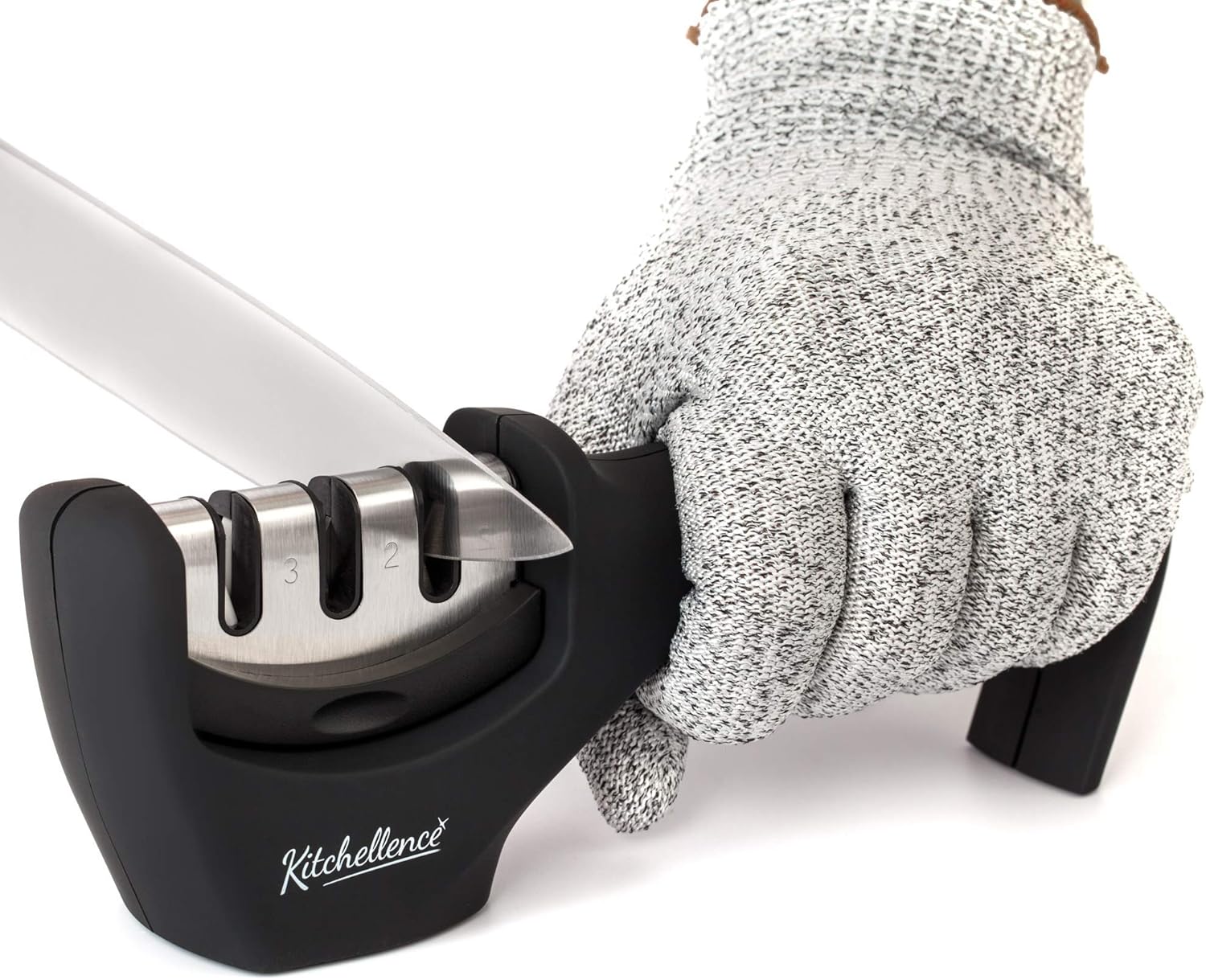
This KITCHELLENCE 3-stage sharpener is a compact, manual system for restoring household knives. You run a dull or nicked blade through the first diamond rod slot to realign and repair damaged edges, then through the second slot to re-establish the V-bevel, and finally through the third slot for a finer polish. It sits on a non-slip base and has an ergonomic handle so it stays stable while you pull blades through; the included cut-resistant glove adds a safety layer during use. The unit is molded from ABS plastic, so it is lightweight and easy to store, and it works quickly for routine touch-ups without tools or electricity. Limitations are that it is a general-purpose hand sharpener best suited for typical kitchen knives rather than specialty steels or serrated blades, and aggressive users may prefer a guided or motorized system for more consistent factory-level grinds. For everyday home cooks who want a simple, safe way to refresh knife edges, this delivers dependable results.
Best for: Buyers who want a low-risk, easy-to-use sharpening solution for everyday kitchen knives and value safety and simplicity over professional-level sharpening control.
Less Ideal for: Do not choose this if you need to sharpen serrated blades, very hard specialty steels, or if you require precise, repeatable edge angles for professional knives.
- Three distinct sharpening stages for repair, bevel restoration, and final polishing
- Diamond sharpening rod in the first stage helps address damaged or very dull edges
- Non-slip base and ergonomic handle improve stability during use
- Includes cut-resistant glove to reduce risk while sharpening
- Lightweight ABS construction is easy to store and handle
- Not designed for serrated knives or specialized high-hardness steels
- Manual pull-through action gives less precise angle control than guided systems
Verdict: A safe, no-fuss three-stage manual sharpener that reliably refreshes household kitchen knives for risk-averse home cooks.
Choosing the Right Sharpening System Knife Sharpener: Key Factors to Consider
Angle Control & Repeatability
Consistent bevel angle is the single most important factor when choosing a sharpening system. A system that locks in a precise angle reduces the chance of overgrinding and ensures every pass produces the same geometry. This matters because small deviations compound quickly, which can ruin an edge or shorten blade life.
Look for systems with clear, positive angle stops and minimal play in the guide mechanisms. Repeatability also affects skill progression; a reliable angle setting helps beginners achieve professional-looking results faster and lets experienced sharpeners reproduce favored bevels across multiple knives.
Abrasive Range And Grit Progression
A usable abrasive range covers coarse grits for repairing chips and re-profiling, medium grits for establishing a working bevel, and fine grits for polishing and burr removal. Systems that offer or accept a wide selection of stones, rods, or diamond plates give you more control over both speed and finish.
Grit progression matters because skipping too many grit steps can leave scratches that take excess time to remove. Also consider abrasive longevity and whether replacements or additional grits are readily available; bonded diamonds and ceramic rods often last longer than softer natural stones.
Clamping And Blade Support
How a system holds the blade affects safety and the quality of the edge. A good clamp grips a range of blade thicknesses and profiles without marring the spine or edge. It should secure the knife so it does not shift during passes, and the support should keep the edge clear and accessible to the abrasive.
Assess whether the system accommodates shorter blades, long chef knives, and nonstandard profiles. Also check for protective features such as thumb guards or spacer blocks that reduce the chance of accidental contact with the abrasive during use.
Ease Of Setup And Use
Sharpening systems vary from simple two-rod setups to multi-axis fixtures with micro-adjustments. Consider how much time you are willing to invest in setup and calibration versus how often you will sharpen. Systems with intuitive angle markings, quick-clamp mechanisms, and clear instructions shorten the learning curve.
For occasional users, prioritize straightforward assembly and fewer parts. Frequent sharpeners may prefer more adjustable systems that reward the extra setup time with finer control and edge quality.
Portability And Storage
If you have limited counter space or travel with knives for catering or events, size and weight matter. Some systems fold flat or break down into compact components, while others are bench-top fixtures. Evaluate whether you need a permanent countertop tool or a portable kit you can stow away.
Consider also how easily consumables are stored and replaced. Kits that include a compact case or labeled storage for stones and rods reduce setup friction and make it easier to keep appropriate grits on hand.
Maintenance And Parts Availability
Routine maintenance includes replacing worn abrasives, cleaning debris, and occasionally re-tensioning clamps or guide rods. Systems backed by an ecosystem of replacement stones, rods, and spare clamps will remain useful longer and cost less to maintain.
Check whether common consumables are industry-standard sizes or manufacturer-specific. Standard sizes make sourcing replacement grits easier and ensure you can progressively upgrade abrasive quality over time.
How To Match A System To Your Knife Types
Different knife steels and profiles respond better to certain abrasive types and angles. Thinner kitchen knives used for slicing benefit from lower-angle finishes that prioritize sharpness, while harder or thicker blades may need slightly higher angles for durability. When selecting a system, verify it supports the angle range you plan to use and can hold the blade profile securely.
- Thin slicing knives: lower angles and finer abrasives for keen edges
- Thicker or high-hardness blades: higher angles and diamond abrasives for controlled material removal
- Specialty blades: confirm clamp geometry and clearance for recurved or tapered edges
Setting And Checking Angle Correctly
Even with an angle-guided system, it is essential to learn how to set and validate the angle. Use a simple angle guide or a digital protractor for initial setup, then check progress by inspecting the burr or using a marker to verify contact across the bevel. Small incremental adjustments prevent overgrinding and yield a better finished edge.
- Mark the bevel with a permanent marker to see stone contact
- Work through grit progression and watch for a consistent burr along the edge
- Use light pressure on fine grits to avoid rounding the apex
Routine Sharpening Workflow
A consistent workflow keeps edges uniform and reduces the time needed for each session. Start with coarse grits only when re-profiling or repairing chips. For routine maintenance, a medium grit followed by a fine finishing stone is sufficient. Always end with light, alternating passes to remove the burr and restore a clean cutting edge.
- Clamp securely and align angle before starting
- Make equal numbers of passes per side to keep the bevel symmetric
- Finish with polishing strokes or a stropping step for high-cutting performance
Care And Storage Of Abrasives
Abrasives require basic care to preserve their cutting action. Clean stones or diamond plates after use to remove metal particles that can clog the surface. For water stones, follow manufacturer guidance on soaking and flattening; bonded abrasives may need only occasional cleaning with a stiff brush. Store abrasive components in a dry, temperature-stable location and keep them labeled by grit to avoid accidental mixing during use.
- Clean diamond plates with a soft brush and soapy water
- Flatten water stones periodically to maintain consistent contact
- Keep abrasive grit sequence clearly labeled in kits
When To Seek Professional Reprofiling
If a knife has deep chips, a severely rolled edge, or a heavily altered original bevel, home sharpening systems can still help, but reprofiling large damage can be time-consuming and may require experience. Consider professional reprofiling for very expensive or heirloom blades if you are not confident tackling major steel removal yourself. For normal wear and small chips, a sharpening system in capable hands will restore a reliable edge without professional intervention.
- Large chips and broken tips may need power tools or pro attention
- Routine rolling edges and small chips are well-suited to guided systems
- Professional reprofiling is an option for high-value or temper-sensitive knives
How We Chose the Best Sharpening System Knife Sharpener
We focused on tools that deliver repeatable edge angles, durable abrasives, and safe, user-friendly setups suitable for domestic and light commercial kitchen use. Our selection criteria prioritized systems that let users control bevel angle precisely, accommodate a range of blade sizes and profiles, and include abrasive options from coarse to fine. Durability of components and availability of replacement stones or rods were key, as well as how easy each system is to set up and store. We excluded handheld pull-through sharpeners and electric grinders because they do not provide the same level of angle control or repeatability as jig-based systems. We also filtered out single-use whetstones without angle guides and systems lacking at least two abrasive grits. Final choices were judged on manufacturability, materials, user safety features, and documented maintenance requirements. The dimensions we weighed most heavily were angle repeatability, abrasive range and longevity, clamping stability, ease of learning, and spare-parts access. These criteria align with practical countertop use and routine maintenance needs for home cooks and small professional kitchens.
Our full evaluation process is outlined in our review methodology.
FAQ
How often should I sharpen kitchen knives with a sharpening system?
It depends on use. For heavy daily use, a light maintenance session every few weeks plus a more thorough sharpening every few months is common. Less frequent home cooks may sharpen once or twice a year and rely on honing in between.
Can a sharpening system change my knife's bevel angle permanently?
Yes. Re-profiling with coarse abrasives removes metal and creates a new bevel angle. Take care when changing angles because substantial removal shortens the blade profile and may affect balance.
Are diamond abrasives necessary for all knives?
Not always. Diamond abrasives cut fast and are good for hard steels and quick material removal, but water stones and ceramic stones can produce very fine finishes on many kitchen knives. Choose abrasives that match your steel hardness and the finish you want.
Will a guided system work on serrated knives?
Most guided systems are designed for straight edges and are not suitable for serrations. Specialized setups or individual serration tools are typically used for serrated knives.
Is it safe for a beginner to use a sharpening system?
Yes, many systems are beginner-friendly and include angle stops and secure clamps. Start with coarse work on inexpensive or old knives to build confidence before moving to high-value blades.
Final Verdict
Choose a sharpening system based on how you use knives and how much control you want over edge geometry. Prioritize systems with reliable angle repeatability and an abrasive progression that matches the steels and finishes you need. Also consider clamping stability and the availability of replacement abrasives to protect your investment. If you want fast re-profiling choose systems with coarse, durable abrasives. If you value a refined, long-lasting edge favor finer grits and a stable guide. With the right match to your skill level and knives, a sharpening system will keep blades performing safely and predictably for years.