
Note: This article contains affiliate links. If you click on these links and make a purchase, we may earn a small commission at no extra cost to you. This helps support our research and content. Read our full affiliate disclosure here.
Selecting the right programmable thermostat for a heat pump matters more than you might think. The correct thermostat keeps your heat pump running efficiently, prevents unnecessary compressor cycling, and maintains steady indoor temperatures through changing seasons. If the thermostat is poorly matched to your heat pump controls or lacks appropriate programming options, you can see reduced comfort and higher energy use. This guide highlights seven shortlisted programmable thermostats that work with heat pumps and explains the features that influence real-world performance. We evaluated compatibility, control options, and installer friendliness so you can pick a unit that fits your system and comfort goals. Read on for the evaluation criteria and practical advice to help you choose the best option for your heat pump setup.
Top Picks at a Glance
| Best Overall The best all-around choice for most situations | Honeywell Home RTH7600D Thermostat |  |
| Best Quality Built to a higher standard if you want something more solid | Honeywell Home Smart Color Thermostat |  |
| Best Value The sweet spot between price and what you get | Sensi Smart Thermostat ST55 |  |
| Best Budget The cheapest option that still gets the job done reliably | Heagstat H725 Thermostat |  |
| Top Rated A top-rated pick with lots of positive feedback | ecobee Smart Thermostat Enhanced |  |
| Most Popular A crowd favorite that many people choose with confidence | Google Nest Thermostat |  |
| Best Seller A high-volume bestseller chosen again and again | Amazon Smart Thermostat |  |
Honeywell Home RTH7600D Thermostat

| Controller Type | Touch |
|---|---|
| Additional Features | Smart Response Technology, Touchscreen |
| Temperature Control Type | Heating and Cooling |
| Connectivity Technology | Wired |
| Power Source | Battery Powered |
The RTH7600D is a straightforward 7-day programmable touchscreen thermostat designed to automate home heating and cooling schedules and learn system run times with Honeywell's Smart Response Technology. You program separate temperature periods for each day using the large backlit touch display, and the thermostat shows current and set temperatures at once for quick checks. It supports auto changeover between heating and cooling and includes system-protecting features like a compressor restart delay and filter change alerts. Installation is intended to be DIY-friendly for conventional low-voltage systems and it can run on battery power or wired 24V. For homes with heat pumps the thermostat lists compatibility with heat pump systems that include auxiliary or emergency heat, so it will handle typical heat pump sequencing and auto changeover without extra configuration in many setups. The interface and menu-driven programming keep setup and daily adjustments simple, though advanced users may miss Wi-Fi, remote control, or app integration found on newer smart thermostats.
Best for: Homeowners who want a reliable, menu-driven programmable thermostat that handles heat pump systems with auxiliary heat and prioritizes simple on-device scheduling over smart-home features.
Less Ideal for: Buyers who want remote control, cloud-based scheduling, or advanced energy tracking should consider a Wi-Fi enabled smart thermostat instead.
- Large backlit touchscreen with clear display of current and set temperatures
- 7-day programmable schedules with four periods per day for flexible temperature control
- Smart Response Technology learns run times to have the home at the right temperature on schedule
- Auto changeover and compressor restart delay protect equipment and simplify season changes
- No Wi-Fi or mobile app control for remote adjustments or integrations
- Lacks advanced energy reports and voice assistant compatibility
Verdict: A dependable, heat-pump–compatible programmable thermostat that focuses on easy on-device scheduling and learned run-time control rather than smart-home connectivity.
Honeywell Home Smart Color Thermostat

| Connectivity Technology | Wi-Fi |
|---|---|
| Controller Type | Touch Screen, Voice |
| Temperature Control Type | Heating and Cooling |
| Power Source | AC Power Supply |
| Specification Met | Energy Star |
The Honeywell Home Smart Color Thermostat is a touchscreen Wi‑Fi thermostat designed for connected homes that need programmable control and remote access. It installs on low‑voltage systems that have a C‑wire and supports heating, cooling and compatible heat pump setups with electric backup, while offering Smart Response Technology to learn user preferences and optimize comfort. The bright, full‑color display is customizable to match décor and provides at‑a‑glance local weather and humidity information, and the Total Connect Comfort app lets you change schedules and control the unit from anywhere. The thermostat also sends intelligent alerts for filter and humidifier pad changes and supports voice control through common assistants. Important limitations are its incompatibility with line voltage electric baseboard heat and the C‑wire requirement, which may necessitate an adapter or professional wiring in some homes. For homes with compatible HVAC and a desire for a user‑friendly, feature‑rich programmable thermostat, it balances convenience and energy tracking well.
Best for: Buyers who run compatible low‑voltage HVAC or heat pump systems and want a smart, easy‑to‑use programmable thermostat that offers remote control, learning features, and energy tracking.
Less Ideal for: Homes that rely on electric baseboard heat or owners unwilling to add a C‑wire or adapter should choose a different thermostat solution.
- Customizable full‑color touchscreen that is bright and easy to read
- Wi‑Fi and app control for remote scheduling and temperature adjustments
- Smart Response Technology learns preferences to improve comfort
- Energy Star certified with energy reports and utility rebate eligibility
- Voice assistant compatibility for hands‑free control
- Requires a C‑wire and does not work with line voltage electric baseboard heating
Verdict: A feature‑rich, Energy Star certified smart thermostat ideal for compatible heat pump and low‑voltage systems that want easy remote control and learning‑based comfort.
Sensi Smart Thermostat ST55

| Connectivity Technology | Wi-Fi (2.4 GHz) |
|---|---|
| Control Method | App, Touch, Voice |
| Power Source | Corded Electric (2 AA batteries included) |
| Specific Uses For Product | Air Conditioner, Boiler, Furnace, Heat Pump |
| Energy Certification | Energy Star Certified |
The Sensi ST55 is a wall‑mounted smart thermostat that gives remote control, scheduling and usage reporting for common HVAC systems including heat pumps. It connects over 2.4 GHz Wi‑Fi and works with major voice platforms and smart home controllers, while the companion app guides a straightforward DIY install and offers alerts and filter reminders. The LED display and button controls keep operation familiar to anyone used to a traditional thermostat, and included batteries plus mounting hardware make setup quick. Energy Star certification and in‑app usage reports aim to reduce HVAC runtime and costs, and data privacy features are called out for users who prefer limited sharing. Limitations include a 2.4 GHz‑only Wi‑Fi requirement and a simple button-style interface rather than a large touchscreen, so it lacks some of the advanced on‑device controls of premium models. For heat pump setups the Sensi supports common configurations, but buyers should confirm compatibility with their specific equipment before installing.
Best for: Buyers who want a practical, energy‑focused smart thermostat they can install themselves and manage from a phone or voice assistant to optimize heat pump operation and run times.
Less Ideal for: Shoppers who want an on‑device touchscreen interface or need dual‑band Wi‑Fi support should look at higher‑end models with richer local controls.
- Easy DIY installation with app guidance and included mounting hardware
- Works with Alexa, Google Assistant, Apple HomeKit and major smart hubs
- Energy Star certified with remote scheduling and usage reports to help reduce HVAC energy use
- Includes batteries and basic controls that feel familiar to users replacing a conventional thermostat
- Supports only 2.4 GHz Wi‑Fi which may require router configuration
- Uses a button/LED interface instead of a larger touchscreen for on‑device control
Verdict: A practical, Energy Star certified smart thermostat that makes it easy to optimize heat pump energy use with simple DIY installation and reliable app and voice control.
Heagstat H725 Thermostat

| Specific Uses For Product | 2H 1C Heat Pump |
|---|---|
| Temperature Control Type | Programmable |
| Power Source | Dual Powered (Battery and Hardwired) |
| Display Type | LCD |
| Connectivity Protocol | BACnet MS/TP |
The Heagstat H725 is a straightforward programmable thermostat made for 2H/1C heat pump and conventional single-stage HVAC systems. It provides separate weekday and weekend schedules with four periods per day, a large backlit 4.5 sq. inch LCD for easy reading, and basic push-button controls that keep programming simple. Installation is DIY friendly with labeled terminals and a universal sub-base, and the unit runs on 24VAC or two AAA batteries so it keeps settings during power interruptions. Useful protections and adjustments include a selectable 5-minute compressor delay, adjustable temperature swing and manual temperature calibration, plus an optional air filter reminder. Limitations are its lack of multi-stage or mini-split support and no advanced connectivity like Wi-Fi or smartphone control, so it is best when you need reliable local scheduling and precise basic control rather than smart-home features.
Best for: Buyers seeking an affordable, no-frills programmable thermostat for a 2H/1C heat pump who prioritize reliable local scheduling and basic protections over smart features.
Less Ideal for: If you want Wi-Fi access, app control, or need support for multi-stage heat pumps and mini-splits, choose a more advanced or model-specific thermostat.
- Designed specifically for 2-heat/1-cool heat pump and single-stage systems
- 5-1-1 day programming with four periods per day for flexible schedules
- Large backlit LCD and simple push-button controls for easy visibility and use
- Dual power (24VAC hardwired or AAA batteries) preserves settings during outages
- Selectable compressor delay and adjustable temperature swing for equipment protection and precise control
- No Wi-Fi or smart-home connectivity for remote control or energy-monitoring
- Incompatible with multi-stage, mini-split, line-voltage, and several specialty systems
Verdict: A budget-friendly programmable thermostat that gives reliable, easy-to-use scheduling and heat pump protections without smart-home bells and whistles.
ecobee Smart Thermostat Enhanced

| Connectivity Technology | Wi-Fi |
|---|---|
| Power Source | Corded Electric |
| Voltage | 24 volts |
| Display Type | LCD |
| Controller Type | Amazon Alexa, Android, Apple HomeKit, Google Assistant, iOS |
The ecobee Smart Thermostat Enhanced is a hardwired Wi‑Fi thermostat designed to cut heating and cooling waste while keeping your home comfortable. It uses built-in radar occupancy sensing and learning software to adjust temperature automatically based on presence and schedule, and it supports app control plus voice control through Siri, Alexa, Google Assistant, and HomeKit. The unit ships with a Power Extender Kit and trim plate to simplify DIY installation on systems that lack a C wire, and the 4‑inch LCD makes local control straightforward. For heat pump systems the thermostat supports relevant control circuits and conventional heat pump configurations, and the smart scheduling and remote control let you preheat or precool rooms before arrival. The practical benefits are energy savings, remote monitoring via the ecobee app and integrations with smart home platforms, plus a three year backing for peace of mind. Limitations are that compatibility should be checked against your exact HVAC wiring and that some advanced features require setup in the app or additional ecobee sensors to manage multiple rooms.
Best for: Buyers who prioritize a reliable, hardwired smart thermostat that adapts to occupancy and integrates with major smart home systems for consistent comfort and energy savings in heat pump setups.
Less Ideal for: People who need a purely wireless or battery-operated thermostat or who want full multi-zone control without adding extra room sensors should consider alternatives.
- Hardwired design with included Power Extender Kit for installations without a C wire
- Built-in radar occupancy sensing for presence-based temperature adjustments
- Works with Apple HomeKit, Alexa, and Google Assistant for voice and remote control
- Smart scheduling and learning features that can reduce heating and cooling usage
- Requires confirming compatibility with specific HVAC wiring before purchase
- Some multi-room accuracy depends on purchasing additional SmartSensors
Verdict: A dependable hardwired smart thermostat for heat pump homes that uses radar occupancy and smart scheduling to deliver consistent comfort and energy savings.
Google Nest Thermostat
| Connectivity Technology | Bluetooth, Wi-Fi |
|---|---|
| Power Source | Battery Powered |
| Display Type | LCD |
| Control Type | Remote Control, Voice Control |
| Specific Uses For Product | Heat Pump |
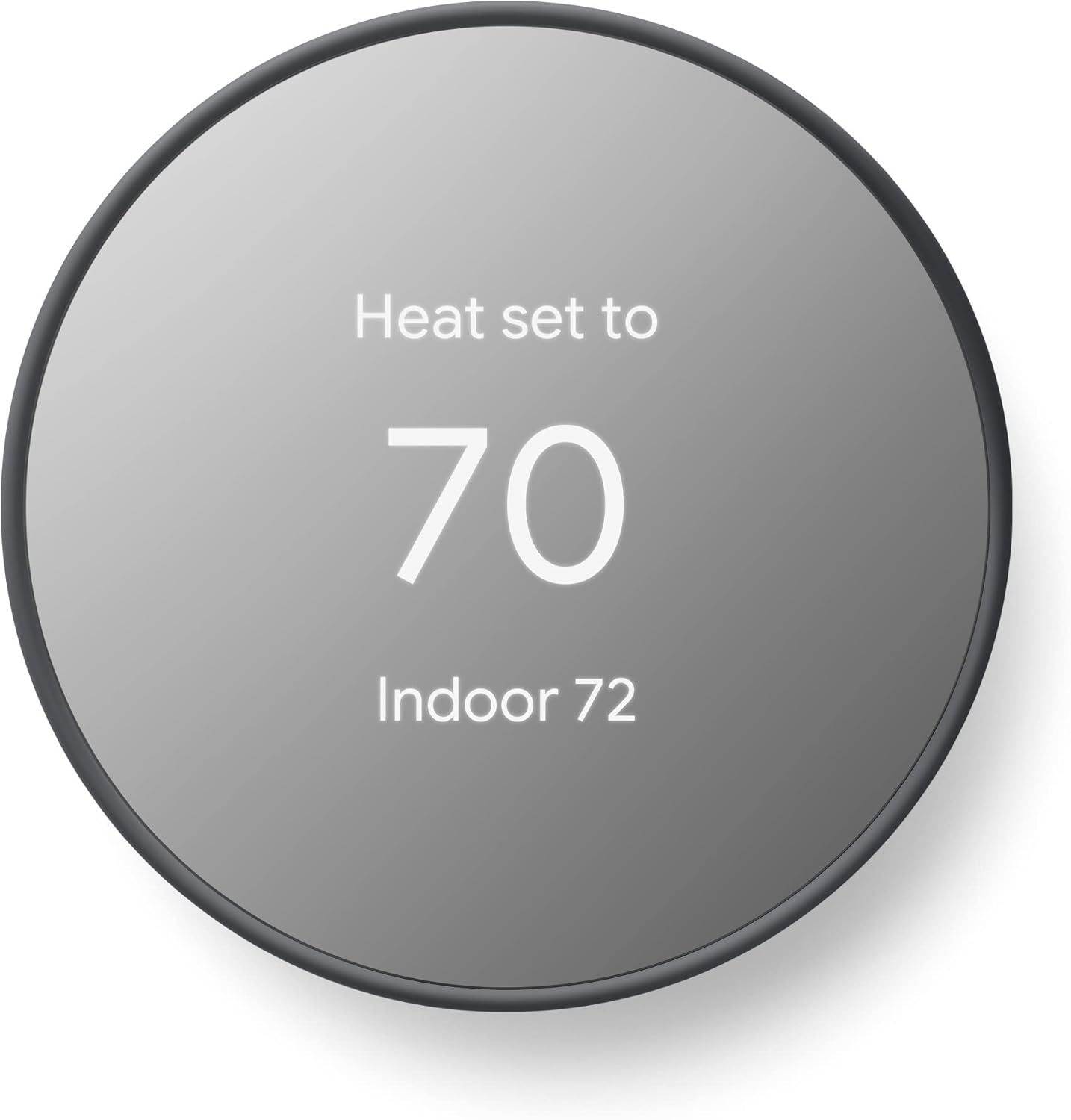
The Google Nest Thermostat is a compact smart thermostat designed to make scheduling and remote control easy for everyday homes, including heat pump systems. It installs on a wall and pairs with the Google Home app for remote adjustments, quick schedule setup, and Savings Finder suggestions that highlight potential energy savings. The unit supports Wi‑Fi and Bluetooth connectivity and can be voice controlled through Google Assistant and other Matter-certified assistants, and it runs on two included A batteries so many homes do not require a C wire. Practical benefits include automatic Eco Temperatures when the thermostat senses you are away, HVAC monitoring alerts to flag possible system issues, and an intuitive touch bar for local control. Limitations to consider are that some specialized or older HVAC systems may still require a C wire or a power accessory, voice features and remote alerts need working internet and compatible smart devices, and the thermostat is designed for straightforward systems rather than advanced multi-zone setups.
Best for: Buyers who want an easy to use smart thermostat for everyday comfort and energy savings on heat pump systems, and who value app and voice control backed by broad user adoption.
Less Ideal for: Homes with complex multi-zone HVAC setups or owners who need advanced commercial controls or guaranteed compatibility with unusual high-voltage systems.
- App and voice control via Google Home for remote temperature management
- Designed to work without a C wire in most homes, powered by included batteries
- Savings Finder and Eco Temperature features that nudge energy savings
- HVAC monitoring that sends alerts for potential system issues
- Easy self-installation with included mounting hardware
- May require a C wire or power accessory on some systems
- Remote features and voice control need reliable internet and compatible devices
Verdict: A user-friendly smart thermostat that delivers app and voice control plus energy-saving features tailored for typical heat pump homes.
Amazon Smart Thermostat
| Works with | Alexa and Ring |
|---|---|
| C‑wire | Required |
| Technology | Honeywell Home thermostat technology |
| Control | Alexa app and voice |
| Programmable | Home, away, sleep schedules |
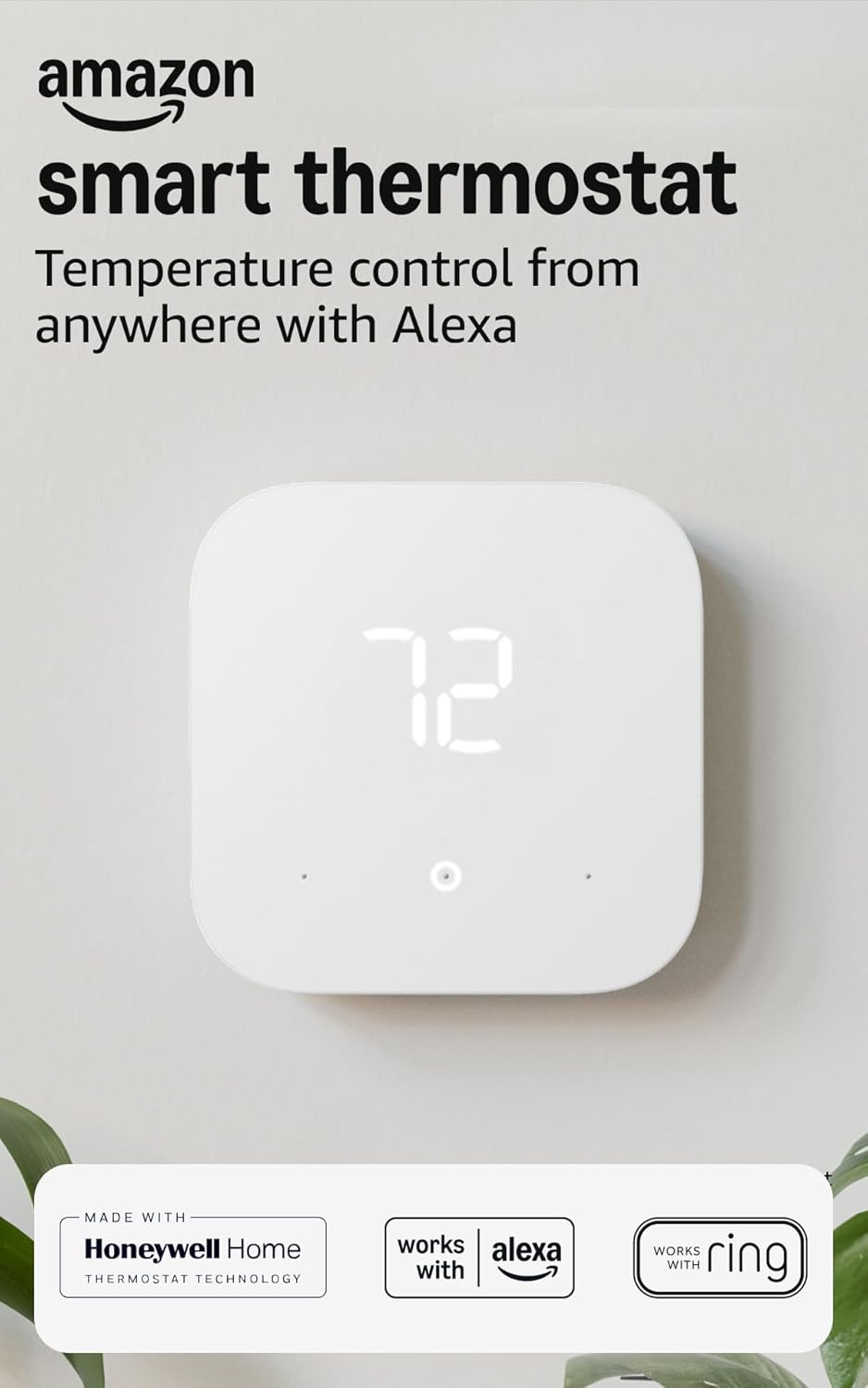
The Amazon Smart Thermostat is a programmable Wi‑Fi thermostat built to replace conventional thermostats and integrate with Alexa for voice and app control. It lets you create home, away, and sleep schedules, monitor and change temperature from the Alexa app, and use Alexa presence and compatible devices to automatically adjust settings. The unit is built on Honeywell Home thermostat technology, which should provide reliable temperature sensing and control, and Amazon offers step‑by‑step DIY installation guidance in the app. Notable practical benefits include Alexa routines and advanced Alexa+ features for multi‑device automation, plus potential energy savings through scheduling and remote control. Limitations to consider are the requirement for a C‑wire at installation and that some advanced heat pump features may depend on compatibility with a given HVAC system; users should confirm their heat pump wiring and control needs before buying. For buyers who want tight integration with Alexa and simple app‑led scheduling, this thermostat covers the basics well, but more HVAC‑specialized controls may be better served by dedicated heat pump thermostats.
Best for: Buyers who prioritize easy Alexa integration, simple programmable schedules, and a straightforward DIY install guided by an app.
Less Ideal for: Homeowners who need specialized heat pump staging, advanced multi‑stage control, or professional HVAC commissioning should consider thermostats made specifically for complex heat pump systems.
- Alexa and app control for remote temperature adjustments and schedules
- Supports programmable schedules and presence‑based automatic adjustments
- Built on Honeywell Home thermostat technology for familiar control behavior
- DIY installation guided by the Alexa app with customer support available
- Requires a C‑wire for installation
- Heat pump compatibility and advanced control features are not guaranteed for every HVAC setup
Verdict: Choose this thermostat if you want an Alexa‑centric, app‑guided programmable thermostat backed by established Honeywell thermostat technology for straightforward energy savings.
Choosing the Right Programmable Thermostat for Heat Pumps: Key Factors to Consider
Heat Pump Compatibility and Staging Support
A thermostat must match the control needs of your heat pump. Heat pumps often require specific wiring for the reversing valve and support for single- or multi-stage compressor operation. If the thermostat cannot handle the correct number of stages or the reversing valve logic, the system may run inefficiently or operate incorrectly.
Check whether the thermostat supports both emergency heat and auxiliary heat if your system uses backup resistance heating. Proper staging support reduces short cycles and wear on the compressor, and ensures that supplemental heat engages only when needed. Compatibility also affects installer effort and whether additional relays or modules are required.
Scheduling Options and Programming Granularity
Scheduling flexibility determines how precisely you can match temperature setpoints to occupancy patterns. Simple day/night programming may be fine for some households, but more complex schedules with weekday/weekend differentiation, multiple setpoint periods per day, and adaptive recovery can yield better energy savings and comfort.
Look for features like separate heating and cooling schedules, setback limits to prevent extreme setpoint swings, and temporary hold options for irregular days. More granular programming lets you reduce runtime during low-use periods without causing repeated short cycles when the system restores comfort.
Control Interfaces and Remote Access
How you interact with the thermostat affects daily convenience and long-term management. Local controls should be intuitive and support quick temporary overrides. Remote access via an app or web portal can be useful for adjusting schedules away from home or monitoring system performance.
However, prioritize thermostats that retain primary functions locally even when network access is lost. Consider whether the interface shows system status clearly, including current mode, active stage, and whether auxiliary heat is engaged. Integration with smart-home platforms can be a plus but should not be required for basic heat pump control.
Installation Requirements and Wiring
Thermostats differ in wiring needs and installation complexity. Many modern units require a common power connection or an add-on power module to operate without batteries. If your existing thermostat wiring lacks a C-wire, you will need to plan for an adapter or battery-powered option.
Also consider whether the thermostat supports the number of control circuits your heat pump uses, such as separate fan control, compressor stages, and auxiliary heat relays. Easier installation reduces labor time and the chance for wiring errors that affect system performance.
Temperature Sensing and Placement
Accurate sensing affects comfort and runtime. Thermostats with adaptive algorithms, remote sensors, or multiple sensing points can reduce temperature swings and prevent the heat pump from short-cycling in response to localized readings.
Placement in the home matters as much as sensor quality. Avoid locations near drafts, direct sunlight, or heat sources. If you have uneven heating zones, remote sensors or zone-compatible controls help maintain balanced comfort without overworking the heat pump.
Maintenance, Diagnostics, and Energy Feedback
Diagnostics and monitoring features help identify issues early and allow you to track system efficiency. Basic diagnostic readouts that show active stages, run times, and error codes make troubleshooting easier for installers and homeowners.
Energy reporting can reveal how programming changes affect consumption, but it should not replace correct staging and control. Regular firmware updates and clear instructions for resetting or recalibrating sensors also reduce the risk of long-term performance degradation.
How Programmable Thermostats Improve Heat Pump Efficiency
Programmable thermostats reduce energy use by lowering temperature setpoints during predictable low-occupancy periods and restoring comfort before occupants return. For heat pumps, the key is to program setbacks that avoid excessive compressor cycling. Small, gradual setbacks and shorter setback durations often work better than large abrupt changes because the heat pump can operate more efficiently in steady-state conditions.
Some programmable units include recovery settings that ramp temperatures back toward setpoints gradually to avoid triggering auxiliary heat. This kind of control preserves the efficiency advantage of the heat pump while still delivering measurable savings.
- Use smaller setbacks to prevent auxiliary heat engagement
- Schedule staggered setpoints to match daily routines
- Enable recovery or preheat features when available
Common Installation Pitfalls and How to Avoid Them
The most common installation issues are incorrect wiring for the reversing valve, missing support for auxiliary or emergency heat, and lack of a common power connection. Before removing the old thermostat, photograph the wiring and label terminals. Verify wiring against the heat pump control panel to confirm which terminal controls the reversing valve and whether multi-stage control is present.
If your wall wiring lacks a C-wire, planners have several options including using a power adapter, choosing a thermostat that can run on batteries temporarily, or running an additional conductor. Always turn off power at the equipment before making wiring changes and consult an HVAC technician for complex systems.
- Label existing wires and take a photo before disconnecting
- Confirm reversing valve and auxiliary heat wires at the outdoor unit or control board
- Consider a pro for systems with multiple stages or complex controls
Programming Tips to Avoid Auxiliary Heat and Short Cycling
Auxiliary or emergency heat is costly compared with normal heat pump operation. To minimize its use, set conservative setback temperatures and avoid large overnight drops that force the auxiliary heat to engage. Use shorter setbacks that the heat pump can recover from within its efficient operating envelope.
Another helpful tactic is to stagger setpoints across the day so the system does not try to rapidly make up large temperature differences. Enable any adaptive recovery or intelligent setback features if the thermostat supports them, since these reduce the chance of sudden auxiliary heat activation.
- Limit setback magnitude to prevent auxiliary heat engagement
- Prefer more frequent small setbacks over one large temperature drop
- Enable adaptive recovery when available
Using Remote Sensors and Zoning with Heat Pumps
Remote sensors can improve comfort when rooms heat unevenly. A sensor in a commonly used living area reduces the temptation to raise setpoints because another room feels cold. Some thermostats average multiple sensors or let you prioritize rooms for more accurate overall control.
If your home has multiple heating zones, ensure the thermostat strategy coordinates with zone dampers or separate zone thermostats. Proper zoning reduces runtime and prevents overworking the heat pump by only conditioning occupied spaces.
- Place remote sensors in representative living areas, not near vents
- Use sensor averaging or room priority to avoid overcooling or overheating
- Coordinate thermostat settings with zone controls for best efficiency
When to Call a Professional
Call an HVAC technician if you are unsure about wiring for the reversing valve, auxiliary heat, or if your system uses multiple compressor stages. A pro can verify compatibility, install required relays or modules, and confirm that control logic is correct so the heat pump runs safely and efficiently.
Also consult a professional when you notice persistent short cycling, frequent auxiliary heat use, or irregular temperature swings after installing a new thermostat. These symptoms often indicate incorrect control wiring, sensor placement issues, or mismatched staging parameters.
- Hire a pro for reversing valve or multi-stage wiring
- Seek service for persistent short cycling or frequent auxiliary heat
- Get a checkup after installation to verify correct operation
How We Chose the Best Programmable Thermostat for Heat Pumps
We focused exclusively on programmable thermostats designed to control heat pump systems and prioritized criteria that matter to homeowners and installers. First, we verified heat pump compatibility and correct staging support because proper compressor and reversing valve control is essential for reliability and comfort. Next, we assessed scheduling flexibility and programming granularity so the thermostat can reduce runtime without causing frequent on-off cycles. Control options and connectivity were evaluated for usability, including local and remote adjustments, but we gave extra weight to thermostats that keep core functions available when connectivity is offline. Installation and wiring flexibility were scored to reflect how easily the thermostat integrates with existing controls and whether it requires a common wire or add-on power module. We also examined temperature sensing and adaptive control features that minimize short-cycling and improve steady-state comfort. Energy reporting and monitoring features were considered for buyers who want feedback, though these were secondary to core control correctness. Units that failed basic heat pump compatibility checks, lacked necessary staging or valve controls, or relied exclusively on cloud features for basic operation were excluded. The final selections balance control accuracy, installation practicality, and programming flexibility.
Our full evaluation process is outlined in our review methodology.
FAQ
Will any programmable thermostat work with my heat pump?
Not all programmable thermostats support heat pump-specific controls. You need a unit that handles reversing valve wiring and supports your system's number of compressor and backup heat stages. Verify compatibility before installing.
How do I prevent the thermostat from turning on auxiliary heat too often?
Use modest temperature setbacks, enable adaptive recovery if available, and avoid large abrupt setpoint changes. Proper sensor placement and gradual preheating before occupancy also reduce auxiliary heat use.
Do I need a common wire for a programmable thermostat?
Many modern thermostats require a common power connection, though some can work on batteries or with a power adapter. Check your existing wiring and plan for a C-wire or a compatible power solution if needed.
Can remote sensors help with heat pump control?
Yes. Remote sensors placed in frequently used rooms can prevent localized cold spots from driving up whole-house setpoints. Sensors that support averaging or room priority can improve overall comfort and efficiency.
Will a smart thermostat save energy with a heat pump?
Smart or connected features can help by providing scheduling flexibility and data-driven adjustments, but energy savings depend primarily on correct staging, sensible setbacks, and proper installation. Connectivity is helpful but not sufficient on its own.
Final Verdict
Prioritize correct heat pump compatibility, proper staging support, and installer-friendly wiring when choosing a programmable thermostat for a heat pump. Scheduling flexibility and reliable temperature sensing let you reduce runtime without triggering auxiliary heat or short cycling. Balance control features and connectivity against the need for local reliability and clear diagnostics. Choose a thermostat that matches your system wiring and offers the programming granularity you need. When in doubt about wiring or multi-stage systems, consult a qualified HVAC technician to ensure the thermostat is configured for safe, efficient heat pump operation.