
Note: This article contains affiliate links. If you click on these links and make a purchase, we may earn a small commission at no extra cost to you. This helps support our research and content. Read our full affiliate disclosure here.
If you are considering a propane tankless water heater, you want dependable hot water on demand without wasting space or fuel. The right unit delivers consistent flow, lower standby losses, and fuel-efficient operation that can shrink monthly utility bills while fitting into small mechanical closets or outdoor mounts. This guide shortlists the top propane tankless water heaters across common household needs, from single-fixture setups to whole-house systems, and explains the features that matter most for reliable daily use. Below we evaluate each pick against real installation and performance criteria so you can match a unit to your plumbing layout and hot-water demand.
Top Picks at a Glance
| Best Overall The best all-around choice for most situations | FOGATTI InstaShower 9 Pro |  |
| Best Quality Built to a higher standard if you want something more solid | Rinnai RX199iN 11.1 GPM Tankless Water Heater |  |
| Best Value The sweet spot between price and what you get | VELPAX Propane Tankless Water Heater 16L |  |
| Best Budget The cheapest option that still gets the job done reliably | Kohree Tankless Propane Water Heater KR5506 |  |
| Top Rated A top-rated pick with lots of positive feedback | Rinnai RX180iN 10 GPM Tankless Water Heater | |
| Most Popular A crowd favorite that many people choose with confidence | CAMPLUX AY132 Portable Tankless Water Heater |  |
| Best Seller A high-volume bestseller chosen again and again | Orbek RV Tankless Water Heater |  |
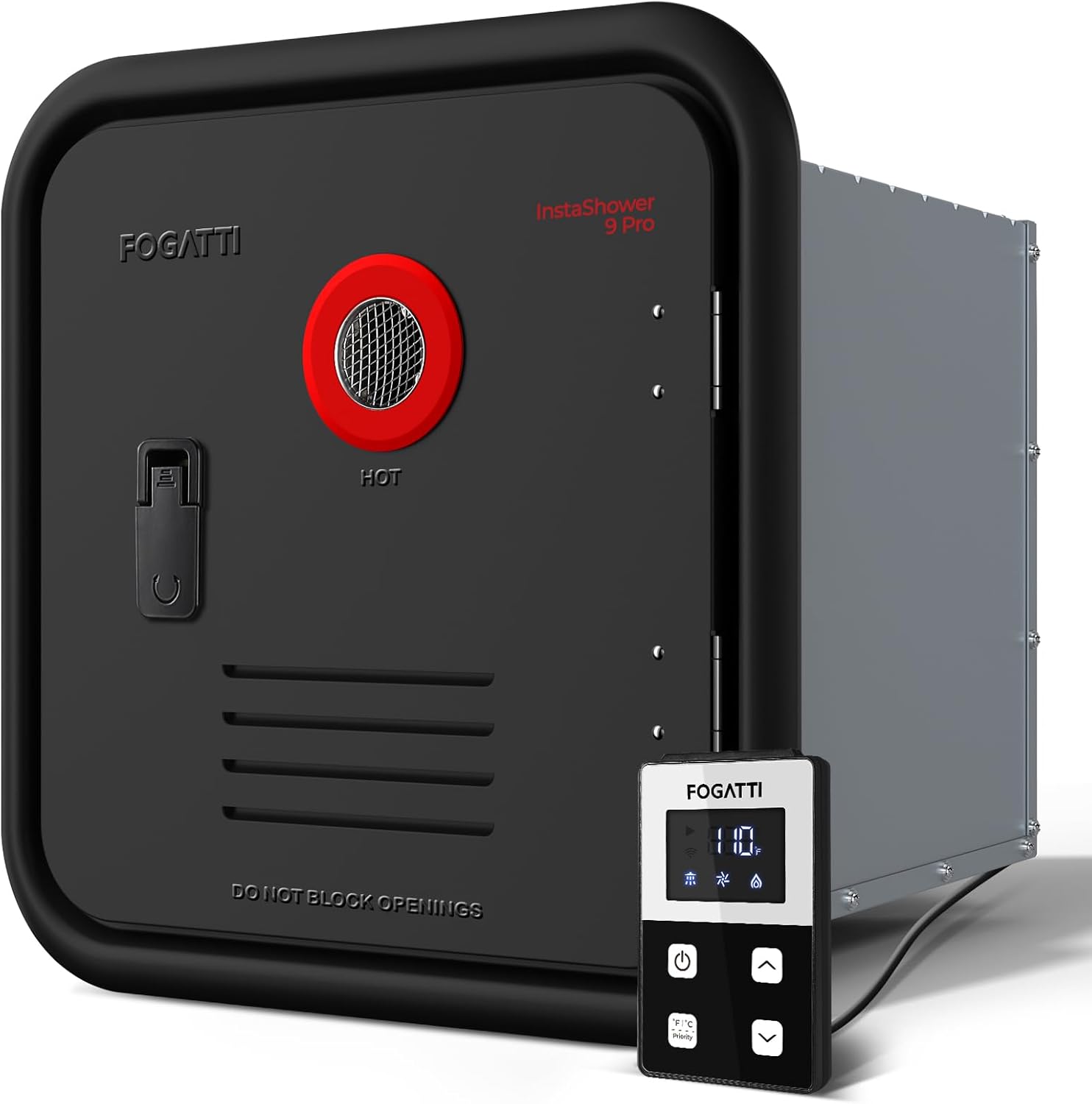
FOGATTI InstaShower 9 Pro
| Power Source | Liquid Propane |
|---|---|
| Flow Rate | 3.6 gpm |
| Heat Output | 66,000 BTU |
| Maximum Temperature | 123 °F |
| Voltage | 12 volts of direct current |
The FOGATTI InstaShower 9 Pro is a built-in, liquid-propane tankless water heater for RVs that provides instant hot water for showers and sinks. It produces 66,000 BTU and claims up to 3.6 gallons per minute, which lets one person shower comfortably while another runs a faucet in many RV layouts. The unit includes a small mixing tank and an intelligent wired remote for temperature control, and it has protective features such as dry combustion and overheat protection, anti-freeze function, a 150 PSI relief valve, and a top-mounted forced exhaust fan. It is built to work at high altitude and uses a NIDEC DC fan for stable performance in windy or thin-air conditions, and the package includes a 15"x15" door and trim ring for retrofit installs. On the downside, full installation requires plumbing and gas knowledge and may need different door sizes or trim for some RVs, and the 3.6 gpm flow will be limiting for simultaneous heavy hot-water use compared with larger systems. This model is a practical, safety-minded upgrade path for RVs replacing older tanks or lower-output tankless units.
Best for: Buyers who want a robust, safety-focused tankless replacement for older RV water heaters and value dependable on-demand hot water during travel.
Less Ideal for: People who need very high simultaneous flow for multiple showers or who prefer a simple plug-and-play portable heater instead of a built-in retrofit.
- High heat output (66,000 BTU) suitable for reliable hot-water delivery in many RVs
- Built-in safety features including overheat protection, dry combustion protection, anti-freeze and a 150 PSI relief valve
- Designed for retrofits with included 15"x15" door, trim ring and wired remote for temperature control
- High-altitude capable and forced-exhaust fan for stable combustion in thin air or windy conditions
- Precise temperature control and a small mixing tank to reduce temperature swings
- Installation requires gas and plumbing competence and may need different door sizes for some replacements
- 3.6 gpm flow is adequate for single or light simultaneous use but not for high-demand multiple fixtures
Verdict: A high-output, retrofit-ready RV tankless heater that delivers reliable on-demand hot water with extensive safety features.
Rinnai RX199iN 11.1 GPM Tankless Water Heater

| Power Source | Gas Powered |
|---|---|
| Flow Rate | 11 gpm |
| Maximum Temperature | 140 °F |
| Heat Output | 199000 BTU |
| Efficiency | UEF 0.98 |
The Rinnai RX199iN is a compact, high-output condensing tankless water heater designed for continuous hot water on demand. It delivers up to 11.1 gallons per minute and up to 199,000 BTU, making it suitable for homes needing multiple simultaneous fixtures. The unit is convertible between natural gas and propane and can be adapted for indoor or outdoor installation with the Versa Vent, which keeps installation flexible. Notable features include a Smart Sense gas control system for responsive temperature regulation, a Quick Flush function to simplify routine maintenance, and a high UEF of 0.98 for strong energy performance. The heater also supports optional Wi-Fi monitoring through an add-on module and has a compact footprint that saves space compared with tank systems. Expect professional installation for proper venting and gas setup, and plan for the separate purchase of the Control-R module if you want remote connectivity. The RX199iN is a performance-focused choice where continuous flow rate, efficiency, and installation flexibility are priorities.
Best for: Buyers who prioritize continuous high-flow hot water and energy efficiency for larger households or performance-focused systems and who are willing to invest in professional installation.
Less Ideal for: Those seeking a plug-and-play electric or small low-flow solution for a single fixture, or buyers who want integrated Wi-Fi without extra purchases should consider alternatives.
- High maximum flow rate (11.1 GPM) supports multiple fixtures at once.
- Super-high energy efficiency (UEF 0.98) reduces operating costs compared with conventional tanks.
- Convertible design for natural gas or propane increases siting flexibility.
- Versa Vent allows indoor or outdoor installation with appropriate venting accessories.
- Quick Flush feature and smart control make maintenance and temperature management easier.
- Requires professional installation and proper venting adaptations for outdoor use.
- Wi-Fi control requires a separately sold module rather than being built in.
Verdict: If you need reliable high-flow hot water with top-tier efficiency and flexible fuel and installation options, the Rinnai RX199iN is a strong performance-oriented choice.
VELPAX Propane Tankless Water Heater 16L

| Power Source | Liquid Propane |
|---|---|
| Capacity | 16 liters |
| Heat Output | 68000 BTU |
| Maximum Temperature | 149 °F |
This VELPAX propane tankless heater provides on-demand hot water at up to 4.21 gallons per minute and is designed for indoor wall mounting. It heats water using a 68,000 BTU burner and an oxygen-free copper heat exchanger, with a stainless steel exterior for corrosion resistance. The LED display lets you set water temperature between 95 and 149 F and the unit includes flame failure, overheat, and anti-freeze protections for safer operation. It starts at very low water pressure (3.6 PSI) so it will run on low-flow fixtures and can serve two to three points of use simultaneously in typical homes. Installation is simplified by 1/2" NPT water fittings and a supplied vent pipe, but because it is propane-only you must plan fuel supply and proper venting for indoor use. The unit is compact and space-saving compared with tank heaters, but buyers should factor in professional gas and vent installation and follow cold-weather draining recommendations to avoid freeze damage.
Best for: Homeowners who want a space-saving, on-demand propane unit to reduce standby heat loss and reliably serve a couple of bathrooms or a kitchen while prioritizing safety features and temperature control.
Less Ideal for: People who need electric or natural gas compatibility or who cannot install proper indoor venting and propane supply should look for a different model.
- Delivers up to 4.21 GPM for simultaneous use at 2–3 fixtures
- High heat output (68,000 BTU) for fast temperature rise
- Built-in safety features including flame failure, overheat, and anti-freeze protection
- LED digital display for precise temperature control
- Compact wall-mounted design saves space over tank heaters
- Propane-only configuration requires proper fuel hookup and indoor venting
- May require professional gas and vent installation to meet local codes
Verdict: A compact, safety-focused propane tankless heater that delivers strong on-demand hot water for households that can accommodate propane and proper venting.
Kohree Tankless Propane Water Heater KR5506

| Power Source | Liquid Propane |
|---|---|
| Flow Rate | 1.58 gpm |
| Maximum Temperature | 120 °F |
| Heat Output | 41000 BTU/HR |
| Water Pressure Range | 3-110 PSI |
This Kohree portable propane tankless heater provides on-demand hot water for outdoor and small-RV use, producing up to 1.58 gallons per minute and a maximum temperature rise of about 120°F. It runs on liquid propane, ignites with two D batteries, and includes a shower head, gas regulator, and brass fittings for quick setup. Safety features are a strong point: overheating protection, flame failure protection, dry combustion protection, anti-freeze protection, and a windproof design help it keep working in variable conditions. The unit is compact and has a handle or a wall-mount option, making it easy to move or mount at a campsite, cabin, or RV. Practical limits are the modest flow rate, which is best suited to a single shower or washing tasks rather than supplying multiple fixtures, and the unit relies on battery ignition and propane, so it is not suitable where those are inconvenient. Build details such as brass connectors and included accessories make installation straightforward for basic outdoor plumbing needs.
Best for: Buyers looking for an affordable, portable propane tankless heater for camping, RVing, poolside washing, or occasional outdoor hot water tasks who prioritize basic safety features and easy setup.
Less Ideal for: People who need high-flow or multi-fixture indoor hot water or who prefer electric or permanently plumbed household systems should look elsewhere.
- On-demand hot water up to 1.58 GPM for showers and washing
- Multiple built-in safety protections including overheat and flame failure devices
- Compact, portable design with handle and wall-mount option
- Includes shower head, gas regulator, and brass hose fittings for easier setup
- Flow rate and output are limited to single-fixture use, not whole-house needs
- Requires propane and D batteries for ignition, adding ongoing fuel and battery needs
Verdict: A budget-friendly, safety-focused portable propane tankless heater ideal for single-shower or outdoor hot water needs.
Rinnai RX180iN 10 GPM Tankless Water Heater
| Power Source | Dual-Fuel (Natural Gas or Propane) |
|---|---|
| Flow Rate | 10 gpm |
| Maximum Temperature | 140 °F |
| Heat Output | 180000 british thermal units |
| Efficiency | 0.98 UEF |
The Rinnai RX180iN is a compact condensing tankless water heater designed to provide continuous hot water for a medium to large household. It produces up to 10 gallons per minute and uses a Smart Sense gas control so the unit can be converted between natural gas and propane, while the Versa Vent option allows indoor or outdoor mounting. Key conveniences include an easy-to-read interface, a Quick Flush function to simplify maintenance, and the ability to add Wi‑Fi control via an optional module. The unit emphasizes efficiency with a UEF of 0.98, which lowers operating costs compared with conventional tanks and non-condensing models. Installation should be handled by a professional and the unit requires matching venting and gas hookup for safe operation. Its compact size saves space but still demands correct installation clearances and periodic flushing to maintain performance. The RX180iN is backed by multi-year coverage on core components and is built from copper and stainless steel for longevity.
Best for: Buyers who prioritize reliable, energy-efficient continuous hot water and want a durable, professionally installed tankless unit that can run on propane or natural gas.
Less Ideal for: Those who need DIY installation, a basic non-condensing replacement, or who want built-in smart features without buying extra modules should consider other options.
- High UEF 0.98 condensing design for strong energy efficiency
- Convertible fuel system supports natural gas or propane
- Versa Vent option enables indoor or outdoor installation
- Quick Flush feature simplifies periodic maintenance
- Compact footprint saves space compared with tank heaters
- Requires professional installation and proper venting adaptations
- Wi‑Fi connectivity requires purchase of an optional module
Verdict: Choose the RX180iN for dependable, commercial-grade continuous hot water and top-tier condensing efficiency in propane or natural gas configurations.
CAMPLUX AY132 Portable Tankless Water Heater

| Flow Rate | 1.32 gpm |
|---|---|
| Heat Output | 34000 BTU/hr |
| Power Source | Battery Powered (2 D batteries) |
| Fuel Type | Liquid Propane |
| Capacity | 5 liters |
The CAMPLUX AY132 is a portable propane tankless heater made for camping, RVs, cabins, and other off-grid outdoor situations. It runs on a 20 lb propane tank and two D batteries for ignition, so no mains electricity is required, and it produces roughly 1.32 gallons per minute of hot water with a rated 34,000 BTU output. The unit includes a folding handle, mounting options and a bundle of accessories—a CSA certified gas regulator, shower head and hose—so setup is straightforward and you can hang or wall-mount it for showers or washing gear. Safety features include multiple protections such as anti-freeze, flame failure, overheat and low-flow/low-pressure startup down to about 3 PSI, which helps it work with small 12V pumps or gravity bags. Expect modest flow and temperature limits compared with full-size heaters: the max listed temp is about 114°F and flow tops out around 1.32 gpm, so it is best for single-person showers, rinsing or washing tasks rather than filling tubs or serving multiple simultaneous fixtures. The build is lightweight and travel-friendly, but buyers should follow the CSA installation guidance and use appropriate propane fittings for safe operation.
Best for: Buyers who want a proven, safety-focused portable propane heater for solo outdoor showers, RV use, or remote cabins and who value reassurance from established customer feedback and certifications.
Less Ideal for: People needing high flow rates, multiple simultaneous hot outlets, or indoor whole-house water heating should choose a larger, higher-capacity unit instead.
- Works off-grid using propane and two D batteries so no electrical hookup is needed.
- Multiple safety protections (overheat, flame failure, anti-freeze, low‑flow/pressure protection) increase reliability in outdoor conditions.
- Includes key accessories (5 ft gas regulator, shower head and hose) for fast out-of-the-box setup.
- Lightweight with a folding handle and mounting options for easy transport and installation.
- Maximum flow and temperature are modest, limiting it to one-person showers and light wash tasks.
- Requires correct propane hookup and battery replacement for ignition, adding ongoing consumables and maintenance.
Verdict: Choose the CAMPLUX AY132 when you need a compact, CSA‑certified propane tankless heater that reliably delivers single-person hot water off-grid with built-in safety protections.
Orbek RV Tankless Water Heater

| Power Source | Liquid Propane |
|---|---|
| Voltage | 12 volts DC |
| Flow Rate | 3.5 gpm |
| Maximum Temperature | 123 °F |
| Mount Type | Door Mount |
The Orbek RV Tankless Water Heater is a 12V DC propane-powered unit designed to replace RV water heaters and provide continuous on-demand hot water for showers, dishwashing, and other freshwater needs. It uses a 60,000 BTU burner and oxygen-free copper heat exchangers with a brushless DC fan to deliver up to 3.5 gpm while adapting to high-altitude conditions. The unit includes safety features such as flame failure protection, dry combustion protection, frost protection, and a built-in pressure-reducing valve, and comes with a remote for setting temperatures between 95°F and 123°F. Installation is intended for standard RV door mounts and standard NPT connections, and the manufacturer notes it can be installed by a competent DIYer if you have a 12V supply or an AC-to-DC converter. Practical benefits include consistent hot water without a storage tank, lower propane usage because the burner runs only on demand, and on-board diagnostics via the remote. Important limitations are the need for a proper 12V power source and correct polarity to avoid fuse issues, and that achieving peak flow depends on inlet water temperature and RV plumbing layout.
Best for: Buyers who want a reliable, safety-focused tankless heater for an RV and prefer a product designed to work at altitude with built-in protections and remote control.
Less Ideal for: Travelers without a stable 12V supply or those who need a guaranteed high-flow output regardless of inlet temperature and plumbing configuration.
- Continuous on-demand hot water with a 60,000 BTU burner for typical RV needs
- High-altitude mode with copper heat exchangers and brushless DC fan for reliable operation at elevation
- Multiple safety protections including flame failure, dry combustion, and frost protection
- Built-in 150 PSI pressure-reducing valve and remote temperature control (95°F–123°F) for convenience
- Requires a compatible 12V DC power supply or an AC-to-DC converter and correct wiring polarity
- Flow rate and maximum comfort depend on inlet water temperature and RV plumbing, not guaranteed in all setups
Verdict: Choose this unit if you want a safety-oriented, high-altitude capable propane tankless heater that provides on-demand hot water for RV living.
Choosing the Right Propane Tankless Water Heater: Key Factors to Consider
Flow Rate And Simultaneous Fixtures
Flow rate is the single most important performance metric for tankless systems because it determines how many fixtures you can run at once without losing temperature. Manufacturers list gallons per minute at specific temperature rises. To estimate what you need, add typical fixture flow rates for appliances and showers you expect to run together. A small point-of-use installation needs far less capacity than a whole-house setup with multiple bathrooms.
Underestimating required flow rate leads to cold-water sandwiching or the need to limit concurrent use. Oversizing slightly is acceptable, but very large units increase installation complexity and may require larger propane supply lines or different venting components.
Venting Type And Installation Complexity
Propane tankless heaters may require dedicated venting for combustion air and exhaust. Options include direct-vent concentric, coaxial, or dedicated stainless-steel exhaust runs. The vent type affects where you can place the unit, whether it can mount outdoors, and the cost and difficulty of install.
Consider whether the house layout allows short, straight vent runs or will need longer runs with elbows. Long runs, vertical terminations, or complicated routing increase labor and add potential points for leaks. Also check required clearances and whether the unit supports indoor or outdoor installation to avoid costly retrofit changes.
Propane Supply And Burner Capacity
Your household propane supply must match the heater's maximum input and steady burn rates. Propane line size, regulator capacity, and tank fill level influence whether a chosen unit will reach its rated performance. High input burners deliver higher flow rates but require adequate fuel delivery.
If your current regulator or piping is undersized, you may need upgrades to achieve full output. Confirm local code requirements for propane connections and ensure the installer verifies line sizing to avoid reduced capacity or safety issues.
Energy Efficiency And Operating Cost
Efficiency affects how much propane the unit uses to produce a given amount of hot water. Look for thermal efficiency ratings and published fuel-consumption figures or estimated annual usage. A more efficient unit will cost less to operate per gallon of hot water delivered, which matters most for homes with heavy hot-water demand.
Also consider features that reduce wasted burner cycles, such as smart recirculation compatibility or modulation that scales burner output to demand. These behaviors reduce short-run inefficiencies and keep running costs lower over years of use.
Maintenance, Service Access, And Reliability
Tankless heaters require periodic maintenance such as flushing to remove scale and inspecting the heat exchanger and burners. Units with easy service access panels and clear diagnostic readouts simplify routine upkeep and troubleshooting. Material choices, like corrosion-resistant exchangers and coated combustion chambers, influence long-term reliability.
If you live where water is hard or temperatures drop below freezing, plan for more frequent maintenance or models with built-in freeze protection. Good documentation and available replacement parts also reduce long-term ownership headaches.
Sizing For Real-World Hot-Water Needs
Sizing a propane tankless water heater means thinking in terms of flow rate at a given temperature rise rather than tank volume. Start by determining the incoming groundwater temperature in your region and the target delivery temperature for showers and appliances. Then calculate the required gallons per minute for the simultaneous fixtures you expect to run.
For example, two showers and a dishwasher running together often need three to five gallons per minute at a 50 to 70 F temperature rise. Consider common household routines like morning shower overlaps to decide whether you need a higher-capacity unit. If you're uncertain, choose an installer who can measure your ground temperature and estimate real-world demand rather than relying solely on rule-of-thumb sizing charts.
- Measure incoming groundwater temperature to determine temperature rise.
- Add up fixture flow rates for simultaneous usage scenarios.
- Account for future changes such as additional bathrooms or a new laundry appliance.
Indoor Versus Outdoor Installation
Outdoor-rated propane tankless water heaters simplify venting because they exhaust directly to the exterior without long vent runs. They are a practical choice when you have an accessible outside wall and want to avoid interior venting complexity. However, outdoor units must be rated for freeze protection or be located in protected niches in cold climates.
Indoor units provide protection from weather and often offer more flexible placement in closets or utility rooms. Indoor installation requires careful attention to combustion air and exhaust venting, and may need specialized stainless-steel or PVC vent systems approved for propane combustion products. Verify local codes about vent terminations near windows, doors, and air intakes.
- Outdoor units reduce venting needs but need freeze mitigation.
- Indoor units require planned combustion air and exhaust routing.
- Check termination clearances and local ventilation codes before choosing placement.
Venting Materials And Clearances
Propane combustion produces hot exhaust that can be corrosive over time. Use manufacturer-approved vent materials to prevent premature failure. Stainless-steel liners or high-temperature-rated coaxial vents are commonly required for longer runs and higher input units. PVC may be acceptable for some low-temperature exhaust designs, but confirm the unit's vent material compatibility.
Clearances at the vent termination affect where you can place outdoor terminations relative to windows, doors, and neighboring property. Longer vent runs and multiple elbows reduce effective capacity and may require upsizing the vent diameter. Plan vent routing before picking a final mounting location to avoid last-minute relocation and extra labor.
- Use manufacturer-approved vent materials only.
- Minimize elbows and long runs to preserve exhaust flow.
- Verify termination clearances for safety and code compliance.
Freeze Protection And Cold-Climate Considerations
In cold climates, freeze protection is essential for outdoor units or installations in unheated spaces. Some units include built-in electric trace heating or internal recirculation to prevent internal components from freezing. If the chosen model lacks such features, installers typically recommend locating the unit indoors or adding external protection measures.
Also consider condensation and drain routing. In freezing conditions condensate lines must be routed and insulated to prevent blockage. Regular maintenance visits before and after winter help ensure freeze protection features function properly and avoid costly damage from burst components.
- Prefer models with built-in freeze protection in cold climates.
- Insulate condensate and water lines when exposed to low temperatures.
- Schedule maintenance before winter to verify system readiness.
Controls, Diagnostics, And Smart Features
User controls range from simple manual temperature dials to digital displays with error codes and network connectivity. Clear diagnostic readouts make troubleshooting faster for contractors and reduce diagnostic visits. Modulating burners that adjust output based on instantaneous flow improve comfort by maintaining steady temperatures under varying demand.
Some systems offer remote thermostats or recirculation compatibility to reduce wait times at the tap. While smart features are convenient, prioritize reliable basic controls and good diagnostic access over bells and whistles if you expect the unit to be in a hard-to-service location.
- Look for clear error codes and accessible diagnostic ports.
- Modulation capability reduces temperature swings during variable flow.
- Remote control compatibility can improve convenience but is secondary to core performance.
How We Chose the Best Propane Tankless Water Heater
We focused on practical, measurable features that determine long-term satisfaction with propane tankless water heaters. Primary evaluation criteria included flow rate performance at realistic temperature rises, venting and exhaust options that affect installation complexity, energy efficiency and fuel consumption under normal household demand, and durability factors such as heat exchanger materials and freeze protection for colder climates. We also considered control features and ease of service to reduce downtime and maintenance hassle. Units that required extensive, uncommon venting modifications or did not offer verifiable flow specs were excluded. We prioritized models with clear documentation on required clearances, venting paths, and recommended maintenance intervals. The final list favors systems that balance installation practicality with the capacity to meet typical simultaneous fixture usage scenarios, so readers can choose a unit that fits their plumbing, space, and climate constraints.
Our full evaluation process is outlined in our review methodology.
FAQ
How do I calculate the right size propane tankless heater for my home?
Estimate the gallons per minute by adding flow rates of fixtures you expect to use simultaneously, then choose a unit that provides that flow at your local groundwater-to-delivery temperature rise. An installer can measure incoming water temperature and confirm the correct capacity.
Can a propane tankless water heater be installed outdoors?
Yes, many models are rated for outdoor installation and eliminate the need for long vent runs. Ensure the chosen unit has adequate freeze protection for your climate or is installed in a protected enclosure.
Will switching to a tankless propane unit save fuel compared with a tank system?
Tankless systems avoid standby losses, so they often use less fuel if your household has intermittent hot-water usage. Actual savings depend on hot-water demand patterns, modulation efficiency, and propane prices.
What maintenance does a propane tankless water heater require?
Routine maintenance typically includes descaling or flushing the heat exchanger annually in hard water areas, inspecting combustion components, and checking venting. Frequency depends on water quality and usage levels.
Do I need to upgrade propane lines for a higher-capacity unit?
Possibly. High-input units may require larger supply lines or regulators to deliver sufficient propane. Have a qualified technician verify line sizing and regulator capacity before installation.
Final Verdict
Choosing a propane tankless water heater is about balancing flow capacity, installation complexity, and operating efficiency. Prioritize a unit that delivers the gallons per minute you need at your local temperature rise, and confirm venting and propane-supply requirements before purchase. Factor in maintenance needs and freeze protection if you live in colder areas. With the right planning on sizing and installation, a propane tankless system can provide reliable, efficient hot water for years.