
Note: This article contains affiliate links. If you click on these links and make a purchase, we may earn a small commission at no extra cost to you. This helps support our research and content. Read our full affiliate disclosure here.
When you need a built-in wine cooler that stays whisper-quiet, every decibel matters. A quiet built-in wine cooler protects delicate wines from vibration and sound that can disturb sediment and accelerate chemical changes, while fitting seamlessly under counters or inside cabinetry. This guide highlights seven shortlisted models chosen for low noise, reliable temperature control, and design that works with typical kitchen built-in installations. We evaluated each option across vibration isolation, cooling method, and long-term temperature accuracy to help you pick the right quiet cooler for aging or daily use. Read on to compare key features and tradeoffs before the product list.
Top Picks at a Glance
| Best Overall The best all-around choice for most situations | BODEGA 24" Dual Zone Wine Cooler |  |
| Best Quality Built to a higher standard if you want something more solid | Whynter BWR-1662SD Wine Refrigerator |  |
| Best Value The sweet spot between price and what you get | Tylza TYBC200 Dual Zone Wine Cooler |  |
| Best Budget The cheapest option that still gets the job done reliably | EUHOMY 12" Wine Cooler FWC007-12SI |  |
| Top Rated A top-rated pick with lots of positive feedback | Vushine 24" Wine Fridge |  |
| Most Popular A crowd favorite that many people choose with confidence | Velieta 24 Inch Dual Zone Wine Cooler |  |
| Best Seller A high-volume bestseller chosen again and again | Icyglee 12" 18‑Bottle Wine Cooler |  |
BODEGA 24" Dual Zone Wine Cooler

| Capacity | 46 Bottles |
|---|---|
| Temperature Range | 41–72°F |
| Cooling Method | Compressor |
| Shelves | 5 beech wood slide-out shelves |
| Installation Type | Freestanding/Built-In/Undercounter |
This BODEGA 24" dual-zone wine cooler is designed to hold a substantial collection while keeping whites and reds at separate, adjustable temperatures. It uses a compressor cooling system and a digital touch panel for 1°F adjustments across two zones (upper for whites, lower for reds), with a stated range of 41 to 72°F. Five slide-out beech wood shelves reduce vibration and make bottle access simple, and the double-layer tempered glass door with UV protection helps protect wine from light damage. The unit supports built-in or freestanding installation thanks to front ventilation and adjustable leveling feet, and features automatic defrost, a power-outage memory function, and a security lock. Practical benefits include fast, stable cooling suited to kitchen environments and low noise operation for residential use. Limitations to note are the single-door, right-hinged orientation that may constrain placement and the need to measure clearances carefully for a true undercounter fit; buyers who want a different door swing or a larger capacity will need to consider other models.
Best for: Buyers who want a versatile 24-inch wine cooler that reliably stores a medium-sized cellar while offering precise, separate temperatures for whites and reds.
Less Ideal for: People who need a left-hinged or reversible-door layout, much larger capacity, or dual independent doors for separate entertaining zones.
- True dual-zone compressor cooling for stable, fast temperature control.
- Digital touch panel with 1°F adjustment and power-outage memory for consistent settings.
- Double-layer tempered glass with UV protection to guard wine from light damage.
- Five slide-out beech wood shelves reduce vibration and make bottle access easier.
- Front-vent design allows built-in undercounter use or freestanding placement.
- Right-hand door orientation may limit installation flexibility.
- Single-door format restricts independent access to zones for heavy entertaining setups.
Verdict: A capable 24-inch dual-zone cooler that balances precise compressor cooling, UV protection, and usable capacity for buyers building a medium home collection.
Whynter BWR-1662SD Wine Refrigerator

| Capacity | 166 Bottle |
|---|---|
| Cooling Method | Compressor |
| Temperature Range | 40ºF–72ºF |
| Shelves | 16 removable wooden-faced shelves |
| Power | 115V / 140 watts |
The Whynter BWR-1662SD is a large single-zone compressor wine cooler built for collectors who need high capacity and reliable temperature control. It stores up to 166 standard 750ml bottles (161 with the display shelf installed) and uses a rotary scroll compressor with internal fan-forced circulation to maintain even temperatures across the cabinet. The unit supports built-in or freestanding installation thanks to front ventilation and a reversible stainless steel-trimmed glass door with UV protection to limit light exposure. Practical touches include 16 removable wooden-faced slide-out shelves, a display shelf for opened bottles, interior LED lighting, a keyed cylinder lock, and a digital thermostat that shows Fahrenheit or Celsius. As a compressor cooler it delivers consistent cooling across a broad range appropriate for reds, whites, and sparkling wines, but it is a large, heavy appliance and will be louder and consume more power than small thermoelectric models; noise is specified under 45 dBA which is reasonable for compressor-driven performance but not silent. The BWR-1662SD suits collectors who prioritize temperature stability and storage density over compactness or whisper-quiet operation.
Best for: Buyers who prioritize stable, cellar-like cooling and maximum storage density for a growing wine collection and are prepared to install a large built-in or freestanding unit.
Less Ideal for: People who need a compact, ultra-quiet countertop cooler or who have strict space or weight constraints that prevent installing a large appliance.
- Very high 166-bottle capacity for large wine collections
- Compressor cooling with fan circulation for consistent, cellar-appropriate temperatures
- Front ventilation and reversible door allow built-in or freestanding placement
- 16 removable wooden-faced slide-out shelves plus a display shelf for opened bottles
- Tempered double-pane glass with UV protection and interior LED lighting
- Compressor-driven unit is audible under load and not as quiet as thermoelectric coolers
- Large footprint and weight require planning for installation and space
Verdict: Choose the BWR-1662SD when you need high-capacity, compressor-grade temperature stability for a serious wine collection in a built-in or freestanding installation.
Tylza TYBC200 Dual Zone Wine Cooler

| Capacity | 6.2 cubic feet |
|---|---|
| Installation Type | Built-In/Undercounter/Freestanding |
| Temperature Range (Wine) | 35-50°F |
| Temperature Range (Beverage) | 41-64°F |
| Annual Energy Consumption | 170 kilowatt hours per year |
The Tylza TYBC200 is a 30-inch dual-zone wine and beverage cooler designed for undercounter or freestanding installation. One side keeps wine temperatures in the 35–50°F range while the other handles drinks at 41–64°F, so you can store bottles and cans at appropriate serving temps in one footprint. It uses a rotary scroll compressor and claims noise under 38 dB, which makes it a good fit for quiet kitchens or home bars. The unit has eight wood shelves, tempered glass French doors with soft-close and locks, a touch-screen LED control with temp memory, and automatic defrost cycles to reduce maintenance. Front ventilation and inverter-style cooling support built-in placement without extra clearance in many cabinets. Trade-offs include a relatively large footprint for a built-in undercounter unit and the need to confirm exact clearances for a 30" cabinet cutout; annual energy use is listed so buyers should weigh that against their efficiency priorities. If you want a dual-zone cooler that stays quiet and handles mixed beverage storage, this model is a practical choice.
Best for: Buyers who want a quiet, built-in-capable cooler that stores both wine and cans at separate serving temperatures and value low noise and easy controls.
Less Ideal for: People with narrow undercounter spaces or those seeking the most energy-efficient, compact single-zone cooler should consider other options.
- True dual-zone control for wine and beverages in one unit
- Quiet rotary scroll compressor rated under 38 dB for low-noise operation
- Front-venting design and inverter-style compressor support built-in installation
- Touch-screen controls with temp memory and automatic defrost reduce fiddling and upkeep
- Tempered glass French doors with soft-close and key lock add security and protection
- 30-inch width requires a larger undercounter opening than standard 24" units
- Higher annual energy consumption compared with smaller coolers
Verdict: Choose the TYBC200 if you need a quiet, dual-zone 30" cooler that fits built-in or freestanding setups and keeps wine and drinks at separate serving temps.
EUHOMY 12" Wine Cooler FWC007-12SI

| Capacity | 2.1 cubic feet / 18 bottles |
|---|---|
| Cooling method | Compressor |
| Temperature range | 41°F to 72°F |
| Installation type | Built-in or freestanding |
| Annual energy consumption | 120 kilowatt hours per year |
The EUHOMY 12" Wine Cooler is a compact undercounter unit built to store up to 18 standard bottles on six adjustable beech wood shelves. It uses a compressor cooling system and covers a 41°F to 72°F range, with a one-touch LED control panel, soft interior lighting, and a temperature memory function that restores settings after power interruptions. The double-layer tempered glass door with stainless trim helps limit light exposure and the reversible door plus built-in or freestanding installation options make placement flexible. For buyers prioritizing a quiet built-in cooler, the compressor design delivers reliable cooling but will produce more noticeable low-frequency noise than thermoelectric units, so cabinet mounting and vibration isolation are recommended. Energy use is moderate at about 120 kWh/year, and the unit includes a key lock and automatic defrost for convenience. Overall, it is a well-featured, space-saving cooler that balances practical storage and protection of bottles at an approachable price point for budget-minded buyers.
Best for: Buyers who need an affordable undercounter wine cooler that reliably holds a small collection and prioritizes practical features like adjustable shelving and temperature recovery after outages.
Less Ideal for: Collectors seeking ultra-quiet, vibration-free storage or long-term cellar conditions should consider higher-end or thermoelectric options designed specifically for silent, zero-vibration performance.
- Compact undercounter form factor fits tight spaces and can be built-in or freestanding
- Holds up to 18 bottles on six adjustable beech wood shelves for flexible storage
- Temperature range 41°F–72°F with memory function protects wines after power loss
- Double-layer tempered glass door blocks UV and the reversible door increases placement options
- Compressor cooling can be louder and cause more vibration than thermoelectric alternatives
Verdict: A budget-friendly, space-saving undercounter wine cooler that offers true compressor cooling, adjustable shelving, and temperature memory, making it a practical pick for small collections in built-in installations.
Vushine 24" Wine Fridge
| Capacity | 54 bottles / 5 cubic feet |
|---|---|
| Temperature Range | 41–64°F (1°F precision) |
| Cooling Method | Compressor |
| Shelves | 5 adjustable wooden shelves |
| Installation Type | Built-In or Freestanding |
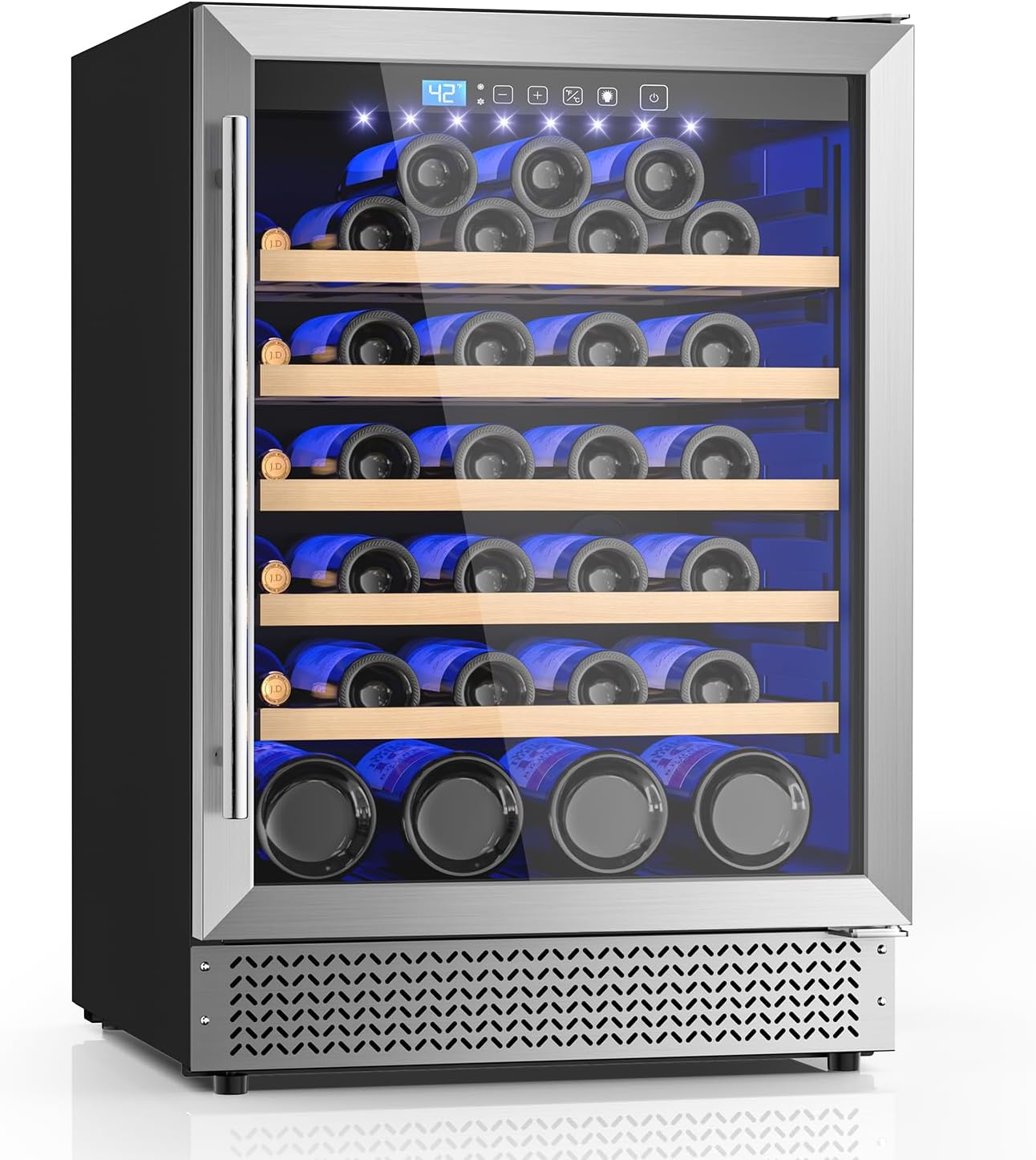
The Vushine 24" Wine Fridge is a purpose-built under-counter wine cooler that stores up to 54 standard 750ml bottles across five adjustable wooden shelves. It uses a compressor-based, air-cooled system with fan circulation and automatic defrost to maintain a 41–64°F range with 1°F precision via touch digital controls, which makes it easy to set serving temperatures for reds, whites, or sparkling wines. The double-layer tempered glass door offers UV protection and built-in blue LED lighting showcases the collection while limiting light exposure. Front-facing ventilation and reversible door installation let you use it built-in or freestanding, and adjustable leveling feet help keep the unit stable and minimize vibration that can disturb wine sediments. Practical benefits include large capacity for entertaining, flexible shelf arrangement for larger bottles, and relatively quiet operation from the low-noise compressor. Expect typical compressor cooler trade-offs such as modest background noise compared with thermoelectric units and the need for adequate front or side clearance when installed under cabinetry.
Best for: Buyers who prioritize a consistently controlled, low-vibration environment for long-term wine storage and want a sizable built-in-capable cooler that handles everyday entertaining.
Less Ideal for: Anyone seeking an ultra-quiet, near-silent cooler for a bedroom or noise-sensitive studio should consider thermoelectric alternatives or specialty silent models instead.
- Large 54-bottle capacity with five adjustable wooden shelves for flexible storage
- Digital temperature control with 1°F precision across a 41–64°F range
- Low-noise compressor with fan circulation and automatic defrost for stable cooling
- UV-protected double-layer tempered glass door to reduce light exposure
- Designed for built-in or freestanding installation with front-facing ventilation and reversible door
- Compressor cooling produces modest background noise compared with fully silent thermoelectric designs
- Requires proper ventilation clearance for built-in installation
Verdict: A reliable, built-in-capable 24-inch wine fridge that prioritizes stable, low-vibration cooling and precise temperature control for serious wine storage.
Velieta 24 Inch Dual Zone Wine Cooler

| Capacity | 4.24 cubic feet |
|---|---|
| Cooling Method | Compressor |
| Installation Type | Built-in/under counter/Freestanding |
| Number of Doors | 2 |
| Additional Features | Touch Control |
The Velieta 24 Inch Dual Zone Wine and Beverage Refrigerator combines separate wine and beverage compartments with a front-venting design that lets it sit under a counter or operate freestanding. It offers independent temperature ranges for each zone so you can keep cans and bottles cold in the left compartment while holding wine at cellar-like temperatures on wooden shelves in the right compartment. The unit uses a compressor and fan circulation for relatively fast, stable cooling and includes touch controls, blue LED lighting, a charcoal filter to reduce odors, and a door lock for security. Wire and wooden shelving are removable for flexible storage and the stainless steel frame and handle give it a clean built-in look. Trade-offs to expect are the moderate 4.24 cu ft capacity that limits very large collections and the specified noise and energy figures typical of compressor models, which may be louder and use more power than the quietest thermoelectric alternatives.
Best for: Buyers who want a compact dual-zone fridge that reliably stores both wine and ready-to-drink beverages under a countertop and value independent temperature control and a finished stainless look.
Less Ideal for: People needing high-capacity wine storage or the absolute quietest, lowest-energy option should consider larger single-purpose cellars or thermoelectric alternatives instead.
- Dual independent cooling zones with separate temperature ranges for beverages and wine
- Front ventilation allows built-in under-counter installation without added clearance
- Touch-screen digital controls and blue LED interior lighting for easy operation and visibility
- Removable wooden shelves and wire racks for flexible bottle and can storage
- Charcoal filter and fan circulation help reduce odors inside the cabinet
- 4.24 cubic foot capacity may be small for larger wine collections
- Compressor-based cooling typically produces more noise and uses more energy than thermoelectric models
Verdict: Choose this Velieta 24" dual-zone cooler when you want a compact under-counter fridge that keeps beverages and wine at optimal, independently controlled temperatures.
Icyglee 12" 18‑Bottle Wine Cooler

| Capacity | 2.1 cubic feet |
|---|---|
| Bottle capacity | 18 Bottle |
| Temperature range | 41-72°F |
| Cooling method | Compressor |
| Number of shelves | 6 |
The Icyglee 12" wine cooler is a small built‑in or freestanding compressor fridge that holds about 18 bottles and targets quiet, everyday wine storage. It uses a commercial‑grade compressor with front ventilation and adjustable beech wood shelves so you can fit different bottle sizes under a counter or in a compact bar area. The one‑touch LED control lets you set temperatures between 41 and 72°F and the unit has a memory function that restores your setpoint after a power interruption. A double‑layer tempered glass door with stainless steel trim reduces UV exposure and the manufacturer claims low vibration and noise around 36 dB, which helps protect sediment and keeps the unit unobtrusive in living spaces. Practical limitations include its modest 2.1 cu ft capacity that suits small collections rather than longterm cellaring, and the compressor cooling will still produce more heat and occasional cycling noise than thermoelectric models. Installation flexibility and the temperature memory make it a steady choice for quiet, built‑in storage in kitchens, apartments, or home bars.
Best for: Buyers who want a quiet, reliable under‑counter wine cooler for everyday serving and short‑term storage and who prefer a straightforward, low‑maintenance unit with temperature memory.
Less Ideal for: Collectors who need large capacity or long‑term cellar conditions should look at larger dual‑zone or higher‑capacity cooling systems instead.
- Compact 18‑bottle capacity fits under counters or as a freestanding unit
- Digital one‑touch control with 41–72°F range for precise serving temperatures
- Adjustable wooden shelves accommodate different bottle sizes
- Double‑layer tempered glass door reduces UV exposure and helps maintain stable conditions
- Low vibration and reported low noise level around 36 dB suitable for quiet environments
- Small 2.1 cu ft capacity is not suitable for larger collections
- Compressor cooling can still produce noticeable heat and occasional cycling noise compared with passive cellar options
Verdict: A compact, low‑vibration built‑in wine cooler that prioritizes quiet, dependable temperature control for small collections and everyday use.
Choosing the Right Quiet Built-In Wine Cooler: Key Factors to Consider
Noise Level and How It Is Measured
Noise ratings are a primary decision factor for a quiet built-in wine cooler because sound affects both enjoyment and wine quality. Look for decibel ratings and manufacturer explanations of how noise was measured. Real-world noise can differ from lab numbers, so consider both the stated dB level and design features that reduce noise such as brushless DC compressors, thicker insulation, and isolated mounting systems.
A cooler rated under about 40 dB is generally unobtrusive in a kitchen environment, but location matters. If the unit sits next to living spaces or bedrooms, prioritize lower-rated models and features that cut vibration-transmitted sound through cabinetry.
Temperature Control and Stability
Tight temperature control is more important than a low minimum temperature. Wines, especially reds and whites stored for aging, require consistent temperatures to prevent premature aging or flavor drift. Seek coolers with digital thermostats, dual-zone controls if you store both reds and whites, and documented temperature variance performance.
Consider how the unit regulates humidity as well, since humidity affects cork integrity. Units that maintain a stable temperature within a narrow band and offer precise digital adjustments will better protect bottles over months or years.
Vibration Management
Vibration can disturb sediment and accelerate chemical reactions in wine, so vibration isolation is a key factor for any quiet built-in wine cooler. Features to look for include rubberized compressor mounts, vibration-absorbing shelving, decoupled fan assemblies, and inverter-style compressors that run more smoothly.
Shelving and rack design also play a role in reducing vibration transfer to bottles. Solid wood or cushioned racks can dampen micro-movements better than bare metal shelving.
Built-In Venting and Installation Fit
Built-in models must handle heat rejection within cabinetry constraints. How a unit vents—front-venting versus rear/top venting—determines whether it will work in undercounter installations or enclosed spaces. Front-venting coolers can operate in tight cabinet openings without additional clearance; rear-venting units usually need proper rear airflow.
Plan for clearance, airflow pathways, and access to controls. Installation notes also affect long-term noise: cramped installations that restrict airflow can force fans and compressors to work harder and louder.
Capacity, Shelving Layout, and Bottle Size
Capacity should match how you store wine. Consider the number of standard 750 ml bottles you expect to store and whether you keep larger formats like magnums. Adjustable shelving and flexible rack layouts make it easier to store mixed sizes without wasted space.
Shelves that cushion bottles reduce vibration transfer and protect labels. Slide-out racks also improve access and minimize the need to move multiple bottles when retrieving one, which reduces handling risk.
Control Interface and Long-Term Reliability
A precise, intuitive control interface lets you fine-tune temperatures and alarms without opening the door. Digital displays, touch controls, and programmable zones are useful for serious collectors. For long-term ownership, look for proven cooling components, straightforward filter access, and clear maintenance instructions.
Warranty terms and serviceability matter because quiet operation can degrade if components like fans or compressors wear out. Units with easier access to replaceable parts and clear service channels tend to stay quieter over time.
Front-Venting Vs Rear-Venting: Which Works for Your Cabinet
Built-in wine coolers use different venting approaches and that choice determines where you can install the unit. Front-venting models expel heat through a grille at the bottom front and are the easiest option for true undercounter installation. Rear-venting or top-venting units need clearance behind or above the cabinet opening and a pathway for airflow.
If you have limited clearance or plan to tuck the cooler under an island, front-venting is the safest bet. For installations with more space and better natural airflow, rear-venting units can still be used but you must follow the specified clearances to avoid increased fan activity and noise.
- Front-venting: best for tight undercounter spots and minimal cabinet modification
- Rear/top-venting: may require additional clearance but can offer different design layouts
- Confirm ventilation requirements before making a purchase to avoid performance issues
Dual-Zone Cooling for Mixed Collections
If you store both reds and whites at once, a dual-zone cooler lets you maintain different temperatures in separated compartments. This reduces the need to compromise with a middle-ground temperature that suits neither style perfectly.
Dual-zone systems can be beneficial for short-term serving and long-term storage, but check that both zones offer the same level of temperature stability and low vibration. Poorly balanced dual-zone designs sometimes sacrifice stability in one compartment.
- Use top zone for whites and sparkling at cooler temps
- Use bottom zone for reds and long-term storage
- Ensure each zone reports accurate, consistent temperatures
Shelving Types: Wood, Metal, and Retractable Racks
Shelving design affects both vibration damping and accessibility. Wooden shelves tend to absorb vibration and are gentle on labels, while metal shelves can be more space-efficient but may transfer more vibration. Retractable or slide-out racks make accessing bottles easier and reduce the need to jostle other bottles.
Look for racks sized for standard bottles with adjustable spacing to accommodate larger formats from time to time. Protective finishes and gentle supports will also help preserve labels and foil capsules over long storage periods.
- Wood shelves: better vibration damping and aesthetics
- Metal shelves: durable and space-efficient
- Slide-out racks: easier access with less bottle handling
Noise Sources and What You Can Do About Them
Noise in wine coolers comes mainly from the compressor, fan, and vibration transmitted into surrounding cabinetry. Isolation mounts, thicker insulation, and quieter fan motors reduce audible noise. Proper installation such as anti-vibration pads and ensuring the cabinet is rigid can also cut noise transmission.
If a unit runs louder than expected, check for loose mounts or uneven leveling. Simple maintenance like cleaning condenser coils where accessible can improve airflow and lower fan workload over time.
- Compressor noise: reduced by isolation and inverter technology
- Fan noise: quieter brushless fans help, but airflow restrictions increase fan speed
- Cabinet vibration: use anti-vibration pads and firm mounting to limit sound transfer
Humidity Control and Cork Health
Humidity affects corks and label condition. Too low humidity can dry out corks and allow oxygen ingress; too high humidity risks mold and label damage. Built-in coolers vary in how much humidity they maintain; some models use activated charcoal panels or integrated dampers to stabilize moisture levels.
If long-term aging is your goal, choose a cooler that preserves moderate humidity or plan simple supplemental humidity solutions, such as placing a small water tray or using humidity-stabilizing packs designed for wine storage.
- Aim for moderate humidity to maintain cork elasticity
- Label protection: consider shelving materials that minimize moisture contact
- Supplemental humidity solutions can help in very dry climates
How We Chose the Best Quiet Built-In Wine Cooler
We focused on factors that directly affect noise, bottle protection, and built-in installation performance. Our shortlist started with models that specify low operating noise or use design features known to reduce sound transmission, such as improved compressor mounting, brushless fans, or enhanced insulation. We prioritized cooling systems that maintain tight temperature bands, because steady temps matter more for wine than absolute extremes. Vibration control and shelving design were assessed next, since reduced vibration preserves sediment and aroma compounds. Installation compatibility and ventilation approach were considered to ensure the unit will function properly when installed under counters or in enclosed cabinetry. Finally, we looked at build quality, control precision, and warranty support as indicators of long-term reliability. We excluded units intended only for freestanding use or those that require extensive external venting incompatible with standard built-in cabinetry. We also excluded coolers lacking published noise or temperature-stability specifications, since quiet operation and accurate climate control are core to the guide. The criteria that mattered most were measured or manufacturer-rated noise level, temperature stability, vibration mitigation features, and built-in ventilation design.
Our full evaluation process is outlined in our review methodology.
FAQ
How quiet is a typical built-in wine cooler?
Quiet built-in wine coolers often operate in the high 30s to low 40s dB range under normal conditions. Actual noise depends on installation, airflow, and whether the compressor cycles frequently.
Do I need a dual-zone cooler for both reds and whites?
Not always. Dual-zone units are convenient if you regularly store and serve both types at their ideal temperatures. If you mostly store one style, a single-zone cooler set to the appropriate temperature can be sufficient.
Will vibration from a cooler damage my wine?
Frequent or strong vibration can disturb sediment and affect long-term aging. Look for models with vibration-dampening mounts and cushioned shelving to reduce risk, especially for bottles intended for years of aging.
Can I install a built-in wine cooler under any countertop?
Most front-venting built-in coolers fit standard undercounter openings, but you must check the unit's installation specs for ventilation and clearance. Rear-venting units usually require extra space behind the cabinet.
How should I position bottles to minimize vibration effects?
Store bottles horizontally on cushioned or wood racks to stabilize them and keep corks moist. Avoid stacking bottles on top of each other and minimize movement when retrieving a bottle to limit disturbance.
Final Verdict
A quiet built-in wine cooler should balance low operating noise with tight temperature control and effective vibration isolation. Prioritize units with documented low noise, stable digital controls, and built-in ventilation that suits your cabinet configuration. Consider shelving type and capacity based on the bottle formats you own, and assess humidity control if long-term aging is a priority. Decide which tradeoffs matter most: absolute quiet versus slightly higher capacity, single-zone simplicity versus dual-zone flexibility. Focus on installation compatibility and verified temperature stability to choose a model that will protect bottles and remain unobtrusive in your home.