
Note: This article contains affiliate links. If you click on these links and make a purchase, we may earn a small commission at no extra cost to you. This helps support our research and content. Read our full affiliate disclosure here.
If noise matters where you live, picking a dehumidifier that runs quietly matters as much as its moisture-removal capacity. A noisy unit can disturb sleep, make living areas feel less pleasant, and limit where you can place the machine. This guide focuses on quiet dehumidifiers for home use and highlights top picks that balance silent operation with effective humidity control. You will find shortlisted units chosen for low operational sound, dependable moisture extraction, and features that matter for everyday household use. We evaluated ease of use, energy efficiency, and capacity so you can quickly find the right quiet model for bedrooms, basements, or shared living spaces. Read on for what mattered in our selection and practical buying guidance.
Top Picks at a Glance
| Best Quality Built to a higher standard if you want something more solid | FreAire 54-Pint Dehumidifier D068B |  |
| Best Value The sweet spot between price and what you get | AIRPLUS 30-Pint Dehumidifier |  |
| Best Budget The cheapest option that still gets the job done reliably | TABYIK DH-CS01 35 oz Dehumidifier |  |
| Top Rated A top-rated pick with lots of positive feedback | hOmeLabs 32-Pint Dehumidifier |  |
| Most Popular A crowd favorite that many people choose with confidence | BEDRED CT11 Dehumidifier |  |
| Best Seller A high-volume bestseller chosen again and again | ToLife C2 Dehumidifier |  |
FreAire 54-Pint Dehumidifier D068B

| Dehumidification Capacity | 54 pints_per_day |
|---|---|
| Floor Area | 4500 square_feet |
| Tank Volume | 1.13 gallons |
| Number of Speeds | 2 |
| Operation Mode | Automatic |
The FreAire D068B is a compressor dehumidifier built to remove up to 54 pints per day, making it suited for basements, large living areas, and other high‑moisture spaces up to 4,500 sq ft. It runs quietly—advertised at 30 dB—and includes a front humidity readout tied to a precision sensor so you can monitor conditions without bending down. Daily use is straightforward: choose from multiple modes (auto, continuous, precise humidity, dry cloth, sleep), set the 24‑hour timer, and either empty the 1.13‑gallon tank or attach the included 3.28 ft drain hose for uninterrupted drainage. Practical touches include a washable filter, auto‑defrost for cool environments, child lock, and caster wheels for moving between rooms. The unit's two fan speeds give a balance between faster moisture removal and lower noise, but the single compressor design means it is optimized for steady, high‑capacity performance rather than ultra‑compact portability or very low energy draw in all conditions. For buyers prioritizing quiet, high‑capacity dehumidification in large spaces, this model delivers useful features and reliable moisture control.
Best for: Buyers who need steady, high‑capacity moisture removal for large rooms or basements and prioritize quiet operation and easy monitoring during continuous use.
Less Ideal for: People looking for a very compact travel or closet unit, or those who need many incremental fan‑speed settings or the absolute lowest possible energy draw in small spaces.
- High dehumidification capacity at 54 pints per day for large rooms and basements
- Very quiet operation (around 30 dB) with a sleep mode that silences indicator lights
- Front humidity display with a precise sensor for easy remote monitoring
- Includes continuous drain hose plus a 1.13 gallon tank with full‑tank auto shutoff
- Washable filter, auto‑defrost, child lock, and caster wheels for convenient daily use
- Only two fan speeds limit fine control between performance and energy use
- Drain hose is relatively short at 3.28 feet which may require additional tubing for some setups
- Unit is compressor‑based and heavier than small desiccant or portable units
Verdict: If you want a quiet, high‑capacity dehumidifier for large rooms or basements that is easy to monitor and can run continuously, the FreAire 54‑pint D068B is a strong choice.
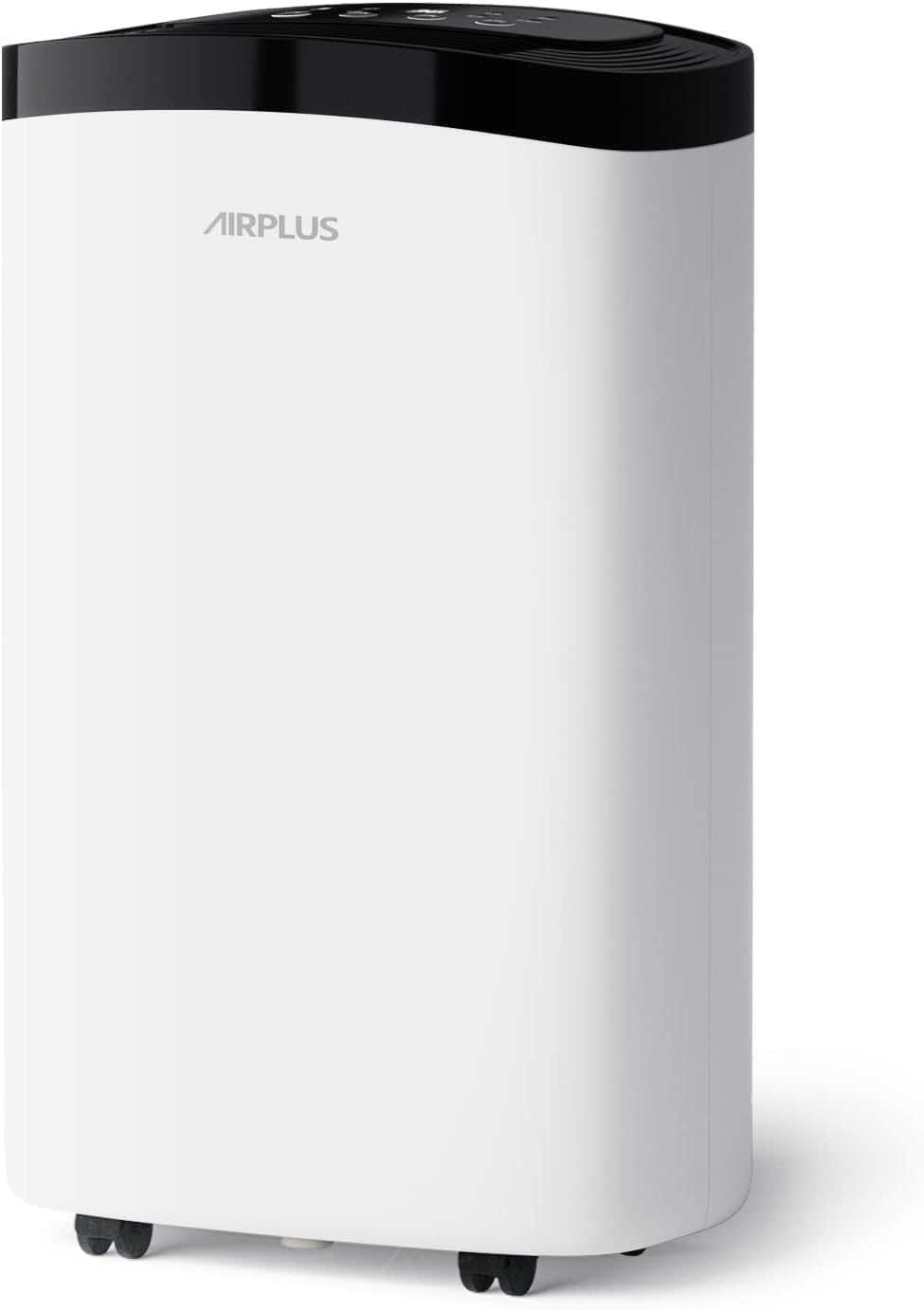
AIRPLUS 30-Pint Dehumidifier
| Capacity | 30 pints_per_day |
|---|---|
| Floor Area | 1500 square_feet |
| Tank Volume | 1.5 liters |
| Wattage | 192 watts |
| Operation Mode | Continuous |
The AIRPLUS 30-Pint Dehumidifier is a compact portable unit designed to control humidity in bedrooms, basements, living rooms and RVs. It pulls up to 30 pints per day under test conditions and offers multiple operation modes including continuous draining, a drying mode for wet laundry, a quiet sleep mode, and a programmable 1–24 hour timer. Practical touches include a 1.5 liter removable tank with full-tank shutoff, a supplied drain hose for unattended continuous operation, a washable filter, and four casters plus a carry handle for easy relocation. At about 192 watts it delivers decent moisture removal without excessive power draw, and the manufacturer rates operation noise at or below typical quiet-dehumidifier levels. Limits to note are the small tank relative to its daily extraction rate, meaning continuous drain is recommended for heavy use, and the unit is intended for moderate-temperature indoor use up to the stated upper temperature rating. For buyers who prioritize straightforward controls, portability, and low-noise night operation, this model is an efficient practical choice.
Best for: Buyers who want a practical, easy-to-use dehumidifier that emphasizes quiet operation, portability, and simple maintenance to keep household humidity under control.
Less Ideal for: People needing heavy-duty commercial dehumidification or very large open spaces where a higher-capacity, industrial unit is required.
- Effective moisture removal rated up to 30 pints per day under standard test conditions
- Continuous drain option with included hose for unattended operation
- Quiet sleep mode suitable for bedrooms and overnight use
- Detachable washable filter and caster wheels for easy maintenance and mobility
- Small 1.5 L tank means frequent emptying if continuous drain is not used
- Performance is specified for specific high-humidity/high-temperature conditions and may be lower in cooler rooms
Verdict: A quiet, portable dehumidifier with continuous-drain capability that is ideal for homeowners wanting low-noise, maintenance-light humidity control in small to medium rooms.
TABYIK DH-CS01 35 oz Dehumidifier

| Tank Volume | 1000 ml |
|---|---|
| Dehumidification Capacity | 0.45 liters_per_day |
| Wattage | 40 watts |
| Floor Area | 280 square_feet |
This small TABYIK DH-CS01 dehumidifier is a budget-friendly, low-power unit aimed at drying small spaces such as bedrooms, bathrooms, closets, and RVs. It uses a Peltier cooling system to pull moisture and can collect up to about 16 oz (450 ml) per day in warm, humid conditions while storing water in a transparent 35 oz (1000 ml) tank that is easy to remove and pour. The unit runs continuously on a single speed and emphasizes quiet operation at about 28 dB, so it sits unobtrusively next to a bed or in an office. A seven-color light adds an ambient option and can be turned off if not wanted. Practical safety features include an auto shutoff when the tank reaches roughly 700–800 ml and a flashing light indicator. Drawbacks are modest drying capacity compared with compressor dehumidifiers and optimal performance requires warmer, higher-humidity environments, so it works best as a spot solution rather than for whole-house moisture control.
Best for: Buyers seeking an affordable, energy-efficient spot dehumidifier for small rooms or intermittent use who prioritize quiet, low-maintenance operation.
Less Ideal for: People who need to dehumidify large rooms, basements, or consistently very damp environments should choose a higher-capacity compressor dehumidifier instead.
- Very quiet operation around 28 dB suitable for bedrooms and offices
- Low power consumption, uses under 1 kWh per day in typical use
- Large transparent 35 oz tank with easy-to-remove groove design
- Auto shutoff with indicator when the tank is nearly full
- Limited daily dehumidification capacity (about 16 oz/450 ml) not suited for very damp or large spaces
- Single-speed operation offers no humidity control or fan settings
Verdict: A quiet, low-cost small-room dehumidifier that delivers energy-efficient, hands-off moisture control for bedrooms and other compact spaces.
hOmeLabs 32-Pint Dehumidifier

| Dehumidification Capacity | 35 pints_per_day |
|---|---|
| Capacity | 1.8 gallons |
| Tank Volume | 1.6 gallons |
| Number of Speeds | 2 |
| Floor Area | 4500 square_feet |
This hOmeLabs unit is a straightforward, room‑scale dehumidifier built for large spaces like basements and open living areas. It removes up to 32 pints per day under typical conditions (and higher at very warm, humid extremes), and offers both a removable 1.6 gallon water tank with auto shutoff and a continuous drain outlet for hands‑free operation. The machine includes washable filter media, two fan speeds plus a TURBO mode for faster moisture removal, and smart features such as Wi‑Fi control and voice assistant compatibility so you can monitor and change humidity from your phone. Mobility is simple thanks to built‑in casters and a handle, and safety conveniences include automatic defrost and auto restart after power interruptions. Expect practical, reliable performance for basement humidity control, though it is a single‑hose portable unit so performance will vary with room layout and extreme cold conditions can reduce extraction rates. For buyers who want easy setup, remote control, and reliable daily dehumidification, this model covers the essentials without complex installation.
Best for: Buyers who want a reliable, easy‑to‑use dehumidifier for a basement or large room and value remote control, straightforward maintenance, and portability.
Less Ideal for: People seeking a hard‑plumbed or whole‑house solution or those who need maximum extraction in consistently cold spaces should consider other types of systems.
- Removes up to 32 pints per day with higher capacity at very high temperature and humidity
- Wi‑Fi control and compatibility with Alexa and Google Assistant for remote monitoring and adjustments
- Continuous drain option plus a removable tank with auto shutoff reduces manual emptying
- Washable air filter and caster wheels make maintenance and relocation simple
- Performance drops in cold environments since rated capacity is specified at warmer test conditions
- Only two fan speeds may limit fine control of noise versus extraction rate
Verdict: A portable, Wi‑Fi enabled dehumidifier that delivers dependable moisture removal and easy maintenance for large basements and open rooms.
BEDRED CT11 Dehumidifier

| Floor Area | 1000 square_feet |
|---|---|
| Tank Volume | 95 fluid ounces |
| Capacity | 5.9 pounds |
| Operation Mode | Intermittent |
| Other Special Features of the Product | 7 Color Ambient Light, Automatic Shutoff, Sleep Mode |
The BEDRED CT11 is a compact thermoelectric dehumidifier intended to reduce humidity in small spaces such as bedrooms, bathrooms, and modest basements up to about 1000 sq ft. It uses semiconductor cooling rather than a compressor, so it runs quietly and is simple to operate with an intermittent operation mode and an automatic shutoff when the 95 oz tank fills. Sleep Mode turns off the lights and lowers noise for overnight use, and the seven-color ambient light gives an optional mood-lighting feature. Practical benefits include easy emptying from the included tank, portability thanks to a lightweight design, and low sound levels that suit living spaces. Important limitations are inherent to semiconductor units: lower capacity compared with compressor dehumidifiers, reduced performance in very cold or very damp basements, and a smaller tank that requires more frequent emptying in high-humidity conditions.
Best for: Buyers who prioritize quiet, low-maintenance dehumidification and want a compact unit that is easy to move and run in living spaces or small basements without frequent intervention.
Less Ideal for: People needing heavy-duty moisture control for large, cold, or very damp basements should choose a higher-capacity compressor dehumidifier instead.
- Quiet thermoelectric operation suitable for bedrooms and living rooms
- Automatic shutoff protects against overfill and simplifies unattended use
- 95 oz removable tank for straightforward water removal
- Sleep Mode and ambient light options for low‑noise nighttime use
- Compact and lightweight for easy placement or moving between rooms
- Semiconductor cooling gives lower moisture removal capacity than compressor models
- Performance drops in cold basement conditions and very high humidity areas
Verdict: Choose the BEDRED CT11 if you want a quiet, portable dehumidifier with auto‑shutoff and sleep‑friendly operation for small basements or living spaces.
ToLife C2 Dehumidifier

| Floor Area | 1000 |
|---|---|
| Capacity | 95 fluid ounces |
| Number of Speeds | 2 |
| Wattage | 93 watts |
| Air Flow Capacity | 95 liters per minute |
The ToLife C2 is a small, portable dehumidifier that uses semiconductor condensation to remove moisture from confined spaces while running quietly. It is intended for bedrooms, bathrooms, closets and small basements where users want lower noise and occasional moisture control rather than continuous heavy-duty drying. The unit offers two fan speeds including a low-noise sleep mode under 30 dB, a 95 oz removable water tank with automatic shutoff, and a seven-color LED that can be locked or used as a night light. Setup is simple: place on a flat surface, plug in, and choose high or sleep mode; the removable tank makes emptying straightforward. Limitations include modest airflow and a 93 W power draw that reflect its small compressorless design, so it will be slower to lower humidity in very damp or large areas and is not a replacement for larger refrigerant dehumidifiers for basements with persistent high humidity. For calm, occasional dehumidification in living spaces the ToLife C2 balances quiet operation and convenience.
Best for: Buyers who prioritize near-silent operation for bedrooms or living spaces and need a simple, plug-and-play unit for occasional humidity control.
Less Ideal for: People needing rapid, continuous dehumidification for very damp basements, large open areas, or commercial drying tasks should choose a larger refrigerant model.
- Very quiet sleep mode rated below 30 dB suitable for bedrooms
- Large 95 oz removable tank with automatic shutoff to prevent overflow
- Portable, compact design with handle for easy room-to-room placement
- Two fan speeds for a balance of faster dehumidification or low-noise operation
- Semiconductor condensation design and modest airflow mean slower moisture removal in very damp or large spaces
- Rated for 220 volts which may limit use without appropriate power compatibility
Verdict: Choose the ToLife C2 when you want a quiet, portable dehumidifier for bedrooms and small rooms that combines easy tank maintenance with low-noise sleep operation.
Choosing the Right Quiet Dehumidifier for Home: Key Factors to Consider
Operational Noise Level
Noise ratings and real-world sound matter because they determine where you can comfortably place a dehumidifier in your home. A lower decibel rating typically means the unit can be used in bedrooms, nurseries, or open-plan living areas without causing distraction.
Look for models with multiple fan speeds and a dedicated quiet or sleep mode. These let you reduce audible output during night hours while still keeping humidity in check. Also consider whether the unit uses vibration-dampening feet or a low-vibration compressor, since mechanical rattles often contribute more to perceived noise than the fan alone.
Moisture Removal Capacity
Capacity, usually expressed in pints or liters removed per day, dictates how quickly a dehumidifier can lower humidity in a given space. Choose a capacity that matches the typical room size and humidity level; undersized units can run constantly and struggle to maintain the set point.
For homes with periodic high humidity or damp basements, a higher-capacity unit or one with an automatic restart and continuous drain option can prevent recurring moisture problems. Also check how capacity is rated—manufacturers often list a maximum under specific conditions—so consider real-world performance expectations.
Energy Use and Operating Cost
Because dehumidifiers often run for many hours, energy efficiency affects both your electricity bill and environmental footprint. Look for energy-efficient compressors, variable fan speeds, and programmable schedules to reduce run time during low-demand periods.
A model with a built-in humidistat and an automatic on/off control will cycle less frequently and use less energy than one that runs continuously. Consider energy consumption at different fan speeds because quiet modes may be far more efficient than full-power operation.
Maintenance and Filter Access
Maintenance affects both the unit's longevity and the continuity of quiet operation. Regular filter cleaning keeps airflow steady and prevents the fan from working harder and louder. Easy-access filters and clear maintenance indicators reduce the likelihood of neglect.
Also check how the water collection or drainage system is handled. A removable bucket with a splash-free pour or a simple continuous drain connection reduces hassle. Units that require frequent, difficult maintenance are more likely to be disabled or produce noise from clogged components over time.
Controls, Placement Flexibility, and Safety Features
Controls that let you set precise humidity targets, schedules, and sleep modes are essential for quietly maintaining comfort. A responsive humidistat prevents long runs and helps the unit stay in a lower, quieter state.
Placement flexibility matters because proximity to occupants affects perceived noise. Look for compact footprints, caster wheels for relocation, and a cord length suited to typical room outlets. Safety features such as auto-shutoff on a full tank and tilt protection reduce the risk of leaks and noisy emergency behavior.
Where to Put a Quiet Dehumidifier in Your Home
Placement affects both performance and perceived noise. Position the unit near the moisture source while leaving clear air intake and exhaust paths. For bedrooms, place the dehumidifier a few feet away from the bed and oriented so the exhaust does not blow toward the sleeping area.
Basements and utility rooms often need units near lower-level moisture sources, but avoid corners that trap exhaust. If floor placement is required, use vibration-isolating pads to reduce rattle and transmission of sound through joists or concrete.
- Keep at least 6 to 12 inches of clearance around intake and exhaust vents.
- Place on a level surface to prevent vibration noise.
- Use continuous drain when unattended to avoid bucket-full shutoffs.
Using Fan Speeds and Sleep Modes Effectively
Fan speed and sleep modes let you trade off noise for drying speed. Use higher fan speeds for quick moisture removal during humid afternoons, and switch to quiet or sleep modes at night to minimize disturbance.
Some units automatically lower fan speed once the target humidity is reached. When available, enable that feature to keep nighttime noise low without sacrificing long-term humidity control.
- Start on high for rapid dehumidification, then switch to quiet mode.
- Use timers to avoid running at high speed overnight.
- Enable automatic humidistat control to reduce unnecessary runtime.
Continuous Drain Vs. Bucket: Which Is Better for Quiet Use
A continuous drain setup reduces the need for bucket emptying and associated noise or interruptions. It also prevents the unit from cycling off when the tank fills, which can produce abrupt sounds on restart.
Buckets with splash-resistant designs can be quiet if the fill/empty cycle is infrequent and handled gently. For bedrooms or long unattended periods, continuous drain is often the least disruptive option.
- Continuous drain is best for long unattended runs.
- Choose buckets with secure lids and comfortable handles to avoid sloshing.
- Verify drain hose routing to prevent water traps that could cause gurgling sounds.
Reducing Vibrations and Rattles
Mechanical vibration is a common source of noise that is separate from fan sound. Ensure the unit is on a flat, stable surface and use vibration-dampening pads when placing on hard floors or near shared walls.
Tighten loose grills or panels according to the manual, and avoid placing lightweight objects on top of the unit that can vibrate. Periodic checks for loose fasteners and a clean fan assembly help maintain quiet operation over time.
- Install anti-vibration pads under feet for hard-surface floors.
- Keep the unit away from furniture that can amplify sound.
- Perform basic cleaning to avoid fan imbalance from dust buildup.
Dehumidifier Features That Improve Home Comfort
Look beyond noise and capacity to features that make daily use simpler. Digital humidistats, programmable timers, remote controls, and Wi-Fi connectivity provide more precise control and reduce the need to adjust the unit manually.
Auto-restart after power loss and full-tank indicators prevent unexpected behavior that could be noisy or inconvenient. Smart features also let you schedule low-noise operation during sleep hours and higher output during daytime.
- Digital humidistats keep humidity within a narrow range.
- Timers and scheduling reduce manual interventions.
- Remote control or apps help change settings without approaching the unit.
How We Chose the Best Quiet Dehumidifier for Home
We selected products that demonstrate consistent quiet operation without sacrificing dehumidification performance. Primary filters favored measurable noise ratings, laboratory-style moisture removal specs, and features that reduce perceptible sound during daily use. We also prioritized units with adjustable fan speeds and low-vibration designs because these directly influence how unobtrusive a dehumidifier is in living spaces. Our evaluation considered energy efficiency, capacity matched to typical room sizes, ease of maintenance, and control options such as timers and humidistats. Durability and warranty terms were factored in as indicators of long-term reliability. We excluded models intended solely for industrial or commercial use, unusually loud high-capacity units, and products lacking clear noise or moisture-removal specifications. In short, the list favors quiet operation, accurate humidity control, reasonable energy consumption, and straightforward upkeep. These are the concrete dimensions we used to compare and rank the shortlisted dehumidifiers for home use.
Our full evaluation process is outlined in our review methodology.
FAQ
How loud is a typical quiet dehumidifier in a bedroom?
Quiet models usually operate in a range that is lower than typical conversation levels and often have a designated sleep mode. Actual perceived loudness depends on fan speed, room size, and distance from the unit, so placing the dehumidifier a few feet from the bed on its quiet setting generally keeps disturbance minimal.
Can I run a dehumidifier in continuous drain mode without noise issues?
Yes. Continuous drain usually reduces interruptions from full-tank shutoffs and associated restart sounds. Ensure the drain hose is routed correctly and clamped to avoid gurgling or water movement noises.
Does using the quiet mode significantly reduce moisture removal?
Quiet mode lowers fan speed, which reduces the rate of moisture removal compared with high-speed settings. However, for steady-state humidity control, quiet mode is often sufficient and more energy efficient for overnight or low-demand periods.
How often should I clean filters to keep noise down?
Check and clean washable filters every one to three months depending on dust levels and usage. A clogged filter forces the fan to work harder and can increase both noise and energy use, so routine maintenance helps preserve quiet operation.
Will placing a dehumidifier on carpet affect noise?
Carpet can absorb and muffle some vibration, but if the unit is unstable it may still vibrate and cause low-frequency noise. Use a stable, level surface and consider anti-vibration pads if you notice rattling or movement on carpet.
Final Verdict
Prioritize models that deliver low operational noise while still matching capacity to the room you plan to condition. Balance decibel ratings with moisture removal capacity and energy efficiency, and prefer units with sleep modes, accurate humidistats, and simple maintenance workflows. Consider placement, continuous drain options, and vibration control to keep the unit unobtrusive. A quiet dehumidifier for home should solve humidity problems without drawing attention. Focus on the tradeoffs between run speed and noise, and choose the combination of capacity, controls, and features that fits your living spaces and noise sensitivity for confident long-term use.