
Note: This article contains affiliate links. If you click on these links and make a purchase, we may earn a small commission at no extra cost to you. This helps support our research and content. Read our full affiliate disclosure here.
If you want fresh juice without waking the household, a quiet juicer makes early-morning extraction practical. The right machine reduces motor noise and vibration so you can prepare juice before work or while others sleep. This guide focuses on low-noise juicers that still deliver efficient extraction, sensible cleanup, and reliable performance for daily use. We shortlisted the top models across different styles and tested criteria to help you pick the best option for your routine. Read on for our evaluation factors and what matters when choosing a quiet juicer.
Top Picks at a Glance
| Best Overall The best all-around choice for most situations | SIFENE Cold Press Juicer AMR8824 |  |
| Best Quality Built to a higher standard if you want something more solid | Hurom H330 Cold Press Juicer |  |
| Best Value The sweet spot between price and what you get | BRECIOUS Slow Masticating Juicer ZM1506 |  |
| Best Budget The cheapest option that still gets the job done reliably | BLACK+DECKER Quiet Juicer JE2500B |  |
| Most Popular A crowd favorite that many people choose with confidence | Jocuu Slow Masticating Juicer |  |
| Best Seller A high-volume bestseller chosen again and again | LAUDLIFE Cold Press Juicer MTIW |  |
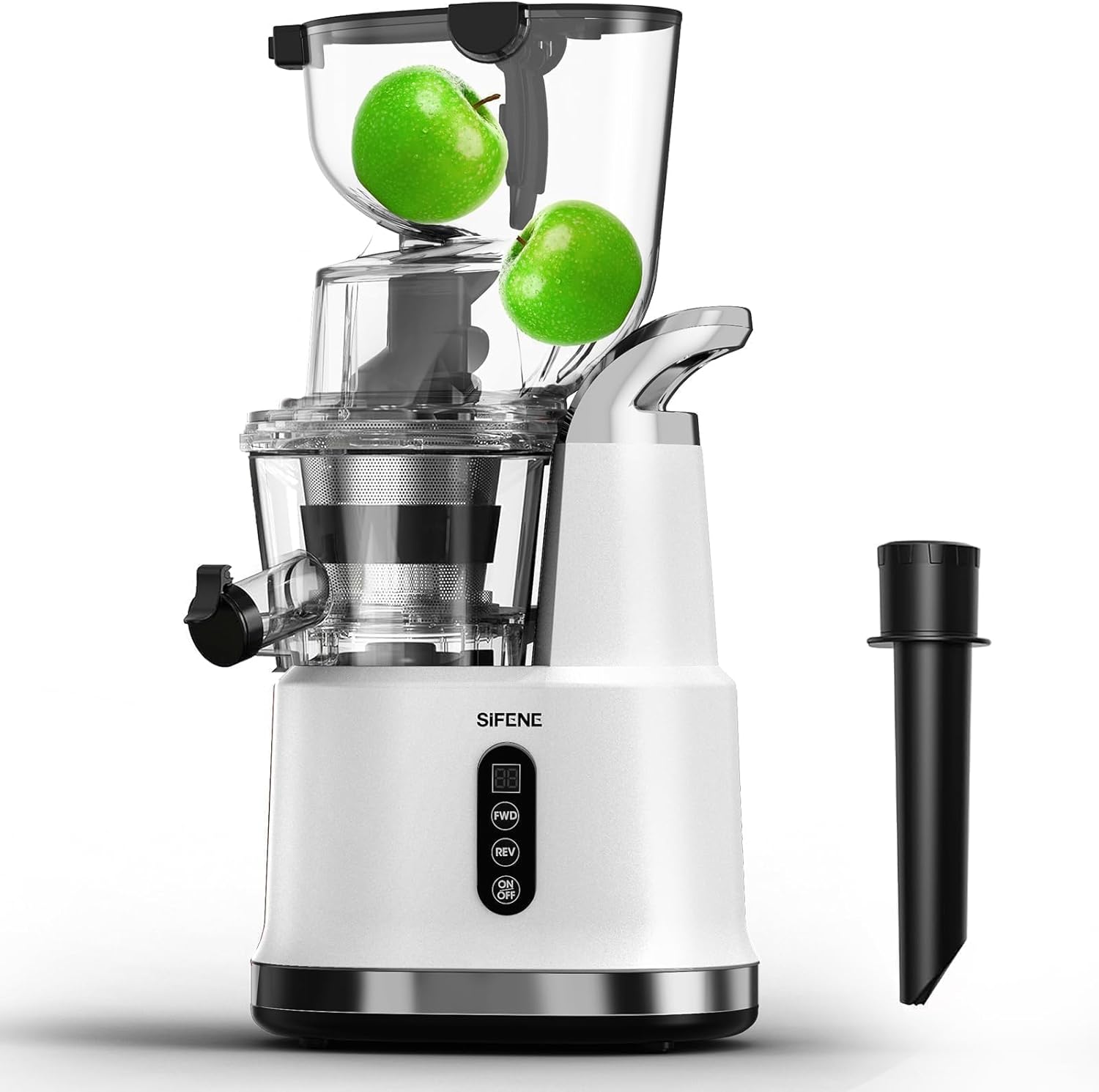
SIFENE Cold Press Juicer AMR8824
| Number of Speeds | 1 |
|---|---|
| Blade Material | Stainless Steel, BPA-Free Plastic |
The SIFENE Cold Press Juicer is a vertical, single-speed masticating machine designed to juice whole fruits and fibrous greens with minimal prep. Its 83mm/70mm extra-large dual feed chute accepts whole apples and long celery strips so you spend less time cutting, while the slow 60 RPM auger squeezes produce gently to reduce heat and oxidation for richer color and a higher yield. Practical features include a reverse function to clear clogs, a drip-free cap, a simple three-piece assembly for quick cleaning, and a brush for the mesh filter. The motor runs quietly under 60 dB, making it suitable for early-morning use in shared homes. Limitations are its single speed control, so you cannot adjust extraction for delicate crops, and the vertical masticating design is slower than centrifugal juicers when producing large volumes quickly. For users prioritizing nutrient retention, quiet operation, and low prep, this juicer delivers solid real-world performance.
Best for: Buyers who want a quiet, nutrient-focused home juicer that reduces prep time and emphasizes juice quality over speed.
Less Ideal for: People who need very fast high-volume juicing or variable speed control for different types of produce.
- Extra-large dual feed chute lets you juice whole apples and long celery with minimal chopping
- Slow 60 RPM masticating auger maximizes juice yield and preserves nutrients
- Low-noise motor under 60 dB suitable for early-morning or quiet households
- Reverse function and drip-free cap reduce clogging and countertop mess
- Detachable BPA-free parts with included brush make cleaning straightforward
- Single speed limits control over extraction for very soft or very hard produce
- Slower throughput compared with centrifugal juicers when making large batches
Verdict: Pick this juicer if you want a quiet, low-speed cold press that handles whole fruit with minimal prep and prioritizes nutrient-rich juice.
Hurom H330 Cold Press Juicer

| Capacity | 2 liters |
|---|---|
| Auger Speed | 50 RPM |
| Power Source | Corded Electric |
| Blade Material | Stainless Steel |
The Hurom H330 is a single-augur cold press juicer built for batch juicing and quiet operation. Its 2-liter self-feeding hopper accepts whole fruits and vegetables so you can load a recipe and walk away while the 50 RPM auger gently presses produce to extract juice with minimal heat and foam. That slow squeeze mechanism yields higher nutrient retention and longer fridge life for juice, and the included fine and coarse strainers let you choose pulp level or make nut milk; an ice cream strainer is available separately. Practical touches include a detachable power cord, safety shut-off if the hopper opens, and parts that disassemble for fast hand-wash cleaning. At the same time this is a relatively heavy, countertop appliance and hand-wash care is required rather than dishwasher-safe parts, so expect some cleanup time after large batches. For someone prioritizing quiet, nutrient-forward performance and large batch capacity, the H330 delivers effective, low-noise juicing.
Best for: Buyers who value quiet, nutrient-preserving performance and want a juicer that can handle whole fruits and vegetables for family-size or batch recipes with minimal supervision.
Less Ideal for: People who need a lightweight, fully dishwasher-safe or ultra-compact juicer for occasional single servings should consider simpler or smaller models instead.
- Large 2-liter self-feeding hopper accepts whole produce for batch juicing
- 50 RPM slow auger preserves nutrients and reduces foam and heat
- Quiet motor suitable for early-morning use
- Includes fine and coarse strainers for customizable pulp levels
- Safety shut-off and detachable power cord for convenience
- Parts require hand washing rather than dishwasher-safe cleaning
- Relatively heavy countertop unit that takes up counter space
- Additional accessories like the ice cream strainer are sold separately
Verdict: Choose the H330 if you want a quiet, self-feeding cold press juicer that handles whole produce and prioritizes nutrient-rich, batch juicing.
BRECIOUS Slow Masticating Juicer ZM1506

| Wattage | 150 watts |
|---|---|
| Number of Speeds | 2 |
| Power Source | Corded Electric |
| Voltage | 120 volts |
| Special Features | Quiet Motor, reverse function, high juice yield |
The BRECIOUS ZM1506 is a single-auger, cold-press masticating juicer built to maximize yield while running quietly. It uses a low-speed 95–110 RPM motor and an upgraded multi-stage auger to extract juice with minimal oxidation, and the manufacturer claims up to 90% yield. Controls include two speed settings plus a reverse mode for clearing clogs, and a three-section filter aims to produce smoother juice with less pulp. Assembly and cleanup are straightforward thanks to one-touch disassembly and dishwasher-safe parts, and the small feed chute and BPA-free plastics emphasize safety. At 150 watts the motor is powerful enough for leafy greens, soft fruits, and many harder items when using the higher speed, and the unit is designed to run below typical household noise levels. Expect some limitations with very large produce that needs pre-cutting because of the narrow feed chute, and like most slow juicers it will process slowly compared with centrifugal models. For buyers prioritizing quiet operation and nutrient-preserving extraction, this model offers a practical balance of performance and easy maintenance.
Best for: Buyers who prioritize quiet, nutrient-preserving juicing and want an easy-to-clean, practical slow juicer for regular home use.
Less Ideal for: People who need very fast throughput or want to juice whole large fruits without pre-cutting should consider a different style of juicer.
- Low-speed cold-press extraction preserves nutrients and reduces oxidation
- Quiet motor designed to operate under typical household noise levels
- Two speed settings plus reverse function for handling a range of produce and clearing jams
- One-touch disassembly and dishwasher-safe parts simplify cleaning
- Small 1.8-inch feed chute requires pre-cutting larger fruits and vegetables
- Slower processing speed compared with centrifugal juicers
Verdict: Choose this juicer if you want a quiet, cold-press masticating machine that prioritizes nutrient retention and easy cleanup for everyday home juicing.
BLACK+DECKER Quiet Juicer JE2500B

| Wattage | 400 watts |
|---|---|
| Power Source | Corded Electric |
| Number of Speeds | 1 |
| Special Features | Quiet Motor |
The BLACK+DECKER Quiet Fruit & Vegetable Juicer JE2500B is a compact juicer designed for everyday home use. It uses a 400-watt motor and single-speed operation to extract juice while minimizing noise, and the upright, space-saving design fits easily on most countertops. Assembly is tool-free with an easy-twist system, and a non-drip spout plus a large pulp container help keep counters cleaner during pouring. Removable parts are dishwasher-safe and an included brush makes cleaning the strainer simpler, though the manufacturer lists hand wash for care. Practical benefits are straightforward: fast, low-noise juicing of common fruits and vegetables, simple setup, and minimal countertop footprint. Limitations to consider are the single speed control, which gives less flexibility for hard versus soft produce, and plastic blade components that may not match stainless-steel durability. For buyers focused on a quiet, no-frills juicing experience, this model delivers good value; power and convenience are prioritized over advanced controls or heavy-duty commercial construction.
Best for: Buyers who want an affordable, low-noise juicer for regular home use and value easy setup, simple cleaning, and a small footprint.
Less Ideal for: Those who need variable speed controls, heavy-duty stainless-steel components, or a juicer built for frequent commercial-level use should consider higher-end models.
- Quiet motor reduces operating noise for morning use
- Compact upright design saves countertop space
- Easy-twist assembly and non-drip spout simplify setup and pouring
- Removable parts are dishwasher-safe and include an easy-clean brush
- Single-speed control limits adjustment for different produce types
- Key cutting components use plastic rather than stainless steel
Verdict: A budget-friendly, quiet countertop juicer that delivers straightforward, low-noise home juicing with simple cleanup.
Jocuu Slow Masticating Juicer

| Wattage | 150 watts |
|---|---|
| Number of Speeds | 2 |
| Power Source | Corded Electric |
| Special Features | Auto-Reversing, Portable |
The Jocuu Slow Masticating Juicer is a single-auger cold press machine that extracts juice from soft and hard produce using two speed settings. It is typically used for daily home juicing of fruits, leafy greens, and root vegetables where preserving nutrients and reducing foam matters. Notable features include a low-noise 150 W motor rated around 60 dB, an auto-reverse function to clear jams, an automatic shutoff after 20 minutes for motor protection, and dishwasher-safe detachable parts for easier cleanup. In practice the juicer yields a relatively dry pulp and produces smoother, less-oxidized juice than high-speed blenders; the small feed chute means you will need to pre-cut larger items but also improves safety. The machine is mostly plastic with stainless-steel blade components, so it is lightweight but not as heavy-duty as commercial metal-bodied models. Expect solid home performance, quiet operation, and straightforward maintenance, but plan for a bit more prep and moderate throughput compared with wide-chute centrifugal machines.
Best for: Buyers who prioritize a quiet, nutrient-preserving cold-press juicer for regular home use and who value safety features and easy cleaning backed by visible user feedback.
Less Ideal for: Anyone needing high-volume commercial output or who wants the fastest possible throughput without chopping produce first should consider a centrifugal or larger-capacity model instead.
- Quiet 150 W motor suitable for early-morning use at about 60 dB
- Two-speed (soft/hard) spiral system for better extraction across fruit and vegetables
- Auto-reverse and automatic shutoff help prevent clogging and protect the motor
- Detachable parts are dishwasher-safe and include a cleaning brush for easier cleanup
- Small feeding chute requires cutting produce into smaller pieces before juicing
- Mostly plastic construction may feel less durable than metal-bodied models
Verdict: A quiet, easy-to-clean slow juicer that delivers nutrient-preserving cold-press juice for home users who want low-noise operation and reliable anti-clog protections.
LAUDLIFE Cold Press Juicer MTIW

| Maximum Power | 250 watts |
|---|---|
| Wattage | 250 watts |
| Voltage | 120 volts |
| Number of Speeds | 40 |
| Capacity | 1.5 liters |
The LAUDLIFE MTIW is a single-auger cold press juicer built to handle leafy greens and whole fruits with minimal prep. It runs at a slow 40 RPM using a high-torque 250 W motor, which gently crushes produce to maximize juice yield and reduce heat buildup, and it includes a REV reverse function to clear jams quickly without full disassembly. The 5.4" wide chute accommodates whole apples and large greens so you can wash-and-drop most ingredients, and removable parts plus a cleaning brush make cleanup straightforward. Notable practical benefits are the very quiet 35 dB operation that lets you juice early or late without disturbing others, and the design that aims to leave drier pulp for higher extraction. Limitations to consider are the plastic blade and ABS construction, which are less premium than some metal alternatives, and the relatively modest 1.5 L capacity that fits daily to small-batch juicing rather than large-volume batches. It is a solid option for everyday cold-press juicing where noise and yield matter more than top-tier materials.
Best for: Buyers who prioritize a very quiet, easy-to-use cold press juicer that extracts leafy greens and whole fruits with minimal prep and simple cleaning.
Less Ideal for: Those who need a heavy-duty, metal‑built commercial machine or who regularly prepare large batches for many people.
- Very quiet 35 dB operation suitable for early-morning or late-night use
- Wide 5.4" chute handles whole apples and large greens with less prep
- Slow 40 RPM masticating action and high-torque motor for higher juice yield and less heat
- Reverse (REV) function clears jams quickly without disassembly
- Includes cleaning brush and removable parts for easier cleanup
- Major plastic/ABS construction and plastic blade rather than metal components
- 1.5 liter capacity may be small for large batches or family entertaining
Verdict: Choose this juicer if you want a very quiet, low-speed cold press that handles leafy greens and whole fruits with high yield and easy cleanup.
Choosing the Right Quiet Juicer: Key Factors to Consider
Noise Level and Vibration
How loud the machine runs and how much it shakes directly affects whether you can use it in the morning or late at night. Look for machines with reported decibel ratings or low-RPM designs that prioritize quiet operation. Vibration damping and a stable base also reduce perceived noise even if the motor is modestly loud.
A quieter motor is beneficial only if the unit's mechanical design controls resonance and feed-tube chatter. Evaluate both motor noise and chassis vibration because one can undermine the other. Consider where you will place the juicer; a rigid countertop amplifies vibration, while a rubber mat or soft surface can reduce transmitted sound.
Extraction Efficiency and Yield
Yield determines how much juice you get from the same amount of produce and affects long-term cost and convenience. Masticating and slow-speed designs often extract more juice from leafy greens and soft fruits, while higher-speed centrifugal units can be faster but sometimes waste more pulp.
For quiet juicers, slower speeds can help preserve nutrients and reduce noise, but you should still assess how dry the pulp is after juicing. Efficient extraction reduces waste and the need to press or reprocess pulp, saving time and ensuring better flavor and nutrition per piece of produce.
Ease of Cleaning
Cleaning complexity is a common dealbreaker for regular juicing. Machines with fewer parts, dishwasher-safe components, or straightforward brushes reduce cleanup time and encourage consistent use. Look for removable strainers and augers that rinse clean without special tools.
Some quieter, slow-speed juicers have intricate screens that trap fibers and require careful brushing. Consider the time you will realistically spend cleaning after each use and prioritize designs that fit into your morning routine to avoid buildup and clogs.
Build Quality and Durability
Materials and construction determine how long the juicer will maintain low-noise performance. Metal gears, solid housings, and reinforced feed tubes resist deformation and reduce motor strain that can cause noise to increase over time. A sturdy machine also handles harder produce without excessive wear.
Warranty length and the availability of replacement parts are indications of expected longevity. Durable components help the juicer stay quiet over years of use by preventing wobble and misalignment that create additional noise.
Size, Footprint, and Counter Placement
Where you keep the juicer affects ease of use and noise perception. A compact footprint makes storage easier but can concentrate vibrations against the counter. Taller or wider models may require more clearance but often have larger feed chutes that reduce prep time.
Think about whether the unit will stay on the counter or be stored between uses. If you store it, consider how easy it is to assemble. Assess height and depth relative to upper cabinets and sink placement to ensure comfortable loading and cleaning.
Control Features and Safety
Simple, reliable controls help you operate the juicer quickly and reduce the chance of misuse that could increase noise or damage the motor. Variable speed options let you tailor noise and performance to different produce types, while automatic reverse functions reduce clogs without manual force.
Safety interlocks and overload protection protect the motor and prevent accidental operation during assembly. These features improve long-term quiet operation by avoiding mechanical strain that causes audible issues.
Quiet Juicer Types and How Noise Differs
Juicers come in several mechanical styles, and each design produces a different noise profile. Slow masticating units run at lower RPMs and often sound like a gentle hum, while centrifugal models spin faster and emit a higher-pitched whine. Noise also depends on internal gearing, vibration isolation, and the materials used for the housing.
When evaluating noise, consider both the decibel rating and the tonal quality. Low-frequency rumble tends to travel through countertops and feels louder than the same decibel number of higher-frequency sound. Choose a type that balances the kind of produce you juice with the noise characteristics you can tolerate.
- Masticating: Lower RPM, generally quieter, better for leafy greens.
- Centrifugal: Faster, louder, quicker for hard fruits but may sacrifice yield.
- Triturating/Two-stage: Very efficient extraction, can be quieter if well-isolated but often larger.
Setting Up for Quieter Operation
Placement and installation affect perceived noise more than many buyers expect. Set the juicer on a solid, level surface and add a small rubber mat under the feet to dampen vibration. Avoid cabinet shelves that can act as sounding boards.
Routine maintenance keeps the motor running smoothly and quietly. Regularly check for loose screws, worn seals, or hardened pulp in moving parts. Lubrication points specified by the manufacturer will reduce friction-related noise over time.
- Use a rubber mat to reduce transmitted vibration.
- Ensure all fasteners are tight before each use.
- Remove trapped fibers from screens to prevent rattling.
Tips to Maximize Juice Yield with Low Noise
To get the best extraction from a quiet juicer, feed produce steadily and avoid forcing large pieces through a small chute. Pre-cutting dense items like beets into smaller pieces can reduce strain on the motor and keep operation smooth. Rotate between soft and hard produce rather than juicing a large batch of one type to avoid clogging and motor stress.
If you frequently juice leafy greens, use a slow-speed design and pack greens in small amounts so the auger can process them thoroughly without stalling. Consistent technique reduces the need for reverse cycles, which can interrupt the quiet workflow.
- Pre-cut hard produce to ease motor load.
- Alternate produce types to avoid continuous strain.
- Use small batches of leafy greens for better yield.
Maintenance Practices That Preserve Quiet Performance
Consistent cleaning after each use prevents pulp buildup that can increase friction and noise. Inspect the filter, auger, and seals for wear and replace parts showing degradation. A light wipe-down of the motor housing keeps vents clear so the motor does not overheat and work harder.
Schedule a more thorough teardown monthly if you juice daily. Pay attention to any new rattles or changes in sound and address them early. Small fixes like tightening a loose bracket or realigning the feed chute can restore quiet operation without professional service.
- Rinse parts immediately to prevent dried pulp.
- Check seals and gaskets for flattening or cracks.
- Tighten or replace fasteners that cause rattles.
Accessories and Add-Ons That Help
A few well-chosen accessories improve the quiet juicing experience. A soft rubber mat placed beneath the unit reduces transmitted vibration to the counter. Dedicated brushes and small scrapers speed cleaning and prevent pulp from hardening in mesh screens.
Storage lids and small containers designed for pulp collection reduce splash noise and mess during operation. Consider a compact pitcher that seals once juicing is complete to minimize commotion when transferring juice.
- Anti-vibration mats reduce countertop noise.
- Dedicated brushes speed up cleaning and reduce clogs.
- Sealable pitchers minimize splatter and handling noise.
How We Chose the Best Quiet Juicer
We evaluated machines based on measurable sound output, extraction performance, and real-world usability. Noise level was measured in decibels under typical juicing loads to identify models that remain unobtrusive during operation. Extraction efficiency looked at juice yield and dry-pulp results across a range of produce, since quieter motors can sometimes trade off power. Ease of cleaning examined how many parts must be disassembled and how straightforward rinsing and brushing are. Build quality and stability were included to ensure low vibration contributes to quieter operation. Controls and ergonomics were assessed for intuitive use, safe feeding, and reliable safety interlocks. We excluded machines that produced excessive vibration regardless of sound rating, those with poor sealing that caused leakage, and designs with impractical or excessive teardown requirements. Our picks emphasize a balance of low noise, consistent juice yield, manageable cleanup, and everyday reliability.
Our full evaluation process is outlined in our review methodology.
FAQ
How quiet is a quiet juicer compared with other kitchen appliances?
Quiet juicers are generally much less loud than blenders or food processors. While decibel levels vary by model and type, slow-speed juicers produce a lower, steadier hum that is easier to tolerate in a shared living space.
Will a quieter juicer give less juice than a louder model?
Not necessarily. Many quiet, slow-speed designs extract juice efficiently, especially from leafy greens and soft fruits. Extraction depends on design and build quality more than noise alone, so check yield-related specifications.
Can I make the juicer quieter with simple steps at home?
Yes. Placing the unit on a rubber mat, ensuring it is level, and removing any loose parts will reduce perceived noise. Regular maintenance and prompt cleaning also prevent rattles caused by pulp buildup.
Are slow masticating juicers always quieter than centrifugal models?
Often they are quieter because they run at lower speeds, but that is not a hard rule. Mechanical design, motor housing, and vibration control play big roles, so some centrifugal units with good isolation can be surprisingly tame.
How much maintenance do quiet juicers usually require?
Maintenance ranges from a quick rinse after each use to a monthly deeper teardown if you juice daily. Quiet designs with complex screens may need more careful brushing, so consider how much time you will spend cleaning when choosing a model.
Final Verdict
Focus on measured noise, extraction efficiency, and cleanup when choosing a quiet juicer. Prioritize machines that combine low decibel operation with solid vibration control so they remain unobtrusive without sacrificing yield. Balance footprint and maintenance demands against how often you will juice and where the unit will live. With attention to noise ratings, build quality, and ease of cleaning, you can pick a juicer that fits your morning routine and delivers consistent results.