
Note: This article contains affiliate links. If you click on these links and make a purchase, we may earn a small commission at no extra cost to you. This helps support our research and content. Read our full affiliate disclosure here.
If you want fresh cold-pressed juice without waking the household, choosing a quiet masticating juicer matters. These slow-gear machines extract more liquid with less heat, which helps preserve enzymes and flavor while running at lower decibel levels than high-speed juicers. The right model balances extraction efficiency, sound control, and ease of cleaning so you can use it daily without fuss. This guide shortlists the top quiet masticating juicers across common kitchen needs and summarizes the features we prioritized. Read on for picks that emphasize low noise, consistent juice yield, and simple upkeep, followed by the criteria we used to evaluate them.
Top Picks at a Glance
| Best Overall The best all-around choice for most situations | Jocuu Slow Masticating Juicer |  |
| Best Quality Built to a higher standard if you want something more solid | Hurom H70 Masticating Juicer |  |
| Best Value The sweet spot between price and what you get | LAUDLIFE Cold Press Juicer MTIW |  |
| Best Budget The cheapest option that still gets the job done reliably | SIFENE Mini Slow Masticating Juicer JS3304 |  |
| Top Rated A top-rated pick with lots of positive feedback | Omega VSJ843QS Cold Press Juicer |  |
| Most Popular A crowd favorite that many people choose with confidence | AAOBOSI Cold Press Juicer |  |
Jocuu Slow Masticating Juicer

| Wattage | 150 watts |
|---|---|
| Number of Speeds | 2 |
| Power Source | Corded Electric |
| Special Features | Auto-Reversing, Portable |
| Blade Material | Stainless Steel |
The Jocuu Slow Masticating Juicer is a compact cold-press juicer that uses a slow spiral auger and two speed settings (soft and hard) to extract juice from fruits and vegetables while minimizing oxidation. It is typically used for making daily fresh juices from items like apples, carrots, celery, beets, and ginger; the smaller feeder chute improves safety and helps remove seeds. Notable features include a quiet low-speed motor rated around 60 dB, an auto-reverse function to clear clogs, and an automatic motor protection that shuts the unit off after 20 minutes of operation. Detachable parts are dishwasher safe and made from BPA-free materials, and the kit includes a cleaning brush to simplify maintenance. Limitations are its modest capacity and small feeding chute that require more prep and slower throughput compared with wide-chute models, and the 150 W motor means very fibrous or large batches take longer to process. For buyers who prioritize quieter operation and higher juice yield per fruit, it delivers a good balance of performance and easy cleanup.
Best for: Buyers who want a quiet, easy-to-clean cold-press juicer for regular home use and care more about juice quality and low noise than fast throughput.
Less Ideal for: Households that need to process large quantities quickly or want a wide-chute, high-power juicer for heavy-duty fibrous produce should look elsewhere.
- Two speed settings for soft and hard produce to optimize extraction
- Quiet low-speed motor (~60 dB) suitable for use without much noise disturbance
- Auto-reverse and intelligent motor protection reduce clogging and protect the motor
- Dishwasher-safe, BPA-free detachable parts and included brush make cleaning straightforward
- Small feeding chute and modest capacity slow down processing of large batches
- 150 W motor is less powerful than larger masticators for very fibrous produce
Verdict: Choose this juicer if you want a quiet, easy-to-clean cold-press machine that prioritizes juice quality and gentle operation over speed.
Hurom H70 Masticating Juicer

| Wattage | 150 watts |
|---|---|
| Power Source | Corded Electric |
| Material | Plastic |
| Item Weight | 14.8 pounds |
The Hurom H70 is a single-auger cold press juicer built for daily use where quiet, efficient extraction and easy maintenance matter. It uses a strainer-free Easy Clean chamber and a two-part auger that separates pulp naturally, so cleanup is fast and avoids mesh filters that trap residue. A large self-feeding hopper accepts bigger pieces so you can add produce while juicing and reduce prep time, and the front-facing gauge lets you monitor juice volume as it runs. At 150 watts and low rpm operation the H70 runs with a subdued hum typical of slow juicers, and the design aims for high yield with minimal pulp, which is useful for leafy greens and harder roots alike. The unit is reasonably compact for countertop use and disassembles quickly for rinsing. Limitations include mostly plastic construction rather than metal parts and hand-wash-only care, which may affect long-term durability and adds a little extra upkeep despite the easy-clean system.
Best for: Buyers who prioritize quiet, high-yield cold-pressed juice and fast cleanup in a compact countertop machine and want a practical juicer for daily use.
Less Ideal for: Those seeking a heavy-duty metal-built juicer for commercial use or people who prefer dishwasher-safe components should consider other options.
- Strainer-free Easy Clean chamber that rinses quickly and reduces clogged mesh maintenance
- Large self-feeding hopper reduces chopping and speeds prep
- Slow masticating action yields more juice with less pulp
- Front-facing gauge for quick visual monitoring during extraction
- Primarily plastic construction may feel less durable than metal-bodied competitors
- Requires hand washing despite simplified disassembly
Verdict: Choose the H70 if you want a quiet, high-yield masticating juicer that minimizes prep and makes cleanup fast.
LAUDLIFE Cold Press Juicer MTIW

| Wattage | 250 watts |
|---|---|
| Power Source | ac_dc |
| Voltage | 120 volts |
| Number of Speeds | 40 |
| Capacity | 1.5 liters |
The LAUDLIFE MTIW is a slow masticating juicer built to process leafy greens and whole fruits with minimal prep. It uses a low 40 RPM auger and a high-torque 250 W motor to extract juice gently, producing higher yield and drier pulp while keeping heat and noise low; the manufacturer claims operation around 35 dB. A 5.4-inch wide chute accepts whole apples and large greens so you can skip chopping, and the REV reverse function clears jams in seconds without full disassembly. Removable parts, a cleaning brush, and dishwasher-safe components make cleanup straightforward for everyday use. Practical protections such as overheat protection add reliability for frequent juicing. Expect quieter operation and better nutrient preservation than centrifugal machines, though the single-auger design means slower throughput and longer run times for large batches. The included plastic components and ABS housing keep weight and cost down but may not feel as premium as metal alternatives.
Best for: Buyers who prioritize quiet, nutrient-preserving juicing and want a low-prep machine that handles leafy greens and whole fruits for daily use.
Less Ideal for: If you need very fast throughput for large volumes or prefer a metal-heavy, premium-feeling appliance, this model may not meet those expectations.
- Wide 5.4" feed chute accepts whole fruits and large greens so less prep is needed
- Low 40 RPM masticating action with high-torque motor yields more juice and drier pulp
- Very quiet operation around 35 dB suitable for early morning use
- Includes cleaning brush and dishwasher-safe detachable parts for easier cleanup
- REV reverse function and overheat protection improve reliability and jam recovery
- Slower juicing speed compared with centrifugal juicers, so larger batches take more time
- Major components are plastic/ABS which may feel less durable than metal builds
Verdict: Choose this juicer when you want a quiet, leafy-green–friendly masticating machine that maximizes juice yield with minimal prep.
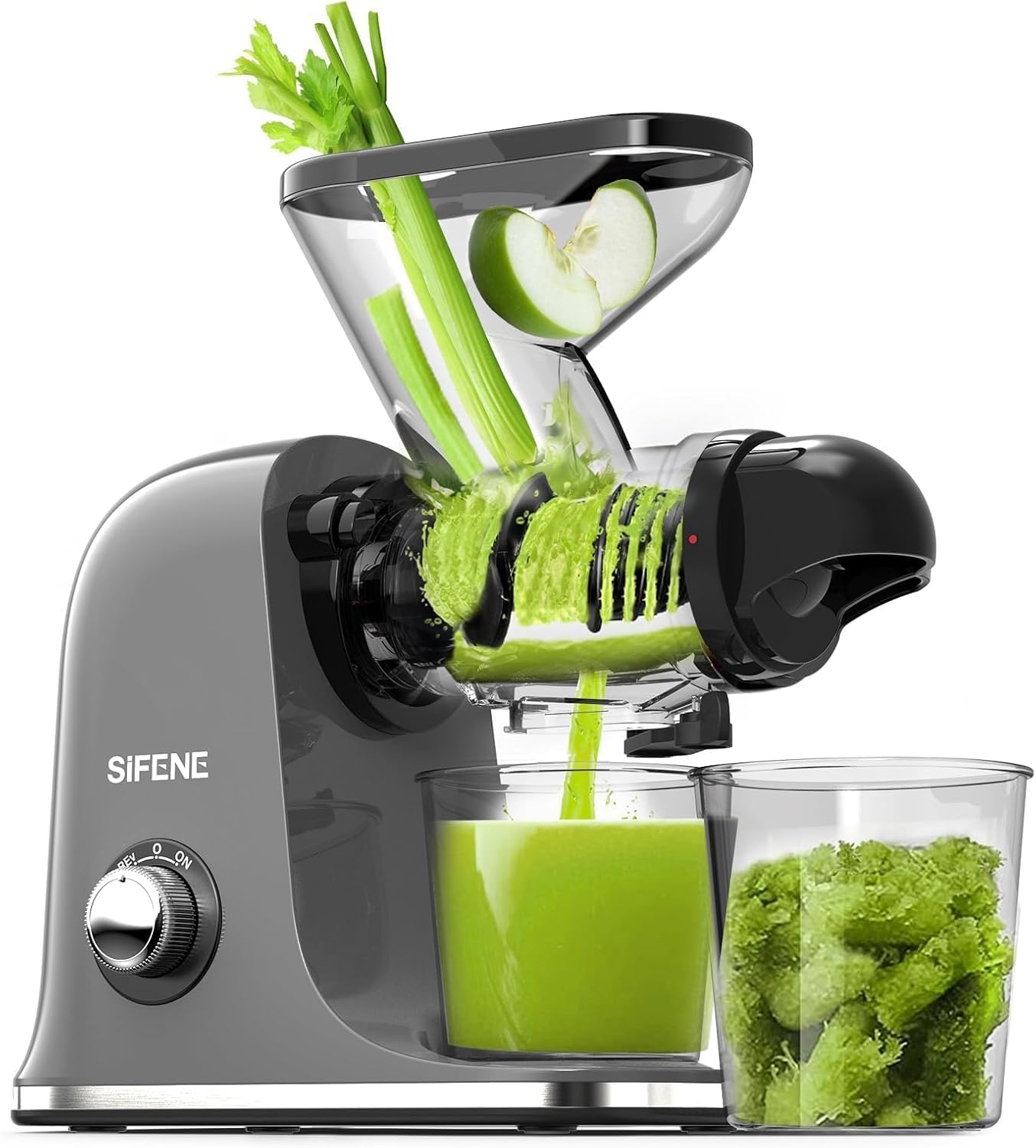
SIFENE Mini Slow Masticating Juicer JS3304
| Wattage | 100 watts |
|---|---|
| Power Source | ac |
| Voltage | 120 volts |
| Number of Speeds | 1 |
| Capacity | 280 ml |
The SIFENE Mini Slow Masticating Juicer is a space-saving cold-press machine built for everyday fruit and vegetable juicing in small kitchens. It uses a low-speed, high-torque 100W motor and a seven-stage auger to gently extract juice while minimizing oxidation, and the dual feed chutes let you put in long items like celery or chopped fruit with less prep. The unit includes a reverse function to clear fibrous produce, a stainless steel micro-mesh filter for smoother juice, and an anti-drip valve so countertops stay cleaner while you switch ingredients. Removable components are dishwasher safe and the package includes a cleaning brush to speed cleanup. With a 280 ml capacity this juicer is best for single servings rather than batch juicing, and its single speed means less control for delicate blends. Expect modest throughput compared with larger models, but you get quieter operation and better nutrient retention than a centrifugal appliance. For buyers who want a compact, relatively quiet cold-press juicer that is easy to operate and maintain, this is a practical budget-minded choice.
Best for: Buyers who want a quiet, space‑saving cold-press juicer for daily single-serving juices in apartments or small kitchens and who prioritize ease of use and low noise over high throughput.
Less Ideal for: Users who regularly juice for multiple people, need large-capacity or high-volume output, or want multi-speed control for specialized recipes.
- Dual feed chutes reduce chopping and speed prep for long produce like celery
- Quiet 100W DC motor and slow extraction minimize noise and oxidation
- Reverse function and high-torque auger handle fibrous ingredients without frequent clogs
- Dishwasher-safe removable parts plus cleaning brush make cleanup straightforward
- Small 280 ml capacity is suited to single servings rather than large batches
- Single-speed control limits fine-tuning for different produce textures
Verdict: A compact, quiet cold-press juicer that delivers nutrient-rich single servings with minimal prep and easy cleanup, making it a smart budget pick for small kitchens.
Omega VSJ843QS Cold Press Juicer

| Speed | 43 RPM |
|---|---|
| Wattage | 150 watts |
| Power Source | Corded Electric |
| Number of Speeds | 1 |
The Omega VSJ843QS is a vertical cold-press juicer designed for steady, low-speed extraction that preserves nutrients and reduces heat and oxidation. It runs at 43 RPM with a 150-watt motor and a three-stage/dual-edge auger system that squeezes fruits, vegetables, and even soy for nut milks, producing smooth, low-pulp juice. The vertical footprint saves counter space and the built-in no-drip tap and automatic pulp ejection make batch juicing and cleanup easier; parts are dishwasher safe which helps with maintenance. Its single low speed and robust gearing deliver high juice yield and consistent performance, and the anti-clog features keep runs from stalling on firmer produce. Because it is a dedicated slow juicer it is quieter than centrifugal models, making it a good fit for morning routines. It is not a multi-speed appliance, so users who want faster processing or high-volume continuous commercial output will find its single-speed, batch-oriented design limiting.
Best for: A buyer who prioritizes dependable, quiet cold-press extraction for daily at-home juicing and wants a machine built to deliver consistent yields with minimal fuss.
Less Ideal for: Not a great choice for commercial kitchens or buyers who need multi-speed machines or very high continuous throughput for large-volume juicing sessions.
- Very low 43 RPM operation preserves enzymes and runs quieter than high-speed juicers
- Dual-edge 3-stage auger and strong gearing improve juice yield and reduce pulp
- Automatic pulp ejection and no-drip tap simplify batch juicing and cleanup
- Dishwasher-safe parts make maintenance straightforward and fast
- Single-speed operation limits flexibility for different produce or faster throughput
- Compact, batch design may be slower for very large juice volumes
Verdict: Choose the Omega VSJ843QS if you want a reliably quiet, low-speed cold press juicer that consistently extracts high-yield, nutrient-rich juice for home use.
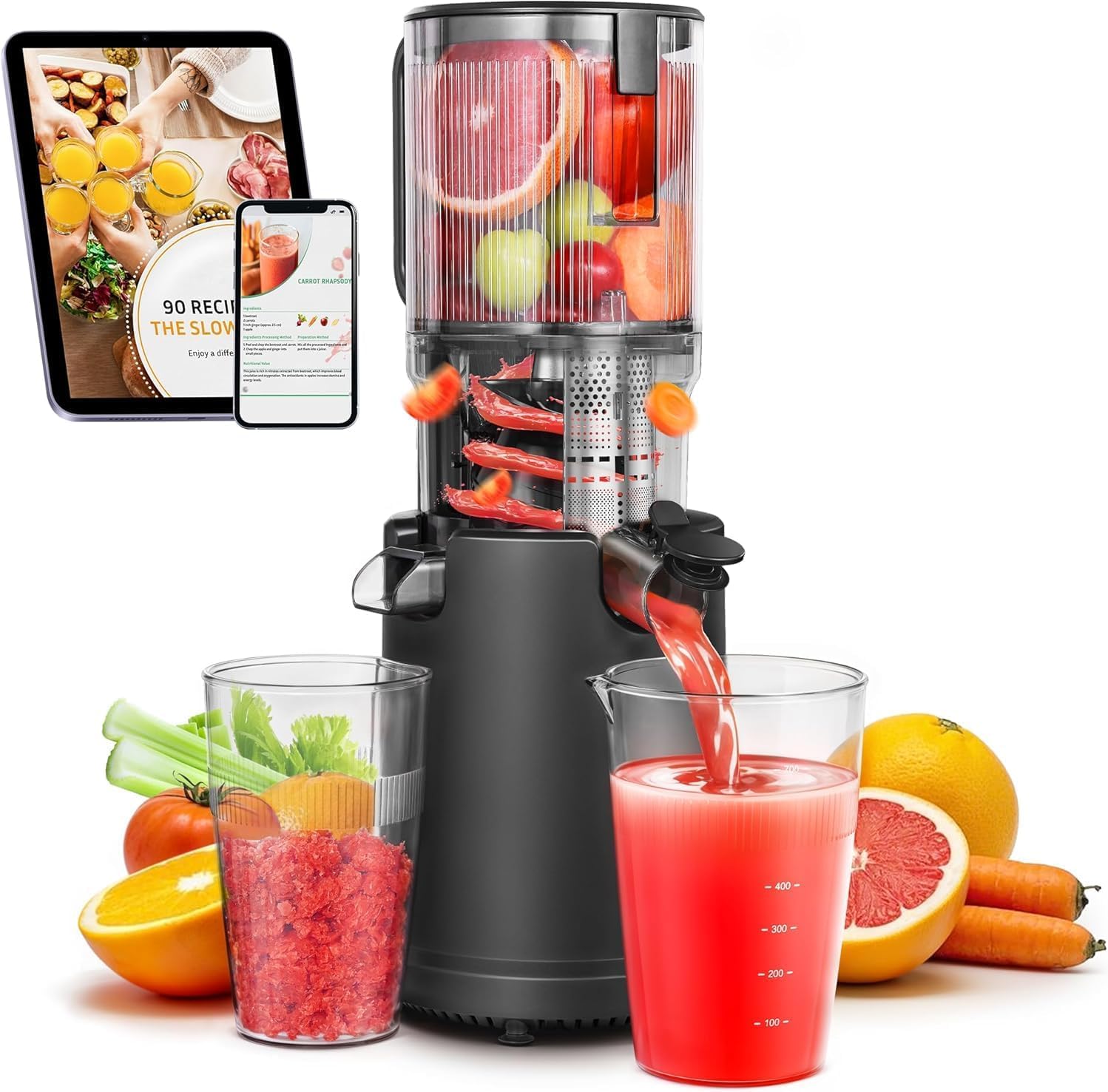
AAOBOSI Cold Press Juicer
| Special Features | Whole Fruit Processing |
|---|---|
| Wattage | 200 watts |
| Maximum Power | 200 watts |
| Blade Material | Stainless Steel |
This AAOBOSI cold press juicer is a slow masticating, single-auger machine built for quiet daily use and high juice yield. It accepts whole fruits and many vegetables through a 5.4-inch chute so you can often skip pre-cutting, and the low 60 RPM motor with 180W (200W peak) power focuses on gentle extraction to preserve nutrients and reduce foam. The included double mesh filters and triple filtration promise smooth, pulp-reduced juice, and stainless steel components plus an auto-cutting blade help handle harder items like carrots and ginger. Noise stays around conversational levels so it is comfortable to run in the morning, and removable parts plus a cleaning brush make maintenance straightforward despite being hand-wash only. Limitations to note are that some leafy greens and very fibrous produce may still require feeding in smaller pieces for best throughput, and as a masticating unit it is slower than centrifugal juicers when processing large volumes. For buyers prioritizing quiet operation and nutrient retention, this unit balances performance and everyday practicality.
Best for: Buyers who want a quiet, nutrient-focused masticating juicer for regular home use and care about social proof and reliability when choosing an everyday appliance.
Less Ideal for: People who need very fast, high-volume juicing or who prefer fully dishwasher-safe components should look elsewhere.
- 5.4-inch wide chute allows whole fruits and reduces prep time
- Low-speed 60 RPM motor for quiet operation and better nutrient preservation
- Double mesh and triple filtration deliver smooth, low-foam juice
- Stainless steel parts and auto-cutting blade handle harder produce reliably
- Hand wash only parts add cleaning time compared with dishwasher-safe models
- Slower processing speed than centrifugal juicers for large juice batches
Verdict: Choose this juicer if you want a quiet, nutrient-preserving masticating machine that handles whole fruits with minimal prep.
Choosing the Right Quiet Masticating Juicer: Key Factors to Consider
Operational Noise Level
How loud a juicer runs is central to the quiet masticating juicer category. Lower RPMs and isolated motor mounts reduce tonal peaks and mechanical vibration, producing a gentler background volume. When comparing units, look for measured decibel ratings during typical loads and descriptions of vibration isolation.
Noise matters because it affects when and where you can juice. If you plan to make juice early in the morning or in shared living spaces, even a few decibels difference can change whether the machine is tolerable. Consider also the quality of the sound: a low humming motor is less intrusive than a high-pitched whine even at similar decibel levels.
Juice Yield & Efficiency
Masticating juicers are designed to press and shear produce slowly so more liquid is extracted and less is left in the pulp. Yield varies with auger geometry, rpm, and feed technique. Check for information about performance on both hard roots like carrots and soft leafy greens, since some designs favor one over the other.
Higher yield means fewer trips to the produce drawer and less waste. For buyers focused on maximum nutrients per pound of produce, efficiency often matters more than speed. Look for models that report low moisture in the pulp as an indicator of good extraction.
Ease of Cleaning
Daily usability depends heavily on how fast and completely a juicer can be cleaned. Complex assemblies with small nooks lengthen after-use chores and discourage frequent juicing. Favor units with simple, tool-free disassembly, dishwasher-safe components where applicable, and streamlined screens or filters that are easy to rinse.
Also consider how accessible the auger and feed paths are for removing fibrous debris. Models that require special brushes or long soak times add friction to regular use. Cleaning burden directly influences whether a quiet masticating juicer will actually be used as intended.
Build Durability & Motor Cooling
Durable construction and effective motor cooling extend lifespan, especially for users who juice daily. Metal or reinforced plastic gears, well-sealed bearings, and thermal protection on the motor guard against wear and overheating during extended runs. Masticating juicers run slowly but can generate heat when processing dense loads for long periods.
A unit with poor cooling may experience reduced torque or thermal shutdowns that interrupt use. Assess warranty length and customer service policies as part of durability considerations, and prefer designs that allow routine maintenance without specialized tools.
Feed-Chute & Throughput
Feed-chute size and geometry influence how much prep the machine requires and how quickly you can make juice. A larger or well-shaped feed chute reduces chopping time, while a narrow chute may require more pre-cutting but can aid in quieter, more controlled feeding.
Throughput also ties back to intended use: if you plan to juice large batches for meal prep, a machine that accepts larger pieces and maintains steady extraction without clogging will save time. For casual single-glass use, a smaller, quieter mechanism may be preferable.
Noise Measurement and What It Means
Decibel ratings give a rough baseline, but context matters. Typical home conversation sits around 60 dB; many quiet masticating juicers operate noticeably below that during normal loads. Look for manufacturers or reviews that provide measured sound levels under realistic conditions rather than idle measurements. Also consider tonal quality and vibration transfer to the countertop, which can amplify perceived loudness.
When testing or comparing, try to note noise at different stages: initial feeding, steady extraction, and when processing particularly dense produce. Some units produce short-lived clicks or pops when fibers move past the screen; these are less annoying than continuous high-frequency noise.
- Compare measured dB values recorded during real-use scenarios
- Check for anti-vibration feet or motor isolation features
- Listen for tonal quality as much as absolute decibel level
Optimizing Yield Without Increasing Noise
Efficient juicing need not mean louder operation. Slow auger speeds and proper feed technique extract more juice while keeping noise low. Feeding produce in steady, moderate amounts rather than aggressively forcing large pieces reduces strain on the auger and maintains quiet operation.
If you want to maximize yield from leafy greens, pre-wringing or loosely rolling greens before feeding helps the auger shear and compress them more consistently. For dense root vegetables, cutting into thinner pieces can improve extraction while preventing clogging and motor effort spikes that increase noise.
- Feed produce steadily to avoid stress and loud stalls
- Prep leafy greens by loosely rolling to improve extraction
- Cut roots into slimmer pieces to maintain smooth operation
Daily Use Tips to Keep Noise Low
Placement and surface matter. Rigid countertops can transmit vibration, increasing perceived noise. Use a silicone mat or soft feet under the juicer to damp vibration. Avoid placing the unit against walls or on lightweight shelving that can resonate.
Routine maintenance prevents noise increases over time. Keep moving parts free of dried pulp, check that the auger and screen seat properly, and inspect any rubber dampers for wear. If a machine begins to buzz or rattle more than before, a quick teardown and clean often restores quiet operation.
- Use vibration-damping pads to reduce countertop transmission
- Perform regular cleaning to prevent buildup and noise changes
- Check rubber mounts and gaskets for wear after heavy use
Common Myths About 'Quiet' Juicers
A lower RPM always equates to quieter operation. While RPM is correlated with noise, mechanical design, motor mount isolation, and build quality play equal or greater roles. A low-rpm unit with poor damping can be louder than a well-engineered slightly faster machine.
Bigger motors are noisier. Larger motors can run more smoothly under load and can actually operate quietly if acoustic and mechanical design is handled well. Focus on measured noise and build features rather than motor size alone.
- Assess overall design and isolation, not just RPM
- Consider measured noise in real-use contexts
- Ignore claims that equate motor size directly with loudness
How We Chose the Best Quiet Masticating Juicer
We prioritized juicers that demonstrably reduce operational noise while maintaining strong cold-press extraction and straightforward maintenance. Our selection process focused on measurable performance attributes and real-world usability for daily juicing. Evaluation criteria included measured noise output during typical use and mechanical design choices that reduce vibration and sound. We assessed juice yield on hard and leafy produce to reflect extraction efficiency and nutrient preservation. Ease of cleaning and disassembly was a major filter because time-consuming tear-downs defeat the point of a frequently used appliance. Build quality and motor cooling matter for longevity under repeated loads, so models with robust gearing, heat management, and warranty-supporting construction were preferred. We also considered feed-chute design and auger speed, which influence how often you need to pre-cut produce and the machine's throughput. Excluded from consideration were high-speed centrifugal juicers and specialty commercial units that are not intended for typical home kitchens. We also filtered out devices with unclear noise specifications or lacking user-serviceable cleaning paths. The final list reflects machines that meet low-noise thresholds while delivering reliable juice yield, manageable cleanup, and durable mechanical design.
Our full evaluation process is outlined in our review methodology.
FAQ
Are masticating juicers always quieter than centrifugal juicers?
Masticating juicers generally run slower and can be quieter in operation, but quietness also depends on mechanical design and vibration control. Some centrifugal models with poor balance may sound louder, while a well-engineered masticating unit can still produce noticeable noise if vibration is not damped.
Will a quieter juicer extract less juice?
Not necessarily. Quiet operation is a function of design and isolation, while extraction depends on auger geometry and compression. Many quiet masticating designs achieve high yields; focus on extraction efficiency metrics rather than noise alone.
How often should I clean a masticating juicer to keep it quiet and efficient?
Clean components that contact produce after every use and rinse screens and the auger promptly to prevent dried residue. A full disassembly and deeper clean once a week or after heavy use helps prevent buildup that can increase noise and reduce yield.
Can vibration-damping pads really make a difference?
Yes. Damping pads reduce transmission of motor vibration to the countertop, which lowers perceived noise. They will not eliminate motor noise, but they often make a noticeable improvement in real-world kitchens.
Is it safe to run a masticating juicer for large batches?
Most home masticating juicers are designed for intermittent operation and can handle batch juicing if you respect recommended run times and allow cool-downs. Check thermal protection features and avoid prolonged continuous runs that exceed the manufacturer's duty cycle.
Final Verdict
When choosing a quiet masticating juicer, prioritize operational noise, extraction efficiency, and cleaning convenience. These dimensions determine how often you will use the machine and how much juice and nutrients you get from each session. Expect tradeoffs between throughput and absolute quiet; higher-feed capacity can increase mechanical activity, while very small, ultra-quiet units may need more prep. Decide which factors matter most for your routine. If early-morning, low-disruption use is the priority, favor models with measured low decibel ratings and vibration damping. If maximum yield and durability are more important, emphasize auger design and build quality while still checking noise controls. That approach will help you pick a juicer you can use regularly with minimal disruption.