
Note: This article contains affiliate links. If you click on these links and make a purchase, we may earn a small commission at no extra cost to you. This helps support our research and content. Read our full affiliate disclosure here.
A quiet small dehumidifier for bathrooms makes a big difference in comfort and moisture control without adding disruptive noise. Bathrooms are humid, confined spaces where excess moisture can lead to mold, peeling paint, and persistent odors. Picking the right compact unit helps you remove moisture efficiently while keeping sound low enough for overnight use and small living situations. This guide covers our shortlisted top picks for small bathroom dehumidifiers. We evaluated units on the practical factors that matter in real-world bathroom use, including noise, moisture removal capacity, footprint and placement, and ease of maintenance. Read on for clear guidance on which features to prioritize for your space and how to match a unit to your bathroom size and humidity issues.
Top Picks at a Glance
| Best Overall The best all-around choice for most situations | Semzodax D01 63oz Dehumidifier |  |
| Best Value The sweet spot between price and what you get | TABYIK 35OZ Dehumidifier DH-CS01 |  |
| Best Budget The cheapest option that still gets the job done reliably | Eva-Dry Mini Dehumidifier E-333 |  |
| Top Rated A top-rated pick with lots of positive feedback | MTOX MT002 Dehumidifier |  |
| Most Popular A crowd favorite that many people choose with confidence | Pro Breeze PB-02 Mini Dehumidifier |  |
| Best Seller A high-volume bestseller chosen again and again | BEDRED CT11 Dehumidifier |  |
Semzodax D01 63oz Dehumidifier

| Capacity | 63 fluid ounces |
|---|---|
| Operation Mode | Auto Dehumidify |
| Other Special Features | Automatic Defrost, Automatic Shutoff, Night Light, Timer, Ultra Quiet |
| Floor Area | 0.67 square_meters |
The Semzodax D01 is a small, user-friendly dehumidifier built for bedrooms, bathrooms, closets and RVs where low noise and portability matter. It removes moisture in automatic or continuous modes, maintains preset humidity targets (60% or 70%), and prevents frost with an auto-defrost function that keeps it working in cool spaces down to 41F. The large 63 oz tank and automatic shutoff reduce how often you need to empty it, and the removable tank simplifies cleaning. Controls include a programmable timer (6/8/10 hours) and a 7-color flowing night light if you want ambient lighting while it runs. At about 35 dB it runs quietly enough for overnight use without drawing attention. Expect solid basic performance in small rooms rather than high-capacity whole-room drying, and the unit is aimed at convenience rather than advanced humidity control features found on larger models.
Best for: Buyers who want a quiet, easy-to-move dehumidifier for small bathrooms, bedrooms, closets or RVs and prioritize low noise and simple automatic operation.
Less Ideal for: People needing high-capacity moisture removal for large basements or whole-home humidity control should choose a larger, more powerful unit.
- Very quiet operation around 35 dB suitable for bedrooms and bathrooms
- Large 63 oz tank with auto shutoff reduces frequency of emptying
- Auto-defrost lets it operate in cooler spaces down to 41F
- Portable and lightweight design makes it easy to move between rooms
- Designed for small areas so it is not suitable for large rooms or whole-house dehumidifying
Verdict: A very quiet, portable small-room dehumidifier that balances low noise and convenience for bathrooms and bedrooms.
TABYIK 35OZ Dehumidifier DH-CS01

| Tank Volume | 1000 ml |
|---|---|
| Dehumidification Capacity | 0.45 liters_per_day |
| Floor Area | 280 square_feet |
| Wattage | 40 watts |
| Number of Speeds | 1 |
The TABYIK 35OZ (DH-CS01) is a small Peltier dehumidifier built for bedrooms, bathrooms, closets and RVs where low noise and portability matter. It runs continuously on a single-button control, collects up to about 16 oz (450 ml) per day under warm, humid conditions, and stores water in a transparent 35 oz (1000 ml) tank with an auto shutoff that stops operation when the tank is near full. The unit is energy efficient at roughly under 1 kWh per day in typical use and operates at a claimed 28 dB, so it will not disturb sleep. A seven-color mood light with an independent button lets you add soft ambient lighting or turn it off. Practical touches include a removable tank with a pour groove and a built-in handle for moving between rooms. Limitations are inherent to Peltier technology: dehumidification capacity is modest and performance drops in cooler or low-humidity spaces, so it is best for spot control rather than drying a damp basement or large area.
Best for: Buyers who want a low-noise, low-maintenance unit to reduce mild moisture in small rooms and prioritize convenience and energy efficiency.
Less Ideal for: People needing fast drying for large damp spaces, basements, or heavy condensation should choose a larger compressor dehumidifier with higher capacity.
- Very quiet operation (~28 dB) suitable for bedrooms and bathrooms
- Large transparent 35 oz (1000 ml) tank with easy-to-remove design
- Auto shutoff when tank nears full for safe unattended use
- Low power draw (about 40 watts, under 1 kWh per day) keeps energy costs down
- Portable, compact design with built-in handle
- Low maximum dehumidification rate (about 0.45 L / day) not suitable for high-moisture problems
- Single speed operation limits control over output and airflow
Verdict: Choose the TABYIK 35OZ if you need a quiet, energy-efficient portable dehumidifier for spot control in small bathrooms or bedrooms.
Eva-Dry Mini Dehumidifier E-333

| Floor Area | 333 square_feet |
|---|---|
| Capacity | 6 ounces |
| Dehumidification Capacity | 0.38 pints_per_day |
| Operation Mode | Continuous |
| Wattage | 22.5 |
The Eva-Dry E-333 is a compact, renewable dehumidifier that uses crystallized silica gel beads to passively absorb moisture without cords, compressors, or fans. It is intended for small enclosed areas—bathrooms, closets, cabinets, cars, and gun safes—where it quietly soaks up 4 to 6 ounces of water over several weeks and signals recharge via color-changing indicator beads. Because it is cordless and chemical-based, there is no continuous noise, no drip tray, and no electricity required during use, making it well suited to quiet rooms and small bathrooms where a continuous appliance would be obtrusive. Recharge is performed by warming the unit (per manufacturer instructions) to drive out collected moisture, and the beads are rated for long life so the device can be reused for years. Limitations include very low daily dehumidification capacity and suitability only for small volumes of air, so it will not replace an electric dehumidifier in larger or persistently damp bathrooms or spaces that need fast moisture removal.
Best for: Buyers wanting an inexpensive, no-noise solution to control occasional humidity in small bathrooms or enclosed spaces who prefer a low-maintenance, rechargeable unit over an electric dehumidifier.
Less Ideal for: People with persistently high humidity, large bathrooms, or rooms that need continuous, fast moisture removal should choose an electric dehumidifier instead.
- Completely cordless operation so it makes no fan or compressor noise
- Rechargeable silica gel beads provide reusable moisture absorption for years
- Compact, hangable design fits in small bathrooms, closets, cars, and safes
- Very low dehumidification capacity not suitable for large or very damp bathrooms
- Requires periodic recharging rather than continuous automatic drainage
Verdict: A silent, budget-friendly rechargeable dehumidifier ideal for keeping small bathrooms and enclosed spaces mildly drier without any running noise.
MTOX MT002 Dehumidifier
| Capacity | 3000 ml |
|---|---|
| Tank Volume | 3000 ml |
| Wattage | 120 watts |
| Operation Mode | Automatic |
| Voltage | 110 volts |
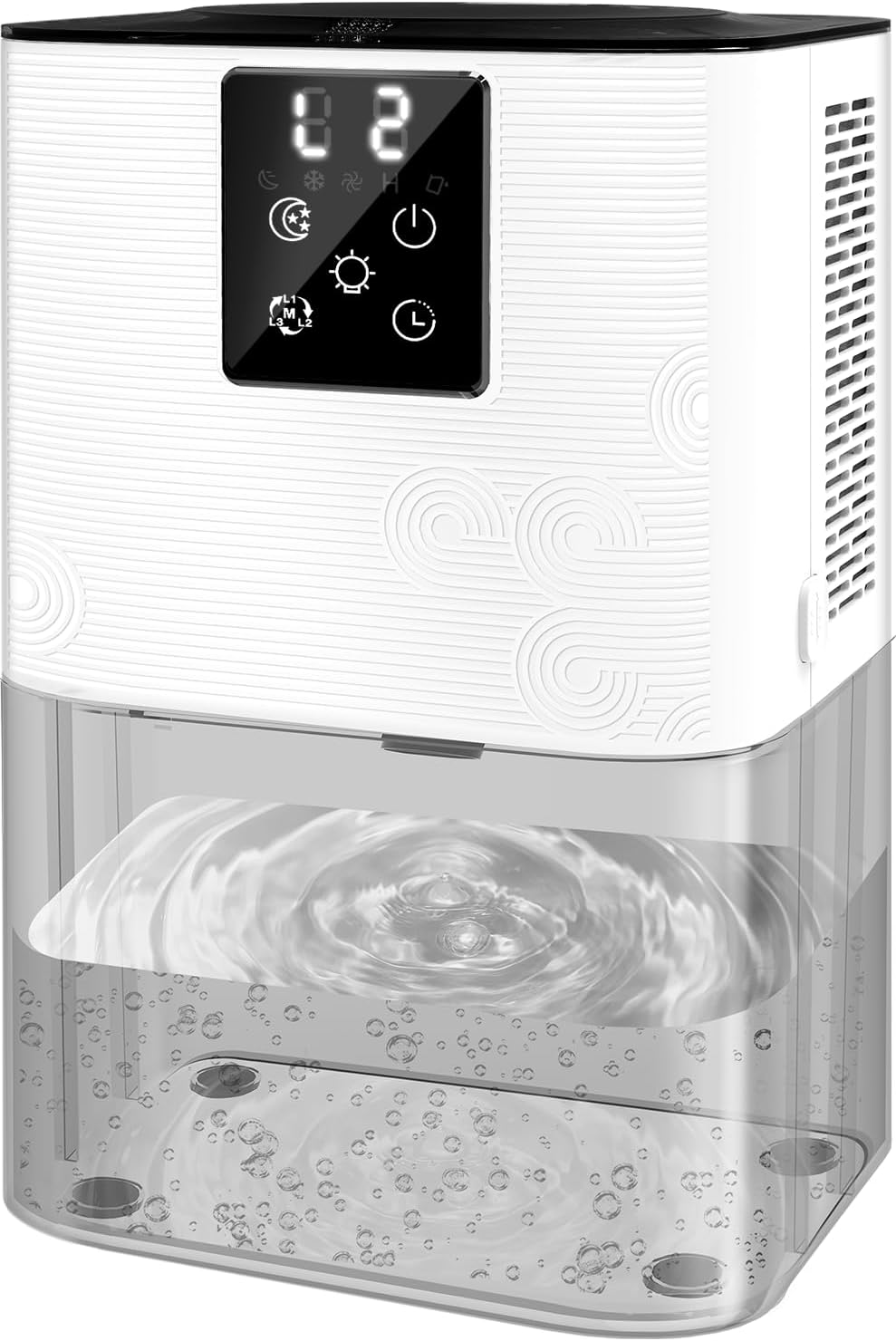
The MTOX MT002 is a small, portable dehumidifier intended for bathrooms, bedrooms, basements, RVs and other enclosed spaces. It extracts up to about 1100 ml of water per day into a 3 liter removable tank and offers three operating modes including a very quiet 28 dB sleep mode for night use. The unit has a digital display that reports humidity, a timer, an auto-defrost function for cold conditions, and an automatic shutoff with a red indicator when the tank is full. A washable filter and included power cord make basic maintenance straightforward, and the compact footprint plus a 7-color night light make it easy to move and place in tight spots. Expect gradual moisture removal rather than industrial-level performance, and for best results run it in a closed room at normal indoor temperatures; airflow clearance and periodic filter cleaning affect long-term reliability.
Best for: Buyers who prioritize low-noise, dependable humidity control for small enclosed spaces and want a compact unit that is easy to maintain and move between rooms.
Less Ideal for: Large, very damp spaces or users needing rapid commercial-grade dehumidification should consider a larger-capacity unit instead.
- Quiet 28 dB sleep mode suitable for bedrooms and nurseries
- Auto shutoff with full-tank indicator prevents overflow
- Auto-defrost protects operation in cooler environments
- Washable filter and simple controls make upkeep easy
- Capacity and daily extraction rate are modest compared with larger models
- Designed for small spaces so it removes moisture gradually rather than quickly
Verdict: Choose the MTOX MT002 when you need a quiet, compact dehumidifier that reliably manages moisture in small bathrooms and bedrooms.
Pro Breeze PB-02 Mini Dehumidifier

| Floor Area | 215 square_feet |
|---|---|
| Capacity | 16 fluid ounces |
| Tank Volume | 17 fluid ounces |
| Wattage | 21 watts |
| Dehumidification Capacity | 0.25 liters_per_day |
The Pro Breeze PB-02 is a small thermoelectric (Peltier) dehumidifier meant for tight spaces such as bathrooms, closets, RVs, and small bedrooms. It uses low-power Peltier cooling to run quietly and continuously, extracting roughly 0.25 liters (about 9 ounces) per day into a 16–17 ounce tank with an automatic shutoff and LED full indicator. Controls are simple and it is lightweight and portable, so you can move it between rooms or tuck it on a shelf. The whisper-quiet operation and low wattage make it suitable for overnight use in noise-sensitive rooms. Expect modest moisture removal that helps reduce light condensation and musty smells but will not handle large damp basements or whole-house jobs; performance also drops below about 41°F and the daily extraction rate is low compared with compressor dehumidifiers. Regularly cleaning the air intake will help maintain airflow and longevity.
Best for: Buyers seeking a discreet, low-energy dehumidifier to control mild humidity and condensation in small bathrooms or personal spaces and who prioritize quiet operation and proven user satisfaction.
Less Ideal for: People needing fast moisture removal in large or very damp rooms, or those who require a unit that works reliably at low ambient temperatures.
- Very quiet Peltier operation suitable for bedrooms and bathrooms
- Low power draw for continuous, energy-efficient use
- Automatic shutoff with LED full-tank indicator for safe unattended operation
- Compact and lightweight for easy portability and placement in small spaces
- Low daily extraction rate not suitable for very damp or large rooms
- Does not operate effectively below about 41°F so not ideal for cold spaces
Verdict: If you want a whisper-quiet, energy-efficient mini dehumidifier for small bathrooms and personal spaces, the Pro Breeze PB-02 delivers simple, low-maintenance humidity control.
BEDRED CT11 Dehumidifier

| Floor Area | 1000 square_feet |
|---|---|
| Tank Volume | 95 fluid ounces |
| Capacity | 5.9 pounds |
| Operation Mode | Intermittent |
| Other Special Features of the Product | 7 Color Ambient Light, Automatic Shutoff, Sleep Mode |
The BEDRED CT11 is a compact thermoelectric dehumidifier intended to reduce humidity in small spaces such as bedrooms, bathrooms, and modest basements up to about 1000 sq ft. It uses semiconductor cooling rather than a compressor, so it runs quietly and is simple to operate with an intermittent operation mode and an automatic shutoff when the 95 oz tank fills. Sleep Mode turns off the lights and lowers noise for overnight use, and the seven-color ambient light gives an optional mood-lighting feature. Practical benefits include easy emptying from the included tank, portability thanks to a lightweight design, and low sound levels that suit living spaces. Important limitations are inherent to semiconductor units: lower capacity compared with compressor dehumidifiers, reduced performance in very cold or very damp basements, and a smaller tank that requires more frequent emptying in high-humidity conditions.
Best for: Buyers who prioritize quiet, low-maintenance dehumidification and want a compact unit that is easy to move and run in living spaces or small basements without frequent intervention.
Less Ideal for: People needing heavy-duty moisture control for large, cold, or very damp basements should choose a higher-capacity compressor dehumidifier instead.
- Quiet thermoelectric operation suitable for bedrooms and living rooms
- Automatic shutoff protects against overfill and simplifies unattended use
- 95 oz removable tank for straightforward water removal
- Sleep Mode and ambient light options for low‑noise nighttime use
- Compact and lightweight for easy placement or moving between rooms
- Semiconductor cooling gives lower moisture removal capacity than compressor models
- Performance drops in cold basement conditions and very high humidity areas
Verdict: Choose the BEDRED CT11 if you want a quiet, portable dehumidifier with auto‑shutoff and sleep‑friendly operation for small basements or living spaces.
Choosing the Right Quiet Small Dehumidifier for Bathrooms: Key Factors to Consider
Noise Level and Night Use
Bathroom dehumidifiers are often run while people sleep or during long showers, so sound matters more than for some other rooms. Look for decibel ratings measured at a realistic distance, not just marketing terms like "quiet." Lower fan speeds and sound-dampening design reduce sleep disruption and make a unit suitable for small apartments where the bathroom may be near a bedroom.
Consider how the unit's noise character feels in practice. A higher-pitched fan tone may be more noticeable than a lower, steady hum even at the same dB rating. If you plan to run the dehumidifier continuously, prioritize models with clearly documented low-noise modes and thermostatic control so the unit only runs as needed.
Moisture Removal Capacity
Capacity is usually expressed as pints or liters removed per day under a specified set of conditions. For small bathrooms, match capacity to the room's average humidity production rather than its square footage alone. A tiny bathroom with heavy daily showering still needs a unit that can remove moisture efficiently and recover quickly between uses.
Also consider how quickly the unit brings relative humidity down from typical post-shower spikes (for example from 80 percent to a target of 50–60 percent). Faster recovery reduces the time surfaces remain wet, lowering mold risk. Balance capacity against size and noise priorities so you do not overbuy a heavy-duty unit that is loud and oversized for the space.
Tank Size and Drain Options
Small units trade larger tanks for compactness. A larger tank means fewer emptying cycles but a bigger footprint. For bathrooms, check whether the unit offers continuous drainage via gravity or a pump. Continuous drain is particularly useful if the dehumidifier will run during long showers or frequent use, eliminating the need to empty the reservoir multiple times per day.
When the unit relies on a reservoir, confirm the shutoff and full-tank indicators are reliable and easy to see in a low-light bathroom. Removable tanks should be easy to lift and drain without splashing, and the fill capacity should align with how often you expect to maintain the device.
Footprint and Mounting Flexibility
Bathroom spaces are often tight and feature awkward alcoves. Compact dimensions and flexible placement options matter. Measure the location where you plan to put the unit and account for clearance around air inlets and outlets so airflow is not obstructed.
Some small dehumidifiers are tabletop or floor models, while others offer wall-mounting or corner designs that free up floor space. If counter or shelf placement is necessary, prioritize units with stable bases and splash-resistant controls. Also consider weight for occasional repositioning and whether the unit's shape helps direct airflow away from damp surfaces.
Energy Use and Long-Term Running Costs
Dehumidifiers can run for many hours in humid climates, so energy consumption affects operating cost and whether the unit is practical for continuous use. Look for energy use specifications at representative operating modes, not just peak wattage. Units with humidistats and auto-shutoff reduce runtime by stopping once the target humidity is reached.
Consider models with energy-saving modes or timers that let you schedule operation for peak humidity times such as after morning and evening showers. Also weigh the potential benefit of slightly higher initial efficiency against the runtime you expect; small gains in efficiency compound over months of regular use.
Maintenance and Filter Access
Bathrooms expose appliances to hair, lint, and airborne particles from personal care products. A washable prefilter that is easy to access will maintain airflow and efficiency while keeping service simple. Check whether the filter is a standard shape or proprietary, since replacement availability and cost matter over a product's life.
Beyond filters, condensation pans, drain fittings, and exterior finishes should be easy to clean and resistant to mildew. Simple user interfaces for emptying, resetting, and adjusting humidity targets reduce the chance of incorrect operation and make routine care quick.
Sizing a Small Dehumidifier for Your Bathroom
Room size and typical usage patterns should drive your sizing decision. For very small bathrooms under 50 square feet with one or two short showers per day, a compact unit with a modest daily removal rate can be sufficient. Larger or heavily used bathrooms need higher capacity to prevent persistent damp spots.
Also account for humidity sources beyond showers, such as towel drying or nearby laundry. If your bathroom is poorly ventilated, choose a unit with a faster moisture removal rate or continuous drain to keep relative humidity in the recommended 40–60 percent range.
- Measure usable placement space and leave clearance around vents.
- Estimate humidity load by activity frequency rather than just square footage.
- Consider continuous drainage for frequent or heavy use.
Placement and Ventilation Best Practices
Even the best dehumidifier performs poorly if airflow is blocked. Place the unit so it can draw air across the room rather than directly from a single corner or behind towels. Avoid placing the dehumidifier inside a shower stall or too close to wet surfaces where it may repeatedly inhale saturated air.
If your bathroom has an exhaust fan, use both devices in tandem: run the fan while showering and run the dehumidifier afterward to speed recovery. For small bathrooms, a combined short fan run and dehumidifier operation often outperforms extended dehumidifier-only use.
- Keep at least a few inches clearance around intake and exhaust.
- Position the unit near the source of humidity but not in direct spray.
- Use bathroom exhaust fans with the dehumidifier when available.
Continuous Drain Vs. Manual Emptying
Continuous drain removes the hassle of emptying the tank frequently and is especially useful in bathrooms used multiple times daily. Gravity drain requires placement near a floor drain and a slight slope for the hose; pump-assisted drain systems allow more flexible location but add complexity.
If you rely on a reservoir, choose a tank that is easy to remove and reattach. Check that the full-tank cutout is obvious and that the unit restarts reliably after emptying. Frequent manual emptying can become a nuisance and increase the chance of overflow if indicators are missed.
- Use gravity drain where possible for simplicity.
- Choose pump drain if the outlet location is above the unit.
- Ensure tank handles and fill openings are ergonomic for quick emptying.
Dehumidifier Safety in Damp Environments
Bathrooms are wet by nature, so choose units with corrosion-resistant components and safeguards against water ingress. Look for splash-resistant controls and seals around electrical components. Units should be stable to prevent tipping when bumped and include automatic shutoff features in case of malfunction.
Also consider GFCI-protected outlets for any device operating near water and follow local electrical safety guidelines. Regular cleaning and drying of surfaces around the unit reduces the risk of mold growth on the appliance itself.
- Prefer models with water-resistant control panels and sealed casings.
- Place devices on stable, level surfaces away from direct water spray.
- Use GFCI outlets and follow manufacturer safety recommendations.
Humidity Targets and Control Options
Select a unit with an adjustable humidistat so you can set a target relative humidity. For bathrooms, aiming for 40–60 percent helps prevent mold while avoiding overly dry air that can irritate skin. Look for clear digital readouts and reliable sensors that do not drift over time.
Programmable timers and automatic modes that react to rapid humidity changes after showers add convenience. If you want quieter overnight operation, choose models with a low-noise or sleep mode that still maintains the chosen humidity threshold.
- Aim for 40–60 percent relative humidity in most bathrooms.
- Choose clear controls and reliable humidity sensing.
- Use timers and auto modes to minimize runtime and noise.
How We Chose the Best Quiet Small Dehumidifier for Bathrooms
We focused on criteria that reflect actual bathroom use rather than abstract scores. Primary filters included measured noise output at typical operating settings, daily moisture removal capacity suitable for small rooms, and compact physical dimensions for awkward bathroom placement. We also prioritized energy efficiency during extended use, intuitive humidity controls with reliable auto-shutoff or continuous drainage options, and straightforward maintenance such as easy-to-empty reservoirs and washable filters. Excluded were large whole-house units, devices intended only for basements or attics, and models that require professional installation. We favored units with clear manufacturer moisture-removal ratings and documented noise figures or independent measurements. Durability markers such as corrosion-resistant components for damp environments and simple serviceability were also considered. Each shortlisted unit met minimum standards across these dimensions so buyers can compare concrete attributes like decibel levels, pints-per-day capacity, tank volume, and drain options.
Our full evaluation process is outlined in our review methodology.
FAQ
How loud should a bathroom dehumidifier be for overnight use?
Look for units with operational noise below about 40 decibels for comfortable overnight use. Pay attention to the noise character; steady low hums are less disruptive than high-pitched fan tones, even at similar dB levels.
Is continuous drainage necessary for a small bathroom unit?
Continuous drain is not strictly necessary but is very helpful if the bathroom is used frequently or for long showers. It eliminates frequent emptying and reduces overflow risk, especially in poorly ventilated spaces.
Will a small dehumidifier prevent mold in a bathroom?
A correctly sized and positioned unit that maintains relative humidity in the 40–60 percent range reduces the conditions that promote mold. It is part of a broader strategy that includes ventilation, quick drying of wet surfaces, and regular cleaning.
How often do I need to clean the filter and tank?
Check filters monthly and clean as needed; frequency depends on local air quality and frequency of use. Empty and rinse the tank at least weekly in heavy-use situations to prevent stagnant water and residue buildup.
Can I run a bathroom dehumidifier continuously?
You can run it continuously if needed, but energy-efficient models with humidistats are preferable because they cycle on and off as targets are reached. Continuous runtime increases energy use and may require more frequent maintenance.
Final Verdict
Choose a quiet small dehumidifier for bathrooms by balancing noise, moisture removal capacity, and how you will maintain the unit. For tight spaces prioritize compact footprint, low decibel operation, and either a reliable continuous drain or a tank size that fits your maintenance routine. Energy efficiency and accessible filters reduce long-term costs and upkeep. Focus on the features that map to how you use the bathroom: higher capacity and continuous drain for frequent long showers, lower noise and smaller tanks for infrequent use or overnight operation. With those tradeoffs in mind, you can confidently select a compact dehumidifier that protects surfaces, controls odors, and keeps the room comfortable without adding disruptive noise.