
Note: This article contains affiliate links. If you click on these links and make a purchase, we may earn a small commission at no extra cost to you. This helps support our research and content. Read our full affiliate disclosure here.
If you deal with persistent dampness in a basement, laundry room, or finished crawl space, a portable dehumidifier with pump can remove moisture without daily bucket emptying. The right unit reduces mold risk, protects stored items, and shortens drying time for laundry while offering hands-off continuous drainage. This guide shortlists seven top-performing portable dehumidifiers with pumps and explains the features that matter for steady, low-maintenance moisture control. Read on for a clear look at extraction capacity, drainage design, and noise and maintenance tradeoffs that affect everyday use.
Top Picks at a Glance
| Best Overall The best all-around choice for most situations | Waykar YDZ-150PM Dehumidifier |  |
| Best Quality Built to a higher standard if you want something more solid | ALORAIR Storm LGR Extreme 180 PPD |  |
| Best Value The sweet spot between price and what you get | Sijipt Guardian SJ80P 80-Pint Dehumidifier |  |
| Best Budget The cheapest option that still gets the job done reliably | Shinco 150-Pint Dehumidifier |  |
| Top Rated A top-rated pick with lots of positive feedback | hOmeLabs 50 Pint Dehumidifier HME1004 |  |
| Most Popular A crowd favorite that many people choose with confidence | AEOCKY LEO 80-Pint Dehumidifier |  |
| Best Seller A high-volume bestseller chosen again and again | Midea 50 Pint Dehumidifier |  |
Waykar YDZ-150PM Dehumidifier

| Capacity | 150 pints |
|---|---|
| Tank Volume | 1.85 gallons |
| Wattage | 520 watts |
| Air Flow Capacity | 212 cfm |
| Operation Mode | Auto, Continuous |
The Waykar YDZ-150PM is a high-capacity dehumidifier intended for large residential or commercial spaces, offering up to 150 pints per day under test conditions and Energy Star efficiency. It is typically used in basements, warehouses, garages, or whole-house situations where continuous moisture removal is needed. Key features include an integrated pump that can lift condensate up to about 9.84 feet, three drainage options (pump, gravity hose, or removable 1.85-gallon tank), an intuitive touch control panel with humidity setpoint, 24-hour timer and auto-restart memory. Practical benefits are strong moisture removal for very damp spaces, flexible plumbing options that avoid frequent tank dumping, and self-drying plus auto-defrost functions that reduce maintenance and protect the compressor. The unit is portable on casters with a top handle and offers quieter operation with two fan speeds and a swing feature for broader air distribution. Important limitations are the relatively large physical footprint and weight for a portable unit and the tank size means heavy continuous use will rely on the pump or hose rather than the reservoir.
Best for: Buyers who need a robust, energy-efficient dehumidifier for very large or frequently damp spaces and value flexible drainage with a built-in pump for unattended operation.
Less Ideal for: Those who want a compact, lightweight unit for a single small room or who prefer many fan speed settings and a much larger internal reservoir.
- High dehumidification capacity suitable for very large spaces up to 7,000 sq. ft.
- Built-in pump with upward drainage option for unattended basement or garage use
- Energy Star certified for lower energy consumption compared with non-certified models
- Multiple drain options including gravity hose and removable 1.85 gallon tank for flexible setup
- Self-drying and auto-defrost features that reduce maintenance and protect internal components
- Large and relatively heavy compared with small home dehumidifiers, limiting placement options
- Tank is modest relative to capacity so continuous operation depends on pump or external drain
- Only two fan speeds may limit fine-grain airflow control in some installations
Verdict: Choose this model when you need a powerful, Energy Star dehumidifier with a built-in pump and flexible drain options for large, hard-to-access spaces.
ALORAIR Storm LGR Extreme 180 PPD
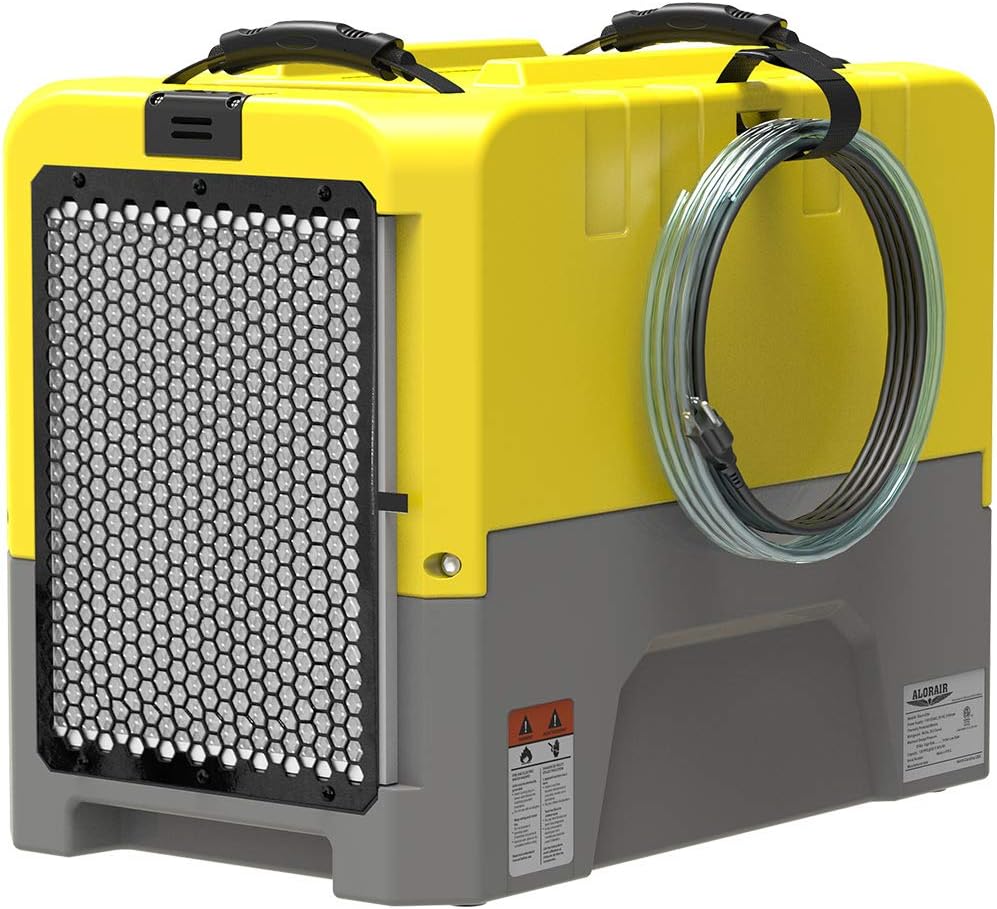
| Capacity | 180 pints |
|---|---|
| Air Flow Capacity | 210 cfm |
| Dehumidification Capacity | 29 gallons_per_day |
| Wattage | 646 watts |
| Voltage | 115 |
The ALORAIR Storm LGR Extreme is a compact commercial LGR dehumidifier built for high-capacity drying tasks such as water damage restoration, basements, warehouses, and crawl spaces. It delivers up to 180 pints per day at saturation (85 PPD per AHAM) using a 210 CFM airflow and includes a built-in pump with a long drain hose and substantial vertical lift for flexible continuous drainage. Controls support adjustable humidity setpoints, auto on/off, memory restart after power loss, and automatic defrost for low-temperature operation, so it can run with little supervision in variable conditions. The roto-molded portable housing, top handles, and stackable design make placement and transport easier in tight areas. Trade-offs are typical for industrial LGR units: it consumes significant power relative to consumer units and is a heavier, purpose-built machine rather than a lightweight household appliance. It shines where fast, reliable moisture removal and pump-assisted drainage are priorities for professional or heavy-duty residential use.
Best for: Buyers who need professional-grade moisture removal for water damage repair, large basements, crawl spaces, or job-site drying and prioritize run time reliability and pump-assisted continuous drainage.
Less Ideal for: People seeking a lightweight, low-power home dehumidifier for small rooms or occasional use should choose a consumer model instead.
- High removal capacity up to 180 PPD at saturation for rapid drying
- Built-in condensate pump with long hose and strong vertical lift for unattended continuous drainage
- Auto-restart, memory start, and automatic defrost for reliable operation in restoration jobs
- Compact, stackable roto-molded housing with top handles for positioning in tight spaces
- Higher power draw compared with consumer dehumidifiers due to commercial-grade performance
- Relatively heavy and designed for professional use, not for casual spot-dehumidifying around the home
Verdict: Choose this unit when you need a compact, pump-equipped commercial dehumidifier that removes moisture fast and drains automatically for professional drying jobs.
Sijipt Guardian SJ80P 80-Pint Dehumidifier
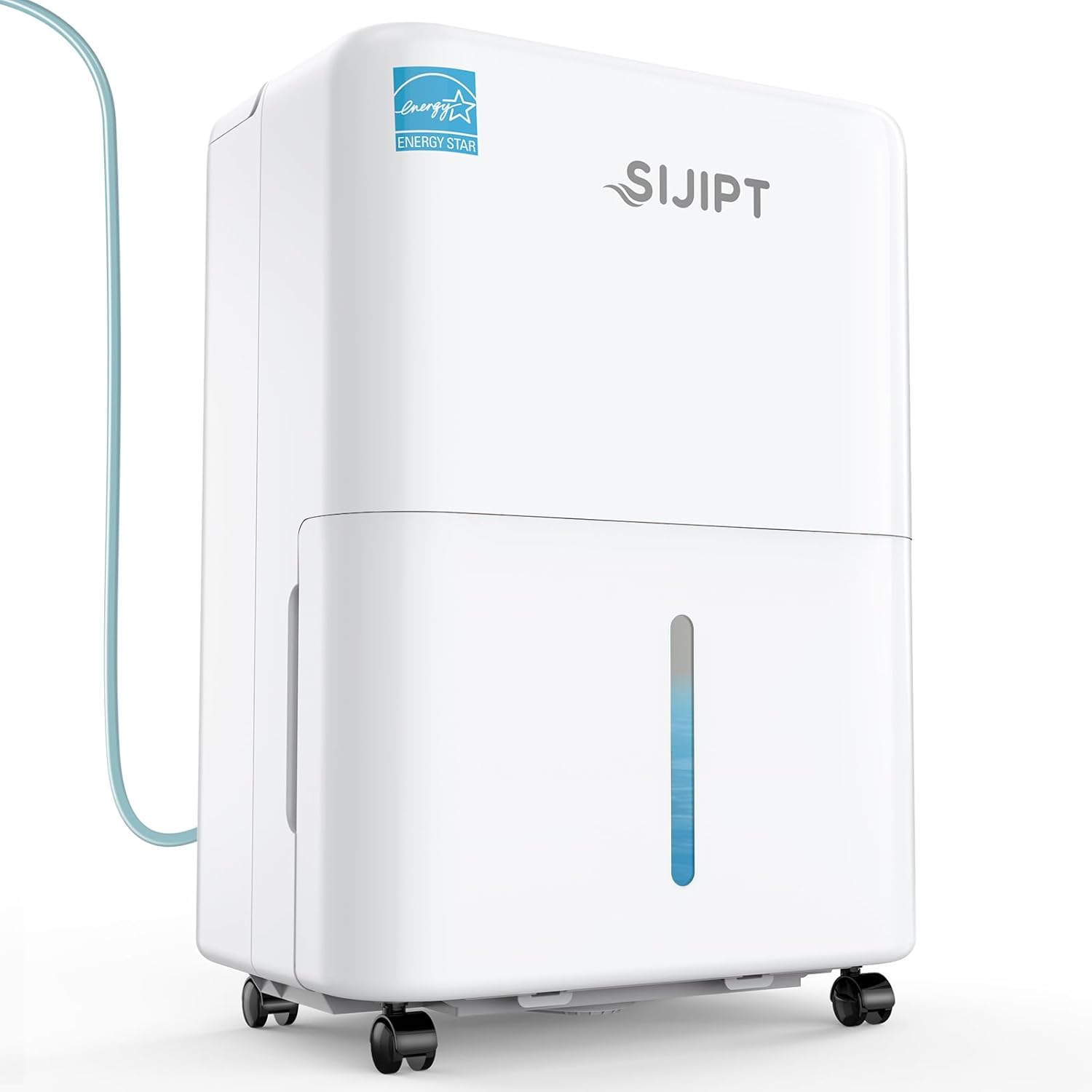
| Capacity | 80 pints |
|---|---|
| Dehumidification Capacity | 80 pints_per_day |
| Floor Area | 5000 square_feet |
| Wattage | 440 watts |
| Air Flow Capacity | 230 cfm |
The Sijipt Guardian SJ80P is a high‑capacity portable dehumidifier aimed at large rooms and basements. It removes up to 80 pints per day and offers a built‑in pump that can push condensate up to 16.4 feet for hands‑free drainage, plus a gravity hose for continuous drain runs. Controls include a rotatable knob and modes for smart humidity control, drying and continuous operation, while features such as auto‑restart, auto‑defrost, a 24‑hour timer, and a washable filter support long‑term use. The unit is Energy Star certified and rated to cover very large areas, which helps keep energy use reasonable given its capacity. Practical conveniences include a removable tank, integrated handle and smooth wheels for moving between spaces. Limitations to consider are the unit size and the need for adequate clearance and power for heavy‑duty use; some users may also find setup of the pump and drain routing requires a bit of planning in confined installs.
Best for: Buyers who prioritize a practical, high‑capacity solution for persistently damp basements or very large rooms and want hands‑free drainage and energy efficiency.
Less Ideal for: Those needing a compact unit for small rooms, ultra‑quiet bedroom use or people unwilling to plan for drain hose routing and placement.
- Built‑in pump that pushes condensate up to 16.4 feet for hands‑free continuous drainage.
- High dehumidification capacity rated at 80 pints per day suitable for large areas.
- Energy Star certified to reduce energy consumption relative to standard models.
- Multiple operation modes, auto‑restart, auto‑defrost and a washable filter for easy upkeep.
- Portable design with integrated handle and smooth rolling wheels for repositioning.
- Large unit that requires floor space and an appropriate power supply for sustained heavy use.
- Setup for pump and drain routing can be awkward in tight or unconventional locations.
Verdict: Choose the Guardian SJ80P when you need a powerful, energy‑efficient dehumidifier with a built‑in pump for reliable, hands‑free drainage in large or damp spaces.
Shinco 150-Pint Dehumidifier

| Capacity | 150 pints |
|---|---|
| Dehumidification Capacity | 70 pints_per_day |
| Tank Volume | 1.85 gallons |
| Wattage | 320 watts |
| Voltage | 115 volts |
This Shinco unit is a high-capacity dehumidifier aimed at large or very damp spaces; it claims up to 150 pints under extreme conditions and is rated for areas up to 7,000 sq ft. It offers multiple drainage options: a 1.85 gallon removable bucket, continuous gravity drain, and a long pump hose for uphill drainage, which makes it convenient for basements or commercial rooms where manual emptying is impractical. The control panel includes a digital display, 24-hour timer, two fan speeds, adjustable humidity in 5% steps, child lock, and an auto-defrost/auto-restart function; built-in Wi‑Fi lets you monitor and start the unit remotely. Energy Star certification and a quoted peak sound level near 48 dB mean it balances performance and efficiency, though the unit is relatively heavy and sized for permanent or semi-permanent placement rather than frequent moving. Expect routine maintenance like filter cleaning and occasional bucket cleaning to keep performance steady. For buyers needing strong daily moisture removal with pump drainage and remote control, this unit delivers practical, heavy-duty capability.
Best for: Buyers who prioritize heavy-duty moisture removal for large basements, garages, or commercial spaces and want the convenience of pump drainage and remote control.
Less Ideal for: Those needing a lightweight, highly portable unit for small rooms or occasional spot use should choose a smaller, simpler dehumidifier instead.
- Very high claimed dehumidification capacity suitable for large basements or commercial rooms
- Built-in pump with long hose for uphill drainage plus continuous and bucket drain options
- Wi‑Fi remote control and digital display for monitoring and preset scheduling
- Energy Star certified for better efficiency compared with noncertified units
- Auto-defrost, auto-restart, timer, and child lock add practical convenience and safety
- Large physical footprint and weight make it less convenient to move between rooms
- Bucket capacity requires occasional manual emptying if pump or gravity drain is not used
Verdict: If you need a powerful, Energy Star dehumidifier with pump drainage and Wi‑Fi for large, very damp spaces, this Shinco model is a practical heavy-duty choice.
hOmeLabs 50 Pint Dehumidifier HME1004

| Dehumidification Capacity | 50 pints_per_day |
|---|---|
| Floor Area | 7500 square_feet |
| Built In Pump | Yes |
| Air Flow Capacity | 135 cfm |
| Number of Speeds | 3 |
This hOmeLabs unit is a heavy-duty portable dehumidifier designed for large rooms and basements. It removes up to 50 pints per day (with a higher rated max in very warm, humid conditions) and offers a built-in pump for automatic continuous drainage, which saves frequent emptying of the bucket. The control panel includes preset Comfort, Turbo, and Continuous modes, an adjustable humidity setpoint, a 24‑hour timer, and a clear digital humidity readout; Wi‑Fi lets you check and change settings remotely. Practical touches include a washable air filter, swiveling wheels, tidy cord storage, and an indicator light for a full tank. The unit is relatively quiet for its capacity but is sizable and heavier than small domestic machines, so expect less portability for moving between floors. It also needs a nearby drain or hose routing to take full advantage of the pump, and power use will be higher during Turbo operation. For buyers who want reliable moisture control in large spaces, its pump and smart control make maintenance and monitoring straightforward.
Best for: Buyers who prioritize consistent, low‑touch humidity control for large rooms or basements and want built‑in pump drainage and remote control to reduce maintenance.
Less Ideal for: People needing a compact, ultra‑light dehumidifier for small rooms or frequent carrying between locations should consider smaller, lighter models.
- Built-in pump enables continuous automatic drainage without manual emptying
- Wi‑Fi remote control for monitoring and adjusting settings off-site
- Multiple operation modes and digital humidity readout for precise control
- Washable filter and accessible tank simplify maintenance
- Swiveling casters and cable storage make relocation and storage easier
- Relatively large and heavy compared with small portable units
- Requires a drain or routed hose to fully use the pump functionality
Verdict: A dependable large‑space dehumidifier with an integrated pump and Wi‑Fi that minimizes manual maintenance for long‑term humidity control.
AEOCKY LEO 80-Pint Dehumidifier

| Capacity | 80 pints |
|---|---|
| Tank Volume | 1.45 gallons |
| Floor Area | 4500 square_feet |
| Operation Mode | Automatic |
| Other Special Features of the Product | Timer |
The AEOCKY LEO is a high-capacity compressor dehumidifier built around a built-in pump for automatic upward drainage, making it suitable for basements and other spaces without floor drains. In everyday use you set the target humidity and the unit runs automatically, routing condensate through the included 5 m hose so you rarely need to empty the tank. The LEO touts ENERGY STAR Most Efficient 2025 certification, a large 1.45 gallon tank, and a rotary compressor with a multi-row evaporator/condenser layout to support strong moisture removal (rated up to 80 pints/day under hot, humid conditions). The brand emphasizes quieter operation, a low-vibration pump design, and smart humidity sensing that keeps levels accurate without frequent adjustment. Practical benefits include hands-off drainage, substantial capacity for large rooms, and better energy performance than many rivals. Limitations are the expected size and weight of a high-capacity compressor unit and the fact that peak 80-pint performance refers to specific high-temperature, high-humidity test conditions rather than typical basement environments.
Best for: Buyers who prioritize proven real-world performance and want a hands-off dehumidifier with a reliable built-in pump for basements or large rooms where social proof and energy efficiency matter.
Less Ideal for: If you need a very small, ultra-portable unit for a single tiny room or occasional travel use, a compact thermoelectric dehumidifier is a better choice.
- Built-in pump with 5 m hose for automatic upward drainage without a floor drain
- ENERGY STAR Most Efficient 2025 certified for strong energy performance
- High dehumidification capacity rated up to 80 pints/day for large spaces
- Smart millisecond-level humidity sensing for precise automatic control
- Designed for quieter operation with low-vibration pump and optimized airflow
- Large compressor units are bulkier and heavier than small thermoelectric models
- Maximum 80-pint claim is tied to specific high-heat, high-humidity test conditions
Verdict: Choose the LEO if you want a high-capacity, ENERGY STAR Most Efficient dehumidifier with a built-in pump for reliable hands-off drainage in basements and large spaces.
Midea 50 Pint Dehumidifier

| Capacity | 50 pints per day |
|---|---|
| Coverage | 4,500 square feet |
| Tank Volume | 1.6 gallons |
| Power | 470 watts |
| Air Flow | 223.7 cfm |
The Midea 50 Pint Dehumidifier is a large-capacity portable unit meant to remove up to 50 pints of moisture per day and cover rooms up to about 4,500 sq ft. It is typically used in basements, laundry rooms, or large open areas where persistent humidity is a problem. Notable features include a built-in pump for automatic vertical or horizontal drainage, washable air filter, three fan speeds including a quiet low mode, adjustable humidity setpoint and a timer, plus Wi‑Fi that works with Alexa and Google Assistant for remote control. In practice the pump and continuous-drain option eliminate frequent tank emptying, and the four-wheel design makes moving the unit straightforward despite its size. The quiet low-mode makes it less intrusive overnight, and the reusable filter helps lower upkeep costs. Trade-offs are its physical bulk and weight compared with smaller units and higher power draw when running at higher speeds, so it is best where strong dehumidification is needed rather than for small rooms or infrequent use.
Best for: Buyers who prioritize reliable, hands-off humidity control for large or problem-prone areas and want the convenience of automatic draining and smart control.
Less Ideal for: If you need a lightweight unit for a single small room or an infrequently used space, a smaller lower-capacity dehumidifier will be a better fit.
- Built-in pump enables unattended continuous drainage vertically or horizontally
- Removes up to 50 pints per day suitable for large spaces
- Wi‑Fi and voice assistant support for remote monitoring and control
- Reusable washable air filter reduces replacement costs
- Quiet low-mode (about 49 dBA) for less disruptive operation
- Large and heavier portable unit compared with smaller-capacity dehumidifiers
- Consumes more power at higher fan/suction settings than lower-capacity models
Verdict: Choose this Midea when you want high-capacity, worry-free dehumidification for large spaces with automatic pump drainage and smart remote control.
Choosing the Right Portable Dehumidifier with Pump: Key Factors to Consider
Water Extraction Rate
How many pints or liters the dehumidifier removes in 24 hours directly affects how quickly a damp room will reach the desired humidity. Higher extraction rates are important for very damp basements, finished crawl spaces, or rooms where water intrusion is common. Extraction performance should be evaluated at realistic indoor temperatures, since many dehumidifiers are rated at higher test temperatures that overstate real-world output.
Consider the size of the space and the severity of moisture. A moderate-size basement with ongoing humidity issues needs a unit with substantially higher removal capacity than a small bedroom. If you plan to use the dehumidifier to help dry laundry, look for units that sustain strong extraction across multiple load cycles.
Pump Lift and Discharge Distance
A built-in pump is useful when gravity drainage is inconvenient or impossible. Pump lift measures how far the unit can push water vertically and horizontally through a hose; this determines whether you can drain to a sink, utility drain, or outside window well. Check both vertical lift and recommended hose lengths to ensure the unit reaches your chosen discharge point.
Pump duty cycle and reliability matter for continuous operation. Some pumps can run almost continuously for long stretches, while others are rated for intermittent duty. Consider how often and how long you expect the dehumidifier to run when evaluating pump specifications.
Energy Efficiency and Operating Cost
Energy consumption becomes a real cost when a dehumidifier runs for days or weeks at a time. Look for units with lower power draw relative to their extraction capacity, and features like auto-defrost and intelligent humidistats that reduce run time. Energy-efficient models can still move a lot of moisture; compare performance-per-watt or extraction-per-kilowatt-hour numbers when available.
Also consider timers and programmable humidity setpoints that prevent unnecessary runtime. In many installations a modestly higher upfront efficiency will pay back over months of continuous or frequent use.
Noise Level and Placement
Noise matters when the dehumidifier is installed near living spaces, finished basements, or laundry areas where people spend time. Look for sound ratings in decibels and consider how fan speed and compressor design affect perceived noise. Some units offer quiet modes that reduce output but keep moisture under control during nighttime or occupied periods.
Placement and acoustics influence real-world noise. A unit that is quiet in a mechanical room can sound louder in a small finished space. Consider vibration isolation, rubber feet, and how close the dehumidifier will be to seating or sleeping areas when choosing a model.
Ease of Use and Maintenance
Regular upkeep affects long-term performance. Check how easy it is to access and clean the air filter, empty or bypass the water tank in case of pump failure, and remove dust from intake grills. Clear, easy-to-read controls and reliable humidistats make daily operation simpler. Some models include washable filters and tool-free access that reduce maintenance time.
Also consider how straightforward hose routing and pump connections are. A unit that simplifies installation and routine care will deliver better results over years of use and reduce the chance of neglected maintenance causing reduced efficiency or failures.
Portability and Physical Footprint
How the unit fits into your space affects both installation and usability. Measure doorways, stair access, and the intended placement area to confirm a good fit. Lighter units with handles and swivel casters are easier to move for occasional relocation or seasonal storage. Heavier, high-capacity units may require permanent placement, so plan for that when choosing.
Also consider vertical height when routing discharge hoses or placing the dehumidifier under shelving. A compact footprint with robust pump performance can be preferable to a larger device if space is constrained.
Where a Pumped Portable Dehumidifier Makes Sense
A portable dehumidifier with a built-in pump is the best choice when gravity drainage is not practical or when you need unattended, continuous drainage. Examples include basements where the nearest floor drain is above the unit, finished lower levels with raised drain lines, or laundry rooms where you want to route condensate directly to a sink or standpipe.
Pumps simplify maintenance because you do not need to empty a tank daily. They also allow the unit to be placed in lower-lying areas without losing the ability to discharge uphill. Evaluate your room layout, drain locations, and how often you want to intervene before choosing a pumped model.
- Ideal for installations below the level of the nearest drain
- Useful in seasonal setups where unattended operation is needed
- Helps when you want to route condensate to a specific sink or exterior outlet
Installation Tips for Reliable Pumped Drainage
Begin by planning the discharge route and verifying pump lift and recommended hose length. Avoid excessive horizontal runs with many bends, as these increase backpressure and can reduce pump effectiveness. Where possible, keep the hose run straight and use the shortest path to the drain point.
Secure the hose with clamps and position the outlet to prevent backflow. If routing through a window or wall, ensure the hose is supported along its length. Periodically inspect the pump inlet and drain hose for obstructions and clean the tank or sump area according to the maintenance schedule.
- Use the shortest practical hose path
- Avoid tight loops or kinks that trap water
- Support the hose to prevent sagging and backpressure
Managing Noise and Vibration
If noise is a concern, place the dehumidifier on a vibration-absorbing pad or rubber feet to reduce rumble transmitted to floors. Use the unit's quiet or low fan modes for overnight use when available. Position intake and exhaust away from seating and sleeping areas when possible to minimize perceived noise.
Routine cleaning of the filter and fan area helps maintain quieter operation over time. A slightly louder compressor during defrost cycles is normal for many models, so plan placement where periodic noise spikes are tolerable.
- Consider anti-vibration pads under the unit
- Use quiet modes for nighttime operation
- Keep intake/exhaust unobstructed to limit strain on the fan
Winter Use and Low-Temperature Performance
Many basements and crawl spaces drop below typical room temperatures in winter, which affects dehumidifier performance. Look for units with auto-defrost or low-temperature operating modes that prevent coil icing and preserve extraction capacity in cooler conditions. Without appropriate defrosting, a unit can spend time frozen and ineffective.
If cold-weather operation is required, monitor humidity and choose settings that balance extraction with energy use. In consistently cold spaces, supplemental heat or a model specifically rated for low temperatures will yield better results than a standard room-temperature unit.
- Auto-defrost extends effective operation in cold areas
- Low-temp ratings indicate better cold-weather extraction
- Monitor performance during initial winter use to confirm effectiveness
Routine Maintenance Checklist
Establish a schedule for inspecting the filter, pump inlet, and condensate routing. Clean or replace washable filters according to manufacturer guidance to maintain airflow and efficiency. Periodically flush the pump tubing and inspect for mineral buildup if you have hard water or significant airborne dust.
Also check seals around hose connections and ensure the pump cycles correctly during extended runs. Proper maintenance reduces the chance of clogs and pump failures and prolongs the unit's effective service life.
- Clean or wash filters monthly in dusty environments
- Flush pump tubing every few months to prevent buildup
- Inspect hose connections and clamps for secure sealing
How We Chose the Best Portable Dehumidifier with Pump
We focused on real-world performance and practical usability when assembling this list of portable dehumidifiers with pumps. Our selection criteria prioritized measurable moisture removal capacity at typical indoor temperatures, reliable built-in pump performance for continuous high-level or distance drainage, and energy efficiency to lower operating cost during extended use. We also weighed noise output for living-area placement, ease of setup and maintenance including filter access and cleaning, and footprint/portability factors such as weight and integrated handles or caster wheels. Units were excluded if they lacked an integrated pump option, were designed only for single-room spot use, or required complex plumbing modifications. We favored products with clear specification sheets and simple user controls that match the needs of homeowners who require unattended drainage over days or weeks. The criteria used here align with the scoring labels below and reflect how the machines perform in typical home basements, laundry rooms, and similar damp spaces.
Our full evaluation process is outlined in our review methodology.
FAQ
Can a dehumidifier pump run continuously?
Many built-in pumps are designed for extended duty and can run for long stretches, but their rated duty cycles vary. Check the pump specifications and the unit's continuous-run guidance. Regular maintenance and proper hose routing reduce the risk of pump strain during long operation.
How far can a dehumidifier pump push water uphill?
Pump lift is normally expressed as a vertical height and recommended hose lengths. Typical portable pumps handle several feet of vertical lift, but models differ. Measure the required vertical rise and compare it to the pump lift rating for reliable drainage.
Do pumped dehumidifiers need a bucket as backup?
Most pumped units still include an internal tank that acts as a backup if the pump or hose is blocked. The tank provides temporary storage and an auto-shutoff if discharge fails. Regular inspection of hoses and pump inlets helps avoid relying on the backup tank frequently.
Are pumped dehumidifiers harder to maintain?
They require the same routine care as other dehumidifiers plus occasional pump and hose checks. Flushing the drain line and clearing the pump inlet are simple tasks that prevent clogs. Overall maintenance is modest and offsets the convenience of continuous drainage.
Will a pumped dehumidifier work in an unheated basement?
It can, but performance depends on the model's low-temperature capability. Units with auto-defrost and low-temp operation are better suited for cooler unheated basements. Without proper features, compressors can ice up and reduce extraction.
Final Verdict
Prioritize extraction capacity and pump lift when choosing a portable dehumidifier with pump, because those two factors determine whether the unit can keep up with moisture generation and route condensate to your chosen drain point. Balance energy efficiency and noise considerations based on where the unit will run daily. Finally, select a model that is easy to maintain and fits your space; regular filter and hose care will sustain performance and reduce service issues. With these priorities in mind, you can select a pumped dehumidifier that delivers reliable, low-maintenance moisture control for your basement, laundry room, or other damp areas.