
Note: This article contains affiliate links. If you click on these links and make a purchase, we may earn a small commission at no extra cost to you. This helps support our research and content. Read our full affiliate disclosure here.
If you rely on tap water for drinking and cooking, a countertop reverse osmosis system can significantly reduce common contaminants while staying compact and easy to install. Picking the right Reverse Osmosis Countertop Water Filter for Home Use matters because systems vary in filtration stages, daily output, and how much counter space and maintenance they require. This guide shortlists the top systems for home use and explains the practical tradeoffs buyers face. Below we evaluate shortlisted units across performance, installation effort, and ongoing upkeep so you can match a system to your household needs. Read on for the criteria we used and the considerations that matter most for everyday use.
Top Picks at a Glance
| Best Overall The best all-around choice for most situations | Bluevua ROPOT Countertop RO |  |
| Best Value The sweet spot between price and what you get | Bluevua ROPOT-Lite Countertop RO |  |
| Best Budget The cheapest option that still gets the job done reliably | Slevoo C2-M25 Countertop RO |  |
| Top Rated A top-rated pick with lots of positive feedback | Aigerri Countertop RO System TJYJ001 |  |
| Most Popular A crowd favorite that many people choose with confidence | DREO RO Countertop WF113 |  |
| Best Seller A high-volume bestseller chosen again and again | DREO RO Water Filter 112 |  |
Bluevua ROPOT Countertop RO
| Purification Method | Reverse Osmosis |
|---|---|
| Power Source | Corded Electric |
| Maximum Flow Rate | 0.26 liters per minute |
| Supported Water TDS Level Maximum (PPM) | 1000 |
| Filter Life Cycle | 24 months |
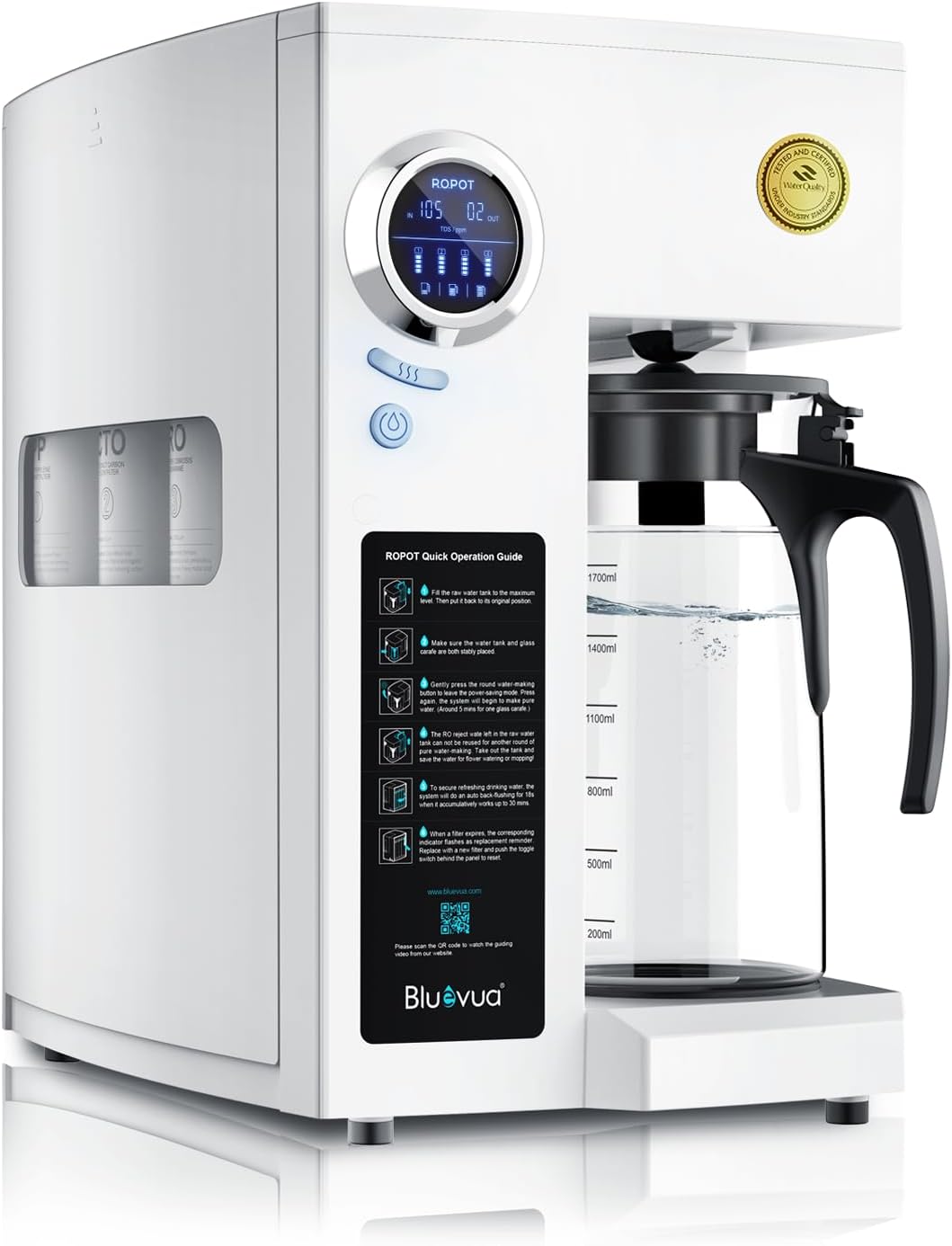
The Bluevua ROPOT is a portable countertop reverse osmosis unit designed to deliver bottled-quality water without installation. You fill the glass carafe, plug the unit into power and the system runs an RO cycle that removes most dissolved solids then adds minerals back for improved taste. A smart display reports TDS and filter life, and the included glass carafe avoids plastics for cleaner storage. The 5-stage filtration and optional mineral filter aim to reduce contaminants while preserving flavor, and the unit claims a 2:1 pure-to-drain water efficiency and an automatic power-saving standby mode. Filters are rated to last roughly 12 to 24 months depending on use, and replacement modules are offered as sets for ongoing maintenance. Trade-offs are its modest 1.7 L capacity and relatively slow flow rate, so it is best for daily drinking and cooking needs rather than rapid filling for large groups, and you will need to budget for periodic filter replacements to keep performance consistent.
Best for: Buyers who want a plug-and-play countertop RO that makes very low-TDS water with minimal installation and prefers a glass storage carafe for taste and aesthetics.
Less Ideal for: Large households or households that need fast, high-volume dispensing throughout the day should choose a higher-capacity or plumbed system instead.
- No plumbing or permanent installation required so it works in rentals and small kitchens
- Borosilicate glass carafe reduces plastic contact and looks premium
- Five-stage RO filtration plus remineralization for low TDS and improved taste
- Smart display shows TDS and filter life for easy maintenance tracking
- Automatic power-saving mode and advertised 2:1 pure-to-drain ratio to reduce waste
- Small 1.7 L capacity limits how much treated water is available at once
- Maximum flow rate is low, so refilling a pitcher or multiple glasses takes time
Verdict: Choose the ROPOT if you want a no-plumbing countertop RO that produces very low-TDS water with a premium glass carafe and clear filter-life feedback.
Bluevua ROPOT-Lite Countertop RO

| Purification Method | Reverse Osmosis |
|---|---|
| Capacity | 1200 ml |
| Maximum Flow Rate | 0.26 liters per minute |
| Filter Life Cycle | 1 years |
| Material Type | Borosilicate Glass |
The Bluevua ROPOT-Lite is a plug-in countertop reverse osmosis system designed to deliver small-batch drinking water without plumbing or installation. You fill the top reservoir and the unit runs water through a five-stage filter and a 0.0001 μm RO membrane, then dispenses treated water into a high-borosilicate glass carafe; the included remineralization stage restores minerals for taste. A smart LED panel shows filter life and water quality and lets you select dispense volume, and the manufacturer rates the system at a 3:1 pure-to-drain ratio and about 0.26 liters per minute flow so you get usable amounts quickly. The compact design and glass container make it a tidy option for kitchens or small households that want bottled-water quality without bottles. Expect annual filter changes and modest daily output geared to one to two people, so it is less suited to large families or heavy continuous use, and the system requires power to operate so it is not a passive pitcher-style filter.
Best for: Buyers who want near-bottled quality water without installing under-sink plumbing and prefer an easy, compact countertop system with a focus on convenience and measurable filter monitoring.
Less Ideal for: Households that need high daily volumes of filtered water or want a completely passive, non-powered pitcher-style solution should look elsewhere.
- No plumbing required—plug-in countertop design for easy setup
- High-borosilicate glass carafe reduces plastic contact and looks premium
- Smart LED display for filter life and real-time water quality monitoring
- Five-stage filtration plus RO membrane with remineralization for better taste
- Efficient 3:1 pure-to-drain ratio and rated flow for quick fills
- Capacity and flow are best for 1–2 people, not high-demand households
- Requires annual filter replacement and regular maintenance
Verdict: If you want a plug-in countertop RO that delivers bottled-quality water into a glass carafe with clear filter monitoring, the ROPOT-Lite is a compact, easy-to-use choice.
Slevoo C2-M25 Countertop RO

| Purification Method | Reverse Osmosis |
|---|---|
| Maximum Flow Rate | 378.5 liters_per_day |
| Supported Water TDS Level Maximum (PPM) | 500 |
| Filter Life Cycle | 24 months |
| Capacity | 4 liters |
The Slevoo C2-M25 is a countertop reverse osmosis system that uses six filtration stages including RO and an alkaline remineralization stage to produce drinking water into a glass pitcher and 4L tank. It is typically set on a kitchen counter and plugged in; the unit displays real-time TDS readings, shows filter life, and enters a power-saving standby when idle. The system claims a 4:1 pure-to-drain ratio, which improves water use compared with older RO designs, and the remineralizer restores electrolytes and raises pH for better taste. Practical benefits include a visible filter life indicator and auto-flush to help maintain water quality, plus a compact portable design that avoids under-sink installation. Limits to expect are routine filter replacements and possible reduced filter life with very high TDS source water, and the unit produces countertop quantities rather than whole-home supply so users will refill the carafe or tank for larger needs.
Best for: Homebuyers who want a countertop RO that delivers bottled-water taste and visible water-quality feedback without installing under-sink plumbing and who prioritize lower ongoing water waste and clear maintenance indicators.
Less Ideal for: Large households that need high daily volumes of purified water or users who prefer a hard‑plumbed under-sink or whole-house system rather than a portable countertop unit.
- Six-stage RO with remineralization for improved taste and reduced contaminants
- Built-in TDS display and filter life indicator for visible water quality and maintenance cues
- 4:1 pure-to-drain ratio for better water efficiency than many countertop RO units
- Includes glass pitcher and 4L tank for ready-to-drink storage and portable use
- Not designed to supply whole-house volumes; output is limited to the included tank and carafe
- Filter life shortens if source water has very high TDS, requiring more frequent cartridge replacements
Verdict: Choose the Slevoo C2-M25 if you want a portable, countertop RO that reduces waste with a 4:1 recovery ratio while giving visible TDS and filter-life feedback for budget-minded home water purification.
Aigerri Countertop RO System TJYJ001
| Purification Method | Reverse Osmosis |
|---|---|
| Installation Type | Countertop |
| Capacity | 5 liters |
| Other Special Features of the Product | 5 Stages RO Filter, Self Cleaning, Reduce TDS, Reduce PFAS, Change Filter Indicator |
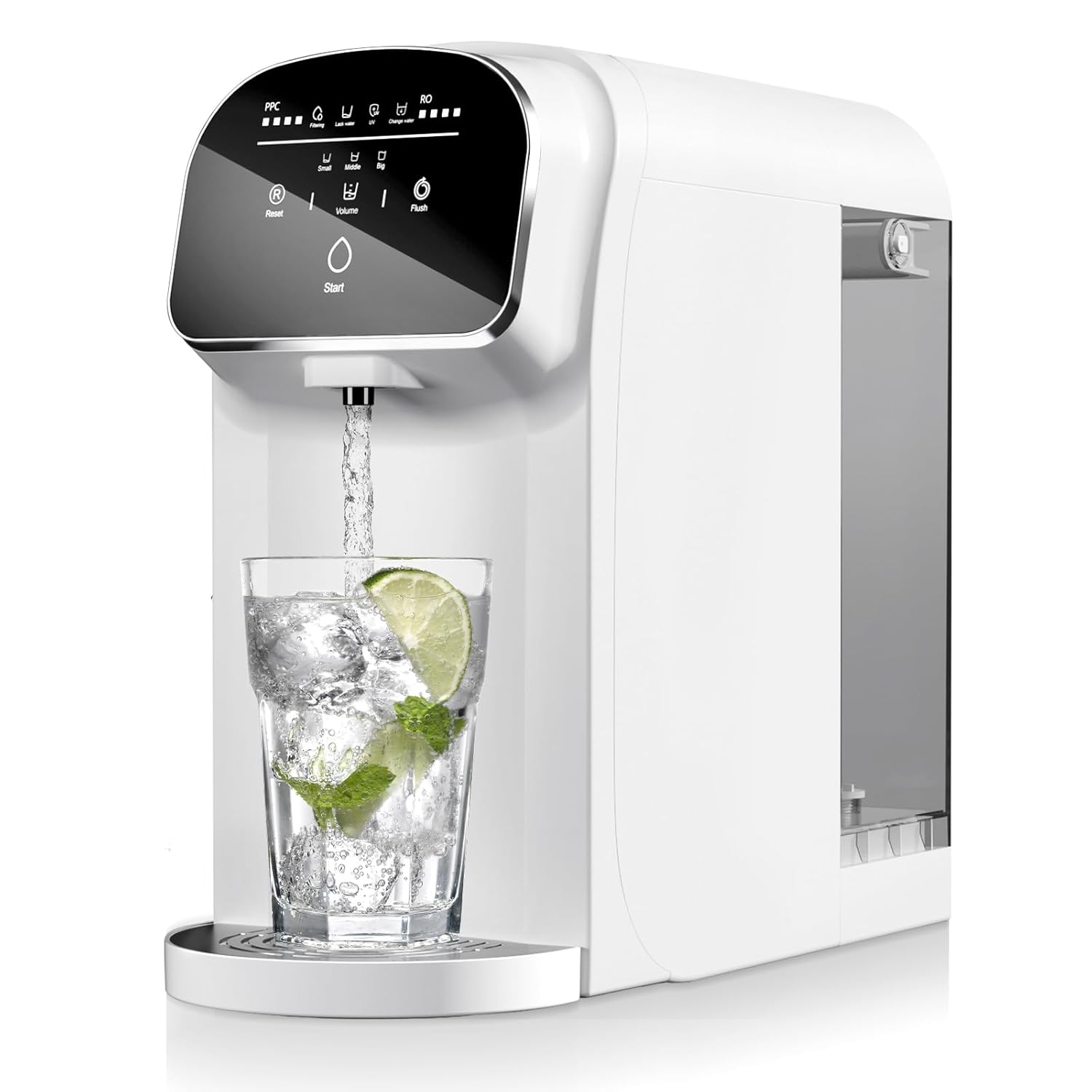
The Aigerri countertop RO system delivers multi-stage purification in a compact, no-plumb package that is suited to kitchens, offices, and RVs. It uses a five-stage filtration train including a PPC prefilter, an RO membrane and UV treatment, and stores feed water in a 5 L tank while keeping 2 L of purified water ready. Setup is simple: fill the tank, plug it in, and the unit produces purified water without modifying household plumbing. Notable practical benefits include a claimed 5:1 pure-to-drain ratio that lowers wastewater compared with traditional RO units, an LED filter-change indicator, and a portable design that fits on counters. The system can produce several hundred gallons per filter set and is aimed at reducing bottled-water use. Important limitations are its countertop footprint and the need to refill the feed tank manually, and like all RO units it produces wastewater and requires periodic filter and membrane replacement to maintain performance. If you prioritize dependable, in-home RO-quality water without installation, this unit is a straightforward option.
Best for: Buyers who value reliable, high-quality RO purification without modifying plumbing and want a straightforward countertop system they can set up and maintain themselves.
Less Ideal for: People seeking a permanently plumbed under-sink solution or those with very limited counter or vertical clearance should look at alternative installed systems.
- Five-stage filtration including RO membrane and UV for broad contaminant reduction
- Plug-and-play countertop design requires no plumbing or professional installation
- 5 L feed tank plus 2 L purified water reserve for on-demand dispensing
- Claims an efficient 5:1 pure-to-drain ratio to reduce wastewater compared with many RO systems
- Built-in filter change indicator and pre-installed filters for easier initial setup
- Requires periodic manual refilling of the feed tank rather than a direct water line
- Takes counter space and needs about 22 inches vertical clearance when opened
- Ongoing cost and maintenance for filter and membrane replacement
Verdict: If you want dependable RO-grade water at home without installing plumbing, this plug-and-play countertop system delivers multi-stage filtration and easy setup.
DREO RO Countertop WF113

| Purification Method | Reverse Osmosis |
|---|---|
| Capacity | 5 liters |
| Other Special Features of the Product | Built In TDS Meter, Change Filter Indicator, Reduce TDS, Touch Control |
| Pure to Drain Rate | 3:1 |
The DREO WF113 is an install-free countertop reverse osmosis system intended to deliver near–bottled-water quality without plumbing work. It uses a 7-stage RO filter and a 3:1 pure-to-drain ratio to remove a wide range of contaminants while the built-in TDS meter shows raw and purified TDS for real-time monitoring. The unit includes a 5 L tank and two auto-fill pitchers so one pitcher is ready while the other refills automatically, and a self-cleaning auto-flush helps keep internal tubing clear between uses. Filter changes are signaled by a life indicator and replacement filters twist in for quick swaps. Practical benefits include easy setup, a compact footprint that sits on counters or desks, and lower ongoing plastic waste versus bottled water. Important limitations are the modest 5 L capacity that suits small households and the 3:1 waste ratio which still produces drain water compared with more efficient systems, so expect some water waste during filtering.
Best for: Buyers who want near–tap-to-bottle quality water without under-sink plumbing and who prioritize visible performance indicators and straightforward, install-free operation.
Less Ideal for: Large families or users who need high daily filtered output or who want the most water-efficient RO systems available.
- 7-stage RO filtration with SGS-tested removal claims for many common contaminants
- Built-in TDS meter and filter-life indicator for simple, real-time monitoring
- Auto-fill dual-pitcher system keeps filtered water available while one pitcher refills
- Self-cleaning auto-flush reduces stagnant water in internal tubing
- Install-free countertop design that requires no plumbing
- 5 L tank limits total on-hand filtered water for larger households
- 3:1 pure-to-drain ratio still produces wastewater compared with low-waste RO systems
Verdict: A convenient, install-free countertop RO system that gives risk-aware buyers visible TDS monitoring and ready-to-use auto-fill pitchers for reliable, high-quality drinking water.
DREO RO Water Filter 112

| Purification Method | Reverse Osmosis |
|---|---|
| Capacity | 3 liters |
| Filter Life Cycle | 6 months |
| Supported Water TDS Level Maximum (PPM) | 1200 |
| Pure to Drain Rate | 3:1 |
The DREO RO Water Filter 112 is a plug-in countertop reverse osmosis purifier designed for one to two people who want install-free drinking water. It uses a 7-stage RO filter and a 3:1 pure-to-drain ratio to remove many common contaminants while the built-in TDS meter shows raw and purified water readings so you can verify performance. The unit includes an autofill 1.1L pitcher with a sensor for hands-free refills and a self-cleaning flushing routine that helps keep internal tubing clear between uses. Filter changes are signaled by an indicator and the replaceable RO cartridge is a twist-to-install design for quick maintenance. Because it is countertop and installation-free there is no plumbing work, but that also means it needs counter space and periodic cartridge replacements; the filter life is listed around six months depending on use and water quality. For buyers prioritizing simple setup, visible TDS monitoring, and low-touch daily filling, this system offers practical, easy-to-use RO performance in a small footprint.
Best for: Buyers who want a ready-to-use countertop RO system with visible TDS feedback and minimal installation effort, especially those who prefer clear indicators for maintenance.
Less Ideal for: Households that need high daily water output for many people or those who prefer a permanently plumbed under-sink solution.
- Built-in TDS meter and filter life indicator for real-time water quality feedback
- Auto-fill pitcher with sensor reduces manual refilling
- Self-cleaning flush helps maintain internal tubing between uses
- Installation-free countertop design requires no plumbing
- 7-stage RO filtration with 3:1 pure-to-drain ratio reduces many contaminants
- Countertop footprint requires dedicated space and uses electricity
- Filter replacement every 6 to 12 months adds ongoing maintenance cost
Verdict: If you want a simple, install-free countertop RO that shows TDS readings and automates refills, this DREO unit delivers measurable purification with minimal setup.
Choosing the Right Reverse Osmosis Countertop Water Filter for Home Use: Key Factors to Consider
Contaminant Reduction & Certification
Effective reverse osmosis filtration is primarily about which contaminants the system reliably removes and at what efficiency. Look for systems that specify removal percentages or list certified reductions for common concerns like dissolved solids, lead, chlorine, and nitrates.
Certification from an independent testing body provides objective verification and makes it easier to compare systems. For home use, confirm whether the unit includes a post-filter carbon stage to improve taste after the membrane and whether replacement membranes are readily available.
Daily Production and Flow Rate
Countertop RO systems vary widely in how much purified water they produce per day and how quickly they deliver water at the tap. Consider your household size and typical usage patterns—a couple who mostly fills bottles can manage with a lower flow rate than a family that regularly fills pots or uses the system for cooking.
Flow rate is also important for convenience. A unit with low instantaneous flow can be frustrating for filling larger containers even if its daily production is adequate. Check manufacturer specifications for both gallon-per-day ratings and faucet flow speed to set expectations.
Installation Type and Ease
One of the main appeals of countertop RO systems is minimal installation. Some attach directly to a faucet with an adapter, while others use a dedicated diverter or a short hose. If you rent or prefer not to alter plumbing, a tool-free adapter-based installation is usually best.
Consider how the unit connects to your existing faucet and whether adapters are included for different faucet styles. Also think about where you will store and refill the unit and whether the installation allows for simple daily use without needing to move heavy components.
Filter Lifespan and Ongoing Maintenance
Filter replacement intervals and the relative cost of consumables determine the true lifetime cost and hassle of an RO system. Some pre-filters and carbon blocks need changing every 3 to 6 months, while the reverse osmosis membrane can last a year or longer depending on incoming water quality.
Maintenance ease matters too. Systems with quick-change cartridges, clear indicators, or widely available replacement parts reduce frustration. Plan for periodic sanitizing of the storage container or housing if the design requires it to maintain water quality.
Countertop Footprint and Design
Space on the counter is often limited, so the physical size and shape of the RO unit influence whether it fits comfortably near your sink. Measure the clearance under and around faucets and consider whether a vertically tall unit or a wider low-profile design suits your layout better.
Weight when full and whether the system needs a separate holding tank can affect placement. Choose a unit whose footprint and aesthetic match your kitchen while leaving room for routine access to filters.
Waste Water Ratio and Efficiency
Reverse osmosis produces reject water during filtration. For countertop units, the waste-to-purified-water ratio impacts both water bills and environmental considerations. Lower waste ratios are preferable, but may come with tradeoffs in cost or throughput.
Evaluate whether the system includes features like permeate pumps or improved membrane technology to reduce waste. Also consider your local water cost and whether occasional higher waste is acceptable for the filtration level you need.
Preparing for Installation
Before installing a countertop RO system, inspect your faucet type and measure the sink area to confirm compatibility. Many systems include a range of faucet adapters, but older, pull-out, or spray-style faucets sometimes need a different approach.
Have a soft cloth and basic tools on hand and read the quick-start guide fully before connecting. If your water supply has high sediment levels, install or use the recommended pre-filter frequently to prevent premature clogging of the membrane.
- Check faucet thread size and shower-style sprayers
- Measure countertop clearance and hose reach
- Pre-filtering helps extend membrane life
Maintaining Taste and Water Quality
A post-filter carbon polishing stage is often the difference between technically pure water and water that tastes fresh. Replace carbon filters according to the schedule and flush new cartridges as directed to avoid off-flavors.
Store purified water in a clean, covered container if your unit uses a holding vessel. Periodic sanitizing of the tank and hoses prevents bacterial growth and preserves taste.
- Flush new filters before use
- Sanitize storage tank every few months
- Keep hoses free from kinks and visible deposits
Assessing Water Source and Pre-Filtration Needs
Know your feed water quality. High total dissolved solids or heavy sediment rates change how often you must replace the membrane and may require more robust pre-filtration. A household with well water may need different pre-filters than one on municipal supply.
If incoming water contains chlorine, a carbon pre-filter is essential to protect the RO membrane. Some systems bundle appropriate pre-filters, while others let you customize the stages to match local water chemistry.
- Get a water quality report or test kit
- Match pre-filters to specific contaminants
- Replace pre-filters more often with poor source water
Daily Use Tips to Maximize Convenience
Keep a small pitcher in the fridge for chilled purified water to reduce frequent tap draws. If your system has a low instantaneous flow, fill larger containers during lower-demand times to avoid wait times.
Label replacement dates on cartridges and set calendar reminders for checks. Regular simple maintenance prevents issues and keeps the system producing at expected rates.
- Store chilled water to reduce faucet use
- Schedule filter replacements ahead of time
- Monitor for unusual tastes or slow flow as early warnings
Environmental Considerations
Consider the reject water produced by RO systems and whether you can repurpose it for non-potable uses like plant watering or cleaning. This reduces waste and improves overall water efficiency in the home.
Also factor the environmental cost of disposable filter cartridges. Choose systems with recyclable components or widely available replacement parts to minimize environmental impact.
- Reuse reject water where safe
- Choose cartridges with recycling options
- Compare expected consumable quantities over a year
How We Chose the Best Reverse Osmosis Countertop Water Filter for Home Use
We focused on features that directly affect household use and long-term satisfaction with a countertop reverse osmosis system. Key evaluation criteria included contaminant reduction efficiency as measured by certified removal of common pollutants, daily production or flow rate so the system can meet typical family drinking and cooking needs, and the physical footprint and installation style for true countertop convenience. We also weighed filter life and maintenance effort because replacement frequency and ease of access determine ongoing cost and usability, plus build quality and materials that influence longevity and taste neutrality. Systems were excluded if they required major plumbing modifications, permanent countertop alterations, or were intended only for commercial settings. We prioritized units with multiple filtration stages including a final carbon polish and clear instructions for routine servicing. Where performance claims lacked verifiable specs or clear documentation on filter life and output, those systems were not considered. The result is a shortlist that balances verified contaminant control, usable daily output, simple installation, and manageable upkeep.
Our full evaluation process is outlined in our review methodology.
FAQ
Do countertop reverse osmosis systems require professional installation?
Usually not. Most countertop RO units connect to a faucet with a supplied adapter and require no permanent plumbing changes. However, some faucet types may need a different adapter or brief help from someone comfortable with minor adjustments.
How often do I need to replace the membrane and filters?
Pre-filters and carbon stages commonly need replacement every 3 to 12 months depending on usage and source water. The RO membrane typically lasts longer, often a year or more, but high sediment or poor source water can shorten its life.
Will a countertop RO system provide enough water for a family?
It depends on the unit and your household's daily demand. Many countertop systems produce adequate drinking water for small to medium households, but larger families or heavy cooking use may need higher daily output or complement with bottled water for peak times.
Can the reject water be used for other purposes?
Often yes. Reject water is not suitable for drinking but can be used for tasks like watering outdoor plants or cleaning. Check local guidelines if you have concerns about specific contaminants before reuse.
How noisy are countertop RO units during operation?
Most countertop RO systems are quiet because they rely on tap pressure rather than pumps. You may hear water moving through hoses, but noise levels are generally low and unlikely to be disruptive.
Final Verdict
When choosing a countertop reverse osmosis system for home use, prioritize verified contaminant reduction, a daily production rate that matches your household needs, and an installation style that fits your kitchen. Balance filter life and maintenance effort against footprint and water waste to find the most practical option for everyday use. Focus on the combination of output, ease of upkeep, and space requirements to arrive at a confident choice that will deliver clean drinking water with manageable ongoing care.