
Note: This article contains affiliate links. If you click on these links and make a purchase, we may earn a small commission at no extra cost to you. This helps support our research and content. Read our full affiliate disclosure here.
If your home draws water from a well, a countertop reverse osmosis system can be a compact, effective way to improve drinking-water quality without major plumbing changes. You want a unit that targets common well contaminants while still delivering usable flow and easy maintenance. This guide highlights the top shortlisted countertop reverse osmosis water filters for well water, chosen for their contaminant-removal performance, throughput, and user-friendly upkeep. Read on for the criteria we used and practical notes on installation, ongoing care, and what to expect from each type of system.
Top Picks at a Glance
| Best Overall The best all-around choice for most situations | AquaTru Carafe Smart Alkaline |  |
| Best Quality Built to a higher standard if you want something more solid | Waterdrop M6CG Countertop RO |  |
| Best Value The sweet spot between price and what you get | Bluevua ROPOT-Lite Countertop RO |  |
| Best Budget The cheapest option that still gets the job done reliably | CO-Z Countertop RO WFS-R040-00 |  |
| Top Rated A top-rated pick with lots of positive feedback | Bluevua ROPOT Countertop RO |  |
| Most Popular A crowd favorite that many people choose with confidence | Waterdrop G3P600 Tankless RO |  |
| Best Seller A high-volume bestseller chosen again and again | DREO RO Countertop Filter WF113 |  |
AquaTru Carafe Smart Alkaline

| Purification Method | Reverse Osmosis |
|---|---|
| Power Source | Corded Electric |
| Maximum Flow Rate | 0.5 gpm |
| Operating Pressure Range | 40 – 85 psi |
| Filter Life Cycle | 6 months (pre-filter) / up to 24 months (RO) |
The AquaTru Carafe Smart Alkaline is a compact countertop RO purifier designed for daily drinking and cooking water. You fill the top tank, plug the unit into a standard outlet, and the system pushes water through a four-stage filtration stack (pre-filter, RO membrane, and carbon stages) before dispensing into a removable borosilicate glass carafe. The unit targets contaminants that basic pitchers and carbon-only filters miss, including lead, PFAS, microplastics, and other regulated contaminants, and the built-in indicators remind you when to replace filters. It is simple to use with a small footprint and suitable for kitchens where under-sink installation is not an option. Limitations include the need for electricity, a modest flow rate that is slower than plumbed systems, and a small clean-water capacity that means frequent refills for larger households or heavy cooking use. Filters have staggered lifespans, so budget for replacements over time.
Best for: Buyers who want certified reverse osmosis-level contaminant reduction in a renter-friendly countertop unit and value easy setup, clear maintenance cues, and glass carafe storage.
Less Ideal for: Homes needing high daily volumes of purified water or continuous plumbed delivery should choose an under-sink or whole-house system instead.
- Removes a broad range of contaminants including lead, PFAS, fluoride-related compounds, and microplastics.
- Compact countertop design with a removable borosilicate glass carafe for serving and storage.
- Four-stage filtration with long-life RO and carbon filters reduces frequency of filter changes.
- Plugs into a standard outlet and requires no plumbing or drilling for installation.
- Built-in filter life indicators simplify maintenance planning.
- Smaller clean-water capacity requires frequent refills for multi-person households.
- Operates on electricity and has a relatively low flow rate compared with plumbed RO systems.
Verdict: Choose the AquaTru Carafe if you need a renter-friendly, countertop RO purifier that delivers broad contaminant removal and convenient glass-carafe dispensing without plumbing.
Waterdrop M6CG Countertop RO

| Purification Method | Reverse Osmosis |
|---|---|
| Filtration Stages | 8-Stage |
| Pure to Drain Ratio | 3:1 |
| Water Tank Capacity | 185 oz |
| Filter Life Cycle | 12 months |
The Waterdrop M6CG is a countertop reverse osmosis system aimed at providing high-purity, mineral-enhanced drinking water without hard installation. It uses an 8-stage filtration train with a 0.0001 μm RO membrane to reduce TDS and contaminants such as lead, fluoride, and PFAS, then adds back minerals for taste. The unit stores processed water in a large internal tank and offers instant hot and cold dispenses (59°F to 203°F) with five preset volume options and a programmable favorite mode for repeat dispensing. Practical touches include an NFC one-tap guide, LED indicators for filter life and volume, and a detachable 40 oz glass pitcher for serving. For well-water use, the 3:1 pure-to-drain ratio and separate waste water tank help manage higher TDS loads while the 12-month filter lifespan keeps maintenance predictable. Trade-offs are the reliance on electricity and countertop space and the expected wastewater from RO processing, so homeowners should plan for drain/waste reuse or higher water input needs.
Best for: Buyers who need a high-performance countertop RO for challenging source water and want ready access to hot and cold mineralized drinking water without plumbing changes.
Less Ideal for: People who cannot allocate counter space or electricity for a dedicated unit or who want a zero-waste filtration solution.
- Comprehensive 8-stage filtration with 0.0001 μm RO membrane for strong contaminant reduction
- Instant hot, cold, and room-temperature dispensing with programmable volume presets
- Large internal tank (185 oz) separates pure and waste water for cleaner output
- Adds beneficial minerals back to improve taste and support hydration
- NFC guide and LED indicators simplify setup and filter monitoring
- Produces wastewater at a 3:1 pure-to-drain ratio, requiring planning for reuse or higher source water use
- Requires countertop space and a power connection, so not fully portable for some setups
Verdict: Choose the M6CG if you want a countertop RO that handles higher-contaminant source water and delivers instant hot, cold, and mineralized drinking water without installation.
Bluevua ROPOT-Lite Countertop RO

| Purification Method | Reverse Osmosis |
|---|---|
| Maximum Flow Rate | 0.26 liters per minute |
| Capacity | 1200 ml |
| Other Special Features of the Product | Portable, Reduce TDS |
| Upper Temperature Rating | 100 °F |
The Bluevua ROPOT-Lite is a plug-in countertop reverse osmosis purifier designed for users who want bottled-quality water without installation. It uses a five-stage RO stack with a 0.0001 μm membrane to cut TDS and common well-water contaminants and adds a remineralization stage so dispensed water is not flat. Setup is simple: fill the top, select dispense volume on the LED display, and the unit produces filtered water into a glass carafe in under three minutes. The system advertises a 3:1 pure-to-drain ratio, which reduces wastewater compared with many portable RO units, and the smart LED tracks filter life so replacements are easier to time. Practical touches include the high-borosilicate glass carafe and compact footprint for small kitchens or cabins. Limitations to consider are the modest 1.2 L capacity and the 0.26 L/min flow rate, so it is best for 1 to 2 people rather than families with high daily demand, and annual filter replacement is required to maintain performance.
Best for: Buyers who want an easy, no-plumbing RO solution that minimizes waste and delivers better-tasting water for one to two people in a small kitchen or well-water point-of-use.
Less Ideal for: Homes needing high daily volumes or fast refills for multiple people should choose a larger or under-sink RO system instead.
- Countertop plug-in design requires no plumbing or installation
- 5-stage RO filtration with 0.0001 μm membrane reduces TDS and common well-water contaminants
- Remineralization stage returns minerals for better taste
- Smart LED displays filter life and allows selectable dispense volumes
- Comes with a high-borosilicate glass carafe instead of plastic
- Small 1.2 L capacity and moderate flow rate limit output for larger households
- Annual filter replacements are required to maintain certification-level performance
Verdict: A compact, no-plumb RO countertop unit that delivers remineralized, lower-TDS water for small households and well-water point-of-use needs.
CO-Z Countertop RO WFS-R040-00

| Purification Method | Reverse Osmosis |
|---|---|
| Capacity | 5 liters |
| Power Source | Corded Electric |
| Supported Water TDS Level Maximum (PPM) | 500 |
| Filter Life Cycle | 1 years |
The CO-Z countertop RO uses a five-stage reverse osmosis stack to deliver highly purified water without installation, making it a convenient choice for renters or well owners who need strong contaminant reduction but cannot plumb in a system. It has a 5 liter (about 1.3 gallon) holding tank, a removable 0.4 gallon pitcher for pouring, and three preset dispense volumes plus continuous dispense for filling bottles or glasses. The unit includes a digital TDS readout and a filter life indicator, and it performs automatic self-cleaning cycles to reduce maintenance. CO-Z claims a 4:1 pure-to-drain ratio and up to 75 gallons per day capacity, which is useful for small households; fast filter swaps are highlighted and the manufacturer states each filter set is good for roughly 528 gallons. Practical downsides are the countertop footprint and the need to plug it in, and like most compact RO units it will produce wastewater and requires regular filter replacement to maintain performance. For well water you will want to confirm incoming TDS and specific contaminants fall within the unit's supported range.
Best for: Buyers on a budget who need a strong contaminant-removing RO solution that requires no plumbing and is easy to move, especially small households or renters evaluating well water quality.
Less Ideal for: Large households with high daily demand or users who cannot accommodate the wastewater output or do not have a convenient counter outlet should consider larger plumbed systems instead.
- Five-stage reverse osmosis certified to NSF/ANSI 58 and 61 for broad contaminant removal
- Countertop, no-drill installation so it is portable and renter-friendly
- Built-in TDS meter and filter life indicator for easy performance monitoring
- Three preset dispense volumes plus continuous dispense for convenient filling
- Automatic self-cleaning cycles and quick filter swaps to simplify maintenance
- Produces wastewater (4:1 pure to drain) which increases water use compared with zero-waste methods
- Requires countertop space and an electrical outlet, not suited for under-sink permanent installs
Verdict: A portable, budget-friendly countertop RO that delivers strong contaminant reduction and easy monitoring without any plumbing.
Bluevua ROPOT Countertop RO
| Purification Method | Reverse Osmosis |
|---|---|
| Power Source | Corded Electric |
| Maximum Flow Rate | 0.26 liters per minute |
| Supported Water TDS Level Maximum (PPM) | 1000 |
| Capacity | 1700 ml |
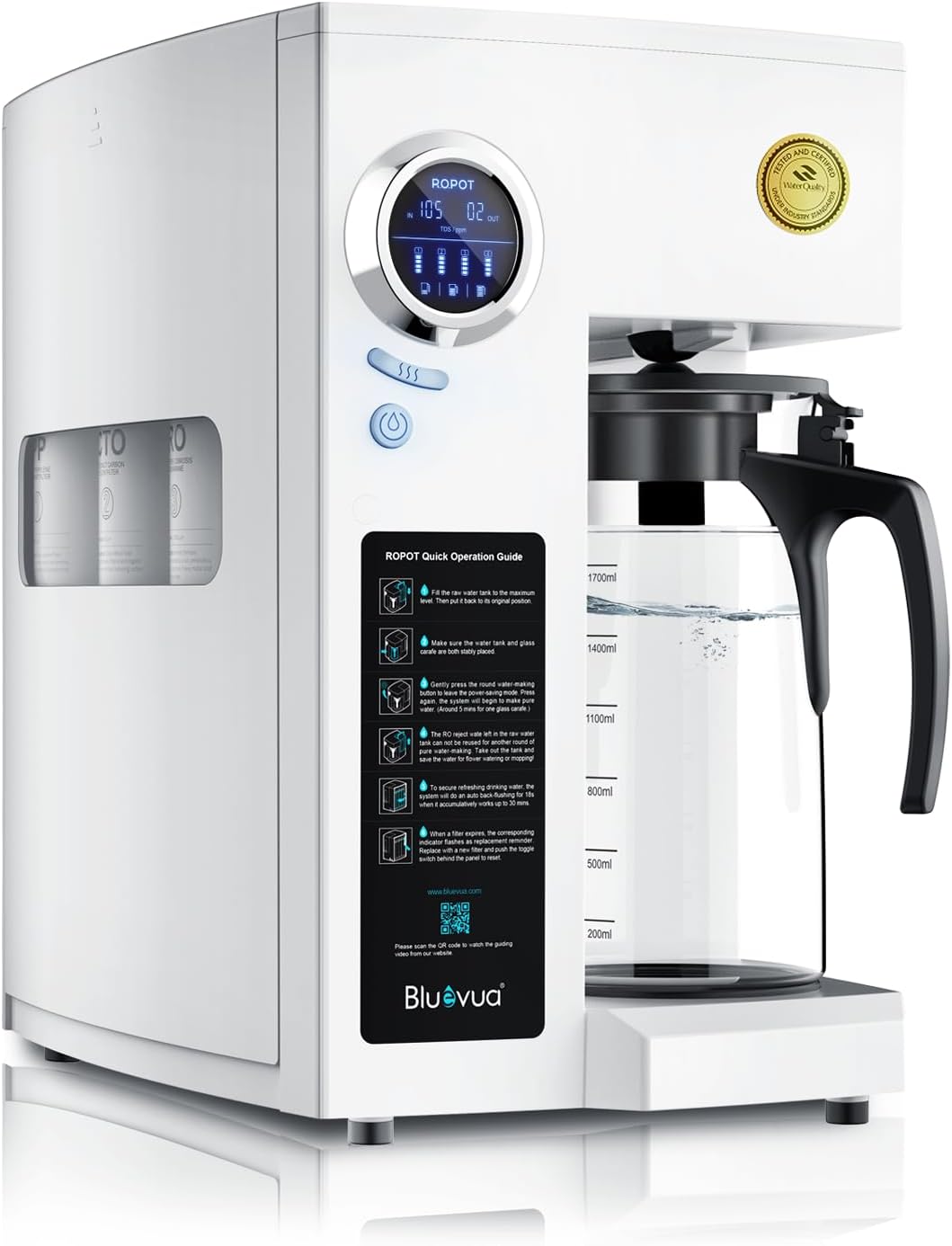
The Bluevua ROPOT is a portable countertop reverse osmosis system designed to deliver bottled-quality water without plumbing. It uses a five-stage RO stack with a remineralization stage and reports pre/post TDS so you can monitor water quality, while a smart display and filter life monitor make maintenance scheduling straightforward. The unit fills a 1.7 L glass carafe and includes a power adapter, cleaning brush and four replacement filters to get started. Practical benefits include the glass carafe that avoids plastic contact, an automatic power-saving standby mode, and a claimed 2:1 pure-to-drain ratio that reduces waste compared with typical RO units. Limitations to consider are the modest maximum flow rate (0.26 L/min), so filling large volumes takes time, and countertop capacity limits throughput for larger households or heavy well-water use where frequent flushing is needed to manage TDS and sediment. Filter lifespans are listed between 12 and 24 months depending on the stage, so plan for periodic replacements if your well water has high contaminant load.
Best for: Buyers who prioritize a reliable, easy-to-maintain countertop RO that clearly reports water quality and minimizes plastic contact for daily drinking water from a private well.
Less Ideal for: Homes that need high daily volumes of treated well water or very fast fill rates should consider plumbed or higher-capacity systems instead.
- Five-stage reverse osmosis filtration with remineralization for low TDS and improved taste
- Borosilicate glass carafe avoids plastic contact and secondary contamination
- Plug-in countertop design requires no plumbing or installation
- Built-in TDS display and filter life monitor simplify water-quality and maintenance checks
- Power-saving standby mode and a claimed 2:1 pure-to-drain ratio reduce electricity and water waste
- Low maximum flow rate limits how quickly the carafe fills
- Countertop capacity may not keep up with large-family or high-demand well-water use
Verdict: If you want a no-install countertop RO that gives verifiable low-TDS water in a glass carafe with easy maintenance, the Bluevua ROPOT is a reliable choice for well-water drinking supply.
Waterdrop G3P600 Tankless RO
| Filtration stages | 8-stage |
|---|---|
| Capacity | 600 GPD |
| Pure to drain ratio | 2:1 |
| Power source | Corded Electric |
| Maximum flow rate | 0.42 gpm |
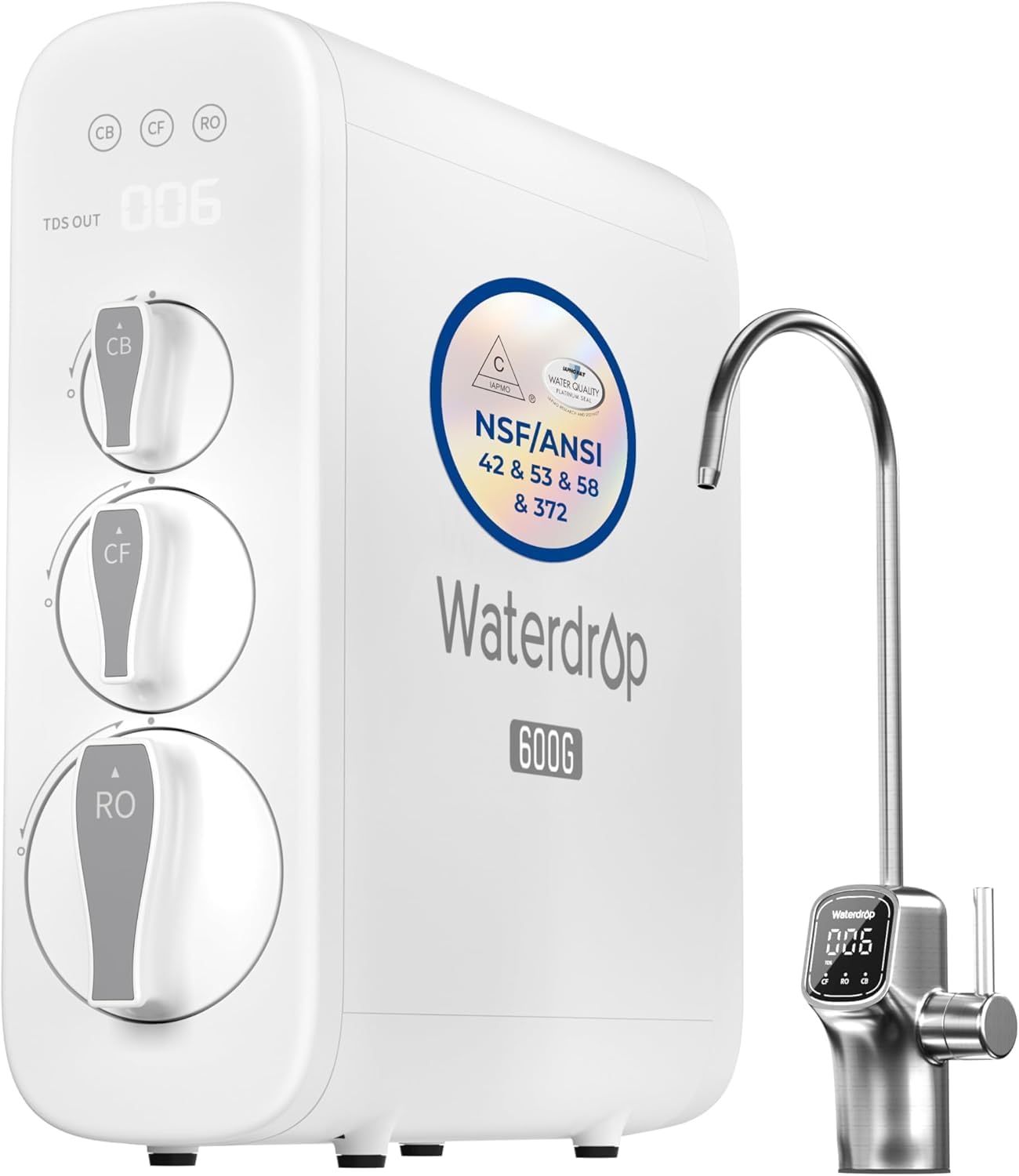
The Waterdrop G3P600 is a tankless under-sink reverse osmosis system designed to give fast, high-capacity purified water without a storage tank. It uses an 8-stage filtration stack including a reverse osmosis membrane and carbon block stages to reduce TDS, chlorine, heavy metals and some emerging contaminants, and the unit produces an 8 oz cup in about 8 seconds at a reported 600 GPD capacity. The smart faucet shows TDS and filter life, which helps you monitor water quality and maintenance needs, and the system runs on plug-in power and includes automatic flushing to keep the membrane cleaner. Tankless styling saves under-sink space and filters are twist-and-replace for quicker service. Important limitations: it requires an under-sink power outlet and some users will need to drill two holes for faucet and drain connections, and the high-capacity rating may exceed typical household needs for well setups unless paired with proper prefiltration for sediment and TDS levels.
Best for: Buyers who prioritize proven performance and clear monitoring when choosing an under-sink RO for drinking water and want a compact tankless layout with visible filter indicators.
Less Ideal for: People without an accessible under-sink power outlet, those unwilling to modify cabinetry for a dedicated faucet/drain, or homeowners who need a simpler non-RO sediment-only solution for well water.
- Tankless design saves over 70% of under-sink storage space compared with tanked RO systems
- High production rate (600 GPD) with a fast dispense time—about one 8 oz cup in 8 seconds
- Smart faucet display reports TDS and filter life for real-time water-quality monitoring
- Low 2:1 pure-to-drain ratio reduces wastewater compared with many RO units
- Requires a nearby electrical outlet for the plug-in power supply
- Installation needs drilling two holes for faucet and drain connection in some setups
Verdict: Choose this compact tankless RO if you want high daily output with monitoring and lower wastewater in a space-saving under-sink package.
DREO RO Countertop Filter WF113

| Purification Method | Reverse Osmosis |
|---|---|
| Capacity | 5 liters |
| Pure to Drain Rate | 3:1 |
| Included Components | Body, RO filter, 2 autofill pitchers |
| Other Special Features | Built-in TDS meter, Change Filter Indicator, Touch Control |
The DREO WF113 is a plug-in countertop reverse osmosis purifier designed to give families filtered drinking water without permanent plumbing changes. It uses a 7-stage RO cartridge and a built-in TDS meter to show raw and purified water readings, and the unit includes two autofill pitchers so one stays full while the other refills automatically. Practical touches include touch controls, a change-filter indicator, and a self-cleaning flush that helps clear internal tubing between cycles. The system is compact enough for a counter or small kitchen and claims a 3:1 pure-to-drain ratio to limit waste compared with many RO units. Filter life is stated at about 265 gallons (1000 L) per cartridge and replacement is a twist-in design. Limitations to consider are the countertop form factor and 5 L storage capacity, which mean it holds a modest amount of ready water and is best for households that consume steadily rather than large intermittent demands; it also weighs over 10 pounds, so it is not truly portable for frequent moves. For well-water buyers the TDS readout and serious multi-stage RO filtration make it a conservative, easy-to-use option for reducing common contaminants.
Best for: Buyers who prioritize reliable contaminant reduction and visible water-quality checks and who want a plug-in RO solution without under-sink plumbing.
Less Ideal for: Homes that need large volumes of filtered water at once or want a permanently plumbed under-sink system should look at higher-capacity or installed RO options instead.
- Built-in TDS meter and filter-life indicator for real-time water quality and maintenance alerts
- Auto-fill dual-pitcher system keeps one pitcher available while the other refills automatically
- Self-cleaning flush reduces buildup in tubes and simplifies maintenance
- Compact countertop installation with no plumbing required
- 5 liter tank limits the volume of immediately available purified water
- Replacement filter runtime (about 265 gallons) may require more frequent changes in high-use homes
Verdict: If you want a conservative, easy-to-use countertop RO that shows real-time TDS and avoids plumbing, this DREO unit is a practical choice for treating well water.
Choosing the Right Reverse Osmosis Countertop Water Filter for Well Water: Key Factors to Consider
Contaminant Profile
Know what is in your well water before picking a system. Well water commonly contains sediment, iron, manganese, nitrates, and occasionally bacteria or volatile organic compounds. An RO membrane addresses dissolved salts, nitrates, and many heavy metals, but it works best when paired with good prefiltration to remove sediment and chlorine-like disinfectants. Matching a unit's certified contaminant reduction list to your lab results ensures the system will actually treat the substances present.
Testing your water annually or when you first install a unit is important. Results guide whether you need additional treatment stages such as UV disinfection for bacteria or specialized iron filters to prevent premature membrane fouling.
Prefiltration and Membrane Protection
Prefilters extend membrane life and maintain system performance. Sediment and carbon prefilters remove grit, organic matter, and chlorine compounds that can clog or degrade the RO membrane. For well water, look for higher-capacity sediment filters and granular-activated carbon stages capable of handling particulate load and organics.
A poor prefilter arrangement can shorten membrane life and increase operating cost. Expect to replace sediment and carbon stages more often with untreated well sources; plan for easy access and standard filter sizes to keep maintenance manageable.
Daily Output and Flow Rate
Reverse osmosis systems vary widely in throughput and usable faucet flow. Countertop systems are compact but often produce less water per hour than under-sink units. Assess your household's typical daily drinking and cooking needs and choose a unit whose daily output and on-demand flow meet those needs without long waits.
Also consider where you will draw water from. Some countertop systems deliver directly to a pitcher or built-in faucet; others require temporary hookup to a tap. If you have moderate-to-high daily use or entertain guests, prioritize higher flow rates and a decent storage capacity.
Waste Water Ratio and Water Efficiency
RO systems produce reject water while concentrating contaminants. The waste-to-product ratio affects household water use and could be a meaningful ongoing cost for homes on wells with limited supply. Efficient systems reduce reject volume per gallon produced, but very low reject ratios can come at the expense of membrane longevity or require higher maintenance.
When evaluating systems, balance waste ratio with membrane replacement intervals and the presence of booster pumps or permeate pumps that can improve efficiency without sacrificing output.
Materials and Corrosion Resistance
Well water can contain minerals and dissolved gases that accelerate corrosion. Look for housings, fittings, and tubing made from corrosion-resistant materials such as food-grade plastics and stainless steel where appropriate. Poor material choices can lead to leaks, taste changes, or premature system failure.
Check for NSF or equivalent material safety claims and avoid systems that use unknown plastics in contact with filtered water. Components that are easy to inspect and replace reduce the long-term risk of corrosion-related problems.
Maintenance Requirements and Ongoing Cost
Maintenance frequency drives long-term satisfaction. Countertop RO systems typically require periodic prefilter and RO membrane changes, and sometimes sanitization. Estimate annual filter and membrane replacement costs and check how straightforward filter swaps are.
Systems with simple, tool-free access and widely available replacement parts reduce downtime and expense. For well-water users, plan on more frequent prefilter changes and factor that into the total cost of ownership.
Installation Options and Hookups
Countertop reverse osmosis units are designed for minimal plumbing work. Many models connect temporarily to a kitchen faucet with an included diverter valve or sit near the sink with a hand-pump or dedicated faucet. For renters or homeowners who want a non-permanent solution, the faucet-hookup approach is convenient and reversible.
If you prefer a more permanent arrangement, some countertop units can be plumbed into a dedicated spout or fed into a small storage container. Consider whether you need a constant on-tap deliverable flow or whether filling a pitcher or bottle on demand is acceptable.
- Temporary faucet diverter hookups for easy setup
- Standalone units that pour into a pitcher or bottle
- Some allow semi-permanent connection to a dedicated faucet or spout
When to Add UV or Iron Treatment
RO membranes do not reliably disinfect bacteria or viruses on their own. If your well water test shows bacterial contamination or you suspect intermittent biological growth, add a UV disinfection stage after the RO membrane to protect drinking water. UV units are compact and integrate well with countertop setups when space and power are available.
High iron or manganese loads can foul membranes and cause taste and staining issues. If tests indicate elevated iron or manganese, install an iron-specific prefilter or oxidizing stage before the RO system to reduce fouling risk and maintain consistent performance.
- UV post-treatment for biological safety
- Iron prefilters or oxidizing stages to protect membranes
- Test first to confirm necessity
Managing Waste Water and Conservation Tips
Because RO rejects some feed water, plan where reject water will drain. For countertop units that use a faucet diverter, reject water typically drains to the sink. If you have limited well capacity, capture reject water for nonpotable uses like plant watering or cleaning to reduce waste.
Conserve water by using RO output for drinking and cooking, and reserving tap water for tasks that do not need RO quality. Periodically check fittings for leaks, as unattended drip losses add up over time.
- Direct reject water to sink drain or collection container
- Reuse reject water for nonpotable chores
- Regular leak checks to prevent unnoticed loss
Signal Indicators and User Feedback
Look for systems that provide clear signals when filters need replacement or when performance drops. Simple mechanical flow indicators, pressure gauges, or electronic reminders can prevent users from running aged membranes beyond their effective life. For well water, pressure and clarity changes often precede membrane failure, so early warnings are valuable.
Choose units with straightforward diagnostics or accessible test points so you can verify output quality after maintenance or if water characteristics shift.
- Mechanical or electronic filter-change reminders
- Pressure gauges or flow indicators to spot issues
- Accessible sampling points for quality checks
How We Chose the Best Reverse Osmosis Countertop Water Filter for Well Water
We evaluated candidate countertop reverse osmosis systems through a practical buyer lens focused on the demands of well water. Our selection criteria prioritized measurable contaminant rejection rates for bacteria, nitrates, and heavy metals; prefilter quality and lifespan to protect the RO membrane; and real-world flow rate and daily output suitable for household drinking and cooking. We also considered build quality and materials that resist corrosion from minerals common in well water, plus ease of maintenance including filter-change accessibility and replacement costs. Excluded from consideration were systems intended only for municipal tap water or portable pitchers that lack an RO membrane. We filtered out units without clearly stated contaminant removal specs or those with inadequate prefiltration, since well water often contains sediment and organics that damage membranes. The shortlist reflects units that balanced removal efficiency, waste water ratio, and user-friendly upkeep — the exact dimensions buyers in well-sourced homes tell us matter most.
Our full evaluation process is outlined in our review methodology.
FAQ
How often should I test well water if I use an RO countertop unit?
Test your well water at least once a year and immediately after any events that could affect quality, such as heavy rains, nearby construction, or changes to the well. Annual tests help detect trends in mineral levels and biological contamination that affect RO performance.
Will an RO countertop system remove iron and manganese from well water?
RO membranes can reduce dissolved iron and manganese, but particulate iron and high concentrations may foul the membrane. A dedicated iron prefilter or oxidizing stage is often needed before the RO unit for effective, long-term treatment.
Do countertop RO systems require electricity?
Most countertop RO systems themselves do not require electricity, as they rely on pressure from the tap. However, added stages like UV disinfection or booster pumps do need power. Check the unit's specifications if you plan to integrate powered components.
Can I install a countertop RO system myself?
Yes, many countertop systems are designed for do-it-yourself installation using a faucet diverter and basic hand tools. If you want a semi-permanent hookup or additional treatment stages, consider professional help to ensure proper plumbing and drainage.
How long do RO membranes last with well water?
Membrane life depends on feed-water quality and prefiltration. With robust prefilters and moderate contaminant levels, membranes often last 2 to 5 years. Heavy sediment or iron without proper pretreatment can shorten that lifespan significantly.
Final Verdict
For well-water households, prioritize systems that combine robust prefiltration with an RO membrane rated for the contaminants identified in your water test. Balance daily output and flow rate against waste-water volume and maintenance burden. Materials that resist mineral corrosion and easy access to replaceable filters will reduce long-term headaches. Choose a configuration that matches how you use water most often — on-demand faucet delivery, pitcher filling, or a small storage reserve — and plan for periodic testing and filter replacement to keep water safe and tasting good.