
Note: This article contains affiliate links. If you click on these links and make a purchase, we may earn a small commission at no extra cost to you. This helps support our research and content. Read our full affiliate disclosure here.
If you want reliably clean drinking water without relying on bottled sources, a reverse osmosis water dispenser for home use can be a practical upgrade. These systems remove a wide range of contaminants and combine filtration with convenient dispensing so you get filtered water from a dedicated tap or built-in dispenser. Choosing the right unit affects water quality, ease of maintenance, and how well the dispenser fits your daily routine. This guide covers seven shortlisted reverse osmosis water dispensers for home use, explaining the factors we considered and how each pick meets common household needs. We evaluate filtration performance, dispensing speed, installation and maintenance needs, and overall suitability for typical kitchen setups. Read on to find the right balance of purity, convenience, and upkeep for your home.
Top Picks at a Glance
| Best Overall The best all-around choice for most situations | Home Master Artesian Full Contact TMAFC |  |
| Best Quality Built to a higher standard if you want something more solid | Waterdrop G3P600 Tankless RO |  |
| Best Value The sweet spot between price and what you get | Waterdrop C2SL Countertop RO |  |
| Best Budget The cheapest option that still gets the job done reliably | CO-Z Countertop RO Water Filter |  |
| Top Rated A top-rated pick with lots of positive feedback | VIVA21 5-Stage Reverse Osmosis System |  |
| Most Popular A crowd favorite that many people choose with confidence | iSpring RCC7AK-BN Reverse Osmosis System |  |
| Best Seller A high-volume bestseller chosen again and again | DREO RO Countertop Water Filter 5L |  |
Home Master Artesian Full Contact TMAFC

| Purification Method | Alkaline, Reverse Osmosis |
|---|---|
| Maximum Flow Rate | 1 gpm |
| Operating Pressure Range | 40-95 psi |
| Filter Life Cycle | 1 years |
| Capacity | 2000 gallons |
The Home Master Artesian Full Contact TMAFC is an under-sink RO system that strips contaminants through seven filtration stages and then remineralizes the water twice to improve taste and raise pH. It is installed under the sink and includes a storage tank and dedicated faucet for on-demand mineral water; the unit uses larger fittings and tubing to deliver a faster fill rate and a DOW membrane rated for 50 gallons per day. Notable features include catalytic carbon contact, sediment and carbon prefilters, and a two-stage remineralizer that adds calcium and magnesium before the tank and again before the faucet, which helps prevent tank bladder degradation and yields slightly alkaline water. The modular, assembled filter cluster makes annual filter replacement tool-free and straightforward, and most key components meet NSF material standards. Limitations to consider are the need for under-sink space for the tank and cluster and typical RO wastewater production inherent to pressure-driven membranes, so installation and drain access matter for performance and convenience.
Best for: Buyers who want reliably very clean drinking water but prefer water that is slightly alkaline and more palatable straight from the tap, and who value easier maintenance and faster dispensing.
Less Ideal for: Homeowners with extremely limited under-sink space or those seeking a zero-waste filtration option should consider alternatives.
- Seven-stage filtration with RO membrane for broad contaminant removal
- Patented two-pass remineralization restores small amounts of calcium and magnesium for better taste
- Larger fittings and tubing give a faster fill rate than many traditional RO units
- Modular assembled design simplifies annual filter changes without tools
- Includes tank, faucet, membrane and installation fittings in the box
- Requires under-sink space for the tank and purification cluster
- Produces wastewater as part of the RO process
Verdict: Choose this system if you want a high-capacity under-sink RO that produces very clean water while restoring minerals for better taste.
Waterdrop G3P600 Tankless RO
| Purification Method | Carbon Block, Reverse Osmosis |
|---|---|
| Filtration Stages | 8-stage Filtration |
| Flow Rate | 600 GPD |
| Pure to Drain Rate | 2:1 |
| Power Source | Corded Electric |
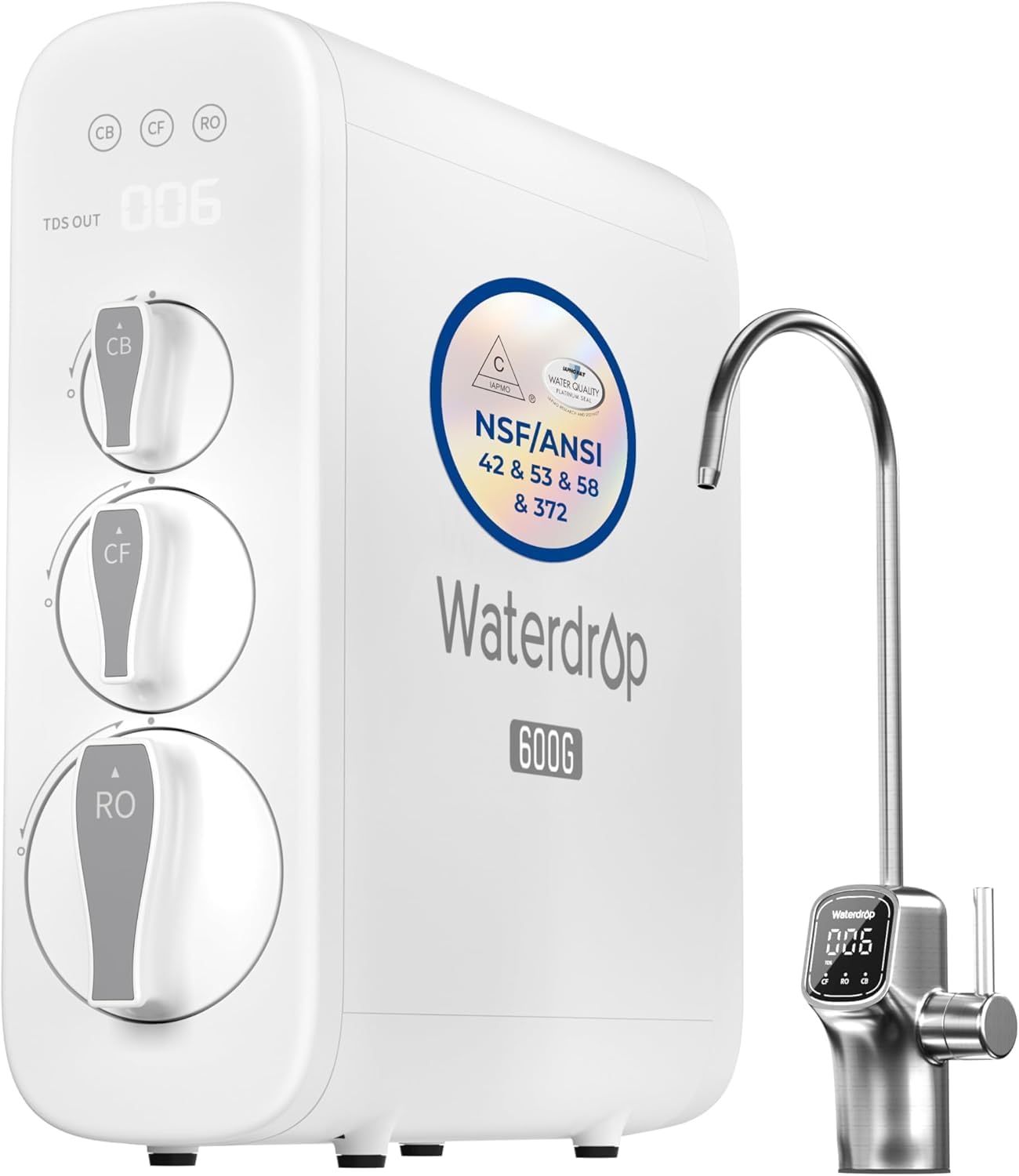
The Waterdrop G3P600 is a tankless reverse osmosis system designed for under-sink installation that prioritizes output and convenience. It uses an 8-stage filtration train including carbon block and an RO membrane to reduce TDS, heavy metals, PFAS, chlorine and other common contaminants while producing up to 600 gallons per day and filling an 8 oz cup in roughly 8 seconds. The unit is tankless to save under-sink space and includes a smart display faucet with TDS readout and filter-life indicators so you can monitor water quality and replacement timing without guesswork. Practical benefits include a low 2:1 pure-to-drain ratio for reduced waste, simple twist-and-replace cartridges, and an automatic flushing function to help keep the membrane clean. Important limitations are the requirement for under-sink power and the need to verify cabinet clearance for the 18.12 x 5.67 x 17.72 inch footprint, and while the system reports high capacity, actual flow depends on feed pressure and TDS levels.
Best for: Homeowners who want a high-performance, high-output RO system that delivers fast, monitored drinking water and saves under-sink space.
Less Ideal for: Renters or users without an under-sink power source or those who cannot accommodate the unit's cabinet footprint should consider simpler countertop or tanked options.
- High output up to 600 gallons per day for fast dispense and heavy household use
- 8-stage filtration certified to NSF/ANSI 42, 53, 58 and 372 for broad contaminant reduction
- Tankless design saves significant under-sink space and enables quick filter changes
- Smart faucet with TDS monitor and filter-life display for real-time water quality feedback
- Low 2:1 pure-to-drain ratio reduces wastewater compared with many RO units
- Requires an electrical outlet under the sink which may need additional wiring
- Physical footprint requires checking cabinet clearance before purchase
- Actual flow and efficiency depend on incoming water pressure and TDS, so performance can vary
Verdict: Choose the Waterdrop G3P600 if you need a high-capacity, tankless under-sink RO that delivers fast, monitored drinking water for performance-focused households.
Waterdrop C2SL Countertop RO

| Purification Method | Reverse Osmosis |
|---|---|
| Filtration Stages | 7-Stage |
| Pure to Drain Ratio | 3:1 |
| Capacity | 75 gallons |
| Filter Life Cycle | 12 months |
The Waterdrop C2SL is a countertop reverse osmosis dispenser that produces mineralized drinking water without any plumbing or drilling. You fill the 108 oz feed tank, plug the unit in, and the built-in pump and 0.0001 μm RO membrane filter up to a 3:1 pure-to-drain ratio while automatically refilling the 40 oz glass pitcher for fridge storage. The system uses a 7-stage filter stack including a mineral stage to restore calcium and magnesium for better taste, and the smart display with voice alerts helps track filter life and refill needs. Setup and initial rinse are voice-guided, and the unit is designed to deliver quiet, tankless operation for kitchens, offices, or RV use for one to two people. Its limitations are that it is sized for small households and requires periodic filter replacement roughly every 12 months under typical use, and like most countertop RO units it still produces some wastewater during filtration.
Best for: Buyers who want a plug-and-play countertop RO that minimizes installation hassle and delivers better-tasting drinking water for a small household or personal use.
Less Ideal for: Large families, high daily water users, or those who want a whole-kitchen under-sink system should look for higher-capacity or plumbed RO solutions instead.
- 7-stage RO filtration with 0.0001 μm membrane reduces a wide range of contaminants
- Autofill detachable 40 oz glass pitcher for easy fridge storage and serving
- Mineral filter restores calcium and magnesium for improved taste
- Smart display and voice alerts simplify setup and maintenance tracking
- Compact, portable countertop design requires no plumbing or drilling
- Designed for 1–2 people so output and tank size may be small for larger households
- Produces wastewater at the typical RO 3:1 pure-to-drain ratio
Verdict: Choose the C2SL when you need a no-plumbing, countertop RO that delivers mineralized, fridge-ready water with simple smart alerts for a 1–2 person household.
CO-Z Countertop RO Water Filter

| Purification Method | Reverse Osmosis |
|---|---|
| Capacity | 5 liters |
| Power Source | Corded Electric |
| Supported Water TDS Level Maximum (PPM) | 500 |
| Filter Life Cycle | 1 years |
The CO-Z countertop RO system delivers household-grade reverse osmosis filtration without any plumbing work by combining a five-stage filter stack, a 1.3-gallon tank and a removable 0.4-gallon pitcher for easy pouring. It is used by filling the tank, plugging the unit in and selecting one of three preset dispense volumes or continuous flow for larger fills, while the control panel displays real-time TDS and filter life. Notable features include a built-in TDS meter, automatic self-cleaning before and after cycles, a filter change indicator and a claimed 4:1 pure-to-drain ratio to reduce waste compared with typical RO drains. The unit is portable so it can be moved between kitchen, office or RV and offers a quoted 75-gallon daily capacity and roughly 528 gallons total before filter replacement. Trade-offs are its reliance on mains power and the need to replace internal filters annually, and some buyers may find countertop footprint and noise during operation a factor in tight spaces.
Best for: Buyers who want an affordable, installation-free RO dispenser for everyday drinking water and value visible TDS readouts and simple preset dispensing.
Less Ideal for: Households that need a fully plumbed under-sink solution, off-grid use, or the smallest possible footprint where counter space is extremely limited.
- Five-stage RO filtration removes a wide range of contaminants and reports real-time TDS readings
- No installation required—plug-and-play countertop design that is portable between locations
- Three preset dispense volumes plus continuous dispense for flexible filling
- Automatic self-cleaning cycles and filter life indicator simplify upkeep
- Requires a power connection so it is not fully passive or usable during outages
- Filters are rated for about a year and will need periodic replacement
Verdict: A budget-friendly, plug-in countertop RO dispenser that gives visible TDS monitoring and easy preset dispensing without any plumbing.
VIVA21 5-Stage Reverse Osmosis System

| Purification Method | Activated Carbon, Reverse Osmosis |
|---|---|
| Filter Life Cycle | 12 months |
| Supported Water TDS Level Maximum (PPM) | 1000 |
| Included Components | Faucet, Installation Kit, Tank, Filtration Unit, Tubings, Leak Detector |
This VIVA21 5-stage reverse osmosis system is a full under-sink kit built to deliver very low dissolved solids and improved taste for everyday drinking and cooking. Installation uses the included faucet, tank, tubing, and fittings and the system runs common RO stages: sediment and carbon prefilters, an RO membrane, and post-carbon polishing. Notable features for reliability-minded buyers are WQA Gold Seal listing to NSF/ANSI 58 and lead-content certification, an automatic shutoff to prevent continuous flow to the drain, and a leak detector included with the kit. The compact tank and leak-resistant fittings make it practical under most kitchen sinks, and the stated supported TDS up to 1000 ppm and 12-month nominal filter life give clear maintenance expectations. Limitations to keep in mind are typical RO considerations: water is produced more slowly than point-of-use filters and periodic filter and membrane replacements are required, and the system does not list an integrated remineralization stage if you want higher pH or added minerals.
Best for: Homeowners who prioritize a dependable, certified under-sink RO system with a complete hardware kit and straightforward maintenance expectations.
Less Ideal for: Buyers who want instant high-volume dispensing without waiting for RO production or who need an integrated alkaline/remineralization feature built into the system.
- WQA Gold Seal listing for NSF/ANSI 58 performance and lead-content certification
- Complete under-sink kit with faucet, tank, tubing, installation kit, and leak detector
- Automatic shutoff and leak-resistant fittings reduce risk of continuous flow or leaks
- Five-stage filtration (sediment, carbon, RO membrane, post-carbon) for low TDS and improved taste
- No built-in remineralization or alkaline stage to raise pH
- RO output is slower than non-RO point-of-use filters and requires periodic cartridge/membrane replacement
Verdict: Choose this VIVA21 5-stage RO kit if you want a certification-backed, ready-to-install under-sink system focused on reliable contaminant reduction and leak protection.
iSpring RCC7AK-BN Reverse Osmosis System

| Purification Method | Reverse Osmosis, Alkaline, Activated Carbon, Carbon block |
|---|---|
| Power Source | No Power Needed |
| Maximum Flow Rate | 284 liters_per_day |
| Supported Water TDS Level Maximum (PPM) | 750 |
| Filter Life Cycle | 6 months |
The iSpring RCC7AK-BN is an NSF 58 certified six-stage under-sink RO system that removes a wide range of contaminants while adding back healthy minerals to raise pH. It uses sediment, carbon, RO membrane, and an alkaline mineral stage to deliver low-TDS water and includes a storage tank and a brushed-nickel top-mounted faucet for convenient dispensing. Installation is designed for DIY with push-to-connect fittings, color-coded tubing, and a patented top-mounted faucet fastener that lets you tighten the nut from above the counter, which helps in tight under-sink spaces. The system requires no electricity and has a transparent first-stage housing so you can visually check sediment buildup. Filters are modular and have staged lifetimes, and replacement sets are available. Expect routine filter changes (the prefilters are rated about six months) and an under-sink footprint to accommodate the tank and housings; homes with very high flow needs may find the built-in storage tank and 75 GPD rating limiting. For buyers who prioritize certified performance and clear inspection features, this is a reliable, serviceable choice.
Best for: Buyers who want a proven, certified under-sink RO that prioritizes verified contaminant removal and visible, serviceable components for confident ownership and social-proof validation.
Less Ideal for: Homes that need very high continuous flow or want a completely maintenance-free drinking-water solution should consider systems with higher flow rates or integrated pumps and larger tanks.
- NSF/ANSI 58 full-system certification for verified contaminant reduction
- Six-stage filtration with alkaline remineralization for balanced pH and minerals
- Transparent first-stage housing for easy visual monitoring of sediment
- DIY-friendly push-to-connect fittings and top-mounted faucet design simplify installation
- Operates without electricity and includes a storage tank and faucet
- Prefilters require periodic replacement (about every six months) which adds maintenance tasks
- 75 GPD rating and tank capacity may be insufficient for very large households with high simultaneous demand
Verdict: Choose the RCC7AK-BN if you want an NSF-certified, six-stage under-sink RO that adds minerals back into the water and makes inspection and DIY servicing straightforward.
DREO RO Countertop Water Filter 5L

| Purification Method | Reverse Osmosis |
|---|---|
| Capacity | 5 liters |
| Other Special Features | Built In TDS Meter, Change Filter Indicator, Touch Control |
| Pure to Drain Rate | 3:1 |
The DREO countertop RO system provides full reverse osmosis filtration in a compact, install-free package for small households. It uses a 7-stage RO filter and reports a 3:1 pure-to-drain ratio while the built-in TDS meter and filter-life indicator let you monitor water quality and know when to replace the cartridge. The unit includes two auto-fill pitchers so one is always ready while the other refills, and an automatic flush function helps keep internal tubing clean with minimal user effort. Setup is simple because it sits on the counter and does not require plumbing, and filter changes are designed to be a quick twist-in replacement. Practical limitations are that the system is sized for daily use by about three to four people, and the RO process produces waste water at a 3:1 rate so it is not the lowest-waste option available; also the filter lifetime is specified in gallons rather than months which means replacement cadence depends on your household consumption. For buyers who want monitored, near-plumbed performance without installation, this is a straightforward, low-fuss choice.
Best for: Buyers who want a monitored, near-plumbed RO drinking water solution without installing plumbing and prefer simple setup, clear filter status, and low-hassle maintenance.
Less Ideal for: Large families or households that need continuous high-volume filtered water or those seeking the absolute lowest wastewater RO systems should consider other options.
- 7-stage RO filtration removes wide range of contaminants with SGS testing claimed
- Built-in TDS meter and filter life indicator for real-time water quality and maintenance alerts
- Auto-fill dual-pitcher system provides grab-and-go pitchers and hands-free refilling
- Self-cleaning auto-flush reduces manual maintenance and helps keep internal tubing clean
- Produces wastewater at a 3:1 pure-to-drain ratio which increases water use
- Sized for small households, may not keep up with higher daily demand without frequent refills
Verdict: A compact, install-free countertop RO system that gives risk-averse buyers real-time TDS monitoring and easy, low-fuss filtered water with included auto-fill pitchers.
Choosing the Right Reverse Osmosis Water Dispenser for Home Use: Key Factors to Consider
Filtration Performance and Contaminant Reduction
Filtration performance is the primary reason to choose a reverse osmosis dispenser. Look for systems that provide specific reduction rates for total dissolved solids, lead, chlorine, and other contaminants common in municipal or well water. Laboratory-verified reduction percentages or third-party certifications indicate reliable performance.
Higher removal rates usually mean better taste and lower health risk from regulated contaminants. Keep in mind that RO systems also remove beneficial minerals, so consider whether a post-filter remineralization stage is important for your water quality preferences.
Dispensing Speed and Recovery Rate
Dispensing speed matters for everyday convenience. A slow flow or small storage tank can result in frequent waits when filling pitchers or multiple glasses. Check both the immediate dispense flow rate and the system's recovery rate, which is the speed at which the RO membrane produces filtered water to refill the tank.
Homes with higher daily water usage need a unit with faster recovery or a larger tank. If you host often or have multiple family members who drink filtered water frequently, prioritize models engineered for higher throughput to avoid bottlenecks.
Installation and Under-Sink Fit
Most home-use reverse osmosis dispensers are installed under a kitchen sink and require a dedicated faucet or dispenser connection. Measure available under-sink space, check for room to accommodate the tank and filter housings, and confirm compatibility with your sink and cold-water line.
Some units are easier to install with quick-connect fittings and clear instructions, while others may need a plumber. If you prefer DIY installation, prioritize systems with straightforward fittings and compact layouts.
Maintenance Frequency and Ongoing Costs
Maintenance includes periodic filter and membrane replacement, sanitizing the system, and eventually replacing fittings or the storage tank if needed. Filter life varies by model and incoming water quality; pre-filters often need replacement every 6 to 12 months while membranes last longer.
Factor in the long-term cost and frequency of parts replacement. Systems with easily accessible filters and clear change indicators reduce hassle and the chance of skipped maintenance that could impair performance.
Waste Water Ratio and Environmental Impact
Reverse osmosis produces reject water during filtration. The ratio of filtered water produced to wastewater generated affects both water waste and utility costs. More efficient systems produce less wastewater for the same amount of purified water.
If local water resources or bills are a concern, choose systems with better recovery ratios or consider add-on solutions that reuse reject water for non-potable tasks. Understanding this tradeoff helps align the system choice with sustainability goals.
Build Materials and Food-Safe Components
Materials in contact with water should be certified for potable use and resistant to corrosion. Look for BPA-free plastics, food-grade tubing, and corrosion-resistant connectors. The storage tank lining and faucet materials can influence long-term taste and odor.
Higher-quality components also reduce the risk of leaks and contamination between filter changes. Durable housings and reliable fittings contribute to longer service life and fewer emergency repairs.
Types of Reverse Osmosis Dispensers
Reverse osmosis dispensers for home use come in a few common configurations: standard under-sink systems with a separate dedicated faucet, integrated dispenser units with a built-in spout, and compact units designed for limited under-sink space. Each configuration affects installation complexity, counter aesthetics, and daily convenience.
Standard under-sink systems separate the storage tank from the dispenser faucet, which keeps the under-sink hardware out of sight. Integrated dispensers combine components to save space but may limit under-sink access for maintenance.
- Under-sink with dedicated faucet: common, flexible, easier to service
- Integrated under-sink dispenser: space-saving, streamlined look
- Compact units: intended for small cabinets or apartment kitchens
Planning for Installation
Before purchasing, measure the cabinet space under your sink and note the location of plumbing lines and garbage disposals. Confirm there is room for a storage tank and filter housings alongside existing pipes. Consider the path for the dispenser tubing to the faucet hole and whether you will use an existing pre-drilled hole or need to drill a new one.
If you are not comfortable with basic plumbing, factor in the potential need for professional installation. Many systems use standard quick-connect fittings, which simplify DIY installs, but older homes with nonstandard valves or tight spaces may complicate the process.
- Measure under-sink clearance and width
- Locate cold-water shutoff and possible faucet hole
- Account for drain line and venting clearances
Maintenance Best Practices
Establish a simple maintenance schedule based on the manufacturer recommendations for filter and membrane replacement. Replace pre-filters more frequently than the RO membrane to protect membrane life and preserve water quality. Keep a record of change dates so you do not miss cycles.
Sanitize the system annually or as recommended, and inspect fittings and tubing for signs of wear or leaks. If water taste or flow changes significantly between scheduled services, check the pre-filters and tank pressure before assuming a major failure.
- Replace pre-filters every 6 to 12 months depending on use
- Replace RO membrane every 2 to 4 years depending on water quality
- Sanitize and inspect annually
Understanding Water Taste and Mineral Balance
RO systems remove minerals that contribute to water taste. Some homeowners prefer the neutral taste of fully demineralized water, while others miss the mouthfeel of mineralized water. Systems with remineralization cartridges add back a small amount of calcium and magnesium to improve flavor and balance.
If your drinking water comes from a soft source or has already low mineral content, consider a unit with a taste-restoring stage. Conversely, if you want the highest contaminant reduction, a no-remineralization approach will maximize purity.
- Remineralization improves taste and raises pH slightly
- No remineralization yields drier, very pure water
- Consider testing feed water to decide if remineralization is needed
Space-Saving Tips for Small Kitchens
In tight cabinets, choose compact housings, stacked filter cartridges, or slimline storage tanks. Some systems relocate the tank horizontally or use tankless designs to minimize vertical clearance. Keep plumbing layout tidy to maximize usable space and allow access for filter changes.
Label tubing and create small service clearances so you can change filters without removing other items stored under the sink. If cabinet space is extremely limited, look for integrated or countertop variants that meet your needs while still providing RO-level filtration.
- Choose stackable or slim filter housings
- Consider tankless or horizontal tanks for low clearance
- Keep service access clear for easier maintenance
How We Chose the Best Reverse Osmosis Water Dispenser for Home Use
We focused on practical, measurable dimensions that matter to homeowners when selecting a reverse osmosis water dispenser for home use. First, filtration efficiency and contaminant removal were prioritized because the core purpose of these systems is to reduce dissolved solids, chlorine taste, lead, and other common impurities. Second, dispense flow rate and tank capacity were evaluated to ensure a unit can meet peak household demand without long waits. Third, ease of installation and compatibility with standard residential plumbing determined real-world usability for typical kitchens. Fourth, maintenance requirements and filter life were weighed since recurring filter changes and drain water ratios affect long-term convenience and cost. Fifth, build quality and materials were considered for durability and to avoid leaching or premature failures. We excluded products that rely solely on single-stage filtration, countertop pitchers, or systems that do not incorporate a dedicated dispensing mechanism. Units with unclear specification sheets or unverifiable performance data were also left out. The shortlisted dispensers were those that clearly documented contaminant reduction rates, provided realistic flow and capacity specs, and offered accessible maintenance procedures aligned with typical homeowner abilities.
Our full evaluation process is outlined in our review methodology.
FAQ
How often should I replace the reverse osmosis membrane?
Membrane life typically ranges from two to four years depending on feed water quality and pre-filter maintenance. Replace pre-filters on schedule to extend membrane life and monitor product specs for recommended intervals.
Will an RO dispenser remove chlorine taste and odor?
Yes. RO systems combined with carbon pre- or post-filters are effective at reducing chlorine taste and odor. Verify that the system includes carbon stages if chlorine removal is a priority.
How much wastewater does a home RO system produce?
Wastewater varies by design and feed water pressure and temperature. Typical residential ratios range from about 1:1 to 4:1 reject to purified water. More efficient units and better feed conditions reduce wastewater.
Can I install a reverse osmosis dispenser myself?
Many homeowners can install under-sink RO dispensers with basic tools if the unit includes quick-connect fittings and clear instructions. Complex or tight plumbing situations may warrant a professional installation.
Does an RO system require a storage tank?
Most traditional RO dispensers use a storage tank to provide immediate dispensing flow. Tankless designs exist but rely on rapid membrane recovery and may deliver lower instantaneous flow in some setups.
Final Verdict
When choosing a reverse osmosis water dispenser for home use, prioritize certified contaminant removal and a dispensing capacity that matches your household demand. Balance installation complexity and maintenance frequency against the convenience of fast, on-tap filtered water. Consider recovery ratio and materials to align the system with sustainability goals and long-term reliability. Ultimately, pick the unit that best fits your under-sink space, delivers the filtration performance you need, and has maintenance requirements you are willing to keep up with. That way you get consistent, great-tasting water without unpleasant surprises.