
Note: This article contains affiliate links. If you click on these links and make a purchase, we may earn a small commission at no extra cost to you. This helps support our research and content. Read our full affiliate disclosure here.
A well-chosen reverse osmosis water dispenser gives you consistent, great-tasting drinking water without the fuss of frequent bottled deliveries. Whether you want a freestanding unit for the kitchen or a counter-integrated dispenser, the right model affects water purity, flow rate, and daily convenience. This guide shortlists the top reverse osmosis water dispensers we vetted for home use and explains the practical tradeoffs that matter. Below you will find our top picks, followed by the factors we weighed, how we evaluated each unit, and common user questions to help you pick the best dispenser for your household.
Top Picks at a Glance
| Best Quality Built to a higher standard if you want something more solid | PHILIPS Countertop RO Dispenser |  |
| Best Value The sweet spot between price and what you get | Waterdrop C2SL Countertop RO |  |
| Best Budget The cheapest option that still gets the job done reliably | CO-Z Countertop RO WFS-R040-00 |  |
| Top Rated A top-rated pick with lots of positive feedback | Aigerri Countertop RO System |  |
| Most Popular A crowd favorite that many people choose with confidence | Waterdrop G3P600 Reverse Osmosis |  |
| Best Seller A high-volume bestseller chosen again and again | DREO RO Countertop WF112 | 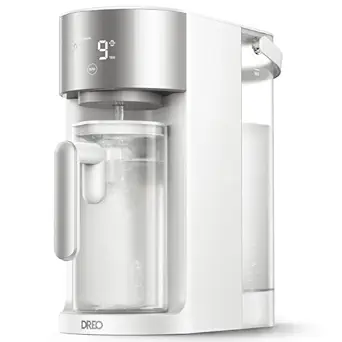 |
PHILIPS Countertop RO Dispenser

| Purification Method | Aquaporin Inside®, Reverse Osmosis |
|---|---|
| Lower Temperature Range | 40 °F |
| Upper Temperature Rating | 203 °F |
| Maximum Flow Rate | 200 milliliters_per_minute |
| Filter Life Cycle | 12 months |
The PHILIPS countertop RO dispenser is a plug-in countertop purifier that delivers filtered water on demand and can dispense chilled, ambient, and near-boiling temperatures up to 203°F. It uses a six-stage reverse osmosis process with Aquaporin technology and a remineralization stage to reduce contaminants and improve taste, and an onboard TDS readout shows source and output levels in real time. Daily use is simple: fill the source tank, select temperature or volume presets on the touch panel, and the unit stores filtered water in a 1.8 L jug for immediate use while a compressor cools the cold tank to about 40°F. Maintenance is straightforward with a 12-month filter life, a change-filter indicator, and a built-in self-clean cycle to limit scale buildup. Expect modest flow speed (about 200 ml/min) so it is best for steady household use rather than high-demand situations, and the unit is relatively heavy and sized for countertop placement rather than portability.
Best for: Buyers who prioritize high filtration performance and want a countertop unit that provides precise temperature control and visible TDS monitoring for everyday family use.
Less Ideal for: Not a good fit for households that need rapid high-volume dispensing or for locations without enough dedicated countertop space.
- Comprehensive 6-stage RO filtration with remineralization for improved taste
- Instant hot and cold dispensing with selectable temperature presets
- Built-in TDS meter and filter change indicator for visible performance monitoring
- Plug-in countertop design requires no plumbing and stores filtered water ready to use
- 12-month filter life and self-clean function simplify routine maintenance
- Relatively slow purified-water output (about 200 ml/min) limits fill speed for large volumes
- Countertop footprint and weight make it less mobile and require dedicated space
Verdict: Choose this unit if you want a high-performance countertop RO dispenser that combines thorough 6-stage purification with instant hot and cold dispensing and real-time TDS feedback.
Waterdrop C2SL Countertop RO

| Purification Method | Reverse Osmosis |
|---|---|
| Filtration Stages | 7-Stage |
| Capacity | 75 gallons |
| Filter Life Cycle | 12 months |
| Pure to Drain Ratio | 3:1 |
The Waterdrop C2SL is a plug-in countertop reverse osmosis system that delivers room-temperature filtered water without any plumbing or drilling. It uses a 0.0001 μm RO membrane and a 7-stage filter stack including a remineralization stage to reduce a wide range of contaminants while restoring minerals for a smoother taste. You fill the 108 oz feed tank, plug the unit in, and it automatically refills the detachable 40 oz glass pitcher for fridge storage or serving. A smart display, voice alerts, and guided first-time setup simplify maintenance and make filter monitoring straightforward. The unit is sized for 1 to 2 people and the included filter is rated up to 12 months or about 528 gallons; the system reports a 3:1 pure-to-drain ratio so it is more water-efficient than many older RO models. Limitations are its focus on room-temperature water only and modest capacity geared toward small households, so it is not intended for heavy daily demand or hot/cold dispensing needs.
Best for: Buyers who want a no-plumb, countertop RO that makes everyday drinking water taste better and is easy to maintain for a small household or office.
Less Ideal for: Large families, high daily water users, or anyone needing hot or chilled dispensing should look at higher-capacity or multi-temperature systems.
- True RO membrane with seven-stage filtration reduces a broad set of contaminants
- Built-in mineral stage improves taste compared with plain RO water
- Autofill detachable 40 oz glass pitcher avoids plumbing and fits in a refrigerator
- Smart display and voice alerts simplify filter monitoring and setup
- Relatively water-efficient 3:1 pure-to-drain ratio for an RO countertop unit
- Designed for small households so throughput and chilled/hot dispensing are limited
- Requires periodic filter replacement and electricity to operate
Verdict: A compact, no-installation countertop RO that delivers genuinely filtered, mineralized drinking water with easy autofill and smart maintenance features for small households.
CO-Z Countertop RO WFS-R040-00

| Purification Method | Reverse Osmosis |
|---|---|
| Capacity | 5 liters |
| Filter Life Cycle | 1 years |
| Supported Water TDS Level Maximum (PPM) | 500 |
| Other Special Features of the Product | Built In TDS Meter, Change Filter Indicator, Self Cleaning |
The CO-Z countertop RO is a plug-in, installation-free reverse osmosis dispenser aimed at households that want purified water without plumbing changes. It uses a five-stage RO stack and an NSF/ANSI 58 claim to remove a wide range of contaminants, and an onboard TDS meter shows water quality in real time. You fill the 5 liter tank, choose one of three preset pour volumes or continuous dispense, and the machine produces filtered water with a 4:1 pure-to-drain ratio while automatically self-cleaning between cycles. Practical touches include a removable 0.4-gallon pitcher for pouring and a filter life indicator to prompt replacements. On the downside the system is relatively heavy for a countertop unit and its daily output and total lifetime filtration are moderate compared with larger plumbed systems, so expect periodic refills and eventual filter changes. For the price it delivers solid RO performance and easy setup for renters or anyone avoiding under-sink installs.
Best for: Buyers who need an affordable, ready-to-use RO dispenser that avoids drilling or plumbing and want visible TDS feedback and simple preset pours for everyday drinking water.
Less Ideal for: Homes that need high-volume continuous production or a permanently plumbed under-sink solution should consider larger or hard‑installed RO systems instead.
- Five-stage reverse osmosis filtration with NSF/ANSI 58 and 61 compliance for broad contaminant reduction
- No installation required — plug in, fill the tank, and start dispensing
- Built-in TDS meter and filter life indicator for easy monitoring of water quality and maintenance
- Three preset dispense volumes plus continuous mode and a removable pitcher for convenient pouring
- Moderate daily capacity means more frequent refills compared with plumbed or larger under-sink systems
- Unit weight and footprint make it less convenient to move frequently
Verdict: A budget-friendly countertop RO dispenser that gives reliable five-stage purification and easy, install-free operation for renters and small households.
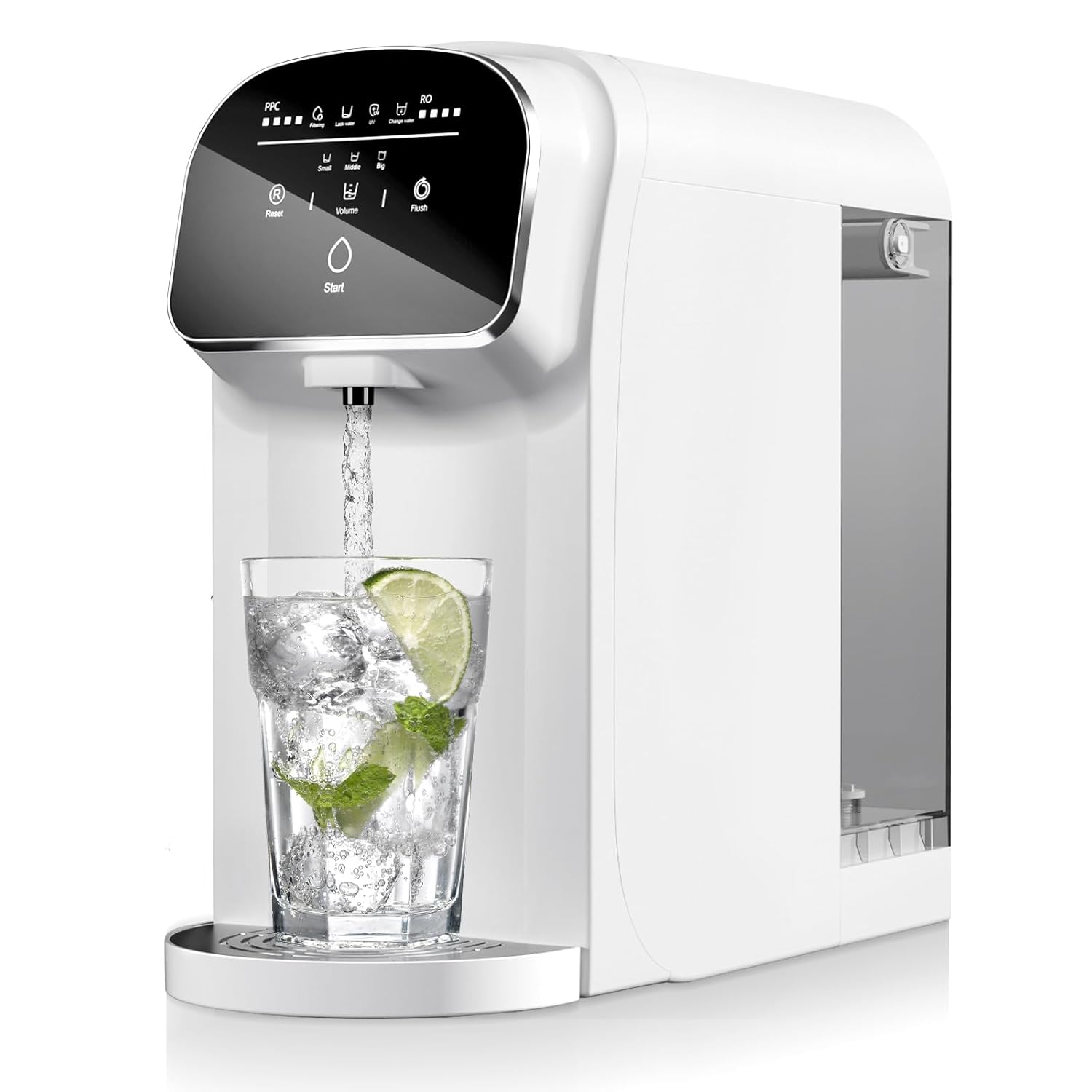
Aigerri Countertop RO System
| Purification Method | Reverse Osmosis |
|---|---|
| Capacity | 5 liters |
| Other Special Features of the Product | 5 Stages RO Filter, 5:1 Pure to Drain, Self Cleaning, UV |
| Container Type | Dispenser |
| Installation Type | Countertop |
This countertop RO dispenser delivers multi-stage purification without plumbing or installation, making it simple to add reverse osmosis water to a kitchen, office, or RV. You fill the 5L feed tank, plug the unit in, and the system runs PPC prefiltration, an RO membrane, and UV treatment before dispensing purified water into a separate purified water tank. The 5:1 pure-to-drain ratio is unusually efficient for an RO device and helps reduce wastewater compared with many traditional systems, and the unit's built-in filter set is rated to produce hundreds of gallons before replacement. Practical benefits include fast setup, portable countertop placement, and the combination of RO plus UV for broader contaminant reduction. Trade-offs to expect are the footprint and weight of a full countertop unit and the need to monitor and replace cartridges periodically; because it is self-contained it does not integrate with existing plumbing for continuous feed without manual refilling.
Best for: Buyers who prioritize a reliable, factory-ready RO system that works immediately without plumbing and who want efficient purified water with layered disinfection for home or small shared spaces.
Less Ideal for: People who need a permanently plumbed under-sink system or a nearly invisible installation should look at hard‑plumbed alternatives instead.
- Plug-and-play countertop design requires no plumbing or professional installation
- 5-stage filtration with RO membrane and UV adds multiple layers of contaminant reduction
- 5:1 pure-to-drain ratio improves water efficiency versus many RO systems
- Large 5 liter feed tank provides daily usable capacity without constant refilling
- Self-contained unit requires periodic filter replacements and monitoring
- Larger countertop footprint and weight compared with small pitchers or inline filters
Verdict: Choose this countertop RO system when you want a reliable, no‑installation reverse osmosis purifier that delivers efficient, multi-stage treated drinking water right away.
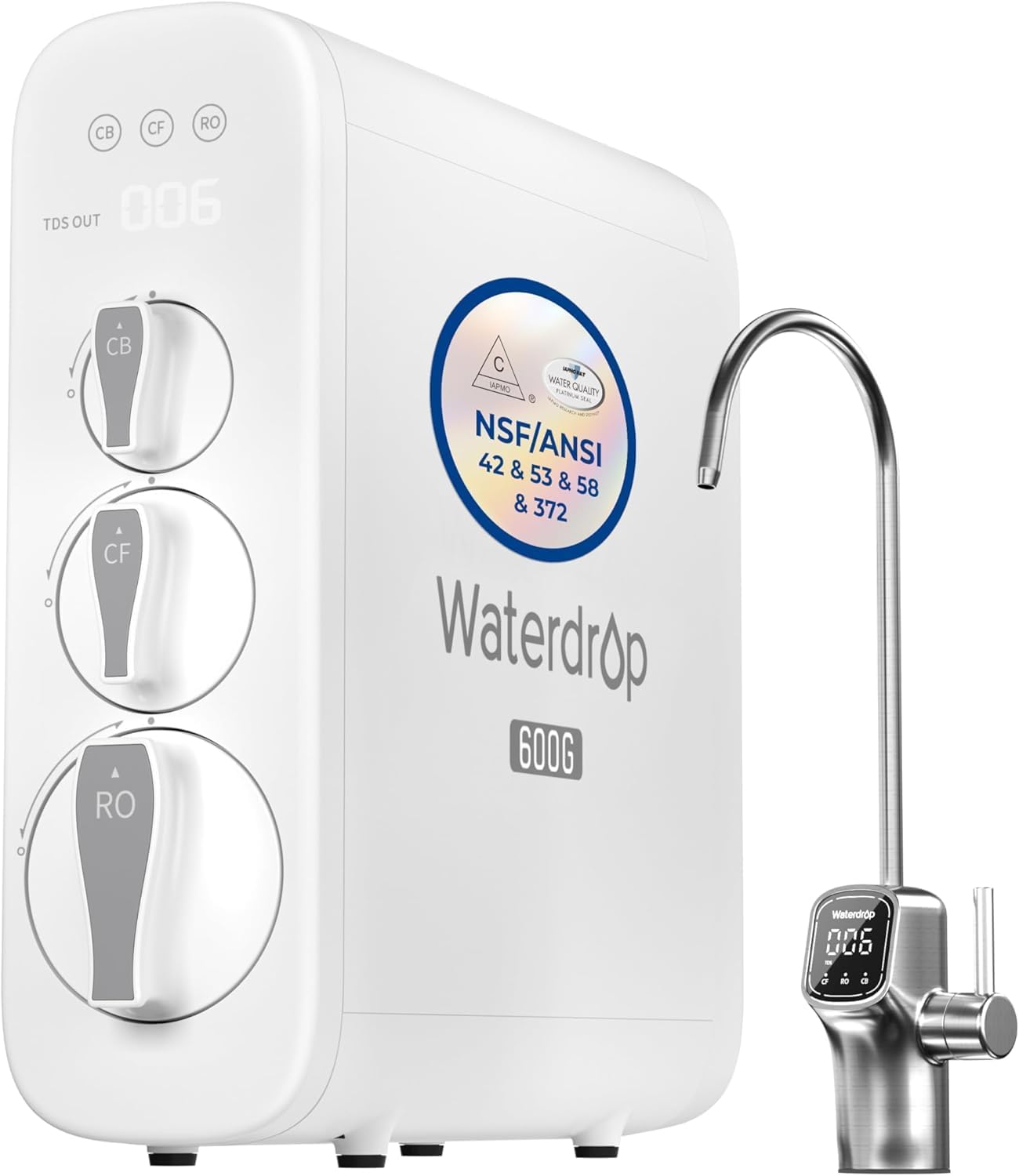
Waterdrop G3P600 Reverse Osmosis
| Filtration stages | 8-stage |
|---|---|
| Flow rate | 0.42 gpm |
| Pure to drain ratio | 2:1 |
| Power source | Corded Electric |
| Supported TDS maximum | 1500 ppm |
The Waterdrop G3P600 is a tankless under-sink reverse osmosis system designed to deliver fast, high-capacity drinking water while saving cabinet space. It uses an 8-stage filtration train including carbon block and an RO membrane to remove TDS, heavy metals, PFAS, chlorine and other contaminants, and the system claims a 2:1 pure-to-drain ratio so it wastes less water than many traditional RO units. The tankless design and compact footprint free up under-sink storage and the quick-twist filters make replacements straightforward without tools. The included smart faucet shows real-time TDS and filter life so you can monitor water quality and maintenance needs at a glance. Expect a steady flow that fills an 8 oz cup in roughly 8 seconds, but note the unit requires a standard under-sink electrical connection and has a specified operating pressure and temperature range, so installation may need checking against local plumbing conditions. For buyers focused on certified contaminant reduction and visible filter monitoring, this unit is a practical, space-saving option.
Best for: Buyers who want certified contaminant reduction and visible, easy-to-monitor water quality in a compact, high-output under-sink RO system backed by many customer reviews.
Less Ideal for: Those who need a completely passive system without electricity, have very tight or shallow cabinets that cannot accommodate the unit, or prefer a tank-style dispenser for stored reserve water.
- High production capacity up to 600 GPD for fast dispensing
- 8-stage filtration reduces TDS, heavy metals, PFAS, chlorine and other contaminants
- Tankless design saves under-sink space and simplifies installation footprint
- Smart display faucet provides real-time TDS and filter life information
- Low 2:1 pure-to-drain ratio reduces wastewater compared with many RO systems
- Requires under-sink electrical connection which may complicate installation
- Installation needs adequate cabinet clearance and two drilled holes for faucet and drain
- Manufacturer filter lifespan guidance requires periodic replacements to maintain performance
Verdict: Choose the G3P600 if you want a compact, tankless RO that delivers high daily output with certified contaminant reduction and a smart faucet for easy water-quality monitoring.
DREO RO Countertop WF112

| Purification Method | Reverse Osmosis |
|---|---|
| Capacity | 3 liters |
| Other Special Features of the Product | Built In TDS Meter, Change Filter Indicator, Reduce TDS, Touch Control |
| Pure to Drain Rate | 3:1 |
The DREO WF112 is a countertop reverse osmosis system designed to deliver near–bottle-quality water without installation. It uses a 7-stage RO filter and reports real-time TDS for both feed and purified water, which helps confirm when the unit is producing low-TDS water. The system fills a 3 liter tank and includes a 1.1 liter auto-fill pitcher that refills hands-free via a sensor, making day-to-day dispensing simple for one to two people. Built-in features like a filter-change indicator and an automatic self-clean cycle that flushes internal tubing reduce maintenance fuss and help keep water tasting fresh. The unit advertises a 3:1 pure-to-drain ratio to limit waste compared with some RO systems, and replacement filters are twist-to-install for quick swaps. Trade-offs are the modest 3 liter capacity that suits small households rather than large families, and the RO process still produces some wastewater despite the improved ratio.
Best for: Buyers who want a ready-to-use, installation-free RO dispenser that provides measurable water-quality feedback and low-maintenance features for everyday drinking water.
Less Ideal for: Homes needing high daily water output or large-family use should consider larger-capacity filtration systems or plumbed RO units instead.
- Built-in TDS meter and filter-life indicator for visible water quality and maintenance prompts
- Auto-fill pitcher with sensor for hands-free dispensing
- Self-cleaning auto-flush reduces tubing buildup and routine maintenance
- 3:1 pure-to-drain ratio lowers wastewater compared with many RO units
- 3 liter tank capacity limits throughput for larger households
- RO filtration still generates some wastewater despite the improved ratio
Verdict: Choose the DREO WF112 if you want a compact, installation-free RO dispenser with real-time TDS monitoring and low-maintenance features for reliable drinking water.
Choosing the Right Reverse Osmosis Water Dispenser: Key Factors to Consider
Filtration Efficiency and Water Quality
A reverse osmosis system's primary purpose is to remove dissolved solids, heavy metals, and common contaminants that affect taste and safety. Look for membrane stage performance and any supporting pre- and post-filters that reduce sediment, chlorine, and organic tastes.
Higher removal rates typically translate into noticeably cleaner-tasting water and lower total dissolved solids. If you have specific local water issues such as elevated lead or nitrate levels, check whether the system targets those contaminants and whether certification or third-party testing backs those claims.
Dispensing Options and Flow Rate
Dispensing performance covers how quickly water is delivered, the range of temperatures available, and control options such as hands-free sensors or manual taps. Flow rate matters for everyday use: slow output can frustrate when filling pitchers or pots.
Consider whether you need hot, cold, or ambient dispensing and whether the machine's dispenser design fits your typical containers. Some units offer adjustable flow or measured pours that reduce spills and waste.
Installation and Space Requirements
Reverse osmosis dispensers come in under-sink, countertop, or freestanding designs, and each has different space and plumbing needs. Under-sink installations hide equipment but require available cabinet space and a drain connection. Countertop or freestanding units are easier to install but take up visible counter or floor area.
Assess the water line access, available clearance for filters and tanks, and whether you can accommodate occasional professional servicing. Ease of installation directly affects initial cost and how quickly you can start using the dispenser.
Maintenance Frequency and Ongoing Costs
RO systems require periodic filter and membrane replacement. The frequency varies by pre-filter type, local water quality, and household usage. Shorter filter-change intervals increase operating cost and maintenance time, while longer-life cartridges reduce hands-on upkeep.
Factor in how easy it is to source replacement filters, whether cartridge swaps are tool-free, and whether the unit provides indicators or alerts for service intervals. Also consider whether the system includes washable or reusable pre-filters to lower lifetime expense.
Build Quality, Materials, and Safety
Durable valves, corrosion-resistant fittings, and food-safe plastics or stainless steel where water contacts materials extend service life and reduce leak risk. Check for child-safety features and temperature safeguards if hot water dispensing is offered.
A sturdier construction often means fewer service calls and better performance under continuous household use. Materials also influence taste and odor profiles, so models with stainless or BPA-free contact surfaces are preferable.
User Controls and Convenience Features
Convenience features include digital displays, filter-life indicators, push-button or touchless dispensing, and integrated storage tanks. These elements shape daily interaction with the dispenser and can make routine tasks faster and less messy.
Decide which conveniences justify a more complex unit. For example, an integrated hot-water dispenser adds functionality but increases safety considerations and maintenance. Simpler controls may be preferable if low upkeep is a priority.
Under-Sink Versus Countertop Installations
Choosing between under-sink and countertop reverse osmosis dispensers is mostly a tradeoff between aesthetics and accessibility. Under-sink units hide the filtration hardware and keep counters clear, but they require cabinet space and a drain connection for the RO waste line.
Countertop or freestanding dispensers are simpler to set up and move, making them a good fit for renters or kitchens without spare cabinet space. They are more visible and generally easier to access for filter changes, but can dominate limited counter areas.
- Under-sink: Cleaner look, hidden tank, requires plumbing and cabinet space.
- Countertop: Easier to install, more accessible for maintenance, occupies counter area.
Understanding Water Storage and Pressure
Many reverse osmosis dispensers use a pressurized storage tank to deliver immediate flow rather than waiting for the membrane to produce water on demand. Tank capacity and internal pressure determine how many glasses you can dispense quickly before the system needs to refill.
If your household uses a lot of drinking water in short intervals, choose a dispenser with a larger tank or higher recovery rate. For low-demand homes, a compact tank or demand-fed design may be sufficient and saves space.
- Larger tanks reduce wait time between fills.
- Higher recovery rates mean less water wasted per gallon produced.
Temperature Control and Hot Water Safety
Units that offer hot water on demand add versatility for beverages and cooking, but they require extra safety features to prevent scalding. Look for models with discrete hot-water controls and child-safety locks if hot water is available.
Temperature selection should be reliable and predictable. If your primary need is cold or ambient drinking water, a system without hot dispensing is usually simpler and has fewer maintenance points.
- Hot dispensing adds function but increases maintenance and safety needs.
- Cold-only units are simpler and often more energy efficient.
Monitoring Performance and When to Replace Parts
A dependable dispenser will include clear guidance on filter and membrane life and may provide visual or electronic indicators for replacements. Replace filters on the schedule recommended by the manufacturer and sooner if local water quality is poor or usage is heavy.
Regular maintenance preserves taste and filtration efficiency. Keeping a log of filter changes and watching for taste or flow changes helps you catch issues early before they affect water quality.
- Watch for decreases in output and changes in taste as early signs of needed service.
- Follow a consistent replacement schedule and use authentic or recommended filter types.
Space Planning and Kitchen Integration
Plan where the dispenser and any peripheral bits will live before you purchase. Consider where the faucet, drain connection, and power outlet are located and whether the unit's footprint fits your cabinet or counter space.
Also think about how the dispenser will integrate visually with your kitchen. Compact or built-in-styled units blend in better, while larger freestanding models can be a focal point and may require relocating other items.
- Measure vertical and horizontal clearances for under-sink tanks and filter housings.
- Check access paths for carrying replacement filters into the installation area.
How We Chose the Best Reverse Osmosis Water Dispenser
We focused on features and specifications that directly affect usability, water quality, and ongoing ownership costs for reverse osmosis water dispensers. Primary evaluation criteria included filtration efficiency measured by contaminant reduction and TDS performance, dispensing performance including flow rate and temperature options, and installation flexibility such as under-sink or countertop configurations. We also examined maintenance burden through filter life, ease of replacement, and accessibility of service parts, plus build quality and materials for long-term reliability. Finally, we considered user-facing controls and safety features like child locks, hot-water safeguards, and certification claims where applicable. Excluded from consideration were dispensers that lack a true reverse osmosis membrane stage or units clearly intended only for industrial/commercial settings. We also filtered out products without documented filter-change intervals or basic safety features. The final shortlist balances water purification performance against day-to-day convenience and reasonable upkeep demands.
Our full evaluation process is outlined in our review methodology.
FAQ
How often should I change filters and the RO membrane?
Pre-filters typically need replacement every 6 to 12 months, depending on local water quality and usage. The RO membrane usually lasts between 2 and 5 years but should be tested or replaced sooner if you notice higher TDS or reduced output.
Can I install a reverse osmosis dispenser myself?
Many countertop and some under-sink systems are designed for homeowner installation using basic plumbing tools. However, if your setup requires drilling, complicated drain fittings, or you are uncomfortable with plumbing, professional installation is a sensible choice.
Does a reverse osmosis dispenser waste a lot of water?
RO systems produce wastewater during filtration, and efficiency varies between models. Higher-recovery systems and units with permeate pumps reduce waste, so compare recovery ratios if minimizing wastewater matters to you.
Will RO-treated water need remineralization?
Reverse osmosis removes most dissolved minerals along with contaminants, which can result in very low TDS water. Some people prefer a remineralization stage to restore a balanced taste and add back beneficial minerals. Whether to remineralize depends on taste preference and dietary considerations.
Are there safety concerns with hot-water dispensers integrated into RO units?
Integrated hot-water functions require temperature safety mechanisms like insulated taps and child locks. Use caution when dispensing hot water and ensure the unit includes protective features if hot dispensing is available.
Final Verdict
When choosing a reverse osmosis water dispenser, prioritize the filtration performance and the dispensing behavior that match your daily habits. If water purity is the top concern, focus on membrane and pre/post-filter specifications. If convenience matters more, weigh flow rate, tank capacity, and ease of maintenance. Balance installation needs and ongoing filter costs against the features you will actually use. Selecting a unit that matches your space, maintenance tolerance, and temperature requirements will deliver the most reliable drinking water experience for your home.