
Note: This article contains affiliate links. If you click on these links and make a purchase, we may earn a small commission at no extra cost to you. This helps support our research and content. Read our full affiliate disclosure here.
If you want consistently clean, great-tasting drinking water at home, a reverse osmosis water filter for home use is one of the most effective options. These systems remove a wide range of contaminants and can improve flavor, odor, and clarity for drinking and cooking. Choosing the right unit matters because size, filtration capacity, and installation complexity affect long-term performance and convenience. This guide covers our shortlist of the top systems that suit typical households, explains the practical tradeoffs to expect, and summarizes the evaluation criteria we used. Read on to compare units that prioritize filtration effectiveness, flow rate, and ease of maintenance before you pick the right system for your home.
Top Picks at a Glance
| Best Overall The best all-around choice for most situations | Waterdrop G3P600 Tankless RO System |  |
| Best Quality Built to a higher standard if you want something more solid | Home Master Artesian Full Contact TMAFC-ERP |  |
| Best Value The sweet spot between price and what you get | APEC Water ROES-50 |  |
| Best Budget The cheapest option that still gets the job done reliably | FS-TFC 5-Stage RO System |  |
| Top Rated A top-rated pick with lots of positive feedback | iSpring RCC7-BN Reverse Osmosis |  |
| Most Popular A crowd favorite that many people choose with confidence | iSpring RCC7AK-BN Reverse Osmosis |  |
| Best Seller A high-volume bestseller chosen again and again | DREO RO Water Filter 113 |  |
Waterdrop G3P600 Tankless RO System
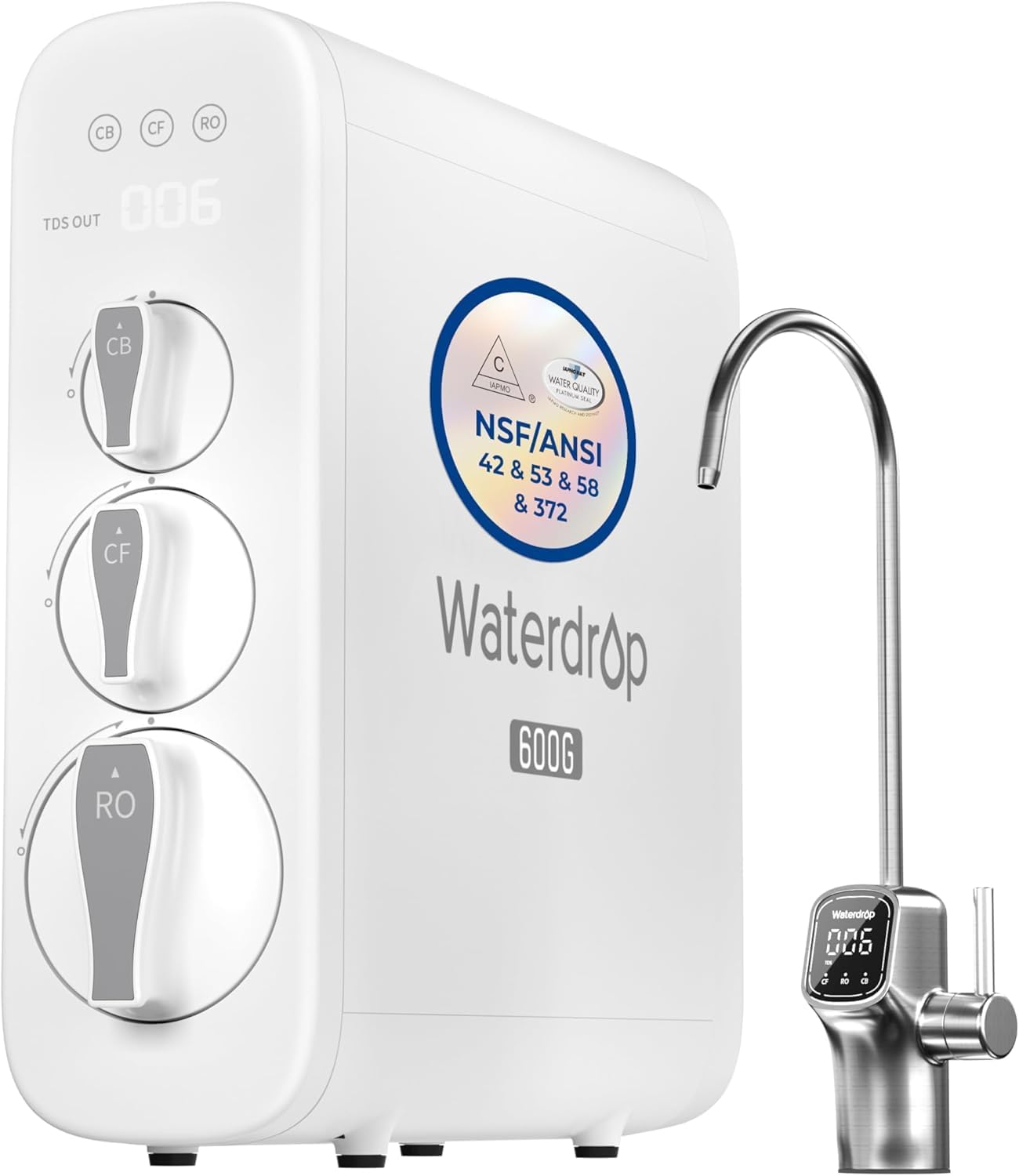
| Filtration stages | 8-stage Filtration |
|---|---|
| Flow rate | 600 GPD |
| Pure to drain ratio | 2:1 |
| Maximum flow rate (faucet) | 0.42 gpm |
| Power source | Corded Electric |
The Waterdrop G3P600 is a tankless under-sink reverse osmosis system built to deliver fast, high-volume purified water without a storage tank. It uses an 8-stage filtration train including RO membrane and carbon block elements to reduce TDS, chlorine, heavy metals and contaminants such as PFAS, and the unit is NSF/ANSI certified for key reductions. The tankless design saves under-sink space and the plug-in power and smart LED faucet provide a real-time TDS readout and filter life indicator so you can monitor water quality and replacements easily. The system produces water quickly—roughly an 8 oz cup in about 8 seconds—and the advertised 2:1 pure-to-drain ratio cuts wastewater compared with many traditional RO units. Installation requires under-sink electricity and two drilled holes for the faucet and drain connection, and while filters are quick to twist out for replacement, the unit does need occasional flushing and space for the components. For buyers who want fast, high-capacity tankless RO with visible monitoring, this system balances performance and convenience.
Best for: Buyers who want a compact, high-capacity RO system that delivers fast, monitored drinking water and value visible water-quality feedback during everyday kitchen use.
Less Ideal for: People without an accessible under-sink electrical outlet, renters who cannot drill holes, or users who prefer a simple non-powered countertop filter.
- High production rate up to 600 GPD for fast filling and heavy household use.
- Certified reductions (NSF/ANSI 42, 53, 58, 372) for chlorine, TDS and lead-free materials.
- Tankless design saves significant under-sink space compared with tank systems.
- Smart LED faucet with TDS monitor and filter life indicator for easy water-quality checks.
- Low 2:1 pure-to-drain ratio reduces wastewater versus many RO systems.
- Requires under-sink electrical outlet and two drilled holes for faucet and drain connections.
- Unit footprint still needs cabinet space for the components despite tankless design.
Verdict: Choose the G3P600 if you want a fast, tankless under-sink RO that saves space while giving high daily output and live TDS monitoring.
Home Master Artesian Full Contact TMAFC-ERP

| Purification Method | Alkaline, Reverse Osmosis |
|---|---|
| Maximum Flow Rate | 1 gpm |
| Operating Pressure Range | 40-95 psi |
| Supported Water TDS Level Maximum (PPM) | 500 |
| Capacity | 2000 gallons |
The Home Master Artesian Full Contact TMAFC-ERP is an under-sink RO system designed to deliver very pure, mineral-enhanced drinking water while addressing common RO shortcomings. Water passes through seven stages including sediment, catalytic carbon, a DOW RO membrane, and a patented two-pass remineralization that adds calcium and magnesium for improved taste. A built-in non-electric permeate pump reduces waste and raises output without using power, and the Fast Flo fittings and larger tubing give a noticeably quicker faucet fill. The modular, canister-style filters are easy to change annually or at 2000 gallons, and catalytic carbon helps remove chloramines better than ordinary carbons. Important limits: the system requires under-sink space for the assembled unit and tank and is intended for feed pressures and TDS levels within the listed ranges, and annual filter and membrane replacements are part of ownership costs. For buyers prioritizing high-performance home RO with faster flow and reduced wastewater, this unit delivers practical, measurable gains.
Best for: Buyers who want a high-performance home RO that prioritizes fast production, reduced wastewater, and mineralized, great-tasting tap water.
Less Ideal for: People with very limited under-sink space or those who prefer a no-maintenance, cartridge-free water solution should consider different options.
- Patented two-pass remineralization restores beneficial minerals for better-tasting water.
- Non-electric permeate pump increases production and cuts wastewater compared with typical RO systems.
- Fast Flo fittings and larger tubing provide a quicker faucet fill rate than many undersink RO units.
- Modular canister design makes annual filter changes straightforward without tools.
- Catalytic carbon stages improve chloramine and chemical removal beyond standard activated carbon.
- Requires dedicated under-sink space for the assembled unit and storage tank.
- Annual filter and membrane replacements add recurring maintenance costs.
Verdict: Choose this system if you want a fast, efficient under-sink RO that reduces waste and returns minerals for noticeably better-tasting water.
APEC Water ROES-50

| Purification Method | Reverse Osmosis |
|---|---|
| Filtration Stages | 5-Stage |
| Capacity | 50 gallons |
| Operating Pressure Range | 40-85 psi |
| Filter Life Cycle | 6 months |
The APEC Water ROES-50 is a five-stage under-sink reverse osmosis system designed to deliver very pure drinking water at about 50 gallons per day. It installs beneath the sink and includes a storage tank and dedicated faucet, with quick-connect fittings and color-coded tubing that make DIY installation and routine filter changes straightforward. The five stages combine sediment and carbon prefilters, an RO membrane, and a post-filter to reduce chlorine, lead, arsenic, fluoride, PFAs, microplastics and other common tap-water impurities, producing neutral-tasting water for cooking and beverages. Filters are sized for long life so maintenance is intermittent: prefilters typically last 6 to 12 months and the membrane and post-filter up to 12 to 24 months depending on feed-water. Practical limits include a modest maximum flow rate and a requirement for 40 to 85 psi feed pressure and AC power for any included components, so performance depends on household water pressure and quality; space under the sink is also needed for the system and tank. For homeowners wanting reliable, high-rejection RO water without professional installation, this is a solid, proven option.
Best for: Buyers who prioritize highly effective contaminant removal and a durable, easy-to-maintain under-sink RO system that they can install themselves for everyday drinking and cooking water.
Less Ideal for: People who need very fast on-demand flow without a storage tank or those without sufficient under-sink space or water pressure should consider alternative filtration approaches.
- Five-stage filtration removes a wide range of contaminants including heavy metals, chlorine, PFAs and microplastics.
- Includes tank, faucet and installation kit so it is ready for under-sink setup out of the box.
- DIY-friendly quick-connect fittings and colored tubing simplify installation and servicing.
- Long filter lifespans reduce frequency of replacements compared with smaller cartridge systems.
- Low maximum flow rate which can limit fill speed for pitchers or kettles.
- Requires adequate feed water pressure and under-sink space for the unit and storage tank.
Verdict: Choose the ROES-50 if you want a proven, DIY-friendly under-sink RO that reliably produces very pure drinking water for daily home use.
FS-TFC 5-Stage RO System

| Purification Method | Reverse Osmosis |
|---|---|
| Maximum Flow Rate | 18 liters per hour |
| Operating Pressure Range | 30-85 psi |
| Supported Water TDS Level Maximum (PPM) | 500 |
| Capacity | 100 gallons |
This FS-TFC 5-stage reverse osmosis system is an under-sink purifier designed to deliver drinking water by removing a broad set of contaminants. It uses a five-stage filtration train and a pressurized storage tank to provide about 18 liters per hour flow at standard pressure, making it suitable for daily drinking, cooking, and beverage prep. The unit is notable for its compact footprint intended to fit under most sinks and for a tool-free, largely DIY installation with included fittings and an RO faucet. It operates without electricity and claims a low 1:1 drain ratio, which helps reduce wasted water compared with many RO units, and the package includes four extra replacement filters to cover roughly a year of maintenance. Important limitations are that filter life is listed as one year and the system needs adequate inlet pressure (30 to 85 psi) and moderate incoming total dissolved solids (up to 500 ppm) to perform as specified, so performance can vary with feed water quality and pressure. The manufacturer offers a two year warranty and lifetime technical support for troubleshooting or parts questions.
Best for: Buyers on a budget who want a capable under-sink RO that is easy to install themselves and keeps ongoing costs low through included replacement filters and efficient water use.
Less Ideal for: Homes with very high TDS feed water, inconsistent low inlet pressure, or those that prefer a higher-capacity commercial-style RO system should consider other options.
- Five-stage RO filtration for broad contaminant reduction.
- Compact under-sink design that fits most standard sinks.
- Tool-free DIY installation with included fittings and faucet.
- Runs without electricity and reports a low 1:1 drain ratio to reduce wasted water.
- Includes four extra replacement filters to lower first-year maintenance cost.
- Filter life listed as one year, requiring annual replacements.
- Requires adequate inlet pressure and works up to specified TDS limit, so municipal well users may need testing.
Verdict: A compact, budget-friendly under-sink RO that delivers broad contaminant removal, easy DIY installation, and low first-year operating cost.
iSpring RCC7-BN Reverse Osmosis

| Purification Method | Reverse Osmosis, Activated Carbon, Carbon block |
|---|---|
| Capacity | 75 gallons |
| Maximum Flow Rate | 3.4 liters per minute |
| Supported Water TDS Level Maximum (PPM) | 750 |
| Power Source | No Power Needed |
The iSpring RCC7-BN is a five-stage under-sink reverse osmosis drinking water system designed to deliver near-bottled quality water for a household. It uses three pre-filters (sediment, GAC, carbon block), a high-rejection RO membrane and a final GAC polish to remove particulates, chlorine, PFAS and many dissolved solids down to 0.0001 microns, and it is NSF/ANSI 58 certified. Installation is typical for RO systems and the kit includes housings, tubing, fittings and a designer brushed nickel faucet; the transparent first-stage housing makes visual checks simple and push-to-connect fittings help limit leaks. The system requires no electricity and stores purified water in the included tank for on-demand use, with a reported capacity of 75 gallons and a maximum flow rate around 3.4 L/min. Considerations: it is intended for municipal tap water rather than untreated well water, replacement filters are required on a schedule, and the unit occupies under-sink space and adds a wastewater stream typical of RO systems.
Best for: Buyers who prioritize long-term, proven contaminant reduction and certified performance for household drinking water will appreciate this system for daily drinking, cooking, and beverage use.
Less Ideal for: If you need a point-of-entry whole-house treatment or have untreated well water without prefiltration, choose systems specifically designed for those conditions instead.
- Comprehensive five-stage filtration including an RO membrane for high contaminant reduction
- NSF/ANSI 58 certification for performance and safety
- Transparent first-stage housing for quick visual filter checks
- Includes faucet, tank and all fittings for a complete under-sink installation
- No power required and compact layout fits under most sinks
- Not designed for untreated well water without prior whole-house treatment
- Requires periodic filter and membrane replacements
- Consumes under-sink space and produces a wastewater drain stream
Verdict: A certified, high-capacity five-stage RO system that delivers dependable, bottled-quality drinking water for households focused on proven contaminant reduction.
iSpring RCC7AK-BN Reverse Osmosis

| Purification Method | Reverse Osmosis, Alkaline, Activated Carbon, Carbon block |
|---|---|
| Power Source | No Power Needed |
| Maximum Flow Rate | 284 liters_per_day |
| Supported Water TDS Level Maximum (PPM) | 750 |
| Filter Life Cycle | 6 months |
The iSpring RCC7AK-BN is a six-stage under-sink reverse osmosis system that delivers thoroughly filtered, remineralized drinking water without needing electricity. It installs beneath the sink and connects to a dedicated brushed-nickel faucet; the patented top-mounted fastener lets you secure the faucet from above for easier countertop installation. The system uses sediment, carbon, RO membrane, and an alkaline mineral stage to reduce a wide range of contaminants including lead, PFAS, fluoride, chlorine and high TDS while restoring healthy minerals and a balanced pH. Clear first-stage housing makes sediment checks simple and push-to-connect fittings with color-coded tubing speed up DIY installation and maintenance. The unit is NSF/ANSI 58 certified for whole-system performance and comes with a storage tank and extra tool set, but like most RO units it requires periodic filter and membrane replacements and produces waste water during rejection. It is compact for under-sink placement but needs a compatible cold-water feed and some basic plumbing comfort to install well.
Best for: Buyers who prioritize verified performance and reliable third-party certification and want a system that removes a broad range of contaminants while adding back minerals for better tasting water.
Less Ideal for: Not a good fit for renters or users unwilling to perform periodic maintenance or make a cold-water feed connection under the sink.
- NSF/ANSI 58 certified full-system performance
- Six-stage filtration including alkaline remineralization for improved taste and pH
- Transparent first-stage housing for visual sediment monitoring
- DIY-friendly push-to-connect fittings and top-mounted faucet fastener for easier installation
- Works without electricity and includes storage tank and brushed-nickel faucet
- RO systems generate reject water during filtration
- Requires routine filter and membrane replacements on a set schedule
Verdict: Choose the RCC7AK-BN if you want a NSF-certified, non-electric under-sink RO system that removes wide-ranging contaminants and returns mineralized, better-tasting water.
DREO RO Water Filter 113

| Purification Method | Reverse Osmosis |
|---|---|
| Capacity | 5 liters |
| Pure to Drain Rate | 3:1 |
| Included Components | WF113 Body, 1 RO Filter, 2 Autofill Pitchers |
The DREO RO Water Filter 113 is a plug-in countertop reverse osmosis system designed to give households ready-to-drink filtered water without plumbing. It uses a 7-stage RO filter and provides a 3:1 pure-to-drain ratio while the built-in TDS meter and filter-life indicator let you monitor water quality and know when to swap cartridges. The unit includes two autofill pitchers so one is always topped up while the other is in use, and the self-cleaning auto-flush reduces stagnant water in internal tubing. Installation is truly install-free—place it on a counter and plug it in—making it suitable for renters or kitchens where under-sink hookups are impractical. Trade-offs include the countertop footprint and roughly 5L tank capacity, which is sized for small families rather than large households, and like most RO systems it produces reject water. Filter life is specified as about 265 gallons per cartridge so replacements are an ongoing cost, but the twist-to-install filters keep maintenance simple.
Best for: Buyers who want a worry-free, plug-in RO system that delivers measurable water quality and simple, low-effort maintenance for a small household or apartment.
Less Ideal for: Large families or users who need high daily output without any reject water should consider plumbed high-capacity systems instead.
- 7-stage RO filtration with SGS-tested impurity reduction for broad contaminant removal
- Built-in real-time TDS meter and filter-life indicator for easy quality monitoring
- Auto-fill dual-pitcher system and 5L tank provide ready access to filtered water without plumbing
- Self-cleaning auto-flush lowers stagnation risk and reduces hands-on maintenance
- Produces reject/drain water inherent to RO systems despite a 3:1 pure-to-drain ratio
- 5L tank capacity may require more frequent refills for larger households
Verdict: A convenient countertop RO that gives risk-averse buyers measurable water quality and easy maintenance without plumbing.
Choosing the Right Reverse Osmosis Water Filter for Home Use: Key Factors to Consider
Filtration Effectiveness
How well the system removes dissolved solids, heavy metals, chlorine byproducts, and microbiological impurities determines the overall water quality. Reverse osmosis membranes are the primary barrier to dissolved contaminants, while pre- and post-filters (sediment and carbon) protect the membrane and remove taste- and odor-causing chemicals.
Look for systems with documented reduction rates for total dissolved solids (TDS) and specific contaminants of concern in your area. Higher removal rates generally translate to better-tasting water and lower health risk from target contaminants, but effective prefiltration also extends membrane life and keeps maintenance simpler.
Daily Flow Rate and Recovery
Flow rate and recovery describe how quickly filtered water is produced and what portion of feed water becomes usable output. A low flow rate or poor recovery ratio can be frustrating during busy times and can increase total water use because more wastewater is produced.
Consider household drinking patterns and whether multiple users will draw water simultaneously. Systems with faster membrane output or larger storage tanks reduce wait times. Recovery rates vary by design and water pressure; higher recovery is more efficient and better for households on metered water supplies.
Installation Complexity
Some reverse osmosis systems are designed for straightforward DIY under-sink installation using standard plumbing fittings, while others require more advanced plumbing skills. Installation complexity affects the time and tools needed up front and whether you will need professional help.
Check whether the system requires a dedicated cold-water feed valve, a drain connection with an adapter, and sufficient under-sink space. Also plan for the location of the storage tank and faucet. Systems that include clear installation guides and push-fit connectors are typically easier for homeowners to install without hiring a plumber.
Filter Life and Ongoing Maintenance
Filter replacement schedules and the ease of changing cartridges impact recurring costs and the system's practical upkeep. Sediment and carbon prefilters usually need more frequent replacement than the RO membrane, and neglecting scheduled changes can reduce performance and shorten component life.
Consider how accessible replacement cartridges are and whether the system uses proprietary sizes. Look for systems with straightforward filter-change procedures and clear service intervals. Good documentation on how to sanitize the system and the availability of replacement parts locally or online will simplify long-term ownership.
Wastewater Production and Environmental Impact
Reverse osmosis inherently produces a concentration of rejected water that becomes wastewater. The wastewater ratio varies by design, pressure, and whether the system uses flow restrictors or booster pumps. Higher wastewater means more water used overall and possibly higher utility bills.
If water conservation matters, choose systems with improved recovery rates, permeate pumps, or optional tankless designs that reduce reject flow. Also consider whether reclaimed graywater options or landscaping uses for reject water are practical for your household to minimize environmental impact.
Storage Capacity and On-Demand Availability
Most under-sink RO systems include a pressurized storage tank to ensure on-demand delivery. Tank capacity impacts how much filtered water is immediately available and how often the membrane must run to refill the tank.
If you frequently refill large containers or have a large family, prioritize systems with larger tanks or faster refill rates. Some modern designs include tankless options or higher-flow membranes to reduce footprint while maintaining supply during peak use.
Sizing a System for Your Household
Match the system's production rate and tank size to your household's daily consumption. A typical small family needs a higher flow rate or larger storage tank than a single occupant who drinks mostly bottled water.
Estimate peak usage times such as mornings and evenings. If multiple people will be filling pitchers or using filtered water for cooking at the same time, prioritize higher output or larger tanks to avoid wait times.
- Consider average daily drinking and cooking needs when selecting membrane capacity.
- Account for other uses like ice makers or beverage machines that may tap the same faucet.
- Plan for future household size changes or more frequent guest use.
Placement and Under‑Sink Space
Before buying, measure under-sink space and cabinet depth to ensure the tank and filter housings fit. Some systems require vertical clearance for cartridge removal, while others use horizontal-stacked filters to save height.
Also check where the drain saddle and feed valve will attach. Tight or oddly shaped cabinetry can complicate installation, so plan routing for the feed and drain tubing to avoid kinks.
- Verify faucet hole availability on your sink or countertop.
- Allow for extra room to change filters without disassembling plumbing.
- Measure both cabinet height and depth, not just width.
Water Pressure and the Need for Booster Pumps
Reverse osmosis membranes rely on adequate feed pressure to push water through the membrane efficiently. Low household water pressure reduces output and worsens recovery ratios.
If your mains pressure is low, look for systems that include or allow an accessory booster pump. Booster pumps raise feed pressure to the membrane, improving production rate and reducing wastewater, but they add complexity and electrical needs.
- Check your typical cold-water pressure before purchase.
- Expect higher performance and faster tank refill with a booster pump if pressure is under recommended levels.
- Weigh noise and electrical outlet requirements for pump-equipped systems.
Sanitation and Preventing Bacterial Growth
Because RO systems store treated water in a tank, sanitary design is critical. Look for systems with antibacterial tank linings or easy sanitization procedures to limit bacterial growth between filter changes.
Periodic sanitizing of the system during filter changes helps maintain water quality. Clear guidance from the manufacturer on disinfection steps and recommended intervals makes maintenance less error-prone.
- Follow recommended sanitization schedules during filter replacements.
- Consider systems that simplify tank access or include quick-swap cartridges.
- Use replacement filters from reputable sources to avoid compromised filtration.
Monitoring Water Quality and When to Test
A simple total dissolved solids meter can confirm that the system is reducing mineral content as expected. Regular testing helps detect declining membrane performance or missed filter changes.
Test after installation to establish a baseline, and retest periodically or after long storage periods or service work. If your tap water source changes, retest more frequently until you confirm stable removal rates.
- Use TDS measurements to monitor membrane health over time.
- Test for specific local contaminants if you have known water-quality concerns.
- Keep a maintenance log with filter-change dates and test results.
How We Chose the Best Reverse Osmosis Water Filter for Home Use
We focused on attributes that matter for households using reverse osmosis systems as their primary point-of-use drinking-water treatment. Key evaluation criteria included filtration performance, measured by the ability to reduce common contaminants such as dissolved solids and chlorine byproducts; system flow and recovery rate, since slow delivery or excessive wastewater affects usability; and installation complexity, including footprint and whether common household tools suffice. We also assessed filter life and routine maintenance demands, because replacement frequency and filter availability determine ongoing running costs and convenience. Build quality and materials were reviewed for long-term durability and sanitary operation. Finally, we considered storage tank capacity and on-demand delivery features, which influence how easily a family can access filtered water during peak use. We excluded point-of-entry whole-house softening systems and products that rely solely on carbon-only pitchers or faucet attachments. Units that required specialized plumbing beyond common homeowner skills were noted but not automatically excluded. The final picks balanced measurable contaminant reduction, reasonable wastewater ratios, manageable maintenance, and straightforward installation.
Our full evaluation process is outlined in our review methodology.
FAQ
How often should I change filters in a reverse osmosis system?
Prefilters such as sediment and carbon typically need changing every 6 to 12 months depending on water quality and usage. The RO membrane usually lasts 2 to 5 years but should be checked if output or TDS reduction declines.
Will a reverse osmosis system remove fluoride and lead?
Reverse osmosis membranes are effective at reducing many dissolved minerals and heavy metals, including lead. Fluoride removal is also possible but varies by membrane and system configuration, so check documented reduction rates for specific contaminants.
Can I install an under‑sink RO system myself?
Many systems are designed for DIY installation with standard fittings and clear instructions. However, complex cabinet layouts, low water pressure, or lack of experience with plumbing may make professional installation sensible.
How much wastewater does an RO system produce?
Wastewater ratios vary widely by design and pressure. Typical residential units produce between one and four gallons of reject water for every gallon of purified water, though systems with permeate pumps or higher-pressure operation can achieve better recovery.
Do I need a booster pump for my home?
A booster pump is useful if your household water pressure is below the membrane's recommended range and you want faster production and better recovery. Measure your cold-water pressure and compare it to the system's specifications before deciding.
Final Verdict
Prioritize filtration effectiveness, reasonable production rate, and manageable maintenance when choosing a reverse osmosis water filter for home use. Balance tank size and flow rate against available under-sink space and water pressure to avoid frustrations during peak demand. Accept tradeoffs between higher recovery and system complexity. If water conservation is important, favor systems with better recovery or optional pumps. With the right balance of filtration performance, installation feasibility, and maintenance demands, you can select a system that reliably delivers safe, great-tasting water for daily household use.