
Note: This article contains affiliate links. If you click on these links and make a purchase, we may earn a small commission at no extra cost to you. This helps support our research and content. Read our full affiliate disclosure here.
A robot mop can free you from daily floor scrubbing while keeping hard surfaces cleaner between deep cleans. When you are shopping with a sub-$200 budget, you need a unit that balances reliable cleaning, decent run time, and easy maintenance without costly extras. This guide shortlists the top affordable robot mops, focusing on real-world cleaning effectiveness, battery life, and convenience features that matter for everyday use. Below are our top picks and the specific evaluation points we used to judge each model, so you can match a choice to your flooring and cleaning habits.
Top Picks at a Glance
| Best Overall The best all-around choice for most situations | Yeedi vac Station |  |
| Best Quality Built to a higher standard if you want something more solid | Ecovacs Deebot T8 |  |
| Best Value The sweet spot between price and what you get | Tikom G8000 Max Robot Vacuum |  |
| Best Budget The cheapest option that still gets the job done reliably | ILIFE V5s Plus Robot Vacuum |  |
| Top Rated A top-rated pick with lots of positive feedback | roborock Q7 L5 Robot Vacuum |  |
| Most Popular A crowd favorite that many people choose with confidence | iRobot Roomba 105 Combo |  |
| Best Seller A high-volume bestseller chosen again and again | ROPVACNIC S1 Robot Vacuum |  |
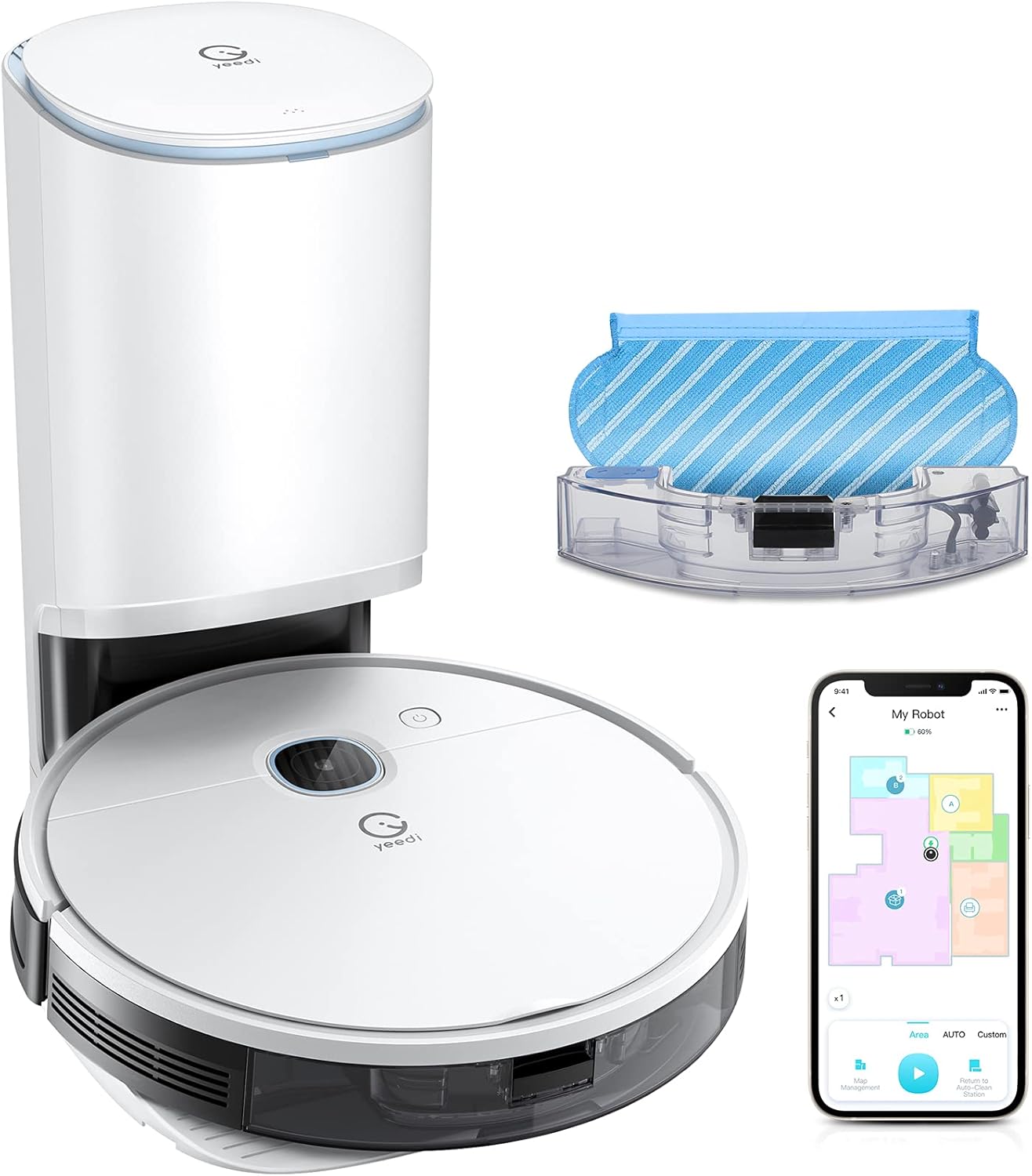
Yeedi vac Station
| Max suction | 3000 Pa |
|---|---|
| Max Runtime | 200mins |
| Self empty | Yes |
| Compatible Devices | Amazon Echo, Google Home |
| Filter Type | HEPA |
The Yeedi vac Station combines vacuuming, mopping, and a self-emptying base into a single, slim robot designed for routine floor care. It maps your home with visual navigation so it plans efficient paths, creates editable room maps, and lets you set virtual boundaries in the app; it also integrates with Alexa and Google Assistant for voice control. In use it switches between vacuum and mop modes, detects carpets and boosts suction where needed, and returns to the station to recharge and resume cleaning. Notable conveniences include a long 200-minute runtime for larger homes and a self-emptying bin that reduces how often you need to touch the dustbin. Limitations to expect are reliance on 2.4 GHz Wi-Fi only and the visual navigation approach can be less effective in very dark or textureless environments compared with LiDAR systems, and the product's larger self-empty bag and mop components add footprint at the base station.
Best for: Buyers who want an automated, low-maintenance floor cleaner that vacuums and mops regularly and value long runtime and app-based room mapping over premium navigation hardware.
Less Ideal for: Those who need guaranteed navigation in very dark or windowless spaces or who require 5 GHz Wi-Fi connectivity should consider other options.
- Self-emptying base with large bag capacity reduces manual emptying frequency
- Visual mapping with editable maps and room-specific scheduling via app
- 3000 Pa suction plus carpet detection for stronger pickup on rugs
- Long runtime (up to 200 minutes) with auto recharge and resume
- App, Alexa, and Google Assistant control for hands-free operation
- Only supports 2.4 GHz Wi-Fi, so it will not connect to 5 GHz networks
- Visual navigation can struggle in very dark or featureless rooms compared with LiDAR
- Base station and mop modules increase the unit's floor footprint
Verdict: Choose the Yeedi vac Station if you want a hands-off vacuum-and-mop robot with long runtime and a self-emptying base for low-maintenance cleaning.
Ecovacs Deebot T8

| Battery Life | 100 minutes |
|---|---|
| Capacity | 0.24 liters |
| Filter Type | Washable |
| Control Method | App |
| Compatible Devices | Alexa, Amazon Echo, Google Home, Smartphones |
The Deebot T8 is a laser-navigated robot that vacuums and mops in a single run while mapping multiple floors for targeted cleaning. It uses TrueMapping laser scans to build accurate floor plans and lets you set no-go and no-mop zones, label rooms, and schedule or customize suction and water levels from the app. TrueDetect 3D helps the robot identify small obstacles like cables and shoes to reduce collisions, and the washable filter and a 240 ml water tank support routine maintenance and mop coverage across most homes. Battery life of roughly 100 minutes is enough for medium-sized areas but may require a recharge for very large homes, and the mopping function is basic compared with powered scrubbing accessories sold separately. The T8 also supports upgrades such as an oscillating OZMO Pro mop and an auto-empty station for more hands-free operation. For someone who wants reliable navigation, app customization, and combined vacuum+mop capability, the Deebot T8 offers a well-rounded, practical solution.
Best for: Buyers who want a dependable, customizable robot that handles both vacuuming and light mopping across multiple floors and value accurate navigation and obstacle avoidance.
Less Ideal for: Households that need heavy-duty scrubbing or have very large floorplans that require longer continuous run time should consider other options.
- Accurate laser TrueMapping for multi-floor mapping and room-level cleaning
- TrueDetect 3D reduces collisions with small obstacles like cables and slippers
- Simultaneous vacuuming and controllable mopping with four water levels
- App control with room labeling, no-go/no-mop zones, and scheduling
- Washable filter and compatibility with optional auto-empty station and OZMO Pro mop
- 100-minute battery may be short for very large homes without recharge
- Mopping is passive and not as effective as a powered scrubbing accessory
Verdict: The Deebot T8 is a strong all-around robot for buyers who want precise mapping, reliable obstacle avoidance, and combined vacuum-plus-mop convenience in a single machine.
Tikom G8000 Max Robot Vacuum

| Suction | 5000Pa |
|---|---|
| Battery Life | 150 minutes |
| Dustbin Capacity | 450 ml |
| Water Tank | 300 ml |
| Noise Level | 45 db |
The Tikom G8000 Max is a low-profile robot vacuum that combines strong suction with mopping to keep hard floors and low-pile carpets tidy with minimal user effort. In use it maps and navigates with anti-collision and anti-fall sensors, and supports app, remote, voice, and onboard button control so you can schedule cleanings and start runs from a phone or the included remote. Notable features include a 5000Pa suction motor for lifting pet hair and debris, a combined 450 ml dustbin plus 300 ml water tank for simultaneous vacuuming and mopping, and a runtime up to 150 minutes with automatic recharge. Its 3-inch height lets it access under furniture and the Zig-zag cleaning mode improves coverage on open floor areas. Limitations to keep in mind are that higher-pile carpets may not get deep cleaning compared with upright vacuums and mopping is best for maintenance rather than heavy wet cleaning; occasional emptying of the dustbin and refilling the water tank are still required. For routine hardwood maintenance the G8000 Max offers a practical balance of suction, run time, and smart controls.
Best for: Buyers who want a practical, time-saving floor care solution for hardwood and low-pile carpets and prioritize long runtime, reliable navigation, and flexible control options.
Less Ideal for: Households that need deep carpet extraction, heavy wet mopping, or commercial-grade cleaning should consider a dedicated upright or standalone mop system instead.
- Strong 5000Pa suction effective on hard floors and short-pile carpets
- Simultaneous vacuuming and mopping with combined dustbin and water tank saves time
- Long run time up to 150 minutes with auto-recharge for larger homes
- Slim 3-inch profile reaches under low furniture
- Multiple control options including app, remote, voice, and onboard button
- Mopping function is for light maintenance and not heavy wet cleaning
- May be less effective on high-pile carpets compared with full-size vacuums
Verdict: A slim, long-running robot that combines powerful suction and light mopping to keep hardwood floors clean with minimal hands-on work.
ILIFE V5s Plus Robot Vacuum

| Battery Life | 110 minutes |
|---|---|
| Capacity | 300 ml |
| Controller Type | App Control, Voice Control, Remote Control |
| Compatible Devices | Amazon Echo, Google Home |
The ILIFE V5s Plus is a slim 2-in-1 robot that vacuums and mops while offering app, remote and voice control for scheduled cleaning. It runs up to 110 minutes per charge and automatically returns to its charging dock when the battery is low, making it suitable for daily maintenance across small to medium rooms. The unit provides five cleaning modes including auto, spot, edge and max for adjustable suction and targeted passes, and its 300 ml tanks handle both dust and water for light mopping tasks. Practical benefits include a low profile that reaches under furniture, compatibility with Alexa and Google Assistant, and sensor suites that reduce falls and collisions. Limitations are a modest suction level compared with higher-end models, a relatively small water/dust capacity that requires frequent emptying for larger homes, and simpler navigation that may miss complex path optimization on cluttered carpets. For its price point the V5s Plus delivers consistent, hands-off upkeep rather than deep clean performance on thick carpeted surfaces.
Best for: Buyers looking for an affordable, no-frills robot that keeps hard floors and low-pile carpet tidy with minimal setup and smart-home control.
Less Ideal for: Homes that need powerful deep-cleaning on thick or high-pile carpets or large houses where longer runtimes and larger dust/water capacity are required.
- 2-in-1 vacuum and mop combination for quick maintenance of floors and light spills
- 110-minute runtime with automatic self-charging for largely unsupervised cleaning cycles
- Multiple cleaning modes and scheduling via app, remote or voice for flexible operation
- Slim profile and sensors help the robot reach under furniture and avoid drops or collisions
- Smaller 300 ml tanks and dustbin need more frequent emptying during larger jobs
- Navigation is basic compared with lidar or advanced mapping systems, so pathing can be inefficient on cluttered layouts
Verdict: A budget-friendly robot that combines vacuuming and light mopping with smart controls to keep small-to-medium homes tidy without breaking the bank.
roborock Q7 L5 Robot Vacuum

| Suction | 8,000 Pa |
|---|---|
| Navigation | LiDAR |
| Battery life | 150 minutes |
| Water tank capacity | 270 ml |
| Filter type | Washable |
The roborock Q7 L5 is a LiDAR-guided robot vacuum that vacuums and mops in a single run, using an integrated 270 ml water tank and up to 8,000 Pa suction to handle dust and pet hair on hard floors and low‑pile carpet. It maps rooms with multi-floor support and quick mapping so you can set scheduled cleans, no-go zones, and targeted room runs from the Roborock app or with voice assistants. Practical features include a dual anti-tangle brush system that reduces hair wrap, carpet boost that increases suction where needed, washable filters, and a child lock. For hardwood floors the precise navigation and along-floor-direction cleaning reduce repeated passes and the electronic water control offers three water levels to avoid over-wetting. Limitations to note are the combined dustbin/water-tank design which means you cannot refill water without handling the combo unit, and the robot requires a 2.4 GHz Wi‑Fi connection for full app features.
Best for: Buyers who prioritize reliable, predictable cleaning on hardwood and want a robot that follows precise maps, runs on a schedule, and minimizes hair-related maintenance.
Less Ideal for: People who need separate, large-capacity water or dust tanks for long runs without handling the unit frequently or who cannot provide a 2.4 GHz Wi‑Fi network.
- LiDAR mapping and multi-floor mapping for accurate, efficient coverage
- Strong 8,000 Pa suction with carpet boost for better pickup of dust and pet hair
- Dual anti-tangle brushes minimize hair wrap and maintenance
- Electronic water tank with three water levels lets you control mop moisture
- App control plus Alexa and Google Home compatibility for scheduled, hands-free operation
- Integrated dustbin and water tank is a single combo part, which adds steps when refilling or emptying
- Requires 2.4 GHz Wi‑Fi for app connectivity, which may need router changes for some homes
Verdict: A strong‑suction, LiDAR‑mapped vacuum‑and‑mop that reliably cleans hardwood with low hair maintenance and smart app controls.
iRobot Roomba 105 Combo

| Battery Life | 100 minutes |
|---|---|
| Power Source | Battery Powered |
| Capacity | 0.5 liters |
| Filter Type | Cartridge |
| Control Method | App, Push Button, Voice |
The Roomba 105 Combo is a compact robot vacuum that combines vacuuming and mopping for routine floor care on hard surfaces and low-pile carpets. It maps rooms with ClearView LiDAR so it cleans in organized rows and avoids obstacles and drops, and it detects carpets to automatically stop mopping where rugs are present. Users can choose vacuum-only, mop-only, or vacuum-and-mop modes and adjust three suction levels plus three water settings for the mop, which uses a reusable microfiber pad and a micro-pump to keep moisture even. The 4-stage cleaning system and edge brush help lift grit from edges and baseboards, and the 100-minute battery life is sufficient for many medium-size homes. Setup and scheduling are handled through the Roomba Home App or voice assistants, and maintenance is typical: emptying the 0.5 L bin, wiping contacts, and occasional brush and filter care. Trade-offs include a relatively modest dust capacity and no self-empty base, so frequent emptying may be needed in high-dirt homes, and taller thresholds or very thick carpets could limit passage and mopping effectiveness.
Best for: Buyers who want a reliable robot that mops and vacuums hard floors with mapped cleaning and easy app or voice control, and who value proven performance backed by many user reviews.
Less Ideal for: People needing hands-off, low-maintenance solutions that auto-empty or those with large homes and heavy pet hair buildup that would require frequent manual emptying and maintenance.
- LiDAR mapping for systematic cleaning and obstacle avoidance.
- Combined vacuum-and-mop modes with selectable water flow and SmartScrub for deeper scrubbing.
- Detects and avoids carpets when mopping to protect rugs.
- Adjustable suction levels to match surface needs and conserve battery.
- Works with app and voice assistants for scheduling and remote control.
- Does not include an auto-empty dock so the bin requires manual emptying.
- 0.5 liter dust/water bin is relatively small for larger households.
- Not designed for tall-pile carpets or heavy obstacle clearance.
Verdict: A dependable LiDAR-mapped vac-and-mop that delivers targeted cleaning on vinyl plank and other hard floors when you want mapped navigation and mopping without a self-empty dock.
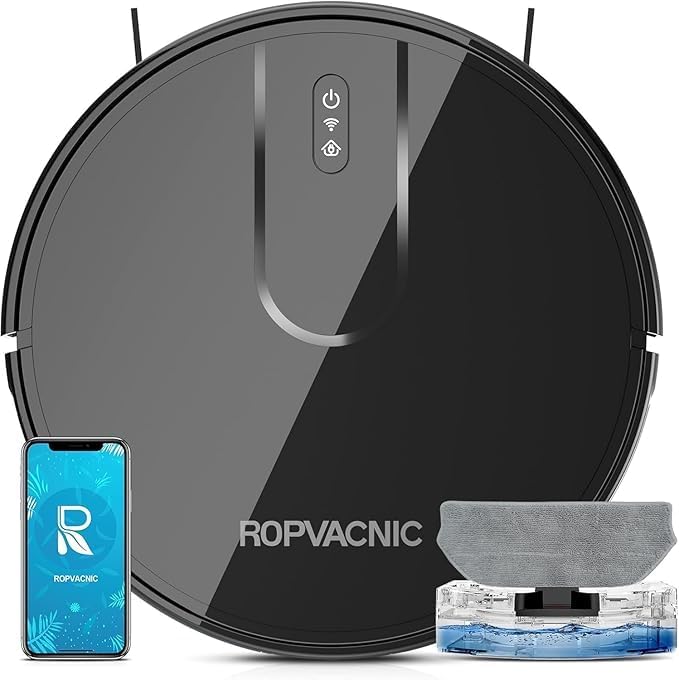
ROPVACNIC S1 Robot Vacuum
| Suction | 5200Pa |
|---|---|
| Battery Life | 120 minutes |
| Filter Type | Multi-layer Optimized High-Efficiency Filtration |
| Control Methods | App, Remote, Touchpad, Voice |
| Surface Recommendation | Hardwood Floors, Low Pile Carpets |
The ROPVACNIC S1 is a 2-in-1 robot vacuum and electrically controlled mop designed for day-to-day floor care in homes with pets and hard floors or low-pile carpets. It cleans using a three-point system with dual side brushes and a no-entanglement design aimed at handling pet hair, and its 5200Pa suction plus multi-layer HEPA-style filtration captures dirt and fine particles. The water tank supports four personalized mopping levels so you can dial back moisture for delicate floors or boost it for stubborn spots, and the unit automatically returns to its charging base when battery gets low. Control options include a smartphone app, remote, touchpad, and voice assistants for scheduled runs and mode switching. Practical limitations include a relatively low profile that is good for under-furniture access but may have a smaller dustbin than larger models, and advanced obstacle avoidance may still struggle with very cluttered rooms or high thresholds between rooms. For everyday maintenance and pet hair pickup this model delivers useful automation and customizable mopping, but expect typical room prep for optimal results.
Best for: Buyers who prioritize independent, automated floor maintenance with app and voice control and need a pet-friendly machine that handles daily debris and occasional mopping without constant supervision.
Less Ideal for: Homes that need heavy-duty deep cleaning, very high-capacity dirt collection, or fully autonomous operation across many uneven thresholds without occasional human prep should consider larger upright vacuums or higher-end robots.
- Combined vacuuming and adjustable electric mopping with four water levels for tailored floor cleaning
- Strong 5200Pa suction and multi-layer filtration for tackling dust, crumbs, and pet hair
- No-entanglement brush design and dual side brushes to reduce hair wrap and reach edges
- Multiple control methods including app, remote, touchpad, and voice for scheduled and hands-free operation
- 120-minute battery life with automatic return-to-dock charging for large-area coverage
- Compact form factor likely means a smaller onboard dustbin compared with larger robot models
- May require clearing clutter and managing room thresholds for the best navigation and mop performance
Verdict: A capable, pet-focused vacuum-and-mop that delivers strong suction and hands-free scheduling for buyers who want reliable everyday cleaning with app and voice controls.
Choosing the Right Robot Mop: Key Factors to Consider
Cleaning Performance on Different Hard Floors
How well a robot mop removes spills, dried spots, and everyday grime varies with floor type and the mop system. Porous surfaces and textured finishes can trap dirt, so machines with stronger agitation, microfiber pads, or multiple cleaning passes usually perform better. Consider whether the unit uses oscillating pads, vibrating heads, or simple damp cloths, because the action and pressure determine how much scrubbing the robot can deliver.
Also think about the mop system's adaptability. Some robots let you adjust water flow or choose cleaning intensities for sticky messes versus light maintenance. Those controls matter if you have a mix of sealed hardwood, tile, and vinyl, since over-wetting certain floors can cause issues and under-wetting reduces cleaning effectiveness.
Battery Life and Recharge Behavior
Runtime determines how much coverage a single charge delivers and whether the robot will finish larger spaces without pausing. For compact homes, shorter runtimes may be fine, but multi-room or open-plan layouts benefit from longer battery life or quick recharge cycles. Also note how the robot behaves when the battery runs low: some robots return to base and resume where they left off after charging, while budget models may stop without resuming.
Charging time is also a practical factor. Faster recharge means less downtime between sessions. If you plan daily or frequent use, a balance of adequate runtime and reasonable recharge time will make the device fit smoothly into your cleaning routine.
Water Dispensing and Pad System
How the mop stores and dispenses water affects both cleaning results and floor safety. Continuous wetting systems can keep a consistent level of moisture, while timed or pulse dispensing conserves water and reduces the risk of over-wetting sensitive floors. The pad attachment — reusable microfiber, disposable cloths, or scrub pads — changes ongoing costs and cleaning labor.
Reusable machine-washable pads are often more economical and environmentally friendly, but evaluate how easy they are to attach and remove. Also check whether the design isolates the water reservoir from electronics and whether the unit allows for adjustable dampness to match different floor finishes.
Navigation, Mapping, and Obstacle Handling
Budget robot mops use a range of navigation systems from simple random bounce to more directed pathing. Smarter navigation yields more efficient cleaning patterns and fewer missed spots, which matters if you want predictable coverage. Obstacle detection reduces the chance of the robot getting stuck under furniture or dragging cords, and bump-resistance helps avoid scuffs on baseboards.
If you have many small obstacles, rugs with fringes, or low-clearance furniture, look for models that advertise obstacle avoidance and boundary awareness. Even within a budget constraint, practical design choices like bumper sensors and edge-to-edge cleaning modes can significantly reduce failure-to-complete incidents.
Maintenance and Long-term Care
Maintenance affects the real cost and convenience of ownership. Check how easy it is to remove and wash pads, access the water tank, and replace wearable parts like brushes and seals. A straightforward maintenance routine keeps the mop working well and prevents odors or bacterial buildup.
Also consider filter access and the availability of replacement pads. Even when sticking to a $200 limit, models with fewer proprietary consumables will be easier and cheaper to maintain. Look for clear maintenance procedures that do not require tools or disassembly to perform routine cleaning.
Which Floor Types Are Best for a Robot Mop
Robot mops work best on sealed, flat hard floors such as finished hardwood, laminate, tile, and vinyl. These surfaces allow pads to make consistent contact and for moisture to be controlled safely. Avoid using robot mops on unfinished wood or highly textured stone because excess water or limited pad contact can reduce effectiveness and risk damage.
Area rugs and high-pile carpets are generally outside the intended use for a robot mop. Many models include a sensor to avoid carpeted zones, but you should still block rugs with fringes or low rugs that the device might attempt to cross.
- Sealed hardwood: use low moisture settings.
- Tile and vinyl: good contact and effective cleaning.
- Unsealed wood or porous stone: avoid heavy wetting.
How Water Settings Affect Floor Safety
Adjustable water flow reduces the risk of over-wetting floors that are sensitive to moisture, like some hardwoods. A steady low-moisture delivery keeps pads damp enough to lift soil while minimizing exposure. If a robot offers only one water level, plan to run shorter cycles and dry floors promptly after the run.
Some units rely on the user to pre-wet pads manually. That approach gives you control but requires more prep and consistent pad dampness for repeatable results.
- Low flow for delicate floors.
- Higher flow useful for sticky spills, but use sparingly.
- Manual pre-wetting increases user control.
Managing Pet Hair and Household Debris
Pet hair and loose debris can clog pads quickly, reducing mopping effectiveness. Choose a unit and maintenance routine that allows you to remove hair from pads and wipe out the chassis between runs. Running a quick vacuum or sweep before the robot mop session will extend pad life and improve results.
If your home has heavy shedding, inspect how the mop's pad and pad holder traps hair. Designs that allow quick pad removal and machine washing are most convenient for pet owners.
- Pre-cleaning floors reduces pad clogging.
- Reusable microfiber pads handle hair better than disposable cloths.
- Frequent pad washing prevents residue buildup.
Integration with Daily Cleaning Routines
A robot mop should complement other cleaning tools rather than replace deep cleaning. Use the mop for regular maintenance to keep floors presentable between more thorough scrubs. Scheduling runs on a daily or every-other-day cadence yields the best balance between cleanliness and pad upkeep.
Consider where the charging dock will live and how often you will need to manually refill the water reservoir. Convenience features such as easy-access tanks and quick-detach pads will make the device more useful in daily use.
- Schedule regular short runs for maintenance.
- Place dock centrally for efficient coverage.
- Plan short manual tasks like sweeping ahead of runs.
Common Misconceptions About Budget Robot Mops
Many buyers expect a robot mop to match the deep-clean power of a manual mop for stubborn stains. Budget units are optimized for maintenance and light soiling and may struggle with heavy sticky residues. Understand that these machines are best at keeping floors clean over time rather than replacing occasional, intensive scrubbing.
Another misconception is that a higher runtime always equals better cleaning. Efficient pathing and pad design often matter more than raw battery minutes. A well-designed shorter-run robot can clean a small home more thoroughly than a longer-running but randomly navigating unit.
- Not a substitute for deep scrubbing.
- Efficient design can trump longer run time.
- Expect maintenance to keep performance steady.
How We Chose the Best Robot Mop
We prioritized practical, measurable criteria that matter for budget-minded shoppers who want a functional robot mop without compromise. Key evaluation dimensions included cleaning performance on common hard floors, battery life and recharge time, water-dispensing control and pad design, navigation and obstacle handling, and day-to-day maintenance needs like pad washing and filter access. Only models with consistently stable cleaning modes and safe water delivery systems were considered. Units that relied solely on single-use pads or had unclear battery specs were excluded. We examined product specifications, user experience signals, and feature sets to assess durability and long-term upkeep costs. The resulting shortlist favors balanced machines that deliver the best combination of effective mopping, run time sufficient for typical rooms, and straightforward maintenance for households under a $200 budget.
Our full evaluation process is outlined in our review methodology.
FAQ
Can a robot mop damage wood floors?
It depends on the floor finish and water control. Sealed hardwood is usually safe when the mop uses low moisture. Avoid robot mops on unsealed wood and minimize exposure on water-sensitive finishes.
How often should I run a robot mop?
Often daily or every other day for high-traffic areas keeps dirt from building up and reduces the need for heavy scrubbing. Frequency depends on traffic, pets, and how quickly floors look dirty.
Do robot mops work without pre-sweeping?
They can, but performance improves if you remove loose debris and hair first. Pre-sweeping or a quick vacuum prevents pads from clogging and extends their usable life between washes.
Are replacement pads easy to find for budget models?
Usually yes for common pad sizes, but availability varies. Favor models that use standard, reusable microfiber pads to simplify sourcing and reduce ongoing costs.
Will a robot mop clean up pet accidents?
Robot mops can handle small, recent spills but may struggle with set-in stains or large amounts of liquid. For pet accidents, manual spot cleaning is often more effective to fully remove residue.
Final Verdict
When shopping for a robot mop under $200, prioritize cleaning action, reliable runtime, and a simple mopping system that lets you control moisture. Expect tradeoffs: budget units focus on maintenance rather than heavy-duty stain removal, so plan to supplement with manual spot cleaning when needed. Choose a model with washable pads, straightforward tank access, and sensible navigation so the device fits smoothly into your regular cleaning routine and reduces the time you spend on floor upkeep.