
Note: This article contains affiliate links. If you click on these links and make a purchase, we may earn a small commission at no extra cost to you. This helps support our research and content. Read our full affiliate disclosure here.
Choosing the right robot vacuum matters when you have both hardwood floors and carpet because each surface demands different cleaning actions. The wrong machine can leave streaks on hard floors or fail to extract deeply embedded dirt from carpet fibers. This guide gathers the top shortlisted robot vacuums that perform well across both surfaces, highlighting machines that balance suction, brush design, and navigation. We evaluate models on practical criteria that affect everyday use, including suction performance, brush and roller systems, filtration, run time, and how well they handle transitions between floor types. Read on to see our top picks and the factors that should drive your decision.
Top Picks at a Glance
| Best Overall The best all-around choice for most situations | iRobot Roomba 105 Combo |  |
| Best Quality Built to a higher standard if you want something more solid | roborock Q10 S5+ |  |
| Best Value The sweet spot between price and what you get | ROPVACNIC S1 Robot Vacuum |  |
| Best Budget The cheapest option that still gets the job done reliably | ILIFE V2 Robot Vacuum |  |
| Top Rated A top-rated pick with lots of positive feedback | Bagotte G6 Robot Vacuum |  |
| Most Popular A crowd favorite that many people choose with confidence | iRobot Roomba 105 Vac |  |
| Best Seller A high-volume bestseller chosen again and again | eufy 11S Max Robot Vacuum |  |
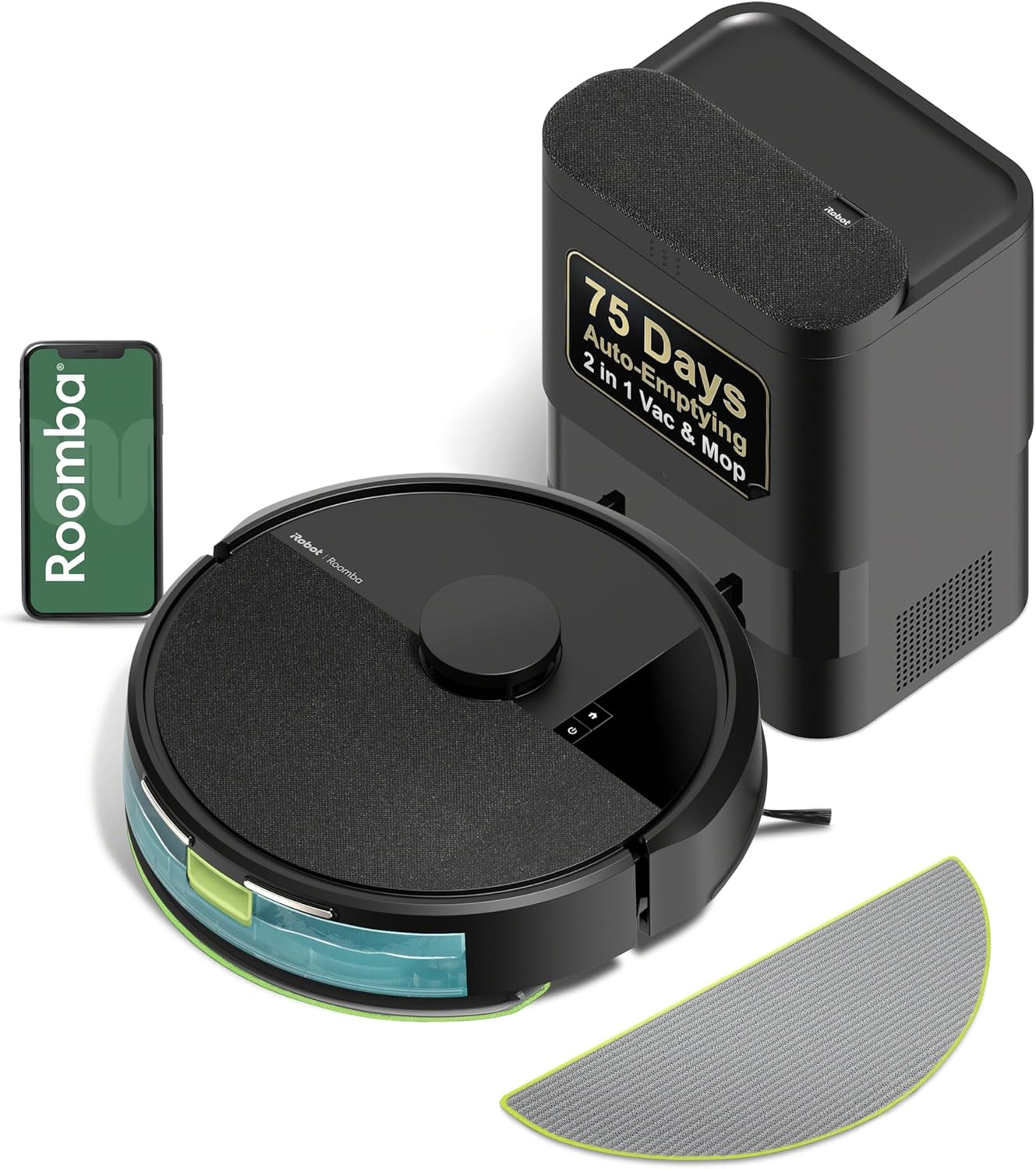
iRobot Roomba 105 Combo
| Battery Life | 100 minutes |
|---|---|
| Surface Recommendation | Carpet & Hard Floor |
| Other Special Features | LiDAR Navigation, Self-Emptying, Simultaneous Vacuuming & Mopping |
| Control Method | App, Touch, Voice |
| Filter Type | Cartridge |
The Roomba 105 Combo pairs powerful vacuuming with a microfiber mopping pad and an AutoEmpty dock to reduce hands-on maintenance. It uses ClearView LiDAR to map rooms and navigate efficiently while avoiding obstacles and stairs, and the app, buttons, or voice assistants let you start, schedule, and customize cleaning. The 4-stage cleaning system combines strong suction, an edge-sweeping brush, a multi-surface brush, and controlled water delivery for mopping; the robot detects rugs and avoids carpet while mopping to protect textiles. The AutoEmpty dock holds up to 75 days of debris in a bag, which makes it convenient for busy households and pet owners. Practical limitations include a 100-minute battery runtime that may require recharges in larger homes and the mop uses a reusable pad rather than a powered scrubbing system, so heavy stuck-on grime may need occasional spot cleaning. Maintenance still requires periodic filter and brush care, and setup needs a 2.4 GHz Wi-Fi network for app features.
Best for: Buyers who want a balanced, low-maintenance floor care solution for mixed hardwood and carpeted homes that prioritizes hands-free debris disposal and reliable navigation.
Less Ideal for: People with very large open-plan homes that need uninterrupted long runs or households that require industrial-strength powered mopping for heavy stuck-on messes.
- AutoEmpty dock holds up to 75 days of debris for low-maintenance operation
- ClearView LiDAR mapping enables precise navigation and room mapping
- Combined vacuum-and-mop modes with controlled water delivery and SmartScrub for deeper scrubbing
- 70x power-lifting suction and multi-surface brushes for strong pickup on carpets and hard floors
- 100-minute battery life can be short for very large homes without mid-run recharging
- Mop uses a reusable microfiber pad without heated washing or drying in the dock
Verdict: Choose the Roomba 105 Combo if you want dependable LiDAR navigation and a self-emptying dock that minimizes upkeep while handling both vacuuming and light mopping across hardwood and carpet.
roborock Q10 S5+

| Maximum Suction | 10,000Pa |
|---|---|
| Capacity | 2.7 liters |
| Battery Life | 150 minutes |
| Filter Type | Washable |
| Cleaning Path Width | 13.9 inches |
The roborock Q10 S5+ combines strong suction, precision navigation, and automated emptying into a turnkey floor-care setup for busy homes. It uses PreciseNse LiDAR mapping and ReactiveTech obstacle avoidance to create accurate multi-level maps and navigate around furniture and clutter, while the VibraRise 2.0 mop provides sonic scrubbing and an auto-lift function so the robot can mop hard floors and avoid wetting carpets. The included auto-empty dock holds a 2.7 L dust bag for roughly 70 days of hands-free operation in typical use, and ultrasonic carpet detection triggers increased suction on rugs. Control options include the Roborock app, voice assistants, and onboard buttons for scheduling, setting no-go zones, and adjusting suction or emptying modes. Noise and size are a consideration since unit noise is listed near 65 dB and the robot is relatively large, which may affect use in very small rooms or quiet-night scheduling. Maintenance of brushes and periodic bag replacement remain necessary despite the self-emptying feature.
Best for: Buyers prioritizing high cleaning performance on both hardwood and carpet who want precise navigation and long stretches of hands-free cleaning.
Less Ideal for: People who need an ultra-quiet machine for night cleaning or who require a very low-profile robot to reach under low furniture.
- Very strong 10,000 Pa suction for deep cleaning carpets and lifting embedded pet hair
- LiDAR navigation with multi-level mapping for precise, repeatable coverage
- 2.7 L auto-empty dock enables extended hands-free operation
- VibraRise sonic mopping with auto-lift allows mopping without wetting carpets
- App and voice control with adjustable emptying and cleaning modes
- Listed noise level around 65 dB can be noticeable during operation
- Unit is relatively large which may limit access under low-clearance furniture
Verdict: Choose the Q10 S5+ if you want powerful suction, precise LiDAR mapping, and a long-lasting self-emptying system for high-performance cleaning on hardwood and carpets.
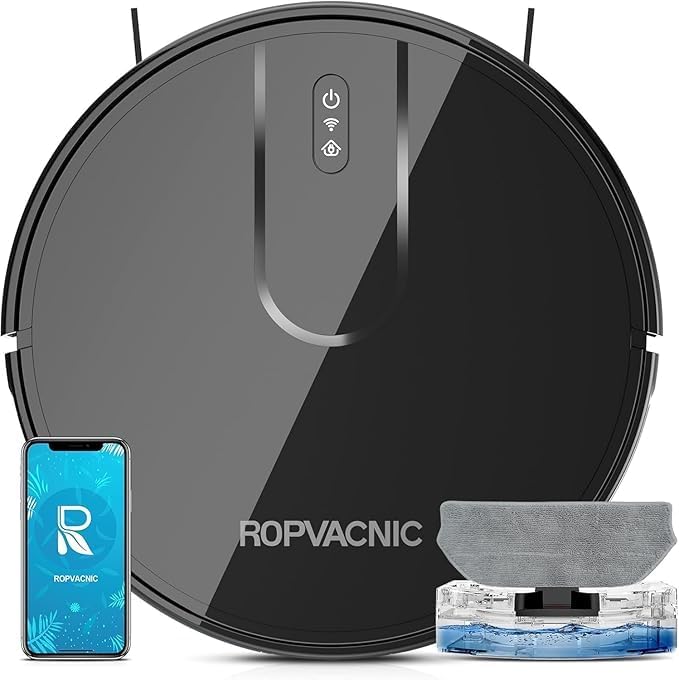
ROPVACNIC S1 Robot Vacuum
| Surface Recommendation | Hardwood Floors, Low Pile Carpets |
|---|---|
| Battery Life | 120 minutes |
| Filter Type | Multi-layer Optimized High-Efficiency Filtration |
| Controller Type | App Control, Remote Control, Touchpad Control, Voice Control |
| Other Special Features of the Product | Adjustable Electric Mopping, Intelligent Auto Docking, Advanced Obstacle Avoidance, 5200Pa Suction |
The ROPVACNIC S1 is a 2-in-1 robotic cleaner that vacuums and electrically mops floors while returning to its dock to recharge automatically. It pairs app, remote, and voice control so you can schedule cleanings, set one of several modes, and adjust a four-stage water level for heavier or lighter mopping. The unit advertises 5200Pa suction and a three-level power setting that helps pick up crumbs and pet hair on hardwood and low-pile carpet, while a multi-layer HEPA-style filter traps finer dust. At about 3 inches tall, it slips under low furniture and uses obstacle sensing to avoid collisions. Runtime is listed at roughly 120 minutes on a charge, which supports cleaning larger areas before it docks. Consider that mop performance from a compact water tank will not replace manual mopping for sticky spills, and like many combo robots it may need occasional edge or corner touch-up. For buyers who want scheduled, hands-off maintenance across mixed hard floors and low-pile rugs, it delivers useful automation and pet-friendly features at a practical performance level.
Best for: Buyers who prioritize practical, automated upkeep of mixed hard floors and low-pile rugs and want easy scheduling, voice control, and pet-hair handling without fuss.
Less Ideal for: Homes needing heavy-duty deep cleaning, industrial-strength mopping, or precise multi-room mapping and zone control should consider higher-end mapping models or standalone mops.
- Combined vacuum and electronically controlled mopping with adjustable water levels for tailored mopping intensity.
- Strong advertised 5200Pa suction and three power levels for handling debris and pet hair on hard floors and low-pile carpet.
- Multi-control options including smartphone app, remote, and voice assistants for scheduled and hands-free operation.
- Long runtime around 120 minutes and automatic self-charging for larger coverage without frequent intervention.
- Low-profile round design that fits under low furniture and uses obstacle sensing to reduce collisions.
- Mop system and compact water tank are best for light cleaning and may not remove stubborn, sticky messes.
- No mention of advanced mapping for precise room-by-room navigation, so coverage may be less efficient in complex layouts.
Verdict: A practical robot vacuum-mop with strong suction and long runtime that keeps hardwood and low-pile carpet tidy with minimal hands-on effort.
ILIFE V2 Robot Vacuum

| Battery Life | 120 minutes |
|---|---|
| Capacity | 300 ml |
| Filter Type | Sponge |
| Control Method | Remote |
| Noise Level | 69 db |
The ILIFE V2 is an entry-level robot vacuum built to keep hardwood and other hard floors tidy without a lot of fuss. Its 2.99-inch slim body fits under low furniture while a tangle-free suction port and sponge filter make it practical for homes with pet hair. You can run scheduled cleanings, switch between auto, spot and edge modes, or start jobs with the included remote control or the single-button on the unit. A 300 ml dustbin and up to 120 minutes of runtime let it cover medium rooms on one charge, and it will automatically return to the dock when the battery is low. Noise is noticeable at 69 dB and there is only one power level, so it lacks adjustable suction or app-based controls, but for straightforward floor maintenance on hardwood and low-pile carpet the V2 delivers solid value at an affordable price.
Best for: Buyers who want an affordable, no-frills robot to maintain hardwood and low-pile carpet cleanliness with simple controls and scheduled runs.
Less Ideal for: Those who need strong adjustable suction, smart app control, or advanced mapping for large or complex homes should consider higher-end models.
- Slim 2.99-inch profile cleans under low furniture
- Tangle-free suction port suited for pet hair
- 120 minutes runtime with automatic return-to-dock
- Multiple cleaning modes (auto, spot, edge) and simple remote control
- Single power level limits suction control for heavier debris
- No smartphone app or advanced navigation features
Verdict: A low-cost, slim robot vacuum that reliably maintains hardwood floors and handles pet hair for budget-focused buyers.
Bagotte G6 Robot Vacuum

| Filter Type | H13 |
|---|---|
| Battery Life | 120 minutes |
| Capacity | 300 ml |
| Control Method | App, Remote, Voice |
| Compatible Devices | Amazon Echo, Google Home, Smartphones |
The Bagotte G6 is a LiDAR-guided robot vacuum that combines sweeping, vacuuming and mopping in a single unit for regular home cleaning. It uses 360° LiDAR mapping to build accurate floor plans and supports virtual no-go zones via the app, which helps it avoid fragile areas and repeat the same coverage efficiently. The vacuum claims up to 6000Pa suction and includes an H13 HEPA filter and a 2-in-1 dust and water tank so it can handle pet hair, crumbs and light embedded dirt on both hard floors and low- to medium-pile carpet. It runs up to about 120 minutes per charge and auto-docks to recharge between jobs. Practical benefits include reliable navigation, voice control with Alexa/Google integration, and multiple accessory spares in the box. Important limitations are that mopping is best for light maintenance rather than wet deep-cleaning and performance on high-pile rugs may be limited; buyers should also expect routine maintenance of brushes and filters to keep suction optimal.
Best for: Buyers who prioritize dependable mapping, predictable room coverage, and easy scheduling for mixed hardwood and low- to medium-pile carpet cleaning.
Less Ideal for: Homes that need heavy-duty wet mopping, very deep carpet cleaning, or that primarily use high-pile rugs where upright vacuums perform better.
- LiDAR 360° mapping for accurate navigation and repeatable cleaning routes
- High claimed suction (6000Pa) for stronger pickup on hard floors and low-pile carpet
- 2-in-1 dust and water tank plus mopping function for basic wet cleaning
- H13 HEPA filter helps capture fine dust and pet dander
- App control with virtual no-go zones and voice assistant compatibility
- Mopping is for light maintenance and not a substitute for deep wet cleaning
- May struggle on high-pile carpets or very deep debris despite strong suction
Verdict: Choose the Bagotte G6 if you want LiDAR-guided, app-controlled vacuuming with strong suction and light mopping for reliable day-to-day cleaning on hardwood and low- to medium-pile carpets.
iRobot Roomba 105 Vac

| Battery Life | 200 minutes |
|---|---|
| Surface Recommendation | Carpet & Hard Floor |
| Other Special Features of the Product | Anti-Fall, Bagless, Dirt Detection Sensor, Eco Mode, LiDAR Navigation |
| Controller Type | App Control, Button Control, Voice Control |
| Cleaning Path Width | 5.8 inches |
The Roomba 105 Vac is a compact robot vacuum built for everyday floor care on both hardwood and carpet. It uses ClearView LiDAR mapping to scan rooms and clean in neat rows while avoiding obstacles and stairs, and the three-stage cleaning system combines a bristle brush, edge sweeper, and a high-suction motor advertised as power-lifting suction to pull dirt from rugs and hard floors. Setup and control happen through the Roomba Home App, physical buttons, or voice assistants, and scheduling, spot cleans, keep-out zones, and four suction levels let you tailor runs for different messes and rooms. The battery claims long runtime and the robot returns to its dock to recharge and resume a job. Practical downsides include basic included accessories and a cartridge filter that needs periodic replacement, and the unit does not include hands-free auto-emptying so you will need to empty the bin frequently in busy homes. For mixed hardwood and carpeted spaces the Roomba 105 provides reliable navigation and effective pickup without extra bells.
Best for: Buyers who want a proven, easy-to-use robot that reliably navigates and cleans both hardwood and carpet and value solid real-world performance backed by wide user adoption.
Less Ideal for: Households that want fully hands-off maintenance or automated bin-emptying, or users who need advanced obstacle recognition and avoidance features beyond basic LiDAR navigation.
- ClearView LiDAR mapping creates efficient room maps and reduces missed areas
- Four adjustable suction levels let you choose quieter or stronger cleaning
- Three-stage cleaning system with edge brush and bristle brush for multi-surface pickup
- App and voice control plus scheduling and keep-out zones for targeted cleaning
- No hands-free auto-empty dock so the dust bin must be emptied frequently
- Uses a cartridge filter that requires periodic replacement
- Includes only basic accessories in the box
Verdict: Choose the Roomba 105 if you want dependable LiDAR-guided cleaning and easy app or voice control for mixed hardwood and carpeted rooms.
eufy 11S Max Robot Vacuum

| Surface Recommendation | Hard Floor & Tile & Medium carpet |
|---|---|
| Battery Life | 100 minutes |
| Suction Power | 2000 Pa |
| Capacity | 600 ml |
| Noise Level | 55 db |
The eufy 11S Max is a low-profile robot vacuum built to clean hard floors and medium-pile carpets without drawing attention. Its 2.85-inch slim body lets it slide under low furniture while 2000Pa suction and a 12.8-inch cleaning path pick up dust, crumbs, and pet hair. It runs up to 100 minutes on hardwood at a reported low 55 dB, and automatic return-to-base means it tops off battery without user intervention. Controls are simple: the included remote and onboard buttons let you start, stop, and switch modes quickly, though there is no Wi-Fi or app control. Practical touches include washable filters, drop-sensing and anti-collision sensors, and a 600 ml dust capacity that reduces how often you empty the bin. The trade-offs are straightforward: navigation is basic rather than lidar or map-based, so room coverage is more random and may miss tight corners, and the single-side-brush design can be less thorough along edges compared with dual-brush models. For routine, quiet cleaning of hardwood, the 11S Max balances strong suction and a slim profile in a simple, reliable package.
Best for: Buyers who prioritize a quiet, no-frills robot that cleans hardwood reliably and fits under low furniture will appreciate this model for regular maintenance cleaning.
Less Ideal for: If you want mapped cleaning, smartphone scheduling, or the most thorough edge-cleaning for complex floorplans, choose a model with advanced navigation and app control instead.
- Slim 2.85" profile reaches under low furniture
- Up to 100 minutes runtime for extended cleaning sessions
- Powerful 2000Pa suction for effective pickup on hard floors
- Quiet operation at about 55 dB suitable for daytime or evening use
- Large 600 ml dust capacity and washable filter lower maintenance frequency
- Random navigation rather than mapping can lead to uneven coverage
- No Wi‑Fi or smartphone app means limited scheduling and remote control options
Verdict: A slim, quiet robot with strong suction made for routine hardwood maintenance when you want reliable, no-frills cleaning.
Choosing the Right Robot Vacuum for Hardwood Floors and Carpet: Key Factors to Consider
Suction Power and Adjustability
Suction determines whether the robot can lift fine dust from hardwood and pull out deeper debris from carpet fibers. Look for units that list strong airflow or suction ratings and, importantly, the ability to boost power automatically when climbing onto rugs.
Adjustable suction or automatic carpet boost helps balance runtime and cleaning performance. Higher suction helps on thicker carpets but drains battery faster on hardwood, so machines that vary power based on floor type give better all-around results.
Brush and Roller Design
Brushes and rollers must be designed to avoid scattering debris on hard floors while agitating carpet fibers enough to free trapped dirt. Combination brush rolls that mix rubber fins with bristles work well because they can both scrape hard-floor particles and comb through carpet pile.
Also consider whether the main brush is tangle-resistant for pet hair and how easily the brush axle can be removed for cleaning. A secondary side brush or dedicated edge-cleaning element improves pickup along baseboards and in corners.
Navigation, Sensors, and Mapping
Reliable navigation prevents missed spots and reduces repeated passes that waste battery. Look for systems that create maps or at least maintain consistent room coverage rather than randomized patterns. Good sensors help the vacuum detect floor transitions so it can adjust cleaning settings when moving from hardwood to carpet.
Obstacle avoidance and cliff sensors are essential to protect both the vacuum and home surfaces. Mapping features that let you set no-go zones or room-specific schedules are useful in mixed-surface homes, where you may want different cleaning intensities.
Battery Life and Realistic Coverage
Battery capacity affects how much square footage a single charge will cover before the unit needs to recharge. For mixed floors, longer runs let the robot complete whole rooms without repeated docking. Consider both stated run time and how that runtime changes when the vacuum increases suction on carpets.
Also check recharge-and-resume behavior. Vacuums that return to the dock, recharge, and then complete the remainder of a job are better suited to larger homes with multiple surface types.
Filtration and Dust Containment
Fine dust and allergens behave differently on hardwood versus carpet. A sealed dustbin and efficient filter help trap dust rather than recirculating it into the air. HEPA-style or multi-stage filters are beneficial for allergy sufferers and homes with pets.
Consider how often the bin and filter need maintenance. Larger bins reduce frequency of emptying on mixed-surface cleans where more debris may be collected.
Maintenance, Accessibility, and Support
Routine upkeep affects long-term performance. Check how easy it is to access the brush roll, clear tangles, and replace filters or brushes. Simple component access reduces the time you spend servicing the machine and keeps cleaning consistent over months.
Availability of clear documentation and straightforward app controls or on-device buttons improves day-to-day convenience. Parts that are user-replaceable without tools are a practical advantage.
How Robot Vacuums Handle Floor Transitions
Transition handling is a combination of physical design and software. Low-profile robots can slide under furniture easily on hardwood, while wheel torque and climbing ability determine whether the unit can scale thresholds and area rugs without stalling. The vacuum should detect when it moves from smooth to textured surfaces and either increase suction or alter brush behavior to maintain pickup efficiency.
Some models use sensors to classify floor types and trigger a carpet-boost mode automatically. Others rely on manual modes you set in an app. If your home has many area rugs or abrupt thresholds, prioritize units with documented climb capability and explicit floor-detection features to avoid incomplete cleans.
- Look for floor-detection or carpet-boost features
- Check wheel clearance and climbing specs for area rugs
- Prefer models with consistent mapping to avoid repeated passes
Dealing With Pet Hair on Mixed Surfaces
Pet hair collects differently on hardwood versus carpet. On hard floors it can scatter and pile up near baseboards, whereas on carpet it can entwine with fibers. A vacuum with a rubberized, tangle-resistant roller and a strong suction profile will reduce hair accumulation on both surfaces.
Routine maintenance is key. Expect to clear the main brush more frequently in homes with pets and choose a unit where brush removal is quick and tool-free. Side brushes help sweep hair out of corners and along edges where pets often shed.
- Tangle-resistant rollers minimize hair wrap
- Larger dustbins reduce emptying frequency in pet homes
- Good edge-cleaning improves pickup along baseboards
Noise, Schedules, and Living With a Robot Vacuum
Noise levels matter, especially if you run the vacuum while at home. Stronger suction typically means louder operation, so check stated noise figures or user feedback when you need quiet daytime cleaning. Scheduling features let you run jobs during times when noise is less disruptive.
Flexible scheduling, quiet modes, and zone-specific routines help integrate the vacuum into daily life. App-based controls that allow quick start, pause, and spot clean reduce friction and keep cleaning predictable.
- Use quiet modes for daytime or work-from-home hours
- Set room-specific schedules for high-traffic zones
- Spot-clean features are useful for quick messes
Maintaining Floor Finish and Preventing Scratches
Hardwood floors require special care; wheels and side brushes should be soft enough to avoid scuffs. Check that the vacuum has rubberized wheels and non-abrasive side brushes to protect finish. Avoid machines with exposed sharp edges on bumper or wheel housings that could catch on delicate surfaces.
Regularly clean rollers and remove trapped grit that can act like sandpaper. Using felt or protective strips on thresholds and ensuring the vacuum's sensors are functioning reduces the chance of accidental bumps that might damage baseboards or floor finish.
- Prefer rubber wheels and soft side brushes
- Clear grit from rollers to prevent scratching
- Use gentle cleaning modes on sensitive finishes
App Features and Customization That Matter
An app that provides mapping, zone control, and suction-level adjustments gives more control over mixed-floor homes. Look for features that let you assign different cleaning strengths to rooms or set virtual barriers around fragile zones. Reliable scheduling and job history also help you understand coverage patterns.
Voice control compatibility can be convenient but is secondary to mapping accuracy and manual override options. Ensure the app is responsive and that basic functions are accessible without a steep learning curve.
- Mapping and zone control for room-specific settings
- Suction-level adjustments and carpet-boost schedules
- Simple scheduling and responsive app controls
How We Chose the Best Robot Vacuum for Hardwood Floors and Carpet
We prioritized candidate robot vacuums that demonstrate balanced performance on both hard floors and carpet through a combination of hardware and real-world usability features. Key evaluation criteria included suction power and adaptability, brush and roller design suited to mixed surfaces, battery life and run-time consistency for typical room sizes, navigation accuracy and edge cleaning for baseboards and corners, and filtration effectiveness for households with dust or allergy concerns. We also considered ease of maintenance, including brush access and filter replacement, and practical controls such as scheduling and spot-cleaning modes. We excluded units that are designed exclusively for one surface type or that lack documented suction variability and brush configurations needed for transitioning between hardwood and carpet. We did not include models without reliable navigation or with impractical battery life for average homes. Our selection reflects products that balance measurable specs with day-to-day usability rather than niche specialty features.
Our full evaluation process is outlined in our review methodology.
FAQ
Can a single robot vacuum effectively clean both hardwood and carpet?
Often yes. Many modern robot vacuums can transition between hardwood and low- to medium-pile carpets by adjusting suction and using versatile brush rolls. Very thick or high-pile carpets may still require a dedicated upright or deep-cleaning tool.
Will robot vacuums scratch hardwood floors?
They usually will not if wheels and brushes are in good condition. Soft rubber wheels and non-abrasive side brushes minimize risk, but you should remove embedded grit from rollers regularly to prevent scratching.
How often should I empty the dustbin for mixed-surface cleaning?
Frequency depends on home size and traffic, but expect to empty the bin after every few runs in a mixed-surface home, especially with pets. Larger bins or automatic emptying bases reduce how often you need to intervene.
Do robot vacuums handle area rugs and thresholds well?
Many can climb low-to-medium rugs and modest thresholds, but performance varies. Check climb or step-over specs and look for models with adequate wheel torque and ground clearance if you have many rugs.
Is carpet-boost necessary for cleaning rugs?
Carpet-boost helps by increasing suction and agitation on rugs, improving pickup of embedded dirt. It can reduce battery life, so units that engage boost intelligently only where needed offer the best balance.
Final Verdict
When choosing a robot vacuum for homes with both hardwood floors and carpet, prioritize machines that offer adjustable suction, a versatile brush roll, reliable navigation, and good filtration. Expect tradeoffs between suction strength and battery life, and factor in how often you are willing to perform maintenance like clearing brushes and emptying the bin. Focus on how the vacuum detects floor transitions, its climb capability for area rugs, and whether the app or controls let you tailor cleaning per room. These priorities will help you pick a model that keeps both surfaces clean without unnecessary wear or repeated effort.